103FF: How to Set Aside Enough for Taxes – Feelings & Finances

How to Set Aside Enough for Taxes Episode Cover Graphic
Header for podcast website

103FF: How to Set Aside Enough for Taxes – Feelings & Finances

How to Set Aside Enough for Taxes Episode Cover Graphic

In this Episode...

How much should you set aside for taxes? In this episode of Feelings and Finances, team member Christelle asks Linzy about a common question that many Money Skills for Therapists participants ask.  

Linzy dives into how to make sense of your business numbers so that you can set aside enough for taxes without setting aside way too much. She breaks down how to determine that number and dispels common misconceptions about how income taxes work. If you’re looking for more support around setting aside enough for taxes, check out the workshop linked below.

Unsure If You’re Setting Enough Aside for Taxes?

If you’re unclear about how much to set aside for taxes, or you avoid thinking about paying your taxes altogether, you’re not alone!

The good news is that I can help you create a plan so that you can face the next tax season with calm and confidence, knowing that you have the right amount of money set aside. All you have to do is join my FREE workshop, Setting Enough Aside for Taxes (in 5 Easy Steps!). 

Have a Question for Linzy?

You can easily submit your question to Linzy on a voice recording. Go to the podcast page on our website and click the “Start recording” button. https://moneynutsandbolts.com/podcast/ 

Follow the prompts to record your question. When you finish your recording, enter your name and email to submit the recording. You can also submit your question directly to Linzy’s SpeakPipe inbox: https://www.speakpipe.com/MoneySkillsForTherapists 

Interested in working with Linzy?

Are you a Solo Private Practice Owner?

I made this course just for you: Money Skills for Therapists. My signature course has been carefully designed to take therapists from money confusion, shame, and uncertainty – to calm and confidence. In this course I give you everything you need to create financial peace of mind as a therapist in solo private practice.

Want to learn more? Click here to register for my free masterclass, “The 4 Step Framework to Get Your Business Finances Totally in Order.

This masterclass is your way to get a feel for my approach, learn exactly what I teach inside Money Skills for Therapists, and get your invite to join us in the course.

Are you a Group Practice Owner?

Join the waitlist for Money Skills for Group Practice Owners.This course takes you from feeling like an overworked, stressed and underpaid group practice owner, to being the confident and empowered financial leader of your group practice.

Want to learn more? Click here to learn more and join the waitlist for Money Skills for Group Practice Owners. The next cohort starts in January 2026.

Connect with Linzy

Want to feel calm and in control of your finances? Connect with us!

🎥 Subscribe to our YouTube channel: https://www.youtube.com/@moneynutsandbolts

🎙️ Listen to the Money Skills for Therapists Podcast on your favourite app: https://moneynutsandbolts.com/podcast/

🤳 Follow us on Instagram: https://www.instagram.com/moneynutsandbolts

📲 Follow us on Facebook: https://www.facebook.com/moneynutsandbolts

💻 Follow Linzy on LinkedIn: https://www.linkedin.com/in/linzybonham/

Episode Transcript

[00:00:00] Linzy: Hello and welcome back to the Feelings and Finances mini podcast series, our second episode per week on the Money Skills for Therapists podcast. These short episodes are all about answering your questions about all things feelings and finances.

[00:00:21] And our question today is from another one of my wonderful team members, Christelle. Christelle is our operations and student care coordinator here at Money Nuts & Bolts. And, uh, let’s listen to her question.

[00:00:33] Christelle: Hello, Linzy, and hello, listeners of Money Skills for Therapists, the podcast. This is Christelle. I’m also part of Linzy’s team, and I am usually the one that speaks with potential students. When you reach out via email, you will speak with me. And so, Linzy, one of the questions that we hear I would say the most often, is how much to save for taxes.

[00:00:58] Like how much should we save? How much should we have aside as the year goes around? Like how to even start with this. Thank you.

[00:01:08] Linzy: As you mentioned, Christelle, this is a question that we hear all the time, about taxes. And this is actually one of the areas that I see the most confusion about business finances is this tax question because it’s one of these things that often I think we think that we understand it, but folks end up over saving.

[00:01:25] And I don’t want you to over save as weird as that sounds. So in terms of where to get started with taxes, saving for taxes, one of the most important things to understand is when you are putting aside your tax money, it is income tax that you are saving, which means that it’s taxes on the money that you actually get to take home.

[00:01:45] That means that the money that you spend to run the business, your operating expenses, you do not pay income tax on because it’s not your income, right? It’s business expenses. It’s operating expenses. So when you are looking at how much money to set aside for taxes, you’re not looking at that money coming in the door.

[00:02:03] That top number is where we often look to for putting aside what we think is our tax rate. But actually the number that you want to be setting aside from is what is left after you run your business. If you’re a sole proprietor the equation is like money come in the door minus operating expenses minus what it costs you to run the business, your business expenses.

[00:02:24] What is left? All of that is considered yours, regardless of whether or not you take it out of the bank account, and that is what you get taxed on, right? So let’s just say, you know, there’s a hundred percent on the top. If 20 percent of the money that you make goes towards operating expenses, goes towards your rent and paying for your EHR, advertising, it’s the 80 percent that’s left that you get taxed on.

[00:02:48] So if your tax rate is 30%, you actually need to set aside 30% of that 80%. Now, that’s where our brains can really start to hurt very quickly. And I remember when I was learning Profit First, which is a system that allows you to set aside money based on that top number. This equation of the like percent times percent always made me be like, wait a second, how do I do that?

[00:03:11] But one way that you can look at it is you’re going to take the money that’s left each month. So look at like a few months as an example, right? Let’s say in three months, your average money that you bring in the door is 10, 000. We’re going to use that for easy numbers. And when you look over those three months, the average that you’re spending on your business expenses ends up being that 20 percent we talked about.

[00:03:35] So $2,000. 8, 000 is what you actually get taxed on, so you’re going to take 8, 000 times your tax rate. Right? So, your tax rate is something that you can find out quite easily. It’s one of those things that we often feel like is this like vague, weird, confusing thing. But, using the power of the internet,

[00:03:53] quite quickly, you’re going to find a number that is good enough for your tax rates. So you can just search tax calculator for your state or your province or your country. And you’re going to put in what you expect to get paid this year, not what you’re bringing in the door, but what do you expect to be taking home this year?

[00:04:11] So let’s say this year I expect to bring in 120, 000 and I’m going to get paid 80. I’m going to put 80, 000 into that tax calculator and it is going to tell me my average tax rate. Now your average tax rate is what you want to look at because ideally, it’s good to just put aside the right percentage of money from the very beginning and not have to stop and check and be like, Oh, I’m making more money now.

[00:04:33] Maybe I need to save more taxes. Maybe I’ve gotten to a higher tax bracket. If you can sit down and project: Okay, this year thinking about all the highs and lows, thinking about what’s normal, thinking about my goals, I’m planning to make 80, 000 this year. See what your effective tax rate is at that 80, 000 mark.

[00:04:52] Now, if you’re American, you’re also going to have your self employment tax on top of that. So you’re going to look at your self employment tax. It’s seven point something, seven and change. You’re going to also want to think about putting that money aside. And if you’re Canadian, you have to pay your portion of CPP, the Canadian Pension Plan.

[00:05:09] And if you’ve opted in to employment insurance, EI, you also have to set aside your own EI, right? Because as a business owner, you are the employer and the employee. So you need to set aside the employer portion of these taxes, whichever country you’re in. And you also need to remit your own employee portion of it, right?

[00:05:27] Like you’re paying taxes for both the business and yourself, right? So you’re going to take a look at those numbers. When you put your numbers into the tax calculator, the number you’re going to get is going to be conservative. Conservative is not a bad thing, but if you see a number and you’re like, whoa, I cannot put aside that much for taxes and live on the rest.

[00:05:46] Then it’s a great time to go talk to your accountant, and ask them this question. Like I’m planning to make this much this year. How much should I actually be setting aside for taxes? Because they’re going to have your bigger financial picture. They’re going to know, you know, if you’re filing with your spouse, between the two of you, what you’re entitled to, what your tax rate is based on your combined income.

[00:06:04] There’s also a certain amount of deductions that everybody’s entitled to. So they’re going to be able to give you a much more accurate estimate. If that feels important to you, and if you have a good relationship with your accountant, you might as well ask them, might as well get that information. But if you don’t have an accountant yet, or if you don’t have a good relationship with your accountant.

[00:06:21] You should find a different accountant. That’s for a whole other episode. But just going to one of these tax calculators online and putting your numbers is going to give you a great place to start. And then it’s deciding for yourself a system to set money aside. Now I will say on this one I could literally talk about this for a whole hour and I have done that.

[00:06:38] I do have a workshop on how to set enough aside for taxes in a five simple steps. And I will link that workshop, actually, in the show notes because I’ve got a tool in there. I’ve got a calculator for you to be able to put in how much you earn and it will add on that like self employment piece, whether it’s like Canadian or American, there’s two different calculators.

[00:06:57] So I’ve got resources for you that are much more robust. If you want to dig into this question, if you want to get total clarity around your tax number, but I will say to start that biggest most important piece is understanding that you’re putting aside money based on what you earn, not everything that you bring in the door. It’s income tax. It’s only on your income, and once you get clear on how much to put aside, you can create a separate bank account system; you can send money off every month. Once you have been in business you will also be asked to make quarterly payments so you will at a certain point have it so that the government is like, “Hey, every quarter, I want you to give us this much money based on what you made last year.”

[00:07:36] If this year you’re making the same as last year, you can use those quarterlies as a guide and just remit whatever amount they tell you. But if you’re a newer in business, you’re not going to have that information yet. And that’s where using the tax calculator that I provide and looking up this information, checking out the workshop that I’m going to link in the show notes can be an extra resource to you when you are in that situation.

[00:07:56] So take the time. Get clear on these numbers. They don’t have to be a mystery. And once you know what the numbers are, then you can make a plan to actually be saving the amount of money that you need. This makes it so tax time is neutral to sometimes even positive, rather than a big stressor. So thank you so much, Christelle, for your question.

[00:08:15] And folks listening, if you want to hear more, check out the link in the show notes for that taxes workshop. I would love to hear from you with your questions. All you need to do to submit a question for the Feelings and Finances podcast series is to head over to our podcast page on our website.

[00:08:31] There’s a link in the show notes. Click on the little SpeakPipe logo. That’s our little tool where you can record your question, just introduce yourself, share your name. You can make up a name if you want. You can call yourself Unicorn Cupcake if you’d like, whatever. But I would love to hear your questions because it makes me happy to be able to chat with folks about these things.

[00:08:52] And my hope is that, for people listening and people who submit questions, this will give you some fuel to get moving, to help you shift things, to start to build a better relationship with money. Build out the systems that you need to take care of yourself and your family and your life. Money is an important tool to do that.

[00:09:08] So thank you so much for listening today.

Picture of Hi, I'm Linzy

Hi, I'm Linzy

I’m a therapist in private practice, and a the creator of Money Skills for Therapists. I help therapists and health practitioners in private practice feel calm and in control of their finances.

Latest Episodes

174: How to Plan for Your Future Self with James Alexander Episode Cover Image

What does it really mean to play your own financial game?

In today’s episode, I’m joined by James Alexander, a certified financial planner who brings both heart and math to the world of money. James and I explore the importance of defining your personal version of financial success, and we discuss why comparing yourself to others can pull you away from what actually matters to you.

Listen to this episode »
Owning Your Power in a Shifting Therapy Landscape with Matt Cohen Episode Cover Image

How do we protect the future of our profession in a rapidly evolving mental health landscape? In today’s episode, I sit down with Matt Cohen, founder of PlaySpace Health, who brings a unique perspective from the world of business and innovation into the therapy room.

Listen to this episode »
172FF: Building Systems That Support You and Your Brain: Linzy Answers Listener Questions Episode Cover Image

Are you caught in the loop of thinking you need to learn just a little more before you take action — or feeling totally stuck when it comes to choosing the right tools for your practice? In this full-length Feelings and Finances episode, I’m answering two powerful questions from therapists working through real-life challenges.

Listen to this episode »

© Copyright 2022 | Money Nuts & Bolts Consulting Inc. | All Rights Reserved

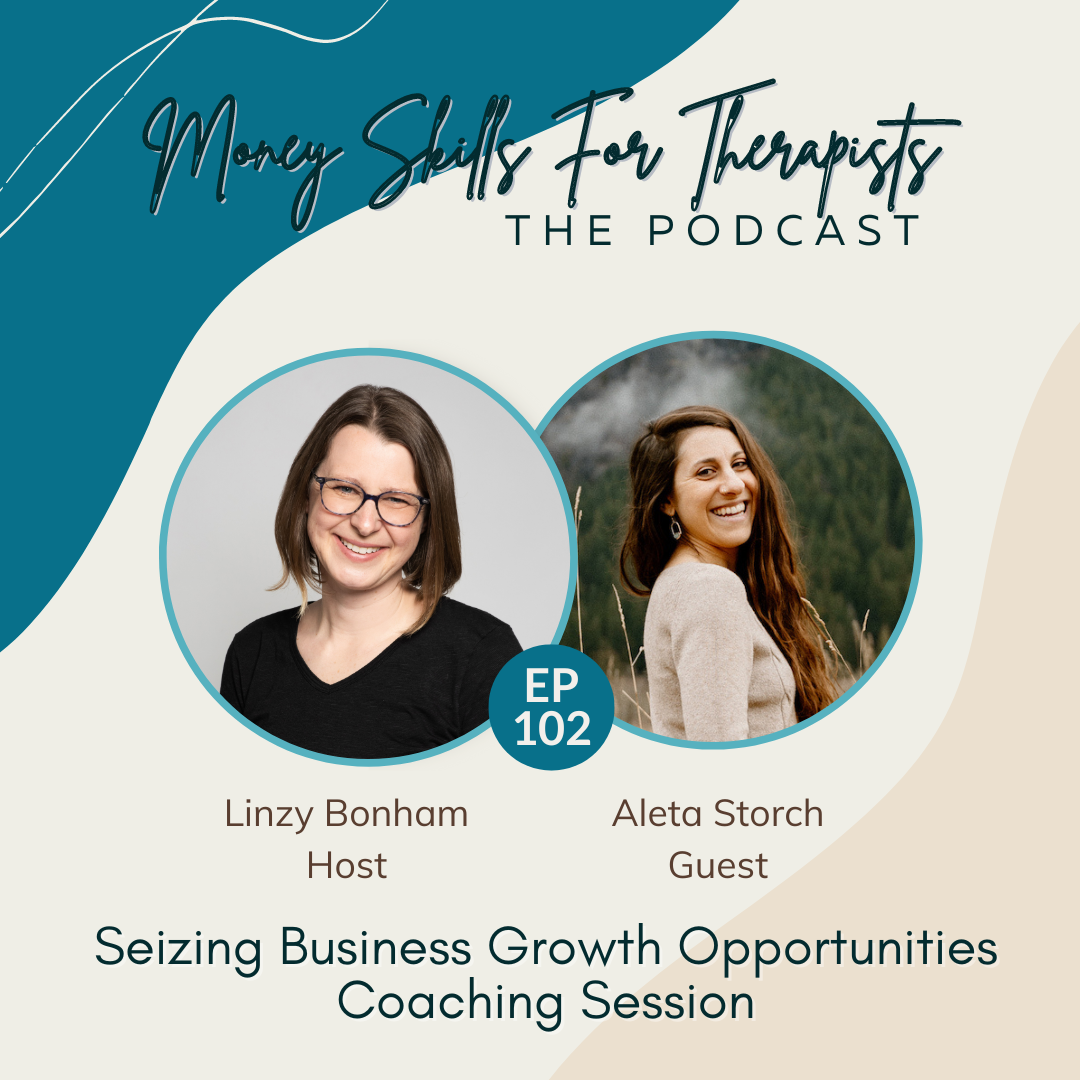
102: Seizing Business Growth Opportunities Coaching Session

Seizing Business Growth Opportunities Coaching Session Ep 102 Episode Cover Art
Header for podcast website

102: Seizing Business Growth Opportunities Coaching Session

Seizing Business Growth Opportunities Coaching Session Ep 102 Episode Cover Art

Linzy: “They like you and you want the people who like you a lot to pay money to actually get the full help that you’re offering inside the membership. So Aleta, what are you noticing with this approach?”

Aleta: “I definitely feel a little less overwhelmed and anxious in just that screw it mentality. It feels less like a Hail Mary, and more like just kind of like first steps.”

Meet Aleta Storch

Aleta is an anti-diet Dietitian, Therapist, and Certified Body Trust® Provider, living in the Pacific-North-West. She specializes in providing anti-diet, values-centered, body liberation work with folks that have disordered eating / a history of dieting, autoimmune conditions, and/or ADHD. Aleta is the owner and founder of her virtual group practice (Wise Heart Nutrition). She is also the creator of the groundbreaking, Eating with ADHD® approach and model, which she developed as a resource for supporting ADHDers in navigating food and eating difficulties, and in developing intuitive eating skills in order to nourish both the body and the brain. This approach is the basis for her monthly membership program, Neurished. She believes wholeheartedly that food freedom and body trust are birthrights, and that every individual is the expert of their own body.

In this Episode...

How can we seize opportunities to grow our businesses? In this coaching session, Linzy talks with guest Aleta Storch about ways to grow our business and to move in the direction of what gives us energy. Aleta shares that she is interested in growing her membership program, Neurished, so that it can be a bigger focus in her business, but she is struggling with how to move toward that goal while also balancing her one-on-one sessions and managing business costs.

Linzy and Aleta talk about how to utilize aspects of Aleta’s business that she already has in place to grow that membership program. Listen in to hear practical strategies that you can use to strengthen your own business through offering more opportunities to your core community.

Connect with Aleta Storch

Get $10 off your first month of Neurished monthly membership program with code BRAINFOOD. Neurished is the only anti-diet monthly-membership program for ADHDers who are looking to heal their relationship with food and their brain so they can neurish themselves the ADHD way. 

Follow Aleta on Instagram: @the_adhd_rd.

Check Out the Jane App

To see how Jane can help you free up your evenings from admin tasks, head to meet.jane.app/more-time to book a personalized demo. But, if you’re ready to get started, you can use the code MNB1MO at the time of sign-up for a 1-month grace period applied to your new account.

Interested in working with Linzy?

Are you a Solo Private Practice Owner?

I made this course just for you: Money Skills for Therapists. My signature course has been carefully designed to take therapists from money confusion, shame, and uncertainty – to calm and confidence. In this course I give you everything you need to create financial peace of mind as a therapist in solo private practice.

Want to learn more? Click here to register for my free masterclass, “The 4 Step Framework to Get Your Business Finances Totally in Order.

This masterclass is your way to get a feel for my approach, learn exactly what I teach inside Money Skills for Therapists, and get your invite to join us in the course.

Are you a Group Practice Owner?

Join the waitlist for Money Skills for Group Practice Owners.This course takes you from feeling like an overworked, stressed and underpaid group practice owner, to being the confident and empowered financial leader of your group practice.

Want to learn more? Click here to learn more and join the waitlist for Money Skills for Group Practice Owners. The next cohort starts in January 2026.

Episode Transcript

[00:00:00] Linzy: They like you and you want the people who like you a lot to pay money to actually get the full help that you’re offering inside the membership. So Aleta, what are you noticing with this approach?

[00:00:12] Aleta: I definitely feel a little less overwhelmed and anxious in just kind of like that screw it mentality. It feels less like a Hail Mary, and more just like first steps.

[00:00:22] Linzy: Welcome to the Money Skills for Therapists podcast, where we answer this question: how can therapists and health practitioners go from money, shame and confusion to feeling calm and confident about their finances and get money really working for them in both their private practice and their lives? I’m your host, Linzy Bonham, therapist turned money coach, and creator of the course Money Skills for Therapists.

[00:00:49] Hello, and welcome back to the podcast. So today we have a coaching episode with a grad of the first round of Money Skills for Group Practice Owners, Aleta Storch. Aleta is an anti-diet dietician, therapist, and a certified body trust provider. She specializes in providing anti-diet value-centered body liberation work to folks who have disordered eating, a history of dieting, autoimmune conditions, and or ADHD.

[00:01:15] She also has an online membership community, Nourished, to support these folks, and today we get into a conversation about this bind that Aleta feels that I think a lot of us have been in before where it’s like you want to be investing in your business beyond the one-to-one work that she does.

[00:01:32] She wants to be investing in her membership community, but also her one-to-one work is how she makes money. So how do you shift into investing in the membership site, in her case, and having the energy to grow the membership site when her energy is going towards the one-to-one work. So we dig into this question today.

[00:01:52] The conversation takes a little bit of a turn. We end up talking about ways that are within reach even right now that she has to make money without investing, and we talk about where we can fall into the trap of wanting to invest. Lots of ground we covered today. Here is my conversation with Aleta Storch.

[00:02:24] Linzy: So Aleta, welcome to the podcast.

[00:02:26] Aleta: Hello, so happy to be here.

[00:02:28] Linzy: So happy to have you here. We were just chatting off mic about how it’s so nice to see each other again, cause it’s been a little while, like three, four months now, since we worked together in Money Skills for Group Practice Owners… I know! So it’s nice to be able to reconnect, and I’m excited to hear where you’re at and what’s going on in your business, during our conversation today.

[00:02:48] Aleta: Yeah, yeah, thanks for having me. I loved that program so much, and I’ve just been missing it.

[00:02:52] Linzy: Yes. Awesome. Okay. So, for today, what would you like to dig into during our coaching episode?

[00:02:59] Aleta: So I… just like thinking about my business structure, one of my offers is one-to-one services. But I am feeling really burnt out on that. And so I’ve really, in the last year, I’ve been focusing on offering a group membership program, so that I can have a wider reach and it’s more affordable.

[00:03:18] And so now that I have my financial picture a little more worked out, thanks to that program, I feel like I can put a little more time and energy into building this program. And I do feel like it could be really lucrative and could open a lot of doors for doing other things.

[00:03:34] But I’m in this place where I’m feeling stuck because if I see fewer clients, then I’m not bringing in as much money. And if I don’t have money to invest, then I can’t grow the program. And it just feels like this vicious cycle of what do I do with that?

[00:03:50] Linzy: Mm hmm. Yes. Okay. So, I mean, my first question is when you’re thinking about growing the program, what specifically are you thinking about investing in?

[00:03:58] What do you need money for?

[00:04:00] Aleta: Yeah, and maybe that’s part of where I’m feeling stuck is I’ve never been in a position where I’ve had money to think about investing, and so I’ve never really thought it through.

[00:04:12] But I know I need more help. I’m working way too many hours. I’m exhausted. I have a practice manager, and she’s really lovely, but she’s not like a marketer.

[00:04:22] She doesn’t really have that knowledge or skill set. So I think more support around the back end of things like funnel building and advertisements, marketing, and then also, do I even invest in advertisements? Do I need that? Yeah, just the stuff I’m not good at and don’t really like doing.

[00:04:41] Linzy: Okay, yes, because you have administrative support for the group practice side of things, so that is taken care of, but yeah, like all these other skills that are not your area that you’re looking for support with. Yeah, because that’s the first thing I was curious is are you looking to bring somebody on board?

[00:04:56] Are you looking to learn these things yourself? Hahaha.

[00:05:02] Aleta: I’ve tried learning, and I just, yeah, I don’t have enough hours in the day. I can’t pay myself enough to do all of those things, right, so…

[00:05:10] Linzy: yeah. Cause do you have specific strategies that you’re thinking about trying to grow your membership site? Are you thinking about Facebook ads? Are you thinking about social media? What are you thinking about?

[00:05:21] Aleta: Yes. Yes. So right now we mostly do Instagram. I have a Facebook group that has quite a few members. It’s pretty active. And I feel like that’s something that we could harness, to create more interest in the membership. But again, like I just… I don’t have the time and resources to do it. And so I think that would be a really good place to focus.

[00:05:44] And then email. Like the email audience I think would be another really great place.

[00:05:49] Linzy: How much are you selling the membership? Like how often are people hearing about it and getting the opportunity to join?

[00:05:55] Aleta: Yeah. So Marcy sends out, once a month she sends out the calendar with an invitation. And then, partly through the month, she’ll send out an announcement for, we do like guest workshops. So that’s like another opportunity in email. And then inconsistently we post in the Facebook group.

[00:06:11] Like if someone has a question, right, we’ll say Oh, this would be really great to bring to the Nourished program. And then on Instagram, again, just here and there, and in stories.

[00:06:21] Linzy: Do you launch?

[00:06:23] Aleta: We did initially. I guess, yeah, do you mean, because it’s like an evergreen program…

[00:06:28] Linzy: Yeah, Yeah. But do you do… Do you ever do like big sales where everybody knows the difference? Okay. Tell me about the face you just made.

[00:06:34] Aleta: Because that feels really overwhelming, right? Because I had a three month group program before this, and I loved it. Yeah, it went decent every time I launched, but it was so exhausting, and so the idea of putting together, right, a funnel, and like, all of the materials, it feels like too much, so I just have popped it out, I guess.

[00:06:55] Linzy: Okay. Yes. And it is a big project. There’s no question about that. you can build evergreen funnels that like, give folks the experience of being launched to with all of the emails and videos and all that stuff. automated, but you have to build out that structure.

[00:07:09] It’s a project. It’s a project I’ve done several times in my own business. And yeah, it definitely is quite consuming. I guess as I’m thinking about this, Aleta, like I’m hearing there’s dietetics work that you do, right? Like your direct work that you’re doing with clients. There’s the membership site that you wanna grow, but marketing is clearly not your first love.

[00:07:31] You would be very happy to outsource it. I guess Something that I’m curious about is like, how big do you want the membership site to be? Like what do you want your days to look like? what do you want the balance between this one-on-one and your membership to be?

[00:07:42] Aleta: Yeah. Yeah. That’s a great question. I would love to get down to a maximum of five clients a week. And then be able to spend like the rest of my time on content creation and community engagement, and connecting with people who could potentially do workshops. And that’s where I find the best.

[00:08:02] I feel really energized working on that community. But after seeing four clients in a row, there’s just no, no energy left, nothing left to give.

[00:08:13] Linzy: Yes. I’m hearing that kind of teaching work is very energizing for you.

[00:08:18] Aleta: Yeah.

[00:08:19] Linzy: Yeah. And as you say, it does feel like a bit of a bind when we’re trying to make a shift like this, because it’s like, you need to make money to pay people to help you.

[00:08:26] But you also, if you’re working so hard, then you don’t have any bandwidth to actually work on it. So, something that I’m thinking about for this in part… I guess there’s two ways that we could think about this. One is what could a runway look like for you where you’re working? Maybe your days don’t change very much in terms of your one on one work, but you are working towards a goal.

[00:08:45] There’s money that’s being put aside for a reason, for a specific plan. That’s one version, which is where you’re planning to make a change. The other way to deal with this would be to start to make incremental change and starting next week, you’re starting to open up more space.

[00:09:02] What makes more sense for you and what you need?

[00:09:04] I feel more drawn to the second one. Just because I feel like, again, like so much excitement about the program. Yeah, and following that energy and that spark. And that’s certainly what I have found is like when you’re excited about something, it is easier to do that work. Like the work has more levity to it. So if we think about this piece then, because what I am hearing is the equation that’s in your head is like,you’re not going to work, but you’re going to need money.

[00:09:28] And I think part of what I’m curious about is is there like a middle road here where at first you start taking your time, and applying your time to marketing. And this is why I was asking about selling because something that I notice about the kind of program you’re talking about which is like a membership, and you’ve had a course before, and that’s a very similar business model to my own is like you can do all the marketing in the world actually, but if you’re not selling, nobody has the chance to buy.

[00:09:51] And if you’re not selling enough that people actually hear about it… Because we always think we’re annoying people, right? Like it’s easy for us to be like, Oh, but they already hear about this, like once a month. But if you think about how often people actually open your email, if you think about how busy they are, if you think about how often people are like, “Oh yeah, I do want to join Aleta’s membership.”

[00:10:07] And then they got distracted, and then they like walk off and like never come back, which I think also for your audience is going to be particularly relevant… Sometimes we have to be waving the flag to say “Hey, I have this great thing!” a lot more often than we might want to at first for anybody to even actually hear your message.

[00:10:25] Right. And it does make me wonder, are there ways that you can be selling to start to generate more money to feed the membership business thatwork, or that you know how to do already that you wouldn’t be creating something from scratch.

[00:10:39] Aleta: I guess I’m confused about the difference between selling and marketing.

[00:10:42] Linzy: So marketing is like great content. Like I’m Aleta. I teach eating for folks with ADHD. Here’s some great tips for you. It’s like giving folks value. It’s building your brand. And so people know who you are, right? That’s marketing, right? It’s creating awareness. Selling is you have until Friday to buy the course.

[00:11:01] Here’s why you should buy it now. Come join the course. The way that I can really help you is if you’re in the membership or the course. That is selling. Like selling is where you’re actually asking somebody to make a decision. Do you want to buy or not right now?

[00:11:15] Aleta: Yes. Yeah. And I think we don’t have a lot of creativity with that. it’s repetitive and yeah, I don’t think we’re doing a good job with that part.

[00:11:25] Linzy: Yes, that selling piece like I’ll share with you like I have a business friend who has a similar size audience to what I have. We have similar size email lists. We have similar size Instagrams. I think I actually did a bigger audience than her. She’s making a lot more money than me because she sells all the fucking time.

[00:11:42] She’s always selling. She’s willing to do that right, and like I don’t love the work. And so it’s something that I find I like to spread out my like times when I’m really like, “Hey, the doors are open. Come join Money Skills for Therapists, or come join Money Skills for Group Practice Owners. She launches every single month.

[00:11:57] Every month she does some sort of event, like a five day workshop series, like some sort of… Yeah, something where folks get value, but then they also get the opportunity to join her course. And there’s some sort of urgency, some reason to join right now, like a discount or a bonus or…

[00:12:10] And, doing that, her business is now at $700,000 a year. She has a smaller team than I do. She has a smaller audience, but she’s just willing to sell. Right? And because she sells. People who are interested get a chance to buy, right? And I’m curious about, if you are going to start selling a little bit more, or bring a little bit of the spark that you have for teaching to selling, if there’s folks in your audience who are already waiting to join your course who’ve just, not gotten the message that, they can join now, and this is why they should join now and not wait till the summer or not wait

[00:12:43] till the fall. Yeah. Like, how do you prompt people to get in the door?

[00:12:45] Aleta: Yeah. Right. Yeah, that makes me think about, over the last six months, we’ve talked about raising the price because there’s so many more resources available, and so using that as a push: get in now, lock in your price. And then we are experimenting with something where I’m doing, a free webinar, or a free workshop, and I am afraid that we’re not going to leverage that in a way that is going to create more revenue.

[00:13:12] Linzy: And so if you’re afraid you’re not going to leverage it, how can you leverage it? How can you turn this event that you’re already excited about into an opportunity for folks to like actually work with you and actually get the full help that you can provide for them? How do you make it a funnel?

[00:13:26] Aleta: As you were talking, a light bulb went off where I was thinking, would it make sense for people who attend the workshop to maybe get a discount on their first month or, have some kind of incentive after offering them free knowledge and support, just to keep that momentum up, and that wouldn’t require that much the back end.

[00:13:47] Linzy: Basically you need to think about how can you pitch people at the end, right? And this can be really uncomfortable and I’m sure for a lot of folks listening like a lot of therapists and health practitioners that are like,

[00:13:55] [panting breath]. Because like selling is like not what we do, but like a phrase that I do find helpful to remind myself of is “selling is helping.”

[00:14:04] Because if you don’t sell, if somebody doesn’t buy the thing that you actually do that helps them, then they’re not actually getting the help that you have to offer, right? It’s like we think we’re doing them a favor by being small and not bothering them and not being annoying, but like you know the effect that your membership has on people and like just to ground yourself in that, what do you see happening for folks who are in your membership community?

[00:14:26] What’s the value that they’re getting out of being there?

[00:14:29] Aleta: Yeah. I mean, I think just, feeling seen and heard and having a safe space where people can show up with a neurodivergent brain and not have to mask, and then also a space where we’re not talking about diets and we’re not… Right, like talking about body sizes and it’s, yeah, it’s just a very like safe community, and I think that’s helpful for people.

[00:14:49] Linzy: Absolutely. Safe community is very valuable, and many people don’t have that.

[00:14:54] Aleta: Right. Yeah.

[00:14:56] Linzy: So if you think about that, like that value that you’re giving folks, because I’m sure you’re also giving them a lot of information as well, and like all these other things you take for granted because this is your zone of genius… I’m sure if I joined your community I would learn a ton of things that I don’t know…

[00:15:09] Aleta: Right, that’s right. Yeah, that is true.

[00:15:11] Linzy: Yeah, just to flesh out that other part of what you offer.

[00:15:13] It’s not just a cuddle puddle. It is actually education that they’re getting. If you think about that, can you use that to help you actually make sure that people know they should join you in there, that it’s worth it for them to pay what is the membership price right now?

[00:15:30] Aleta: It’s only $57 a month.

[00:15:32] Linzy: Okay, that they should pay $57, are you thinking about increasing that to a specific number?

[00:15:37] Aleta: Yes, and I don’t know where to start. I feel like I should know… But I don’t know what makes sense or kind of where to start with that.

[00:15:47] Linzy: Yes. And with pricing, like there’s a lot of pieces that go into pricing. There’s always going to be this kind of element of price elasticity is what they call it, where as you raise your price at first, like if your sales stay about the same, you’re going to be making more money, but then there’s going to be a certain price where less people buy, and you’re like evening out because you’re making more high value sales, but less sales. Like there’s some play and experimentation to happen there, but like something that makes me think about is this saying that I heard recently, which is a ship in motion can change course, right? But it’s getting in motion is very hard, right? So it’s like you do have a ship in motion, but I think it’s like a little slow right now because I think you’re a bit afraid, maybe, to like really be like, “Hey, get on my boat!”

[00:16:30] Aleta: Yep. Yes.

[00:16:31] Linzy: To extend the metaphor in a way that it’s not meant to go. But it’s if you do this launch, do you want to sell at 57? Do you want to try a different price and see, or do you just… What’s your priority right now? Is it to get folks in the door, or is it to test a new price?

[00:16:46] Aleta: I think it’s probably to get people in the door because members, yeah… there just hasn’t been a lot of movement in number of members.

[00:16:55] Linzy: Get that energy flowing. Beautiful.

[00:16:57] Aleta: Yeah.

[00:16:57] Linzy: Then it’s thinking about, with this workshop that you’re already planning, and I don’t think you actually need to pay somebody to do this. You can. We’ll talk about that in a minute. But you already are creating this event where there’s going to be this energy.

[00:17:08] Folks are going to get value from you. They’re going to, like, get a sense of your vibe. They’re going to see how you teach. They’re going to feel seen and heard. At the end, how do you want to be inviting them into the membership? What could that look like that is a natural,

[00:17:22] And next, if you want more from me…

[00:17:24] Aleta: Right.

[00:17:25] Linzy: Do you do an email launch?

[00:17:27] Are you going to announce it on the webinar? Do you want to give them a reason to join now? You mentioned maybe a discount, maybe… sometimes people will join now and your first three months is only this much money… what makes sense to you knowing what tends to work for your folks?

[00:17:41] Aleta: Yeah. And maybe a mix of all 3, right. Just like with ADHD, multiple exposures.

[00:17:46] Linzy: Just hit all the buttons.

[00:17:47] Aleta: Yeah, talking about it, right, on the webinar saying, you’re going to get an email with the discount code. Here it is as well now. If you want to, if you have that impulsivity and you want to do it now, and…

[00:17:57] Linzy: Maybe don’t say it quite like that, but yes.

[00:17:58] Aleta: Right, right.

[00:17:59] Totally. Yeah.

[00:18:00] Linzy: Don’t pathologize it while you’re talking about it, haha.

[00:18:02] Aleta: Let’s be impulsive. Go with your gut.

[00:18:06] Linzy: Yes.

[00:18:07] Aleta: Yeah. And then following up maybe with multiple emails. And I think right now I just have one that’s set up after that doesn’t have a discount code. It’s just: Come join the community. Cool. And that’s it. And I wonder if maybe even sharing an experience or two from some of our members about what’s been helpful. Yeah. And why.

[00:18:27] Linzy: Yeah. I think if you’re going to do, is it going to be just a one time workshop, or is it a series?

[00:18:32] Aleta: We’re testing it out.. yeah. So right now it’s just one. We’ll see what happens.

[00:18:36] Linzy: So it’s one workshop. You do your best; you teach your heart out. Right. and then at the end you segue into I want to tell you more about how I help people with this long term. This is my community. I’m really proud of it. This is the kind of experience that people get out of it.

[00:18:50] This is what this person shares. This is what this person shares. This is what it includes. And because you’ve been here for this workshop, and you’re part of my community, and you’re going to know if this is, I really want to make it a no brainer for you to keep doing this work together, and making real change in your relationship.

[00:19:03] Here’s a discount code. If you use it by next Friday, you save this much money.

[00:19:07] Aleta: Mhm.

[00:19:07] Linzy: I cannot wait to continue this work with you. I’ll see you inside the community. You’re going to be hearing about this over email. Like, when I say this, I’m making this up, but you get what I’m saying. How does it feel in your body if you think about selling as helping?

[00:19:20] Like really owning the value and like really putting out that value to the folks who are at that workshop?

[00:19:26] Aleta: It feels really good. It feels less like slimy, I guess, when it is, yeah, here’s what I offer, and like you’ve actually seen it, and felt it and experienced it. 

[00:19:37] Linzy: I always feel great when I’m selling and I know that I’ve just like given something really valuable, like that there’s no question. And like I also like selling when somebody’s had a real experience of me because I don’t want somebody to join my community who’s like I don’t like her face or we have totally different politics, and like she’s grating and terrible. You want it to be the right fit, and you’re giving them an opportunity to actually get an experience of working with you and knowing if they want to keep working with you, right? Which is like a beautiful kind of gift and also almost like an assessment session that you’ve had together.

[00:20:09] And then they get to decide if they want to keep going, and you’re going to make it easy for them to keep going.

[00:20:14] Aleta: Those are the people we want in the community as well, like people who are going to show up, who are excited.

[00:20:18] Linzy: Yes. So we had started talking about investing, and putting into the business. So, and you had talked about wanting to take this road kind of gradually, putting more energy towards this other business. So I’m curious, Aleta, like if you think about the work that it’s going to take to build out this pitch for the end of the funnel, build out some emails, think about what is going to be the best offer to create some like real urgency so people are really getting rewarded for making like a decision.

[00:20:45] How much time do you think you need to build out this extra part to the workshop that you’re already planning to do?

[00:20:51] Aleta: Yeah. Some of it’s already done, which is really helpful. I think even if I just spent like a couple hours a week… It’s on the 28th, so three weeks away… I mean I feel like in six hours I should be able to get a lot done. yeah, and then I also do have, right, the help of Marcy, and so maybe figuring out that I can delegate.

[00:21:12] Linzy: Making a project. Do you have a project management tool for your team?

[00:21:19] Aleta: We just meet once a week and kind of make a checklist for each of us. Yeah.

[00:21:24] Linzy: So I would think about I mean, for us, when we do a launch, when we’re selling like this, we have a pretty visual team. So I always make a schema of: they start here, they come to the webinar.

[00:21:32] Then from there, they get five emails and all of the emails lead with little arrows to the sales card that has the special code. And it just helps my team, like us all, to visualize and understand. Also, who’s building what, like what color code things, too, of this is your thing, this is my thing, So like just, with Marcy, working together to think about what exactly are we building, focusing on building that thing, because something that I will reflect to you is this is something that is essentially free for you to do, right?

[00:22:00] Like you already have a cart tool, I’m sure, that you use, and you already have a course, or a membership, I should say, you already have a membership.So what you are giving up, so to speak, is a couple hours of time. Do you think… do you need to give up session time for this? Or is there like administrative time?

[00:22:15] Aleta: No, probably not. And yeah, I mean, there are probably things that I’m doing that aren’t as urgent, or aren’t maybe moving me towards, right, that kind of growth that could wait.

[00:22:27] Linzy: What would be your goal for sales coming out of this workshop?

[00:22:31] Aleta: Like number wise? Or, ooh, that’s a good question.

[00:22:35] I would love even to get like minimum of 10 new members would be amazing. Yeah. Right now I think we, we have 17 paying members.

[00:22:49] Linzy: Okay. Great.

[00:22:50] 10 new members, you’d be growing your team.

[00:22:52] Aleta: I don’t know if that’s a lofty goal…

[00:22:52] Linzy: Yeah, well, you’d be growing your community by almost a third. So something to consider is how many folks do you need to show up live to the webinar, thinking about realistically how many people will jump from there into the course.

[00:23:07] And then from there you can build backwards, right? If I need to have this many people show up live, and generally speaking, 50 percent of people tend to show up to an event that they book for, that’s my experience, maybe even a little less, then how many people do I need to get to register?

[00:23:19] And then you can actually start working towards, using the metrics

[00:23:23] Aleta: I have that sheet that you [gave in the course], those metric skills, which has been so helpful!

[00:23:26] Linzy: Yes, right, because now you can actually quantify it to be like, okay, our goal is because we want to make 10 sales, and we think that maybe we’ll be able to make 20 percent of people who join the webinar will buy, right?

[00:23:39] That means that you need to have 50 people join the webinar. to have 10 people by, right? So how many people do you need to have sign up for the event?

[00:23:49] Aleta: I need a hundred.

[00:23:50] Linzy: A hundred. Yeah. A hundred people to sign up. And then it’s okay, what actions do you have to make to get a hundred people to sign up for this workshop?

[00:23:58] Right? And like with that you have a goal to work towards. So it’s: send an email. Okay, that email got seven people. Okay, let’s make a Facebook post. Okay, that got two people. Let’s make another Facebook post, right? It’s like… it really is like something that now you have an actionable goal… or a goal to action towards, I should say.

[00:24:13] And then you get to also experiment and be curious. What gets us the biggest impact? Where do our people sign up from? What kind of language resonates the most with them? Is it about urgency? Is it when we talk about pain points? Is it when we talk about the picture on the other side, the pleasure picture, right?

[00:24:27] Like the transformation. What gets them the most excited? What do they respond to?

[00:24:31] Aleta: Yeah. That’s super helpful to think about. I don’t need to put a ton of money and investment in immediately. It might be helpful to try some things first and then use that information to put money where it’s going to have the most return.

[00:24:47] Linzy: Because I think sometimes when we… When we want to spend, but we don’t actually know what we want to do yet, sometimes I think it’s an impulse. We want to buy our pain away.

[00:24:56] It’s well, if I put money towards this, then I’m fixing it. Right. But if we don’t actually have a strategy, and we don’t know exactly what we’re doing and why?

[00:25:04] Then we can end up just throwing money in a pit.

[00:25:07] Aleta: Yes, which has been historically my experience, for sure.

[00:25:12] Linzy: And What I have found with business in general, but certainly with this kind of thing like marketing and selling is like I said, a ship in motion can change course, right? But you have to get in motion.

[00:25:21] So it’s kind of like that fail fast, do something, and you’re like, cool. That got me literally zero signups. Okay, so what was that about? Was it like the wrong time of day? Was that subject line really boring? Did people even open that email? But it’s only when you take action that you start to get information that you can use to inform your strategy,

[00:25:39] to let you know what actually works for your audience, right?

[00:25:41] And most of the time, nobody notices what you’re doing anyways.

[00:25:45] The internet is a loud place, right? Like their inbox is super crowded. So if you get an email and nobody opens it, it actually just means they didn’t even realize that you sent them an email. So send them another email.

[00:25:56] Aleta: Right. Right. Make it more fun to open. Yeah.

[00:26:01] Linzy: Yeah. That’s it. Right? Like it’s data. And I’m curious… Can you take that attitude that we talked about, like in, Money Skills for Group Practice Owners of taking it in as data? Could that help you in this project?

[00:26:11] Aleta: Yes. Yeah. Definitely. Rather than this is the be all and end all. If this doesn’t work, then, I’m screwed.

[00:26:18] Linzy: Yes.

[00:26:19] Aleta: Yeah, which I think is how I have been approaching it.

[00:26:21] Linzy: And that is like something that…

[00:26:23] Aleta: An experiment.

[00:26:24] Linzy: Something that my very first coach, when I built my online sales funnel, which I’ve had for five years now, that’s something that she talked about that stuck with me upfront. And it’s helpful for therapists to hear, even though it’s like, this is the kind of thing we help other people with all the time, right?

[00:26:38] But she was like, it’s not about you. You can’t make it a story about yourself. If you do a launch and nobody buys, if you do an ad and somebody says something mean about you, if you put something out there and nobody cares, like it’s just data. And if you can put it on a spreadsheet

[00:26:52] even, and treat it like data, it’s even better because then you start to be able to also collect those things that work, right? But it’s only when we’re in action that we can get feedback. And what I’m wondering as I said, with you, I wonder if you’ve got a bunch of people who want to buy. They just haven’t been given enough urgency to buy or enough of like a notice to realize oh now is a good time to buy,

[00:27:13] but they’re waiting because you’ve already done a lot of work of building a community and audience. And I don’t think it takes a lot of people to get you 10 new members.

[00:27:20] Aleta: I hope not.

[00:27:22] Linzy: But you’ve got to give them the chance.

[00:27:24] Aleta: Yeah, that is true. And just like getting out in front of them and… Yeah.

[00:27:27] Linzy: Yes. They like you. They like you, and you want the people who like you a lot to pay money to actually get the full help that you’re offering inside the membership.

[00:27:35] Aleta: Totally. Totally.

[00:27:37] Linzy: So Aleta, what are you noticing with this approach?

[00:27:41] Aleta: I definitely feel a little less overwhelmed and anxious in just that screw it mentality. It feels less like a Hail Mary and more just like first steps. So that feels really good. And I feel like I have, yeah, kind of like a clear… next steps forward, I guess, of what I’m actually doing.

[00:27:59] What needs to happen?

[00:28:01] Linzy: I’m curious in terms of mindset, like what would be helpful for you to remind yourself of or what is the belief that you need to hold to be able to do these things that are not natural for you at this point?

[00:28:12] Aleta: Yeah, I mean, I think, what you were saying, right? if I don’t put it out there, like I’m doing a disservice in a way, that it’s not annoying to share what I have to offer with people. And if they don’t like me, they can unfollow or unsubscribe. 

[00:28:32] Linzy: Exactly. Yeah. Like your program changes people’s lives, right? And you need to do the service of letting them know that it is available for them. Because what you’ve built is also so specific, it’s so niche that for the folks who are fit, they’re going to be like, “Oh, thank God I’m here.”

[00:28:42] Right? And that is like a real gift that you don’t want to be denying people who are going to be the right people for your program.

[00:28:48] Aleta: Totally. Totally. Yeah, so helpful. Thank you.

[00:28:52] Linzy: Welcome. Thank you. Thanks, Aleta, for coming on the podcast. 

[00:29:10] Linzy: The conversation with Aleta brings up for me something that I see a lot and I feel in myself, too, which is where we have a pain point in our business. And so we just want to make it go away by spending money. I think we all do this to some extent. I know I certainly do. And I have a lot of students who come through Money Skills for Therapists who identify as course junkies, who are just constantly signing up in that case for training, constantly wanting to do training for how to use Instagram, and do training on this new modality, and do training on, I don’t know, supervision.

[00:29:41] And constantly doing these things and putting money out, and it can feel like spending money is an action in itself because after all we’re investing when we’re spending money, but we’re only investing if we’re actually doing something that is strategic and that we’re actually going to have the energy to put in to get the value out of, and especially when we’re spending money on outsourcing, as Aleta was thinking about doing, we want to make sure that we’re actually making an investment and not just spending money to try to make a problem go away, right?

[00:30:09] And in this case, as we dug into it with Aleta, my sense is that she has a community, and from knowing her, I know that she has a community that she’s built. She’s like really honed an area of expertise and there’s probably low hanging fruit right there of opportunities to make money and grow her membership site without actually paying somebody else to do anything because she already knows how to sell.

[00:30:32] It’s just putting the energy in, and collecting the data, and those pieces that we were talking about towards the end. So I’m very excited, to hear from Aleta how her launch goes, and, yeah, just to have her taking action, and that’s what we all need to do is it’s very tempting sometimes to pay somebody else or to want to kind of sit

[00:30:49] on our hands around the things that are uncomfortable. But, as we talked about, it’s in taking action that we actually learn what works and learn what doesn’t, and figure out how to actually make the business work and build the business that we want. We do that through action. You can follow me on Instagram at Money Nuts and Bolts.

[00:31:05] And if you’re enjoying the podcast, please take a few minutes to leave a review on Apple Podcast. It’s really, really helpful. It gives folks a sense of what the podcast is about, gives them a sense of the vibe. And it’s the best way for other therapists and health practitioners to learn about the podcast and be part of these conversations.

[00:31:21] Thanks for listening today.

Picture of Hi, I'm Linzy

Hi, I'm Linzy

I’m a therapist in private practice, and a the creator of Money Skills for Therapists. I help therapists and health practitioners in private practice feel calm and in control of their finances.

Latest Episodes

174: How to Plan for Your Future Self with James Alexander Episode Cover Image

What does it really mean to play your own financial game?

In today’s episode, I’m joined by James Alexander, a certified financial planner who brings both heart and math to the world of money. James and I explore the importance of defining your personal version of financial success, and we discuss why comparing yourself to others can pull you away from what actually matters to you.

Listen to this episode »
Owning Your Power in a Shifting Therapy Landscape with Matt Cohen Episode Cover Image

How do we protect the future of our profession in a rapidly evolving mental health landscape? In today’s episode, I sit down with Matt Cohen, founder of PlaySpace Health, who brings a unique perspective from the world of business and innovation into the therapy room.

Listen to this episode »
172FF: Building Systems That Support You and Your Brain: Linzy Answers Listener Questions Episode Cover Image

Are you caught in the loop of thinking you need to learn just a little more before you take action — or feeling totally stuck when it comes to choosing the right tools for your practice? In this full-length Feelings and Finances episode, I’m answering two powerful questions from therapists working through real-life challenges.

Listen to this episode »

© Copyright 2022 | Money Nuts & Bolts Consulting Inc. | All Rights Reserved

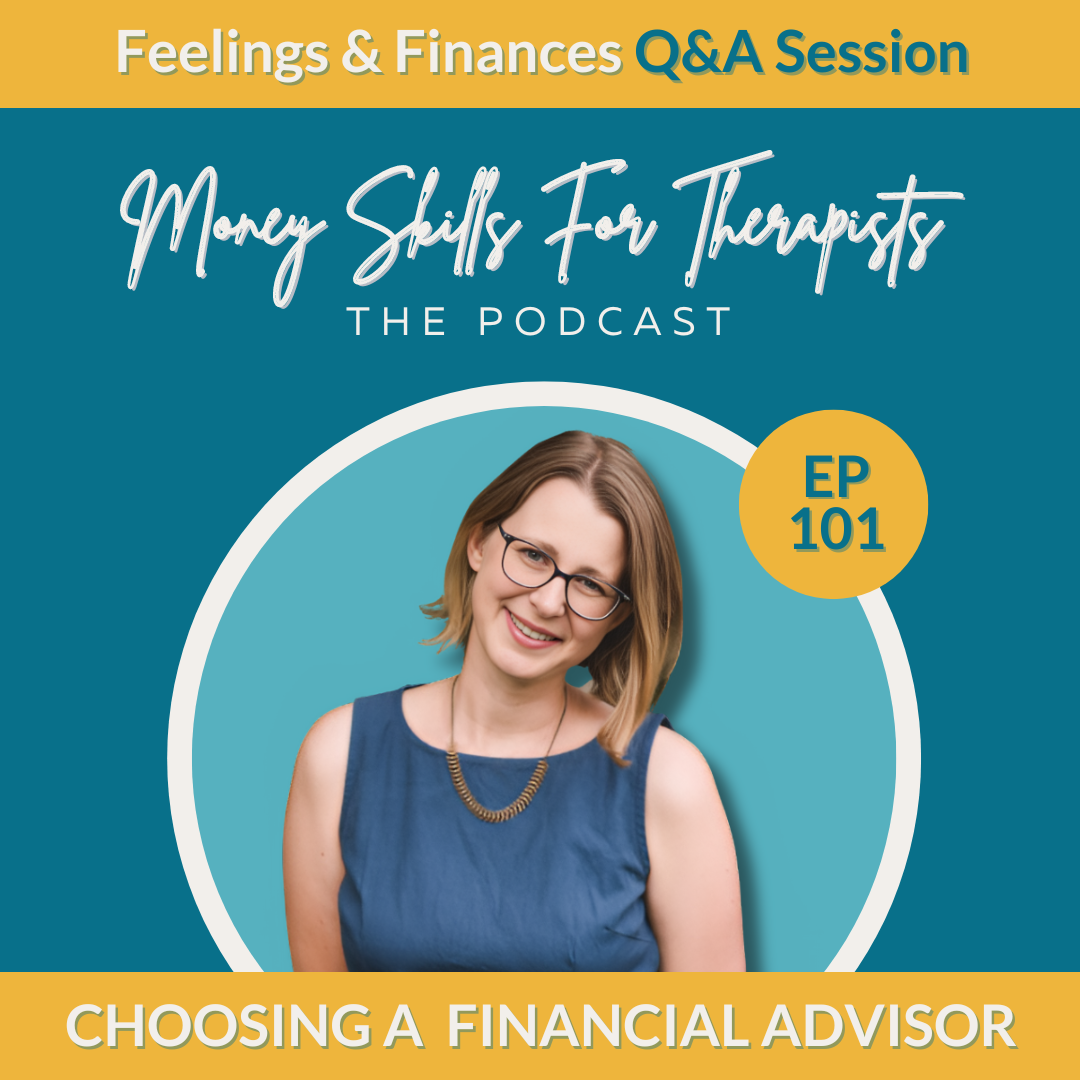
101FF: Choosing a Financial Advisor – Feelings & Finances

Choosing a Financial Advisor Feelings and Finances 101 Episode Cover Graphic
Header for podcast website

101FF: Choosing a Financial Advisor – Feelings & Finances

Choosing a Financial Advisor Feelings and Finances 101 Episode Cover Graphic

In this Episode...

What should you consider when seeking a financial advisor? How can you pivot when you’re already with a sales-based company? In this new mini series, Linzy takes listener questions and answers them in the Feelings and Finances episodes that come out on Fridays. 

Today, Linzy takes a question from Money Skills for Therapists team member Ashley and talks about when it is worth it to make a move with investments and how to take steps toward that move.

Have a Question for Linzy?

You can easily submit your question to Linzy on a voice recording. Go to the podcast page on our website and click the “Start recording” button. https://moneynutsandbolts.com/podcast/ 

Follow the prompts to record your question. When you finish your recording, enter your name and email to submit the recording. You can also submit your question directly to Linzy’s SpeakPipe inbox: https://www.speakpipe.com/MoneySkillsForTherapists 

Interested in working with Linzy?

Are you a Solo Private Practice Owner?

I made this course just for you: Money Skills for Therapists. My signature course has been carefully designed to take therapists from money confusion, shame, and uncertainty – to calm and confidence. In this course I give you everything you need to create financial peace of mind as a therapist in solo private practice.

Want to learn more? Click here to register for my free masterclass, “The 4 Step Framework to Get Your Business Finances Totally in Order.

This masterclass is your way to get a feel for my approach, learn exactly what I teach inside Money Skills for Therapists, and get your invite to join us in the course.

Are you a Group Practice Owner?

Join the waitlist for Money Skills for Group Practice Owners.This course takes you from feeling like an overworked, stressed and underpaid group practice owner, to being the confident and empowered financial leader of your group practice.

Want to learn more? Click here to learn more and join the waitlist for Money Skills for Group Practice Owners. The next cohort starts in January 2026.

Connect with Linzy

Want to feel calm and in control of your finances? Connect with us!

🎥 Subscribe to our YouTube channel: https://www.youtube.com/@moneynutsandbolts

🎙️ Listen to the Money Skills for Therapists Podcast on your favourite app: https://moneynutsandbolts.com/podcast/

🤳 Follow us on Instagram: https://www.instagram.com/moneynutsandbolts

📲 Follow us on Facebook: https://www.facebook.com/moneynutsandbolts

💻 Follow Linzy on LinkedIn: https://www.linkedin.com/in/linzybonham/

Episode Transcript

[00:00:00] Linzy: Hello and welcome to our first ever episode of the Feelings and Finances mini podcast. So this podcast series is going to be second episodes that come out every week on our Money Skills for Therapists Podcast, and these will be short episodes that are all about answering your listener questions.

[00:00:20] So if you have questions for me, if there’s a situation that you have going on in your business that you’re not sure about, if you’re finding it hard to get to your finances, I would love to hear your question and answer it in a podcast episode. I know that it can be intimidating to send your questions out into the universe.

[00:00:38] On our podcast page, we have SpeakPipe set up, which is where you can leave your name and your question for me. I know it’s intimidating to do that, but I also want to remind you that by doing that, by putting yourself out there a little bit… And you only need to share your first name, and you can use a pseudonym if you want, you get the chance to hear back from me and to have it out there and actually get your question answered.

[00:01:02] So to get us started, my team has recorded some questions. So the first question that I’m going to answer today is from Ashley, our podcast editor, and here is Ashley’s question.

[00:01:11] Ashley: Hey, it’s Ashley with the Money Skills for Therapists team. I am so excited to record a question for the Feelings and Finances episodes that we will now be releasing in the Money Skills for Therapists feed. I’ve learned so much from Linzy and from all the amazing guests on the podcast as I’ve been listening over the years, but I have a question that I haven’t really known the answer to.

[00:01:36] So I am excited to pop on here and ask it. And my question is, Linzy, you have shared so much about fiduciaries and other types of financial advisors. And I certainly, now that I know a bit more and have a little more financial literacy, I recognize the benefit of that. But I know for myself, I have been putting money into kind of the, I don’t know, more traditional, financial

[00:02:02] approach. I use Edward Jones specifically. And I’ve been doing that since I was 13 and babysitting, and was like, “Oh, I can invest money. And, I actually can help my money grow.” And so I’ve had that stuff set up for a long time. So I guess my question is, what do you say to people who already have money invested in mutual funds and already have a financial advisor who is more in the sales type role?

[00:02:29] If I want to make a change, is there something I can do now to take steps moving forward, or is it too late? I think probably it’s not too late, but I guess that that is the question that always comes to my mind is knowing what I know now, what steps can I take to be more proactive in my financial investments moving forward, but also recognizing where I am on the journey already?

[00:02:54] I’m excited to hear what you have to say about that. Thanks so much for taking these questions and for giving listeners an opportunity to ask them.

[00:03:02] Linzy: Well, Ashley, thank you for your question. There’s a couple pieces to this question, and I’m going to address the pieces that are really in my lane. And then I’m going to direct you, of course, to the folks who can help you, who this is very much their lane.

[00:03:15] So, as I think everybody listening to this podcast knows, but I should make clear, I’m not a financial advisor; I’m not an accountant. I’m a financial educator. My role is to help you think about where you’re coming from, connect with what’s happening below the surface to get you moving to make

[00:03:31] informed decisions, right? So what I’m hearing, Ashley, first of all, to reflect back to you, where you have done so, so well, is that you have been investing since you were 13 years old, which is amazing. You and I, our little selves could have been friends.And you’ve been investing for so, so long, with this company, Edward Jones, and these mutual funds that what I’m hearing is there’s this probably inertia there in terms of like, well, you’ve been doing this thing for so long, literally decades at this point.

[00:04:00] Is it too late to move? What do you do at this point knowing what you know? And what I’ve noticed can come up with us when we’re more like relational people, and also just around feeling stuck around money, is it can be easy to feel like well I’ve already got this thing I’ve been doing it a long time.

[00:04:15] We can almost get this sense of like loyalty to these large institutions or like a fear of switching that we’ll like do something wrong and whether it’s a loyalty or fear we can feel stuck in these relationships, a little bit like beholden, or that it’s just easier to stay there than it would be to leave. So what I want to remind you of, Ashley, is that it’s never too late to make switches that are going to improve your financial health and… This is outside my lane, again,

[00:04:46] but mutual funds tend to have a much, much higher management rate. So the amount that you pay to have those be actively managed by somebody is usually well over 2%. And 2 percent of your money over like the long, long, long term, over decades, ends up being a lot of money. So you still have decades to go, Ashley, before you retire.

[00:05:08] And I know that because I know you. And so, taking the time to decide what you actually want to do with your money, and making a switch now will have literally decades of impact on how much money you’re going to have when you go to use that money in retirement or in your later years. So, I would say the first thing to do is to get clear about how much it is costing you to have these investments where they are now.

[00:05:31] This is about grounding yourself in where you are, right, rather than just making an emotional decision. I’m going to encourage you to start by looking at the numbers and, find your statement, look at what your MER is, which is the management rate that you’re charged, and see what that percentage is.

[00:05:47] And then you could probably find online. There’s so many great resources around this stuff online. Look at an investment calculator for the MER rate for what you’re currently committed to with Edward Jones, and see over the course of the next week 30 years, how much money is that going to be?

[00:06:02] Based on how much money you’re paying them to management, how much money is going to go towards this MER that you’re paying? I think that’s going to help you to ground in the fact that this is worth making a change. Then when it comes to making a change, this is where bringing in another professional to guide you is a great idea.

[00:06:21] So you have a relationship with somebody right now who, as you say, is in more of a sales role, more of that,old school financial advisor who is also benefiting from you having money in certain places or from selling you certain products. Finding a fee-for-service financial advisor is a great place to start to recalibrate your picture, get somebody’s eyes on your situation to look at like, where are you right now with your goals?

[00:06:43] Where do you want to be? They can help you create that big picture perspective, and then they can also help you start to think about where you want to put your money. I’m a big fan of ETFs. That’s how my partner and I invest, and to learn how to invest in ETFs, we literally learn from blogs on the internet.

[00:06:59] So um, Millennial Revolution is a great blog. They’re a couple from Waterloo, Ontario, so in my neck of the woods, who retired in like their early 30s, saved up a whole bunch of money, and they have some really great blog articles that teach you all about ETFs. How to invest them in a balanced way… The approach now to investing, Ashley, that most folks take is like put your money in everything and then leave it.

[00:07:25] Right? So think about your risk, how much risk do you want to be taking? And then spread your money out over a bunch of different stuff so you don’t have all your money in Tesla or all your money on the American stock exchange. Spread it out and then just leave it, but you’re going to be paying a much, much, much lower rate.

[00:07:41] And that’s where it’s really going to make a big difference for you financially, Ashley, is by having that lower rate. And we’re talking about like tens of thousands of dollars, if not more, over the next few decades, right? So this is one of those things where it’s really worth it to take the time, ground in your numbers.

[00:07:57] Not surprising that that’s the first piece of advice that I’m giving. Look at what you’re paying now. Look at what would happen if you were paying 0. 2 or 0. 1 percent instead for an MER and then look at getting the support in place so you feel like you can confidently make that switch to maybe managing them yourself.

[00:08:17] You can also put your money into large ETFs that are just kind of like a mix of all sorts of different investments. But I would say, ground in your numbers, look at getting support, look at getting a financial advisor who can help you look at your big picture, educate yourself, do some learning, and don’t let yourself get stuck in inertia.

[00:08:34] Because you’ve been with this financial institution, I see this happen with banks sometimes, too, where we feel weirdly loyal to our banks. You need to be thinking about what is best for your family’s financial situation and tens of thousands of dollars, or even more in the future, is what is much more important than the friction of switching now or some of the learning that you’re going to have to do.

[00:08:56] So that’s my advice. I’m excited since I know you, I’m going to get to hear about your journey and what you decide to do with this. And thank you so much, Ashley, for submitting our first question for the Feelings and Finances Podcast Miniseries.

[00:09:09] So folks who are listening, I would love, love, love to receive your questions and dedicate an episode to answering your question. So you can go over to our podcast page, you’ll see a link in the show notes, click on the Speak Pipe, just like Ashley. Introduce yourself, and just share your question. I would absolutely love to be able to answer your question in an episode, help you get moving, help you get thinking about things differently so that you can be actively shifting your relationship with money, as a listener of this podcast.

[00:09:41] Thank you so much for listening today.

Picture of Hi, I'm Linzy

Hi, I'm Linzy

I’m a therapist in private practice, and a the creator of Money Skills for Therapists. I help therapists and health practitioners in private practice feel calm and in control of their finances.

Latest Episodes

174: How to Plan for Your Future Self with James Alexander Episode Cover Image

What does it really mean to play your own financial game?

In today’s episode, I’m joined by James Alexander, a certified financial planner who brings both heart and math to the world of money. James and I explore the importance of defining your personal version of financial success, and we discuss why comparing yourself to others can pull you away from what actually matters to you.

Listen to this episode »
Owning Your Power in a Shifting Therapy Landscape with Matt Cohen Episode Cover Image

How do we protect the future of our profession in a rapidly evolving mental health landscape? In today’s episode, I sit down with Matt Cohen, founder of PlaySpace Health, who brings a unique perspective from the world of business and innovation into the therapy room.

Listen to this episode »
172FF: Building Systems That Support You and Your Brain: Linzy Answers Listener Questions Episode Cover Image

Are you caught in the loop of thinking you need to learn just a little more before you take action — or feeling totally stuck when it comes to choosing the right tools for your practice? In this full-length Feelings and Finances episode, I’m answering two powerful questions from therapists working through real-life challenges.

Listen to this episode »

© Copyright 2022 | Money Nuts & Bolts Consulting Inc. | All Rights Reserved

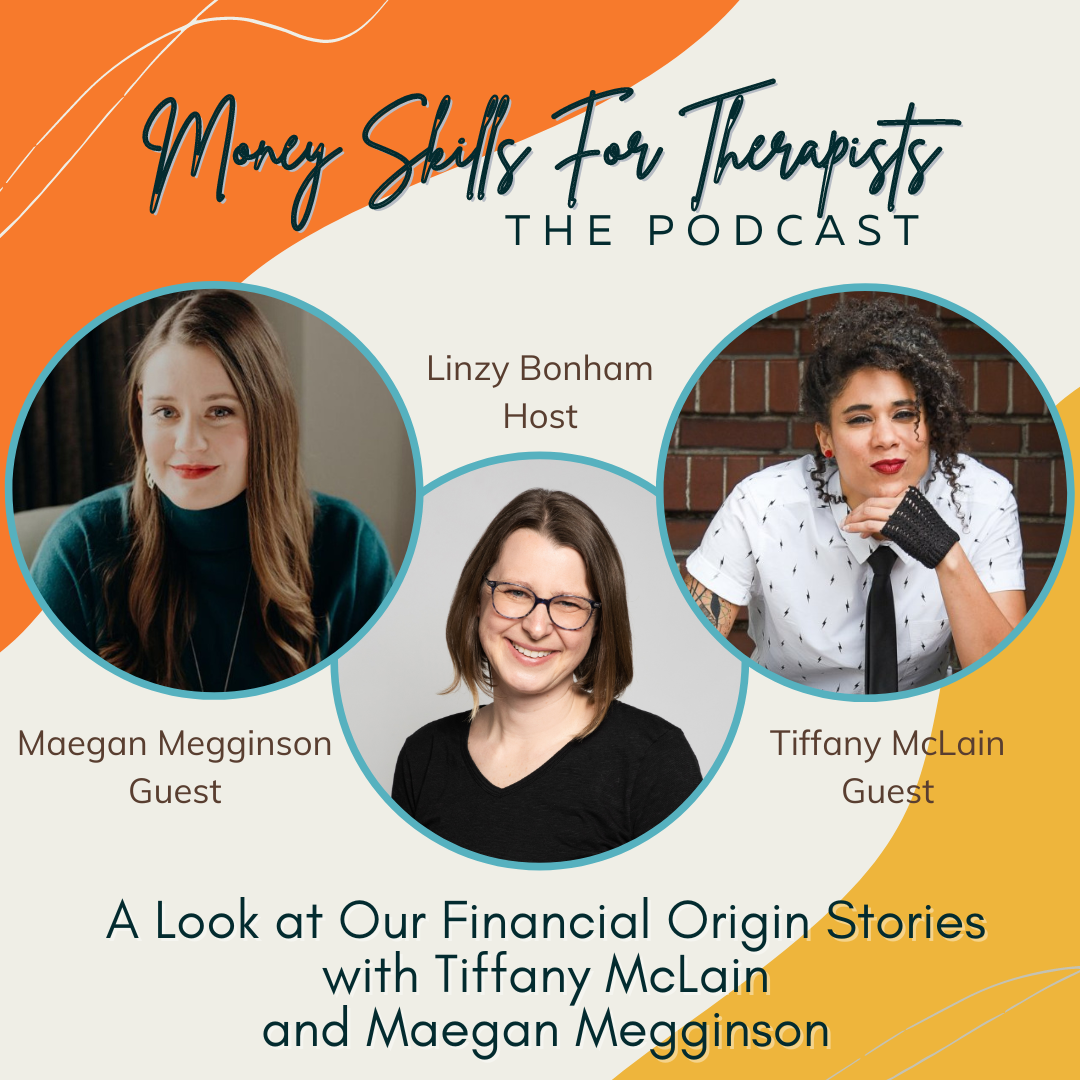
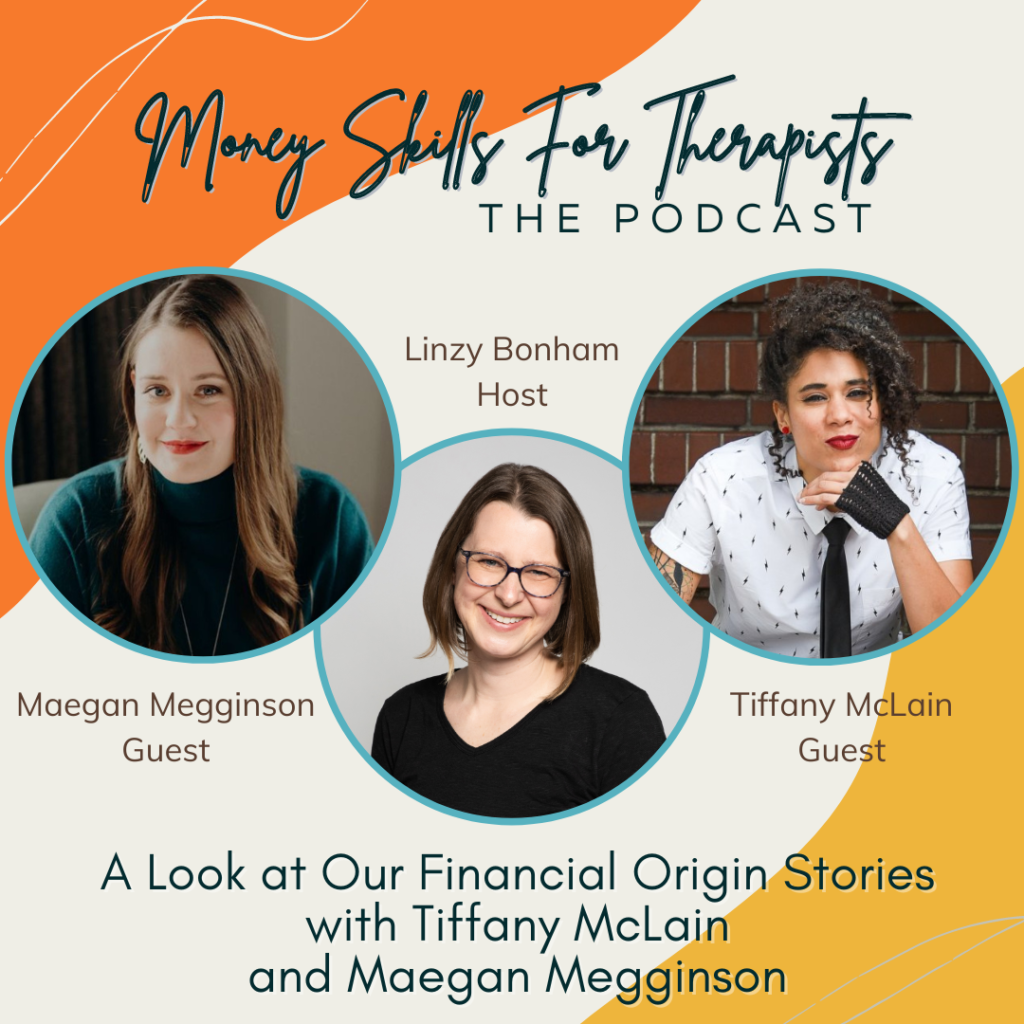
A Look at Our Financial Origin Stories with Tiffany McLain and Maegan Megginson

A Look at Our Financial Origin Stories with Tiffany McLain and Maegan Megginson Episode Cover Image

A Look at Our Financial Origin Stories with Tiffany McLain and Maegan Megginson

A Look at Our Financial Origin Stories with Tiffany McLain and Maegan Megginson Episode Cover Image

“You’re a real inspiration around actually having a well-rounded life. And I literally come to you… this because we talk, and say, how do you do that? How do you have time to serve on the board? How do you have the internal energy to have this garden in your backyard? And then I take it, and I test it out. Yeah. So, thank you for being a model. Your parents, I think, were a model to you of what it could look like, and now you’re a model to me of what a well rounded life can look like.” 

~Tiffany McLain

Meet Tiffany McLain

Tiffany McLain, LMFT is a clinical fee strategist for therapists in private practice. Her mantra is, “Full fees are the new black.” Via her program, The Lean In. MAKE BANK. Academy, she helps therapists ethically earn 30 to 50% more per month while seeing fewer clients by showing them how to think about and directly address fees in a clinically appropriate manner.

The Lean In. MAKE BANK. Academy is a program that addresses the underlying money mindset stories that keep therapists broke so they can become THAT therapist who charges premium fees, cash pay. With the LIMB 4-step framework to make BANK, regular coaching calls to help you go to the next level, a phenomenal community of funny and intelligent therapists, be ready to get real raw and real rich.

Meet Maegan Megginson

Maegan Megginson is a licensed therapist and business mentor who serves mission-driven entrepreneurs online and in person in Portland, Oregon. Maegan helps business owners recover from burnout and reignite their vision for their work and their lives by blending the emotional, psychological, and spiritual elements we need to become deeply rested and wildly successful. 

In this Episode...

How do our first experiences with money and business shape who we become? In celebration of the 100th episode of the podcast, Linzy is joined by her business besties Tiffany McLain and Maegan Megginson, and they dive into their own origin stories when it comes to early perspectives on money, business, and entrepreneurship.

Check out this behind-the-scenes conversation as Linzy, Tiffany, and Maegan examine how their childhoods shape who they are today. They also share about how they consciously run their own businesses and what they hope to put out into the world through those businesses. Do not miss this inspiring, intimate conversation about what business can look like when we approach entrepreneurship with empathy, compassion, and balance.

Connect with Tiffany

You can learn more about Tiffany’s work on her website. 

Check out Tiffany’s  free fee calculator: https://leaninmakebank.com/fee-calculator/

Connect with Maegan

Get Maegan’s Recover From Burnout email series. A 10-day journey to find your way back to yourself—without time blocking, hiring extra help, or trying to “just do less.”

https://maeganmegginson.com/recover-from-burnout/

Previous Episodes with Maegan and Tiffany

Interested in working with Linzy?

Are you a Solo Private Practice Owner?

I made this course just for you: Money Skills for Therapists. My signature course has been carefully designed to take therapists from money confusion, shame, and uncertainty – to calm and confidence. In this course I give you everything you need to create financial peace of mind as a therapist in solo private practice.

Want to learn more? Click here to register for my free masterclass, “The 4 Step Framework to Get Your Business Finances Totally in Order.

This masterclass is your way to get a feel for my approach, learn exactly what I teach inside Money Skills for Therapists, and get your invite to join us in the course.

Are you a Group Practice Owner?

Join the waitlist for Money Skills for Group Practice Owners.This course takes you from feeling like an overworked, stressed and underpaid group practice owner, to being the confident and empowered financial leader of your group practice.

Want to learn more? Click here to learn more and join the waitlist for Money Skills for Group Practice Owners. The next cohort starts in January 2026.

Check Out the Jane App

To see how Jane can help you free up your evenings from admin tasks, head to meet.jane.app/more-time to book a personalized demo. But, if you’re ready to get started, you can use the code MNB1MO at the time of sign-up for a 1-month grace period applied to your new account.

Episode Transcript

[00:00:00] Tiffany: You’re a real inspiration around actually having a well-rounded life. And I literally come to you… this because we talk, and say, how do you do that? How do you have time to serve on the board? How do you have the internal energy to have this garden in your backyard?

[00:00:15] And then I take it, and I test it out. Yeah. So, thank you for being a model. Your parents, I think, were a model to you of what it could look like, and now you’re a model to me of what a well rounded life can look like.

[00:00:24] Linzy: Welcome to the Money Skills for Therapists podcast, where we answer this question: how can therapists and health practitioners go from money, shame and confusion to feeling calm and confident about their finances and get money really working for them in both their private practice and their lives? I’m your host, Linzy Bonham, therapist turned money coach, and creator of the course Money Skills for Therapists.

[00:00:49] Hello and welcome to the 100th episode of the Money Skills for Therapists podcast. I’m very excited that we’ve hit this milestone in the podcast: 100 episodes. It’s hard to believe, but, to celebrate today, I’m really excited to share with you a conversation between myself, Tiffany McLain and Maegan Megginson.

[00:01:10] So Tiffany and Maegan are two of my business besties. They are the folks that I talk to all the time who have been walking this path with me for quite a while. Tiffany McLain is the creator of Lean In. MAKE BANK., and Maegan Megginson coaches entrepreneurs and therapists with building burnout proof businesses, integrating rest into their businesses.

[00:01:30] They’ve both been on the podcast before. And today we are having a conversation about our early beliefs around money and business. We discovered… As I was putting together this episode, I realized I should say that all three of us had entrepreneurial fathers growing up. And I was thinking about how so often we talk about our general money beliefs, and this is like work that I’m doing with folks in Money Skills for Therapists often is what are your earliest memories around money?

[00:01:55] Right? And what did you believe about money as a kid? But there’s this other very specific layer that’s relevant to all of us as well, which is business. What do you believe about business? What did you believe about business? What did you witness about business when you were a kid? Today Tiffany and Maegan and I take turns talking about our own experiences growing up with entrepreneurial fathers, kind of the lessons that we took from that, the things that we observed. We talked about how that shows up in our businesses now, and then we also talk about what we are trying to model, in Tiffany and I’s cases to our kids, and for all of us as well to the people around us, what are we now trying to show other people about business and money? I spend a lot of time thinking about what I want my son’s experience of money to be? What are the stories that I want him to carry into his adulthood? Because all of us who are parents are shaping our kids’ stories about money every single day in the way that we talk about it, the way we show up, the way we talk about our business.

[00:02:50] So we cover a lot of grounds today. We probably could have done a 12 part series on this. Of course, when you get three therapists talking about their families of origin… Here is my conversation with Maegan Megginson and Tiffany McLain for our 100th episode of Money Skills for Therapists podcast.

[00:03:06] You

[00:03:21] Linzy: So Tiffany and Maegan, welcome to the 100th episode of the Money Skills for Therapists podcast.

[00:03:27] Tiffany: Woohoo!

[00:03:29] Linzy: I am very honoured to have you both here. And I will say too, trying to get the three of us into one space is like a miracle. And also Steph Claremont was supposed to join us on this call, and she ended up not being able to make it in the end because of the eclipse that’s happening right now and trying to make sure her children don’t burn their eyeballs out.

[00:03:44] Trying to get four online business entrepreneur health practitioner folks in the same space. It’s difficult. So thank you very much, both of you, for being here.

[00:03:54] Maegan: Today I wanted to dig into our own stories, not just about money, because I talk about money stories a lot with folks, right? About the beliefs that we carry into business and the beliefs that we carry into money and how much that impacts our ability to manage it, our ability to learn about it… And this is definitely what I’ve seen over the last few years of doing this work is more than I ever imagined when I started this work. Those stories shape so much of how folks actually experience money and experience their business, right?

[00:04:25] Linzy: Like those beliefs and those somatic experiences and the emotions. But something that I was thinking about with the three of us, as I was thinking about this opportunity that I have today, talking to the two of you, is also beliefs about business, because there’s like a subtle difference there, between, you know, like beliefs about business that we have and money, and how those things go together.

[00:04:44] And with the two of you as well, something that I realized preparing for this call, is we all have dads who were entrepreneurs growing up, which I think is a very interesting parallel. So I wanted to dig into that. Let’s start at the beginning, with our own memories about business and money from those early memories. Tiffany, could I start with you? Thinking back to your earliest memories about business, and money, and what you absorbed, what do you remember believing about these things when you were growing up?

[00:05:20] Tiffany: I love this topic and also, whoa, what a big topic. I’ll do my best to be brief, and then we’ll see where it goes. For me, money, business, entrepreneurship, it can’t be separated from race. My mom is white. My dad is Black. They were married back in the day. They’re married to this day.

[00:05:41] Often people are surprised, by the way, when I say my parents are still married. I don’t know if that’s a race thing or just a generational thing. My mom always worked a stable nine to five job where you have a pension in the government, making your way up over time. My dad was in and out of entrepreneurship.

[00:05:57] He was always trying things, but always going back to a stable base of working for a car and… actually a used car salesman. My dad was a used car salesman. Cue all of the jokes. So going back and forth between that, trying to get out and do his own thing was a constant occurrence in my family as we were growing up.

[00:06:14] So I had, on one side, my white, stable mother, working consistently, making her way up. And on the other side, my Black father, who truly didn’t believe that he would ever be able to be taken care of and do well, working for somebody else, especially in a white town, a white city. His belief was if he was ever going to make it, he had to make it independently, and on his own, without relying on anybody.

[00:06:39] And in some ways that really served him. And in many ways that really got in the way of him actually becoming an entrepreneur who reached the level of success he wanted.

[00:06:48] Linzy: Yeah, and I do have to say, just when you say that people are surprised that your parents are still together, I feel like I was also surprised when I learned your parents are still together. But the reason, I think the reason that I think that is, you talk about them being so different, like your narrative about them, you’re like, two opposite worlds come together, and you’re like, well, two opposite worlds couldn’t possibly stay together… Yeah, but like huge

[00:07:09] contrast there between your two parents. and I’m curious, Tiffany, like with that, do you remember having specific ideas or beliefs about the way that your dad was operating versus the way that your mom was operating? Like, how did you experience the different ways that they were approaching trying to create stability and yeah, build that for your family.

[00:07:31] Tiffany: The idea of creating stability. So in reality, my mom had the stable ongoing job. My dad was trying to create a bigger sense of stability. And actually over time we really did move up the socioeconomic ladder due to his efforts. He grew up very impoverished in the worst projects in Chicago, and then back when he was growing up… Violence, you know, what he saw was just beyond what… I didn’t learn about it till I was much older, what his experience was like.

[00:07:56] So from where he came from to where he went was profound. He also had to bring a lot of bravado… He had to have a huge narcissistic kind of energy to actually be able to bust out of where he started from, and to go where he was going. But what that did in my mind was create a setup where I looked down on… Two things, both look down on a consistent, reliable position where you’re working for somebody, was devalued, and the idea of going after your own thing, charting your own path, was very much valued.

[00:08:25] However, in reality, my mom’s stability is what actually allowed the family to stay afloat through his ups and downs. So I think in one way, idealizing this doing it on your own, but also for me, there was no other option. I could, I literally thought as a Black person, as a Black woman, who’s quirky or out of the box, I’m not going to ever be able to work for someone else.

[00:08:44] I just couldn’t imagine ever working for anybody who would ever actually let me grow or see my potential. I just imagined that wasn’t a possibility for me. So going off and doing my own thing was literally the only option I could have conceived of in my mind, and yet I saw the disruptions it created in my upbringing.

[00:09:02] My dad was gone a lot of the time, our income would be up where we’re on top of the world. We’re rich people, by the way, not rich people… But in my mind, we’re rich people. and then on the other side, suddenly things were taken away. Or we were in a ton of stress because we suddenly didn’t have any money.

[00:09:15] Didn’t know where it was coming from. So it was this constant rollercoaster and insecurity. On my dad’s end, and also there was a, any day now I’m going to be a millionaire… Any day now the millions are coming. So there was also created in me this idea of relationally, we can put that aside, but even in terms of socioeconomic status, riches come when you just do the one right thing.

[00:09:36] And then in a year, you become rich. So there was this idea of richness as being rich is just around the corner. Having everything you want is just around the corner because you just got to find the secret key. Not like hard work over years and self growth. That doesn’t lead to riches. Those are the suckers.

[00:09:51] The real richness comes from Cryptocurrency or whatever it is that’s going to just unlock the key for us.

[00:09:57] Linzy: Yeah. It’s kind of that magical thinking, but it also makes me think of this other thing that I remember you saying that your dad said, where there’s sheep and there’s wolves? Can you remind me? The sheep get…?

[00:10:07] Tiffany: The sheep get sheared. A constant… That was a constant mantra in my mind. The sheep get sheared, Tiffany. So he was a salesman in all kinds of ways, probably relationally, but also in his professional life. But for him, sales was tied to one person is the sucker and one person is taking advantage of.

[00:10:23] So that really made it difficult when I was going off into my own business to think about sales as a different kind of relationship, or engaging with our team members who we ultimately had to build a team, or a client. I was really resistant to going into business at all because I didn’t want to live in this paradigm of suckers and people taking advantage of.

[00:10:43] And so I had to do a lot of work internally to move away from that as a paradigm for what business actually is and what it needs to be to have ultimate success. And I don’t mean just monetary success, but actually personal and interpersonal success.

[00:10:57] Linzy: I feel like we could just talk, Tiffany, about your story for the next hour.There’s so much here. But yeah, what I really hear there is there’s this real winners, losers, narrative. It’s either you’re winning or you’re losing. this kind of predatory, but you want to be the predator, right?

[00:11:10] If there’s winners or losers, you don’t want to be the loser. That’s not the right side to be on. you need to be on top.

[00:11:16] Maegan: Can I add something, or ask a question? Yeah. Okay. Maegan Megginson here.

[00:11:19] Linzy: Hello, Maegan Megginson.

[00:11:22] Maegan: Buckle up, Tiffany! I’m just kidding. No, I, so I’m still thinking about the sheep and the wolves and how interesting, but also that like, when you said that, what I heard was lone wolf… Not like the wolf as part of the pack, but You’re a sheep, and you get sheared, or you’re a lone wolf, and I’m curious for your dad, how did that translate in terms of community?

[00:11:41] Did he have community as an entrepreneur, or did he live most of his working life as this lone wolf? And what did you learn from that?

[00:11:51] Tiffany: Tiffany getting analyzed by two very good therapists. The hundredth episode. Here’s what I’ll say. Great question.

[00:11:59] Maegan: Don’t worry, my turn’s next.

[00:12:00] Tiffany: We’re waiting for you, Maegan Megginson.I can’t help but come back to race. When we think about the poverty he grew up in, and what it means to be in America and the structural system, a Black man in America, especially one without ties and without financial stability, you’re in trouble if you trust anyone.

[00:12:20] You’re in trouble if you are emotionally vulnerable. And where my dad came from, I mean, you will literally get killed. There are many examples he has of literally having dead bodies in front of him. This is his day to day growing up. So for him, it was absolutely lone wolf. You cannot rely on anyone because everybody, ultimately, all the way up to our very biggest systems of the government, are going to take advantage of you if they can.

[00:12:46] So that really has been something and continues to be something that I’m working on, is how to actually build community. How to build… How to collaborate within business, both within a team, but also within, relating to other businesses without this continual fear of, wait, am I being a sucker right now?

[00:13:06] If I’m open and vulnerable, are they actually going to take advantage? And I think actually our business has grown slower because I have entered into things where I actually wasn’t advocating for myself or the business because I really wanted to be on the other side of… if anyone’s going to be taken advantage of, I’d rather it be me so that I’m not the one, the perpetrator.

[00:13:24] I’d rather be the victim. And so trying to work on… actually we also can move forward and be strong and take up space has been something throughout our business and something we teach I think that’s probably the genesis of the Lean In. MAKE BANK. Academy is helping therapists actually understand their own needs as well, and not simply focusing on the needs of the other, their clients.

[00:13:46] Linzy: Tiffany McLain. Thank you. This has been the hundredth episode of… So much there. Yeah, what I’m hearing there is like, when there’s this model that you absorbed from your dad, because it sounds like your mom’s doing this whole other thing, right? She’s like creating the stability in your family, right?

[00:14:03] But that’s not taking the spotlight. That’s not interesting. That’s not magical. That’s not just wait till next month. Yeah, what I’m hearing is like, when there’s this narrative of good guy, bad guy, you don’t have friends, right? And when you grow up in systemic racism, where systems are set up to treat you disfavorably, and there are so many examples everywhere of the banking system and mortgage system, discriminating against Black people, yeah, it’s just you. Like, where’s the room in there to have an actual community or even have a healthy, positive relationship with the folks you’re doing business with, like with your customers when it’s every man out for himself?

[00:14:40] Tiffany: Absolutely.

[00:14:42] Linzy: Huh. Okay. Maegan Megginson, it’s your turn.

[00:14:45] I’ve got to give Tiffany a break.

[00:14:46] Maegan: Okay. Just gotta take a sharp left turn. I have so many questions, but I… I’m just going to stuff them deep down inside…

[00:14:54] Linzy: That’s very healthy. Just do that.

[00:14:55] Maegan: Next time we’re hanging out, Tiffany. Yeah.

[00:14:58] Tiffany: That’s where they belong.

[00:14:59] Maegan: Stuff my questions deep down inside. Okay. Can you just remind me: what’s the question?

[00:15:02] Linzy: Yes, where we started. Yes. Yes. The question is about your early memories about your beliefs and like interpretations about business and money.

[00:15:11] Maegan: Yeah. Yeah. It’s such a big question.

[00:15:14] Linzy: I know. Thank you.

[00:15:16] Maegan: Tiffany, I see why you made a face at the beginning. Yeah, it’s like my mind is racing with the ways in which, Tiffany, our stories are similar. There are some ways our dads were so similar, and then other ways they are so different. And that is fascinating to me.

[00:15:32] So, yes, I’ll start with a disclaimer. I really do love my dad. So just so everyone knows, I do, I love him. I’m figuring it out. We’re figuring it out. But like my early childhood, the season of my life when my dad was creating his business, was the most complicated part of our relationship.

[00:15:51] And I learned a lot of things that I do not want to replicate as a business owner. And I’m also extremely grateful for the financial privilege his success gifted me and created for me. So it’s really complex. It’s really nuanced, like the origin story of my life with my entrepreneurial father.

[00:16:13] So I’ll say just high level overview that my dad is a hundred percent a white man. So let’s just be very clear about that. He’s just as white as they come. And he grew up pretty poor and his success is quote self made. He considers himself like a self made success. I’m using air quotes because those of us who understand white privilege

[00:16:31] know that there’s no such thing as a white person being self made. But, what I will say about my dad is that he was extremely persistent and extremely driven to create a path for himself that was different than the path his ancestors had followed up to that point. My dad was the first person in his family to go to college.

[00:16:49] He had got an associate’s degree, and then he really worked his way up in his industry from being a salesperson. So it’s boring, but he worked in sandblasting and painting, which is very specific. I grew up in Baytown, Texas, which is where Exxon lives, ExxonMobil Gas. So I grew up around a lot of refineries, and all of those big machines and refineries have to be painted, inside and out.

[00:17:14] So my dad was in sales for the company that would sandblast those machines. So he worked his way up as a salesman and eventually opened his own sandblasting and painting company, and grew that company to the point where he was able to sell it for a lot of money when I was in very early high school.

[00:17:32] And it really changed the financial trajectory for my family at this kind of pivotal early adolescent season of my life. So I feel like my development as a child, an adolescent, followed the rollercoaster of an entrepreneur who started from scratch and took it all the way to the end.

[00:17:55] What did I learn from that experience? So, I’ll say, like, my most predominant memories are really when I was in junior high. And what I witnessed in junior high was someone who really believed he had to sacrifice everything in order to be successful, including his family. I didn’t see my dad much.

[00:18:17] Everything that he did was in service of making more money. All of the conversations in our house were about success and hard work and work ethic, and you can sleep when you’re dead, and pull yourself up by your bootstraps.

[00:18:29] And, to be successful means making a lot of money early in your life so that you can retire early. This was my dad’s dream was to be able to retire early. And he did. And he is retired now when many of his friends and colleagues are still working, and the way he lives his life is not anything like how I want to live my life when I’m in my sixties.

[00:18:52] So I feel like I’ve just grown up with this entrepreneurial figure who was very successful, but had to sacrifice so many parts of himself and his relationship with me along the way.

[00:19:03] When you were growing up, do you remember at that time feeling critical or questioning his approach or was that just how it… How it had to be, how it was?

[00:19:14] Well, I think by nature I’m a person who is critical and questioning of most things, and that has always been true. And I think it’s actually… It was the origin of a lot of conflict that I had with my dad for the first few decades of my life is that I wasn’t afraid to say, “Hey, this thing you’re doing is really messed up,” or like, “Why are you doing this?”

[00:19:35] Or “This isn’t right.” And so we fought a lot. We had a lot of conflict in our relationship. I doubt I was able to say it this succinctly, but I think what I knew in my body was that he was treating his body like a machine, and he was treating his family as expendable.

[00:19:53] And, yeah, we had a lot of conversations about the things that didn’t feel quite right, but also I was 12, so I wasn’t able to… to say clearly, oh, I think you’re giving too much to your business, or I think you’re a workaholic, or whatever the case may be, I was just able to say, you’re being really mean,or mom is really sad when you don’t come home, or why can’t we spend more time together, or whatever was clear to me then, I would say it, but I don’t know that it was clear to any of us at the time that the missing piece of the puzzle was connection.

[00:20:25] And so I think Tiffany, it’s why I was so interested in what you were saying about your dad around the sheep and the wolves, because my dad, too, really similarly, there was always the sense of

[00:20:35] I’ve got to do it on my own. And I think it’s… it really showed, as a kid, that you didn’t get to have success and community.You didn’t get to have success and family, there’s just such this deep internalized capitalism that was reinforced in my upbringing that wealth, financial wealth, is the only type of wealth that matters, and I’ve had to do a ton of work in deconstructing as an adult to say, oh wait, no, no, no. Actually, financial wealth is one small piece of the pie, I want wealth in all areas, in relationships, in love, in time, in freedom, in travel, in creativity.

[00:21:13] But I grew up in a house where success was financial wealth, and the price that we paid for financial wealth was pretty profound.

[00:21:24] Linzy: Yeah, and I mean, it’s kind of like your dad did the American Dream.

[00:21:28] Maegan: He did the American Dream. 100%. And he would say he’s still doing the American Dream.

[00:21:34] Linzy: And it does make you think about the limitations of the American Dream narrative. Because in the American Dream, you never talk about, but then you also balance it with this thing. And there’s… like, yeah, there’s just no nuance there. And I think that I still see so many folks that I know, especially men who have this narrative of I’m going to do this, and then I’m going to retire, and then life is going to begin.

[00:21:56] But it’s But you’re really damaging your marriage right now. And you’re not actually having time with your kid. And I feel like your dad is on the other end of that spectrum. Like he did it. He checked all the boxes. He sold the company. Isn’t that the dream, right? You build the company, you sell the company, you have all the money.

[00:22:08] But yeah, there’s all these other, I love what you’re saying about like these other types of wealth, that you’ve had to learn to expand your

[00:22:15] Maegan: Well, and it’s still to be clear, it’s still a challenge between me and my dad. So my parents did get divorced. My parents are definitely no longer married. They got divorced when I was a senior in high school, and I absolutely see the stress that this business caused as a primary factor. I mean, it probably would’ve happened

[00:22:34] in a dozen other scenarios, too, but the way that his identity became wrapped up in the business, and the way that pulled him away from the family, I have no doubt contributed to my parents splitting and divorcing. The other thing I was just going to say, Linzy, is, so obviously, I’m an entrepreneur now, and this is a major connection point between me and my dad.

[00:22:57] We’re not super close, you know, we have a fine relationship. It’s just it’s totally fine, and I love him, and I hope that we grow closer as the years go on. But really the only thing we have in common in our lives is that I also own businesses. And it’s really hard to talk to him about it because we do have such different values about what it means to be successful,

[00:23:19] the choices that I’m making as I work to sell one of my businesses are very different choices than he made to sell his. And I can experience now as an adult, the projections that he puts on to me based on his understanding of what it means to be successful, what it means to run a business, and it’s really sticky.

[00:23:39] It takes me… I have to stop and pause and breathe all the time to really untangle what’s Dad’s belief and what’s my belief, and how do I create a tapestry where, like, all of that can be true, and we can be in community, and we can talk about this. But I don’t lose myself in the process. Because how I want to be in the world is very different from how he was in the world.

[00:24:02] I would love to also have his success, but I’m not willing to give up what he gave up in order to have it.

[00:24:09] Tiffany: Yeah. Which is a very important distinction. Tiffany, I’m curious what your reflections are with Maegan, what’s coming up for you? I muted myself so that I’m not jumping in and interrupting every 30 seconds!

[00:24:21] Maegan: It’s hard, isn’t it?

[00:24:21] Tiffany: Yeah! So I’m listening from the perspective of the American Dream, and all the people… I know a lot of people who have that idea: if I just build the business, sell it, then I’m free to retire. So can you talk to us a little bit about what doesn’t work for you post?

[00:24:37] So the making his American dream, as being his child didn’t work out for you, but now you’re looking at this person who has achieved the American Dream. And you’re saying, that’s not my American Dream. Can you talk about what you don’t love about the idea of suddenly being free, having time, ultimate time and money freedom?

[00:24:55] Yeah, I mean, I see a person that acquired all of these resources, and now all of a sudden has all of this time, and it’s well, what do I do? Where’s my community? In what ways am I growing?

[00:25:08] Am I healing? Am I becoming more of who I’m meant to be? I think, when you are deeply committed to the American Dream and then you achieve the American Dream, it’s like, “Well, I guess I’m done.” Existentially speaking, I guess I am done. I was here to achieve the American Dream.

[00:25:25] I was here to create something, and sell something, and then have enough money that I could just chill out for the rest of my life. And you finish that, and then what? You just, fuck around all day for the rest of your life? What do you care about? How do you want to contribute to the planet?

[00:25:41] I want to live a life with depth and texture and nuance and questions and exploration. AndI don’t ever want to be finished working. I think that’s the other thing that’s a big difference between us is that my work is my life.

[00:25:55] My work is what I believe in. I feel called to do my work in the world, and I don’t ever want it to be over. And when I see people who achieve the American Dream, and they finish working. It’s just they’re just waiting for the end. And there’s something really depressing about that to me.

[00:26:14] Linzy: Yeah, the phrase that one of my friends uses is talking about people who hit the retire early, sell the business, is that you’re the dog who caught the car. And you catch the car and you’re like, Oh shit, now what do I do with the car? I’ve got a car in my mouth. Yeah. And part of what I’m hearing here, and I think your dad, who is a rich and complex human, who we don’t know everything about, to be clear, but it’s what I’m thinking about partially is projects and energy, right?

[00:26:36] And we only have so much bandwidth for projects and energy and focus. And it’s like your dad put his focus here, and he did this thing really well, right? But when you’re focused all here, you’re not doing all these other things, right? Like you’re not cultivating that relationship with yourself. You’re not exploring, I don’t know, your interest in like Russian literature that you’ve always had. You’re not like building deep relationships with your family, right?

[00:26:59] There’s just so many ways that you can’t be when you’re putting all of your energy into this one project that, as you say, like when you accomplish the project, then it’s yeah, now what?

[00:27:08] Now what do you do? Because I think often, too, like when we spend so much focus on this metric, this number you’re going to hit, you’re not spending time cultivating all these other types of like skills,

[00:27:17] and ways of being, and, I don’t know, challenging yourself, connecting. Because like I think something that we all have in common is our appreciation for richness and texture and meaning, right, and like depth. And I think yeah, if you’re really going hard at being yourself. Business, I’m going to put a Z in there, Bizness…

[00:27:34] There can’t be depth there because if there was depth there, I think you would have to treat people well. You’d have to consider relationships, you’d have to slow down… you’d have to make different decisions that would be contrary to this kind of narcissism that I think helps people win at that traditional business game.

[00:27:50] Maegan: Right. And similar to Tiffany, the only reason my dad was able to create the huge success that he had so quickly in his life, (1) the narcissism and the willingness to sacrifice depth and family and et cetera, but also because he had a wife at home caring for his kids. My mom always worked.

[00:28:10] My mom loves to work. Actually, there came a point after my dad sold his company when I was in high school that my mom was like, “I don’t have to work anymore.” So she took a year off and then she was like, “This is terrible. I’m going back to work. I never want to stay home ever again.”

[00:28:22] But yeah, the reason he was able to do it was, yeah, because she was home. She was cooking meals. She was doing the laundry. She was taking me to play rehearsal. Like she was doing everything that he wasn’t present to do. So I think,isn’t it interesting that here we are, three women who had three entrepreneurial dads, and there’s something really cool here about the generational reversal of gender roles and the claiming of things that maybe our moms weren’t allowed to do or didn’t feel that they had access to.

[00:28:52] So that’s a part of this story that I really appreciate, too.

[00:28:55] Linzy: Mmm hmm.

[00:28:57] Maegan: One quick thing that I do want to give my dad credit for. Again, complicated relationship, but so many gifts. My dad taught me money skills from a very early age in my life. And I am so grateful to him for this. Like he took me to the bank in elementary school.

[00:29:12] He taught me how to open my own savings account. He taught me how to save. We had agreements, where I had to, starting in the third grade, I had to put 50 percent of anything that I got into the bank. If it was birthday money, if I babysat, 50 percent of it had to go into the bank.

[00:29:28] And he taught me how to save money so that I could buy a car when I turned 16. And then he went to the car dealership, and he helped me negotiate. And I’m so grateful to have financial literacy because I was raised by someone who values financial literacy. So I just wanted to say that. And I feel like that foundation of financial literacy helped me to go into business for myself at a very young age as an adult because I did understand the financial workings of the world.

[00:29:56] And I also knew what I wasn’t willing to spend money on, what I wasn’t willing to spend resources on. So I did learn so much from him and will continue unpacking all of this in therapy for the rest of my life, like the rest of us.

[00:30:11] Linzy: Thank goodness for therapy. We can all agree.

[00:30:14] Maegan: Thank God for therapy. Yeah.

[00:30:16] Okay. I’m going to jump in with my dad’s story. We have so many questions for you.

[00:30:20] Linzy: Do you?

[00:30:20] Maegan: So something that is interesting to me thinking about my entrepreneurial father, that’s really different from

[00:30:27] Linzy: your entrepreneurial fathers, is my dad loves people, and he loves community, and he wants to be liked and he really cares what people think about him. And that I think really shaped his relationship to business in a really different way. So my dad, when I was, like a baby, he was a snap on tools dealer. I don’t know… Does Snap on Tools exist in the United States? Is that a thing? I don’t know.

[00:30:48] No idea. He was like a tool dealer, and he had a truck, and he would drive the truck to different zones and sell tools out of the truck. So it’s like you had your own like areas, and when he was away and missed my first steps,

[00:31:01] he decided, okay, I’m going to take my entrepreneurship closer to home, and he started running a retail store. So when I was a kid, my dad ran a retail store still very much in the working class, like blue collar area. He sold work clothes to construction dudes. And he had a lot of Harley Davidson belt buckles.

[00:31:15] I remember lots of those being around. Levi jeans. I had a source when I was a kid, lots of Levi jeans in my life. So he ran that business, but my dad, I think, had, like, all the heart… This is what I witnessed, he had all the heart, he cared so much, but it’s just, he could never get it to work. So one of my earliest money and business memories is, I remember, it was, like, the house that we grew up in, I grew up in the country until I was, like, 12, and then we moved into town, so it’s the house that I grew up in, so I was probably, I don’t know, 8, 7, and I remember my mom crying and running up the stairs because she was so mad at my dad because he was never home.

[00:31:49] And I just understood that he was never home because the business wasn’t working, right? There was this constant kind of cloud hanging over us when I was a child of the business isn’t working, but it’s going to work. I’m going to run these ads. This thing’s going to happen. It’s always very similar to your narrative, Tiffany, of like, it’s just about to work.

[00:32:05] And my dad still, when he talks about his business now, decades later, talks about that. It was always just about to work and then this… then something would happen, right? So there was always this sense of it could work, but it didn’t. Meanwhile, my mom was an accountant. She worked for a corporation.

[00:32:19] She was the highest in that company that any woman had ever been. So she had to deal with this bullshit all day from these misogynists. Right? And she did the heels and the perfume and the eighties, So she would work full time all day. Pick us up at the babysitter’s, come home, make us dinner, like at 5:30 at night, out in the country. So she was really carrying us, is how it felt. Financially, she was the earner in our family, but also she was like creating that stability while my dad was like figuring this thing out. But yeah, I really learned that business is hard.You fail at it.

[00:32:49] Ultimately, my dad’s business did not work, and my parents, thankfully, were able to get a loan from my mom’s parents, who had been, like, farmers, who were very, financially conservative and savvy. My grandmother was very smart about money. So they were actually able to lend my parents $100, 000 to cover off the business debts.

[00:33:06] And this would have been in the nineties. That’s a lot of money in today’s dollars. It was probably more like $300, 000. So there was like this cloud hanging over my parents. Cause it was like, really cool that my grandparents could do this for them. But also there was like this debt that was owed.

[00:33:19] And I remember we would go have dinner with my grandparents on a set schedule and there’d be like a check passed to pay it off. So it was very much this thing of like my dad had lost the business, and my mom’s family had bailed us out. So it always felt like, yeah, with my dad, like it was like so much heart, but not a lot of like strategy and skill.

[00:33:37] And I asked my mom once, like when did you know that dad’s business wasn’t going to work? And she was like, Oh, years before he called it. She could just see; she’s an accountant. She’s very financially savvy, right? She could just see that the numbers weren’t working. The strategy wasn’t there.

[00:33:52] but I definitely, Yeah, I saw a lot of what not to do. Yeah, and I will say, Meg, even though my dad has the experience of being an entrepreneur, we don’t talk about business at all now. He’s never tried to give me business advice, which is really interesting to me. He’s just kind of like, you got this.

[00:34:10] He doesn’t even step in. and I think he’s very impressed with my success, and has said kind things about me, behind my back and in front of my face, about the business, but I think he’s… Now he’s taking this attitude that like, I have done something that he couldn’t do.

[00:34:23] And he ended up having a second career, working for other folks, salesman. My dad’s a salesman, to his core, Tiffany, same thing, and Meg, all salesmen. Which also I have to say, in terms of business beliefs, I really looked down on that when I was a teenager, I thought being a salesman was skeezy. And the fact that my dad was a Canadian who did business in the U S? I thought he was a trader. Right. So so interesting now, cause here I am. Hello. I’m…

[00:34:48] Maegan: Making your money off of us Americans.

[00:34:50] Linzy: Making off of Americans. but like now it’s yeah, now I sell to Americans, and sometimes I have Canadians who get mad at me that like I operate in US dollars, but it’s like, well, there’s 10 times more Americans than there are Canadians.

[00:35:00] I’ve ended up really doing what my dad was doing, but it is that whole like coming… I’m coming full circle or eating my words, I really had a lot of judgments that my dad, sold in the States, would be happy if the Canadian dollar was, like, going down because then he’d make more money, and now, I’m in the exact same boat.

[00:35:16] So here we are.

[00:35:17] Maegan: Oh, it always ends up that way.

[00:35:20] Linzy: I know. Be humble.

[00:35:21] Maegan: Alright, I have a question right out of the gate. I’m really curious about this part of the story when your dad took a loan from your mom’s family. And am I hearing correctly that he paid it back? So your dad took… and you were how old when this happened?

[00:35:40] Linzy: I would have been, when my dad’s business closed, I’m going to say I was probably in grade five or grade six. So, ten.

[00:35:46] Maegan: It’s always grade five, isn’t it?

[00:35:46] Linzy: I know. Isn’t it?

[00:35:48] Maegan: Something so pivotal about those years. Well, I’m just really… I mean, obviously, I’m curious about this because of the work that you do now and the way that I know you now to be this very financially responsible person. So I’m curious about what you felt as a fifth grader, sixth grader… What was it like for you to witness your dad, quote, failing and then having to go to your mom to take all of this money that he then paid back over years and years, the check sliding…

[00:36:18] Linzy: Yeah. And it wasn’t really between my dad and my mom’s parents. It was between my parents and my mom’s parents. So my mom stepped in, really, was the feeling. It’s my mom’s got this now, right? My mom is the financial manager in my parents’ relationship, and in my household when I was a kid, that was very clear.

[00:36:35] There were always checks on the table. Lots of checks on the table. Never in envelopes, always on the table. So I remember the kitchen table, like we’d come down for breakfast. My dad would always get ready for work earlier and leave for work like before my brother and mom and I came down in the morning.

[00:36:48] And there’d be a check on the table like every two weeks. It’s like when he got his paycheck, he would cut my mom a check for his portion of the household expenses,, like he would pay, but she managed all the money. She still does to this day. My mom is very financially competent. So yeah, it really felt more just like my mom had taken it over, and she was now managing this debt between my family and my grandparents, which, to be clear, my grandparents were phenomenal people, and in no way held this over my parents’ head. There was no shame, there was no guilt, it was just this thing that they were able to do, and so they did it, and it was, like, added into, this relational piece of, come have dinner, and just pay us back, it was probably quarterly or something, I don’t know what the frequency was, but it was built into kind of like the relational fiber of the family.

[00:37:32] Yeah, so it wasn’t a burden, but it was just very much Mom’s got this now.

[00:37:37] Maegan: But Dad wrote the checks.

[00:37:40] Linzy: No, Mom wrote the checks.

[00:37:42] Maegan: Mom wrote the checks, too. Did you have a feeling about this as a kid, or was it so well integrated into your family that it didn’t even seem like a big deal?

[00:37:49] Linzy: It just seemed like how it was. Like, yeah… no, I didn’t have feelings about that. I think I feltMeg, you’re not a Dr. Becky person because you don’t have a child that you’re trying not to fuck up. But Tiffany and I have children that we’re trying not to fuck up. So, Dr.

[00:38:01] Becky talks about this… thank you so much… talks about this concept of being a sturdy pilot. And my mom was very much a sturdy pilot. She’s just like, yep, this is what we’re doing. This is how we’re managing it. Like she had this real, like sturdiness to her. And so I do think I felt safe when I knew my mom was managing money. It was like, she’s got it.

[00:38:21] Maegan: Wow. It’s so interesting to me how a core part of the mission of each of our businesses, of our work in the world, is so closely connected to this maybe like small t trauma, complicated thing, that happened around business and around money. I mean, here’s Linzy helping people understand money and make smart financial decisions so that they don’t get into the position where everything fails and they have to take out a loan.

[00:38:54] And here’s me having learned that wealth is about more than money and that we have to slow down and really make space for the things that matter. And then Tiffany, what you were sharing about Lean In. MAKE BANK., and how you feel so, so drawn to support people in really tending to themselves and to creating community and not being the sheep and not being the wolf.

[00:39:17] It’s really inspiring to see. How we can take these places that we grew up in, these lessons that we learned, and turn them into really meaningful work in the world.

[00:39:29] Tiffany: I think that I’m hearing… I don’t quite know how this works with your dad, Linzy. So I’m curious if he fits into this paradigm. I hear the two different options of binary, if there are any, of using a business defensively to avoid introspection and growth, and using a business to lean into self understanding and growth.

[00:39:50] My sense from all three of us is that we actually use our business to understand ourselves better, and to grow as people, both for ourselves but for those around us. And I’m curious, Linzy, if you also felt like your dad was using the business defensively, or if he was actually using it to learn and grow and become a more integrated person, become more conscious.

[00:40:11] Linzy: Yeah, I think my dad… That’s a good question. I mean, I think that kind of language would obviously never be on my dad’s tongue, to learn and grow and become more conscious, but certainly learn and grow. But I think my dad is like a true extrovert. And part of what I see is like for him, his business was all about creating connections.

[00:40:29] Like he’s like our… the folks that we support so often who are just like, they just want to help other people. They just want to take care of people. And my dad, I remember, years ago when I started doing my therapy business, he was like, well, what you and I do is very similar. Sales and therapy are very similar.

[00:40:42] And I was like, like hell they are. And now I’m like, Oh, damn it. Bob Bonham was right again. Because like in the Myers Briggs as well, right? Like the INFJ is only one letter off from the ENFJ, INFJ is the therapist, ENFJ is the salesperson. They’re both about helping, right? They’re about helping somebody like to do the thing that’s going to change.

[00:41:02] And whether that’s like having a quiet, introspective conversation, which is a therapist role or whether that’s sales and being like, look, I know that this sandblasting technology is going to change everything for your company. And I’m totally convinced of that. And I’m going to stick by my guns until you buy it.

[00:41:15] They’re both about helping people, right, in different functions. But I think what my dad didn’t have, and still doesn’t have, is he didn’t have the strategy, right? He didn’t have the balance of… I really love people. I want to make people happy. And also I need to be paying attention to there being enough money in the bank.

[00:41:31] And also I need to be making sure that I’m setting boundaries. And also I need to be strategic about when I’m spending money and how, or making sure that the numbers actually work. I don’t know if my dad’s ever used a spreadsheet before. That’s not true. I’m sure. Bob Bonham, if you’re listening, I’m so sorry.

[00:41:44] I’m sure you’ve used this spreadsheet before. But that’s not his world, right? And I noticed this myself, too, when my spouse, when Rodrigo started a boardroom cafe with some guys, they didn’t read a single fucking business book. I was like, have you heard of books before? Cause for me,the way that I think about business in the world is like, there’s all these really smart people who have walked the path before us, who have figured things out, who have wise things to say, who have strategies and tools we can use.

[00:42:06] And we shouldn’t just be sitting by ourselves trying to reinvent the wheel. We should be tapping into this incredible knowledge that’s out there. But my dad didn’t do that, doesn’t do that. And I think that was really kind of his downfall was he just wanted to make money for his family and everything to be wonderful, and make his customers happy, and take care of his staff.

[00:42:25] And he loved his staff so much. He still talks about his staff with fondness, like years later. But to his own detriment, because there was no bigger plan that actually made it sustainable.

[00:42:34] Tiffany: I might be jumping the gun here, but I’m so curious. We all have beliefs about what our… we saw our fathers doing that put us off certain aspects of entrepreneurship, or we developed very strong beliefs about we’re not going to do it, or we’re not going to do it that way.I’m curious about the ways that has actually limited your growth at times, as you look back over your entrepreneurial journey, have these internal nos actually held you back in terms of how your business has grown, or what you’ve been able to accomplish that you’ve wanted to accomplish.

[00:43:09] Maegan: Yeah, I would say, for me, this is a theme I’ve really been exploring in my personal work the last year, and it’s my tendency to overcorrect. And I think this comes straight from my reactions to my dad in business, and in life, and in general. So overcorrecting, meaning like I see that, I see something that’s bad or wrong.

[00:43:29] So I just want to go in the polar opposite direction and do the total opposite. So if I see someone selling in a sleazy way, I’m just like, I’m just not going to sell. How about that? Oh, if I see someone do, manipulate or cause harm, I just want to go and do the opposite thing. And I think that I’m actively really teasing apart how I’m overcorrecting in my own business even still today because there are these shadow parts of me that don’t want to do it the way that my dad did it. And I think that I really, in my own work, I’m opening up space to say okay, I think we’ve overcorrected.

[00:44:07] How about we spend some time looking at the good things that he did, too. He was incredibly successful. What did he do that worked? What can you take? What can you learn from him? Take the good and leave the bad. So yeah, I think that’s a really great question, Tiffany. And I would say for me, it’s because I saw the ways that he made decisions that felt exploitative to me or decisions that devalued community and connection and family,

[00:44:33] I have slowed down my own growth by maybe not putting fuel on the fire. And in moments when showing up a little bit more, being a little bit more present, could move my business forward, but I’m so afraid of sacrificing the things that I witnessed him sacrifice that I hold back. And I want to let some of that wounding go so that I can more easily step on the gas when the time is right. Yeah. Thanks for that question. That feels really important.

[00:44:59] Linzy: Mhm. Yeah, and like, when I think about that question, Tiffany, I feel like my answer is almost no. As strange as that sounds, but by the time I came into building my own business, my dad’s business that didn’t work was so far in the past that I didn’t look to him for advice. And actually I had to draw a really clear boundary with my dad, which is not something I’ve had to do very often in my life, where when I first started my therapy practice, I was so excited.

[00:45:23] I just was elated, over the moon, that I was building this thing that I got to do on my own terms. And I remember having a conversation with my dad and I was like, it’s been quiet. Like I haven’t got as many phone calls as I wanted and he was like, it could be like this forever. This might just be how it is.

[00:45:38] And I was like, whoa.

[00:45:39] Maegan: Oh God.

[00:45:40] Linzy: And so I actually had to say to him like, Okay, I want to talk to you about this. But if you keep bringing that kind of stress and fear, I’m actually not going to be able to share this part of my life with you because basically, get your bad vibes out of here. Because it was his trauma.

[00:45:55] It’s his, he has business trauma, a hundred percent. My dad, when he drives by like a closed storefront, I remember driving by a closed storefront with him once, and he was like, every time you see a closed storefront, that’s somebody who’s hurting. It’s like his heart just aches for people like, for his story that he’s made up, which often is true, right?

[00:46:13] Like families do lose hundreds of thousands of dollars, especially on storefronts and restaurants. And my dad feels for every single one of those people. So I had to kind of almost put that to the side. And then for me, it was like, it’s always about bringing in that other balance and that skill set that I get from my mom, which my dad, I don’t think ever invited into his business, which is that strategy and groundedness and that accounting.

[00:46:33] My mom is not a people person. Like she likes people, but she’s not like my dad and I, like my dad and I love people. Like I’m like, I love the humans. They’re so interesting. They’re so cute. They’re so fun. We spend a lot of time in my business talking about how cute everybody that we work with is. We just love our students.

[00:46:46] We love each other. We’re like, they’re so cute. That’s my dad. My mom doesn’t feel like that about humans, but if I bring in like her kind of like spreadsheety groundedness with my dad’s love of humans, which I very much have, I feel like I do get this beautiful blend. So I just need to keep that balance of not falling totally into like… I just, especially now with my team, I’m like, I just want to give them all $100, 000 a year, and like they can work one day a week, and take 17 weeks off.

[00:47:11] I want to give them the world and I have to like balance… If we make sales, these things can happen. And that’s very much my mom coming in, right? That like groundedness that then allows me to continue to have jobs for my team, who I want them to have jobs for the long term. So that’s, yeah, I don’t know.

[00:47:26] Do you think… Tiffany, call me out. Do you think that I’m a… am I ignoring my shadow parts? Do you see Bob Bonham’s legacy in me?

[00:47:34] Tiffany: I’m leaving this conversation, like I leave so many of these conversations, which is, Wow, your family was so functional and healthy and stable.

[00:47:41] Maegan: I’ve said this to Linzy times, too.

[00:47:43] Linzy: Sorry.

[00:47:45] Maegan: One of the most functional families I’ve ever known.

[00:47:46] Linzy: I know. I remember once when the two of us were away with Annie Wright and it was revealed in a conversation that my family used to have dinner together, and you all looked at me like I was like an alien, like your family had dinner together? I was like, your family did not have dinner together!

[00:47:58] Okay. Yeah. I mean, I do have the gift of not having a huge amount that I have to undo from my parents. My parents, I mean, speaking, Maegan, about wealth, my parents are incredibly wealthy people. They’ve ended up being financially wealthy. They sold… They bought a house in the right place. They sold it.

[00:48:15] They’ve moved to the city that I live in, but they are also very wealthy relationally. They have a lot of interests. They have so many friends. They have so many hobbies. It’s like a joke when I call them, which of their 18 hobbies are they engaged in right now? So they’re not going to answer my phone call.

[00:48:30] Like they just have really built wealth on so many fronts, and it’s nice to have somebody to look up to and not have to just always be like, I’m not doing that. I’m not doing that, which is often…

[00:48:39] Maegan: So, a quick side story. I met Linzy’s family this summer. I visited Linzy in Canada where she lives. And I was giving her a hard time leading up to it. And I was like, I just, I can’t wait to see that, you’ve been bullshitting me the whole time, and your family is so dysfunctional, and it’s just going to be like the craziest shit I’ve ever seen. And then it wasn’t. We had a barbecue at her parents’ house and I was like, Oh, you literally just have the most, like the sweetest, most well adjusted family.

[00:49:04] This all makes sense. You make so much more sense to me now that I have spent the afternoon with your family, and Linzy, we’re happy for you.

[00:49:11] Linzy: Thank you. So much. Yes, there’s always a part of me that needs to tell you about my other traumas I’ve experienced, but I’m going to hold that back. My life has not been perfect…

[00:49:18] Maegan: Save that for later.

[00:49:19] Linzy: But my parents are great. Yes.

[00:49:21] Maegan: Your life hasn’t been perfect, but entrepreneurially speaking, you just, you’re…

[00:49:26] Linzy: I’m doing great. Okay, Tiffany.

[00:49:28] Maegan: I’m really, yeah, I’m really curious, Tiffany, to hear your answer to your question.

[00:49:32] Tiffany: I was asking the question. I wasn’t intending to answer the question. Holy mackerel.

[00:49:36] Maegan: Good. Yeah, try again.

[00:49:37] Tiffany: How the tables have turned. Shoot. In many ways, I’ll say in the question being, How I’m seeing various aspects of my parents, how they’ve navigated the world… I do feel now driven to give the same caveat you’ve given Maegan over and over again.

[00:49:53] My parents are wonderful. They gave me so much. If it weren’t for them, where would I be? What a delight. We’re continuing to work on our relationship, and it’s wonderful to have them in San Francisco where we could be spending a lot of time together. Okay out of the way, Disclaimer, We’re all growing and changing.

[00:50:12] I think that I’m really aware of the way trauma, I’ll say unconscious patterns, impacted my dad’s ability to be successful. Of course. And to be fair, he was actually, again, given where he came from, incredibly successful. They put me through college undergrad, like what? Somehow they found a way to do that.

[00:50:31] They also later subsequently went bankrupt at least once. So again, ups and downs. He was so… you said earlier Maegan, something about disentangling your mind from your father’s. And I think that’s been a huge factor in my own business. My mind quickly gets co-opted by others, and I lose my own ability to think clearly.

[00:50:49] I get confused because I don’t want to be the one who knows everything and is exactly clear about my path. My dad knew exactly what to do, exactly where to go. Nobody else had feedback because he knew, but ultimately he didn’t know, and it got in his way. And so I’m constantly wondering what is unconscious?

[00:51:06] What actions am I taking that are unconsciously sabotaging my business?I’m working through that now. I have an analyst who I see twice a week. You all hear about her all the time and it’s really been helpful, but before that really feeling like, to collaborate with people in a way that actually works…

[00:51:21] that’s been difficult for me. Finding mentorship or people to learn from has been difficult. I often struggle with wondering what I have a value to offer. Ooh, what do I actually have a value? So these little, probably all the tiny ways trauma makes its way into business has come into my business.

[00:51:39] But maybe the biggest thing, thinking about watching my dad’s trajectory, is how is he so certain that in six months we were all going to be millionaires, and then suddenly six months later we were bankrupt. So constantly makes me vigilant about what am I not seeing here that I need to know? And it’s been helpful over time to find people like you ladies, to be able to give me honest feedback, or point out the things I can’t see, and learning to find people who can do that for me.

[00:52:05] Tell me the things, whether I end up agreeing or not agreeing, at least I’m soliciting all as much feedback from others as I can possibly get without also losing my mind in that. It’s a complicated answer, but there you go.

[00:52:17] Maegan: Oh, no, that really resonates for me, Tiffany, both this thread of, I learned from my dad that I can’t trust myself, which is what I’m hearing, it’s like I learned I can’t trust myself, but also because there was no model for healthy community. I didn’t have anybody to help reflect me back to me. And it’s really inspiring the way you’ve, and continue to, change that in your life by being in community with me and Linzy and the way you show up and share and talk about your story, like this is such a powerful lesson for all of us.

[00:52:55] Tiffany: I want to put you in my pocket and have you just say what I said, but so much more clearly and articulately that I could ever say it. That’s going to be my new app. Maegan Megginson app.

[00:53:06] Maegan: Hey, maybe that’ll make me, maybe that’ll make me rich so I can stop working…

[00:53:09] Linzy: That’s it, Maegan!

[00:53:11] Maegan: And live the American dream forever.

[00:53:12] Linzy: A million dollar idea. You two are so inspiring to me.

[00:53:14] Linzy: I was going to say, I love you guys. I had that moment. I love you guys. Okay, so, starting to wrap it up. Let’s end on not a muddily trauma point, boo. Let’s end on a where are we going point. So, I was thinking about this, because we’re talking about parents.

[00:53:32] Mostly we’ve talked about our dads. Our moms could get a whole bunch of episodes to themselves as well. Especially Karen Bonham, lots to say. But, I was thinking, Tiffany, for you and I, we have kids, so we’re also modeling. Every day, we’re modeling to our own little humans who are absorbing all the stuff, what business means, and what money is.

[00:53:51] And then all of us are trying to put messages out into the world about what business can be, right? And what this life can look like, what these relationships can look like. So I was wondering, what is it that you are trying to put out in the world now? What are you trying to show yourself? The people closest to you? Tiffany, what are you thinking about with your kids? What do you want them to believe about business and money?

[00:54:16] Tiffany: Holy mackerel. For probably the past year, I’ve been thinking a lot about three resources. This is something we’re talking about with our student body, too. Time, money, and emotional and psychological bandwidth. I think we can add relationships in there one day, but for now, we’ll stick with these.

[00:54:33] And I think about business as a tool to continue to increase each of these resources, so we can continue to show up how we want to in our lives. So how can we leverage our time to make more money? How can we leverage our money to get more emotional and psychological bandwidth? So to that end, when I’m thinking about how I incorporate business, and how I want my kids to think about business, my whole entire business is set up so that I can be present for my kids and, on some level, hopefully for myself too, to so I can show up personally for the relationships that matter.

[00:55:05] Business is a tool to do that. Business is a tool to understand more about myself. I would love my kids to take away the idea that, Man, holy mackerel, business… I’m thinking about you, Maegan, with capitalism. I’m like, Oh no, I don’t know how Maegan is going to think about this, but I think about business as a tool to make money.

[00:55:21] We can make money that way, and money can increase our emotional, psychic bandwidth, our ability to be free and present in our relationships. It’s just a tool. And it’s fun to think about also a tool for self growth. So I’d love my kids to be able to imagine… They can add value to the world that people pay them for.

[00:55:38] And in order to do that, they must know themselves, really know who they are in their gut, know what they want for themselves, and clear thinking. And if people are clear thinking, and they want to put that towards money, create a business, they can make an impact, help other people, employ folks, continue to grow and learn themselves.

[00:55:54] That’s really muddled, but I want them to… I want them to understand that business is simply a tool that they can use to create these other aspects of their lives, but mostly I don’t want them to think about business. I just want them to have a mom who’s present. I’m going to work. When are you going to work? I say, “I’m playing.”

[00:56:07] I’m going up to play and make money for us. That’s how I want them to think about their creative lives.

[00:56:12] Maegan: I’ll ask my Maegan app later to translate that for me.

[00:56:15] Linzy: It’ll be so concise, you’re going to love it.

[00:56:17] Maegan: You’re making

[00:56:18] Linzy: Maegan, you’re Maegan, no, I would like that. I would pay for that. Okay, Maegan, you’re up next.

[00:56:22] Maegan: Well, Tiffany, I think you nailed it, and I think that what makes capitalism exploitative is the focus on making money above all other things in the world. Making money to the detriment of the well being of the earth, of our bodies, of our relationships. That’s what makes exploitative capitalism a problem.

[00:56:44] Money isn’t the enemy here. Like money is a tool, just like you said, and I do think that dismantling capitalism requires small business owners like us having conversations like this saying, how can I remove myself from oppressive systems that harm people, right? How can I make changes in my business so that no one’s being harmed and we’re actually funneling our energy and our resources into the people, places, and things that matter to us you the most, and that requires saying no to a lot of like ways of doing business that people like my dad tell us are the only ways to do business successfully.

[00:57:26] So I just want to piggyback on what you said, Tiffany, because I think you actually said it really beautifully. Like, how can I show my nieces and my nephews and my friends and my community that business can be playful, it can be joyful, and most importantly it can support me in making my life so rich in all of the ways that matter, and then by extension I get to make the lives of everyone around me better, and then by extension they get to make the lives of everybody around them better. And it’s just this infinite ripple effect of goodness that all starts with the business that makes money for me day to day.

[00:58:04] Tiffany: Can you say, Tiffany, to answer this question and then can you just plug in Maegan’s answer and I’ll move my mouth and it’ll look like I said all of that so gloriously?

[00:58:14] Linzy: No, we like your answer. We like your answer a lot.

[00:58:16] Maegan: Yeah, and I only arrived at my answer because of your answer. So I feel like this just takes us back to the beginning of… we need each other. We need to be in community. Like when we’re operating like lone wolves, like my dad did, like your dad did, Tiffany, like we, of course, will continue perpetuating the harmful ways of operating because they thrive on us being isolated.

[00:58:37] It’s by being in dialogue about this together, we get to expand the way we think about all of this, and that’s the power. The power is in the community conversation. So, yeah. I’m just like, Linzy, I’m so glad that you did this. Okay, Linzy, we, but obviously we really want to know your answer, too.

[00:58:54] Linzy: Building on your answers, which were both brilliant, especially Tiffany’s, the words that come to mind for me, and this is possibly partially it’s I want to show my child what I didn’t experience, right? Like I feel like for me as a child, business was heavy. It was foreboding. It was like this dark cloud of Eugh, it’s maybe going to work, but it’s not working.

[00:59:14] I don’t think I ever really believed that it was going to be this magical thing. It always did feel like this kind of burden. And when I think about what I want to be modeling to my son, is expansiveness, lightness. This is also about my own personal growth, right? Because so much of my coping and like my nervous system response when I’m under stress is to go small, fade out, quiet, heavy.

[00:59:37] And so, so much for me about the business has been about, as you said Meg, like when you really own your… yourself, your gifts, you can find ways to make that your living, and you can find ways to even make that living for other people. If I think about my business now, it’s not just my living.

[00:59:55] I have two full time people who work for me. I have three contractors who have fairly significant contracts with me that’s probably 30 to 50 percent of their income comes from me showing up, and like doing my thing and I have noticed like that’s been really good for my self esteem. Maybe my self esteem has had to grow in order to keep that going, but I notice now my son is five, and sometimes he tries to be like a little asshole. It’s like a game that he plays where he tries to upset me so he’ll call me like Mummy Dummy and… I know! Mean, right? Ouch. It rhymes,

[01:00:24] so it’s true? So I will counter him with oh, you mean Mummy Beautiful, Mummy Intelligent, Mummy Compassionate, Mummy Kind. And I can say those things about myself and actually mean them. And I was noticing that just yesterday when I was in a little bit of a back and forth with my son where I was countering something unkind he had said.

[01:00:41] And I was like, yeah, I could probably say 20 kind things about myself confidently in a list. And I think so much of that has been about owning my gifts and just letting myself be seen, and attracting the folks who want those gifts, which is not everybody, but attracting folks and like having folks come into the course and like them just being like, I’m so happy to be here.

[01:00:59] And I’m like, I’m so happy you’re here. And it just feels so generative and connective that it’s it’s just all good stuff. So that’s kind of the feeling I want him to have is like this sense of possibility. And then when I think about, too, like money as a tool, it’s we’re building out our backyard this summer.

[01:01:13] I’m going to do these big planting beds, there’s going to be apple trees and birches, and I just got the list this morning from our landscape designer, who I love, of these plants, and it just made my heart sing… This list of like 40 plants that we’re going to plant in the backyard and like I love that I get to pay him to be in his zone of genius and design this incredible thing that I could never do and we’re going to create that in the world and we’re going to share that with our tenants like it does feel like this gorgeous ripple effect when you have the tool that is money to like make cool shit happen and support other people in their own like gifts and livelihoods. So that’s… it.

[01:01:44] Yeah, that’s what I want my son to be absorbing about business and money.

[01:01:47] Tiffany: Beautiful. Mommy Beautiful. Beautiful.

[01:01:50] Maegan: Mummy Beautiful.

[01:01:52] Tiffany: Mommy Smart. Mommy Smart.

[01:01:54] Maegan: Linzy, while we’re on the compliment train, can Tiffany and I just say a couple nice things to you because it is your 100th podcast episode? Are you open to that?

[01:02:03] Linzy: I, yeah. I wouldn’t be upset if you did that. Yeah.

[01:02:05] Maegan: I mean, I’m just so proud of you, Linzy. Track us back in time to, when was it? 2016? 2017? I always forget which year it was.

[01:02:14] Whatever. It was way back then. We were in a mastermind group hosted by Tiffany, and we were in San Francisco, and we met each other, and we were both just these little therapists who had dreams of, doing other things, and, here we are on your freaking 100th episode of this podcast, which Linzy told us before we recorded is in the top 2.5% of podcasts on the entire planet Earth, which is amazing! And Linzy, it’s just what you’re talking about, you want to teach Auggie, you are. Every single day. But you’re not only teaching it to him, you’re teaching it to all of us, so, I’m so proud of you, and I’m so grateful to be your friend.

[01:02:53] Linzy: Thanks,

[01:02:53] Tiffany: Yeah. First of all, you were never a baby therapist, Maegan. When you and Linzy showed up back in whenever that was, 2016, you were already baller. So I was like, what am I going to possibly be able to help these two with? Likewise, Linzy, you were… I don’t know if I can tell you this. I’m so inspired by you.

[01:03:09] We even just two weeks ago, put a little garden bed in our backyard because Linzy is somebody who you have rich relationships, you’re involved with the school, you’re building things in your backyard, and you’re running a business, and you’re hiring people, and you’re having these huge successes like being in the top 2.5% of podcasts. You’re a real inspiration around actually having the well rounded life. And I literally come to you… you know this because we talk, and say, how do you do that? How do you have time to serve on the board? How do you have the internal energy to have this garden in your backyard?

[01:03:40] And then I take it and I test it out. Yeah. So, thank you for being a model. Your parents, I think, were a model to you of what it could look like, and now you’re a model to me of what a well rounded life can look like. I’ve actually been able to implement friendships now. I have friends that I go out on walks with, or at this garden that I’m now doing with my kids in the backyard, because I’m paying attention to and learning from how you live your life.

[01:04:02] Linzy: Thanks, friends. This is so nice. And it does make me excited because we’re going to be together for my 40th birthday. Because that’s another expansive thing that I’m doing where I turned 40, and I’m going to make a big fucking deal out of it. So we’re going to be together in London, going to high tea, and going to bookstores.

[01:04:18] And I’m so excited because I find with you two as well… I’m going to keep the love fest short enough, but, every time I spend time with the two of you in person, too, I feel like my cup fills right back up. Like it’s like I’ve been high for a long time and, Yeah. I think for a little while there, I had the challenge of like, how do I find friends in town that I like as much as Tiffany and Maegan who live on the other side of the continent? You set the bar high! You are hard to beat.

[01:04:44] You truly are. So I feel really blessed to have both of you in my life. It’s been a huge gift. Tiffany, you changed everybody’s life when you did Next in 2016 slash 17, whatever year it was in San Francisco. That was for me, like when I pushed go on the business, but it’s also, I think when I pushed go on No, I am going to take myself seriously, and I am going to, think about what I actually want life to look like, and, it’s really happening, and that’s, an immense gift, and you two are a huge part of that, so thank you. Thank you to both of you for coming on the 100th episode of the Money Skills for Therapists podcast.

[01:05:14] Maegan: Such an honor!

[01:05:15] Linzy: Yeah, I’m so glad. I’m so glad you’re here. I’m so excited to share this.

[01:05:18] Maegan: But I would love you both to plug yourselves, so folks can find you and follow you if they want to get further into your world, Tiffany McLain will start with you.

[01:05:28] Tiffany: I would say go to leaninmakebank. com. That’s the best place to go to get started, and get our fun with fees calculator.

[01:05:34] Linzy: That calculator is amazing.

[01:05:35] Maegan: Your fun with feet calculator is so great. I’ve given it to so many people. I’ve used it so many times. It’s just great. Shameless plug for Tiffany. Okay. Hi. Yes. you can find me at Maeganmegginson.Com. Linzy will tell you how to spell my name in the show notes, and I would love for you to join my Deeply Rested newsletter.

[01:05:52] Linzy: Do it. All right. Thank you, friends. This was really fun.

[01:05:57] Tiffany: Thanks, Linzy.

[01:05:57] Maegan: Thanks, Linzy.

[01:06:13] Linzy: Coming to the end of this conversation, I feel immense gratitude for my friends.I’m very blessed. And I really encourage folks who are listening, if you do not have folks in your own world who are also walking the same path that you’re walking, whether that’s solo practice, or group practice, or looking to expand into larger kind of coaching offers or courses like Maegan and Tiffany and I do, get those people in your world.

[01:06:40] It really does change everything. And I think that the pieces that Tiffany and Maegan were talking about today, like what they witnessed with their own fathers and this kind of lone wolf version of business, this kind of like predatory capitalism where there’s winners and losers and it’s cutthroat, it really can be different.

[01:06:56] And part of it being different is having folks around you who you trust, who have values that align with your values, who can call you out. If you’re doing something that doesn’t align with your values, who you can talk through about the challenges that are coming up, have those deeper conversations.

[01:07:12] I think having that support, for me at least, has been such a huge part of being able to actually grow a business that I’m proud of that actually reflects my values, where I feel like I’m not like, saying one thing and doing another. Having the right people is so, so, so important. I think especially for therapists and health practitioners where it’s so easy to be isolated in private practice and be by yourself, and not have those sounding boards to talk things through, and really be clear on what you’re doing and why and where you want to be going.

[01:07:38] If you don’t have business besties, get business besties. It is a very worthwhile thing to put your energy into. So, Maegan and Tiffany, you can find the links for them in the show notes. As Maegan said, you’ll see the spelling of Maegan’s name in the show notes as well, because it’s not your typical Maegan Megginson.

[01:07:53] But just so, so grateful to Tiffany and Maegan for coming on the podcast today. You can follow me on Instagram at Money Nuts and Bolts. And if you’ve been thinking about leaving a review for the podcast, and every time you’re like, next time I’ll do it. This is what I’m asking you for my 100th podcast birthday.

[01:08:12] Let’s just say this is my birthday. Let’s say this was my 100th birthday podcast. I would so appreciate it if you could take 30 seconds to commemorate the 100th episode of the podcast to go over and leave a review on Apple Podcasts. It really does make a huge difference. It lets folks see that people are listening to the podcast.

[01:08:30] It lets Apple know that people are interested. It helps people to find us. It helps people to understand what to expect, to know if the podcast is going to be for them. It would be a beautiful gift that you could give me if you can leave a review for the podcast today. Thank you so much for listening.

Picture of Hi, I'm Linzy

Hi, I'm Linzy

I’m a therapist in private practice, and a the creator of Money Skills for Therapists. I help therapists and health practitioners in private practice feel calm and in control of their finances.

Latest Episodes

174: How to Plan for Your Future Self with James Alexander Episode Cover Image

What does it really mean to play your own financial game?

In today’s episode, I’m joined by James Alexander, a certified financial planner who brings both heart and math to the world of money. James and I explore the importance of defining your personal version of financial success, and we discuss why comparing yourself to others can pull you away from what actually matters to you.

Listen to this episode »
Owning Your Power in a Shifting Therapy Landscape with Matt Cohen Episode Cover Image

How do we protect the future of our profession in a rapidly evolving mental health landscape? In today’s episode, I sit down with Matt Cohen, founder of PlaySpace Health, who brings a unique perspective from the world of business and innovation into the therapy room.

Listen to this episode »
172FF: Building Systems That Support You and Your Brain: Linzy Answers Listener Questions Episode Cover Image

Are you caught in the loop of thinking you need to learn just a little more before you take action — or feeling totally stuck when it comes to choosing the right tools for your practice? In this full-length Feelings and Finances episode, I’m answering two powerful questions from therapists working through real-life challenges.

Listen to this episode »

© Copyright 2022 | Money Nuts & Bolts Consulting Inc. | All Rights Reserved

Simplify Clinical Note Taking with Mentalyc Founder Maria Szandrach

Episode Cover Image for Simplify Clinical Note Taking with Mentalyc Founder Maria Szandrach

Simplify Clinical Note Taking with Mentalyc Founder Maria Szandrach

Episode Cover Image for Simplify Clinical Note Taking with Mentalyc Founder Maria Szandrach

“If you take care of yourself and make sure that your priorities are right and you’re there to help providing therapy and not just stressing out about notes being submitted on time, then just basically the therapy quality goes up, and it’s more fulfilling also. I think we can use AI and use technology actually as a way to basically maximize on this time with clients, to maximize on our presence in sessions.And yeah, just focus on this human, human element AI cannot do.” 

~Maria Szandrach

Meet Maria Szandrach

Serial entrepreneur, social impact leader, and CEO of Mentalyc, Maria Szandrach is a force to be reckoned with in the mental health tech space. Driven by a personal experience with therapy and a mission to make mental healthcare more accessible and effective, Maria has spearheaded the development of groundbreaking AI-powered solutions that are revolutionizing the industry.

Mentalyc, Maria’s current brainchild, is a testament to her unwavering commitment to innovation and positive impact. This AI-powered platform automates note-taking for therapists, streamlines administrative tasks, and personalizes treatment plans, all while building a unique dataset to enhance psychotherapy. With thousands of happy clients under its belt, Mentalyc is rapidly transforming the way therapy is delivered and experienced.

In this Episode...

Are you looking for ways to save time with your clinical notes? Linzy talks with guest Maria Szandrach, founder of Mentalyc, about how therapists can use Mentalyc to simplify their clinical notes with the support of AI. Maria shares how Mentalyc leverages AI to generate accurate, organized clinical notes that comply with insurance standards and HIPAA standards.

Linzy and Maria dig into how to assess the return on investment of tools like Mentalyc, and they discuss the benefit of saving time on tasks like clinical notes. Maria talks about both the tangible and intangible benefits of using Mentalyc to simplify note taking while maintaining privacy and protecting client information.  

Check Out Mentalyc

Discover Mentalyc with a 30-day free trial – https://www.app.mentalyc.com/register 

You can also benefit from a 10% discount when using the code: “MSFT10“. 

Interested in working with Linzy?

Are you a Solo Private Practice Owner?

I made this course just for you: Money Skills for Therapists. My signature course has been carefully designed to take therapists from money confusion, shame, and uncertainty – to calm and confidence. In this course I give you everything you need to create financial peace of mind as a therapist in solo private practice.

Want to learn more? Click here to register for my free masterclass, “The 4 Step Framework to Get Your Business Finances Totally in Order.

This masterclass is your way to get a feel for my approach, learn exactly what I teach inside Money Skills for Therapists, and get your invite to join us in the course.

Are you a Group Practice Owner?

Join the waitlist for Money Skills for Group Practice Owners.This course takes you from feeling like an overworked, stressed and underpaid group practice owner, to being the confident and empowered financial leader of your group practice.

Want to learn more? Click here to learn more and join the waitlist for Money Skills for Group Practice Owners. The next cohort starts in January 2026.

Episode Transcript

[00:00:00] Maria: If you take care of yourself and make sure that your priorities are right and you’re there to help providing therapy and not just stressing out about notes being submitted on time, then just basically the therapy quality goes up, and it’s more fulfilling also, I

[00:00:15] I think we can use AI and use technology actually as a way to maximize on this time with clients, to maximize on our presence in sessions.And yeah, just focus on this human element AI cannot do.

[00:00:26] Linzy: Welcome to the Money Skills for Therapists podcast, where we answer this question: how can therapists and health practitioners go from money, shame and confusion to feeling calm and confident about their finances and get money really working for them in both their private practice and their lives? I’m your host, Linzy Bonham, therapist turned money coach, and creator of the course Money Skills for Therapists.

Hello and welcome back to the podcast. So today’s guest is Maria Szandrach. She is the founder of Mentalyc. And today we are talking about her tool that she’s developed, which helps therapists with note keeping through AI. We talk about AI in general when it comes to mental health and the world. You will hear in this episode that I am not a total adopter of AI.

[00:01:13] I have my fears and concerns. And I bring those to my conversation with Maria today. And we get into discussing tools for therapists. return on investment, how to think through when a tool is worth investing for you. And, just the solution that she’s come up with for a pain point that I know was huge for me in private practice, which was clinical notes.

[00:01:32] Here is my conversation with Maria Szandrach.

[00:01:50] Linzy: So Maria welcome to the podcast.

[00:01:52] Maria: I am very happy to be here, very excited about this conversation given that I actually studied finance and it’s a topic close to my heart as well. 

[00:01:59] Linzy: Yes, So finance is where you’re coming from, and we chatted about that just a little bit off mic. You’ve come kind of through that world and now you’re supporting therapists. And you’ve entered into the therapy space. Can you tell folks who are listening a little bit about what you do?

[00:02:12] Maria: Yeah, sure. So I studied finance, as I mentioned, and I was always very interested in businesses, how they operate. So already as a child, I was running some businesses. My first one was to breed hamsters, and I was trading violins. So it has always been a big hobby of mine. And also as I was… Actually when I was a teenager, I went to therapy myself for an eating disorder.

[00:02:35] So I went to five different therapists and two psychiatrists in that process, until I recovered. So, it was a very confusing and painful time for me and my family. So that’s basically, brought me at some point later in life, after having different business experiences, to this point where I decided that helping therapists is something that I want to invest my time and my skills into.

[00:03:00] So currently I’m running a company called Mentalyc, which writes notes for psychotherapists, so they don’t have to.

[00:03:06] Linzy: I’m sure people’s ears are perking up right now because I know for myself, when I was in private practice, notes were one of my biggest pain points as a therapist, right? So they love doing the clinical work, but writing a note afterwards, I noticed, can be a huge barrier for a lot of therapists.

[00:03:24] I hear this come up again and again as a part of our jobs that we do not like, and can really pile up. I was just talking to somebody the other day about how at one point I fell behind on like literally hundreds of notes in my practice and like just the emotional weight of that and knowing that I had this massive mountain of work…

[00:03:41] I think that’s a little bit extreme, but I don’t think that’s an unusual experience to really fall behind on notes. I think that happens to a lot of therapists.

[00:03:49] Maria: That is something that we also see that some notes are basically on the to do list since like weeks or even months in some cases, right? And then it’s impossible for anyone to remember exactly what happened.And also insurance is never happy with notes that look all the same, right?

[00:04:05] Copied and pasted from the previous note. So those are the problems that we are solving. And given that there is so much amazing progress, technological progress, in the field of AI, it just makes sense to use all this technology in a safe and ethical manner to help therapists focus on where they bring the most value, which is spending time with their clients, right?

[00:04:29] Being really like present in the session and, really like close to their emotional state rather than being like pulled away from this, trying to jot something down on the side, lose the eye contact and then be stressed in the basically the whole evening and weekend are blocked with note taking.

[00:04:48] That’s not what we want for therapists. Or for anyone!

[00:04:51] Linzy: No, I have a friend who I went to my social work master’s with, who’s still a very good friend, and she works at a university in a clinical setting. And she has now her system that she’s kind of worked out after, the 15 years that she’s been practicing is she writes notes on Saturday mornings, like it’s actually part of her weekend.

[00:05:07] That’s the only way that she can actually make it happen is like Saturday morning, she goes to a cafe and she stays there until she writes all of her notes, which is a solution to a problem. But it’s also that she is literally having to give up part of her weekend in order to do the thing that she’s being paid to do during the week.

[00:05:23] She’s not being paid to do that on the weekend. So it, yeah, it can, definitely just add up and become quite a burden for folks.

[00:05:30] Maria: We did survey therapists extensively, like in our early days, because Mentalyc is about three years old right now, but, uh, when we were starting, we did an extensive research on when therapists take notes, how long it takes, and so on. And it really takes usually between 10 to 20 minutes per session.

[00:05:47] And usually there’s no time to do this between sessions, right? So everyone wants to have this pee break and not complete the notes. So that’s exactly like it piles up for the weekend or for one day when there are no sessions. That we also have seen frequently, right? Then like on Friday, for example, the therapist is not meeting anyone and just writing notes the whole day.

[00:06:07] Linzy: Yeah. It can eat a lot of time. So, Okay. So I’m going to go back to the word that you mentioned a little earlier, which I’m sure people’s ears perked up because I feel like it’s a divisive word, which is AI, right? So part of your solution, or I guess the core of your solution, is using AI technology.

[00:06:21] I know for myself, like I live in a household where I feel like we’re a little bit split about AI. My partner loves AI. He does AI art as a hobby in the evenings. And I find myself, there’s like certain elements of AI that I appreciate, but I also am nervous about it.

[00:06:37] My joke to my partner is that he’s just ready to greet our robot overlords. Like he’s welcome. And I’m like, I don’t know if this is good. So, you know, I’m curious about your response to that in terms of concerns about safety, privacy. Tell me more about what you say to people like myself who are not totally all in on AI being an amazing thing.

[00:06:58] Maria: AI is also like a very broad term, which can mean really a lot of things. So.AI is there, for example, in our browser, where we do a Google search, right? And it suggests the terms that you might want to use. Or it does this like auto completion of sentences. Or it fixes your grammar in the text, right?

[00:07:14] Or it helps you find the right movie on Netflix. So, it does a lot of things where you don’t even realize that it’s AI. And recently there’s, like a lot of attention goes to this direction of general AI that will replace humans, and that’s what all the movies are about. So such AI is not there yet.

[00:07:33] And there’s a lot of speculation around when it’s going to happen. But so far there is no proof that it’s anywhere very close. That is a common question also from therapists, whether it’s going to replace them. And that’s actually a very hard question. I would like to say that no, but I would rather say that I don’t know because it depends a bit on the timeline.

[00:07:54] And a surprising discovery, I would say of the last year is that actually a lot of people like to talk to AI, maybe like your partner, right? So not everyone, but there’s definitely a group that likes to chat with an AI bot and finds this helpful for kind of, I don’t know, like brainstorming with themselves and helping them resolve some conflicts and problems, right?

[00:08:14] So, I believe in some form, it might be replacing parts of the work, but I believe it would be ideal if there is still the therapist who is like leading the process, right? So that’s what we want to ensure. That AI is kind of like all around the therapist if needed, but the therapist is still there as a captain of this ship and this process.

[00:08:36] So AI can be great for things like note taking, for example, because it doesn’t actually require any therapeutic qualities to it, right? It’s just like basically a cold analysis of data, of patterns. And that’s where I believe it can be very helpful to therapists because it saves a lot of time. It writes notes in a way that insurance wants to see it.

[00:08:55] So, it also saves a lot of worries, right, about, is my note correct or compliant? It can be trained to write them the medical necessity is well described.

[00:09:06] That’s where AI is great. I guess over time, maybe it will also take some other parts, right? Maybe it will help you organize your calendar or maybe it will facilitate the intake, like for example, sending some questionnaires, right, to the client. There’s a lot of things that can be done, but we should keep it there, not to replace therapy altogether.

[00:09:29] Linzy: We’re not talking about some… The ideal scenario is not that there’s a robot that somebody walks into the room and has a conversation with a robot, but what I’m hearing is like this is a tool, right? And like you can use the tool to support you in being in your zone of genius and doing that therapeutic work with your client.

[00:09:44] And then use this tool to take care of the parts of your business that are not your zones of genius, don’t take like all of your talents and skills, but can pile up and be a pain point, which is, using a tool that’s going to help you to increase your note writing.

[00:09:58] Maria: Because AI has this capability that no human has of being able to process a lot of data and find patterns, right? In our lifetime, we will see like a number of clients, but AI can basically be kind of fed with data from millions of sessions, and identify something that could be basically brought to the attention of therapists, right?

[00:10:19] Say, for example, that for a similar client, I’ve seen somewhere this intervention worked better. So the therapist can decide and potentially implement that in their session, right? But especially if you have a diverse population, so they would have different diagnosis, different problems, different backgrounds,

[00:10:36] That could be helpful to have AI suggest something that you could do as an idea. Or maybe have you noticed that your clients said this, right? And we all have some like blind spots, so that might be helpful as well. So in general, AI can be very helpful, not just to therapists, but to any professional.

[00:10:52] And what we also see is that professionals in other domains use AI way more since a long time. So…

[00:11:00] Linzy: Yeah. It is true. There is something about therapists, I kind of count myself in this, although I have moved into the online space, so certainly I’m a lot more like Internet-y than I used to be, but there is something kind of old school about the profession, right? which I think people are also looking for a need, right?

[00:11:15] Which part of what therapy is providing people is profound human connection, right? And a lot of people are just missing that in their life period, right? Like we are isolated from community. That’s going to feed all sorts of trauma, mental health issues, relationship issues. Everything gets worse I think when we are isolated as people, so as therapists, in some ways, we’re kind of almost filling this gap of being a person who’s deeply present with somebody, just being with them in a room, or maybe over Zoom, but it’s like you’re just with that person, and you’re using all of your own intelligence and your, relational gifts to help that person to move and shift and, you know, heal, right?

[00:11:53] And so I’m not surprised, you know, that you say that we are,as a group, slower to adapt to AI, because I almost wonder if it is a bit of an old school profession in some ways where we’re like, but the people… And I can kind of, imagine, you know, some listeners having that, but yeah, but I like that it’s simple and direct.

[00:12:10] And I’ve even worked with folks who don’t want to use clinic management software. Like they don’t even want to use the EHR because there’s a distrust of that. So they’re keeping paper notes or paper ledgers. That’s not most people, but I think that can even show up in our profession where it’s like the good old days.

[00:12:25] We prefer the good old days instead. I’m curious, what is your response to that in terms of being afraid of this kind of technology or like why it’s worth it for us to think about maybe stretching ourselves a little bit?

[00:12:38] Maria: We actually have a lot of users who have not used any EHR before they came across Mentalyc, and now Mentalyc is the only tool they use. So what I have learned from them is that you can look at it very differently. Like actually in order to preserve this human element, we can eliminate those other destructive elements, such as writing notes for the whole day, and spend more time actually on building that human connection that AI cannot build in the same way.

[00:13:05] And that is actually very needed. Looking at the bigger numbers, kind of like the market trends, there’s a big shortage of therapists, right? And therapists are also getting burned out. They consider changing careers. We also have a lot of such users who were telling us that Mentalyc made them change their minds, and actually,they stayed being a therapist because now they can actually exactly take care of just providing therapy, right? 

[00:13:29] Which is the reason why they even chose this career. You look at it from this perspective, and you consider this being the most valuable element of therapy, I would say it even makes more sense to outsource the other parts, right? Like accounting, or note taking, all those elements, just so that you have more energy, more like presence in the session.

[00:13:52] Because you, of course, if the therapist is getting burned out, the quality of therapy might also decrease, right? So if you take care of yourself and make sure that your priorities are right, and you’re there to help provide therapy and not just stress out about notes being submitted on time, then just basically the therapy quality goes up, and it’s more fulfilling also, I believe, right?

[00:14:14] Because then we actually help. And this is visible also on the, on the receiving end, right? There are more grateful clients, and so on. So I think we can use AI and use technology actually as a way to basically maximize on this time with clients, to maximize on our presence in sessions.And yeah, just focus on this human, human element AI cannot do.

[00:14:38] Linzy: Yes. Yeah. What I’m hearing is, it’s a tool that, by taking off this kind of energy burn, this thing that’s sucking your energy, that’s not why you’re here to do the work, you have energy left to do your best work, right? And show up in the way that you really want to show up with your clients.

[00:14:54] So I’m curious as we’re talking, Maria, I’m having a hard time picturing… What does the tool look like? How does it work? Is it actually sitting with you in session, listening to the conversation? What is Mentalyc?

[00:15:08] Maria: There are multiple ways it can be used. The most popular version is that it can record sessions. Record on audio, and then it transcribes it, and writes a note based on the transcript. So we don’t store audio files, right? We only use them for the transcription process. We anonymize the transcripts.

[00:15:26] So all the addresses, names, locations, all of the PHIs are removed. And, that is done by one AI algorithm. And then a couple of other algorithms basically break this down to understand what were the symptoms, like what was happening, what was like the chief complaint, right? We actually really use a lot of this language that insurance prefers.

[00:15:45] So the note is very well structured, has sections, subsections, bullet points, diagnosis symptoms. It shows actually how the symptoms build out, to the diagnosis, right? What are the impairments? Well, what are the interventions from which modalities they come, right?

[00:16:02] So it’s really, I would say, like a summary of a session, but very specialized that it creates, in a form of an intake or progress note in a lot of different templates. Therapists can create their templates or adjust them. They can write notes for EMDR, for even prescribers can write notes, right?

[00:16:18] Like child therapy, play therapy, couples, families, individuals. So there’s a lot of things that can be adjusted in the tool, but the most unique, I would say, part of it is that you can just hit record at the end of the session, just upload this thread, and then the note is there.

[00:16:36] So all this conceptualizing, seeing how to put it in this note, right? How to organize it… It’s not needed. The only thing the therapist has to do is to review this draft, maybe make some small tweaks, if they disapprove of some interpretation of it or so, and just save it. And if, we don’t have a recording of the session for any reason, like the client didn’t consent.

[00:16:56] It’s very important, right, to ask for consent. Or the therapist forgot to click record or any other reason, then the note can also be created from a recap of that session. So the therapist can just dictate or also type in what happened in that session in a very unstructured, like fluffy language.

[00:17:14] And this would organize it. And again, write the note matching the same template that was used for other recordings.

[00:17:23] Linzy: I’m thinking about Loom, the video software, which I use quite a bit in my business to communicate with my students and, you know, folks who I’m coaching or within my own team. And Loom has recently developed technology, which is very similar to what you’re talking about, same kind of thing, where it’s like I record a video, and like literally within seconds,

[00:17:42] There’s a summary of that video, like a little summary paragraph. There’s chapters that have been created. And it blows my mind. But I will say, you know, as somebody who’s, as I said, has some skepticism or misgiving or yeah, maybe fear, straight up fear about AI. I love that tool. It saves me so much of that processing time to even explain to somebody what I’ve just talked about and,I’m assuming kind of like it’s similar to what Mentalyc is doing, it’s right most of the time.

[00:18:09] It’s amazing how that technology does understand what I was saying and can contextualize it and can pull out the important parts. It’s mind blowing.

[00:18:17] Maria: That’s all I mean… This technology is being used in other contexts, right? Because the difference between let’s say Loom and what we do is this, it’s first of all, a lot of like settings around, like, how do we want to refer to the client, right? Is it the client or a member or a patient or something else, right?

[00:18:33] Who provides the therapy? A provider? I don’t know, counselor, healer, right? There’s a lot of things that you can tell the software how it should do it, that are specifically useful for this therapy context, and this whole summary, like what you described to have chapters could be interesting, maybe for a supervision session or so, right?

[00:18:48] Linzy: Like, analyze what happened. But if we need a progress note that is compliant, then those generic tools just don’t write it that way. And also, obviously, like all the security HIPAA compliance, all of those things Definitely not HIPAA compliant.

[00:19:01] Maria: Yeah. no, it’s not. Yes.

[00:19:03] Linzy: Right. Just to be clear, I’m not suggesting you use Loom to write your clinical notes. I was just, yeah… it really did bring up that experience of yeah, it is really nice to just be able to talk. I’m also a talker, like I’m a verbal processor.

[00:19:14] So for me, writing is actually very difficult, and it’s something that’s taken me quite a while to really realize and own in our business. Like I could talk for literally an hour straight, and I will say things out loud that I’m like, oh I didn’t even realize that thought was there, but that is what I meant. It’s like my thoughts form in the air. If I sit down and try to write that on paper, it takes me five times more energy.

[00:19:35] Like it takes me so much longer, so much more effort. So what I’m hearing, too, is for folks who are verbal processors, even if you don’t record in session, you can just sit down and record your recap out loud. And it’s going to do that organizing, putting it in the right language, making it, you know, insurance compliant to make sure you’re pulling out all of those right pieces.

[00:19:53] It’s going to do that structuring for you.

[00:19:57] Maria: It will, exactly, reframe it. Because yeah, if you, if we’re just talkers, right, we will just say whatever, like something from the beginning of the note, like the client had this issue, but I did this and then they said this and then that happened, I don’t know. It could be like anything, right? And in the note, it’s very important that it’s written in a way that it’s very easy for like an auditor or maybe a referral, right? 

[00:20:16] Or like a supervisor or whoever to read and follow and that it’s well structured. So definitely AI can do that part well.

[00:20:25] Linzy: So this podcast, as you know, we focus on finances. So I’m curious from your perspective, Maria, how would a tool like Mentalyc be of any financial benefit to therapists in private practice?

[00:20:39] Maria: The benefits are, I would say twofold, at least when it comes to solo practitioners or just the therapists. One is the time saved. And that is a really a lot of time if you think about it, because therapists usually spend 10 to 20 minutes per session writing notes, right? So if we see six clients a day, that’s like one to two hours every day, which would be like five to 10 a week, right?

[00:21:03] And 20 to 40 a month, that’s a lot of clients we could see additionally. Usually when we ask clinicians, before they use Mentalyc, what they would do with that time, and they say they, the last thing they would do is to see more clients because they feel so overworked.

[00:21:19] Linzy: Yes.

[00:21:20] Maria: As they use it for, for some time, they actually changed their minds, and we see that they started growing their practices.

[00:21:25] So what usually happens is either they see more clients or they start ideating towards hiring more therapists. So that’s definitely a big financial benefit. Definitely also if you actually grow your practice or have multiple clinicians, all those hours keep adding up plus their extra benefit is that, like no one likes writing notes, right?

[00:21:45] So if we are hiring clinicians to our group practice and we can tell them, we actually don’t have to write notes, that usually leads to just higher work satisfaction, right? And this actually can contribute to them staying longer in our group practice. And actually finding and hiring a therapist is also extra expensive.

[00:22:04] Linzy: So this is an extra benefit because we don’t need to train them, right? all of those things actually consume a lot of money and time. Yes,

[00:22:11] Maria: There’s this part of insurance compliance, even though, practically, audits don’t happen that often. It’s always the second thing that might happen, right?

[00:22:22] That we all fear. So actually not having that worry is a big deal. And actually we have some clients who did have an audit,before using Mentalyc and the way they described it, this is quite terrifying, right? Because then the sample of your notes is reviewed. And, basically we spoke with a group practitioner who told us that he had to pay his debts for two years after this audit.

[00:22:46] Linzy: Whoa, yeah. Yeah, it can be thousands and thousands of dollars if you’re determined not to be in compliance.

[00:22:54] Maria: And the sessions were actually, I believe, very high quality, right? All conditions from this group seemed very qualified. I believe just that… and that’s also what we very often hear that the skill of actually like scribing, especially in a specific way that insurance wants, is a very different skill from providing care.

[00:23:13] And it’s also not well taught in the education process, right? Like usually it depends heavily on whether we’re lucky to have a supervisor who knows well how to write notes.

[00:23:25] Linzy: Yes. Yeah, I think my own note writing style probably changed a few times over time, where it’s like I had, you know, kind of the template I learned from one of my supervisors, who was actually like a marriage and family therapist, and I became a trauma therapist, so like that kind of worked for a bit, but it didn’t quite fit, and then I like saw how another colleague was writing notes, and I was like, oh that’s really nice, so I used that for a bit, but then I didn’t use a certain section.

[00:23:47] Yeah, I would say if I look back on my own note writing, I never felt super solid that I was actually capturing what I needed to capture. That being said, I’m Canadian. I didn’t have concerns about insurance doing clawbacks because it was all out of pocket. But still, it’s a bit of a drain to know that you might not be doing something as well as you could or that there might be deficits later when you go back to try to get information.

[00:24:09] Yeah, what I’m hearing with this is it’s just going to alleviate that concern. You’re just, you just know that it’s being done

[00:24:15] Maria: And that is very common, actually. I would say that the majority of clinicians are somewhat insecure about their notes, right? That’s like what I’ve been doing since forever, but I’m not sure how others do it. There’s a lot of actual training that you can pay for, right? Where someone is supposed to teach you how to do this.

[00:24:31] So all those things are elements that we can save money on, right? So not only it just writes the notes, but also it writes them in a compliant way and it incorporates all those validities into that note. We’re still keeping it insurance compliant, or keeping insurance happy, right?

[00:24:47] So it will include both medical necessity, but also elements that are specific to that modality. We have a lot of EMDR therapists, for example.So we have sections for them inside of the note. So all the notes are optimized for kind of like having this high clinical value in case you want to use this notes to refer someone, right,

[00:25:06] or to discuss as a supervisor, but also insurance value. So there’s a lot of research that goes into it. All those notes are standardized. They try to marry all those requirements, and we follow all the changes in what insurance requires. And that is also a lot of reading of very boring documents.

[00:25:23] So all that time, basically… The note taking time, the research, training… It would still be good, obviously, if the therapist does some training and knows how the notes should be, but the extent of it, right, can be much different. So those are all hours, and every hour, as we know, can be just a billable hour instead of note taking and research.

[00:25:44] Yeah. And something that I find sometimes, therapists in private practice struggle to kind of think through is return on investment, right? Like sometimes the strategy that they want to use for technology is to have as little as possible. Don’t pay for anything that you don’t actually have to, like do the work yourself.

[00:26:01] Linzy: What do you say to somebody who’s like, I do not want to pay for another tool. I want to keep my overhead expenses low. What is your thought on like the return on investment, specifically for Mentalyc?

[00:26:13] Maria: The easiest approach to this would be to just calculate the time you spent on notes. Right. If you don’t know it, you can just put the timer on the whole week, every time you write notes and see how much it takes. And this is basically, something that you then can compare into how much you would pay for a monthly subscription to Mentalyc. 

[00:26:35] And subscriptions are actually starting from $39.99, and the most expensive subscription that we have, that is not even required by most clinicians, costs $119.99, right? And the one that is very common is like $69.99. So this is like less than one session for most clinicians, right? So if you save more time than one session in a month, then it already has a positive ROI.

[00:26:58] And of course you will save a lot more sessions. So basically seeing likehalf a client more a month would already pay for the tool.

[00:27:08] Linzy: And that is a good denomination to use, like client sessions. I think that’s something that we can all wrap our heads around is okay, one hour of my work. How much do I get paid for one hour of my work? And then by making this investment, how many hours am I getting back? Which, as you mentioned earlier, you might end up using to see more clients.

[00:27:22] You might end up using it to expand your practice. And I do find that a lot with therapists is it might just be the folks that I attract, but I do find lots of therapists who I support, You know, with a different problem, like getting their financial. pieces in order, and making peace with their money, and getting their system set up.

[00:27:38] What I often find is once that pain is gone, once it’s not eating their bandwidth anymore, there are all these other things they want to do. They do have these like great ideas, right, for a group practice, or a course that they want to teach, or moving into consulting, or even starting like a totally different type of side business that energy is opening up.

[00:27:55] So yeah, what I’m hearing is like for, you know, if you’re an out of pocket therapist and you’re charging $130 a session, it’s like for half an hour probably, you would be getting back all of these hours, but also like bandwidth and concern. So that’s a decent return on investment, I would say.

[00:28:14] Maria: Exactly. So I think really the easiest would be to see how much time a month you spent on notes. And then how much one session brings you. And then you already have the baseline, right? And then there are all these benefits on top. So those are maybe a bit harder to calculate because if you want to calculate the likelihood of a clawback, right, we would need to actually calculate the risk of this happening.

[00:28:35] So it would be like a more complex financial model, But this small exercise gives you a baseline and then the rest of the benefits are just on top.

[00:28:43] Linzy: Yeah, I totally want to pull out my calculator and do the math, but I don’t need to do that. But folks listening, you could always pull out the calculator and do the math. And this kind of thinking is helpful when you’re thinking about a tool like Mentalyc, if this is something that, you know, would fix a pain point for listeners, but also this applies to so many other things in our businesses of just being able to zoom out and think okay, if I put in this, what am I getting back?

[00:29:04] And as you’re saying, Maria, financially, there’s going to be a return on investment, but then there’s also these other positive intangibles that might be hard to put a dollar amount on, but sometimes can be even more valuable, right? Like the lack of stress or more time for connection or hobbies… like those are things that make life so much better and don’t have a specific dollar amount, but are definitely worth a lot.

[00:29:25] Maria: Yes, it is also you might find out that you spend this time on something else than seeing clients, right? And maybe this actually pays you a different rate per hour. So there’s other things you can find out after you implement the change. And as I was mentioning, a lot of our users were saying they would not see more clients and then they changed their mind.

[00:29:42] But we also found out that they do a lot of other things. We, for example, have a blog, which has hundreds of blog posts written by clinicians. So we basically hire freelancers, clinicians who have experience with writing blogs that are optimized from the marketing perspective, right? So, there are clinicians that basically enjoy writing, right?

[00:30:07] Do we also have clinicians that actually create some posts or videos on our social media because they want to try something else and they want to do something creative, right? And we have a lot of like memes or some a lot of humor in those… so I also highly recommend checking out our social media.

[00:30:25] They’re entertaining, even for me, even though I’m not a therapist.

[00:30:29] Linzy: So, one last piece that’s kind of in my mind is… You did mention earlier, but let’s speak more directly to HIPAA compliance, data storage. Tell me about those pieces of your tool.

[00:30:43] Maria: So We follow the highest possible industry standard of security. So it’s all the same technology that banks use. And encryption and anything you can imagine that makes the product basically almost unhackable. I always say almost because every system can be hacked.

[00:31:00] Our system is actually built in a way that pretty much no one can really hack, like all the databases. So the biggest risk is if someone actually hacks individual therapist accounts. And that’s usually what has happened, actually, is user negligence, right? So if a therapist would leave a laptop somewhere without the password to go away, someone comes and clicks, right?

[00:31:21] So, for this to actually protect such a scenario, we actually have all those like extra security measurements, like for example, not storing audio files, and only storing anonymized transcripts, right? So that if someone would actually leave their computer unattended and these transcripts are somehow leaking anywhere, no one can say whose therapy that was.

[00:31:43] So we even go kind of like an extra mile. We always spend a lot of time brainstorming on the team how to not just kind of like checkmark, you know, like the HIPAA and what we have to have, but to like really make it as safe as possible.And for example, those audio files, we’re like, we don’t need to start them to be able to create a note.

[00:32:00] So then we decided to just not store them. So we definitely are HIPAA compliant. We have a template for client consent. You can download the BAA, all of that stuff is there plus more. We also consult, like clinical lawyers, ethics committees, and we also basically coach ethics committees on how to evaluate tools and technologies and how to build helpful guidelines.

[00:32:25] So we are very involved in all of that, because we definitely believe it’s very important, right? And as I went to therapy myself, I would definitely not want someone to randomly read my notes.

[00:32:36] Linzy: No, none of us want our own therapy notes getting out in the world. What I’m hearing is , they’re anonymous. and then also their, the recordings are gone as soon as they are kind of analyzed by your tool.

[00:32:46] Maria: In general, someone getting access to this data is insanely unlikely, right? But we still like to basically make sure that in this very rare case that would happen, that is the least damage possible. And our client consent also talks about benefits for the client, right?

[00:33:03] How it actually helps therapists to be focused and like all those things, but also talks about risks in detail. So we even have a whole page on our website that talks about security and transparency, where we even draw how the system works and where this data is removed. And we really try to, basically make it very accessible to everyone to understand what is happening. Great. Well, Maria, thank you so much for coming on the podcast today. If folks are curious about Mentalyc, want to learn more about it, where can they find Mentalyc on the internet? Yeah. You just need to look for Mentalyc.Com, and the Mentalyc is spelled like mental YC.

[00:33:42] Linzy: Wonderful. Thank you so much for this conversation today, Maria.

[00:34:00] Linzy: My conversation with Maria definitely got me thinking about my own hesitancy around certain tools and what are the tools that we don’t even question and that we just, you know, use. Like she said, you know, there’s AI built into Google to make suggestions. And there has been for like a decade, at least, I’m sure.

[00:34:17] Where is it that I feel nervous about bringing in technology? And I have to say, I was skeptical, at first when reading about the tool, but, I think that, you know, they figured out something that certainly solves a pain point for a lot of us. And it sounds like there’s been lots of thinking that they’ve done in terms of

[00:34:35] the compliance, and making sure that data isn’t stored that doesn’t have to be. And like I said, I’m a big fan myself of using Loom videos, and sending those, and the summaries that those create are incredibly accurate and very useful. And so Mentalyc doing this in the mental health space, I can see that saving therapists lots and lots of time.

[00:34:54] So check out Mentalyc if you’re curious about it. And I appreciate Maria coming on the podcast today. You can follow me on Instagram at Money Nuts and Bolts. And if you’re enjoying the podcast, I would so appreciate it if you could leave us a review on Apple Podcasts. You can talk about your favorite episode or what you appreciate about the podcast.

[00:35:14] It is the best way for other therapists and health practitioners to find us and be part of these conversations. Thanks for listening today. 

Picture of Hi, I'm Linzy

Hi, I'm Linzy

I’m a therapist in private practice, and a the creator of Money Skills for Therapists. I help therapists and health practitioners in private practice feel calm and in control of their finances.

Latest Episodes

174: How to Plan for Your Future Self with James Alexander Episode Cover Image

What does it really mean to play your own financial game?

In today’s episode, I’m joined by James Alexander, a certified financial planner who brings both heart and math to the world of money. James and I explore the importance of defining your personal version of financial success, and we discuss why comparing yourself to others can pull you away from what actually matters to you.

Listen to this episode »
Owning Your Power in a Shifting Therapy Landscape with Matt Cohen Episode Cover Image

How do we protect the future of our profession in a rapidly evolving mental health landscape? In today’s episode, I sit down with Matt Cohen, founder of PlaySpace Health, who brings a unique perspective from the world of business and innovation into the therapy room.

Listen to this episode »
172FF: Building Systems That Support You and Your Brain: Linzy Answers Listener Questions Episode Cover Image

Are you caught in the loop of thinking you need to learn just a little more before you take action — or feeling totally stuck when it comes to choosing the right tools for your practice? In this full-length Feelings and Finances episode, I’m answering two powerful questions from therapists working through real-life challenges.

Listen to this episode »

© Copyright 2022 | Money Nuts & Bolts Consulting Inc. | All Rights Reserved

Making Your Schedule Work for You Coaching Session

Making Your Schedule Work for You Coaching Session Episode Cover Art
Header for podcast website

Making Your Schedule Work for You Coaching Session

Making Your Schedule Work for You Coaching Session Episode Cover Art

“I guess there’s a thought that’s coming up that if I have those boundaries, and I’m not available for my clients, that they’ll leave, which… I know logically, right? If I say it out loud, logically, I know that’s not true. I know that’s just my anxiety coming up. But that story is still there for me.” 

~Margaret Pendergrass

Meet Margaret Pendergrass

Margaret Pendergrass is a licensed therapist and certified grief counselor. She just opened her private practice in Roswell, GA after being in a group practice for a long time. Her practice specializes in grief, chronic illness and caregiver support.

In this Episode...

Is your client schedule working for you? In today’s coaching session, Linzy talks with listener Margaret Pendergrass, and they dive into how Margaret’s business could better support her. Linzy and Margaret discuss how a more predictable schedule and clearer boundaries could better serve her needs. 

Margaret shares that she has reached her goals for her new solo private practice quite quickly, but as she’s considering next steps, she realizes there are areas that could be improved. Linzy and Margaret talk about how our work needs to support our life, and Margaret identifies that her schedule, which needs to change often because of her daughter’s illness, is a source of friction for her. Listen in to hear practical guidance on boundary setting when it comes to your schedule.

Interested in working with Linzy?

Are you a Solo Private Practice Owner?

I made this course just for you: Money Skills for Therapists. My signature course has been carefully designed to take therapists from money confusion, shame, and uncertainty – to calm and confidence. In this course I give you everything you need to create financial peace of mind as a therapist in solo private practice.

Want to learn more? Click here to register for my free masterclass, “The 4 Step Framework to Get Your Business Finances Totally in Order.

This masterclass is your way to get a feel for my approach, learn exactly what I teach inside Money Skills for Therapists, and get your invite to join us in the course.

Are you a Group Practice Owner?

Join the waitlist for Money Skills for Group Practice Owners.This course takes you from feeling like an overworked, stressed and underpaid group practice owner, to being the confident and empowered financial leader of your group practice.

Want to learn more? Click here to learn more and join the waitlist for Money Skills for Group Practice Owners. The next cohort starts in January 2026.

Episode Transcript

[00:00:00] Margaret: I guess there’s a thought that’s coming up that if I have those boundaries, and I’m not available for my clients, that they’ll leave. which… I know logically, right? If I say it out loud, logically, I know that’s not true.I know that’s just my anxiety coming up. But, that story is still there for me.

[00:00:25] Linzy: Welcome to the Money Skills for Therapists podcast, where we answer this question: how can therapists and health practitioners go from money, shame and confusion to feeling calm and confident about their finances and get money really working for them in both their private practice and their lives? I’m your host, Linzy Bonham, therapist turned money coach, and creator of the course Money Skills for Therapists..

[00:00:50] Hello, and welcome back to the podcast. So today we have our coaching episode with listener Margaret Pendergrass. Margaret is a new private practice owner in Roswell, Georgia. After being in group practice for a long time, she stepped out on her own. She specializes in grief, chronic illness, and caregiver support, and sees about 20 clients a week.

[00:01:12] So in our conversation today, Margaret and I dug into this question of, once you’ve hit your initial goals in your practice, right… Once you’ve hit the goal that you were like, okay, this is where I want to be, and in her case, even faster than planned, then what do you do next? What do you focus on next?

[00:01:28] So we dig into that question, talking specifically about. her life with her daughter having leukemia, that being in the picture and coming up, we get into her values both as a business owner and a person, and dig into how her practice can specifically support her and her values. And we talk a lot about boundaries as well, along the way, holding boundaries with clients and around her schedule, and kind of all of the pieces that come up around that.

[00:01:55] Here is my conversation with Margaret Pendergrass.

[00:02:14] Linzy: So Margaret, welcome to the podcast.

[00:02:16] Margaret: Thank you for having me.

[00:02:18] Linzy: Yeah. Thank you for being here. So, Margaret, this is, I think it’s my second episode now of recording a coaching episode with a listener, like someone I haven’t worked with before. So thank you for being up, for coming, and chatting with me on the podcast today. Can you tell me, Margaret, what you’re coming in with today?

[00:02:37] What do you want to focus our time on?

[00:02:39] Margaret: Yeah, so I am fairly new to private practice. I really only went into kind of having my own private practice, really just a few months ago, and it’s been going really well. And I’ve met my initial goals and I’m looking at figuring out what’s next. And so I have about a thousand ideas that I have all thrown at the dartboard, and then all crossed off again.

[00:03:04] And so I have some goals. I’ve got some, some kind of values. I’m an acceptance and commitment therapist, so I love values. And I just need help figuring out between those things, what is it that I really need to be prioritizing.

[00:03:18] Linzy: Okay.

[00:03:19] Margaret: Because I have a lot.

[00:03:20] Linzy: Sure. Of course. Yeah. Yeah. Okay. So tell me about where you are right now in your practice. Like what is the level you’ve gotten to? What is that original goal that you’ve now hit?

[00:03:28] Margaret: Yeah, so my original goal was just to get to around what I considered full. Which is funny because it’s like once you hit something then, of course, you move it.

[00:03:37] Linzy: The goalpost.

[00:03:38] Margaret: right?

[00:03:38] Linzy: Yep. Classic. Classic. Okay.

[00:03:41] Margaret: I wanted to get to around 20 clients a week. And so that’s where I’m at and I wanted to also feel pretty comfortable with the flow in of new referrals, and that’s something that I feel comfortable with.

[00:03:55] And so both of those kinds of goals were met pretty quickly.

[00:03:59] Linzy: Yeah.

[00:04:00] Margaret: So I feel very comfortable with those two things.And I immediately was like, okay, well maybe I need to shift that to maybe I can see more clients, or maybe I need to do groups or…

[00:04:11] Linzy: Yes, okay.

[00:04:12] Margaret: I was immediately like, okay, I need to, again, shift things and move things.

[00:04:17] Linzy: The endless more popped up by the sounds of it. Yes. Okay. Okay. So this is a beautiful opportunity. It’s a nice spot for you to actually be pausing because I think this is where we can be tempted to just add more, more, and more, and more… More clients. As you say, adding groups… It sounds to me like your first idea for more is putting more of your energy into this business by doing more. So that’s an option; that’s on the table. But I am curious, as you’re thinking about these other goals and values, what else are you noticing coming up now that you’ve hit this initial goal in your business?

[00:04:50] Margaret: Yeah. So, one of the things that I really wanted to do when I went into private practice was to have better work-life balance.That was one of the values that I had going in. And so one of the things that I’ve thrown around is maybe not working nights anymore. I still work one night a week, which is an improvement, but maybe not working nights, or I work every other Sunday.

[00:05:18] So maybe not working Sundays.and having that time back. Maybe moving my schedule around. So right now, currently, I’m back to back, so I’m, I see a client eight to nine, and then nine to 10, and then 10 to 11. So maybe reworking it. So I have small breaks in between or something like that.

[00:05:37] So balance, I think, is the value there that I’ve really been maybe neglecting a little.

[00:05:43] Linzy: Yeah, yeah. Yeah, and I’m curious about that; my brain goes in a few different directions at once, but the question that I feel like could be a helpful place to start is ,like, where’s the pain right now? Like what are the things about your schedule that are interfering with your life or that you don’t like, or are depleting you?

[00:05:57] Margaret: Yeah. I think a helpful thing to know is that I, I have a daughter, I have a daughter. she just turned three and she throws a lot of monkey wrenches into my

[00:06:08] Linzy: Oh, they do.

[00:06:09] Margaret: And so Yeah, so every time my schedule gets in a really good place, she comes along and messes it up. So, you know every time I’m like, okay, I think I like this schedule.

[00:06:20] She comes along and messes it up. She also has some health needs. So she has leukemia. She goes in for cancer treatments all the time, and she has frequent hospitalizations And so all the time weekly to bi weekly, my schedule is changing, and so I’m always shifting clients around and moving things.

[00:06:42] And so every time I feel like I can, well, maybe I can stop nights, maybe I can not work Fridays, then something like that comes along, and I need to move clients there, or I won’t be able to fit them in that week.

[00:06:55] Linzy: Yeah.

[00:06:56] Margaret: And so I feel this, this like tug in both directions.

[00:06:59] Linzy: Yeah. It sounds like, so there’s like a health crisis that will come up, and then your schedule has to be shuffled, and you move folks within that week so you don’t lose the income. But then, your beautifully set schedule is immediately just like cast to the side. Yes.

[00:07:14] Okay. Okay. So I mean, that also makes me curious. Given this piece in your life, like with your daughter having leukemia, being in cancer treatment, I’m curious about the 20 clients a week number. Is there a reason you set that particular number? Like, is there a reason your practice needs to look like that?

[00:07:32] Tell me more about what you need your practice to look like to meet your life needs.

[00:07:37] Margaret: Yeah. I guess I based that number off, the amount of income that brings in,

[00:07:41] Linzy: Yep.

[00:07:42] Margaret: And feeling comfortable with that amount of income being something closer to what I would like to make.Ideally, I do use the profit first model. So, making that amount of income and then taking half of that to actually use feels like a good amount.

[00:08:02] So that’s really where that number comes from.

[00:08:04] Linzy: Okay. Yeah. And then in the Profit First model, then you’re also spending maybe about 30 percent on operating expenses, 15 percent on taxes. Are all those numbers also working for your needs?

[00:08:14] Margaret: Yes, I do about 20 percent for taxes is about what I found I need to do. And then I do 5%. that I put away for like profit. but I also use it for taking a week off every quarter. I learned that from one of your masterclasses.

[00:08:32] Linzy: Yes. Yes.

[00:08:32] Margaret: That’s been very helpful.

[00:08:33] Linzy: It’s the best. I just took my kind of week off two weeks ago, and I was just home and I went on a minimalism kick, and I just started throwing out all my things and I was like, this feels great. It just feels great to be able to be a person every quarter. So I’m, yeah, that’s awesome.

[00:08:45] Okay. Yeah. The reason that I was asking about that is I’m just thinking of all of the unpredictability in your life. And also what I can only imagine is an immense amount of stress and emotional duress with having a child who is ill. Is that accurate to assume that that’s also in the picture?

[00:09:02] Margaret: Oh yes, definitely.

[00:09:04] Linzy: Cause with this, you said at the beginning too, there’s this piece around goals, and there’s also values. Tell me about your values. What, what is really important to you?

[00:09:13] Margaret: When it comes to the values that I want out of my career and my business,the most important thing to me is simplicity, something I don’t get a lot of, right now, but I do want. I don’t want to have a lot of complicated systems. So simplicity is number one. I think quality is number two. I want to be able to offer a good service.

[00:09:35] I want to be able to bring a good income for my family. And then number three is balance.

[00:09:43] Linzy: Okay, so balance is third. And tell me about your values in your life.

[00:09:47] Margaret: For me personally, my main value is strength because I think, you know, at least for this part of my life, that’s the most important thing that I can I think bring to the table for, for what I’m experiencing just between opening a new business and having a sick kid. This is, just a lot going on in my life.

[00:10:07] Linzy: Absolutely. Okay. So strength is your top. It sounds like a necessity, too, given where you are. What are other life values that are near the top for you?

[00:10:17] Margaret: Yeah, the other kind of ones that I focus on a lot are celebration.

[00:10:21] Linzy: Okay.

[00:10:21] Margaret: I love that one because it’s easy to forget to do in the, again with all the stress, I very easily find myself just giving into that, and irritability and anxiousness and forgetting to celebrate the little stuff. So celebration. Ease, that’s a big one. And then affection.

[00:10:43] Linzy: Okay.

[00:10:44] Margaret: Again, something that I forget to do. But that does make an enormous difference. when it’s there.

[00:10:50] Linzy: Okay. So, I want to focus on these things for a minute because I hear about the values in your business and that’s important. We’ll come back to those. But, part of what I’m hearing, too, is like, you’ve set up this private practice. It’s going really well. Like way faster than you could have anticipated.

[00:11:07] You are thinking about how it could be better. And then you’re also going through this really stressful season of life with your daughter. And I’m hearing that strength is an important value and a necessity. There’s also celebration, ease, affection. So one curiosity that I have, Margaret, is how can your business support you in having more celebration and ease and affection in your life?

[00:11:34] Margaret: Yeah. I think it goes back to that… the schedule.

[00:11:37] Linzy: Okay. So tell me about what the schedule could look like to support those things.

[00:11:42] Margaret: Yeah. I think about the schedule…I can’t help that it moves around so much. That’s something that’s out of my control, but I think I can set better boundaries around the schedule, even if sometimes there’s clients that I can’t see in a week.Having better boundaries will, in a given week, make a big difference to my quality of life and my ability to actually celebrate and be affectionate and show up.

[00:12:14] And it’s something I know I’ve struggled with is really setting those. And then even more than setting them, actually sticking by them.

[00:12:23] Linzy: Holding them. Yes. Okay. Okay.

[00:12:25] Margaret: Holding them. Yes.

[00:12:27] Linzy: What do those boundaries need to be? What are the boundaries that need to be put in place?

[00:12:31] Margaret: A hard cutoff time for when I stop seeing clients at the end of the day, probably earlier than I have it set now.

[00:12:38] Linzy: Yep.

[00:12:40] Margaret: To give me a little bit of a wiggle room before I pick up my daughter. So I’m not just running from work straight to get my daughter, straight to the madness of home life.

[00:12:50] Linzy: Okay. Yep. Yep.

[00:12:51] Margaret: And then I think maybe giving myself some permission to have most Fridays off.

[00:12:58] Linzy: Mm hmm.

[00:12:58] Margaret: I know there’ll be times where maybe that’s not fully possible. But again, giving myself at least Friday afternoons off,

[00:13:06] Linzy: Okay.

[00:13:07] Margaret: I already noticed myself backtracking.

[00:13:09] Linzy: Okay. Tell me what the backtracking is. What are you noticing? Like, just with being like, at least Friday afternoons? Friday is too much?

[00:13:15] Margaret: Exactly. Right.

[00:13:16] Linzy: Okay. Yes.

[00:13:17] Margaret: I already, I already noticed myself going back into that, like you’re asking for too much…

[00:13:23] Linzy: So that’s the belief. Cause I was wondering. Yeah. Like what is the thought or the belief underneath that? So you’re asking too much. Tell me about asking too much.

[00:13:30] Margaret: I think, it’s like if I, I guess there’s a thought that’s coming up that if I have those boundaries, and I’m not available for my clients, that they’ll leave.which. I know logically, right? If I say it out loud, logically, I know that’s not true.I know that’s just my anxiety coming up.

[00:13:51] But, but yeah, that story is still there for me.

[00:13:54] Linzy: Okay. And that story, like there’s a logical part of you that knows that’s probably not true, right? The part of you that doesn’t know that it’s untrue, that thinks your clients are going to leave if you’re not available Friday, or maybe Sunday, or in the evening. Tell me more about that story. Like, is there something feeding that story?

[00:14:15] Have you had bad experiences? Where does that idea come from that folks will leave if you’re not totally available? Right.

[00:14:21] Margaret: I only started going into private practice a couple of years ago, from leaving a nine to five job. And I went into it very slowly. At the time I didn’t take any insurance. I was only seeing clients private pay, and it took me a very long time to build any kind of caseload.

[00:14:42] For a long time I had one client, maybe one or two, maybe three. And it really stayed like that for quite some time. And it really only built up to be anything close to what it is now, I would say within the past few months. I mean, really my income has doubled within the past six ish months.

[00:15:03] And my referrals have doubled within the past six-ish months. So it feels hard to trust it.

[00:15:08] Linzy: Yes. Absolutely. Yeah. This is relatively new compared to what you experienced before. And that can be hard to trust. And like another way that I think about that as well as it’s kind of like you haven’t caught up to yourself yet. Like there’s still a part of you there back in that one or two client place, having a hard time building a caseload.

[00:15:26] But what I’m hearing, you know, what you started by telling me at the beginning of our conversation is you’re at 20 clients a week, and there’s still a stream of referrals coming, right? Like you have built that over the last six months. That’s become a reality for you. Are you able to really connect with that?

[00:15:43] Like thinking about all the folks on your caseload, and the calls that you regularly get? Yeah.

[00:15:49] Margaret: It really took me a while to find the, like, confidence, right, that was, that was there, but it really took me a while to, to be able to speak with confidence about what I was doing. But now that I can, I think it’s really transformed how I talk with people, and then how they talk with other people.

[00:16:12] And that’s really made an enormous difference. It took me a long time to get to that point, so I think that really was a big contributor.

[00:16:21] Linzy: Okay, so now what I’m hearing is you can talk about what you do with confidence, so people understand what you do, people are able to tell other people about what you do, right? You’re building a reputation, and the demand is more than you can handle by the sounds of it at this point, right? And so that new reality, I wonder, like, if you let yourself trust that that is real, and it’s not just going to evaporate, like there’s not going to be mass amnesia tomorrow, and everybody will forget about their interactions with you, and, you know, what you do.

[00:16:51] Chances are tomorrow everybody will wake up with their same brains and they’ll be like, “Oh yeah, that was a great conversation I had with Margaret, I should tell my neighbor about her, they’d be a perfect fit.” All of those seeds that you’ve planted are growing, right? If you can trust that, tell me exactly, what do you want your schedule to look like to allow you to have this celebration and ease and affection in your life?

[00:17:16] Margaret: Yeah, I think I want to start a little bit later.

[00:17:20] Linzy: What time?

[00:17:20] Margaret: I think I don’t want to see anybody before 10am.

[00:17:24] Linzy: 10 a. m. is your start time. Okay. What’s your end time? Yeah.

[00:17:27] Margaret: think I want to be done by 4.

[00:17:30] Linzy: Love that for you. Okay. And Fridays off.

[00:17:36] Margaret: Fridays off. Yeah.

[00:17:38] Linzy: Fridays off. And tell me what you’re going to do on your Fridays. Let’s put something in. Because when we just take something away, there’s a vacuum. What is going to be happening in your Fridays that make those days as full and compelling as seeing clients?

[00:17:52] Margaret: Yeah, I think I’d like to write.

[00:17:54] Linzy: Those are your writing days.

[00:17:55] Yeah. And writing days, is that already a routine, or a habit that you have of writing?

[00:18:02] Margaret: No. No. It is just a pipe dream.

[00:18:05] Linzy: Great. You are at the pipe dream point of your life where you can make this happen, right? So that’s something to think about. And the reason I’m saying that, like, making it as compelling is when we, yeah, just take something away.

[00:18:17] When we just delete, it’s really hard to hold that boundary if somebody asks us, like, Hey, could I see you on Friday? If you’re like, if what you’re going to be doing is like wandering around your house, and being like, “Oh, what am I doing today?” That makes it really hard to protect that time because that time’s not sacred, right?

[00:18:32] But if this is your writing time, I’m curious, Margaret, what would that look like? What are your writing Fridays look like?

[00:18:40] Margaret: Mm hmm. Yeah, I think I would go to a coffee shop. And sit in a coffee shop. There’s a really great coffee shop not far from my office that I always mean to go to and I never go.

[00:18:51] Linzy: There you go. Okay. Okay. You’re going to go to the coffee shop and what time of day will you go to the coffee shop?

[00:18:56] Margaret: Yeah, probably early. Because I am an early person.

[00:18:59] Linzy: Early, like 8am? Okay. Okay. Like, 8am. Great. Okay. So on Fridays at 8am, you’re going to go to the coffee shop. How long are you going to stay there? Like, what’s a, what’s a good writing session for you?

[00:19:10] Margaret: I think probably like 3 to 4 hours.

[00:19:12] Linzy: You’re going to stay till about lunch. Okay. And then what about weekends? What are your weekends going to look like to make space for celebration and ease and affection?

[00:19:20] Margaret: Yeah, I think I want… yeah, I don’t think I want to think about work at all.

[00:19:25] Linzy: No work. Okay. Great. And what do you think this is going to mean for the quality? Because I’m hearing your values in your business are simplicity, quality, and balance. What would this schedule do for the quality of the work that you’re doing?

[00:19:38] Margaret: I mean, I think I would be able to be much more focused on my sessions because I wouldn’t be so stressed.

[00:19:45] stressed and focused on, oh my gosh, I’m going to work until eight o’clock tonight, or I’m exhausted, and have to run and pick up my daughter in 10 minutes, and I need to be wrapping this up, right?

[00:19:58] I would have the space there to just breathe, and let conversations happen more naturally.

[00:20:05] Linzy: Okay. Yeah. So you’re going to be more focused. You’re not going to be distracted. You had mentioned, too, this idea of like, not working back to back. Right? And I’m thinking about simplicity. So it makes me wonder about if you’re doing 20 clients a week, like if we’re going to stay at that number, which there’s a whole other conversation there, right?

[00:20:21] About potentially like fees and shifting and whatever… But let’s just work on the assumption that 20 is your full; you’re going to stay full. That’s five clients a day. Thinking about your value of simplicity. I’m wondering what would be a nice, simple schedule. Look like client appointment slots that allow you to see five folks a day in that 10 to four window that you want to be working.

[00:20:44] What would those spots be?

[00:20:45] Margaret: Yeah, I mean, I think I would like to have at least a 15 minute break in between. so that I’m not rushing my documentation, but I haven’t done the mental math to see how many hours that is.

[00:20:58] Linzy: Let’s do the math on paper. Okay. I’ve got a pen. And so would you want to start right at 10, or do you like to have a little buffer when you arrive in the office

[00:21:06] Margaret: I’d like to start at 10, cause I’ll probably, I’ll probably get there much before 10.

[00:21:09] Linzy: So the first session is at 10, 15 minute buffer. The next session would be at 11:15. If you want to do a second morning session. So 11:15. This is what I used to do, by the way, is I had 15 minute buffers. I need to make tea, I need to do notes, I need to wander in a circle between clients. It’s very important.

[00:21:25] Okay. So it would be, 11:15, which would give you 12:15 PM then would be like a lunch break. Or 12:30 if you give yourself 15 minutes for those notes. So 12:30 would be lunch. How long would you want to have for lunch?

[00:21:38] Margaret: Probably 30 minutes.

[00:21:40] Linzy: So we do 30 minutes, then 1 o’clock, would be your first afternoon session, 2:15. And then the last one would be, I think it’s a little squishy, 3:30, which would put you to 4:30. So there’s like a little… so then you can decide now, you can kind of accordion it, right?

[00:21:58] Like, is two back to back sessions worth it to get out at four. What are you noticing thinking about these priorities of the 15 minute buffer and getting off at four, what’s more important to really protect?

[00:22:12] Margaret: Yeah, probably the 15 minute buffer.

[00:22:16] Okay.

[00:22:16] Linzy: So this particular schedule that we just sketched out would be sessions at 10 AM, 11:15, one o’clock, 2:15 and 3:30, which would have you finishing your last session at 4:30. And would get you, kind of like, out the door going home, 4:45. How does that sit in your body?

[00:22:38] Margaret: Yeah, that feels good.

[00:22:40] Linzy: Yeah? Is there anything about it you’d want to change?

[00:22:41] Margaret: Yeah. No,

[00:22:43] Linzy: That’s nice.

[00:22:44] Margaret: I mean, I love that schedule.

[00:22:46] Linzy: Yeah, it’s a good schedule.

[00:22:46] Margaret: I wish every week could be like that.

[00:22:49] Linzy: Well, it can be. It can be. So this is, this is another thing for you to decide how much you want to make it a priority. But I, I will tell you that, in my clinical practice where I did complex trauma work, very heavy, very heavy work, I needed those buffers. I had set appointment times every single day.

[00:23:07] So every day there was an appointment slot like this and I had regular appointments with my clients. This particular client would be like Tuesdays at 10 is their day. And like every week, unless something unusual happens, they’re on vacation, or they’re going to be away. I see them every Tuesday at 10 AM.

[00:23:23] And then I see somebody else every Tuesday at 11:15 AM. Right? Like it’s very simple, and it gives you a lot of predictability. You can also then plan your schedule of… say you have two super heavy clients, making sure they’re not back to back, that kind of stuff. Ending your day with a client who you, you always feel light and buoyant after seeing them, or putting a client who you really need a lot of mental space in the morning.

[00:23:44] Cause that’s when you’re brighter, right? Like you get to really be strategic and then it lets your schedule be predictable for you, but it also lets it be predictable for your clients. Cause they know, okay, I see Margaret every Thursday at 1 PM. Super simple. They can plan their life.

[00:23:57] How does that kind of idea sit with you of actually making a set regular schedule for you and your clients?

[00:24:04] Margaret: Yeah. I like it. I think the challenging part is going to be because I haven’t enforced those boundaries before with my clients is going to be a shift for both of us.

[00:24:16] Linzy: Yes. Yes. I was just shredding my clinical notes the other day because on my minimalism kick, I’m now letting go, letting go, letting go of so many things. So I have these clinical notes, mostly from 2017, that I’m shredding, and I found my paperwork that I had forgotten about of my set appointment slot

[00:24:31] paperwork that I had released at a certain point, and this was years into my practice. This is not right away. But it says something to the effect of, I have a regular appointment slot system in my practice. This allows you to have a guaranteed time to see me. This is your spot and it belongs to you.

[00:24:46] Because of that, I ask that you only have so many cancellations in the year. And if you can’t make it, let me know so someone else can use your time. And I was reading it. I was like, damn, this is good. You know, when you do something, you’re like, oh, that was really good. But it’s like, it’s something I rolled out.

[00:24:58] Right. It wasn’t something that kind of just naturally happened. Like I was like, hello, we are making a change. I am making this system, and something that I found myself, Margaret… and I told myself stories that my clients wouldn’t be able to handle it because they’re complex trauma, and some of them can’t leave the house, or they have like DID, like there’s like a lot going on… My reaction that I got from my clients was relief. Even like, I remember one of my teenage clients like literally made a little jump for joy. She was like, “Oh my god, I get to see you every Tuesday at 2:15? This is amazing!” Because it made her life simple, and it let her have that reliability of knowing every week she’s going to see me.

[00:25:34] There isn’t that chance that we’re not going to have our time together. And so, I will share that when I rolled it out, it was good for my clients, and it was definitely very good for me as well. But it is like, there’s a boundary setting there, which can be kind and caring. But yeah, there would be a rollout to it.

[00:25:52] What do you think about the idea of rolling out something like that?

[00:25:55] Margaret: Yeah, I think that’s, again, it’s probably an anxiety story coming up for me. And you’re right, there’s probably… Again, it says a lot more about me and what I’m projecting from my own anxiety onto my clients. I rolled out like a cancellation policy last year, and I had a lot come up around that, and then there was absolutely zero pushback.

[00:26:17] Everybody was like, yes, you should have a cancellation policy!

[00:26:19] Linzy: Good for you.

[00:26:21] Margaret: Yeah.

[00:26:21] Linzy: I think you’ll find this as much the same, right? Because also part of what we do for our clinical clients is we model boundaries, right? Like it’s one thing to talk to them about boundaries, and do boundary exercises with them. But when you actually model boundaries, you are giving them an actual lived experience of healthy, clear boundaries, which is one of the most therapeutic things we can do for somebody, right, is actually like walk the talk.

[00:26:45] So, thinking about this then, if you set up a schedule between 10 and 4, possibly with regular appointment slots so it’s predictable for you, because something that occurs to me, too, Margaret, is if, In this, you could also think about, is there an overflow time, right, where you know if you have to cancel Tuesday, you see folks Friday, or do you have a policy where it’s like, if they get canceled, they get canceled, right?

[00:27:09] And you’re just going to, like, move to the next week. I don’t know if they know about your daughter being sick. Maybe they do, maybe they don’t, but, I’m fairly sure nobody would want you to be overworking yourself if they knew about the energy that obviously is going to be required from you at home.

[00:27:21] But that’s something else for you to think about for your boundaries is like, what happens when shit comes up? Because it’s going to, right? And so planning on that. So that’s part of the situation. But if we think about the schedule, this 10 to 4 with potentially regular appointment slots, right? So you’re, you’re not going to be so tired and distracted and working late.

[00:27:39] I’m curious, what would this do for your relationship with your daughter?

[00:27:43] Margaret: I think it would make me be less anxious at home, which would make me be less irritable and more present.

[00:27:50] Linzy: More ease, more affection, more celebration. Because those things take energy and bandwidth. And I find myself, like, when I’m tired and depleted, I don’t show up as the parent that I want to be. Right? Like, it takes a lot of rest and groundedness to be the parent we want to be, especially in stressful times.

[00:28:06] Margaret: Yes.

[00:28:07] Linzy: Yeah. What do you notice in your body if you think about being able to show up more present for your daughter?

[00:28:13] Margaret: Yeah, like a lightness.

[00:28:15] Linzy: hmm. Yeah. Is there anything about this that isn’t sitting well, or that you’d want to tweak, or that you’re noticing a lot of internal objections to? Mm

[00:28:25] Margaret: No, the only thing that I notice coming up for me is that,I know reliably that my daughter’s going to have these appointments.

[00:28:33] Linzy: Yes.

[00:28:33] Margaret: I know that the schedule’s going to have a lot of change, and all of that, and again, the idea of having to cancel again and again, and again, that brings up a lot of hard feelings for me.

[00:28:46] Linzy: Yes. And with that, that’s where there might be some opportunity for other kinds of wiggle. Like, for instance, if you are able to drop your lowest insurance panel, right? And so that it brings up your income… could you see less clients so there’s less rearranging? Is it having an overflow time where you’re like, I have two overflow slots on Friday afternoon.

[00:29:07] So I have my morning of writing; Friday afternoon is my overflow time. If I have to cancel people early in the week, I will offer the two most urgent cases, I will offer spots on Friday, right? So you know that that’s there. Again, you’re just, you are planning for unpredictability. Right?

[00:29:22] Like you’re building that in. And so I would be curious about what having something like that in place might, might do, to that unpredictability that, that, as you said, you can’t control. You can’t control when appointments are going to come up, or those kinds of things, but how can you control the fact that there’s going to be appointments that come up?

[00:29:36] What can you do about that? What do you think is possible there? What are your options for that reality?

[00:29:41] Margaret: Yeah, I do have one insurance that is significantly lower that I have been, again, one of the things on my many lists of goals and things I’ve been throwing at the dartboard is, is maybe coming off that insurance.So I think that’s probably a place that I should start. I’ve been thinking about it for months.

[00:30:01] Linzy: Okay. That’s a sign.

[00:30:02] Margaret: It’s probably mostly my anxiety keeping me from doing it.

[00:30:06] Linzy: Yeah. And, it is scary to say no to something, right? To say like, actually, I don’t, I don’t need this subpar treatment. Thank you very much. But I would be curious from a numbers perspective, if you spend some time with your numbers, if you did drop that insurance panel, which takes three months, right?

[00:30:20] They don’t just let you walk away right away, but if you did drop that, and if those clients either started paying you out of pocket, or if those clients ended up going to a different therapist, and clients who are on some higher paying insurance panels, what does that do to your income? And my curiosity is, does that allow you to maybe work one or two sessions less a week, and just create more breathing and wiggle room for the unpredictability that’s going to come up? Right? Like what’s the best way that that move could serve you? Is it more money, or is it less clients? Cause you’re in a very specific season of life, right? And so it’s really thinking about, yeah, where, where can, the money serve you best. And one of the things money can do for us is buy back our time, and time is really precious, especially with children. And especially when there’s illness. It’s very precious time. How does that land with you?

[00:31:08] Margaret: I like the way that feels.

[00:31:09] Linzy: Mm hmm.

[00:31:10] Margaret: I like the way that feels of prioritizing how I spend my time, maximizing how I spend my time to make the most income so that the time that I’m not working is intentionally spent.

[00:31:23] Linzy: Precisely. Yeah. I mean, you’re in a spot where you have powerful choices you get to make, right? So you get to decide now how this great thing that you’ve built can support you in your life, and in this season of life that you’re in. So Margaret, coming to the end of our time together today, what are you taking away from our conversation?

[00:31:40] Margaret: Yeah, that I probably have a lot more control over my schedule than it feels like, and that I need to spend some time setting better boundaries, sticking by them with my clients, and that that will probably be liberating for both of us.

[00:31:57] Linzy: Good boundaries are good for everybody.

[00:31:59] Margaret: Yes.

[00:32:00] Linzy: Great. Thank you so much for coming on the podcast, Margaret.

[00:32:02] Margaret: Alright, yeah, thank you so much for having me. 

[00:32:20] Linzy: The conversation with Margaret today had a lot of pieces to it. Some of my favorite pieces, cause they’re the pieces that matter the most. And I’m thinking especially about values. What actually matters to us? How can our practices actually support us in being the therapist we want to be and the business owner we want to be, but also being the human that we want to be, right?

[00:32:40] Making our life look the way that we want it to look… how can our practice support us in that? And then also, what does our practice need to look like for us to be okay? What are our boundaries? And it can be really difficult to give ourselves permission to work within the boundaries that we actually need to be well.

[00:32:58] But as we talked about today, when we do have boundaries that are taking care of us, we show up better. We do better work for our clients. And we’re actually modeling boundaries to our clients. And then also, as we talked about, it also supports values, and so Margaret’s value of being able to celebrate and have ease and affection… that takes energy, right?

[00:33:20] And by making sure that we’re not giving too much energy to our businesses, we have energy to show up for the people that we love the most and the people who need us the most, which is our family and our friends, not our clients, even though it can certainly feel that way so often. So thank you so much to Margaret for coming on the podcast today.

[00:33:39] You can follow me on Instagram at Money, Nuts and Bolts. And if you’re enjoying the podcast, I would so appreciate it if you could leave me a review on Apple Podcasts, you can share about your favorite episode, what you appreciate about the podcast. It is the best way for other therapists and health practitioners to find us and be part of these conversations.

[00:33:57] Thank you for listening today.

Picture of Hi, I'm Linzy

Hi, I'm Linzy

I’m a therapist in private practice, and a the creator of Money Skills for Therapists. I help therapists and health practitioners in private practice feel calm and in control of their finances.

Latest Episodes

174: How to Plan for Your Future Self with James Alexander Episode Cover Image

What does it really mean to play your own financial game?

In today’s episode, I’m joined by James Alexander, a certified financial planner who brings both heart and math to the world of money. James and I explore the importance of defining your personal version of financial success, and we discuss why comparing yourself to others can pull you away from what actually matters to you.

Listen to this episode »
Owning Your Power in a Shifting Therapy Landscape with Matt Cohen Episode Cover Image

How do we protect the future of our profession in a rapidly evolving mental health landscape? In today’s episode, I sit down with Matt Cohen, founder of PlaySpace Health, who brings a unique perspective from the world of business and innovation into the therapy room.

Listen to this episode »
172FF: Building Systems That Support You and Your Brain: Linzy Answers Listener Questions Episode Cover Image

Are you caught in the loop of thinking you need to learn just a little more before you take action — or feeling totally stuck when it comes to choosing the right tools for your practice? In this full-length Feelings and Finances episode, I’m answering two powerful questions from therapists working through real-life challenges.

Listen to this episode »

© Copyright 2022 | Money Nuts & Bolts Consulting Inc. | All Rights Reserved

Compassionate Approaches to Finances with Diane Webber

Compassionate Approaches to Finances with Diane Webber Episode Cover Image

Compassionate Approaches to Finances with Diane Webber

Compassionate Approaches to Finances with Diane Webber Episode Cover Image

“It’s just the relief and the opening. I use the word liberating sometimes. It’s like it just opens up so many more choices. And I think there’s a lot of I can’t do this because I can’t earn enough, or I can’t do this because I can’t… And when those things are figured out, it means you can make choices. If what you really want to do is X or Y, you’ve got the system in place that’s going to now say, go! Go do that!” 

~Diane Webber

Meet Diane Webber

Diane is a licensed professional counselor and certified financial social work counselor with a fully online private practice in Northeastern Pennsylvania where she serves clients experiencing financial anxiety, general anxiety, strained relationships, and grief & loss. 

Diane is also a proud team member of the Money Skills for Therapists coaching team, enthusiastically celebrating successes as members of the program redefine their money mindsets and sharpen their money skills.

In this Episode...

How can our relationship with money change and improve through life experiences? Linzy talks with Diane Webber, a therapist in private practice who coaches alongside Linzy in the Money Skills for Therapists program. Diane shares about her background, what led her into focusing on finances, and how her relationship with money has changed over time.

Linzy and Diane dig into how our attitudes toward money can have a big impact on our lives, and Diane shares the way that she supports others in their financial journeys. Listen in to hear Diane’s compassionate, focused approach toward the role money can have in our lives. 

Connect with Diane

You can learn more about Diane’s work on her website. You can also find her in Money Skills for Therapists course. She will be delighted to coach you there.

Interested in working with Linzy?

Are you a Solo Private Practice Owner?

I made this course just for you: Money Skills for Therapists. My signature course has been carefully designed to take therapists from money confusion, shame, and uncertainty – to calm and confidence. In this course I give you everything you need to create financial peace of mind as a therapist in solo private practice.

Want to learn more? Click here to register for my free masterclass, “The 4 Step Framework to Get Your Business Finances Totally in Order.

This masterclass is your way to get a feel for my approach, learn exactly what I teach inside Money Skills for Therapists, and get your invite to join us in the course.

Are you a Group Practice Owner?

Join the waitlist for Money Skills for Group Practice Owners.This course takes you from feeling like an overworked, stressed and underpaid group practice owner, to being the confident and empowered financial leader of your group practice.

Want to learn more? Click here to learn more and join the waitlist for Money Skills for Group Practice Owners. The next cohort starts in January 2026.

Check Out the Jane App

Want to simplify and streamline things in your business? Jane is an online platform for health and wellness practitioners that makes it super easy to book, chart, schedule, bill and get paid. 

Click here and use my code MNB1MO for a 1-month grace period as you make the switch and settle into Jane!

Episode Transcript

[00:00:00] Diane: It’s just the relief and the opening. I use the word liberating sometimes. It’s like it just opens up so many more choices. And I think there’s a lot of I can’t do this because I can’t earn enough, or I can’t do this because I can’t… And when those things are figured out, it means you can make choices. If what you really want to do is X or Y, you’ve got the system in place that’s going to now say, go! Go do that!

[00:00:26] Linzy: Welcome to the Money Skills for Therapists podcast, where we answer this question: how can therapists and health practitioners go from money, shame and confusion to feeling calm and confident about their finances and get money really working for them in both their private practice and their lives? I’m your host, Linzy Bonham, therapist turned money coach, and creator of the course Money Skills for Therapists.

[00:00:47] Linzy: Hello, and welcome to season nine of the Money Skills for Therapists podcast. I’m very excited about today’s episode because I feel like in a way today’s episode is bringing an aspect of the business of Money Nuts and Bolts forward to share with our podcast.

[00:01:03] I’m having a conversation with our coach from Money Skills for Therapists, Diane Webber. So Diane is a therapist based in Pennsylvania. She specializes in financial therapy, supporting women going through transitions. She’s a graduate of Money Skills for Therapists. She’s a graduate of the Money Boss Mastermind, which was a small mastermind I did a couple of years ago. 

[00:01:21] And now, since last year, she is the coach inside of Money Skills for Therapists. So in that course, Diane and I each do some calls, and together we coach students, and help them through building their skills and changing their relationship with money. And so I’m really excited to bring her onto the podcast today, both to introduce you to her, but also to give you all a taste of the conversations that we also have behind the scenes, like what is it like to help people inside Money Skills for Therapists. 

[00:01:44] So in my conversation with Diane today, we talk about her changing relationship with money through different chapters of her life, right? Through a first marriage, and pregnancy and solo parenting, and a second marriage, the loss of her father.

[00:02:05] We also talk about money in relationships in general, what she sees in her clinical work, how relationships with money can also change through being in a partnership. And we talk about our shared experiences with coaching inside of Money Skills for Therapists. What it’s like to work with therapists; what it’s like to support therapists with talking about something that is very stigmatized and vulnerable and difficult to talk about, which is money.

[00:02:29] Diane made some great connections between money and sex and food, in terms of the charge and stigma around all these things. Very excited to share this conversation with you. Here is my conversation with Diane Webber.

[00:02:58] So Diane, welcome to the podcast.

[00:03:00] Diane: Thank you. I’m very excited to be here.

[00:03:03] Linzy: I’m very excited to have you here. Diane, you are the coach in Money Skills for Therapists right now. I talk about having a coaching team, and Christelle does some support of students, but really it’s you and me. We are the coaching team in Money for Therapists.

[00:03:17] Diane: Yeah.

[00:03:18] Linzy: I’m really excited to have you on today so that, you know, we can talk about you and your experience with money, what you’ve learned about money, as a therapist in private practice and coming from all sorts of interesting professional backgrounds that you do, too. So before we dig in a little bit more to your story, can you tell folks a little bit about yourself?

[00:03:37] Diane: Sure. Absolutely. My name is Diane Webber and I have a small private practice in Northeastern Pennsylvania. For anyone who watches The Office on TV, I’m just north of Scranton, and we carry that with pride here. I opened a private practice in July of 2018. And before that, I spent 16 years working in one of our local universities.

[00:04:01] 11 of those years I supported college students with disabilities and provided accommodations and accessibility, any kind of services and supports that they needed. Prior to that, I worked in corporate America in the Northern Virginia and Washington, D. C. area. So I have, kind of a, a colored work background but in a lot of fun and different ways.

[00:04:22] And what I have truly found is that each of those milestones or steps along the way has informed the next one.

[00:04:29] Linzy: Mm hmm.

[00:04:30] Diane: And when COVID happened in 2020, I switched to a fully online telehealth platform, and I never went back.

[00:04:38] I work from home most of the time, and I meet a lot of dogs, a lot of cats, I see jammies and robes as well as, it’s a very interesting shift to move a private practice into a telehealth platform, but I really enjoy it. And it really works well with my life these days, so I’m happy about that.

[00:04:56] Linzy: The telehealth thing is interesting. It’s just making me think like I didn’t do a ton of online work like after COVID, because after COVID, I only saw like kind of a small handful of clinical clients before I finally just went, you know, 100, 100 percent into Money Skills for Therapists.

[00:05:10] But it does make you think about I remember one session I did with a client where he held the phone at this really kind of funny, weird angle as he was like, you know, doing his EMDR. And I’m like, kind of like looking up his nose. And it’s yeah, this is different than it would have been in person.

[00:05:21] Diane: Yep.

[00:05:21] Linzy: There’s something kind of very intimate about being in somebody’s home, as you say, like with pets and robes and, yeah.

[00:05:28] It has brought a different aspect to therapy work.

[00:05:31] Diane: Yes. Yes. Very much so. You actually really get to see a different aspect of people, too. You know, you see their lives beyond what they present when they bring it to your office. So it’s been, it’s been really interesting.

[00:05:44] Linzy: You know Irvin Yalom, the therapy writer, I remember reading a book by him where he says, if you have not met your client’s partner or family member… If you haven’t done a family session or you haven’t seen their home, you need to do it because you get this completely different perspective, as you’re saying, Diane, of what that person’s life actually looks like. We all have our own ways of talking about our life and telling our story.

[00:06:07] But for a therapist to actually see somebody’s home or sit with them with somebody they’re in a relationship with is a totally different perspective on the folks that we’re supporting. Mhm.

[00:06:18] Diane: I couldn’t agree more. I also tend to use a lot of very everyday metaphors and analogies in the work that I do. It’s just the way my brain works. I’m all the time going, that’s like this and that’s like that. But when we’re trying to make sense of thoughts and feelings and, anxieties and decision making, it’s hard to wrap our heads around it.

[00:06:37] And so being able to use everyday analogies, it brings it way down to a much more relatable level for people. So I often will use things I see in, on screen and, and, you know, not to mention stories that, you know, I bring back stories and make connections with things. I actually have a lot of fun with that too. You know, it’s kind of a fun aspect of the work.

[00:07:00] Linzy: Yes, certainly. So, in terms of your entry into the role, we were chatting a little bit off mic before we started recording about your journey into actually becoming the coach of Money Skills for Therapists. And I feel like it actually encapsulates a lot of the stuff that we tend to talk about in our community and on this podcast. So can you tell your experience of actually applying to become the coach for Money Skills for Therapists what did that look like for you?

[00:07:26] Diane: Sure, sure, absolutely. If I can back up just a little bit, I was maybe in my second year of private practice and, you know, eager to grab all kinds of learning and resources. And some of the things I was kind of collecting talked about how it was important to have a niche. And when I first opened my practice, I had a long history of working with individuals with disabilities.

[00:07:48] And so I did pick up some of that aspect, but I realized I didn’t want to keep doing that. I wanted to shift. And a lot of the specialties that my colleagues were doing, I honestly, I wasn’t interested. I was like, nah, nah. I don’t know. What’s me? And what I found was that the common thread across so many of my clients, the ones that I was excited to work with when I said, “ooh, they’re coming,” you know, was there was some kind of transition that they were trying to make and money was a key component.

[00:08:17] So, whether they wanted to leave a relationship that was unhealthy and they didn’t think they could afford it, or they wanted to change careers, but they didn’t think they could manage that financially, or they had a loss and now they were in charge of the finances and didn’t know how to manage any of that.

[00:08:34] There was this money piece that I found really interesting and also not commonly talked about. And also not commonly talked about. And I was in a workshop and I said, I don’t know what this is, but this is what I want to do more of. And one of the colleagues said, you might like financial social work.

[00:08:51] You might like financial therapy. And I said, that’s a thing? And she said, yeah, that’s a thing, and started to give me some resources, which then led me down a rabbit hole to some different podcasters and eventually to you as well. And it was in one of your podcasts that I learned about Money Skills for Therapists.

[00:09:07] And it was at the end of 2021. And I remember signing up, and I took the program in January, February, March of 2022. And I just loved it. I love that detail and that I, you know, for those who can see, I’m just curling my fingers because I like getting into some details sometimes.

[00:09:28] And this was a kind of fun and safe place for me to do that. And, I really enjoyed that course and immediately implemented a lot of what I learned both in my private practice and in my life. And then a few months later you offered the Money Boss small group coaching which I signed up for. During that time my father also passed away very suddenly, and my father was… an accounting and finance person in his career and money was always topic of conversation in our household.

[00:10:00] So as soon as I started working after college, I had a retirement account set up. You know, talking about money was a common thing in our household. Whenever you do an exercise where someone says money is, my immediate response is, is like this precious treasure. And, which is, has its pros and cons, because I do very much regard it positively and I see it as something very important, but I also can hold it too tightly sometimes.

[00:10:26] And, so that’s been a great, you know, growth experience.

[00:10:32] Linzy: When I see that gesture from you… like the hands and, you know, folks who are watching on YouTube will see this, but the shadow side, I think, of that is it reminds me of Gollum.

[00:10:40] Diane: Yes, exactly. And you’re like, oh, this, my precious. Yeah.

[00:10:46] Linzy: Yeah. There can be a clutching or clinging, to that reverence.

[00:10:50] Diane: Yes, yes, and that, that can get in the way very much. So part of through the Money Boss small group coaching program, it inspired me to do a workshop with our local college community about financial therapy, about financial anxiety, and how that may be an important topic for college students.

[00:11:08] Personally, I have a 17 year old. So thinking about his relationship with money as he gets ready for college, my past history with college students, I thought this could be a really interesting topic and a fun way to practice speaking about it. And it was really well received from that. One of the local universities has asked me to come and do more workshops about it.

[00:11:30] And the topic was really about our relationships with money and why they’re important. Just like we have a relationship with food, we have a relationship with our loved ones. We have a relationship with ourselves and our bodies. We also have our relationship with money, and it’s not often talked about, or talked about comfortably, and it’s important.

[00:11:46] So, that was a really neat experience that started to bolster my confidence in that area. 

[00:11:51] And I just kept kind of coming back to this piece because I really enjoy that education component, and I like the community component that private practice, and especially at telehealth private practice, lacks. And I kept thinking if you want this you have to go out and find it. You have to create it. You’ll have to get it because your job isn’t giving it to you right now, and that’s okay. You just need to find it somewhere else. And it was June of 2023, and you posted an announcement that you were hiring a new coach.

[00:12:23] My family and I were getting ready to go on vacation. We had saved up to go on a trip to Italy, and my mom had decided to go with us as a really neat thing to kind of feel connected to our family despite my dad’s passing. And when I submitted the application, it was really great. really fun and I have a lot of pride in being able to say, I, as I write this, I’m about to go on vacation.

[00:12:47] And through this course, I have money set aside for vacation. I have money set aside for my operating expenses. I can lighten my workload for the next two weeks while I travel. And, um, so this is that work in action.

[00:13:03] Diane: That was really fun to be able to do, to just, you know, crank it out, which is not my style. I am a very methodical person and I was like, if you want this, you’re going to focus on it over the next three days and get it submitted. And, yeah, which was also fun and a bit of a stretch for me as well. But, as we see, it worked out. I’m just loving the work and loving watching the transformations happen as people join the course and work through it.

[00:13:29] And, the lessons that they learn and feel comfortable sharing at the end are, are really fun. I’m sad when some of the folks graduate. I’m sad. I’m like, Oh, I’m going to miss them.

[00:13:39] Linzy: Ha ha ha ha ha! The course used to be cohorted, right? So it used to be that there was like a group that would move through together, and it was much shorter, right? So now the container right now for Money Skills for Therapists for folks listening is a six month container, right?

[00:13:50] So it’s kind of like folks have lots of time to access as much support as they need, and like Diane and I really get to know people in that time because if folks decide to show up a bunch, like if you show up to every call, you’re going to see Diane and I each 12 times, right? And so it’s like we really build those relationships.

[00:14:05] But before, when I first built the course, it was only six weeks long, not six months. And so it would be very intense, getting to know everybody over six weeks and then having to say goodbye to everybody all at once. And one of my decisions that I made when I really leaned into this business is I was like, I can’t

[00:14:22] actually do that emotionally. I can’t be saying goodbye to a group of people all at once every, you know, three months to have to say goodbye to a group of people that I’ve gotten attached to, like the emotional kind of ugh that was so much because yeah, we do really get to know students.

[00:14:39] And this is what I say to folks. If you show up, like we will know you, we will support you. We will love you. Because we do really get to see folks progress and grow and understand what makes folks tick over our six months together.

[00:14:52] Diane: Yes. And there is often life that happens in six months, and that is also what happens in our businesses. So we’re constantly adjusting and recalibrating. And so for us to be able to experience that with them, and help present options can also be really useful for now and well into their futures.

[00:15:15] Linzy: Absolutely. As you were telling your story of going through Money Skills and then going through Money Boss, and stepping up to, basically like putting yourself out there, right. In your own community and starting to do this financial education. I mean, I remember supporting you through that process, and the other amazing therapists in that group supporting you through that process.

[00:15:32] And something that I remember noticing towards the end of Money Boss, which I would say is still very much alive now, is like you’ve developed so much more of a sparkle.

[00:15:42] You sparkle so much more.

[00:15:44] You and I, similarly, are people who tend towards a kind of safety and we can be probably overly safe of weighing out, does this make sense? Right. And more on the probably staying small side of things rather than the… you know?

[00:15:56] Diane: Yep.

[00:15:56] Linzy: That is something seen in you over the last a couple years that we’ve known each other is like you have really… and for you it is sparkle. I don’t know how else to say it.

[00:16:04] Diane: Thank you. Ha, ha.

[00:16:06] Linzy: You sparkle so much more in the work that you’ve done and in putting yourself out there and realizing oh people want to hear more of this, like they’re asking me for more in your community and then like through coaching in like Money Skills you’re just so much more yourself. So much more open than you were a couple years ago when we first started working together. Like I can see that work that you have been doing on that, that aspect of your life. Yeah.

[00:16:31] Diane: Thank you. First of all, I really appreciate that, and I’ll say it doesn’t come without being terrified. My first coaching call, I had a very detailed outline of what I was going to do, and I had a PowerPoint, and you know, I was like, and, and then I realized everyone in the room is human, and they were so enthusiastic and excited, and, yesterday’s coaching call, we did takeaways at the end, and it was really powerful to hear each of the students say what they were taking away, and I was like, wow, okay, that’s awesome.

[00:17:04] Christelle and I joked about it not long ago. I said, I’m starting to use more GIFs. I’m getting a little pizzazz in the mighty networks. And, it’s like, it’s in there. it’s in there, but I am a very methodical person. I tend to be more on the reserve side. I grew up, I was born in 1975.

[00:17:20] So I grew up very much in the eighties and nineties when the societal pressures were to stay small. No fat, low fat, be tiny, you know, and I’m a petite person also. And so it was like every message I got was just be very, very, you know, under the radar, and don’t make a lot of waves. And, so it’s been interesting to really think about if you’re in a service profession in your own business, it’s important to be seen and heard, and people can’t know about you unless they know about you.

[00:17:51] And that’s been a real kind of back and forth. interplay or I don’t want to say struggle, but it’s been a really interesting conversation in my own head about, no, no. And then yeah, people don’t know you’re out there unless they know you’re out there. And that’s an important message for us and all of our students as well, you know, in the work that they’re doing.

[00:18:09] Linzy: Yeah. And this is what I see in the therapists that we support: folks are so talented, and they’re so capable, and they’re so brilliant in whatever niche they’ve carved out for themselves. They know so much about the thing that they know, whether that is mental health or folks who are, you know, SLPs or OTs, like they just have such brilliance.

[00:18:27] But when you keep your brilliance privately in your own little home office.And then, you know, wonder why folks aren’t finding you. It’s well, they’re not going to wander through your house.

[00:18:37] Diane: No one else gets to enjoy it.

[00:18:39] Yeah.

[00:18:41] Be like, where is this person? Haha, yeah.

[00:18:46] Linzy: For me, being in the online space and being like the face of, of Money Skills for Therapists and like trying to get folks in the door to like work with us so we can help them with all these pieces that we support them with, you know… There is this phrase, which is like selling is helping.

[00:18:59] And it can feel super uncomfortable to sell and be like, I’ve got this thing. This is what the thing does. This is the results we see. I’m not making this up. You know, and the things that you and I see in the program every day, it can feel extremely uncomfortable. And sometimes people get… They’re not happy that you’re selling.

[00:19:12] They try to tell you to be quieter. But if we don’t let ourselves be seen, if we don’t help people understand, this is how I can actually help you, then we can’t actually help them. They’re not getting the full support that we’ve already created a container to do. And so that’s true of therapists and like the therapy work that they do, but it’s also true of courses and the kind of work that we’re doing. Like you need to kind of toot your own horn and be like, this is really great.

[00:19:36] I’m over here. Otherwise, nobody knows what you’re doing, and they’re not going to get the benefit of what you do.

[00:19:42] Diane: Yeah, I fully agree. I think it’s worth pointing out, too, especially for those in the United States, there was a cyber security breach and, to just point out that even those of us who’ve had a lot of experience and would like to think our money skills are fine tuned or fine tuning, still experience fear, you know, still are like, Oh my gosh, what are we going to do?

[00:20:06] How’s this going to work? And, myself included, My practice is 100 percent insurance reimbursed and, the EHR system that I use for my records management uses Change Healthcare significantly. And so there’s been a huge delay in any kind of reimbursements coming in. And for me, even though I’m in this all the time, every day, to go, Oh my gosh, what is this going to mean?

[00:20:34] And then to be able to kind of pause and say, okay, you have your systems, you know, you know what you do. You just go back to those basics and look at what you have. And you can move things. That’s what it’s for, you know… And so I try to be very real throughout as, as a human and, and someone experiencing all, all kinds of things as well as someone who has done the work and seen the results.

[00:20:58] Because that’s also really important that there is no arriving, there is no, you like, we keep reviewing, revisiting as our businesses change, as life circumstances like this, that are completely out of our control happen, to be able to kind of pause and regroup is an important thing also.

[00:21:16] Linzy: It is. And you know, it makes me think about a podcast that I recorded recently with Jenet Dove, who’s one of our grads, I did a coaching episode with her and she used this phrase of “life lifes,” right? You know?

[00:21:27] Diane: Here it comes. Yep.

[00:21:28] Linzy: You make plans; you’re like, oh, I’m actually going to die.

[00:21:31] So figure that out, right?

[00:21:33] And so that’s the only thing that we can anticipate is that unexpected things are going to come up, right? So how do we build systems to help us navigate that without, without the opposite of what you and I are talking about in the place that you and I have both come from, which is like making yourself too small or like controlled, trying to control everything about life.

[00:21:49] How do you make systems that are robust and that will take care of you, but also give you flexibility to live? And still be present and enjoy life… You know, it’s not about, building up your 100, 000 emergency fund, which, you know, we can do, and those of us with kind of hoarding tendencies can do, but it’s the robustness of having a buffer here, and a buffer there, and a bit of savings here.

[00:22:10] And, those things make a really big difference when things like, you know, the Change Healthcare, cyber attack happen.

[00:22:16] Diane: It happens. Yeah.

[00:22:17] Linzy: Right now I’m sure the folks who have the buffers, are feeling, you know, that security and safety much more than the folks who, who haven’t. Because we’re also reliant on these big systems that we can’t control.

[00:22:29] Diane: Right. Right. And to be able to look at accounts and say, okay, I think I could float for about a month. I think I could float for about six weeks. It is nice and concrete. You know, as opposed to what am I going to do? How are we going to do this? Well, let’s see, we’ve got six weeks. If we get to four and we’re still not there, then we look at, do I pick up a part time job?

[00:22:51] Do we get a loan from the bank? You know, but to have those concrete pieces of information reduces the fear quite a bit.

[00:22:58] Linzy: It’s clarity that we’re all about.

[00:23:00] Diane: Yes. And to circle back to the preciousness, you know, it’s that idea, I’d look at my operating expenses account and say, see, you have a buffer in there.

[00:23:10] And I’d be like, but that’s the… And that’s what it’s for. It’ll sink. It’ll shrink. And then you’ll rebuild it. And that’s fine. And so this is your opportunity to actually see it in action. And use it.

[00:23:21] Linzy: Use it for what it’s there for, which is moments like this. So, I mean, speaking of this idea of, kind of, “life life-ing,” and things happening to you, you know, one of the things that I so expect appreciate about you, Diane, and, you’ve already talked about some of your professional experience, which gives you this kind of diversity of experiences that you bring to your coaching.

[00:23:39] But also, you’re someone who has experienced some distinct chapters of life that I think give you a maturity and wisdom around money, having gone through certain things. So I’m curious,

[00:23:50] Diane: Yeah.

[00:23:51] Linzy: Can you tell us a little bit more about what you have learned about money? How has your money relationship changed through some of the different chapters of your life?

[00:23:58] Off mic, you mentioned divorce and remarrying. And you mentioned in this recording about your father passing away unexpectedly. What have those things taught you about money? 

[00:24:08] Diane: It’s been really interesting. and I like using the word interesting because I tend to be an emotional person. And so I can get very tearful very quickly. And so when I use words like curious and interesting, it keeps me in a different space. Not that I’m not comfortable being emotional because I absolutely am.

[00:24:29] Very early on I knew I wanted to be a working mom, and I graduated from college during the dot com startup phase that was huge. So, we had all these little college graduates going into corporate jobs and our little suits and our little bonuses and our, and, you know, now that I think of it, I’m like, Oh my gosh, I was so young.

[00:24:50] And so I worked in management consulting and government contract work in the Washington DC area. And I saw a lot of working moms there, and I knew that was important to me, but I did not like what I saw. You know, and so I thought I wanted to be a working mom, but not that kind. And that was a really powerful observation for me to hold.

[00:25:14] And, which then made me think, okay, so then this isn’t it for me forever… I need to find something else. And my mom worked in a college library her whole career. So she kept pushing, you know, you might want to work in a school or work in a university where your schedule is a little more family friendly and it’s a fun environment and, and so on and so forth.

[00:25:35] I ended up getting married in DC and, and my now ex-husband was from the Pennsylvania area, which is how we ended up back here. And we were trying to decide: do I go to grad school? Does he find a different job, or do we move closer to family? And what we decided on was that we would move closer to family, and I would go to grad school, and he would find a job

[00:25:55] in this area, which is what led me into going to get my master’s locally here. I loved the counseling program. I did not want to be a therapist, but I loved the counseling program. I wanted to work in higher education and researched all the different paths that I could get to. So,one thing that was really interesting is when I went to grad school, I was not working.

[00:26:16] I had a graduate assistantship, but I wasn’t working and I really did not like not bringing in very much income. It felt very uncomfortable for me. I have a vivid memory of standing in front of a vending machine and debating over a dollar fifty for a candy bar because I was like, I didn’t earn this.

[00:26:32] I didn’t feel like I could spend it. And so that idea of having my own source of income was really important and has been throughout.I got my master’s and ended up getting a job at the university where I got my master’s and then I got pregnant with my son, and unfortunately our marriage did not survive.

[00:26:51] Fortunately we’re still very close. We do a great job raising our son together. But, so I was on my own. I was still pregnant actually, and that was really, really challenging. So that idea of I need to be able to support myself and I need… I can, you know, part of it was, I know I can. And so I, and I will, and I’m kind of figuring those things out. Forced me to grow up really quickly in a way. And my family was three hours away, and my brother’s out in Chicago. So I was, you know, pretty much on my own and trying to kind of figure things out with the local community. Which I did. And I have an amazing son, and I met my second husband, as he was a teacher at the university, and it’s really interesting. His relationship with money is very different.

[00:27:37] We both do not like debt, which is the same. I very much like to save and he’s, he supports that, but he’s an artist and an art teacher. And, one of the things that very much stands out for me when we first started dating was that he said, I earn enough money to pay for a trip to Italy, and then I go.

[00:27:56] And then I earn more money to pay for the trip. And then I go, and I was like, wow. Because I was raised to save, save, save. Watch it grow. You know, and I was like, but that makes so much sense. You know, that just, that makes so much sense. So we do balance each other in very nice ways in that regard, because I have a tendency to hold it precious.

[00:28:16] He has a tendency to say, like, why?

[00:28:19] Linzy: Yeah.

[00:28:20] Diane: We want life experiences. And we have a son together, and so we have really made it a goal to have really neat experiences with our kids. And we are very open to say we are saving for this trip, and then we’re going to go. And in between, we do inexpensive camping trips or things like that because I feel it’s important to be more transparent about money and its purpose and its use, and that it’s important to work for what you want.

[00:28:48] And then you go, and then you celebrate, and then you do it again, and then you do it again.

[00:28:53] Linzy: That’s interesting. Yeah, so your husband really has had quite an impact, it sounds on your relationship to money. It’s changed a lot through that marriage.

[00:29:00] Diane: Yes. Yeah, it has, and in both marriages I was the keeper of the checkbook. I was the keeper of things. And in both cases, my spouses were very fine with that, which was nice. I did not, we did not have conflict about money in either marriage.

[00:29:16] I never felt that was an issue. And I have several friends, and a lot of clients, who experience that a lot. And so I find that really interesting. And it’s one of the things I really like to explore. One of the ways I got more interested in financial therapy was the idea around control of money, literacy, awareness, knowledge, and also different comfort levels around debt.

[00:29:40] Financing things. And I just find that fascinating. You know, I’m like, wow, in a way that I don’t get tired of. You know, there are other things where I might get a little tired and this one I’m like, “Say more.”

[00:29:56] Linzy: It’s so true though. I think that compatibility, I guess it’s compatibility. I’m sure there’s other aspects to it, too, but just being able to be on. By the way, I love that you’re drinking from your Money Boss mug. I just need to say. She’s got her Money Boss mug from the Money Boss Mastermind..

[00:30:12] Diane: I love it. 

[00:30:13] Linzy: Mine broke recently, which was so sad. The handle just fell right off. 

[00:30:14] That compatibility with a partner of being able to come on to enough of the same page about money that it’s not a conflict in your relationship or marriage is a big deal. 

[00:30:26] It’s a big deal because I certainly know couples that do not agree about how money should be managed and don’t agree about what’s valuable and what’s not. Or couples that even though they’re married manage their money very separately, so it’s like one is broke and one has a lot of money, that’s a huge stressor when you can’t get on the same page about money.

[00:30:47] Because everything is money. As a couple, your project is to build a life together.

[00:30:52] Diane: I fully agree, yeah. I find it really interesting, I have some clients that have some debt that they have not shared with their spouse, and I find that really interesting, and try, you know, to gently explore but respect their reasoning, you know, and I’m like, okay, huh.

[00:31:09] Linzy: Mm hmm.

[00:31:11] Diane: And vice versa, clients whose spouses don’t allow them access to their finances. And I think, how can they not allow you?

[00:31:19] Your name’s on the account. How can you be limited? And, you know, but even having trouble at banks trying to get access to statements or things like that. then the whole piece of, I just don’t want to talk about it.

[00:31:29] I don’t want to… One of my very dear colleagues, you know, I personally am very modest. I don’t like talking about sex. I said, I realized one day to others who don’t like talking about money, it’s if I were to have a very frank conversation about sex, I’d be like, or about food, like those are areas that can be very complicated and, and, and I was like, again, interesting.

[00:31:54] There’s a lot of parallels, a lot of parallels in those three areas of how much do you talk about? How much is not enough? How much is too much? That also has allowed me to be much more compassionate and also curious and careful in terms of any of the conversations that happen, whether it’s with clients or in Money Skills.

[00:32:13] Linzy: Yeah, that’s an interesting parallel, money and sex. I’ve never thought about that before, but I’m definitely the kind of person who will be hanging out with friends and I’m like, yeah, well, how much do you make a year?

[00:32:21] Diane: Yeah. Yeah, exactly. Yeah.

[00:32:23] Linzy: And when I do it, I know that I’m breaking the rules. I know I’m not supposed to do that.

[00:32:27] And of course I will gladly tell them everything about our own financial picture. But I’ve definitely, I’m thinking about one couple that Rodrigo, my partner and I, were friends with for a little while. They moved out of town unfortunately. They were a very cool couple, but I remember, you know, having a conversation with them and they were like, yeah.

[00:32:42] And then our accountant got us like a big tax refund. And I was like, Oh, 5,000 big? Or 10,000 big? I’m like, what are we talking about? What does this even mean? But yeah, you are like breaking the rules, and something I’ve been speaking about, what I was reflecting to you about seeing you sparkle so much more… 

[00:32:59] In myself, too, I’ve noticed myself sparkling a lot more in the last few years. And part of the question I have to ask myself now is: Am I obnoxious? Am I not reading the room? Because it’s like I’m just so excited to talk about these things. But yeah, I’m sure so many folks do maybe experience the exact same way as somebody who starts talking about, you know, sex in a very detailed, personal way at a dinner party and you’re like, I don’t really want to talk to you about this. I don’t even know you.

[00:33:25] Diane: Exactly.

[00:33:26] Linzy: It’s parallel in terms of intimacy, like the level of intimacy and vulnerability that comes with money. Cause we’re so used to it, but I’ve definitely met, you know, sex educators who just will talk about anything.

[00:33:36] And I also am not someone who talks a ton about sex with people that I don’t know. So I would probably feel a similar level of discomfort to what lots of folks feel about trying to, you know, talk to them about money in a really frank way. You got to kind of read the room, you know, with where folks are at.

[00:33:52] And I do notice like with Money Skills for Therapists, I’ve had moments like this on calls and I wonder if you have, too, where like I will say to somebody like, if you’re up for sharing your numbers, it would be really helpful. Sometimes like folks share no problem. They’re like, yeah, yeah, yeah.

[00:34:04] Here’s my YNAB or here’s my QuickBooks or my bank. And it’s so educational for everybody else who’s there. Like it is this shame reducer for everybody in the space to see somebody else’s real numbers, whatever it means, whether they’re bigger or smaller or different or like totally different system, like it’s just so demystifying and that’s one of our, our values as a company to have transparency around money, and facilitate those types of open conversations, but also, you know, I’ve had students before who were like, I want to share, but I think I’m going to barf. But I want to share, but I think I’m going to barf.

[00:34:35] Like it is really… it can be really, really activating to share that. It’s kind of like taking your clothes off. You know, but then when you do it, you’re like, Oh, it’s not so bad. Like whenever I’ve gone to a women’s spa, and everybody’s naked, at first, it’s okay, okay, I can do this.

[00:34:51] Diane: Right. Right. Right.

[00:34:52] Linzy:  And then it’s: we all have bodies. We all have bodies. 

[00:34:53] Diane: Exactly.

[00:34:54] Linzy: We all have bank accounts. It’s kind of like all the same thing.

[00:34:57] Diane: Yeah. Mm hmm.

[00:34:58] Linzy: But, it definitely can be very, very charged… Lots of defenses and responses that come up, for us around these types of topics.

[00:35:05] Diane: And I have very recent experiences of it myself. When we were doing some initial training on YNAB, and you were helping me get some things set up, I vividly remember you said, you know, “Can you open your account?” And I was like, “Now?” You’re like, yeah. And I did. And then it was open for a while, and I was like we need to shut this down.

[00:35:27] Someone’s going to get at it. And you were like, I think you’ll be okay. You’re sitting at the computer. I think it’s fine. You know? And I’m like, in my mind, I’m like, you get in, you get out. Like you don’t, you don’t like, cause someone could hack your computer and get it. And so to have it there and to have it there for a long time was really interesting.

[00:35:46] And, You know, so I get it, you know, I get it from living it. An example I often use in more of my clinical work, which is also similar. I have a lot of clients that are debating medication, and they’re very nervous to have that conversation with their doctor, and I normalize it.

[00:36:03] You know, we talk about all the pros and cons and what they’re comfortable with and things like that, and then I often normalize it by saying, so for example, if you had a rash, you’d go to the dermatologist and nobody likes to talk about a rash, but they look at it and they’re like, Oh yeah. I know exactly what that is, and here you go, you know, or, and so various in very similar domains and it’s another example of how everyday analogies can kind of bring it to Oh, Oh yeah, yeah. I see how it’s really not that big of a deal.

[00:36:35] It just brings everything down so that it is not nearly so intimidating or scary and and it kind of puts us all of us on a much more human level

[00:36:44] Linzy: It does, and I think by doing that, we can address something that otherwise will just be a problem forever. Right, like it’s interesting you make that analogy with medication because I personally started on antidepressants for the first time like last year. You know, like I just turned 40, so I was 39 years old.

[00:37:03] I tried medications for the very first time. I’ve done lots of therapy, obviously, but I finally kind of had that conversation with my doctor of I think maybe it’s time I had some other stuff come up, some PMDD come up.

[00:37:13] Linzy: Premenstrual Dysphoric Disorder. It’s not fun for folks who are listening. And the treatment for that is antidepressants. And so I was like, sure, I’ll try antidepressants. I’ve always been kind of curious. And I will say that it has changed everything about my life. My life has become infinitely easier, right? But it was getting to that point of having the conversation, and things getting bad enough to ask for help.

[00:37:34] And now what I’m having to process is the grief that I didn’t do this 25 years ago. And this is what I see with our students around money, right? And you know, I just had that come up the other day on a Money Skills for Group Practice Owners call where somebody was talking about how just like, “Shit, for so many years, I haven’t been looking at this.”

[00:37:52] And for so many years, like it hasn’t been working and like the pain of that. And then when you finally start to get it working and you’re like, “Oh, I could have done this so long ago.” There is a grief that comes up.

[00:37:59] Diane: Mm hmm. Yep. Yep.

[00:38:02] Linzy: Because it’s hard and it’s scary, but once you address it, you’ve changed something fundamental about your life.

[00:38:09] So it’s worth the work, but it’s hard to get there. And, yeah, it takes many of us many, many, many, many, many years to deal with all sorts of things.

[00:38:17] Diane: All sorts. Yep. And I always say, you weren’t ready then, and you’re ready now. Right?

[00:38:21] Linzy: True. So true. So Diane, coming towards the end of our conversation today, I’m, I’m curious for you, working with students, who are therapists and health practitioners in Money Skills for Therapists. I’m going to ask you, what is your favorite part about supporting therapists with money?

[00:38:41] Diane: Mm hmm. That is a great question. And my instant response is that I genuinely get excited when they have a success. Like I, I literally, I’m like, yes. Like I, when there’s that, aha. And especially if they’ve been working at it, working at it, working at it, and they’re like, I got it. that is so much fun, because I know that feeling of relief and accomplishment when you do something that you have found to be so hard,

[00:39:11] Linzy: hmm.

[00:39:11] Diane: and then it works and the ease that comes after it is, I just get so excited about that.

[00:39:17] Linzy: Yeah. And you know what’s so funny? I don’t know if it’s just because like attracts, but I feel the exact same way in terms of excitement. and this is something that I’ve, I’ve written before about in you know, promotional emails selling the course. Like when I was a therapist, because I did complex trauma therapy and like folks had just so many defenses that were present at any moment,

[00:39:35] part of my demeanor as a therapist is I was very calm, right? Because sometimes my excitement could actually be overwhelming for somebody. If I see them doing some really great parts work, or like processing trauma, my excitement could actually run interference on this very delicate emotional work that they’re doing.

[00:39:50] So I had to really keep that zipped inside. But as a coach and as a teacher, you just get to be excited. And I find that when I’m, you know, often saying goodbye to folks, like when folks are leaving the community and they’ve been there for six months. The word that I always use and I try to find synonyms, but I just can’t. I am so excited for you.

[00:40:08] I’m so excited for what things are going to look like in the next six months. Cause we also know that this is like cumulative work, right? So like the

[00:40:13] good habits that you build add up over three months and six months and a year. And yeah, I feel like I’m just telling everybody that I’m excited all the time, but I am because like, it is such powerful work.

[00:40:23] And once you see somebody get through whatever that barrier is for them, whether it’s like an emotional barrier, like a story, some you know, childhood trauma around money or being small that they start to shift, or whether it’s like learning an actual skill that they needed that now they have forever.

[00:40:38] Like it is so exciting. The possibilities are endless.

[00:40:42] Diane: It’s limitless. Yeah, it’s just the relief and the opening like I use the word liberating sometimes It’s like it just opens up so many more choices where… and I think there’s a lot of I can’t do this because I can’t earn enough or I can’t do this because I can’t… and when that those things are figured out, it means you can. You can make choices. If what you really want to do is X or Y You’ve got the system in place

[00:41:07] that’s going to now say, go! Go do that. I’ve got this. I got this over here. You go do that. And that’s really exciting because they’re going to just add so much more value to the world. And we need that right now. So it’s yes! Go do great things out there.

[00:41:20] Linzy: Exactly. Exactly. Now that you’ve got this sorted out, all that energy can go towards all the amazing things you didn’t have the bandwidth for before.

[00:41:26] Diane: What you’re meant to do. Yeah. Yeah.

[00:41:28] Linzy: Well, thank you so much, Diane, for coming on the podcast.

[00:41:31] Diane: Oh, you’re welcome. It’s been really fun.

[00:41:33] Linzy: Yes. Thank you.

[00:41:49] Linzy: My conversation with Diane just really brings to mind for me the richness of money. Like we could have talked for like six hours. There’s so much to talk about, especially when you’re somebody like Diane and I, who want to dig in and get into money. There’s just so many facets in terms of money in life and different relationships to money and like building the systems that support you.

[00:42:11] Money is just like a whole universe unto itself. and I’m really happy to have Diane on the team. having those conversations with money skills for therapist students alongside me. So just really appreciative of Diane today. And I’m sure there’s lots of pieces that got folks wheels turning, about money.

[00:42:28] and life and what we want our relationships with money to look like. You can follow me on Instagram at Money, Nuts and Bolts. And if you’re enjoying the podcast, those podcast reviews on Apple Podcasts really are helpful. They show people that we are a real podcast that people really listen to,

[00:42:45] and that they should want to listen to. so if you can take three minutes to leave a review on Apple Podcasts, sharing about your favorite episode, what you appreciate about the podcast, that’s really helpful for us. Thank you so much for listening today.

Picture of Hi, I'm Linzy

Hi, I'm Linzy

I’m a therapist in private practice, and a the creator of Money Skills for Therapists. I help therapists and health practitioners in private practice feel calm and in control of their finances.

Latest Episodes

174: How to Plan for Your Future Self with James Alexander Episode Cover Image

What does it really mean to play your own financial game?

In today’s episode, I’m joined by James Alexander, a certified financial planner who brings both heart and math to the world of money. James and I explore the importance of defining your personal version of financial success, and we discuss why comparing yourself to others can pull you away from what actually matters to you.

Listen to this episode »
Owning Your Power in a Shifting Therapy Landscape with Matt Cohen Episode Cover Image

How do we protect the future of our profession in a rapidly evolving mental health landscape? In today’s episode, I sit down with Matt Cohen, founder of PlaySpace Health, who brings a unique perspective from the world of business and innovation into the therapy room.

Listen to this episode »
172FF: Building Systems That Support You and Your Brain: Linzy Answers Listener Questions Episode Cover Image

Are you caught in the loop of thinking you need to learn just a little more before you take action — or feeling totally stuck when it comes to choosing the right tools for your practice? In this full-length Feelings and Finances episode, I’m answering two powerful questions from therapists working through real-life challenges.

Listen to this episode »

© Copyright 2022 | Money Nuts & Bolts Consulting Inc. | All Rights Reserved

How to Evolve in Your Business with Maegan Megginson

How to Evolve in Your Business with Maegan Megginson Episode Cover Image

How to Evolve in Your Business with Maegan Megginson

How to Evolve in Your Business with Maegan Megginson Episode Cover Image

“You, me, the people who listen to this podcast, we are pretty good… not to toot our own horns, but we’re really awesome. We’re smart, we’re empathic, we’re emotionally intelligent; we’re the whole package. And when you’re the whole package, you are going to be good at just about anything you put your mind to. What that means in practice is that we’re extra vulnerable to getting caught in the trap of believing that because we’re good at something, it’s what we should be doing.” 

~Maegan Megginson

Meet Maegan Megginson

Maegan Megginson is a licensed therapist and business mentor who serves mission-driven entrepreneurs online and in person in Portland, Oregon. Maegan helps business owners recover from burnout and reignite their vision for their work and their lives by blending the emotional, psychological, and spiritual elements we need to become deeply rested and wildly successful. 

In this Episode...

What does it look like to evolve in your business? Join Linzy as she sits down with Maegan Megginson, a returning guest, to explore the process of business evolution. Linzy and Maegan examine the concept of pivoting in your professional life as personal growth unfolds.

Maegan candidly shares her own career trajectory, illustrating how it has shifted over time, and she discusses insights from her coaching experiences with other business owners. Together, Linzy and Maegan talk about the financial and emotional aspects of pivoting, and Maegan shares why evolution in business can be a fulfilling and essential part of the professional journey. 

Connect with Maegan

You can connect with Maegan at https://maeganmegginson.com/ or on Instagram https://www.instagram.com/maeganmegginson/

Get Maegan’s Recover From Burnout email series. A 10-day journey to find your way back to yourself—without time blocking, hiring extra help, or trying to “just do less.”
https://maeganmegginson.com/recover-from-burnout/

FREE Workshop Series: Overcoming Money Shame

Are you tired of feeling completely overwhelmed and anxious about your private practice finances? CLICK HERE to join me live April 22nd – 25th at 12pm PT / 3pm ET  for my FREE Zoom workshop series, which will teach you how to go from money shame and confusion, to calm and confidence.

I’m also giving away $500 cash to one lucky participant! All you have to do is sign up today to save your spot and be sure to attend the workshops for your chance to win.

Previous Episodes with Maegan Megginson

Interested in working with Linzy?

Are you a Solo Private Practice Owner?

I made this course just for you: Money Skills for Therapists. My signature course has been carefully designed to take therapists from money confusion, shame, and uncertainty – to calm and confidence. In this course I give you everything you need to create financial peace of mind as a therapist in solo private practice.

Want to learn more? Click here to register for my free masterclass, “The 4 Step Framework to Get Your Business Finances Totally in Order.

This masterclass is your way to get a feel for my approach, learn exactly what I teach inside Money Skills for Therapists, and get your invite to join us in the course.

Are you a Group Practice Owner?

Join the waitlist for Money Skills for Group Practice Owners.This course takes you from feeling like an overworked, stressed and underpaid group practice owner, to being the confident and empowered financial leader of your group practice.

Want to learn more? Click here to learn more and join the waitlist for Money Skills for Group Practice Owners. The next cohort starts in January 2026.

Check Out the Jane App

Want to simplify and streamline things in your business? Jane is an online platform for health and wellness practitioners that makes it super easy to book, chart, schedule, bill and get paid. 

Click here and use my code MNB1MO for a 1-month grace period as you make the switch and settle into Jane!

Episode Transcript

[00:00:00] Maegan: You, me, the people who listen to this podcast, not to toot our own horns, but we’re really awesome. We’re smart, we’re empathic, we’re emotionally intelligent; we’re the whole package. And when you’re the whole package, you are going to be good at just about anything you put your mind to. What that means in practice is that we’re extra vulnerable to getting caught in the trap of believing that because we’re good at something, it’s what we should be doing.

[00:00:26]  Linzy: Welcome to the Money Skills for Therapists podcast, where we answer this question: how can therapists and health practitioners go from money shame and confusion to feeling calm and confident about their finances and get money really working for them in both their private practice and their lives? I’m your host, Linzy Bonham, therapist turned money coach, and creator of the course Money Skills for Therapists.

[00:00:48] Linzy: Hello, and welcome back to the podcast. So maybe this is a tradition. It’s a season closer, our final episode of season eight. And for this episode, I’ve invited on my biz bestie, Maegan Megginson, to talk about what I have been jokingly calling Burn It All Down with Maegan Megginson. That’s probably not going to be the episode title that you’re going to see on here.

[00:01:13] Cause what does that even mean? But Maegan and I today have a conversation about pivoting, about what to do when you have built something that you notice is no longer feeding you. We talk about her own journey with leaving therapy, stepping away from a group practice,

[00:01:30] and even doing some major pivoting in how she is coaching, and changes that she’s making literally right now in her business, that have not landed, to try to make her business more and more aligned with what actually feeds her. So this is a great episode for you if you’re feeling if you’re dissatisfied or trapped in the work that you’re doing, if you’re curious about expanding or doing something different.

[00:01:54] There’s lots of wisdom in this episode that Maegan has hard earned by making these big changes and also by being mid change, but also an interesting trajectory of looking at how she has changed what she’s doing, but also has built some financial stability along the way, which has allowed her the freedom to explore and do work in different ways as she’s figuring out how she wants to be working now, today, in the present.

[00:02:22] Here is my conversation with Maegan Megginson.

[00:02:41] So Maegan, welcome back to the podcast. 

[00:02:44] Maegan: So happy to be here. Thanks for having me back.

[00:02:47] Linzy: I’m so happy to have you here. Always. We were joking before we started that we ended up in like a gratitude loop of like jokingly thanking each other.

[00:02:53] Maegan: No, thank you.

[00:02:54] Linzy: No, no. Thank you. Thank you. Thank you.

[00:02:56] Maegan: No, uh uh. Thank you.

[00:02:59] Linzy: Which would make a really boring podcast episode, but I think sums up a lot about our relationship.

[00:03:03] Maegan: Speak for yourself. I would love it. Season

[00:03:07] Linzy: So thank you for coming on. This is going to be a season closer of a season. I don’t know what I’m at season a million. Let me see here. Season eight.

[00:03:14] Maegan: 780, Season 8, Got it.

[00:03:17] Linzy: Season 8, so episode 96. I’m coming up to episode 100. And I like having you on the podcast for many, many reasons. One is that I do feel like you’ve become one of the recurrent guests.

[00:03:26] It’s Linzy has on her friend to have kind of more casual conversations. Rather than the conversations that I get to have that I really enjoy, but that are much more, a first date where I’m meeting people for the first time and like seeing what they’re about, and like we’re almost like discovering as we’re having the conversation what do we have in common?

[00:03:43] Where do we think differently? Will we have a second date? Usually the answer is no, but with you, it’s endless dates.

[00:03:50] Maegan: Endless dates. It’s the romance that never ends.

[00:03:54] Linzy: From across the continent.

[00:03:56] Maegan: From across the continent. Well, in all seriousness, so I can have the last gratitude word, thank you for having me on as a recurrent guest, and I’m also really honored to be the final episode of the season. So, yeah, I feel really grateful, and I’m excited.

[00:04:11] I know very little about what we’re going to talk about today, which feels fun. Like we’re bringing a little mystery into the relationship, which is very important for long term relationships. I’m happy to be here and I am ready to be torn apart with your probing questions.

[00:04:25] Linzy: I was going to say, that’s very much like your couples sex therapist knowledge coming in. I was like, oh, I didn’t, we’re just going to talk about trauma now. Let’s get into the depths of your soul, Maegan Megginson, because that’s what I was trained to do. when we were talking about what we would chat about today, the joking episode title that I’ve given you, but it’s like a joke that won’t go away, is Burn It All Down with Maegan Megginson.

[00:04:48] So, I wanted to chat with you today about pivoting, and about… Is there another way to say pivoting about making changes in your business or like reassessing your business or being flexible and open? Because I think you more than anybody that I know in the business space kind of emblemize this of like really trying to consciously align your business with what really feeds you.

[00:05:10] And so you are in a pivot at this very moment. You are mid pivot. Have you landed a pivot? Tell me about pivoting.

[00:05:17] Maegan: hmm. Mm hmm. I have so many thoughts about pivoting, we’re going to have to stay really focused for this one podcast interview. I joked last year… It was it was spring last year when I realized “Oh, I know what’s happening here. It’s another pivot,” and I joked that I needed to add Professional Pivoter to my resume that actually it’s just like Maegan Megginson Professional Pivoter, I also loved the double alliteration, but alas, I can’t actually call myself a professional pivoter But I do have a lot of feelings about pivoting and a reframe I would love to offer people who are listening is, that pivot in itself can have a pretty negative connotation.

[00:06:00] People hear pivoting, and they think giving up, you know, or they think, Oh, I’m like, wasting all of the years that I invested into this other thing, all of the money that I invested in this other thing. There’s something about a pivot that feels like a sharp right turn where you’re leaving everything behind.

[00:06:17] And I’ve really had to work in my own personal process this last year on letting go of that very colonized way of thinking about our career trajectories. Because we’re all up against this internalized, capitalistic, colonized belief that we need to get one job straight out of high school, we need to major in something in college, and then get an internship, and then get a job, and stay in that one field forever, and just keep climbing the ladder until we retire and then we die.

[00:06:44] And for some people that fits. But for most people it doesn’t, because actually we live life in a cyclical way. We make laps around the track. We evolve. So for me, I’ve really reframed pivoting as allowing myself, giving myself full permission, to be in evolution, to be a person who is constantly evolving.

[00:07:06] And instead of thinking about my changes as sharp pivots, I just think about this kind of gentle winding path. And I let the path lead me to where I’m I need to go next instead of only walking due north because that’s what I was told I was supposed to do.

[00:07:23] Linzy: It’s a much more embodied way to be with what you’re doing with your whole life, right? Because we are talking about career, right? And so as you said, there’s this kind of upward trajectory, or this locked in narrative that we get. Like you do the things to jump through the hoops, to be locked into the thing there you want to be in, you do that forever.

[00:07:42] What you’re talking about is a much more present way, I think, to be with what you want to do where it’s not, life is not an upward trajectory where you hit the top, right? It is like a path where there’s different seasons, and different priorities and values at different times. And what I’m hearing from you is just such a present relationship with what you actually want to be doing in a given season or moment in your career, rather than still being locked into this thing that you agreed to when you were 22 years old.

[00:08:12] Maegan: Yes. And I think this conversation is especially applicable for people who own their own business because our business hopefully is an expression of who we are and the work that we want to be doing in the world. Most of us go into business for ourselves, especially as therapists or healers, because the work feels like an extension of our soul, of our core identity.

[00:08:38] So as a small business owner, the work that you’re doing, the business that you’re running, it needs to be an extension of who you are. And inevitably who you are is going to change over the decades that you are hopefully alive on this planet in this lifetime, however you want to think about it. So I do think that,different people in different circumstances, of course, are going to have different relationships to what it means to evolve or what importance they place and the type of work they’re doing in the world.

[00:09:07] But if you are a healer, and you have created your own service based business, you probably identify with that feeling inside of wanting your business to be an expression of who you know yourself to be. And we have to give ourselves permission to change and grow as we grow.

[00:09:26] Linzy: Yeah, absolutely. I’m hearing a piece here about identity, right? Of like an expression of yourself and who you are. But something that I think about too is when we create certain services in our business, when we agree, this is the way that I help people. We are creating a job that has certain tasks, right?

[00:09:43] Like we are saying I go into my workplace at this time, I do these kinds of things, right? And that is how you’re spending your human life. That’s how you’re spending your day, right? So when we do lock ourselves into an idea of who we were, when you are doing work that’s not feeding you, not only is it not aligned with you in terms of what you want to be in the world, but it’s like you’re spending your day doing stuff that maybe you don’t enjoy anymore.

[00:10:06] And that’s not actually feeling like a good use of your energy. And if we think about how much of our life we spend working, that’s a lot of time that you’re spending doing something that you’re not actually being fed by anymore. If, if you’re in that place.

[00:10:20] Maegan: I think it’s one of the biggest contributors of burnout. Sometimes people are burnt out, and they love their work, but they’re just not doing it sustainably or they’re doing it in the wrong way or whatever. But often there’s something much deeper at the root of burnout, and I would say nine times out of ten, it has to do with the person who’s feeling burnt out is showing up in the world in a way that’s no longer in alignment with who they are.

[00:10:49] Maegan: So yeah, I mean, what you’re saying, it feels so true in my own personal experience and the work that I do with other people that if you are acting out of alignment in your work and your business with who you are, you’re going to be unhappy, you’re going to get bitter, you’re going to get resentful.

[00:11:03] Eventually you’re going to feel burned out by work that used to energize you and used to light you up. So that’s, that’s actually one question I love to ask people when they’re saying, “I feel… I’m so burnt out. I’m so burnt out” is, “Hey, take a breath. And I’m actually really curious is the work that you’re doing now

[00:11:21] connected to who you are in this moment? What’s the relationship between your work and your identity, and if they have grown apart, then they might need to get divorced. you might need to consciously uncouple from what you’re doing professionally if it’s no longer Working for you

[00:11:38] Linzy: Okay. So, we’ve been talking abstractly, philosophically, spiritually, lots of metaphors, as we do. Let’s get concrete, too, for folks who are listening. What are we talking about when we talk about you wandering the path, pivoting? Can you tell folks who are listening about the changes that have been happening in your business?

[00:11:57] The changes that you’re making… What has that been looking like for you?

[00:12:00] Maegan: Yeah, I can. I don’t know how concrete it is. That’s another part about the quote pivoting process or the evolution is you, you have to give yourself permission to go through seasons where you are wandering alone in a dark forest. And you’re like, I know in general I’m heading in the right direction, but I also have no idea where I am right now.

[00:12:22] And I feel mostly safe, but also I hear a wolf howling in the background. This is not for the faint of heart. Like burning everything down, as you said, and, and building from the fertile ashes is a really intense psycho spiritual emotional process. So I don’t want to downplay that. I don’t want to say this is easy.

[00:12:41] For me, it’s the only way to be, because I know if I’m not living in alignment with my own personal process, I do feel burnt out. I do feel unhappy. So anywho, backtracking. I became a therapist really early in my life, I went to college straight out of high school. My first year of college, I was a double major in theater performance and psychology.

[00:13:04] And at the time I had spent all of high school acting, and I had done summer programs in New York City. And I was just committed that my path was in the arts. And I, I did one year of theater school in college and was like, These people stay up way too late. Honestly, that was like the number one thing that wasn’t working for me, is I was like, you guys, I need more sleep than this.

[00:13:25] This is not going to work for me. So, I, I dropped the theater major, and I, and I will say, as I’m reflecting on my whole life, that was my first big pivot, was letting go of the part of my identity that had been so over identified with who I was in the arts. And it was, somewhat easy because you’re in college, you know, there’s room, there’s permission to explore, to change, to evolve.

[00:13:50] But I remember there was grief. I felt really sad. I felt really scared. Am I making a mistake? But I was also loving my psychology classes. There was something about those people and conversations that was lighting me up. It was stimulating a part of my brain that hadn’t been stimulated before.

[00:14:06] And I trusted. Intuitively, I trusted that I’m going to follow the breadcrumbs, right? I’m going to follow the breadcrumbs of alignment and energy and excitement, and I finished that psychology degree and then went straight from undergrad into grad school. I think there was an overlap before I had my college graduation ceremony, the summer term for my marriage and family therapy program started.

[00:14:30] So there was no break between college and grad school, which in hindsight, I don’t think I recommend, but we do what we do. And I became a therapist really quickly. So,went to grad school, worked in a group practice for about a year after grad school, and then left that group practice and started private practice, and was a couples therapist from day one.

[00:14:51] Couple years later, added on the certified sex therapy specialty. Did that for a while, and let me just pause there before I continue the story, but that was the first pivot was like the, Oh, I’m this, the arts isn’t quite right for me. Let me pivot into psychology. Let me move from psychology into marriage family therapy.

[00:15:09]  Linzy: Something that sticks out to me about this story is it was fast, which is interesting to note because knowing you as a person…

[00:15:24] Maegan: Yeah. I’m not fast.

[00:15:25] Linzy: You’re not fast. You’re slow. I remember having a conversation with another friend of ours, who’s a very fast moving person and you were saying, “Yeah, I could just sit in, you know, my beanbag chair and look out the window and think for hours.”

[00:15:36] And she was like, “What are you talking about?” But like you, you do have that thoughtful, slow pace. And so it is notable to me that you moved so quickly into these pretty major decisions and these pretty major commitments. What do you make of that?

[00:15:54] Maegan: 15 years of therapy. I think I’ve, I think I’ve cracked the nut of that mystery. But thanks for naming that because it does, it feels really important for me to name that. It has taken, you know, two decades to come back to the part of me that is authentically slow.I experienced some traumas in high school that really reinforced in my nervous system that moving fast, and being a people pleaser, were the strategies for survival.

[00:16:27] Always have a plan. I think something I learned in surviving these traumatic experiences was, “Hey, just have a plan,” you know, cause if you have a plan, you’re going to be out of here in this many days. And then in this many days you’ll be here and there. It was reinforced really early in my life that having a plan and knowing exactly what comes next creates the illusion of safety and security. And I think, I mean, I can say unequivocally that my trauma response is fawning, and, I think that is so reinforced in college and grad school and academia as a whole, you know, when you are the type A perfectionistic people pleaser who just exists to, you know, make sure others feel seen and validated and supported, you’re going to thrive in an academic setting.

[00:17:14] You know, your professors are going to fucking love you, and they are going to like dote on you, and they are going to also probably groom you into becoming something very similar to what they themselves have become. And that certainly was true for me. So I think there was this double whammy in the first chapter of my professional life, if you will, where I was moving really fast with a plan because that was how I knew to survive.

[00:17:40] That’s how I knew to operate in the world, and it took decades to really unwind from that way of operating, and giving myself permission to pivot and evolve professionally has been a big part of that healing process to realize, hey, it’s okay if you don’t have a plan. It’s okay if what you thought was going to happen next year actually turns out to be entirely different.

[00:18:04] We’re safe now. We don’t have to play by the rules. We don’t have to follow the plan. So I love when I see people who are also really, They’re like over planners, you know, when they’re like following a plan. I love now just to slow down together, take a breath and, and ask when did you learn that planning would make you feel safe and secure?

[00:18:29] And are there ways maybe that that isn’t true anymore? And are there ways potentially that the plan is blocking you from tuning in to what is trying to come through you now? always the answer is no. Yes, that is happening, and we have to just slow down and deconstruct that to be able to, to know where to go next.

[00:18:51] Linzy: Yes. Yeah. I’m, I’m laughing a little bit cause I’m like, it sounds like a, it’s a leading question. You know that that’s true most of the time when you’re working with folks, obviously, also because we attract folks who tend to have similar patterns to us. But yeah, as you’re talking, something that I’m thinking about, too… you know, you and I talk, too, about kind of moving the goalposts or like this idea of what you’re looking for is just over the horizon.

[00:19:14] Like we do a lot of kind of reflecting on how it’s so easy to defer life. Like life is going to happen over here. Happiness is over here. Stability is over here. Safety is over here. And that’s what I’m hearing in the story is like the plan is always to get somewhere else. The plan is not about being here.

[00:19:28] It’s somewhere else. Somewhere else is safe. But it’s, yeah, catching up to yourself as an adult that like you have actually built a safe life. You can be here. And think about what you want to build here. You don’t always have to be going somewhere else.

[00:19:43] Maegan: Oh, it’s such a good point, Lindsey, and it feels so true, and it reminds me of something I talk about in my own work with my clients. It’s like the when then paradigm, right? When we’re constantly in this position where we’re saying, when this happens, this happens, then I’ll be happy. You know, when this happens, then I’ll feel safe.

[00:20:04] When I have this much money in my bank account, then I’ll feel secure. When I have, you know, this certification, then I’ll feel smart enough. When I have a business that’s generating this much revenue, then I’ll feel successful. We’re on this hamster wheel, and at the same time, we’re constantly moving the goalpost.

[00:20:19] It’s just so unsustainable. It’s so unfair. It’s so incongruent with what it means to be embodied in the human experience, living each moment fully and authentically. So yes, what you’re saying about being present, it feels so important and, and that in itself is a life lifelong learning for almost all of us, you know, of learning how to be in the present moment and how to know where to find, in the present moment, safety and love and success and calm, peace.

[00:20:55] Relief. It’s all here. It’s all available to us all the time. We have to learn how to slow down long enough to find it. And it’s really hard to slow down and find it when we’re running businesses that make us really unhappy. I mean, businesses that we’ve outgrown or moved away from or whatever, however you want to think about it, take so much psychic and emotional energy.

[00:21:19] So even if you’re like, quote, only seeing 20 clients a week, If you’re seeing 20 clients that you don’t like, don’t thrill you, and you’re not getting paid what you need to live a comfortable life, that 20 clients a week feels like 40 clients a week.

[00:21:35] Linzy: Yes.

[00:21:35] Maegan: I want to name that: it’s easy when we’re talking about this philosophically for it to sound easier than it is.

[00:21:41] There are so many competing factors and forces and variables that make this work really hard to do, but it starts with a planting of seeds. You know, and maybe the one, the seed that’s being planted in your mind right now is, “Hmm, can I catch myself when I’m doing when then, you know, oh, can I notice when maybe I feel intuitively like there’s a part of me that wants to be doing something slightly different?”

[00:22:08] Linzy: Mm hmm. So back to your story.

[00:22:11] Maegan: So, act two. I was a therapist. And I was a really good therapist, and I want to say something about that. You, me, the people who listen to this podcast, we are pretty good… not to toot our own horns, but we’re really awesome.

[00:22:27] You know, we’re smart, we’re empathic, we’re emotionally intelligent, we’re the whole package. And when you’re the whole package, you are going to be good at just about anything you put your mind to. What that means in practice is that we’re extra vulnerable to getting caught in the trap of believing that because we’re good at something, it’s what we should be doing.

[00:22:48] And this was a big part of my transformation away from being a therapist. I mean, it took probably three years for me, two to three years of being in the process of exploring my ambivalence about whether or not I still wanted to be a

[00:23:05] therapist. My own therapist, bless her soul. She had to be so annoyed with me by the end because I would just keep going through the same ambivalence every single week. She was so patient.

[00:23:17] But what I discovered in that process was like, wow, being good at being a therapist has become the main part of my identity, and I don’t actually know who I will be when I can’t identify in that way anymore. And it’s reinforced by all of the people who say shit like, “But you’re so good at it!”

[00:23:39] Or I can’t, what do you mean you’re not going to do that anymore? It’s obviously what you’re meant to do. You know, all of these people who are like, I think trying to give you a compliment, but actually are just, reinforcing… because what’s being said under the surface is, Oh, but wait, that’s your calling.

[00:23:56] That is your identity. I, really what they’re saying is, I don’t know who you are when you’re not a therapist. And then they project that uncertainty all over you, and you’re left in this black hole of fear and mystery where you don’t know if it’s safe to let go of this profession or this identity because every, it’s how you know yourself, it’s how everybody knows you, and it’s a huge process.

[00:24:25] Pivoting, when your career is your identity, is a huge personal process.

[00:24:31] It’s a huge process when the thing you’re pivoting away from, or evolving away from, is a huge part of your identity, both within yourself and if other people know you in that way as well. It’s a big job. You have a lot of layers that you have to shed before you can actually hang up that hat and move into something else.

[00:24:50] Linzy: Yeah. Well, and I was thinking, there’s a couple things that come up as you’re saying that. One is I’m thinking about something I know almost nothing about, which is family constellation kind of theory of therapy, but I just have this visual, from that model, which is like a mobile where it’s like, when you have a mobile, you’re in these fixed relationships with these different people in your constellation.

[00:25:10] And when you try to move, they all rebel because they’re like, no, no, no, that’s your spot over there, right? So that occurs to me about how people… and we do this to other people too, no doubt, unconsciously police people into the role that we’re used to them playing. But it also makes me think about what have, have we done in our lives when we do play one role so well?

[00:25:28] That the people around us also have a lack of imagination for what else is possible, right? Because I could totally think of another scenario where it’s I’m going to leave my job as an engineer and they’re like, I’m so happy for you because like your art is so important, and it’s so great that you’re going to make space for it.

[00:25:41] Like when somebody has kind of those competing parts and like the friends and families can feel that and see how there is all this other potential. But being a therapist can be so all consuming, and can take so much of our little time and energy that sometimes those other parts of us aren’t apparent to other people and, and they don’t know who we are besides being a therapist because we’ve kind of gone all in on this part

[00:26:02] Maegan: Yeah. Well, because you don’t know who you are, besides being a therapist.

[00:26:05] Linzy: They’re reflecting back to you what you’ve been doing in the world, which is therapisting 24 seven. Even at parties, you’re still a therapist.

[00:26:12] Maegan: Right. It’s how everyone knows you. And I think you’re speaking to another side of the coin, too, when the thing that you’re pivoting towards… And to be clear, that, that might be nothing, you know, you might be saying, I’m, I’m shutting down this business or I’m quitting this job and I’m just going to do nothing for a little while, or you might say, I’m quitting this lucrative job as an engineer and I’m going to be an artist.

[00:26:33] And then people project their capitalism, like stuff onto you and be like, Oh, how are you going to survive? How are you going to make money? Oh my God, you’re giving up your business. It was so successful. How could you give that up? So, no matter what you do, people are going to project onto you.

[00:26:49] It’s really threatening, especially if you’re female identified. I think the world at large gets really threatened when females are shedding layers of identity, especially when those layers are about being a martyr, or being in service to other people, stepping into more powerful identities and expressions of themselves in the world.

[00:27:08] People are going to get activated, and it’s part of the personal growth process to learn how to thicken your skin, but not thicken it to the point where you’re jaded. It’s like thickening a permeable skin, you know, like we have to be able to withstand people’s projections, but we want to hold on to the parts of us that are intuitive, that are empathic, that do have our finger on the pulse of the collective emotional experience.

[00:27:37] So again, it’s a really big process.

[00:27:39] Linzy: Mm hmm. Mm hmm. The word that comes up to me, when you say that is like sturdy, like we have to learn to be sturdy where we’re like, we’re solid, we’re holding it, but it doesn’t mean that we’re rigid. I’m going to point out that we’ve totally fallen away from your actual story.

[00:27:53] Maegan: Okay. So the TLDR of this chapter of the story. So I was a therapist. Let’s reverse. I was a therapist. I was a good therapist. I was in private practice. I, my husband and I, and our three dogs moved from Texas to Portland, Oregon. And when we moved here to Portland, I started my private practice 2.0, I called it. And I was full within a month. I mean, I had figured out the game in Texas and I got here and bam, I was full. It was going great. Now, my husband, he had quit. He was in corporate America. He was in oil and gas. He was an engineer, actually. I don’t know why I didn’t catch this parallel earlier.

[00:28:31] And he was really burnt out because what he was doing was not in alignment with who he is. So he quit that job. We knew he was going to take a sabbatical. Moved to Portland. That sabbatical turned into actually, I don’t think like a nine to five is for me at all. And the question in our family became, okay, so what are we going to do?

[00:28:51] We want to honor this and we want to pave our own way. We want to honor that this isn’t for you, but also we now live in Portland, Oregon which, spoiler alert, is really expensive. So we needed money to live comfortably in this city, and we decided, as so many therapists do, that since my private practice was going so well, we should just hire a few more therapists and start a group practice and run it together.

[00:29:13] And we did, and that group practice still exists here in Portland, the Center for Couples and Sex Therapy. And it is a smashing success and I’m so proud of what we created. I am so proud of the livelihoods that we create, the work life balance that we create for these clinicians, and the impact that we have in the community.

[00:29:33] These are all things that I’m so proud of and are so meaningful to me. And it became clear to me pretty quickly in that process that being a group practice owner was not what I wanted to do with my life. It did not serve me, personally, in many ways, at all. And it had become another identity, being a group practice owner.

[00:29:55] So at the time I was a group practice owner and a couples and sex therapist. So I went through a really dark season where I had to look in the mirror and acknowledge that I’m doing two things. I have two identities, and neither of them feel like a true expression of who I am. So I started coaching on the side, because why not add one more plate into the spinning mix, you know what I mean?

[00:30:20] Why not? I was like, let me try this. And, and I will say something I’ve reflected on that I am grateful for, like to myself. I am grateful in how, naturally, I have chosen courage in my life, the courage to, to just try something new. And this doesn’t work. Let me just try something new. There’s definitely been downsides to that, i.e. running three different projects at the same time. That’s too many, especially if you’re a highly sensitive person. So there’s, there’s pros and cons of all choices that we make. But I think part of the reason I’ve been able to do so many things in, you know, my relatively short existence is because I am not afraid to try and fail.

[00:31:04] Because I know the only way I’m going to get closer to what feels right is to try something that doesn’t feel right and to scratch that off the list and to move to something else. That really is the philosophy that I think first was very natural and unconscious, and I’ve taken that

[00:31:23] and made it explicit in my life. And I really try to honor that as a way of showing up in the world. So there was a period of time where I was doing all three things. I was running the group practice. I was seeing couples and sex therapy clients, and I was experimenting with business coaching. And that was a wild time.

[00:31:41] And. One, something had to go, it was too much, so that kind of led to the first big pivot in this space when I hung up my hat as a couples and sex therapist. And that’s been about two and a half years. It’s been two and a half years since I stopped seeing therapy clients. It was hard. It was painful; it was emotional. There was so much grief, so much grief, especially as I was saying goodbye to clients I’d been working with, some for almost a decade.

[00:32:09] It really was a shedding of a huge part of my identity in a similar way that letting go of being in the arts was shedding a huge part of my identity. So I did that. And on the other side, I was running the group practice, and I was coaching. So over the last five or so years, my coaching has evolved in so many different ways.

[00:32:33] And I’ll say more about that in a moment. And for the group practice, I’ll say, I’m still very actively invested in the process of moving away from the group. You know, we’ve hired a full time manager. We’ve hired a clinical director. I’ve really done everything I can do to remove myself from the day to day operations of that business while still supporting its existence in the community. And pros and cons to that. But I’ve at least been honest with myself that it can’t be you. So how do you get yourself out of the thing that’s not serving you, even though everyone in the community is like, “Oh my god, but it’s so great, and we love it so much, and look what you did!” And whew, there are strokes to the ego

[00:33:13] everywhere you turn, and you have to be strong enough to withstand that feedback to really honor with integrity, what is true for you. With my coaching work I was really intentional when I started coaching to name my company,just myself, Maegan Megginson Coaching. And I did that because I didn’t want the name of my business to inform them

[00:33:38] or influence in any way, what I was doing inside of the business. I felt really constricted in my therapy practice. I had the center for couples and sex therapy. I felt like the only thing I could do was couples and sex therapy, because that’s literally what the thing was called. So when I opened the coaching business, I said, I want to create a business that is a playground for me.

[00:34:00] I want to create a space that I know probably for the rest of my career will house me showing up and serving and leading and lots of different capacities. I need a business that is… I don’t know, like a series of blank canvases. I need room to move and grow, and I need it to be okay if I changed my mind and I, and I want to be able to move through that process with more ease than I had been able to move through that process up to that point, and that’s very much what happened.

[00:34:32] And as I’m allowing that to be a more fluid process, it also gets harder and harder to tell a succinct story about what the pivots have been, because I actually feel like I’m constantly evolving in my coaching work. At the beginning of the coaching business, I was working with a lot of group practice owners, and my husband was also supporting group practice owners and understanding their finances.

[00:34:54] And, you know, I started there because that’s what I knew. And as I was moving away from that part of my identity, surprise, surprise, I didn’t want to talk to group practice owners every day in my coaching business. So I pivoted and started moving more into supporting highly sensitive therapists and more introverted entrepreneurs.

[00:35:12] And then that started feeling a little too restrictive. You know, I was like, Hmm, this isn’t, this is interesting and I like it, but this doesn’t feel quite right. And then I moved into the personal branding space and really committed for several years to being someone who was offering skills and strategies, but through a different lens, and that was going great.

[00:35:32] And that worked really well, but probably about midway through last year, also in the midst of some really deep personal healing and personal transformation that I was doing behind the scenes, I had to name that that absolutely was not what I wanted to be doing. Again, another example of just because you can, doesn’t mean you should. Just because you’re good at it doesn’t mean it’s the thing you are being asked to do in the world from your highest, wisest self.

[00:36:03] So all of last year, we behind the scenes have been slowly deconstructing everything that we spent the last few years doing and building. I had this beautiful program called Next Level Therapist that I spent so much time and so much money creating. And I’m so proud of everyone that came through that program and everything that we did, and I stand by it a hundred percent, and we shut it down because

[00:36:29] it’s not in alignment with the way that I want to show up in the world now. So here I am in February 2024, and I’ve given myself permission to do very little this year. I’ve gone back to my roots of working with clients one on one. I’m thinking of myself as operating in more of a mentorship role now, really bringing together the emotional, the spiritual, the visioning, the long term plan

[00:36:59] for mission driven business owners, right? I see myself as kind of paving the way in the world through my own process to be able to offer something different to people now. I want to be what I needed three years ago for the people that I’m serving, so I’m experimenting now with what am I, and what am I doing, and how do I describe this?

[00:37:20] And I’m getting more and more comfortable saying to you, to anyone who asks, I don’t know, but it feels pretty magical and it feels more aligned than anything I’ve ever done before, so I’m just going to keep following these breadcrumbs and trust that it’s all working me towards some bigger plan for my life and my work in the world.

[00:37:43] Linzy: Mm hmm. Something that I’m thinking about, listening to your story kind of in such a clear sequence is, it’s kind of like you’re getting, you’re serving yourself from three years ago.

[00:37:55] Maegan: Mm hmm.

[00:37:56] Linzy: Has that been the case at other times, too? That you’re going back for yourself three years ago?

[00:38:02] Are you always serving Maegan from three years ago, but Maegan’s needs are changing because she’s growing and evolving as a person? I don’t know why I’m talking to you in the third person, but you know what I mean.

[00:38:10] Maegan: Yeah, I know. It’s great. Keep doing it. I think there are times when It’s really clear to me that I’m serving myself from the past. I don’t think that’s what I was doing as a therapist. I think that the clinical work that was calling to me was, much more about healing, probably like ancestral wounds if I really go back in time.

[00:38:31] I mean, certainly it’s weird that I was a 21 year old couples therapist,My caseload were often couples who were like, 40 and above and I think about my husband and I now going to see a 21 year old couple therapist and I’m like, no, thank you. And I’m like, Hey, what a hypocrite.

[00:38:48] That’s exactly what you did. So you know, I don’t… I just have to believe that I was called to that work to heal wounds that I don’t even fully understand.

[00:39:00] Linzy: Mm hmm.

[00:39:01] Maegan: It worked. I also think that, I did it. Quick tangent:, I really believe that there are two kinds of therapists, or we can say healers more broadly.

[00:39:11] There are two types of healers in the world. There’s the type of healer who’s drawn to the work to heal themself, and in the process they get to heal a lot of other people, too. And there is the healer who is genuinely designed to serve as a healer for others. Regardless of their own personal journey.

[00:39:30] And I feel like you discover which of those healers you are when you reach a big milestone in your own personal process, and your own healing work. And I saw it with myself, and I’ve seen it with so many people since then that when you reach a point in your own healing that you’ve, you’ve really, not that we’re ever fully healed, but you’ve checked a lot of boxes in your process.

[00:39:53] You either realize, “Oh, I don’t actually want to be a therapist anymore,” or you are more enlivened by the work than ever before. And I was definitely in the first category. So I don’t know exactly what was calling me, into being a couples and sex therapist. I feel like I was healing things I didn’t fully understand.

[00:40:15] I feel like doing that work through my twenties into my early thirties allowed me to deepen my relationships in a really meaningful way. It allowed me to deepen my understanding of my sexuality in really meaningful ways, But it was never as intentional as what I’m doing now, which is very much, you know, getting comfortable with my life path of doing the work that I’m here to share with others.

[00:40:42] Linzy: The language that you’re using here is really interesting to me because there’s a part of my brain that… We’ve talked before. We did an episode together about kind of healing our way out of being therapists, right? Because that was both of our trajectories. Yeah, we did a whole episode on it.

[00:40:55] If you’re listening and you’re really interested in that part of the story, Maegan and I deep dived into our, both of us, our own journeys to leaving being therapists. And that was a few seasons ago. Something that I’m, I’m thinking about now as you’re, you’re talking in kind of this healer language, cause this has been an evolution that I’ve, I’ve seen you undergo in the time that we’ve known each other.

[00:41:15] I don’t know if this is language you really would have used like seven or eight years ago when we became friends. But it makes me wonder, like, how do you define healer? Like when you’re talking about people who are like just healers at heart, am I a healer, Maegan Megginson? Or is that, that’s something different?

[00:41:33] Tell me more about what you’re talking about when you do talk about somebody who’s just really called to the work, regardless of what they’re working through themselves. 

[00:41:42] Maegan: That’s a great question, Linz. and I appreciate that reflection. As I’m listening to it, I’m nodding. I’m like, yeah, you’re right. I have, I, that has been an evolution for me. And I think part of that evolution has been my own decolonizing work around therapy and the mental health field in the Western world, and all of the ways that therapy has really been so profoundly colonized, right?

[00:42:09] You have to be very privileged to be in a position to go to grad school, to get the certifications, to pay for supervision. There’s so much gatekeeping that happens. There are so many rules and parameters that we really are, in so many ways, brainwashed in graduate school to believe that being a good therapist requires staying in a very narrow lane of rules and ethical guidelines, and we have to, ascribe to the different models and theories of all of the smart white men who came before us, and we are also taught to look down on people are

[00:42:47] healing in other capacities. And this is taught explicitly in some programs and implicitly in others, but there is a superiority about being a therapist. We get to kind of, you know, look down our noses at people who haven’t been to graduate school, people who are only coaches, people who are doing something that maybe is woo or spiritual and not evidence based.

[00:43:12] So I have really worked in my own process to wind my way out of that paradigm and to look with fresh eyes at the many different ways that people show up in service for the healing of other people in the world. And the last four or five years, I’ve also tried hard to, for me, to experiment working with people that 10 years ago, 

[00:43:45] I would have had a big opinion about. you know, I…As a therapist, I’d have been like, Oh, I would never work with this kind of person or that kind of person. What are their credentials? You know, are their practices evidence based? I would have asked all these questions. So I feel like it’s important for me to know you go, you pay your money, and you experience working with every possible person who are showing up and doing healing work in a way that’s really aligned for them. See what your experience is.

[00:44:14] And the more I do that, the more I realize that it’s kind of bullshit that being a licensed therapist is somehow superior to the other way people are showing up and doing healing work in the world. So, what do I think it means to be a healer? Well, I think it doesn’t matter what I think it means to be a healer.

[00:44:30] I think, what do you think it means? What do you need to be healed? And if what you need to be healed is financial education and support, then Linzy Bonham is a healer. And if what you need is someone who does EMDR to help reduce symptoms of your trauma, then your EMDR certified psychotherapist is a healer.

[00:44:52] And if what you need is a life coach to encourage you to advocate for a raise at work, then that life coach is a healer. And I don’t get to be the arbiter of who is a healer and who isn’t a healer. I am just more, in my professional work, as someone who serves healers and mission driven business owners, I am more curious about how you define yourself and what your intention is behind the mission that you are trying to bring into the world.

[00:45:22] And if you say to me, I feel really called to support, serve, help, heal in this way, then, in my mind, you’re a healer.

[00:45:33] Linzy: I like that. Yeah. It’s funny, you know, you, you mentioned like therapy has been colonized and my brain. Isn’t therapy colonizing? Was it ever not colonized?

[00:45:45] Maegan: Right? yeah.

[00:45:45] Linzy: Just the whole structure of it. But, yeah, like this, this openness, I mean, this, this I think has really been part of your evolution.

[00:45:52] Maegan: I do, I mean, your woo factor has gone way up to be real with you. I, I would actually just say that what I’ve allowed you to see has gone up.

[00:46:00] Linzy: Ah, there you go. Different parts. Oh, yeah. Yeah. Like that openness. But like that I think also really aligns with what you were talking about earlier of, you know, the, like the path that you’re taking where it’s like, wander, and see what’s there. And so in your business, this is how you’re approaching your own work that you do for others, is what I’m hearing, is like letting yourself see what feels good, trying things.

[00:46:22] Does that feel in alignment with…? does that not feel in alignment? What I’m hearing too is that’s also what you’re recommending and what you’ve experienced with working with other folks too, right? Like just try things and see, and let yourself be surprised by what is amazingly helpful and even more helpful than EMDR from somebody who’s got no, you know, official education, but it’s got these incredible healing gifts.

[00:46:41] Maegan: Yes, and you know, I want to own something else, too, and this is actually something I’m like very actively processing right now,

[00:46:48] I am owning in my work and in my life that I got swept up in,what I’m going to call the online business cult, because that very much is what it is, and how it operates.

[00:47:00] And I think we as therapists are really vulnerable to getting swept up into this whole section of the internet that’s about passive income and scalable offers and sales funnels and audience growth and not throwing the baby out with the bathwater. There are good elements to all of those things, but there’s a way that the whole vision is sold to us as a magic pill that will solve all of the distress that we feel in our private practices. And it’s not true, and that’s not how it works, and I’m really in my own work right now looking at how I got swept up in that, how I contributed and perpetuated some of those beliefs that I think are false and harmful, and there are ways that they harmed me and took me away

[00:47:47] from the core of who I am, these parts that you’re reflecting back to me now.

[00:47:53] So this is part of why I’m giving myself this year of… I’m calling it my year of being in the void, where I’m showing up and working and serving in ways that feel deep and intimate and authentic, and very, very, very low pressure. So I am just wiping the slate clean of anything that puts me in a performance mode or anything that turns the volume up on the need to make a certain amount of money or a certain number of sales or grow my audience by this many people.

[00:48:25] I just, I need to take a big step away and come back to who am I, and how do I want to integrate who I am with the work that I do in the world. So I’m also thinking of this as a big healing year for myself and a deepening of my own understanding of what I’m doing and where I’m going and my work.

[00:48:46] And I’m really committed to sharing really openly about that in interviews like this, but also with my email community. I just want to be a voice in people’s inbox who’s telling the truth, and really giving people permission to also tell the truth to themselves, to their clients, to their communities, to their families.

[00:49:07] I just think we all need to be more committed to telling the truth.

[00:49:11] Linzy: So the financial side of this… this is a podcast called Money Skills for Therapists.

[00:49:16] Maegan: Oh, yeah, sure.

[00:49:19] Linzy: How have you made the money work to give you this? Cause I could, I can imagine some folks listening are like, I would love to be able to give myself the space to really think about what feeds me or checking with who I am now.

[00:49:30] Maegan: Yeah.

[00:49:31] Linzy: How do you actually float yourself while you’re letting yourself wander?

[00:49:36] Maegan: Yeah. I wish I could say I was a trust fund baby. That would make my life so much easier, but alas, I am not. So this is a great question, and I’m so appreciative of you for asking it. Three things. Thing number one, part of the ruse of the whole online business industry is that you need to make a ton of money.

[00:50:01] And the more money you make, the more successful you are, and you know, just look every day at how you’re holding yourself back. And what could you do to, you know… Okay, you made 250,000 last year, great, next year make 400,000, the year after that make 600,000. When does it stop? When is enough enough?

[00:50:17] And a big part of trying to wiggle my way out of that world was really looking at how I have been making more money than I need. and, And that’s fine, and I will one day return to making the amount of money that I was making and hopefully more. I’m not ashamed to have money, and I’m not closed off from financial abundance.

[00:50:40] But I think it’s really important that we’re looking so very closely at the relationship between how much money I’m making and how much of myself I’m giving, and I was giving more of myself than I wanted to give. So thing number one was sitting down with my husband and my team and going, okay, here’s how much of myself I want to give next year.

[00:51:04] Here’s how I want to feel. Here are the kinds of projects I want to work on. Can we all be okay with making a lot less money than we have been making. All in favor? Say aye. Great. Everyone agrees. The next question becomes how much money do we need to be safe, secure, and comfortable. And that is where we’ve spent most of our time financially.

[00:51:29] The last four months or so has really been dialing things down, and looking at what expenses can we cut. What things are superfluous, and how much do we need to just be okay to just be comfortable, back midway to our conversation, a reminder that I still own another business and I feel really fortunate right now.

[00:51:52] It’s not lost on me. Sometimes I can get lost in like why do I still do this? Why do I still have this other business? No, it’s not lost on me that maybe I still have it because I actually need it right now. Because I’m able to pay myself from that business it reduced the Transcribed Need to make more money in the coaching business.

[00:52:12] So we are pulling money from my therapy center, and we’re pulling a little bit of money from the coaching business. And then we did the math. Okay. If we know our personal financial needs are X, we’re going to meet this percentage from business number one, this percentage from business number two.

[00:52:27] We have one full time team member. How much do we need to pay her, and what are our recurring overhead expenses? We have written down that Maegan is not allowed to make any purchases without first approving them by the team because I do have a bad habit of being like, yeah, I’ll buy that thing. Yeah.

[00:52:44] I’ll do that course. Yeah. I’ll join that Mastermind. This is a year of trying not to spend very much money. So it’s math, and we did the math and now we know, okay, in order to keep the coaching business afloat during this year of exploration and healing, we need to generate x amount of money per month. So we have this baseline that we know we need to meet.

[00:53:06] And we figure out how do we meet that through the ways I’m willing to show up and serve clients now. And so far it’s going just fine.

[00:53:17] Linzy: I mean, what you’re talking about is my dream combination always, and what I’m, I’m always trying to support folks doing, which is take the math, combine it with what you actually want. What matters. Values aligned. And have these two things integrate. And that sounds like exactly what you’re doing, right?

[00:53:33] Like you’re not being delusional. You’re not, cutting your expenses down to nothing where it’s hurting you. You’re not, setting yourself up to make a ton of money. It’s like you, you found this, I don’t know, sober center, the, the workable number, that checks all the boxes.

[00:53:48]  Maegan: Yeah. And again, it’s for now. And because like you said earlier, this is about being present. In this moment. I’m not kidding myself. You know, it’s not like I think that making the amount of money I’m making right now is going to work for me for the rest of my life. No. Next year, we’re going to have to up the ante a little bit so that we can make some investments that we want to make, or do a little bit more travel, or fill in the blank, whatever’s comfortable to us then.

[00:54:20] But in the spirit of letting go of the need to know exactly where I’m going all of the time, we’re trusting that if we know what we need right now, and the needs of right now are being met, and we really are just showing up every day curious about how it’s going and what direction we want to move, we’re going to get to exactly where we need to go, and we don’t have to stress about it.

[00:54:41] We don’t have to panic about it. We don’t have to be scared about it. There’s a big part of this process for me right now that is about learning how to trust.

[00:54:50] Linzy: Beautiful. 

[00:54:55] Maegan: I still have a mortgage to pay, you know.

[00:54:57] Linzy: Yes. It’s a both and. It’s a both and.

[00:54:59] Maegan: Exactly that.

[00:55:00] Linzy: Maegan, thank you for coming on the podcast. For folks who want to get further into your world, it sounds like they could also get live updates of this process through your email list. Can you tell them where to find you? Wonderful.

[00:55:16] Maegan: So you can find me at MaeganMegginson.com and, we’re… I’m also happy to share something I just recently created: Recover from Burnout. It’s a 10 day email series to help you recover from burnout without doing anything or buying anything. So really taking what I’ve learned in my own process and turning it into 10 little seeds that I’ll sprinkle into your inbox and let you absorb at your own time and your own pace.

[00:55:43] In your own way. So I’m happy to share that. And I also host a weekly writing group called Express Yourself. So if you’re interested in hanging out with me and exploring more of who you are through writing, you can register for that at ExpressYourselfStudio.Com.

[00:55:57] Linzy: Thank you. Thank you, Maegan.

[00:55:59] Maegan: Thank you, Linzy. Thanks for having me. 

[00:56:16] Linzy: Something that always impresses me about Maegan is, as she mentioned herself actually, her courage. I do remember having a conversation with her probably sometime in the last six months, maybe even a little further back than that, where we were talking about her shutting down her program, Next Level Therapist;

[00:56:33] shutting down her program, Spotlight, or considering it, which was her second level program. Again, as she said, very successful programs. And when things are successful, it’s very difficult to justify closing them down, but she was clear that she wanted to change the way that she’s doing things.

[00:56:50] And I said to her that of all the people who I know, she is somebody who I totally trust is going to figure out exactly what makes sense for her. Right? Which is probably not one final destination, right? But I know that Maegan always figures out the next step. And part of why I know she can do it is because she’s built skills, and she has resources and support.

[00:57:15] And that’s something that, for everyone listening, I want to remind you of if you are not happy in the work that you’re doing… If you’re thinking about doing it differently, changing your niche, exploring a different career path, turning what you do into a course… whatever you might be thinking about that is working differently is all the skills that you have accumulated through your education and experience, all of that experience that you have earned, all of that lives on inside of you. Like it doesn’t go away.

[00:57:44] And when you have kind of that backpack that’s filled with all of this resourcing that you’ve done for yourself, the relationships that you’ve built, the education that you have received… that doesn’t go away, and you get to carry that with you, and that is going to allow you to land on your feet, to figure it out, to solve problems in the meantime, right?

[00:58:06] Like something that I found myself increasingly wanting to say, especially at the school council that I’m part of, as we’re talking about issues that are coming up is, “We’re all adults here. We can solve problems,” right? And the same is true, especially for therapists and health practitioners.

[00:58:19] Like we’re all adults, we can solve problems. And if you can trust yourself to solve problems, and if you can trust yourself to apply skills to new scenarios, then you can. step out and do different things. You do not have to be trapped because you get to take all of that with you. So I appreciate Maegan coming on the podcast today and sharing about her midway journey.

[00:58:42] You can find me on Instagram at Money Nuts and Bolts, and if you’re enjoying the podcast, giving me a review on Apple podcast is super helpful. I know that you know that because this is episode 96. So I’ve probably said this, I don’t say this every time, but I’m going to say, I’ve probably said this at least 90 times.

[00:59:01] But if you do have two minutes to spare, to help out a former therapist turned money coach with a podcast, if you can head over to Apple podcasts and leave me a review, that is the best way for other therapists and health practitioners to find us and be part of these conversations.

[00:59:17] Thanks for listening today.

Picture of Hi, I'm Linzy

Hi, I'm Linzy

I’m a therapist in private practice, and a the creator of Money Skills for Therapists. I help therapists and health practitioners in private practice feel calm and in control of their finances.

Latest Episodes

174: How to Plan for Your Future Self with James Alexander Episode Cover Image

What does it really mean to play your own financial game?

In today’s episode, I’m joined by James Alexander, a certified financial planner who brings both heart and math to the world of money. James and I explore the importance of defining your personal version of financial success, and we discuss why comparing yourself to others can pull you away from what actually matters to you.

Listen to this episode »
Owning Your Power in a Shifting Therapy Landscape with Matt Cohen Episode Cover Image

How do we protect the future of our profession in a rapidly evolving mental health landscape? In today’s episode, I sit down with Matt Cohen, founder of PlaySpace Health, who brings a unique perspective from the world of business and innovation into the therapy room.

Listen to this episode »
172FF: Building Systems That Support You and Your Brain: Linzy Answers Listener Questions Episode Cover Image

Are you caught in the loop of thinking you need to learn just a little more before you take action — or feeling totally stuck when it comes to choosing the right tools for your practice? In this full-length Feelings and Finances episode, I’m answering two powerful questions from therapists working through real-life challenges.

Listen to this episode »

© Copyright 2022 | Money Nuts & Bolts Consulting Inc. | All Rights Reserved

Making Financial Space for Joy Coaching Session

Making Financial Space for Joy Coaching Session Episode Cover Image
Header for podcast website

Making Financial Space for Joy Coaching Session

Making Financial Space for Joy Coaching Session Episode Cover Image

“I did give myself a little bit of a raise, but it was like I was wanting to keep fudging the numbers to make the raise bigger. I think it’s also part of this as a newer business owner because last year was my first full calendar year in business, and so let’s get to Q1 and see what that tax payment is looking like. So I really am getting a better idea of what this is looking like.” 

~Ellie Tripp

Meet Ellie Tripp

Ellie Tripp is an early career psychologist in solo private practice, starting their practice out of necessity.  Ellie’s approach to therapy is collaborative, relational, and individually tailored.

In this Episode...

How can we make intentional space in our finances for joy? How can we move from being too restrictive into finding a more balanced approach toward spending? Guest Ellie Tripp shares about how when it comes to spending on joy, she struggles to give herself permission to spend the money needed to participate in fun events like concerts and travel.

Linzy and Ellie dig into why Ellie is experiencing this friction with spending and what she can do about it. Linzy provides some insight into how this occurs and offers practical actions Ellie can take to find more ease with this aspect of her finances. This episode is perfect for all of us who struggle to allow ourselves to spend money on what brings us joy.

Interested in working with Linzy?

Are you a Solo Private Practice Owner?

I made this course just for you: Money Skills for Therapists. My signature course has been carefully designed to take therapists from money confusion, shame, and uncertainty – to calm and confidence. In this course I give you everything you need to create financial peace of mind as a therapist in solo private practice.

Want to learn more? Click here to register for my free masterclass, “The 4 Step Framework to Get Your Business Finances Totally in Order.

This masterclass is your way to get a feel for my approach, learn exactly what I teach inside Money Skills for Therapists, and get your invite to join us in the course.

Are you a Group Practice Owner?

Join the waitlist for Money Skills for Group Practice Owners.This course takes you from feeling like an overworked, stressed and underpaid group practice owner, to being the confident and empowered financial leader of your group practice.

Want to learn more? Click here to learn more and join the waitlist for Money Skills for Group Practice Owners. The next cohort starts in January 2026.

Check Out the Jane App

Want to simplify and streamline things in your business? Jane is an online platform for health and wellness practitioners that makes it super easy to book, chart, schedule, bill and get paid. 

Click here and use my code MNB1MO for a 1-month grace period as you make the switch and settle into Jane!

Episode Transcript

[00:00:00] Ellie: “I did give myself a little bit of a raise, but it was like I was wanting to keep fudging the numbers to make the raise bigger. I think it’s also part of this as a newer business owner because last year was my first full calendar year in business, and so it’s almost like let’s get to Q1 and see what that tax payment is looking like. So I really am getting a better picture of what this is looking like.”

[00:00:26] Linzy: Welcome to the Money Skills for Therapists podcast, where we answer this question: how can therapists and health practitioners go from money shame and confusion to feeling calm and confident about their finances and get money really working for them in both their private practice and their lives? I’m your host, Linzy Bonham, therapist turned money coach, and creator of the course Money Skills for Therapists.

[00:00:51] Hello and welcome back to the podcast. Today we have a coaching episode with Ellie Tripp. Ellie is a graduate of Money Skills for Therapists. She graduated about a year and a half ago. She’s an early career psychologist in solo practice, and she shares that she started her solo practice out of necessity when the group practice that she joined after postdoc was potentially closing.

[00:01:12] And she put here in brackets “due to financial mismanagement; they needed you.” She says, “Money Skills for Therapists help me get to where my practice finances don’t feel like a total mystery to me.” So in our conversation today, Ellie and I talked about this piece that, for her, is more around personal finances.

[00:01:27] She mentions, and what we focus on today, is around swinging between, “I can’t afford it.” Then like, “Whatever, I’m just going to make it work.” Right? These two extremes when it comes to making a spending decision, and Ellie and I dig into and explore where those stories might have came from, what she wants to believe now, and we look at both the mindset pieces around how she wants to think about and prioritize these things. Connecting with her values to know what is worth spending on, and then also going back to systems and numbers and grounding herself in her actual numbers for her practice, and figuring out what her practice can do for her now at this stage, into the second year of her private practice.

[00:02:09] Here is my coaching episode with Ellie Tripp.

[00:02:27] Linzy: So Ellie, welcome to the podcast.

[00:02:30] Ellie: Thank you. Glad to be here.

[00:02:32] Linzy: So you are a graduate of Money Skills for Therapists. And can you tell me,

[00:02:36] remind me, how long ago did you finish up the course now?

[00:02:41] Ellie: I think it’s probably been about a year and a half. 

[00:02:44] Linzy: It doesn’t feel like that long.

[00:02:46] Ellie: No, it doesn’t.

[00:02:47] Linzy: Okay. Okay. So about a year and a half ago that you finished up the course, and you were mentioning off mic that what you wanted to chat with me about today is something that you, you wanted to talk about when we had our time together in the course, but we ended up talking about other stuff instead.

[00:03:01] Ellie: Yeah, yeah. I feel like I got into some money stories there, but then, like, so much focus on systems and, like, navigating that. And so this is something I’ve noticed both personally and professionally. it is like this thing where I’ll look at something that I think I really wanna do, a coaching program or a vacation or concert tickets or whatever, and I’ll think, oh no, I really can’t afford that.

[00:03:26] And then not necessarily with anything to do with actual numbers, .

[00:03:30] Linzy: Yes. Okay. ‘

[00:03:31] Ellie: cause heaven forbid we look at the data. I will switch into this. Screw it. Let’s make it happen. I can totally do this. And I hadn’t quite teased apart like what in the world is happening here and like how could I maybe slow this whole process down?

[00:03:47] Or whatever.

[00:03:49] Linzy: I’m curious, like, how much time is there between these two reactions? 

[00:03:54] Ellie: That’s a great question. That’s interesting. I feel like sometimes it could be mere moments. maybe depending on the volume of the excitement to do the thing. Of like, ooh, I really can’t make that happen right now. Screw it. We’re in. But then other times I think it, there’s maybe a little bit more lag time, and maybe a little bit more like slowing down, potentially looking at some numbers, but almost like trying to fudge them to really make them work when maybe they can’t actually, and or maybe they actually totally can, but I, it’s like the emotion is getting in the way of like objectively really looking at what makes sense.

[00:04:40] Linzy: Yes. Yes. Because I’m hearing like both of these reactions aren’t necessarily grounded in any data. like if you, if you’re going for the, fuck it, do it anyways reaction, maybe you’re looking at data, but only to support the fact that you already decided you want to do it. Okay, so, let’s focus on the first story first, which is the like, I can’t afford it. Can you like tell me more about I can’t afford it?

[00:05:04] Ellie: My brain was just like, well, isn’t that just like the story we tell ourselves right out the gate? It’s just like, I can’t afford it. I don’t know how much that’s actually grounded in any truth, but that seems like, especially if something is of a larger price

[00:05:18] tag.

[00:05:18] Linzy: Mm hmm. Okay. Okay. So, yeah. For you it’s like such a default story.

[00:05:23] That you’re like, well obviously, it’s just the truth.

[00:05:26] Ellie: Mhm.

[00:05:27] Linzy: Okay.

[00:05:28] Ellie: Mhm. Mhm.

[00:05:29] Linzy: And like, I’m just curious, do you notice, is there a certain price tag that triggers this reaction? Or can it also happen for smaller things?

[00:05:36] Ellie: I think it can happen for smaller things. Like, like if I’m thinking of something in my personal life, like a concert ticket. Probably if it’s like over a hundred dollars, I’m like, ooh, I don’t know that I can afford that, can’t afford that, or make some choices that make that totally doable on a semi regular basis.

[00:05:57] If it’s something like, like a business coaching program,

[00:06:02] I think that has evolved. I think prior, you know, I’m only a few years out of grad school, so I think as I was kind of starting my business and all of that. Anything over like a thousand dollars. I was like, gird your loins. Um, But now that I have like explored more of like what’s available in business coaching and like doing money skills for therapists and things like that Now it’s you know, it’s more like if it’s over two thousand dollars then i’m really starting to… not that i’m not getting stressed potentially about things that are under that amount But probably anything over that is when i’m really like I’m, not so sure

[00:06:42] Linzy: Yes. Okay, okay. So, that number was 2, 000, you said?

[00:06:49] Linzy: Okay. Yeah. I mean, that’s, that’s an interesting point that you make that it’s, that has shifted for you, you know, based on where you are in business. So that’s an interesting reflection, right? Like that the story has changed where it lands. Okay, so that’s with business.

[00:07:02] There’s kind of this dollar amount. Personal, I’m hearing like if it’s something like concert tickets, then like more than a hundred bucks makes you pause. What is more than a hundred bucks that you would easily spend though? You know, like what, where’s the rules difference? What is definitely always worth more than a hundred bucks?

[00:07:19] Ellie: Vacations.

[00:07:20] Linzy: Okay. Yeah.

[00:07:22] Ellie: For sure. But then, yeah. So I was thinking, like, okay, so personal and concert tickets, that’s one example, but like, a vacation or something like that, I don’t know, between, Or like flights, like anytime it gets over 300, even if it’s like you’re flying to Europe or Right? it’s like that’s going to be more than, that’s going to be more than 300,

[00:07:44] Linzy: probably. You kind of hope it is at that point, frankly. like,

[00:07:47] Ellie: I know, right, exactly, yeah, like we don’t want the plane to crash, so it’s kind of interesting to think what the difference would be there,

[00:07:58] Linzy: Yes.

[00:07:59] Ellie: I’m not totally sure, yeah,

[00:08:00] Linzy: What I’m noticing is, and this is generally something I’ve noticed in myself too, is the story of I can’t afford that seems like it’s a story about money. Right? Like it’s just a dollar amount. I can’t afford that. Like I just don’t have that money. Right? But generally speaking, there’s going to be something else that we would turn around and see at the same price tag that, that story wouldn’t come up.

[00:08:21] Ellie: Right.

[00:08:21] Linzy: If you go to the grocery store, and you spend 110 on groceries, does I can’t afford that come up when you see your grocery bill? Yeah. So what’s different about those things?

[00:08:33] Ellie: Oh, just spending for my own enjoyment and fulfillment. How dare I? Interesting. Yeah. There’s the juice.

[00:08:42] Linzy: There you go. Okay. So tell me about the, like, how dare I.

[00:08:47] Ellie: Yeah, that’s interesting. I mean it just. It feels like, yeah, like if there, oh gosh, it’s such like, like if, if there’s some sort of sense of personal enjoyment, then there has to be some sort of like martyrdom associated with it. Or I don’t know if martyrdom is the right word, but like

[00:09:06] there’s some sort of,

[00:09:10] I should be depriving myself or I, I don’t even, yeah, sacrifice… do I deserve this?

[00:09:19] Is this like, like, I feel like this. This sort of feels like it connects to, that’s like, this is maybe a different coaching session, but like, like the stories around like being able to raise your fees as a therapist, and like, no, we’re supposed to just give it all away for free, and you’re in a giving profession, and so, and so it feels like that’s like another side of that coin.

[00:09:39] Linzy: yeah, those connections to that area too, because, what it makes me curious about is, for, for this part of you, the like, how if you enjoy something, it has to be… it sounds like there’s, you’re not allowed to just enjoy something. There has to be something that comes with it, even, we haven’t quite articulated exactly what it is, but like, something in the realm of martyrdom or sacrifice, or maybe having earned it, you have to have earned it.

[00:10:06] Ellie: Yeah, that feels right.

[00:10:08] Linzy: Okay. So, this idea that you can only enjoy things if you’ve earned them. Do you know where that came from? 

[00:10:18] Ellie: Well, honestly, where my brain immediately goes to is like, you know, getting your homework done so that then you could like, watch your… I mean, we got like a half hour of TV probably or something when I was little, so, before iPads and screen time being what it is… So there was kind of that or like, like you needed to fulfill all of your obligations before you could do the fun thing.

[00:10:40] Linzy: Right, and in this case, like, what would be the obligations that you’d have to fulfill before you’re allowed to, like, have a concert ticket or go on a trip that’s more than 300 plane

[00:10:49] ticket?

[00:10:50] Ellie: Right. So it would be a “worth it” trip. yeah, it’s kind of, I don’t know, there’s like almost this kind of unrealistic expectation that what? I’m supposed to have all my bills paid for the next six months and have six months saved and have this huge gigantic cushion before I can do anything enjoyable. But even as I’m saying it, I’m like, well, that’s not a nice way to live or realistic…

[00:11:21] Linzy: Logically, there’s other parts of you. It makes me think about, like, the ant and the grasshopper. Do you remember that story? It’s, it’s, I mean, I’ve been refreshed because I’ve read it to my five year old recently, but it’s like this story about, it’s summer and the ant is like working hard to like save up for the winter and the grasshopper is just like having fun and enjoying the summer.

[00:11:42] And you know, like they have some exchanges where basically the, the grasshopper is like, why are you working so hard?

[00:11:46] Like relax. It’s summer. Enjoy. And the ant’s like, no, no, I have to save up for the future. Like I have to be responsible. And then of course winter comes, and the grasshopper has no food and the ant has got a bunch of food and I’m sure depending on the version of the story, I’m sure in some dark Russian version, the grasshopper dies a terrible death. In the like sanitized American, North American version, the grasshopper like gets a little food from the ant, learns his lesson, and then the next summer learns that he should be, there’s a time for work and a time for play, that he should be working hard throughout the summer, even though it’s beautiful so he doesn’t starve to

[00:12:19] death. This is kind of the vibe it brings up for me, what you’re saying.

[00:12:24] Ellie: Yeah. Well, and what’s sort of flashing? I grew up in a, you know… We were comfortable and like, you know, my parents helped pay for, you know, pay for college and things like that. So it’s like, it’s not like, there was this big deprivation, but I do sort of remember like, if there was a big celebration dinner or a trip or something like that, it would be like, yeah, let’s do it.

[00:12:50] But then, oh, we need to like, be watching, like there was then sort of a, on the flip side of it, we need to be watching what we’re spending. And so it was kind of this like, well, wait, but we can… we want to do this or even like, I feel like, you know, some of the ways that love is shown in my family is like, no, let us buy the dinner, or like being able to give in those ways or give to charity and things like that, but then like also hearing like, Ooh, but you know, things are tight.

[00:13:24] And so kind of having these confusing messages. And never actually talking about any of the, like, actual numbers. Like, we didn’t really talk about that.

[00:13:32] Linzy: Like, it sounds like enjoyment was always coupled with some sort of stress. Or there was like a hardship that had to come with it, or that would get coupled with it in the lead up to something that was enjoyable.

[00:13:43] Ellie: hmm. Yeah.

[00:13:45] Linzy: Or even it sounds like in the, potentially, in the wake of something, like a gift, there might then also be mention of financial stress.

[00:13:52] Ellie: Yeah. Yeah. Like, we’re happy to do this, or we’re really excited to do this, but also,

[00:13:57] ooh, like, biting our nails about it.

[00:13:59] Linzy: Yes.

[00:14:00] And this, this is your parents?

[00:14:01] Ellie: Mm hmm. Mm hmm. Mm hmm.

[00:14:04] Linzy: Do you see this in other family members as well?

[00:14:07] Ellie: I’m trying to think. Part of me is thinking, I don’t think we’ve talked openly enough about money for me to really know.

[00:14:14] Linzy: Yeah. that’s true, eh?

[00:14:15] Ellie: Yeah.

[00:14:18] Linzy: Okay. So there’s this pairing that has happened in your family. Which you’ve

[00:14:21] experienced for decades, probably the whole time you’ve known them, where it’s like anytime there’s something enjoyable, there’s also going to be this stress or hardship that is paired with it.

[00:14:32] Okay, so thinking about that, Ellie, like zooming out

[00:14:38] with your adult brain, because this is something you absorbed all through childhood, I’m sure, and into your teen years and twenties. With your adult brain, what do you notice about that story, thinking about your family? Hmm?

[00:14:51] Ellie: I don’t know if this is necessarily what you’re asking for, but really what I’m thinking is I don’t want to keep doing

[00:14:57] Linzy: Mmm hmm. That’s not for you. 

[00:15:01] Ellie: Yeah, it feels like then it’s hard to be able to just enjoy things, and because we didn’t actually talk about the numbers, like, I don’t actually know, were we, were we really stressed then about paying for groceries?

[00:15:15] It didn’t feel like it, but I don’t know, I have no idea. And that’s also, like, thanks for protecting me from that, and also talking about it could be helpful. but I think, for myself, like, I’m thinking about doing this, this next level of clinical training. And turns out, because of Money Skills for Therapists, I actually set aside way too much money for taxes.

[00:15:40] Linzy: Nice.

[00:15:41] Ellie: Which is a great, great problem to have because then I’m like, and I’m just kind of leaving it there as like a,

[00:15:47] Let’s just kind of keep it there. Let’s get through the first quarter and make sure this story is true. I still am holding too much for taxes,

[00:15:55] Linzy: Okay.

[00:15:55] Ellie: but also it’s kind of like, it’s kind of like how I treat my tax return.

[00:15:59] I just pretend it’s never going to happen. So then it’s super bonus money when I get it. So I’m kind of treating it like that. But in my head, I’m like, Oh, but okay. This, this training is, I mean, it’s like 5, 000 plus stuff. Like it’s a big clinical training.

[00:16:13] Linzy: Significant, yeah.

[00:16:15] Ellie: But I’m like, Oh, but I actually kind of already have a couple thousand dollars just sitting there that I’ll be able to just shuffle into that.

[00:16:24] And like, there’s something about that. It just like, my whole body relaxes where I’m like, I really want to do that. I think it’ll be great for me clinically and like personally, just based on what I’ve heard from people and what they get out of it.

[00:16:38] It’s actually based on the data and the numbers. I’m not depriving myself and like, I can still pay all my business expenses.

[00:16:46] And so there’s something… so I think that story is like,

[00:16:51] yeah, I’m good with that. I don’t really want to live in that space anymore.

[00:16:57] Linzy: No, and what I’m hearing is you’ve now built skills and systems that mean that you also don’t have to live in that place, right? Because that place is very much about having a purely emotional relationship with money. That is, that there isn’t any sense of like, oh, actually there’s more than enough.

[00:17:12] Or like, oh, but we have like this extra paycheck coming next month. And, you know, we’ve already hit this goal. Like there’s, there’s no grounding there. Like it’s all the emotion around money. The feast or famine. around money with none of the actual data. But what I’m hearing is you actually have systems and skills that mean that you do have data, and you actually do have money set aside because you’ve over saved a bit for taxes, which is way better than super under saving.

[00:17:38] Ellie: Yes, best problem.

[00:17:40] Linzy: So there’s like a couple thousand that’s already there that you earmarked for taxes, and now that you’ve done your return, you see that it’s extra that could go right into this training. Mm hmm.

[00:17:50] Okay.

[00:17:51] Ellie: And I guess where my mind, my brain goes is like, I’ve done all this work on the business money side of things, but then at home, for me personally, like, I’ve been able to give myself a little bit of a raise, and still would like to be bringing home a little bit more. So maybe that’s also looking at that stack of extra tax money and going, okay, well, could we also split that between professional you and personal you.

[00:18:19] Linzy: Also, yeah, if, if you’ve over saved, there can be a rechecking of your percentages and your system that you’re using, right? And then you can see, yeah, is that money that stays in the business, or is that more paycheck for you on a monthly basis, based on now that you’ve seen how your taxes have actually shaken out? So there’s opportunity there to also give you just more month to month stability and comfort. 

[00:18:44] Ellie: Yeah, I think so.

[00:18:46] Linzy: With this story then, you know, that you inherited, that you know you don’t want, the like, kind of feast or famine story, the like, you know, we can’t do it, let’s do it, like this pairing that’s happened,

[00:18:57] what do you want to believe instead, Ellie, about making financial decisions?

[00:19:02] Ellie: I want to ground my money decisions in actual numbers and in alignment with my values in like a really mindful and intentional way.

[00:19:15] Linzy: Okay.

[00:19:16] Linzy: So, thinking about concert tickets and travel, which are two things that I also like, let’s talk about how those connect to your values. How are concert tickets relevant to your values as a person?

[00:19:31] Ellie: Yeah, I mean, I can be somebody that is maybe a little too like perfectionistic and works too hard sometimes, or just, or then also is just like whatever just going through life and I… Like concert tickets light me up. Like live music lights me up.

[00:19:51] Whether that is me just going to see somebody I really love and I go by myself and like It’s the best, or I get a group of people together and we like, dance like idiots and have a great time, and so it’s like, also a connection, community sort of thing.

[00:20:07] Linzy: Okay. So I’m hearing there’s connection and community if you go with someone else. What is the value associated with that first part you talked about where like you can tend to over, you know, work a little too hard. What is it that concerts then bring into your life?

[00:20:21] Ellie: Joy.

[00:20:22] Linzy: Okay.

[00:20:22] Okay. So I’m hearing values here of joy.

[00:20:25] Connection.

[00:20:27] Ellie: Mm hmm. Like Freedom.

[00:20:29] Linzy: Yeah. Okay. Joy, connection, freedom. And what about travel? What values does that connect to? 

[00:20:45] Ellie: Same thing. Okay. Yeah. Yeah. And like a sense, sense of like adventure,I don’t know, those are all things that make me feel more alive. 

[00:20:46] Linzy: Yeah. And that’s what I’m thinking of. It’s like, it’s living. Right? You’re giving yourself experiences of like deep aliveness. And that’s how I feel about live music as well. And I have a list of concerts that I regret not attending.

[00:21:01] Ellie: Yeah.

[00:21:01] Linzy: Because often bands don’t come around 50 times, you know, like it’s like, and especially like being in Canada, you know, I’m not in New York City where every band hits Toronto, right?

[00:21:12] Ellie: Right.

[00:21:13] Linzy: you know, sometimes it’s exciting if somebody even crosses the border, on their tour. So what I’m hearing here is almost to like seizing opportunity, like seize the day, seizing life, and actually giving yourself those experiences of joy and connection.

[00:21:28] Ellie: Mm hmm. And I think that there’s a piece of, like, so, in my personal YNAB right now, it’s like, I’m going to France in May to see a cousin, and Taylor Swift. And,

[00:21:40] Linzy: Nice!

[00:21:40] Nice!

[00:21:41] Ellie: so, get the package deal.

[00:21:43] Linzy: There you go. Mmhmm.

[00:21:48] Ellie: Traveling to Denver in June for a friend’s wedding, and like, so there, there are things on the budget that are, like, grounded at all of those things. And, feels a little bit like living outside my

[00:22:00] Linzy: Mmhmm. Mmhmm. Yeah.

[00:22:02] Ellie: And so, there’s like the joy/ adventure / doing the things that make me feel alive… and also then wanting to stay grounded in reality of like car payments, student loans, medical bills. Those are real.

[00:22:21] Linzy: They are real. They are real. And if you don’t pay them, it doesn’t go well. yes, yes. And yeah, like what I’m hearing here is this, Inside of you, and I’ve experienced you as a very, like, you can come across as very, like, focused, you take care of things, you’re like serious in terms of like, I’ve never once thought like, Ellie’s kind of reckless.

[00:22:42] She might want to rein it in a little. That’s never occurred to me in the time that we worked together when you were in the course, but what I’m hearing is like there, you know, there is that, that side of you that’s like very much, you want to make sure you’re taking care of things.

[00:22:54] Ellie: Mm hmm.

[00:22:54] Linzy: But then there’s this other side that’s about like joy and living and like being in, in the moment now. Right? Because I always think about that, too, is like we don’t know how long life is going to be. We don’t know what our life is going to look like as we get older. Right? So I also think about that now, like living while you’re young and healthy and all of those

[00:23:09] Ellie: hmm. Mm

[00:23:10] Linzy: And something that I’m curious about is you mentioned, you know, that you ended up saving more for taxes than you needed. There might be opportunity in the business. Like, can you revisit your business numbers and just reassess whether you could give yourself a raise at this moment?

[00:23:27] Ellie: Yeah. Yeah. Yeah. I think that that’s helpful because I think… I did give myself a little bit of a raise, but it was like I was wanting to keep fudging the numbers to make the raise bigger. I think it’s also part of this as a newer business owner because last year was my first full calendar year in business, and so it’s almost like let’s get to Q1 and see what that tax payment is looking like. So I really am getting a better picture of what this is looking like now that it is more….  Because I do, I wonder if I do start to kind of stockpile money in the business out of fear.

[00:24:10] Ellie: And then at home, that then makes the concert tickets and the fun things feel like they go in the fuck it bucket, where I’m just like, Well, there’s the car payment and all this, but like, fuck it, we’re going make it happen.

[00:24:25] Linzy: you know, I am hearing that there is planning for trips, right? Like you are saving money, but it doesn’t sound to me like there’s necessarily like a concert ticket line in your budget at the moment.

[00:24:34] Ellie: No.

[00:24:35] Linzy: That’s part of it too, right? What I’m picturing for your budget is either a line that’s concert tickets or that’s just like straight up like joy.

[00:24:42] Here’s my like two hundred dollars a month of joy and maybe that’s a concert, and maybe it’s dinner with friends, and maybe it’s some other spontaneous thing, to make sure that that is actually getting space because otherwise it’s almost like you’re

[00:24:53] setting that up as like a devious part of yourself that’s not getting considered and then has to just be like, “Fuck all of you. I’m going to the concert!” Because it’s not being taken care of; there’s no space for it in the budget otherwise.

[00:25:06] Ellie: Yeah. And I think your point of even just like observing me as like a coach for six months or whatever, is like, I haven’t been a reckless person, and so, but I think because I’m not a reckless person, that then at some point I reach my limit, and then I’m like, screw it, we’re going to Mexico.

[00:25:26] Linzy: Yeah, and there is this extreme that happens, I

[00:25:28] think, yeah, when we don’t let all parts of ourselves get expressed in our life, right? And like in IFS parts work that, you know, those would be kind of exiles, right? Like parts that are owning like disowned feelings or desires. And that is what happens is we do end up like doing things in the extreme because, you know, that part of you is not getting fed, like it’s not getting space in your normal life, or specifically in your budget.

[00:25:52] It’s not getting its own budget line, right? And so there is no space for it other than to kind of like break through and impose itself. And just say fuck everything else because there’s no other option it sounds like at this moment.

[00:26:07] Ellie: Yeah. Well, well, and I do have… I have like the fun money line, but I think it’s gloriously too low.

[00:26:14] Linzy: I was going to say it’s insufficient. Can I ask how much money is in the fun money line?

[00:26:19] Ellie: And you know, I think I probably have it at like 50 or 80, and that does not include dining out.

[00:26:24] Linzy: Okay, dining is separate, but $50 or $80. Yes. Yeah, and considering probably a decent concert ticket is more than $100, it’s not meeting your needs. So, I am curious, like, if you check in with your concert loving, joy and connection seeking part of yourself, how much money a month would help to feed this part so that it gets regular space in your life?

[00:26:51] Ellie: Yeah. I would say like $150 to $200, and I would almost say like $200 to then start to kind of build up the buffer.

[00:26:58] Linzy: That’s true.

[00:26:58] Ellie: Because some months, nobody’s coming to town and I don’t care. And, you know,

[00:27:04] Linzy: So 200 a month. And it sounds to me, you’ll have to go back to your numbers, look at maybe your profit first calculator, take another big picture perspective. But it sounds to me like there’s probably at least $200 a month in your business that could be coming home to you instead.

[00:27:21] Ellie: Yeah, that would be a nicer raise than the, like, I don’t know, $60 raise or whatever…

[00:27:27] Linzy: Ellie!

[00:27:28] Ellie: to myself. I know, I know, I’m scared.

[00:27:32] Linzy: You’re scared. I was like, that doesn’t even count as a raise. Not, not like in the world that we live in. Maybe in like 1930 that would have been a good raise per month, but you know, a hundred years later, it’s not going to make a big difference for you. No, maybe not. Maybe not. It’s like you got to buy like one slightly nicer item at the grocery shop maybe is what that would get you.

[00:27:51] Maybe. Yes.

[00:27:52] Okay. Okay. So thinking about our conversation then, what do you see as your action

[00:27:57] plan? What are your next steps coming out of this conversation today?

[00:28:02] Ellie: Yeah, I mean I think it is, like, kind of in this first quarter, like actually going back and reevaluating the numbers and that that might be like, I feel like I am using the tax percentages that profit first says, and all of that. And it’s kind of like, and it feels like it’s actually, I’m, my buffer is a plenty.

[00:28:22] And so I think it’s actually reevaluating it on what are the actual numbers say? And what are the averages that I’m going to need to pay out so that then I can shuffle that around.

[00:28:31] Linzy: Well, and part of where you are with having been newer in practice is, chances are you’ve just earned less than you will earn in the future. So that’s also something to consider. And that’s like going back to module five in the course and just like looking at those tax lessons again and thinking about, okay, last year this is where I landed with my new cruising altitude and what’s normal now, or if I actually get to capacity this year,

[00:28:52] this is how much I’m projecting to make and this is the tax bracket I will land in, because something else with taxes, that an accountant pointed out to me once is when you’re on the lower end of the taxes, like if you’re paying, I don’t know, if you’re going to owe like $15,000 of taxes, Americans are entitled to about $10,000, kind of like the first $10,000 of the income you earn is not actually taxed, right?

[00:29:13] So there’s this certain amount that you’re just not going to pay and when you’re only paying, saving for a few thousand dollars of taxes, that’s a big difference, right? But as you get more established in your business and maybe you’re going to start owing like $40,000 of taxes, that exemption amount doesn’t make such a big difference anymore. Right, so that would be my suggestion is to ground in not just where you’ve been but where you’re going. What is going to be your tax percentage this year?

[00:29:38] And then I would say run it by your accountant to say like, “Hey, looking at what I’m planning to earn this year, I’m seeing I’m going to earn about, I don’t know, like 80, 000 take home. That puts me in this tax bracket. But can you tell me also what you know I’m going to be eligible for and what you would actually predict I’m going to owe for taxes?

[00:29:54] Because they’re going to know your tax picture the best. Because they know everything that you’re eligible for. They can put you in the context of all these other things. So that would be my suggestion. And then see what else that number, like, that money can do for you if you do get to lower that percentage.

[00:30:10] Ellie: Yeah. Yeah. That’s helpful. And I think that there’s a space of like, because, like I had surgery last year and then was taking less clients for part of the year. It’s like, okay, let’s actually base this on the last like six months.

[00:30:21] Linzy: Yes, exactly. What your new normal is.

[00:30:22] Ellie: Yes, versus the full last year.

[00:30:23] Linzy: Yes. And it makes sense to me too that you have been having a hard time kind of maybe like trusting the numbers or wanting to give yourself a raise because you did come into a new practice. You had a serious surgery that had a serious, you know, recovery time period.

[00:30:38] So it’s really, it sounds like, only maybe the last six months where life has been really normal and where you’re like this, this, where you’re kind of what I like to call cruising altitude. You’re at the spot where you’re like, yeah, this is kind of like, if we just go along tickety boo. This is where I would be.

[00:30:50] Ellie: Mhm. Yeah. That feels right.

[00:30:54] Linzy: Okay. you’re going to be going back, looking at your numbers, seeing where there’s opportunity to give yourself a raise, talk to your accountant so you get a really accurate picture,

[00:31:03] and I’m curious, Ellie, you have your action plan. What else are you taking away from our conversation today?

[00:31:11] Ellie: Increase my fun money category. Like, like, let that be one of the priorities.

[00:31:16] Linzy: Mm hmm.

[00:31:18] Ellie: Yes, we have to pay the car payment and the student loans and all of that and those are substantial, but really making sure that those things are prioritized.

[00:31:27] Linzy: Yeah, when I was a teenager, I was an overly serious teenager. You might be

[00:31:31] shocked to find out.

[00:31:33] Ellie: Really shocked.

[00:31:33] Linzy: I know, I know. I was like a punk goth, so on the outside I looked kind of scary, but I was also like a straight A student, very responsible. And I remember starting to like to use this phrase which I thought I made up but I probably didn’t, which is, life is for the living.

[00:31:48] Which is something I had to remind myself of like, you know, if I was slightly older, I probably would have gotten it tattooed on my arm to be like, I need to look at this every day. Life is for the living. Right. And I think when you’re really good at managing and being responsible and like not making mistakes, it’s easy to forget that life is for the living, right?

[00:32:05] Like life is about joy and connection. It’s not about like having everything totally lined up perfectly. and this is what I’m hearing with you is like, there needs to be more space for actually just planning for that, for just being alive.

[00:32:19] Ellie: hmm. Yeah. And not having it be a deprivation. And I think some of that, that’s probably another episode, is like graduating from grad school a little bit later in life and then therefore retirement planning and all those things are happening later. I think that that probably attaches to that. I’m like, no, we got to get ahead.

[00:32:37] Linzy: Yeah. It feeds that. And, you know, like something that I’m taking away from our conversation today is just the importance of taking care of all of those parts of you, right? Not letting that part that knows that you’re not where you want to be in terms of retirement, not letting that part take fun and joy away from the part of you that loves going to concerts.

[00:32:55] Ellie: yeah, exactly.

[00:32:56] Linzy: Those dollars can do multiple jobs for you.

[00:32:59] Ellie: That’s right. Yes.

[00:33:01] Linzy: Ellie, thank you so much for coming on the podcast today. It was lovely. It’s lovely to talk to you again.

[00:33:07] Ellie: Yeah. This was great. Really appreciate it.

[00:33:09]

[00:33:24] Linzy: My conversation with Ellie, just really brings to mind for me, balance, just the importance of balance with our money. Balance in life, obviously, is also a good thing. But in terms of finances, I think what we see over and over again is if you put too much money towards one thing, right? Like if we don’t let our money take care of many parts of us, ideally all parts of us, right?

[00:33:47] If we’re not using our money to really take care of who we are as whole people, then we end up making plans that we can’t actually stick to, right? We can’t be in integrity with our plan or our budget if we are denying that part of us, like in Ellie’s case, that loves concerts and travel and connection and joy, right?

[00:34:05] And what I see people often do, where this often comes up, is people paying down debt too aggressively, right? Where the part of you that wants to pay down debt is like so urgent and just so stressed about the debt that you try to put so much money towards debt every month. But ultimately, of course, other things are going to come up in your life, right?

[00:34:23] There’s going to be fun things that come up, like in Ellie’s case, but there’s also going to be responsibilities that come up, and then you can’t stay to that plan. And you have to break the plan that you’ve made, and do something differently because you’ve set up a plan that isn’t really sustainable. And in Ellie’s case, she has set up a plan for her money that is not sustainable in terms of like, it doesn’t actually take care of this part of her that really enjoys life, right? She doesn’t actually have enough room in her budget to do the things that really feed her, like going to concerts, and traveling, and being with friends, right? 

[00:35:01] And so by actually building that into her budget, she’s now going to have the opportunity to approach those decisions from a balanced place with actual numbers because she’s not just denying that part of her and then having it have to rebel to get a, to get its needs met. So there’s so much, I mean, I relate heavily to Ellie in this conversation today. We chatted a little bit off mic afterwards about how I am planning a trip to London and Iceland for my 40th birthday that is coming up this year, and it’s definitely a stretch.

[00:35:23] And it hasn’t actually been in my budget, but I am going to make it work and I’m, you know, going to be strategically doing things, to help the money to be there because it’s really important to me. And that’s also another thing too, is we can’t always plan for the really fun and exciting opportunities that are going to come up.

[00:35:39] But if we commit to them, we can also make the money work, right, by making strategic decisions, and being in our own businesses, it’s a beautiful thing because you can actually make decisions that help, more money show up when you need it to, to feed you, and feed your life, and let money actually take care of us.

[00:35:54] So thank you so much to Ellie for coming on the podcast today. You can follow me on Instagram at Money Nuts and Bolts and if you’re enjoying the podcast, you know, ’cause I ask you a lot, but it’s really helpful if you review the podcast on Apple Podcasts. It is the best way, for other folks to find us, for other therapists and health practitioners to be part of these conversations.

[00:36:19] So if you’re enjoying the podcast, if you could take three minutes to jump over to Apple Podcasts, and leave a review, maybe share about what you appreciate about the podcast, about your favorite episode, that would be deeply appreciated. Thank you for listening today.

Picture of Hi, I'm Linzy

Hi, I'm Linzy

I’m a therapist in private practice, and a the creator of Money Skills for Therapists. I help therapists and health practitioners in private practice feel calm and in control of their finances.

Latest Episodes

174: How to Plan for Your Future Self with James Alexander Episode Cover Image

What does it really mean to play your own financial game?

In today’s episode, I’m joined by James Alexander, a certified financial planner who brings both heart and math to the world of money. James and I explore the importance of defining your personal version of financial success, and we discuss why comparing yourself to others can pull you away from what actually matters to you.

Listen to this episode »
Owning Your Power in a Shifting Therapy Landscape with Matt Cohen Episode Cover Image

How do we protect the future of our profession in a rapidly evolving mental health landscape? In today’s episode, I sit down with Matt Cohen, founder of PlaySpace Health, who brings a unique perspective from the world of business and innovation into the therapy room.

Listen to this episode »
172FF: Building Systems That Support You and Your Brain: Linzy Answers Listener Questions Episode Cover Image

Are you caught in the loop of thinking you need to learn just a little more before you take action — or feeling totally stuck when it comes to choosing the right tools for your practice? In this full-length Feelings and Finances episode, I’m answering two powerful questions from therapists working through real-life challenges.

Listen to this episode »

© Copyright 2022 | Money Nuts & Bolts Consulting Inc. | All Rights Reserved

Financial Planning that Works with Our Lives with Childfree Wealth Founder Jay Zigmont

Financial Planning that Works with Our Lives with Childfree Wealth Founder Jay Zigmont - Episode Cover Image

Financial Planning that Works with Our Lives with Childfree Wealth Founder Jay Zigmont

Financial Planning that Works with Our Lives with Childfree Wealth Founder Jay Zigmont - Episode Cover Image

“We start with the life stuff. And what ends up happening is if you don’t start with the life stuff, you can make a financial plan that works, and completely miss the life.  Our clients have gotten used to this. My two cents on this, and we’re doing some work on studying this, is clients sign up for the financial stuff. They stay for the life and behavioral stuff.” 

~Jay Zigmont

Meet Dr. Jay Zigmont

Jay Zigmont, PhD, MBA, CFP® is the Founder and CEO of Childfree Wealth®, a life and financial planning firm dedicated to helping Childfree and Permanently Childless people. Childfree Wealth is the first life and financial planning firm dedicated to serving Childfree people.

In this Episode...

How can financial planning be more aligned with individual life goals? Linzy talks with Dr. Jay Zigmont, a financial planner for childfree people who want to learn how to manage their finances in a way that makes sense for their lives. Jay and Linzy dig into how financial planning often focuses on numbers but is far more effective when it is focused instead on life goals.  

Linzy and Jay talk about how our money goals can and should align with our individual life goals, not with a preset track that is the same for everyone. Jay shares about how his financial group supports childfree and childless people specifically and why it’s so important to focus on the life specifics for people when advising them about finances. Listen in to learn practical ways to consider life goals when setting financial goals. 

Connect with Jay

You can follow Dr Jay on Instagram @childfreewealth.

Download his Free book “Portraits of Childfree Wealth” here: https://childfreewealth.com/book 

Dr Jay is the co-host of the Childfree Wealth podcast. Discover it here: https://childfreewealth.buzzsprout.com/

Interested in working with Linzy?

Are you a Solo Private Practice Owner?

I made this course just for you: Money Skills for Therapists. My signature course has been carefully designed to take therapists from money confusion, shame, and uncertainty – to calm and confidence. In this course I give you everything you need to create financial peace of mind as a therapist in solo private practice.

Want to learn more? Click here to register for my free masterclass, “The 4 Step Framework to Get Your Business Finances Totally in Order.

This masterclass is your way to get a feel for my approach, learn exactly what I teach inside Money Skills for Therapists, and get your invite to join us in the course.

Are you a Group Practice Owner?

Join the waitlist for Money Skills for Group Practice Owners.This course takes you from feeling like an overworked, stressed and underpaid group practice owner, to being the confident and empowered financial leader of your group practice.

Want to learn more? Click here to learn more and join the waitlist for Money Skills for Group Practice Owners. The next cohort starts in January 2026.

Episode Transcript

[00:00:00] Jay: We start with the life stuff. And what ends up happening is if you don’t start with the life stuff, you can make a financial plan that works and completely miss the life. And clients have gotten used to this, and my two cents on this, and we’re doing some work on studying this… Clients sign up for the financial stuff; they stay for the life and behavioral stuff.

[00:00:24] Linzy: Welcome to the Money Skills for Therapists podcast, where we answer this question: how can therapists and health practitioners go from money shame and confusion to feeling calm and confident about their finances, and get money really working for them in both their private practice and their lives? I’m your host, Linzy Bonham, therapist turned money, coach and creator of the course Money Skills for Therapists.

[00:00:43] Hello and welcome back to the podcast. Today’s guest is Dr. Jay Zigmont. Jay is the founder and CEO of Childfree Wealth, which is a life and financial planning firm that helps childfree and permanently childless people. Childfree Wealth is the first life and financial planning firm dedicated specifically to childfree people.

[00:01:06] And our conversation today gets into being childfree and the specifics of money that come from being childfree, but also very quickly deviates, probably because I myself am not childfree, into like the bigger questions of meaning and purpose and kind of those philosophical questions that can come up of what money is for and what it can do for us when we are not just focused on obligation, right?

[00:01:31] So something Jay and I talk about today is folks who are childfree don’t have that default project, right, of just like providing for their kids, and trying to give their kids the best in life, and trying to leave a legacy for their kids, and because they don’t have that project, they have the question to ask themselves, I think, much sooner than folks who have children can or do: what is my purpose?

[00:01:52] What can money do for me? What do I actually want in my life? What brings me joy? And so Jay and I today talk about some of the similarities in our approaches. He comes from an education background. I come from a social work, trauma therapy background, but different language to talk about some of the same things, the way that he supports their clients in taking care of the behavioral and personal, the life parts of money to allow them to learn.

[00:02:15] And yeah, these bigger questions that money brings up about life, kind of spiritual questions about meaning, and purpose, and what creates for a satisfying life. Here’s my conversation with Dr. Jay Zigmont.

[00:02:42] Linzy: So Jay, welcome to the podcast.

[00:02:45] Jay: Thanks for having me.

[00:02:47] Linzy: I’m excited to have you. We were just chatting off mic, of course, before we got started, about, you know, we’re coming from different worlds and different language, but kind of helping people with the same, the same issues with different language, different scripts. So can you tell folks who are listening a little bit about your background and what you do?

[00:03:06] Jay: Yeah, so I’m one of those weird people that come to finance from not finance, you know, so I came out of actually healthcare and academia and my PhD is in adult learning. So I’m really on the learning side. And the way I say it is we are a learning organization that does financial planning. We help people learn how to do their finances, not necessarily do it for them.

[00:03:22] And that’s a little shift because a lot of the investment stuff is like, Oh, we’ll just take care of it all for you. And that doesn’t work. And I specialize in helping people who are childfree and, just from a definition standpoint, those are people who don’t have kids, aren’t planning on kids ever childfree tends to be by choice, childless not by choice, but you know the bottom line is kids are never part of the picture, and that’s about 20 to 25 percent of the population. And most people go, I have no clue that that is that larger percentage… or because of that population, it has unique concerns, unique issues, and really we do a lot of work on life planning as much as we do financial planning because they’re following a different life script.

[00:04:01] Linzy: Absolutely. And I mean, I love your emphasis on learning, first of all, to jump back to that point and what you said, because I feel similarly, like there are so many financial professionals that are like, “I’ll take care of that. You just give that to me,” right? And what I see with folks who I tend to support, who can be really avoidant of money, is that can be very enticing to be like, “Oh, they’re just going to take care of it for me.” right. But like that has a lot of long term consequences. And you mentioned that doesn’t tend to work. Can you tell me what you’ve seen doesn’t work about that approach?

[00:04:32] Jay: Yeah, so the approach we use is actually called “advice only.” We give them advice, and they do it. We’re going to start offering some investment management, but really we’re just trying to do some paperwork for people. But what we’re trying to argue is you have to learn about money at some point in your life.

[00:04:47] And I’m in the U. S., and in the U. S. we do a terrible job teaching people about money… I mean, the only thing I learned in high school was how to balance a checkbook, which is a giant waste of time. And we do a terrible job at this, and then we expect people to be able to do it. And I’ve worked with a lot of folks, and I’m more on the coaching side, looking forward, but I was working with somebody who’s a social worker, and I asked her, how do you split the work?

[00:05:11] You know, how much work can you do? And she said it this way. She said, “Look, if a client’s not willing to do at least 50 percent of the work, I can’t help them.” And she’s right, but I’m like, well, then why in the world, in the financial world, can we do 90 percent of the world? We can’t. Like the actual data on this says somewhere around 80 percent of your success with finances is behavioral.

[00:05:31] It’s your mental models, your ways of thinking. 20 percent is your numbers. But most financial planners, most investment managers, others, spend 90 percent of their time on the numbers. And might talk about one behavioral issue. Like the CFP, Certified Financial Planner, actually 10 percent of the content is around behaviors.

[00:05:49] And I’m like, No! This is missing it because, you know, I can help you work on a financial plan. We can do all the numbers. But if you don’t change your money mindset, you’re lost. And I don’t necessarily mean saving more money. We spend more time with our clients talking about spending money than saving money, which really seems weird, but you’ve got to learn all of it in order to feel comfortable and having more money is not going to make you more comfortable with money. You have to work on your mindset.

[00:06:17] Linzy: Absolutely. And, you know, I love you pointing that out because my partner and I worked with a financial coach. I’m Canadian. We worked with a Canadian money coach a few years ago when we were, you know… my business was still building and like we were having kids, we were thinking about having another kid, you know, which we’ll talk more about all of this in a minute. but what I noticed is I wanted someone who could help us… kind of do for us what I do for other people, which is help you dig in and be like, “Okay, well, what, what matters? And why are you doing what you do? And like, what are you looking for when you’re spending this kind of money?” And I got none of that. And I felt so dissatisfied. And then I felt disappointed with the service we got, even though she did kind of what she promised, which was make us a plan. But when we would look at numbers, she’s like, “Well, you have to make more or spend less.” I’m like, oh, really? Brilliant. Thank you so much. Mind blown. Because I think she just didn’t have the training. She didn’t have the training to actually help us dig into, okay, what’s happening here? And how do you work within your situation as it is right now, and how do you think about how your situation is going to change, and how do you align your money with your needs at the moment, and like, put things in perspective, like, all of these things are so important, and as you say, like this is that, like, important 80 percent that actually makes the numbers work, and yet so much of the financial world, it’s just all spreadsheets, all numbers, all the time, but that’s not what life is.

[00:07:38] Jay: Well, and part of that has to do with incentives. So mostly investment management folks are paid a percentage of assets or something along those lines. So their incentive is to sell products or bring assets in. That’s it. I come out of the coaching world and our model, we actually meet with clients on a monthly basis

[00:07:54] usually. You know, sometimes a little more, sometimes a little less. It is much closer to a therapy practice where it’s like, “Hey, we’re going to work on one to two issues at a time. We’re not going to overwhelm you. We’re going to work on what’s key to you and we’re going to build your plan over time as you get there,” rather than, “Hey, let me drop a plan on your desk and you know, here’s 150 pages and like, good luck.”

[00:08:13] And some of my colleagues, and it’s been interesting, they’re like, really? Clients want to talk to you that much? I’m like, they always have something to talk about. And now mind you, we have childfree folks and they tend to have a lot more flexibility in their life. And they change their goals every week, it seems.

[00:08:27] So it is part of the audience. But, what I find is people come to us and go, Well, I don’t, you know, first couple of meetings, I don’t know if I’m going to have enough to talk about. And then we’re two years later, and they’re like, Oh, so this came up, and this, you know, now I’m taking my parents, I’m letting them do it.

[00:08:41] I’m like, cool. There’s always something, and we’re able to do that. And one of the really interesting things where you are, is it’s like this discussion with couples, of like, hey, sometimes I can say things to a couple, you’ve been saying to each other forever that’s just not heard. And I can call things out.

[00:08:57] You know, I was having a discussion yesterday with somebody. We have a lot of couples that have large age gaps. So when you have somebody like, say, seven, ten years age gap, at some point, somebody’s going to be living ten years without the other person. And that impacts your finances, impacts your thoughts around it, estate planning, long term care.

[00:09:14] And people are like, well, I just don’t want to talk about it. I’m like, well, no, you have to. Like, this is not an option. You have to, especially with childfree folks who don’t have next of kin to make decisions for them. You have to figure that out and we can have those tough conversations. Well, the thing with the financial world is there’s not really an incentive to dive into those tough ones in the normal model.

[00:09:34] We charge an annual fee; we get paid for our time. We don’t get paid by products. So yes, our structure is there, but that is a rarity.

[00:09:42] Linzy: Yeah, it is a rarity, and I would say, my opinion is it’s essential. I personally do not share with my audience any financial planners who are actually just selling you products. Because as you say, like those important conversations that are actually going to impact the way that money works for you in your life,… the traditional financial planning model doesn’t actually pay people to do that work with you, nor does it actually train them to do that work, right? But it’s like, as you say, like, they’re being paid to sell you a certain product, they get a certain percentage of, you know, assets under management or whatever, but it’s just not what they do.

[00:10:15] That’s just not what they offer. And so, you know, I appreciate you and folks who are doing the kind of work that you’re doing where you are just being clear of like, this is what we are offering you, this is how much it costs, because then you can have those actual important conversations that make a change, that help people change the way that they’re relating and spending their money because like… I love spreadsheets. I love me a good spreadsheet, but it doesn’t actually solve Interpersonal or emotional or just those big existential issues like you’re talking about like one day You will probably live without your partner.

[00:10:47] What is that going to look like? Those are scary things to talk about, and a spreadsheet doesn’t actually do that for you.

[00:10:53] Jay: Absolutely. And this group will understand. I’m going to take you behind the scenes. I don’t usually talk about this. We’re training people to do this. We’ve got people we call childfree wealth specialists. And I’ve been working with my staff on building the next generation of people to do this and, you know, taking on more clients.

[00:11:08] And one of the things we’ve been talking about is we have about an hour with a client and how do we set an agenda? And how do you like to work this through? And we always say a client brings one or two things to talk about; we bring one or two. So we try to prepare for two or three things in case they don’t have anything that day.

[00:11:24] If you’ve worked in a therapy world, you know, sometimes clients walk in with things, you’re like, “Alright, that was not on the list, and we’re going there!” But what I’ve been trying to explain is how do we do this? And one of the frames we come up with is for our three things, the number one is a life or behavioral component.

[00:11:38] So what are they, what’s the big picture they’re working on? Number two is kind of like we, a little bit of the homework stuff. Like, oh, we have got to get these accounts done, the paperwork done. Like just, that’s the financial stuff. And number three is we have what we call, an annual calendar.

[00:11:53] We have like, Oh, in February we’re working on taxes… and you know, one, whatever it is. But we start with the life stuff. And what ends up happening is if you don’t start with the life stuff, you can make a financial plan that works and completely miss the life. And clients have gotten used to this, and my two cents on this, and we’re doing some work on the, on studying this.

[00:12:14] Clients sign up for the financial stuff, they stay for the life and behavioral stuff. And We have clients, you know, that’ll say, this felt like a therapy session and, you know, I’m like, okay. And, you know, we often have clients that end up in tears because money has so much baggage and other things with it.

[00:12:30] And they’re like, all right, we took care of the investments. Can we talk about… and it’s like, sure. That’s where the magic is. That’s where we truly change people’s lives, where we’re helping them, you know, have discussion. I have a podcast, one of our top download podcasts is I’ll Make You Quit Your Job.

[00:12:47] And it’s those people that are miserable at what they’re doing. And we’re like, cool, let’s figure out another plan. They’re like, well, but I can’t, I got to make the money. I’m like, no, you can change and be happy. And like, I have people that, you know, quit these high paying good jobs and then go be an author and pay nothing, but they’re happier.

[00:13:05] Like, that’s the type of stuff, that’s where the money is, like, that’s where the good stuff is. And people say, well, but you’re not just talking about investments. I’m like, nope. Investments are the easiest part of what I do.

[00:13:17] Linzy: Absolutely. I mean, you’re preaching to the choir here, 100%. You know, and, and as you said, like, we are coming at this, this from different silos, different language, but like, same thing, the way that I talk about this distinction is the, the emotional pieces and the practical pieces, and the practical pieces need to happen, right?

[00:13:32] Like, you do need to have your papers in order to pay your taxes, right? You do need to know when certain deadlines are; you do need to have a plan that actually is going to work. But those emotional pieces, what I found, Jay, is like, if you don’t address those pieces, those emotional pieces, which, with my therapy background, it’s like I see their, I see trauma, I see childhood stuff, I see larger societal messages about who is deserving and who is worthy and who is capable. But if you don’t address those things, then the practical stuff can’t happen. Like the emotional stuff is in the way. Like that is the actual lived experience of being a human. And if you’re not taking care of that, you can’t learn.

[00:14:10] Jay: Absolutely. So let’s pick an issue. And we actually have a program we call The 8 No Baby Steps for childfree folks. Step 7 is a plan for parents. And we end up with two boats. We have the parents that have nothing, that long term care and health care is going to be a big issue. And we have the parents that have a whole lot of money coming down.

[00:14:26] And by the way, there’s nowhere in between. Like, just the income disparities that just, like, I either see one or the other. And we start pulling this apart, and the first step we get into is, what’s your boundary around this? And people are like, wait, what? I’m like, no, seriously. Mom did not plan for her health care.

[00:14:44] You know my mom’s been disabled since I was 16. I can’t teach my mom anything. It’s just kind of the rule.s You can’t teach your mom or your spouse finances. Just can’t. But like you have to have a boundary around how much can you help because if you help too much, you’re going to sink yourself, and you have to set that boundary when they’re not sick Be like well, but but but you’re saying I I’m like, “Yes, I’m saying your mom’s going to be in Medicaid care because she can’t afford anything else, and you can’t afford to pay it.” And if I don’t address that boundary issue first, the finance is just destroyed.

[00:15:20] And I’ve seen people where, you know, they don’t want to dig into that because of all the guilt and other things, you know, expect expectations and it just becomes a nightmare. And on the flip side, I got the ones where, Oh, well, I’m, I’m inheriting 10 million. You know, I, it’s not my money. The baggage that comes with it and, you know, what should I do with it?

[00:15:40] And what’s my purpose in life now? And now I don’t have to work. And it’s all this stuff. And I’m like, the money management of this? So easy. It’s the, it’s the discussions. Like, the only parents we take on as clients right now are actually parents who are childfree folks. And we’ll sit in the room with the parent and, and our childfree client and say, okay, what’s your estate plan?

[00:16:00] What’s your financial plan? What’s your insurance? And it’s the first time that as an adult, they’ve had a conversation with their parents about money, and their parent is 80 years old. And we’re over here trying to figure out a plan. And I’m like, “We need to have this conversation,” and that’s so important.

[00:16:16] I have so many clients now, saying, “My mom loved you…” you know, blah, blah. It was great that we actually had the conversation. And I always tell my clients, they can blame me for everything. You know, say, Dr. Jay says, I’ve got to talk to you about this. Cool. Blame me for all of it. And starting that conversation and that is just so powerful.

[00:16:33] When you’re talking about this practical versus, you know, the behavioral, the emotional, I sometimes have to use the practical as the gateway to get into the emotional and sometimes the other way around. So it’s like, how do you find that balance between the two? Because if you have one lens too much, you almost can lose the client in the meantime.

[00:16:52] I had somebody who would not let me touch anything on the life or behavioral side until we had gone through a whole bunch of practical stuff. And I got to know him over time and I’m like, yeah, you took like three, four months before you let me dive in. And her answer was, yeah, I wanted to make sure you’re not an idiot first.

[00:17:08] And I was like, all right, well, you know, there’s a judgment call there, but now I’ve proven it on the numbers. Okay, now you can dig into the life stuff. And I’m like, wow, that’s really interesting. I’m going to think about that one for a long time, but that’s where you have to find the balance. And I think the challenge is whichever school you come from is where you see the problems first, but that’s not always where the client is.

[00:17:31] Linzy: Yeah, that’s such a good point. I mean, we have our own bias, obviously, of the zone that we like to focus on and like to be with. But yeah, I mean, what you’re describing every therapist, and every manual health practitioner, listening is going to hear as well as like, you need to meet the client where they are. Right? You might see this glaring issue that needs attention right away, but if they’re not able to be with it, then you’re wasting your, your air, right? And you might lose the client by moving them too fast or, or not focusing on what feels important or what they’re able to focus on at that time. So I think everybody listening right now is nodding like, yep, yep.

[00:18:03] That’s how we work with our own clients, right? And I love you drawing these parallels because I think with money, it’s easy for us to, as therapists, as people who didn’t get great financial education, or maybe who are coming to this late, right, like feeling behind, it’s easy to focus on all those numbers pieces and feel left behind, and expect somebody to just like slap down a bunch of numbers.

[00:18:25] But like, yeah, they need to be doing what we do with our own clients, which is like meeting us where, where we’re at. And that’s legitimate to be done. So Jay, I want to dig into the childfree side of things now because I know that’s such a big specific part of the work that you’re doing. With the clients that you work with, what do you see in terms of how being childfree impacts their finances and their life? What looks different for them?

[00:18:48] Jay: So the first thing you’ve got to think about is this standard life script that says you must go to school, you get married, you have kids, buy a house, pass on my next generation, retire, all that fun stuff. That life script, and we, you know, it’s part of what we call pronatalist bias, it’s just an assumption, you’re going to have kids, you’re going to go through this process, you’re going to do all that, is so strong in our culture, in our religion, in our families, that when childfree folks or childless, not by choice, take a hard right turn off that standard life script, you end up without a script, really.

[00:19:23] And that becomes a challenge, you know. The hard part of this is, we all do stuff that we don’t even realize why we do it. Let’s be honest with that. And, you know, we’re following decisions the 18 year old version of us made. You know, like a life path. And at some point, by the way, we realize the 18 year old version of us was dumb.

[00:19:40] Okay, like, let’s just be honest with that. Like, we need to rethink that. But we start following the standard script. So now, you deviate off that script. I have this kind of love and hate word with that deviation because now you become a deviant because you are doing a different life path.

[00:19:56] The first thing is people think we’re weird. Okay. And we are a little bit in the general population, but we’re talking about something like 20 to 25 percent of the U. S. for example. In Japan it is 33%. I don’t know Canada off the top of my head, but like there’s large percentages. And it’s growing, you know, younger generations are jumping on this. And I don’t…

[00:20:15] I don’t, at all, vote on how somebody else should have their kids. I don’t want them to vote on mine. You know, like, you get your own choices. But I think the hard part is, when you are on that childfree path, you can actually get to a point we call the childfree midlife crisis, which is you hit your personal, professional, and financial goals, and then you’re like, now what?

[00:20:35] Where childfree folks, you know, don’t really care about how much money we’re passing on to the next generation. You know, we don’t have next of kin for that. We don’t really care as much about retirement, I actually have a couple therapists that work with me, and they’ll cut back their practice, but they’ll probably do it for as long as they’re around, because they enjoy it.

[00:20:54] Where they can make different choices in life, and we say living a life of childfree wealth means you have time, money, and freedom to do what you enjoy. Now that doesn’t mean you’re rich, like there’s no magic checks that come from the sky and make you rich, but it’s almost an analysis paralysis, paradox of choice routine of like too many choices. What do you do when you can do anything?

[00:21:17] And I will tell you, that’s the hard part. And that’s why in our process, we always work on what life do you want to live first, then your finances. I have clients, they’ll come to me first and go, well, when can I retire? And I’ll ask them, well, do you want to? They go, no.

[00:21:32] Well, then why are you asking about retirement? Well, because that’s what the standard script says. The standard script says you buy a house, you retire, you pass away. How do you do that? And how do you do it when there’s really no great examples? Like, you don’t have a friend where you’re like, oh, you know, Jane did this! I’m just going to follow Jane.

[00:21:50] And when society is saying, hey, that’s not the right path in quotes.

[00:21:56] Linzy: Well, it’s something that occurs to me with this… I had a conversation with one of my students who’s a dietician who’s in Money Skills for Group Practice Owners, so she’s a group practice owner, she does have kids, but she lives in Kansas, so life is affordable. She owns her house, right?

[00:22:10] And we had a conversation once, a call where I had an accountant come in to share some American accountant expertise, and the student asked her, like, What do you do when you’ve hit all your goals? Like, if I’ve paid my mortgage and I don’t really need to work that much. And what I’m thinking about is she kind of hit that point that folks who are childless get to, or childfree, get to much faster, right?

[00:22:36] Like, when you have kids, it’s hard. Kids are expensive, right? Like, you’re saving for their education. There’s kind of all of these. obligations and necessities that are in your way that mean that you don’t hit the point that you’re talking about until kind of your kids are gone, right? Like, I see my parents hit that point of like, What does life mean?

[00:22:53] How do we make life rich like in their seventies, right? But like when you don’t have kids, you skip all of that. I love my child very much, but there is all this obligation. There’s this kind of burden of setting up their life and like the money goes towards that and you’re tired and there’s, there’s all these like, obligations on your time and your money and your energy. When you’re childfree,

[00:23:12] what I’m hearing is like you get to that kind of like what is the meaning? What is my purpose way earlier because you’re not participating in this very labor intensive, and I say that, you know, literally, process of raising a child. Does that seem fair or am I missing something there in the mix?

[00:23:29] Jay: Well, I mean, it’s not necessarily easier or harder, you know, like that’s a judgment that, you know, I’m not going to judge anyone’s life. I think what I’ve tended to find is when parents hit that earlier, so this is the classic midlife crisis, you buy the car or whatever, you know, but they tend to shift their goals to their kids.

[00:23:47] Now, little Johnny needs to go to Yale. I need to set them up for the future. I need to do this. And it’s a way to kick the can down the road. Now, when it comes to the elderly folks, you know, so we’re 70, 80s now… Everybody’s all, well, I want to set my grandkids up for… I want to leave a legacy. I want to… so we keep pushing it to someone else versus answering that question of like, what is my impact on the world, and what do I enjoy?

[00:24:14] We often talk about Marie Kondo in your life: getting more of the things that bring you joy, and getting rid of things that don’t. And people are like, But what brings me joy? I’m like, how do I know? But nobody’s ever asking that question. It’s, you go to work, you work hard, you retire, you pass on money.

[00:24:29] When those aren’t there, you’re required to answer those questions. And for the folks that are childless not by choice, it’s actually a grieving process of the life you thought you were going to live to picking a new life. To the point where I will say, if you’re still in the grieving process, you’re not ready for working on where’s your life going to go, you’re not ready for me, and I’m not saying anything.

[00:24:52] I’m not judging. I’m just saying you’re not in that spot in life. I was on another podcast, and the guy had kids and he said, listen, parents should really learn from the childfree folks to ask these questions earlier because it’s really about the big ones and we’re imprinting on our kids the same like hedonic treadmill, the same expectations. If we said hey enjoy your life, and that’s the priority Like we’d all be just a little bit happier, right?

[00:25:17] Well, we did a study on this. We asked childfree folks Are you happy? Just an open ended question. Little bit under 300 responses. 94 percent said yes.

[00:25:25] Linzy: [00:25:26] Yeah. Yeah.

[00:25:26] Jay: If you look at the general population, you are never going to hit that number.

[00:25:30] Linzy: Yeah. No, and I have a friend who is not planning to have kids. He’s in his late 20s and he, you know, quoted this data to me, and I’ve seen other places… yeah, people without children are happier, right? 

[00:25:41] That’s interesting. As somebody who wanted kids, I can’t imagine that life. But also I’ve changed my brain by having a kid so it’s like I biologically kind of messed with my brain when I went down this path, and that’s such an interesting point that you’re making about that deferring of your own happiness or deferring of your own purpose of like, yeah, my, my role is to work hard enough that my kid can go to private school.

[00:26:03] And then my role is to save for them to go to college. And then I want to have a down payment for them to make their life easier. Like we’re constantly focusing on the well being of others. And therapists, especially, folks who are listening, therapists and health practitioners. We already tend to be so much that way. Even without children in the picture, right, of always thinking about is everybody else okay. And are my clients okay? Can my clients afford my service? Like, is, you know, is my mom okay? Is my sister okay… who is really difficult to have a relationship with, but I should talk to her anyways because she needs to talk to me… If you want to talk about boundaries,

[00:26:34] right, like when you’re already in that kind of martyr, self sacrificing… And yeah, I love what you’re saying because I think too it gets down to this basically philosophical question of: what makes your life rich, and meaningful, and worth living?

[00:26:46] And yeah, I’m hearing that that’s a central question for the folks that you’re working with because, yeah, I hear what you’re saying earlier about what I said. Harder/ easier… who knows? Everybody’s life is different… But certainly you don’t have this one project happening that can be very distracting. that project is not in the way. you’re with your humanness, and your own life, and you don’t… I think it’s probably harder to hide in obligations to others when, when you don’t have a kid.

[00:27:15] Jay: It also allows you different choices. I’m not saying better or worse, just different. So if you look at the stats of childless folks in the U. S. over 55, 32.1 percent were never married versus 2.5 percent of parents. So you have a huge difference in the coupling structure. Now, they might be in a long term couple but not married, different things.

[00:27:35] Where just basic assumptions get changed. And the challenge is, for childfree folks, You often get pushed back to kind of the standard plan. Like everybody around me is like, of course, you’ve got to save for retirement. And you’re like, but I don’t care about retirement. Of course, you got to save money for the next area.

[00:27:52] No, I don’t care about that. My nephews get what’s left over, but like if they get 10,000 or a hundred thousand, that’s fine. If they get a million dollars, I made a mistake because I should have given that throughout their life when they could have used it. Not when I was 90 and dead.

[00:28:04] All these things are changing, like buying a house is a choice for childfree folks, not a requirement… Life insurance is not a big issue for childfree. It starts changing, and what happens is you find out as a society, we have put such a value on how much money you make. And it really doesn’t matter.

[00:28:22] Now, for the people that are struggling, that’s different. If you’re barely making rent and ramen, the amount of money you make absolutely matters. The data changes, but something like 85,000 a year, anything above that, doesn’t add much happiness. Sometimes I see 100,000, but, you know, whatever.

[00:28:35] Something along those lines. And now it’s like, but I went to school for this, and I’ve been going up the ladder, and I’ve done all this, and, my identity is my work. No, it’s not! Your work’s the least important thing about you, but we’re so stuck on that. And I think the hard part is finance pushes people towards those numbers.

[00:28:59] What’s your net worth? What are your numbers? And our childfree folks want to die with zero net worth, so we actually have to bring it down. Try changing somebody’s mindset to actually have to, like, bring their net worth down. It completely messes with it. And then everybody around is like, are you crazy?

[00:29:11] What are you doing? And like, no, I’m perfectly fine for my plans. It might not fit your plan. And that’s that hard part, and I think the challenge right now in the hyper political environment we’re in and some of the social media stuff is everybody’s judging each other way too much, good, bad, or ugly. And finances are just an easy way to judge, and you don’t know people’s lives.

[00:29:35] And for childfree folks, you know, they work with financial planners, and I always tell them, ask the financial planner: how’s my life different because I’m childfree? And if they say, well, it’s not different, well, they’re wrong. You know, if they say, well, you might change your mind.

[00:29:47] Well, that’s a judgment. That’s a different problem. You know, walk away. If they say, I don’t know. I am actually okay with that answer! Or we’ll figure it out. But automatically the answer is, oh, well, we’re just going to do the same plan everybody else is on. Well, no. From a financial standpoint, two parents’ financial plans are actually relatively similar.

[00:30:05] They’re probably 90 percent plus the same. The numbers change. The steps, the timing. But then the plan is very linear. For childfree folks, not so much. And that’s the piece that just messes with everybody’s brains. Because if you go out and you Google financial advice, almost all, I mean, 99 percent plus assumes you have kids.

[00:30:30] The software has assumptions built in there. The directions… Dave Ramsey here talks a lot. I’m in Tennessee. He’s here. He talks a lot about, you know, getting out of debt. And an interesting thing… He’s got a huge financial plan for everything, but he says, have kids whenever because, you know, that’s God’s will is his words.

[00:30:45] And like, it’s not part of the financial plan. I’m like, hold on, you know, it’s built into the plan! And like, these are all the assumptions you don’t realize to the point where one of my key questions for clients, they’ll get into this. And I say, whose voice is in your head saying you’ve got to do that?

[00:31:04] And usually the first answer is mine and I’m like, you sure? It’s never. It’s never theirs. It’s their parents, the culture, it’s the religion, it’s the other things saying you got to do this. And I’m like, is that what you want? No. Well, then why are we doing it? And that’s where it just starts falling apart for them, and they have to rebuild then.

[00:31:24] All right. What do I want to do? You know, I always jokingly ask, what do you want to be when you grow up, but that’s the question. Like, what do you want to be? And I’m not necessarily saying money. I’m just like, what do you want to do?

[00:31:36] Linzy: Yeah, absolutely. you made reference there to Marie Kondo and like what brings you joy. And, I had a week off a couple weeks ago. This is something that I try to do where like once a quarter, I have a week off just to be a human. That’s what I call it. It’s just my “be a human” week. I don’t go on vacation.

[00:31:50] I don’t try to make it even relaxing. I’m just like, What do I want to do when I’m not doing my job? Because I think that’s a really important question, as you said. It’s so easy to make our identity about our work. This is who I am. I am a therapist. I am a business coach. I am a financial planner. But it’s such a small part of who we are, and like, I said to one of my employees the other day who let me know that she’s pregnant and having a baby, she felt guilty because she’s going on mat leave and we’re Canadian and she’ll probably be gone for like 15 months. And I said to her, That’s great, because like my business isn’t going to be there with you on your deathbed.

[00:32:21] Like if you want to have another child, that’s way more important than work, right? But work, we can make it such a priority. And in this week off, what I did is I took a, I’m on a minimalism kick right now. So I read Minimalist Home by Joshua Becker. I’m doing Life of Focus, which is Cal Newport’s course.

[00:32:37] I’m on this big focus: what actually matters. It’s so interesting because as you said, you know, there, there is this metric. It used to be 50, 000, now it’s like 85, 000. Above that, you don’t get happier. And something that I realized is like, I’m at that point. I’m at the point where our material needs are met, right? Do we have things maybe as fast as we want to? No. But do we actually need those things faster? No, right? Like, do I want to make a $20,000 beautiful, ecological paradise in my backyard? Yes. Do I need it? No. So it’s like, I’m at that point where it’s optional. And then you do have to ask yourself like, yeah, what really matters to me? What actually makes life rich and meaningful? 

And we’re usually moving so fast that it’s a question that we skip and defer, sometimes forever, but money is such a tool to allow us to bring more of that into our life. But I do think it’s a question that a lot of us hide from, frankly, through all of these different distractions and excuses.

[00:33:32] Jay: Absolutely. I mean, I can pinpoint my point of this. I was in health care and unfortunately nobody here is going to be surprised. Um, health care is all about money. Let’s just be honest with that. I thought it was about serving patients, but turns out, not so much. You know, once you become a healthcare executive, you learn that and burned me out.

[00:33:49] And I was like, but I’d hit my personal, professional, and financial goals. And I’m like, now what? And I actually ended up. Like, running a maple syrup farm for a while, and selling stuff on Ebay, and stuff. Because I was just bored. You know, out on a tractor and I remember, I got a text. One of my friends from high school had actually died of cancer, and it was my first friend that I lost from high school.

[00:34:10] You know, I was in my early 40s and it’s kind of like that hit. And I’m going, what am I doing? Kind of like, what’s my impact? I’ve always been goal driven. I’m one of those people that went from no degree to a Ph. D. in five and a half years. I did my bachelor’s in nine months. Okay, like I’m a goal driven person.

[00:34:27] It’s kind of the dog that caught the car. You’re like, yeah, now what? And my realization was, I really don’t necessarily have new personal goals, but I can help other people reach their goals. And it’s one of those weird things is you start realizing that you need something to get you up in the morning.

[00:34:50] People retire and they don’t know what they’re retiring to. It’s always a problem. and I don’t care what that is. The thing is, it’s hard when, if you’re from a helping profession, we’re always giving for others. But how do you find that balance between you and helping others and where do you go and to what level?

[00:35:07] And Right now, my nightmare is who makes decisions for childfree folks when they can’t. You know, and in the U. S., there’s big issues around the next of kin and other things. It literally keeps me up at night. And I think I finally figured out a solution. We’re working on that now. But if everything goes right with my company, we’ll be able to serve less than 1 percent of the childfree population with this solution.

[00:35:28] That’s if everything is perfect.

[00:35:30] Linzy: Right.

[00:35:31] Jay: The other 99 percent I can’t serve and help, like, drive me crazy. Because you start seeing, okay, what do I want my impact to be? Where do I want to go? And yeah, I’m in the financial space… I’m going to make money doing it, but that’s not a driver anymore. It’s just a scorecard. And you know, my wife and I, you know, she’s an epidemiologist, and our rule in the house is you don’t do free work.

[00:35:54] You do work you enjoy, you get paid for it. Because otherwise people will take advantage of you. That’s kind of like, well, volunteer. That’s a different question, but that’s not work for free. And I think the hard part there is it’s so countercultural that it just starts challenging your core beliefs. You know, so I was listening to one of your podcasts and you were talking about pricing for therapists.

[00:36:19] And we had a little bit of a crisis with this, too, on our pricing. Like, whatever price you set is going to determine the clients you serve, and who do you want to serve? Well, we have this helping… we want to help everybody, so let’s make it accessible at a lower price. Yes, but you’re sacrificing yourself to do that.

[00:36:34] And then certain clients are offsetting other clients. And we actually have gone to like, here we have an academy and a group program that’s very accessible to everybody. It’s 50 bucks a month. And then we have our expensive program that’s one on one. But it’s one of those things you need to get through your soul of like, who do I want to serve?

[00:36:49] How do I want to serve them? What’s my impact going to be? Oh yeah, by the way, then my finances will fall behind it. And maybe it is that you need that week to yourself. We actually use a lot of work with sabbaticals taking six months to find yourself and people like, well, I’ve never done that. I’m like, that’s the point.

[00:37:08] And people go, you know, at the end of sabbatical, they always come with a completely different answer than they ever thought. That’s okay. And I think that’s the challenge. We don’t stop to go, so why are we doing this? And I don’t even care why. Like, you can pick any reason. As long as it’s yours.

[00:37:28] Linzy: Yes. Yes, absolutely. And I think, you know, the folks, like the therapist kind of community, tend to be so driven on, on mission and like making the world better. but as you say, like, I think it is helpful to put your life in perspective and be like, even if my practice reaches maximum people, even if I saw the maximum amount of clients, or even if I run groups or courses and I serve thousands of people a year, I would be serving this tiny portion of the folks that I want to reach, and I think there’s something depressing about that, but also really helpful in that it’s like okay so this is an important part of your life you do have this mission but you’re not actually going to change the whole world, so what else is also important, right?

[00:38:10] Because like what I find with the folks I serve, it’s like therapy is such meaningful work. It is meaningful. It is heavy. It is like you are in the dark like dank places with people that they’ve never invited anybody else in, and you’re helping to bring light into those places. And it’s so powerful, and it’s so profound, but also it’s like what else do you need in your life to be fulfilled, right?

[00:38:33] Because that’s not it. That’s not your only purpose. You’re not only there to serve others, right? And so I’m thinking about what makes a meaningful life, and how money can serve us. And I’m, I’m kind of picturing like a plate with a mix of stuff on it, right? And this is something that, in the Life of Focus course that I’m doing…

[00:38:50] So Cal Newport, talking about his thinking and his work, he talks about this with… Scott Young is his collaborator. They’re both guys who teach people how to learn and how to be effective, and they talk about this: if you’re spending all day doing intellectual work, don’t go home and read books all night. You need to go to the climbing gym, you need to go for a walk, you need to go dancing with your partner, like, This variety and richness, I think also we tend to underestimate just like we need to be fed in multiple ways to be satisfied as beings.

[00:39:18] We need to be fed, you know, intellectually, emotionally, spiritually, in terms of community and connection. and don’t underestimate the importance of all these things in making life rich and meaningful. I’m curious, how does that land with you? That idea that there’s like multiple points we need to be hitting to have a satisfying life.

[00:39:36] Jay: Absolutely. And there’s lots of frameworks. The pie of life and all that. Pick whatever framework you like. And I’m one of those that I’m okay if your pie is a little slanted. Because, you know, I think people try… we get this concept of work life balance. Like, that’s like a scale and you have to… look, there’s going to be seasons where it shifts.

[00:39:58] And I’m much more on that seasons of life approach to it. I think personally, one of those reflections. So I grew up, and my parents… my father was a bus driver, my mother was a stay at home most of her life. Not a lot of money. Broke, broke, broke. But the one thing they taught was whatever you do, be the best at it,

[00:40:14] which is a really double edged sword. Okay. And, and as I get older, I’m learning the second edge to that more and more. Because like, oh, I can serve 1 percent and I’m like, That’s not enough. And I’m like, no, that is. And how do you be good with good? You know, we just did a book club for our podcast on the gap and the gain.

[00:40:37] And how do you look at the gain rather than the gap, and saying, yes, I’ve served these people. Don’t look at the ones you didn’t serve. Which, by the way, our nature is just like, I’m going to see the ones I didn’t serve or, you know, the clients I missed or whatever. And I think I personally am working on that.

[00:40:53] Work life balance. We have a concept we call FILE: Financial Independence Live Early rather than retire early.

[00:40:59] Linzy: I love that.

[00:41:00] Jay: And really we’re talking about the dimmer switch for work. How do I pick the right work at the right time, at the right level, at the right place? And have work that’s truly meaningful. And you know what? If that puts retirement off, that’s okay.

[00:41:15] And how do I find that balance? One of my staff members, Bree, she’s our chief experience officer. She’s 20 years younger than me. She’s Gen Z and she’s teaching me a lot about balance. I’m telling you they’ve got it a whole lot better than… I’m Gen X. I’m just saying they’ve got it a whole lot better than us as far as understanding it, and we’ve been working on how do you create a work environment in finance where life is balanced.

[00:41:41] And in finance, by the way, when you start in finance, you work 60 hours a week and you just… nose to the grindstone. And we’re not doing that. And she always is pushing back on me, like, Alright, so what are you doing this weekend? What are you chilling? You know, like, and I’m like, oh, I have got to get this done.

[00:41:56] And I know that’s a problem here. And I help my clients with it. It’s kind of like the therapists that come to me and I talk about setting boundaries and they’re like, I talk to my clients and I’m like, yeah, you need to do that too. I’m not saying I’m perfect. The way I believe to make money accessible is humor, humility, and vulnerability.

[00:42:13] If you can’t admit your own mess ups…

[00:42:16] Jay: My mess up is that balance. And it’s really that double edged sword of always be the best at it. So if I’m going to pick up a hobby, I’m going to be the best at it. That’s the baggage I have to unpack. That’s also the stuff from the financial standpoint.

[00:42:29] Well, I’ve got to be the best at it. I have got to have this right. I’ve got to have this. Right. We’re, me and my wife now have been working more on like, just, what do we enjoy?

[00:42:35] Linzy: Yeah, exactly.

[00:42:37] Jay: She’s like, well, I wanna go to XY dinner. She’s like, well, it’s expensive. I’m like, cool, let’s do it. Like, who cares? Like really, it doesn’t make a difference.

[00:42:45] And what’ll happen is if you go so far down this… We get the Super Savers. They actually, you know, they have millions of dollars, they’ve got more money to do it, but they’re buying the frozen blueberries because they’re a dollar cheaper than the fresh blueberries. I’m like, buy the good blueberries and enjoy life.

[00:43:01] And it’s just so hard. And I don’t know if it’s our culture, our upbringing, our structure, our, for me it’s that double edged sword. I don’t know what. I’m hoping 20 years from now to have a better answer. But, you know, I was talking about Bree, who’s our Chief Experience Officer, and, you know, she’s like, look, work is something I do.

[00:43:21] It’s not who I am. And I’m like, yes! But how the heck do you know that at 26? And I’m over here at 46 going, I don’t know. Like, and those are the things you’re trying to learn that we’ve got to help our clients with.

[00:43:37] Linzy: We do. Yeah. In our company, one of our values is work to live, not live to work. And I feel like I’m one of the few bosses that I know who tells my team to work less on a regular basis. We do an apocalypse list every day where my team posts, okay, these are the main three things I’m working on today. And with one of my team members who’s like a perfectionist, so talented, works so hard. We just had a conversation this morning. I was like, this is an ambitious list, laughy face emoji, uh, if you had to actually prioritize some of these things. And I helped her cut back because it’s like, I don’t want you burning out under my watch.

[00:44:10] That’s not worth it. I want you to enjoy your life. I want you to have a great weekend. I want you to be able to connect with your partner. I actually don’t want my company to be responsible for people having a shitty life. That’s actually really important to me because it’s just not worth it.

[00:44:22] It’s just not worth it for anybody. It doesn’t actually help us in the end, and like, I don’t want somebody burning out to make me more money. That is so against my values, but yeah, there really is this… as you said, there’s lots of questions as to what drives us. And I think I will say, I think Americans, you might have it a little bit more than Canadians, although I, I haven’t done any research on that to prove that. but yeah, really stopping and looking at what matters. Cause this is what I noticed, too, Jay, as I’m going through my like minimalist life of focus kick that I’m on right now, I’ve been throwing out so much stuff. I’ve been throwing out so much stuff. And like, I already considered myself… an aspiring minimalist, is what I would have called myself before.

[00:45:00] So it’s not like I’ve ever been a shopper, all those things. But I threw out half of my clothes in half an hour. Because when I really focus on how much I have and the abundance and like, feel gratitude for that, I’m like, How could I want more? Holy shit, I have so much! It’s so interesting to me that the more that I am slowing down and being with what I have, the less that I strive. Because I’m like, how could I possibly ask for life to be richer than what I have right now? I don’t think it gets better than this. Right? So it’s like, how can you be with that?

[00:45:31] Jay: Yeah. And let’s be real. So. So, I’m on this podcast, we’re talking about finance. We haven’t talked about numbers and, you know, goals and, you know, because it’s not what’s important. Now, it’s a measure, and people need a measure, and what I find with the super goal driven people is I have to give them a different goal.

[00:45:48] So, for example, instead of, you know, the financial goal, it’s number of lives touched, or, you know, some other measure, or you’re going to, I don’t care, read the most amount of books. I can’t reprogram them from being goal driven, like I, I’ve given up on that. But you know, can I shift it to something that matters to them?

[00:46:04] You know, so I, did you pick up the minimalist challenge, the one a day, two a day… Did you see this one?

[00:46:09] Linzy: No, no.

[00:46:10] Jay: Okay. So I love this with clients and it’s funny you mentioned it. So the minimalist challenge is, and we’re recording this end of February, so whenever this airs, beginning of the next month. First day you get rid of one thing, second day two things, three, four.

[00:46:22] So by the last of the month, you’re getting rid of 30 things. And everybody goes, I can’t really. No, you can. Okay, and I donate to Goodwill or whatever I can if I can, rather than just trashing. Let’s go through it. And every time people get to the end, they’re like, Why do I have all this stuff? And then I’ll pull back their budget and I’ll go, Listen, you spent 20, 000 last year on that stuff.

[00:46:46] Would you rather go to Paris on that trip you’ve always wanted to do? Or do you want that stuff? My personal problem is Amazon. Okay, Amazon and me, you know, we have got to, we… Sometimes packages show up at the door, I don’t know what’s in them. Like, that’s a problem. But, we all have it, but how do we find that balance and make sure our money, our life, is going towards the things that matter.

[00:47:09] And what I do is I’ll have this conversation with people like, listen, do you wanna get DoorDash if that’s a problem area? Or, Do you want that once in a lifetime trip or giving or whatever you’re doing… that? You’re like, well I’d love to quit my job and do this starting a side business. Well, if you didn’t buy stuff, you could do that.

[00:47:29] Linzy: Mm hmm. Yes.

[00:47:30] Jay: People are like well, but I need the stuff. We get to retail therapy, you get sad. What do I do? Add to the cart things you don’t like. But I’m like, hey, is it truly bringing you joy?

[00:47:39] Linzy: Mm hmm. No.

[00:47:41] Jay: And I had somebody the other day… we actually set up that for every item that comes in, two have to go out.

[00:47:45] Linzy: Yes.

[00:47:46] Jay: Just, that’s it. And it makes you make a choice.

[00:47:50] Linzy: It does. Yeah, and I think it makes you slow down because like, you know, the folks that I tend to support sometimes can be very scared of things like budgeting, the idea of restriction and being denied. What I have noticed is when you do slow down so you’re actually with what you have, you realize: I actually already have more than what I need, and I actually have more than I can even enjoy or be present with, right?

[00:48:11] Like in Minimalist Home, he talks about how the average American family has 300, 000 items in their home. Like can you even conceptualize that? Like visualize what’s in your home, right? And like the minimalist process is going through and being with each thing that you have one at a time. And what I’ve noticed is like, when I do that, I don’t long for more, right? I realize like, wow, we have so much, and I’m even like, yeah, like trying to pass these like skills on to my child and like really model like what actually makes our life rich and meaningful? Because it’s not how many toys you have and it’s not how many books you own even. It’s reading those books, it’s the space to be with the books, right?

[00:48:51] It’s like the time to go out with a friend who you haven’t seen in years, or it’s having the money to treat a friend for dinner… I’m turning 40 this year. So all my high school friends are turning 40. So two of my friends just turned 40 in January. And my closest, my oldest friend, I should say, who has been my friend since I was 12… Because I have built, you know, myself to the financial place that I am, I sent him $150 to have a great dinner with his partner, right? And that’s like a really beautiful gift to be able to give somebody. Then he’s like thinking about me. It’s like I’m able to treat him even though he lives eight hours away, right? I’m able to give him an experience where he just gets to relax and it was his first time out with his partner in a long time. Like that’s a beautiful gift to give, and that is so much more meaningful than any object I could have bought him. I gave him a beautiful experience, and I got the honor of kind of being part of that experience by being able to treat him to that. And that to me is so much more powerful than any pair of jeans that I could buy.

[00:49:48] Jay: You’re on the right path. Now I’m going to give you your next step. Now we’ve gone through the minimalist. The next step is, I want you to read the book, Die with Zero by Bill Perkins.

[00:49:55] Linzy: Okay. Yep.

[00:49:56] Jay: And we use it a lot with the childfree folks, but he originally wrote it for parents. And his point is, there’s a relationship between time, money, and health.

[00:50:05] Linzy: yeah.

[00:50:06] Jay: At the end of life, you have time and money, but no health. And right now, you know, in early life, you have less money, but you have less time, but you have better health. And his point was, there are experiences that you can have, you can give, you can do throughout life, that can completely change somebody’s life, that are a whole lot better than passing on money to the next generation, you know, at the end.

[00:50:30] And he comes to that from actually an engineering background, but I love the concept. The challenge is people go, well, but what if I run out of money? I’m like, listen, we can protect you from running out of money. We figure out a plan for long term care. There’s ways to do it. But the concept of what can my money do for experiences to people and help people?

[00:50:52] You know, if you have kids, what can you do for them throughout their life rather than when you die? You know, if you don’t have kids, all right, what impact can I make in my life and others? You know, if you want to see actually a group that understands childfree folks, it’s actually the philanthropic arms because they know who we give more money.

[00:51:07] That’s just kind of the reality check, money, it gets where it goes. But maybe you can give to that favorite charity, be part of their board, be part of their organization earlier in your life; you can make that impact. And when I have these discussions with people, they start realizing I’d get more out of that than the stuff I’m buying.

[00:51:25] You know, like I will have people that have trouble spending money and they love travel. But they won’t spend it on themselves like, okay, cool. So let’s do this: we’re going to set a budget for 20, 000 for travel for the year, and a matching budget for giving And now we’re going to do a test. At the end of the year, I want you to tell me what you get more out of… the travel or the giving?

[00:51:44] You know what the answer is. It’s not the travel. I’m just telling you, it isn’t.And where you can do that type of impact throughout life… And once you realize just collecting more stuff Doesn’t help you, it starts making sense. But the reality check is, it’s from where we came from. I inherited three sets of china.

[00:52:03] Why? Cause, I did. And, I’m like, what the heck do I do with this stuff? And, you know, it came from grandparents and all this… it’s nothing really fancy. At the end I was like, I’m just going to donate this.

[00:52:15] Linzy: Yep.

[00:52:16] Jay: I can’t use it. It’s not dishwasher safe. I can’t put it in the microwave. People in the family are like, what? You got rid of the china? And I’m like, Yes. Seriously, but that’s where we’re coming from.

[00:52:27] Linzy: I got rid of my china two weeks ago. Whole china collection. Full set. Full set. I had the same conversation with my partner. We were like, could we use this as our everyday dishes? And we were like, yeah, can’t go in the dishwasher. Can’t go in the microwave. God forbid we put in the microwave by accident and blow up our house. And I just let it go. Right? Because like, what does it mean? It’s china that came down through my family… I have lots of beautiful… I still even have things in my life that remind me of the people that I love who aren’t here anymore. And I have memories of those people. And I have things that are much more, uh, representative of them than probably the China that they also inherited, that then they kept out of obligation for years and then passed down to, you know, my mom, and passed down to me. So yeah, same page, same page.

[00:53:27] Jay: And then they start realizing, well, do I really want to buy this stuff? And what are we going to do with it? And who’s going to… Our childfree folks are not passing it on to the next generation. So, I got a lot of people doing the van life, other things. You know, my wife and I, we’re going to get in a boat and travel the world. We’re on that minimalist path already. 

[00:53:48] Linzy: Exactly. Yes. Yes. So Jay, for folks who are listening, who want to get further into your world, where can they find you and follow you?

[00:54:17] Jay: ChildFreeWealth. com, ChildFreeWealth Podcast, and ChildFreeWealth on Instagram.

[00:54:24] Linzy: That’s so clear. So check out Jay, Childfree Wealth, who works with folks who are childfree and childless, but as you mentioned, if folks are going through the grieving process, which I know can be a big part of that journey for some folks, give it a beat before you dig into all the potential that comes with your life situation. Thank you so much Jay for joining me today.

[00:54:45] Jay: Thanks for having me on.

[00:55:01] Linzy: My conversation with Jay has got me thinking a little bit about this kind of ecosystem of ideas. You know, like we ended up talking about minimalism quite a bit. Not what I was planning to talk about, but not surprisingly, because the people in my life know that I’m talking about it all the time right now.

[00:55:14] Thank you, people in my life, for your patience. But there’s kind of this ecosystem of different ideas that can complement each other about money and and understanding the purpose of your money, being connected with what really matters to you, what gives you joy, minimalism, and getting away from just kind of buying stuff with money or seeking status, because as so many people who know who’ve kind of reached their status goal, it doesn’t actually give you the life satisfaction that you’re looking for.

[00:55:40] And, it was nice to kind of dig into all these different ideas. I’m definitely going to be checking out the book that he recommended to me, Die With Nothing, I believe it’s called. I will be reading that very soon. And just excited myself to keep digging into these ideas of, Yeah, how do you make life rich and meaningful, especially once you’ve got that primary project that so many of us spend so much time working on creating financial stability, creating a business that takes care of you.

[00:56:06] That’s a project that I personally have not completed, but it’s going well. So these other questions are becoming more and more pressing, I know, for me personally, and I hope that folks listening today took a lot away from our conversation as well. I so appreciated this interview with Jay. You can follow me on Instagram at money, nuts and bolts. And if you’re enjoying the podcast, as always, please leave me a review. I just got a message yesterday from one of my Money Skills for Group Practice Owners students who has WhatsApp, uh, back pocket access to me, voice access. She sent me some messages in our ongoing conversation, talking about some of the recent podcast episodes that she’s enjoyed, and like what she’s taking away from the podcast.

[00:56:46] And I said to her, and I will say to you, if you haven’t already, please leave a review for the podcast. If you’re finding yourself enjoying it, it’s a really, really helpful way for Apple Podcasts to know people are enjoying the podcast, they’re paying attention and that helps other people to find the podcast.

[00:57:01] Thanks for listening today.

Picture of Hi, I'm Linzy

Hi, I'm Linzy

I’m a therapist in private practice, and a the creator of Money Skills for Therapists. I help therapists and health practitioners in private practice feel calm and in control of their finances.

Latest Episodes

174: How to Plan for Your Future Self with James Alexander Episode Cover Image

What does it really mean to play your own financial game?

In today’s episode, I’m joined by James Alexander, a certified financial planner who brings both heart and math to the world of money. James and I explore the importance of defining your personal version of financial success, and we discuss why comparing yourself to others can pull you away from what actually matters to you.

Listen to this episode »
Owning Your Power in a Shifting Therapy Landscape with Matt Cohen Episode Cover Image

How do we protect the future of our profession in a rapidly evolving mental health landscape? In today’s episode, I sit down with Matt Cohen, founder of PlaySpace Health, who brings a unique perspective from the world of business and innovation into the therapy room.

Listen to this episode »
172FF: Building Systems That Support You and Your Brain: Linzy Answers Listener Questions Episode Cover Image

Are you caught in the loop of thinking you need to learn just a little more before you take action — or feeling totally stuck when it comes to choosing the right tools for your practice? In this full-length Feelings and Finances episode, I’m answering two powerful questions from therapists working through real-life challenges.

Listen to this episode »

© Copyright 2022 | Money Nuts & Bolts Consulting Inc. | All Rights Reserved