Build a Better Business (with a Bookkeeper) with Andrea Rotondo

Build a Better Business with Andrea Rotondo
Header for podcast website

Build a Better Business (with a Bookkeeper) with Andrea Rotondo

Build a Better Business with Andrea Rotondo

Because we feel like it should be hard, we overcomplicate things. And we just bring all the systems that are the most complicated things. One spreadsheet for this, this software for this, my notepad for this… And then it just becomes so overcomplicated because we think it should be hard, so we unconsciously go at it to make it hard!

~Andrea Rotondo

Meet Andrea Rotondo

After spending a few years at home with her little ones as a military family, she was ready to start something new. Andrea’s background in psychology, volunteer work, and first-hand experience with frustrating accounting processes filled her with a desire to help others in a meaningful way by merging both worlds: numbers and emotions.  This is when Liquid Cents was born. Through her bookkeeping firm, she supports women business owners who want to build wealth while helping others. 

In this Episode...

What can a bookkeeper do for your private practice? When is a good time to consider hiring a bookkeeper? In this episode, Linzy and guest Andrea Rotondo dig into what bookkeeping can look like for therapists in private practice and how to address this potentially problematic part of business in a way that can be empowering and rewarding.


Linzy and Andrea talk about negative stories that often surface for therapists when it comes to working with financial professionals, and Andrea shares how to incorporate the bookkeeping part of your business in a way that can benefit and strengthen your private practice.

Connect with Andrea Rotondo

Interested in working with Linzy?

Are you a Solo Private Practice Owner?

I made this course just for you: Money Skills for Therapists. My signature course has been carefully designed to take therapists from money confusion, shame, and uncertainty – to calm and confidence. In this course I give you everything you need to create financial peace of mind as a therapist in solo private practice.

Want to learn more? Click here to register for my free masterclass, “The 4 Step Framework to Get Your Business Finances Totally in Order.

This masterclass is your way to get a feel for my approach, learn exactly what I teach inside Money Skills for Therapists, and get your invite to join us in the course.

Are you a Group Practice Owner?

Join the waitlist for Money Skills for Group Practice Owners.This course takes you from feeling like an overworked, stressed and underpaid group practice owner, to being the confident and empowered financial leader of your group practice.

Want to learn more? Click here to learn more and join the waitlist for Money Skills for Group Practice Owners. The next cohort starts in January 2026.

Episode Transcript

Andrea [00:00:01] Because we feel like it should be hard. We overcomplicate things and we just bring all the systems that are the most complicated things. One spreadsheet for this, this software for this, my notepad for this, and then it just becomes so ever complicated because we think that it should be hard. So we unconsciously go at it to make it hard. 

Linzy [00:00:28] Welcome to the Money Skills For Therapists podcast, where we answer this question How can therapists and health practitioners go from money shame and confusion, to feeling calm and confident about their finances and get money really working for them in both their private practice and their lives? I’m your host Linzy Bonham therapist turned money coach and creator of the course Money Skills For Therapists. Hello and welcome back to the Money Skills For Therapists podcast. So today I have a conversation with bookkeeper Andrea Rotondo. After spending a few years at home with her little ones as a military family, Andrea was ready to start something new. Her background in psychology, volunteer work, and her firsthand experience with frustrating accounting processes filled her with a desire to help others in a meaningful way, merging both worlds – numbers and emotions. This is where Liquid Cents, her business, came from. Through her bookkeeping firm, she supports women business owners and wants to build wealth while helping others. So those of you who are listening, if you heard the numbers and emotions together, you’re going to understand why Andrea was a natural fit to come on the podcast. We’ve been connecting with her over the last while on the Internet because I think we share some very similar values around money and numbers and bringing in that emotional side and making numbers make sense. And today in our conversation, Andrea and I get into how to have a successful relationship with a bookkeeper. What goes into making a relationship with a bookkeeper work? We talk about how negative money stories can really feed into our relationship with bookkeepers, maybe create a little bit of drama on our side as the people trying to get information to bookkeepers. And then we also talked about the value of bookkeeping, not just at tax time to have everything in order, but also throughout the year. So if you’ve been curious about bookkeeping or if you’ve had bad experiences with bookkeeping in the past, you’re definitely going to want to listen to this episode. Lots of interesting and insightful points from Andrea and just insight into how she works and how bookkeepers think and what they want for their clients. Here is my conversation with Andrea Rotondo. So, Andrea, welcome to the podcast. 

Andrea [00:02:46] Thank you so much for having me, Linzy, I’m so excited to be here. 

Linzy [00:02:48] Yeah, I’m excited to have you. So, Andrea, you are a bookkeeper. 

Andrea [00:02:53] Yes. 

Linzy [00:02:54] I feel like bookkeepers and therapists – at least in therapists’ minds – occupy different parts of a spectrum. Or maybe a universe from each other. And so I wanted to start by asking you, like I think a lot of folks who are listening might not necessarily have the best impression of bookkeeping sometimes. A story I’ve heard many times – and I know a story that we experienced with my partner’s business when he owned a restaurant here in the city we live in – is like lots of times bookkeepers might not be a fit and people have had an experience of like working with someone who didn’t end up following through or was hard to get a hold of or to communicate with or where they didn’t just- it just didn’t really like flow or fit, you know? And I’m curious from your perspective, when folks have had experiences like that, what would you say would be helpful for them to think about going forward if they’re going to need a bookkeeper again in the future? 

Andrea [00:03:49] Yeah, that is true. I definitely have had a lot of people coming to me telling me kind of like I can see their attitude towards the relationship a little bit hesitant or a little bit with reservations. And then either because I ask them or they just tell me they share that they have had a negative experience before. Yeah, I would say that’s just like any other professional relationship. Communication is so important. So when you are looking for a bookkeeper, you want to see – either because they’re telling you as part of their consultation or as part of their website or social media or any way where they’re putting information out there about them and how they work – about communication and their communication style. Because sometimes it’s not necessarily that they are doing something wrong or you are doing something wrong. It’s a matter of connecting with each other. And sometimes if your preference is a phone call, but the bookkeeper or accountant doesn’t really do phone calls, but uses a different method, then that might not be the person for you. Or sticking to email. You want to do only email and your bookkeeper wants to do only phone calls. So there’s a lot of technicalities that sometimes it’s not necessarily the person, it’s just the way that we’re communicating. And also because this is such a heavy topic on many therapists that I have seen, it also feels uncomfortable because we are the ones bringing the uncomfortable conversations inside of you and we have no hesitation. 

Linzy [00:05:26] Yeah. 

Andrea [00:05:26] We’re going to ask you. 

Linzy [00:05:27] Right. That’s your job. 

Andrea [00:05:28] Part of what we do. Yes. So there might be a little bit of reservation in that case because you might feel that we’re probably being too pushy when in reality this is just what we’re doing. 

Linzy [00:05:39] Right. 

Andrea [00:05:40] And again, that’s something that you can vocalize and tell the person that you’re working with. Like, look, this is a pretty big issue or a big deal for me when it comes to managing my finances, being open with you on being vulnerable and sharing where I am in the process. And the more that the bookkeeper knows where you are and how you feel about things, they’re going to be able to help you and assist you because just like you are in your profession, what you’re doing to help others. We are also in on our side. Yes, we are here because we want to help you succeed and we want to be part of your success story in a way. So we do want the most the best for you. And that’s where I have seen, for example, clients feeling judgment or I have seen many therapists say, Yeah, I just don’t like to talk to my accountant because I either don’t understand what they’re saying or I feel like they’re looking down at me, or just the words and the phrases that they’re using make me feel uncomfortable. Again, that’s something that you can choose the person that you’re working with, and if it’s not a good fit, it’s not a good fit. But also communicating like this is where I am in my stage of my business or with finances. How can you help me go through this better? And they are probably going to give you, you know, the answer or may adapt to the way that- to where you are. 

Linzy [00:07:08] You need to tell them what you need. Yeah, I- that’s- I mean, that’s such an interesting point, Andrea, about like the loadedness of money. And when we have all these feelings about money like a bookkeeper is making or your accountant is making what they think is a very neutral request, like, they just need this information. Like, you know, as financial professionals, they understand all the pieces that need to get pulled together to like, do your taxes or understand your big picture or whatever they’re trying to do for you. But on the receiving end, like the therapist or health practitioner side, if we have all this like shame and confusion or embarrassment or stress around it. Those – what is maybe neutral – asks from one side can feel very loaded and we can like perceive judgment or perceive other negative things. Like I’ve even noticed with myself. I started working with Bookkeeper for the first time just last year. I was like, okay, there’s a ton of transactions to categorize. As much as I like doing this, I just was starting to find I wasn’t getting to especially my sales tax. I have to do sales tax. So I hired a bookkeeper and I like the owner of the company. She’s lovely. And I actually recently had like a quarterly meeting with her, which really like solidified like, Oh yeah, I know she’s really great. But the way that they communicate is through a lot of like automated messages. So it’ll just be like an automated email that comes of like submit these documents. And they’re obviously they’re just it’s all automated, it’s just robots. But if you don’t, you know, fulfill the request and check off the things. And like three or four days later it emails you again. Yeah. And as a feelings and relationship-oriented person I’m like, what there’s no hello how are you? Like, for me there is this piece where it’s like I, I’m so oriented towards that kind of interpersonal connection that without that, it does open up space for me to feel like I’m being demanded on or like they’re telling me I’m too slow or not good enough. Like, right. It opens space for all those negative stories that really have nothing to do. Like this is actually an automated system. They probably don’t even realize it sent me a reminder because they haven’t looked at my file and seen what’s happening yet. But there is just like so much opportunity basically for drama in our minds on the receiving end. You know, what I’m hearing, one thing is like improving that communication when we don’t have that like nice open channel and we feel that maybe that trust that the person thinks well of us. But also I think, yeah, when we still have like things about money that feel unresolved or negative stories, there’s just like such an invitation for those to pop up when somebody is just being like, Hey, I need these forms from you. Or like, Hey, what’s this thing that you spent money on? Just so much opportunity for negative stories to come popping up. 

Andrea [00:09:38] Absolutely. And I think that that’s also rooted in what your goal is with working with a bookkeeper. Yeah. So your goal is simply to get a report at the end of the year so that you can give it to your tax preparer to file taxes. And you don’t really look at the numbers, You don’t really use that to you- for example, if somebody is working with you, you might ask them, Hey, what is your PNL for your business? You know, they’re not having any other conversations. Then they might feel that, like you were saying, those negative stories around all of these requests because you are not really having an open communication and your expectation from this person is to do all the work and give you a report at the end of the day. But if you’re hiring a bookkeeper because you want to improve your relationship with money because you don’t really know like how to do this, you know, like you went to school, like everybody says in this world, I went to school to become a therapist, not to learn business. So if you are like, okay, I need a team of people, you know, I need Linzy to help me with this. I need a bookkeeper to help me with this. I need a tax expert at the end of the year, or quarterly, depending on your need. Then you’re approaching it differently. And when somebody asks something from you or asks you a different question, or you feel like I need to know something and you’re the one that is going to ask a question, then that communication is going to feel a little bit more, I would say personable because there is an expectation of communication from each other. It’s not just one sided. In either way.

Linzy [00:11:13] Yeah. And so it it’s the relationships that you take because I think to, you know, something that I teach, Andrea, that I really value deeply, is like the idea that therapists and health practitioners, you know, we are the bosses of the business, so you need to be the CEO of the business, whether that’s like your business, where you’re seeing, you know, ten clients a week or whether that’s a group practice where you have 20 people working for you. Like you’re the boss and you need to have enough financial literacy to understand the numbers, be able to make educated decisions. And like if you see bookkeepers as folks who are like helping you in that cause, then I think that can be a much more empowered framing, right, where you’re like, okay, there, there, I delegated, right? I haven’t given away responsibility, but I’ve delegated the data entry, data organization piece to someone who has more knowledge and more expertise than I do. But ultimately they’re giving me back information that’s going to be helping me be empowered and make good decisions and tweak and adjust what I’m doing to make my business look how I want it to look like. That’s a very, you know, that’s an empowered framing. But if we’re just kind of like if we hand it off in a disempowered way where it’s just like, I don’t know, you take the stuff, it’s like, Oh God, you want more from me? And like, I don’t know what that thing is. I don’t even know what I’m doing. Like, when we don’t have that empowerment, then I think that can feel like an even more overwhelming and disempowering relationship too, because I think that what can happen is when a bookkeeper doesn’t understand something or doesn’t miss a piece or, you know, there is that breakdown of communication that can just like deepen that sense of like powerlessness and lack of control and lack of understanding. Right? Because now it’s like you hired this person to fix it and then they didn’t fix it. And now it’s even worse than it was before. I’ve heard that story so many times from so many people in all different business fields. They made it even worse. And you still use it from a negative story perspective with just even more baggage coming out of those experiences. I think when we maybe are expecting somebody to do something that is not what they’re promising to do, if that’s not actually the service that they’re telling you they’re going to offer. Right. But they’re not taking over the financial responsibility in your business. They’re just trying to pull together the information that you give them to create a clear picture, right? 

Andrea [00:13:19] Absolutely. That was incredible what you just said. And it’s so true, for example, when I have consultations with new people that probably just found me and they haven’t been following me on social media and they don’t really know how I work, yeah, that’s one of the important pieces that I tell them. Like you’re not hiring me to hand things to me and then you never hear from me. Like you’re going to hear from me on a constant basis. Not every day, you know, like I don’t want you to feel like you’re not really hiring me to have things off. You’re hiring me because I’m part of your team, because I’m going to be of assistance and step forward in your own process of becoming better at finances. I don’t think that we’re all – in really anything in life where we made it, you know, there’s always improvements that we can do. So that’s how I feel, like that’s how I position my business with the businesses that hire me. I’m here to support you. I’m here to be of assistance to you. And of course, I’m going to do all the work in QuickBooks and I’m going to do all the categorizing, but I’m going to come back with questions and I’m going to come back and tell you, Hey, it’s time for us to meet because I want you to look at those numbers and I want you to understand what that means, because I hear all the time, like, you have to know your numbers. You’re a business owner. You have to know your numbers. What does that really mean? 

Linzy [00:14:37] Right. 

Andrea [00:14:38] And we all have where we all come from, different backgrounds. We all have starting- like different starting points in our own businesses. We are in different points in our own relationship with money. So the way that you understand those numbers is really not so black and white. It’s very- it’s one piece of your own story with your numbers and your business. And ultimately the majority of the therapists that I work with and that I see in this world in my professional space, this is part of their livelihood. This is not just, you know, I’m just doing this or I’m not really in the business and this is just a huge corporation. This is part of their personal the way that they live. So when you are not fully clear on this, you don’t really check out of this at the end of the day, like because you finish your last session, you go home, this is going to be heavy on you, on your shoulders, is going to be hindering in your mind because now you go home and you have to go pay for something and you are not sure, right? 

Linzy [00:15:43] Yes. 

Andrea [00:15:44] If you have the money left back or oh my God, I have to pay taxes or. 

Linzy [00:15:48] Totally. 

Andrea [00:15:49] You know, so many questions that are going to be left there in your mind. 

Linzy [00:15:54] Like when we don’t have that clarity in the business, that’s going to permeate our personal lives because they’re like, the one completely depends on the other. 

Andrea [00:16:02] Exactly. Yeah. Yes. 

Linzy [00:16:03] Yeah. So for folks who are listening, when would you suggest it’s time for someone to work with a bookkeeper? Because like some folks who are listening might be like brand new or even just thinking, there’s even folks, you know, who listen, who are thinking about starting a practice and they’re kind of thinking ahead and trying to glean the things that are going to help them start successfully, you know? So when do you think it is time for at least somebody to think about bringing a bookkeeper into their team? 

Andrea [00:16:30] That’s a great question. I have two answers. The first one is I think you should have a meeting with a bookkeeper right like before you have your first client, even if it’s like a one-time session, just so that they can help you build your bookkeeping system. So the way that you are getting paid, for example, simple things for us, might be new information to you. So you don’t really know what you don’t know. Not everybody knows that they should have two separate bank accounts, for example. That’s something that everybody throws out there, but not everybody knows that. So having that initial communication with a bookkeeper that knows not only how things work financially, but also your industry, is going to be really helpful so that you can set your systems up correctly from the start because if you start them incorrectly, you can’t just kind of like skip that period of time that you didn’t really do things correctly. 

Linzy [00:17:28] No, no. 

Andrea [00:17:28] We’re going to have to go back and fix everything and catch everything up or do a clean up, and that’s going to be more costly later on. If you don’t want to hire somebody from the start because of finances, which is totally understandable, I would say speak to somebody. They can help you figure things out, maybe set things up in Quickbooks. Maybe if you are going to use QuickBooks or anything else, but they can kind of guide you through it. 

Linzy [00:17:55] Right. 

Andrea [00:17:57] And then the other part of it would be bookkeepers are not as expensive as you might think that they are. So once you’re starting to feel like you have consistent income, I would say just reach out to somebody. Usually consultations are free. Just check it out and see if you feel like this is a good time. Right? Because another aspect of, for example, using a software like QuickBooks or any other software, is that therapists or business owners in general think that the best, like the software itself knows what they’re doing, like the software. 

Linzy [00:18:33] Right. Yes. 

Andrea [00:18:34] The software doesn’t know. Like it’s built there. 

Linzy [00:18:39] Yes. 

Andrea [00:18:39] But they assume that you know what you’re doing. So if you don’t have a basic understanding of bookkeeping or accounting, then everything that you’re putting that seems very simple might be ending up in the wrong place. 

Linzy [00:18:56] Yes. Yes. 

Andrea [00:18:57] And then you go back and you’re like, oh, my gosh, but I’m looking at my EHR and I’m making this much. But when I look at my QuickBooks or anything else, it’s wrong. So and then you start again. Having all of that feeds into how your perception about money is and your relationship with money. So if you can set it up right from the beginning the right way, you’re going to save yourself a lot of negative moments. 

Linzy [00:19:22] Yes, it’s a lot of headache, a lot of cleanup. And I think also a lot of that like, you know, again, the deepening of the story of like this is hard. I can’t do it. Like, I’m never going to get this figured out. And, you know, you’re definitely speaking my language in terms of, like, get it set up from the start. You know, like folks who I worked with, too, who do it from the beginning. Sometimes folks talk about like when they do Money Skills and they don’t have a business yet, they’re like, but it feels kind of academic, like, it’s not really yet. I’m like, That’s great. I know it would be like meatier if you had like numbers to really dig into, but the fact that instead you’re like setting up your system thoughtfully from the start and you’re going to be directing money where you want it to go from the beginning, you’re saving yourself so much headache, right? That like, you know, that is like so much more valuable than, you know, being able to apply the things to real numbers that are terrible and that you realize you need to fix, right? Like it’s like the opposite experience of having, you know, sometimes I see a therapist – and you probably have too – who’ve been in the field for ten years, 15 years, 20 years, who never kind of got it locked in. And still it feels like confusing and cumbersome and unwieldy and they don’t understand their numbers. That’s like literally decades of headaches and uncertainty and financial stress that could be headed off, had the work been done at the beginning. And to be fair, I think, you know, a lot of these things are becoming more accessible. I’d like to think that the work that you know, you’re doing and I’m doing and being out on the Internet and trying to help the right people find us is making these solutions easier to find than they used to be 20 years ago. But yeah, the stress that can be saved when you do it from the start is significant. 

Andrea [00:20:59] Absolutely. Because in the beginning, you’re going to have a very minimal amount of transactions. So you’re learning how to do something. It’s less work. It’s going to take you 5 minutes, 10 minutes. But if you’re working, like if you’re hoping to start it all later on, we want to have everything happening. Not only you’re going to be busier, you’re already seeing more clients, you’re already doing billing, you’re already doing social media, like you have so many other things to do. And then you’re coming at this with 50 transactions, 30 transactions. And this is income, and this is expenses. How about a credit card? And then what about this? So then it just becomes overwhelming. And like you said, we start going back into that negative narrative of like, oh, but I’m not good at this. When it’s not, but it might not be the case. You know, in most cases, I think that that’s not the case. I think it’s just we’ve got to put the pieces in place and let everything flow. 

Linzy [00:21:53] Totally. And, you know, as you’re saying that, too, I’m thinking about how I think so many therapists and health practitioners have the story. Money is hard. So when they hear things like this of like, well, make it easier, they’re like, Well, but it’s not easy. It’s hard. So I’m going to unconsciously, I don’t think consciously, but like, that’s what I noticed in the course of this like contrast of folks who are building system for something that isn’t a problem yet. They’re like, but it’s supposed to be hard. So I must not be- this must not be right because this isn’t hard. Right. And so I think, you know, part of it is letting yourself start to understand that money can be easier – if not easy – when you do have these conversations with folks who can help you set up the right systems from the beginning. And when you do have the right supports in place, money isn’t hard. I think what’s made it hard is that we have like the lack of education, you know, like the lack of knowing how to use the tools. You know, we don’t have money modelled to us. Like there’s all these reasons that it’s been hard, but it doesn’t have to stay hard. Even if that’s been your past experience. 

Andrea [00:22:53] Right. And because we feel like it, like you were saying, it should be hard, we overcomplicate things.  

Linzy [00:22:59] Oh, my gosh. Yes

Andrea [00:23:00]  And we just bring all the systems that are the most complicated things. And just – one spreadsheet for this, this software for this, my notepad for this. And then it just becomes so over complicated because of what you said – we feel and we think that it should be hard, so we unconsciously go at it to make it hard. 

Linzy [00:23:24] Exactly. Exactly. Yeah. So when folks are working with you and getting bookkeeping and there is an up to date bookkeeping happen, you know, they’ve got that delegated to somebody on their team. What do you see are the benefits of that? What’s helpful about that for therapists and health practitioners? 

Andrea [00:23:40] I love that. That’s one of my favorite parts of bookkeeping, because bookkeeping is that, sure, like the actual recordkeeping of things, but then it’s what you do with that information that really makes a difference. And you were saying, for example, like, I want my clients to feel like they are the CEOs regardless of where their business is at. And everybody’s going to have different goals. So for somebody, ten clients is their goal. Somebody, a group practice is their goal. It doesn’t really matter where your goal, where you are, or what your goal is. Bookkeeping and the information that bookkeeping provides for you is kind of like that map of this is where you are and it shows you the reality. And when you know where you want to go, you start putting like the steps in place in front of you and you can grab that information. For example, one of my clients, she works with a business coach, and according to her business coach, she was telling her, I think you can spend 5% of your expenses into marketing, according to where you want to be. 

Linzy [00:24:49] Right. 

Andrea [00:24:49] So we were looking at the numbers. Where are we right now? We’re at 3.4. Okay. So next month, I know to put more money into that. Okay, How about next month? Where are we at? Okay, we have a little more room. So it’s also a good compliment to folks who are working with somebody like you, with a business coach. Because you can easily grab that information that is kind of expected for you to know in many situations. And it’s going to be easier to make those choices if you don’t know how much you’re spending on something or how much money. How much money is coming in is not really an issue. Having seen that to be an issue because just know that. Yeah, but is where the money is going. Like, for example, a very common question is I know that I’m making money, but I don’t know where my money is. We have that, right. By having your bookkeeping in place, you know where it’s going. And sometimes it’s a hard reality and you have to work through it. And it really shows you your conscious and unconscious- I say beliefs around money. If you tend to withhold on, for example, spending money. You’re going to see that in your. 

Linzy [00:26:02] Yes, you are. Yes. 

Andrea [00:26:03] If you like to spend without reservations, you are going to see that. And for example, the benefit of a customized start of accounts, which is just the list of categories for your income and expenses. Yeah, it’s really, really important as well. Instead of having just like a regular whatever comes with your software kind of thing. To customize it a little bit more for your preference so that when you’re looking at it, you can find answers a little bit easier according to what you’re looking for. So how much of my spending on contractors. Are all of my contractors therapists, or are some of them at minimum? Okay, I know now how much I should save because everybody talks about saving, you know, like you have to have money saved for payroll or things like that. You know, how much money to save, you know, your net income, which is going to help you to save for your taxes, which is something else that business owners kind of struggle a little bit with. So it just provides you the information that you need on an ongoing basis. And if you have it up to date, it’s not going to be such a struggle to find any. You can literally get these reports with just a few clicks if you are using a software, and you can just go in and check, okay, I have room for more or I have some bills coming up or you know, it’s just providing information for you to make better decisions. 

Linzy [00:27:31] Absolutely. And the word that comes up for me around that is clarity. Just gives you clarity. You understand sometimes you might not like what you see when you have clarity, right? Sometimes it might be better than you thought, but either way, you now have clarity and then you can make informed, empowered, and strategic decisions ultimately by having that information. But without that information, what I also find too, is often our negative stories will lie to us about what’s happening. You know, like it’s like I sometimes will see folks’ bank accounts and like from talking to the person, my impression, you know, in the course is that they have very little money and things are very tight. Their practice is not doing well. And then I see their bank account and it’s like somewhere in the realm of ten times more money than I would expect to see. And it’s just like there’s a complete disconnect here, right? But without because they haven’t yet developed the literacy and the understanding of the numbers and like what the numbers need to look like and then really being in touch with what they actually do look like. They’re living in a totally different reality than their numbers. Yeah, they are living like they have no money. And their bank account is overflowing with money. That’s really just kind of sitting there not realizing any potential, not paying down even debts that they have or taxes that they owe because they’re so mired in the story that they don’t have enough. Right. So there can be complete fiction going on when we don’t have that clarity and don’t understand our numbers. 

Andrea [00:28:50] Yeah, we jump into assuming pretty much we just think. And then, like you said, we tend to like- our assumptions tend to be negative stories about things instead of, you know, I’m going to think of the best case. It’s just always, I don’t have anything. I’m going to run out of money. I don’t know what I’m going to do next month. 

Linzy [00:29:09] And close my practice and live in a box. 

Andrea [00:29:13] Why am I doing this? I should have stayed back in my group practice like, yes, we just jump into assumptions that are terrifying when having this information is really not that complicated and it’s really not that hard. And I know that it feels that way, but it’s not. It doesn’t have to be that way. Yes. 

Linzy [00:29:33] Yes. So, Andrea, then to give us a sense of how you work with people, what is your relationship look like with your clients? What are you doing for them? How often do you communicate with them? 

Andrea [00:29:43] Yeah. So when it comes to the actual bookkeeping, I’m the one who takes care of pretty much all the categorization. Sometimes people come with spreadsheets, for example. That’s what they have been using or if they haven’t been using anything at all. So I. Kind of like start them up in software. I take care of their monthly reconciliations, which that’s another word that people run away from, like, Oh my gosh, reconciliation. Yeah, we took care of all of that. And then either on a monthly or quarterly basis, what I do is I have a client call with my clients and we go over their reports. But I always like to start with asking my clients, what is it that they want to talk about? Because I don’t want them to feel like I’m just lecturing them, you know, like you’re just coming with your coffee and you’re just listening to me. I make it very conversational because ultimately I’m doing this so that they can get better at managing their money and managing their business. So we- I ask them, you know, what is it that it’s bothering you? What is it that it’s just hovering in your mind? What do you want to talk about? And we look at those numbers, and when you have everything organized and like again, I keep talking about software because that’s how I do it. And for example, Quickbooks. Yeah, we can literally just click on a number and then you’ll have a list of transactions. 

Linzy [00:31:01] Everything that makes up that number. 

Andrea [00:31:02] Yeah, right. And then they’re like, Oh, okay, this makes sense. Oh, okay. All right, got it. Or for example, professional development is something that it lately it has been one of the biggest expenses across the border. Oh, yeah. So we look at those and then I ask them, for example, questions like, okay, is this giving you the benefit that you’re in for? If not, do you think that it is time to maybe not continue or what about for next year? Or if we look at the totals of the bank accounts every month, okay, this is how much money you had last year compared to this year. What do you think about this? 

Linzy [00:31:45] So, yes. 

Andrea [00:31:46] I’m mostly asking questions. And I think that therapists are so good at listening and so good at asking questions that because of that, you’re in such a good place when it comes to money, because that is exactly what I do in these calls. Yeah, just kind of like sparking that curiosity when it comes to money and just saying, Oh, what is making this number? Like what is a total? Why am I spending money on this? Am I making the money that I’m making? Does that make sense to the amount of time that I’m working? 

Linzy [00:32:20] Yeah. 

Andrea [00:32:20] Is it time to hire somebody else? Should I hire a VA? I’m not making that much money, but I feel like I’m working 50 hours a week. Yeah. So all of these things, it just takes taking this time and looking at your numbers with a few questions in hand. 

Linzy [00:32:38] Yeah. And I think like a mindfulness kind of phrasing around that would be like being with like you’re helping just, you’re facilitating people being with their numbers and helping to guide them on like, what are those key numbers that we look at? What are the key numbers we compare those with? You know, like when we do see a number that’s not what we want it to see. I’m hearing like you ask some reflective questions. 

Andrea [00:32:58] Right. 

Linzy [00:32:58] To get them thinking and, you know, those are skills, you know, that I’m also trying to help folks build and learn. But it can be so nice to have somebody with you, right, like that kind of – coregulation would be the therapeutic term for it – like somebody else’s nervous system with your nervous system to, like, keep you from going, like I’m failing or whatever negative story pops up. Right. But you know, also with you, they have that professional expertise of like you, this is what you do, right? Like you are a professional bookkeeper. And so you’re going to be able to help them focus on those numbers that really matter. 

Andrea [00:33:33] Right. And because you are, for example, you are paying me or any other bookkeeper that you hire, you are going to want to get what you’re paying for, if that makes sense. So it’s going to be harder for you to skip that, meaning that if you were to just not have anybody, that you’re paying them for that. So you just leave it for next month and then next month comes around and you’re really busy, so you just leave it for next month and then the end of the year comes and you never really got caught up and you keep going. You’ve never really looked at anything. But if you have somebody there as part of your team, you’re more likely to get things done. Your bookkeeping is more likely to get up to date. Like, our work depends on the information that you provide. So, you know, and you coming into that call, again, it’s you showing up. 

Linzy [00:34:23] Yeah. Yeah. 

Andrea [00:34:25] And it takes time. Like, I like to say we all have different starting points, so it takes time. You can’t really expect that. You’re just going to be super hearing numbers after the first call. You know this. It takes practice, it takes time. And the more that you get into the conversation, the more that you come into these calls, the better you’re going to feel about it and the more confidence that you have that is coming from that practice, it’s going to show up. And you making stronger decisions. You feel confident about them because we make choices every day, whether we see it or not. We are making choices every day. But are you making stronger decisions than before. 

Linzy [00:35:10] Yeah. Yeah. And you know, I love that. I think part of what I hear in that and something I love about delegating is when we do bring the right person into our team, we are delegating a task, but we’re also delegating bandwidth. Right. Like you’re holding kind of that bandwidth to be like, Hey, finances, let’s check in. I need this thing from you. Right. And like, because that’s, I think, something that can be such a struggle when we’re busy, and especially if folks are like running a practice and you have kids at home or you’re taking care of aging parents or like there’s all these other demands on our time and energy. And part of staying on top of finances, like staying on top of all the other services, is just like the bandwidth to be like, okay, now I’m going to focus on this. I’m going to shift gears and I’m going to create space. And one of the nice things that I’ve noticed about delegating, you know, now that I’m at a place where it’s like I’m the boss of the numbers, I’m not giving responsibility, but I am giving up tasks is it’s like somebody else is like, Oh, hey, it’s the first of the month, let’s get your stuff together, which is something that therefore I don’t have to hold that in my mind. And I get to use my energy to do the things that I’m really good at or the things that only I can do in my business. Because bookkeeping is not something that only I can do. But recording this podcast is something that only I can do, right? So right, you get to use your energy differently. 

Andrea [00:36:25] Absolutely. 

Linzy [00:36:26] Yeah. It’s the beauty of having support and and a good team and the right team when you find the right fit. 

Andrea [00:36:32] Exactly. And so, for example, something else that I like to do for my clients is keeping notes of our conversations. Like when we’re talking, I keep notes and I think that that is I don’t know, you tell me, Linzy, like I feel like that is such a good, like great gifts because you guys are always taking notes. 

Linzy [00:36:49] Yes, we are. 

Andrea [00:36:50] And I know that that’s one of the, you know, like, oh, my gosh, notes. So, you know, at the end of the call, your notes are here. And usually the feedback has always been like, Oh my gosh, great. Like, I don’t have to keep track. Not only of everything that you’re telling me right now, but I have to keep notes. It’s all there. It’s all organized, and you can always come back at it. 

Linzy [00:37:10] Yes. Oh, that’s great. That’s very therapist of you, Andrea, to keep notes. I feel like that’s not standard financial professional process or whatever. I’ve certainly never experienced working with somebody who’s also keeping track of our conversations. So that’s great. 

Andrea [00:37:26] That’s good to know. Yeah. 

Linzy [00:37:29] So, Andrea, thank you so much for joining me today. If folks want to get further into your world, where can they find you? 

Andrea [00:37:38] Yeah, well, they can find me on LinkedIn. That’s where I kind of like hang out the most. I just find me with my name, Andrea Rotondo. And you can also find me on Instagram @andrea.rotondo And my website is Liquid Cents Bookkeeping. Cent is C E N T S, but Liquid Cents Bookkeeping dot com. 

Linzy [00:37:58] Awesome. Thank you so much. 

Andrea [00:38:00] Thank you for having me. 

Linzy [00:38:14] In my conversation with Andrea, I was so struck by how invested she is in wanting her clients to really understand their numbers and feel empowered. And I think it just says so much about how personal fit is so important, right? Like, if that’s something that is important to you, looking at a bookkeeper, there are people out there. There is Andrea. There are people like Andrea who just like we are invested in our client’s well-being as therapists and health practitioners. They are equally as invested in their client’s well-being as bookkeepers. Right? And it’s finding someone who is going to take that- have that same kind of value values that you have. If that is something that you want and need. I think it’s so easy for us to make stories about folks in different professions and, you know, put thoughts into their head, you know, which are usually just our own negative thoughts, like they’re judging me. They think my numbers are terrible, they think I’m an idiot, whatever. Right. And we put those words into their minds and we end up having this very- sometimes we get very messy relationships to financial professionals because of what we believe that they’re thinking. But often it’s not what they’re thinking at all. They’re here to help us and support us. And if you do feel like your accountant is actually judging you, or your bookkeeper’s actually judging you, then it’s time to move on and find someone else if there really is bad vibes in that relationship. I so appreciate Andrea for coming on the podcast today. If you would like to follow me on Instagram, you can find me @moneynutsandbolts. We are sharing free emotional and practical money content on there as well as some reels – working on my reels. And if you’re enjoying the podcast, jump over to Apple Podcasts and leave us a review. It’ll take you 2 minutes and it really helps people to find the podcast. Thanks for listening today. 

Picture of Hi, I'm Linzy

Hi, I'm Linzy

I’m a therapist in private practice, and a the creator of Money Skills for Therapists. I help therapists and health practitioners in private practice feel calm and in control of their finances.

Latest Episodes

Overcoming the Fear of Discussing Money with Clients Episode Cover Image

How can you make sure that the professional development courses you’re choosing actually align with your bigger goals? In this Feelings and Finances episode, Linzy answers a question from Stef, a current Money Skills for Therapists student, who is struggling to navigate the flood of course offerings that all seem exciting but might not be the best use of her time or money. Stef shares how she’s been struggling with whether each course is a strategic investment or just another shiny opportunity.

Listen to this episode »
Building Confidence to Leave Your Job for Private Practice Coaching Session Episode Cover Image

How do you balance serving your community with the financial realities of running a group practice? In this coaching episode, Linzy sits down with Anastasia Canfield, owner of Creative Remedies, a multidisciplinary practice supporting neurodivergent, queer, and BIPOC clients through expressive arts therapies. Anastasia shares the challenge of staying true to her mission of serving marginalized communities while ensuring she can offer fair wages and benefits to her team.

Listen to this episode »
Navigating Taxes and Ethics in Your Private Practice Episode Cover Image

How do you stay aligned with your values when your taxes fund things you don’t believe in? In this Feelings and Finances episode, Linzy responds to a question from Lessey, a therapist grappling with the ethical dilemma of paying taxes that support government practices and systems she finds morally troubling. Lessey is exploring whether it’s possible to feel at peace with paying taxes in a system that doesn’t align with her values, and whether there’s anything she can do about it.

Listen to this episode »

© Copyright 2022 | Money Nuts & Bolts Consulting Inc. | All Rights Reserved

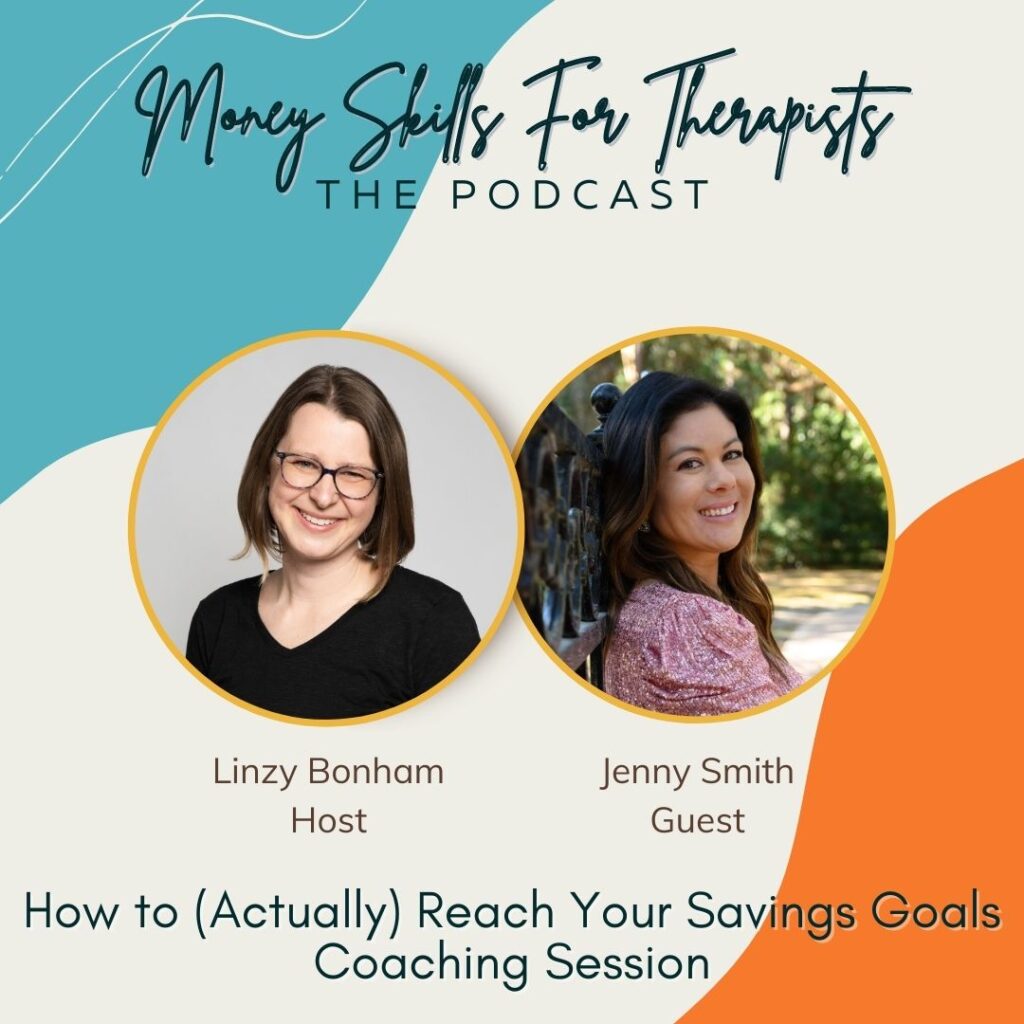
How to (Actually) Reach Your Savings Goals Coaching Session 

How to Reach Your Savings Goals Coaching Session
Header for podcast website

How To (Actually) Reach Your Savings Goals Coaching Session

How to Reach Your Savings Goals Coaching Session

“[I’m noticing that] $8,000 just seems better. I just felt more relaxed just hearing that number. It just seems so much more attainable. Sometimes when I set these goals, I just feel like, ‘this is not possible.’ And the self-doubt starts.”

~Jenny Smith

Meet Jenny Smith

Jenny started her private practice after the pandemic, and it has been the best decision in her career. She has always struggled living paycheck to paycheck and wants to do it differently now. Reduce the scarcity mindset and feel calm and confident in her business finances. Since she is going into year 3, she thought, what better time to do this! 

In This Episode…

How much do you actually need to save for business expenses and an emergency fund? Once you know those numbers, how do you set yourself up to effectively save that money? In today’s coaching session, Linzy and guest Jenny Smith dig into specific numbers that would work best for Jenny’s financial needs, and they come up with a plan to attain that goal.

Linzy and Jenny take a realistic look at what Jenny really needs when it comes to emergency funds, and looking critically at those numbers helps Jenny set attainable savings goals that, when paired with effective strategies, will help her reach her goals. 

Want to work with Linzy?

Are you a Solo Private Practice Owner?

I made this course just for you: Money Skills for Therapists. My signature course has been carefully designed to take therapists from money confusion, shame, and uncertainty – to calm and confidence. In this course I give you everything you need to create financial peace of mind as a therapist in solo private practice.

Want to learn more? Click here to register for my free masterclass, “The 4 Step Framework to Get Your Business Finances Totally in Order.

This masterclass is your way to get a feel for my approach, learn exactly what I teach inside Money Skills for Therapists, and get your invite to join us in the course.

Are you a Group Practice Owner?

Join the waitlist for Money Skills for Group Practice Owners.This course takes you from feeling like an overworked, stressed and underpaid group practice owner, to being the confident and empowered financial leader of your group practice.

Want to learn more? Click here to learn more and join the waitlist for Money Skills for Group Practice Owners. The next cohort starts in January 2026.

Episode Transcript

Linzy [00:00:04] What are you noticing with this? What comes up? 

Jenny [00:00:06] Well, 8000- just seeing- I just felt more relaxed just hearing that number. It just seems so much more attainable. Like sometimes when I set these goals, I just, you know, kind of feel like this is just not possible. And the self-doubt and. 

Linzy [00:00:28] Welcome to the Money Skills For Therapists podcast, where we answer this question: How can therapists and health practitioners go from money shame and confusion, to feeling calm and confident about their finances and get money really working for them in both their private practice and their lives? I’m your host Linzy Bonham therapist turned money coach and creator of the course Money Skills For Therapists. Hello and welcome back to the podcast. So today’s episode is with Jenny Smith. Jenny is a therapist. She’s currently a student in Money Skills For Therapists. And in our conversation today, Jenny and I get into savings. She has savings goals. She’s always struggled with savings, though. How much to save, how to save, how to actually, like, keep money out of reach so that she doesn’t steal from herself. And so Jenny and I dug in today, starting with the topic of an emergency fund or a buffer. Looking at those numbers and then how to actually make it so that she can see herself and be integrity with her goal of saving and not steal from herself. So if you find that you struggle with saving, either putting money aside or actually leaving that money alone so it can be left for the actual purpose, the savings purpose that you have determined for it, then you’re going to get a lot out of this conversation today. Here is my coaching episode with Jenny Smith. So, Jenny, welcome to the podcast. 

Jenny [00:02:10] Yes, thank you. Thank you. I’m so happy to be here. 

Linzy [00:02:13] Yeah. So, Jenny, you are in Money Skills For Therapists right now and you’re like a few months in at this point. 

Jenny [00:02:22] Yes. 

Linzy [00:02:23] So we’ve had some coaching conversations already in our work together in the course. What have you brought today that you want us to dig into together on the podcast? 

Jenny [00:02:33] Well, I’m, I have some goals, and one of them is for my savings and to save the 3 to 6 month buffer. And I’m just it’s been really challenging for me to do so. And, and so that’s been a really big struggle for me, even probably before I came into the into the group. 

Linzy [00:02:52] Sure. Okay. Okay. And that 3 to 6 month buffer – to help me understand – is that like your buffer in your business for operating expenses, is that like an emergency fund for your personal life? What is that money for? 

Jenny [00:03:05] Well, you know, I have separated my business and personal. So really, I would like to have a buffer for my business and then also doing it for my personal. 

Linzy [00:03:14] Okay. Right. So those both sides you want to see. Okay. And so in your business, then, would we be talking about just saving operating expenses, like money to keep the business running because you’re going to have personal money saved in your personal accounts for like paying for your life. Okay, Awesome. Great. Okay, So that’s 3 to 6 months. First of all, let’s talk about that goal. You’ve got a range there of 3 to 6. Tell me, like, where does that range come from or like, what number do you want to land on in that range so we can make it like a really specific goal? 

Jenny [00:03:44] Yes, I was thinking probably about 10,000 would be a good a great little buffer. I’m kind of seeing my operating expenses around 2000 – 3000 depending on if I do training or or have to pay for dues and so forth yearly or or. 

Linzy [00:04:01] Okay so, your monthly operating expenses is 2000 to 3000. And for folks listening. Operating expenses is the money that we spend to run our business as Jenny’s saying, like, trainings, rent, software, the things that you know, we’re not talking about Jenny’s paycheck or taxes, we’re just talking about the money to keep the business running, keep the machine running each month. So $2000 to $3000 is your monthly. And so you’re thinking 10,000. So I could see like 10,000. Yeah. Like if you’re spending 3000, that’s like three and a half months buffer. If you’re spending 2000, it’s like five months buffer. With that, Jenny, like this is about kind of your your personal risk tolerance. What is it, about $10,000 that feels like the right amount for you for that goal? 

Jenny [00:04:41] Well, you know, 10,000 is a good amount. If there was an emergency, I could always use for the business or, you know, or if I get into, you know, a medical accident or condition, I’m able to take some time out and still have the business running efficiently. 

Linzy [00:04:58] And with this, like something I would want to reflect to you is that if you’re not working, your business expenses will also go down. 

Jenny [00:05:06] Correct. That’s true. 

Linzy [00:05:07] Right. So like, if it’s like I don’t know if you like, I don’t know. You’re laid up in bed because I don’t know. You have an accident or a surgery that takes a long recovery time. You’re not gonna be taking new trainings at that time, but you might still be paying on payment plan if you’ve signed up for other trainings. So that’s also just things to think about as we’re thinking about this number is, you know, at that point your business would be kind of just like you just be maintaining the minimums or if it’s actually something that’s more like a six month break, you probably would actually just shut a lot of stuff down. 

Jenny [00:05:35] Right. Right. 

Linzy [00:05:37] You wouldn’t keep paying for EHR if you’re not seeing clients, you would put it into like a dormant state and reactivate it. Yeah. So thinking about that, I’m curious, like if we think about your base business expenses, how much would that number be? We want a safe number, but I wonder if there’s a lower number there that would actually cover just kind of like covering your subscriptions for a month while you go away on vacation or for a couple of months if you break your leg? 

Jenny [00:06:03] Yes, I would say probably less than a thousand. 

Linzy [00:06:06] Okay. Okay. Because that’s kind of like your floor business expenses, your operating expenses. 

Jenny [00:06:10] Yeah, maybe 5 to 500 to 1000. 

Linzy [00:06:13] Okay. So a lot lower than that 2000 to 3000? 

Jenny [00:06:16] Yes. 

Linzy [00:06:17] Okay. What do you notice when I. When I say that, pointing out like the that lower number, that’s possible. 

Jenny [00:06:23] It makes it more doable. I guess. That makes me feel like it is more doable. 

Linzy [00:06:27] Yes. Because 10,000 like that is an ambitious goal to save in the business for your business, as I understand it. Your business being like a sole proprietorship where it’s just you. Right. And like, it sounds like most of the spending that you would do would be on professional development, But you’re not going to be doing if you’re not able to work. So if we actually had the floor at like $5000 to $10000. How many- how much time do you want to be saving for? Is it three months? Is it six months? 

Jenny [00:06:52] I would probably say six months. 

Linzy [00:06:54] Okay. And why six months? 

Jenny [00:06:56] Well, I guess emergency. You know, since I am the primary breadwinner of the family, I would probably like to save six months just to have a bigger buffer if something happens. 

Linzy [00:07:08] Okay. So with that, what do you think about the idea of saving for six months at home but saving for less time in your business? Because as I say, if if there is actually something that happens that you’re like, oh, my gosh, this crisis is happening in our life, I’m not going to work for six months, you’re just going to shut things down. 

Jenny [00:07:26] Right. 

Linzy [00:07:27] Right. Maybe you’d have to pay like a subscription or two, like a payment plan. But mostly you would just go dormant in your business. And it sounds like where you could actually use the money, since you’re the main breadwinner, would be at home, right? 

Jenny [00:07:38] That’s true. Yeah. 

Linzy [00:07:40] What do you notice, like thinking about that of kind of making the priority more about having that six months at home, but maybe only having two or three months for the business? Maybe taking some number between this low floor OpEx amount we talked about and this like higher amount. 

Jenny [00:07:55] That sounds a lot better actually, and it makes a lot more sense. Okay. 

Linzy [00:07:59] Yeah. Okay. So six months, we’re gonna talk about that as your home goal. But in the business, if you know your base expenses are somewhere between 500 and a thousand and your top end expenses are 3000. What if we say it’s like 1500 a month is kind of like your average safe number. So three months would be $4500. 

Jenny [00:08:17] Mm hmm. 

Linzy [00:08:17] How does that number land with you? 

Jenny [00:08:19] That feels a lot better. Yes. 

Linzy [00:08:21] Okay, good, good. I’m noticing, like, some relief or relaxation that’s just happened. 

Jenny [00:08:27] Absolutely. Yes. 

Linzy [00:08:28] And I am curious, Jenny, with that. Like, what do you notice is different for you about thinking about the 4500 as a goal in the business rather than 10,000? 

Jenny [00:08:37] Well, it seems to be more attainable for me. It doesn’t seem it’s such a far stretch like you know, it kind of makes you feel like you’re unmotivated to get to ten. You know, that’s like you can’t really even get there. 

Linzy [00:08:48] Yeah. And what I’m noticing with ten is like ten is a really large goal for being in solo practice, but it’s also an unnecessary goal because there wouldn’t really be a scenario where you would actually need a full ten because if something is really that serious, you would be cutting down and reducing expenses. Yeah, so we don’t need to make you save for something that’s difficult and also unnecessary. 

Jenny [00:09:08] Yes. Yes. 

Linzy [00:09:09] Whereas the money could be necessary at home. Okay, good. You’re smiling. So that tells me we’re going in the right direction. So. 

Jenny [00:09:14] Yes, we are. 

Linzy [00:09:15] Okay. So that would be a goal for the business. Now, a goal for home. Again, we want to think about the fact that if something happens in your home that you can’t earn, you’re probably also going to adjust some of your expenses, right? Like probably not going to be living the high life right. While also having some sort of like medical or family emergency. 

Jenny [00:09:34] That’s true. 

Linzy [00:09:35] Right. So thinking about that, what would be a monthly number that you would want to see set aside given your role in your family’s finances that would cover an emergency, a monthly number? Let’s start with a monthly number. 

Jenny [00:09:47] Yeah, I would say maybe around three thousand, you know, maybe to 2500 if I’m really pinching. 

Linzy [00:09:54] Yes. 

Jenny [00:09:55] With meals and everything. Right. Everything. 

Linzy [00:09:58] Okay. Okay. So maybe let’s not go that low. Let’s go 3000 then. And so $3,000 for six months would be a goal of $18,000. 

Jenny [00:10:09] Yes. 

Linzy [00:10:10] Okay. What do you notice with that number? 

Jenny [00:10:12] That’s a lot. Yeah. 

Linzy [00:10:14] That was a bit of. Ooh, yeah. Okay. Yes. But now we have two real numbers. Aim for one for your business, one for home. 

Jenny [00:10:21] Mm hmm. 

Linzy [00:10:21] Okay, so now let’s think about how to actually make these things happen. So tell me, like, what has been your relationship with savings so far? 

Jenny [00:10:31] So far, it’s been a very difficult role. I don’t think I have ever really been a great saver. If I have it, I’ll spend it. And so that’s been challenging to just be able to save. And if I do have it in savings, sometimes I’ll go and use it for something else. 

Linzy [00:10:48] Okay. Right. So there’s even like stealing from yourself when you have put it into savings. Yes. Okay. So right now in your business, you are- you’ve set up profit first. Do you have this as part of your profit first yet like an OpEx- right now, let’s think about the OpEx part of it and operating expense emergency funds. Is that part of some of the calculations you’re doing so far? 

Jenny [00:11:11] It is. It’s just not really consistent, I guess. 

Linzy [00:11:16] Okay. And tell me about that lack of consistency. 

Jenny [00:11:19] Well, one is due to each month fluctuating and since December, you know, kind of went into a little bit of a slump. So I’m trying to get back up to it. 

Linzy [00:11:29] Okay. Yeah. And when you have those lower numbers, what do you end up kind of doing in those months with your numbers, with you’re dividing up? 

Jenny [00:11:38] Well, really, it’s mostly going to either salary or, you know, taxes or the operating expenses and not nothing to the savings or, you know. Right. 

Linzy [00:11:49] Okay. So these ones get kind of deprioritized when money’s a little bit lower. Okay. Yes. And with that, like our you know, I’m picturing in my mind your profit first calculator, which obviously folks can’t see on the podcast, but we do have a calculator in the course that I know that you have where you know, you put in the money that you’ve made that month and then it tells you how to divide it between the different categories that you’ve determined. What is the paycheck amount that you want to see that you’re like prioritizing when money is lower, what is that paycheck that you send home? 

Jenny [00:12:19] Well, it would be nice to be about 4000, but three three, you know, would be a good start. Yeah, at least. 

Linzy [00:12:28] Okay, so 4000, but 3000 is like doable, but 4000 is what you actually want, right? 

Jenny [00:12:33] Just because I have some other you know, I want to save up for a new car, you know, I want to put some in vacation. 

Linzy [00:12:39] Rights. 

Jenny [00:12:40] You know, so I can fill that up a little bit. Yeah. Okay. 

Linzy [00:12:44] So there’s those goals at home, too, that you’re trying to fund in addition to the ones we’re talking about here. So with this then, Jenny, tell me, what have been like the numbers that you’ve been seeing that have meant that you had to move things around? Because I know for a while you were above ten every month. 

Jenny [00:13:01] Yes. 

Linzy [00:13:02] And so $10,000, I should say, to people, $10,000 revenue, you were above that. And now that’s shifted, right? 

Jenny [00:13:08] It has shifted even down to like 6800 a month, you know, maybe seven a month. And so I’ve even used the profit first calculator and done it like for weekly. 

Linzy [00:13:20] Okay. 

Jenny [00:13:20] Yeah. Gone down to weekly, which sometimes it’s like 1700 a week or something. Yeah. 

Linzy [00:13:25] Okay. Yeah. Yeah. And doing those disbursements weekly is a good idea to actually move the money around weekly just as part of your money time flow. But okay, so you’ve brought it down to 7000 and what’s the percentage that you have set aside for paycheck in your calculator? 

Jenny [00:13:39] In the calculator it is 45%. But then I have a salary too, which is the retirement, saving up for college, and you know, vacation, car – in savings, which is 17%. 

Linzy [00:13:51] Okay. Right. You have that big goals fund. So something I’m noticing is you have a lot of savings goals. 

Jenny [00:13:57] Yes. 

Linzy [00:13:57] Which is great. But I can see how it’s stretching the dollars in different directions. 

Jenny [00:14:02] Yes. 

Linzy [00:14:02] Right. 

Jenny [00:14:03] Okay. 

Linzy [00:14:03] Yeah, because I’m sitting here. Okay. So at 6800, 45%, your paycheck would be like 3060. So it just gets you that low amount. When you had those 6800 dollar months. 7000 at 45% would be a take home paycheck of 3150. So still on that lower end of what you want to see. So we’ve got that 17% and tell me about that 17%. Again, what are those goals for retirement? 

Jenny [00:14:29] Yeah, I have a college fund for my son. Yeah. Vacation eventually. Want to get a new car. I would love to pay cash for the car. That’s a big goal of mine just to be able to do that. Yeah, that’s great. And then also now for the $18,000 I need in savings, right? 

Linzy [00:14:47] Yes. And this emergency fund. Okay. So what I’m hearing then is you have a lot of goals. We’ve got these emergency funds, we’ve got these, you know, retirement. That’s a very important goal. We don’t want to forget about that one. College fund, vacation, new car, all of these things. And then also at the same time, sometimes you struggle with saving and end up taking money out of savings. At least historically that has happened. 

Jenny [00:15:10] Yes. 

Linzy [00:15:10] Okay. There’s two pieces to this here. The first one that I want to think about is priorities. You know, priority. Like Jesse, the founder of YNAB, has an article that I like about budgeting with children. You’re a parent, you have a son. I also have a son, similar ages. And he talks about when you teach kids about budgeting and you you know, his suggestion is like you- every time they see a toy that they like, you add it to their budgeting list and then when they get allowance, you say, okay, is this going towards the Lego? Is this going towards that dragon action figure? Is it going towards this? Kids are very good at picking one thing. They understand what a priority is. A priority is one thing. As adults, we never use the word priority. We use priorities. And then we list five things because we’re trying to balance all these things at the same time. And that’s really what I’m feeling from you here, right, is like this money is being pulled in all these directions because all of these things are important. So I’m going to ask you, which of these things is your number one most important? 

Jenny [00:16:07] Well, I think right now, obviously, retirement and savings would be probably the savings and. 

Linzy [00:16:13] Savings for what? 

Jenny [00:16:15] Emergency.  

Linzy [00:16:17] Okay. So your emergency fund. Okay. So retirement is up there. An emergency fund is number two. Okay. And your retirement goal, how much do you like to see going away for retirement, you know, each month?

Jenny [00:16:28] I would like to do 500. My max I can put in is like 6000 a year. So that kind of. 

Linzy [00:16:34] Okay so that hits your- beautiful. Okay. So that’s very clear and simple. 500 a month. Great. Which still gives us quite a bit to work with. So that emergency fund. Jenny, how important is it for you and also think about your life circumstances and any kind of like illness or family stuff that might be swirling about? When do you actually want to see your family have an $18,000 emergency fund? 

Jenny [00:16:57] I would like to have that as a goal this year if possible. 

Linzy [00:17:01] By the end of this year. 

Jenny [00:17:02] Yeah. 

Linzy [00:17:03] And right now, do you have any money towards that goal or are we starting at zero? 

Jenny [00:17:08] I have like about 800. 

Linzy [00:17:12] And tell me, why do you want to have it by the end of the year? 

Jenny [00:17:14] Well, one of it- just to kind of cross that off my list of things that are on that I need to do, you know, kind of is done. And so it’s financially okay. 

Linzy [00:17:25] Yeah, yeah, yeah, yeah. It feels good to like, got that, you know, pat yourself on the back. Because the other things here, like your college fund for your son. Is there a certain annual payment that you want to make or need to make in terms of those investment rules? 

Jenny [00:17:42] Yes. It’s about 169 a month. 

Linzy [00:17:45] Okay. Okay. So not very much. 

Jenny [00:17:46] Yeah, that’s a little bit more doable. Obviously, my goal is to be able to put even like a thousand a month or something to get that paid off sooner than the time. But. Yeah. 

Linzy [00:17:57] Okay. Yes. Yeah, yeah. And that would definitely be very nice. But 169 is your obligation. 

Jenny [00:18:02] Yes. 

Linzy [00:18:02] And then the new car. Do you see yourself needing a new car in cash this year or is that more like in the next four years? Five years? 

Jenny [00:18:09] I would say like three years. 

Linzy [00:18:11] Okay. Three years in the road. Great. And then what about vacation. 

Jenny [00:18:15] That I would like to maybe do one or two this year would be great. 

Linzy [00:18:20] And how much do you want to see for that vacation fund? 

Jenny [00:18:23] Maybe around. Maybe 4000 total for the year. 

Linzy [00:18:27] So 4000 total would be if we’re looking at the rest of the year, I’m going to divide it by ten. That’s like $400 a month. 

Jenny [00:18:34] Okay. 

Linzy [00:18:35] And just to give a sense of like you’re going back to your numbers again, like if we’re looking at 7000 months – and I think you can get your practice income up again, but we’re going to play with these super safe numbers just to be conservative. If you’re putting aside 17% towards these big goals, you’ve already got that built into your profit first calculator. That would be $1,190 a month that you’re working with. Okay. And if 500 is retirement, if 169 is college, because I know for our sons where, you know, I’m Canadian and you’re American, so different rules. But we do set aside that money because we make up we have to there’s a matching that happens so I know that that one is small but important. And then your new car I’m going to pause that for a second just to see what the numbers can do before that. 400 for vacations, and then emergency funds. You want to have the $18,000 by the end of the year. I’m going to run these numbers. So what I’ve done is I’ve just taken the 1190, which is kind of our very safe number for savings. I’m going to take out the 500 for retirement, the 169 for college, the 400 for that vacation fund. So it leaves 121 a month would go towards your emergency fund, which is lower than you want. 

Jenny [00:19:48] Mm hmm. 

Linzy [00:19:49] Now, if we’re curious, you have had $10,000 months before. 

Jenny [00:19:53] Yes, Right. 

Linzy [00:19:54] And, you know, practices ebb and flow and there’s always some things you can explore around your marketing and networking and all of that good stuff. If you have a $10,000 month, that 17% now becomes 1700 dollars. Mm hmm. And at 1700 dollars, if I take out the ones that we talked about here, that gives you 631 a month to put towards emergency fund. Mm hmm. So that gives you a lot more wiggle to start building up that fund. Now, that’s not going to get you to $18,000 by the end of the year, but it is going to build. And so this is something for you to think about is like really gut check with yourself. Of that pool of money that you are right now, that you’re earmarking for savings. And you could also look at your optics and see like, okay, can I bring down my OpEx a little to bring up savings a little? How would that feel? But if you saw it, divide it up in this way, how would that sit with your body? Would you feel like you’re on track or does it feel like you’re not making enough progress on those goals? I am curious to read you the numbers. 

Jenny [00:20:54] Yeah. 

Linzy [00:20:54] Okay. At a lower month, it would be $500 going towards retirement. Mm hmm. 169 Going towards your son’s college fund. Mm hmm. $400 towards vacations and $121 towards that emergency fund. 

Jenny [00:21:08] Mm hmm. 

Linzy [00:21:09] On a higher month, it could be $631 going towards an emergency fund. Okay. Now, in this, I will point out we have prioritized vacation over emergency fund. 

Jenny [00:21:18] Yeah. 

Linzy [00:21:18] So if you wanted to say, like, okay, vacation is important, but I’m going to do one trip instead of two and it’s going to be 2000. Right. Then that extra 200 could go towards the emergency fund instead. 

Jenny [00:21:27] Yeah. And get that going. 

Linzy [00:21:29] What are you noticing with these numbers? 

Jenny [00:21:31] Well, I don’t know. Part of me is like, well, maybe 18,000 for emergency is too, you know, unrealistic right now. I dont know.

Linzy [00:21:38] Yeah. Yeah. And what I would think about is, as a self-employed person, our circumstances are a little different, right? Because it’s like if you’re working for Twitter, for instance, if you were recently working for Twitter, your world got changed upside down when it was acquired by somebody and like all these people got laid off. You are more precarious when you work for somebody else. Working for yourself, unless you actually become like injured or some other way incapable of working at all, you are able to earn money quite quickly because you have a skill set where you get paid a high amount of money for like literally an hour of work. 

Jenny [00:22:14] Yes. 

Linzy [00:22:15] Right. Because we have this kind of like quality over quantity profession where it’s like in one hour we can like change someone’s life. Therefore, you have like high earning potential. So that six months may or may not actually be super important given your life circumstances at the moment. 

Jenny [00:22:31] Right. 

Linzy [00:22:31] Right. If there was like chronic illness on the horizon, if there’s like cancer scares or possibilities, like there’s going to be reasons that we might not be able to work, that would mean that six months is going to be a really important number. But right now, in the constellation of these other things that are important to you, I wonder if maybe a lower number for this year, but still a real number. But like, if you aim to get your emergency fund up to $8,000 this year, how that would feel to bring down that bar a little with the intention and the next year you can save another 8000 and then the year after that you can save another 8000 and you could have 24,000 three years from now, which chances are you’re never going to use all of that money. 

Jenny [00:23:09] Right. 

Linzy [00:23:10] Even if you have it, you might dip into it a little bit. It’s kind of worst case scenario money. 

Jenny [00:23:15] Yes. 

Linzy [00:23:16] Right, Right. What do you what are you noticing with this? What comes up? 

Jenny [00:23:19] Well, 8000- just seeing- I just felt more relaxed just hearing that number. 

Linzy [00:23:24] Yes. 

Jenny [00:23:25] It just seems so much more attainable, like sometimes that these goals, I just, you know, kind of feel like this is just not possible and the self doubt. 

Linzy [00:23:35] Yes. And $8,000. Like if we’re looking at, you know, if you can get your practice back up to the place that it has been, you know, and that it was in the fall, $8,000 divided by 631, you would be there in a year. Right. So in a year you could be at $8,000. If you have some higher months, that would go even higher if you deprioritize your vacation a little and plan to save 2000 instead of 4000, it would be much faster. Maybe it would be nine months or ten months instead of 12. So there’s like, you know, there’s variables here. But having that as a goal, what do you think the impact of that would be, having an $8,000 goal instead of 18,000? 

Jenny [00:24:10] Yes, I like that a lot better. I really do. It just seems so much more doable. Just like with a business. 

Linzy [00:24:18] Exactly. Yeah. Yes. And with that operating expense goal that we talked about, too, which we also brought down from 10000 to 4500, that’s something that you could look at saving inside your operating expense fund. So you could look at, you know, okay, every month in my fund, I actually have a line in my budget, which is my OpEx buffer goal. And every month I’m going to put away. Same thing.  Think about when do you actually want to hit that 4500. So if it’s like if we wanted to see that 4500 in a year, you would put away 375 a month that would get you there. If you want to make it a little bit longer, a little bit shorter, you can wiggle it. But like building that into your profit first budgeting is going to be a really powerful way, especially for the OpEx goal where you’re just like, keeping it in the business, right? Of making it happen. Okay, so now we have adjusted numbers. So now we’re onto the next piece, which is like actually making the savings happen and not stealing from yourself. 

Jenny [00:25:06] Right. 

Linzy [00:25:07] Right. Because numbers, numbers can be beautiful, but if they don’t end up doing the job that we want them to do because we end up using them for something else, then they’re not serving us in the way we intended. So with these numbers, I mean, we can think about each of these goals individually or you can think about them all together. Knowing yourself, what do you need to do with this money to make it actually stick around and actually be available for the goals it’s intended for, rather than getting used on a month where money’s a little bit tighter. A shiny object that comes along. 

Jenny [00:25:37] I mean, make it where it’s not accessible. 

Linzy [00:25:40] Mm hmm. Mm hmm. Out of reach. 

Jenny [00:25:42] Yeah. 

Linzy [00:25:42] Do you have somewhere like that right now? Do you have a bank account that’s out of reach? 

Jenny [00:25:47] Well, I do have an extra one for my business, but I have different savings accounts lined up just for my different expenses. So I can maybe make one of those, like, savings accounts difficult to get into or something. 

Linzy [00:26:03] Yeah, Like, I mean, when we have the tendency to steal from ourselves. And it talks about this in profit first, it’s like, put it far away, Make it hard. Right. Like if you know, you have a piece like a part of yourself that is prone to thievery or prone to scarcity and therefore grabs the money because you feel like you need it somewhere else. Hmm. You need to set up, you know, the saying, Jenny, is like, create systems that are smarter than you are. 

Jenny [00:26:27] Yeah. 

Linzy [00:26:27] Right. We all have our own kind of like, things that challenge us, or our own flaws or areas that we’re working on. And so it’s like build a system that is going to make it hard for you to do the thing that you’re trying not to do. And so having a totally separate bank, a bank where you cannot make an easy transfer. 

Jenny [00:26:43] Right. Right. 

Linzy [00:26:44] There’s a lot of sucky banks in the United States. Find a sucky bank. Where it’s very hard to get the money out. Where they make it difficult. Because you want it to be difficult. 

Jenny [00:26:53] Right. 

Linzy [00:26:53] Yeah. Right. We want this money. We want the vacation money to be there when it’s time for your vacation. Right. And your retirement money. Could you just directly send that to your investments fund? 

Jenny [00:27:03] Yeah, I could. I usually just save it and do it at one bulk, but I could. Yeah. 

Linzy [00:27:08] Yeah. And with that, you could look at doing an automatic transfer if it’s going to be 500 a month. Like if that’s the number that it’s going to be. From your business account, you can set an automatic transfer. An automatic bill payment is I know how we do it in Canada. I don’t know how your bank specifically will talk to each other, but, like, get it out of your account every month and, like, into that retirement fund. And then you can always, like, invest. If you have to invest that money in a second step, you can do that later. But just like get it where it’s supposed to be basically as soon as the money’s ready to go. 

Jenny [00:27:37] Okay. Yes. 

Linzy [00:27:38] So that might be like an end of the month transfer. Like the 26th of every month, $500 gets sent to your retirement because, like, automation is a great thing. You know, it takes- we don’t have to actually make the decision. There’s an opportunity for another part of you that’s like, Oh, but we could really use the money somewhere else, or It’s a bad month and we should just keep it in the business. We know there’s parts like that in the mix, so we want to remove the opportunity for them to kind of interfere with our bigger plans. 

Jenny [00:28:01] Yes. Okay. Yeah, I can definitely do that. 

Linzy [00:28:04] And same with the college prepaid. Does that already automatically going out? I think I’ve seen that in your books before. Or does that sit around too? 

Jenny [00:28:10] Yeah, it goes out every month. 

Linzy [00:28:12] Okay, so that’s already. So same thing. You can automate that if it’s not already. A vacation fund. Think about where to put that. Does that need to be at a separate institution? And then emergency fund. Maybe it’s your vacation fund and emergency fund live in two different bank accounts. Yeah, in some bank that is out of sight, out of mind? 

Jenny [00:28:30] Yes. Okay. 

Linzy [00:28:31] That’s what we want. How does that feel for you? 

Jenny [00:28:34] It feels a lot more doable, for sure. Just having this conversation. Yes. 

Linzy [00:28:38] Yes. Like your numbers. Your numbers are good, right? And we know that your numbers have been even better at different points in time. So it’s just building out this system so that what you want is automated and that happens automatically. And that’s the default rather than what has been your behavioral default, which is maybe scarcity or taking. We don’t want that. So we want to make it super easy for the thing you actually want to have happen. Happen. 

Jenny [00:29:02] Yes. Yes. That sounds doable. 

Linzy [00:29:05] Awesome. So, Jenny, coming into the end of our time, what are you taking away from our conversation today? 

Jenny [00:29:10] Well, I just feel a lot more, you know, motivated and feeling like this is possible and more calm about the situation rather than scarcity or anxiety, right? 

Linzy [00:29:22] Yes. Yeah. So I would encourage you, if you have 20 minutes after our time together, just like put this stuff in place. 

Jenny [00:29:28] Yes, I will. 

Linzy [00:29:28] Make it happen. And yeah, I’m excited for you. I’ve said this to you many times in the course, but like I see your growth and I also like, see your potential with, like, the earnings that you’ve built up, the practice that you’ve built, your ability to hold all these goals. So it’s just like building out these systems. You are, you are on a very good path. 

Jenny [00:29:45] Okay. Well, thank you so much. Yes. 

Linzy [00:29:48] You’re welcome. Thanks, Jenny. 

Jenny [00:29:49] Thank you. 

Linzy [00:30:03] In my conversation with Jenny. You know, something that I noticed at the beginning, and I think this is so common when we have stress and perfectionism and scarcity around money is the goals that she had set were just way higher than she needed. There could be scenarios where, you know, we do need to have a six month buffer right away. You know, if we have a parent who’s in failing health and we know that we want to stop and like take a caregiver leave to be with them, or if we’re having a serious health scare, you know, there are scenarios where we might eventually need to have six months of money. But in Jenny’s case, at this time, compared to her other goals, those initial numbers that she set, first of like her operating expense buffer in the business, once we talked about that, it didn’t need to be 10,000. It only needs to be 4500. And that emergency fund for home, rather than being 18,000, you know, we settled on 8000. Having that as a goal by the end of the year, releasing these ideas that, you know, creating stability needs to be by hitting like these high numbers, like doing it right – and putting this in quotations – often just sets us up to feel like we’re failing because we set goals that are so hard but also unnecessary. Right. So once Jenny actually identified realistically what she actually needs to achieve this year, she could align those emergency fund goals next to the other things that are important to her in her life now and her retirement and her son’s college fund and vacation and have a much more kind of balanced approach to saving. And then, of course, that piece of putting it out of reach using automation will mean that Jenny has a system that will work against her tendency to take that money and will allow her to have the money go where it actually needs to go and have that vacation money, for instance, actually be available when she wants to go on a vacation. So such a lovely conversation today with Jenny. If you want to follow me on Instagram, you can find me @moneynutsandbolts. We share emotional and practical money content on there all the time as well. As I’ve mentioned, some reels working on reels and if you are enjoying the podcast, please leave me review on Apple podcast. It takes literally 2 minutes if you have an Apple account. I actually tried to do it the other day at an Apple account that didn’t work. But if you have an Apple account, if you could take 2 minutes to let me review, it’s super helpful and is the best way for other therapists to find us. Thanks for listening today. 

Picture of Hi, I'm Linzy

Hi, I'm Linzy

I’m a therapist in private practice, and a the creator of Money Skills for Therapists. I help therapists and health practitioners in private practice feel calm and in control of their finances.

Latest Episodes

Overcoming the Fear of Discussing Money with Clients Episode Cover Image

How can you make sure that the professional development courses you’re choosing actually align with your bigger goals? In this Feelings and Finances episode, Linzy answers a question from Stef, a current Money Skills for Therapists student, who is struggling to navigate the flood of course offerings that all seem exciting but might not be the best use of her time or money. Stef shares how she’s been struggling with whether each course is a strategic investment or just another shiny opportunity.

Listen to this episode »
Building Confidence to Leave Your Job for Private Practice Coaching Session Episode Cover Image

How do you balance serving your community with the financial realities of running a group practice? In this coaching episode, Linzy sits down with Anastasia Canfield, owner of Creative Remedies, a multidisciplinary practice supporting neurodivergent, queer, and BIPOC clients through expressive arts therapies. Anastasia shares the challenge of staying true to her mission of serving marginalized communities while ensuring she can offer fair wages and benefits to her team.

Listen to this episode »
Navigating Taxes and Ethics in Your Private Practice Episode Cover Image

How do you stay aligned with your values when your taxes fund things you don’t believe in? In this Feelings and Finances episode, Linzy responds to a question from Lessey, a therapist grappling with the ethical dilemma of paying taxes that support government practices and systems she finds morally troubling. Lessey is exploring whether it’s possible to feel at peace with paying taxes in a system that doesn’t align with her values, and whether there’s anything she can do about it.

Listen to this episode »

© Copyright 2022 | Money Nuts & Bolts Consulting Inc. | All Rights Reserved

Tax Time Tips and Self-Care

Tax Time Tips and Self-Care
Header for podcast website

Tax Time Tips and Self-Care

Tax Time Tips and Self-Care

“If you notice that you’re starting to make your tax plans, and you’re thinking, ‘Well, I didn’t do it all year, so now I’m just going to have to make it happen and push through…’ If you’re noticing any kind of propensity towards making this a painful punishment, I’m going to ask you to stop and think about how this could look different for you this year.”

~Linzy Bonham

In This Episode…

Does the tax season fill you with dread? Rather than being unkind to yourself for the things you didn’t do the way you thought you should this year, listen in to these tips and action items that Linzy shares.

Take steps today to make this tax season more manageable. Check out this solo episode where your host Linzy talks with us directly about things we can do to manage our taxes as therapists in private practice, and reduce the stress that comes with tax time.

Want to work with Linzy?

Are you a Solo Private Practice Owner?

I made this course just for you: Money Skills for Therapists. My signature course has been carefully designed to take therapists from money confusion, shame, and uncertainty – to calm and confidence. In this course I give you everything you need to create financial peace of mind as a therapist in solo private practice.

Want to learn more? Click here to register for my free masterclass, “The 4 Step Framework to Get Your Business Finances Totally in Order.

This masterclass is your way to get a feel for my approach, learn exactly what I teach inside Money Skills for Therapists, and get your invite to join us in the course.

Are you a Group Practice Owner?

Join the waitlist for Money Skills for Group Practice Owners.This course takes you from feeling like an overworked, stressed and underpaid group practice owner, to being the confident and empowered financial leader of your group practice.

Want to learn more? Click here to learn more and join the waitlist for Money Skills for Group Practice Owners. The next cohort starts in January 2026.

Episode Transcript

Linzy [00:00:03] If you notice that you’re even starting to make your tax plans of like, Well, I didn’t do it all year, so now I’m just going to have to like, make it happen and push through. And if you’re noticing any kind of propensity towards making this a painful punishment, I’m going to ask you to stop and think about how this could look different for you this year.

Welcome to the Money Skills For Therapists podcast, where we answer this question: How can therapists and health practitioners go from money shame and confusion, to feeling calm and confident about their finances and get money really working for them in both their private practice and their lives? I’m your host Linzy Bonham therapist turned money coach and creator of the course Money Skills For Therapists.

Hello and welcome back to the Money Skills For Therapists podcast. Today we have something a little bit different. Today I’m doing a solo episode. You may have picked up on the fact that I really like talking to other people and I always love being able to have peers and colleagues of mine and people who have done significant work around their own relationships with money or who are helping us work with money in different facets of our business. I love the opportunity to connect with those folks and bring them on the podcast. There’s nothing like a good conversation in my books.

But today I want to dig in to a topic that is very much just like I just want to impart to you some information that will hopefully make your life easier, if this is a problem that you have, and this is how to make tax time bearable, comfortable. Okay, maybe even kind of nice. I don’t know if I can go that far, but I want to talk to you about tax time prep because we are coming into that time of year and the time that I’m recording this, end of February, we’re going to be sharing this episode in March. It’s like taxes are in the air. There’s that swirl coming around.

I know in Canada we need to get our, you know, documentation is due at the end of this month. If you’ve had employees, you need to get all your stuff out to employees. We are definitely like getting into tax season for most of us. If you are a sole proprietor, you’re going to be filing your taxes. Your year-end would have been the end of December. So we are coming into that tax season where taxes are due in April. And this is a time of year that is just rife with opportunity for pain and headache and negative stories about ourselves. And I’m also about to argue our self-punishing behaviors.

So let’s talk about how to actually make tax time work for you. First, we want to talk about the mindset. If you’ve attended my Saving Enough for Taxes workshop, which is an adjacent topic but different than we’re talking about today. If you’ve attended that workshop or if you have done Money Skills For Therapists, you know that I start with mindset – and my vacation workshop too. We always start with mindset and the reason for that is so much of what is difficult about money is the stories that we tell ourselves and that emotional relationship that we have with it that really sets up and informs how all of our tasks go. If you tell yourself that getting ready for taxes is tedious and stupid, or if it’s evidence of how you failed as a business owner or you don’t know what you’re doing, you are obviously creating conditions in which you’re going to feel really shitty, more or less. So the very first thing I want to talk about is don’t make tax season a punishment for yourself.

Something that I’ve noticed is when therapists and health practitioners, when we have avoided taxes throughout the year, when we haven’t been doing that kind of tracking work as we go that we know we’re “supposed” to do. I’m putting that in quotations, but it is actually very helpful to track as you go. When we haven’t done that work as we go, we end up with this mountain of work, or at least a small, unpleasant hill of work to do. And the tendency that I see is that therapists turn this into a punishment for themselves. They make themselves do it on the weekends. They make it like for a whole day they have to just like, compile all their tax stuff.

Sometimes I’ve heard of people like closing themselves in a room, so it’s just like this intense, unpleasant experience of basically what you are doing is you’re doing a whole year of financial work in like one or two days, which sucks. Even if I did that, that would suck. I would not have fun with that because I just don’t think the human mind, it’s not really built for us to do that kind of task for that long.

So if you notice that you’re even starting to make your tax plans of like, Well, I didn’t do it all year, so now I’m just going to have to like, make it happen and push through. And if you’re noticing any kind of propensity towards making this a painful punishment, I’m going to ask you to stop and think about how this could look different for you this year. What do you need for it to not be a punishment? How can this just be a normal, neutral part of your business? Taxes are just what happens when we have a business that is successful.

If you have a business that is generating money and then is giving you an income that you’re going need to pay income tax on, taxes are just part of that, right? It is a normal part of doing business. And if we can start to think about how to bring that more into a neutral space, you don’t have to love it. But if you can bring it to a more of a neutral space, there’s going to be a big shift in what this looks like.

So if we want to talk practically about that piece of not punishing yourself, part of it is just like, okay, this part of my business, maybe I didn’t take as much care of as I wanted, and there’s more tasks than I need to. Or, you know, if you have taken care of it. They’re still going to be kind of a little pile of tasks that need to be done. How can you spread it out so that it’s just another task on your to-do list that you work at little by little, rather than making this big, terrible mountain task?

You have time right now. If you’re listening to this podcast at the time that it comes out, you have at least a few weeks to compile this stuff together. At least two weeks. So is it that you work on it half an hour on Monday, an hour on Wednesday and an hour on Friday. You know, for a couple of weeks. Is it that you work on it in the evening? We’re going to get into more of these details later. But just start to think about how do you just make it this neutral, rather than a burden or a punishment or setting it up as something that, again, invites all those parts of you that have negative things to say, to just go nuts and have their say, making it neutral.

The next piece is a practical piece, and this is: create a central spot for all your tax-related stuff for your business to go. You’re going to have one physical spot and one digital spot. So I noticed this time of year, you start to get receipts being emailed to you from like charitable donations that you’ve made. I got a receipt the other day from the Globe and Mail newspaper, which is a national newspaper here in Canada. Apparently, I got a tax credit for having a newspaper subscription. So in my email inbox, for example, I have a tag that I’ve created called Taxes. So I also have a receipt tag where I tend to tag all my receipts.

But now when I’m getting things that I know are specifically for tax time, like that end-of-year charitable receipt or this newspaper tax credit receipt, which I was not expecting, I just put the taxes tag on those. So when I go to put together my tax information, I have now put it in the right spot as I went along, little by little. And so it was all going to be there. When I do that search for that tag in my Gmail, there’s all my taxes stuff in one place. I don’t have to go searching and be like, Wait, did these people send me a receipt? Do these people send me a receipt? It’s all together already.

Same goes with your home when mail comes in the door. I mean, this is a great habit to have in general. If mail tends to go missing in your house. My partner and I just created a mail drop spot in our house. Have a spot where tax-related stuff can go, right? Maybe you have a mail spot as the first step, but as soon as you open that and you realize it’s a tax thing, having a folder that’s out somewhere visible that just says taxes, where any W-2s or T forms that come in, whether you’re American or Canadian, any kind of receipts that are being mailed to you, again, like charitable stuff, any investment income that you’ve had, you’re going to get a receipt from that from your bank or your investment platform. Just put them all together again.

What we’re doing here is we’re taking something that could become this huge, painful mountain. If we ignore it, ignore it, ignore it, and then just like dive headfirst into it. If we pay attention to it a little bit as we go and just make that habit of putting the things where we need to find them, when it’s time to find them, then you’re breaking up the work and you’re making it small, little easy micro tasks rather than this big pile of tasks that you’re going to have to do all at the same time. That’s going to be very painful.

Now let’s talk about what you actually need for taxes. This is not going to be an exhaustive list because it’s going to be very specific to you and your family composition and what credits you are eligible for. But let’s talk about the business side of it. So basically speaking, what you’re going to need to gather together for your accountant for tax time is your income information and your expense information.

Your income information can usually be pretty easily found if you are using an electronic EHR like Jane app or simple practice. I believe therapy notes. Anything that is gathering together the information of when your clients have paid, you will have the ability to do a report where you can just pull that number to say, Yep, this year I billed $75,000, $80,000, whatever it is, that is where you get your income information. Pretty simple.

Your expense information, what you’re going to want to do is gather together all the physical receipts for things you bought. I’ve noticed in the time that I’ve been doing this work with therapists, physical receipts have significantly reduced. There’s just not as many of them anymore. We don’t tend to do things in person as much anymore, for better or for worse. I think I would argue for worse. But any paper receipts that are around, getting those into one spot, and again, this can be something that you can set your mind to doing over time. It doesn’t have to be one big massive task, but you could set a half-hour task for yourself one day of just like rooting through that pile of stuff on your desk and putting aside everything that’s a work-related receipt. Find the drop spots in your house, go through your cupholder in your car if things get crammed in there. Start to just be curious of where that stuff can be and pull it together. Having receipts, the actual receipts that show what you bought, is helpful.

I’ve had people asking for whether or not what’s on a credit card is good enough for your receipts and my understanding – and again, I’m not an accountant – but my understanding from accountants is if you get audited, the IRS or the CRA, or if you’re in Europe, whatever your regulatory tax body, they’re going to want to actually be able to see the information of what the money was for. Just having a charge on your credit card that says Amazon does not prove to them that it’s actually an eligible work expense. So the more that we can gather that information again as we go and as you’re getting ready for taxes, gather that information means that you literally have the receipts should you ever get audited.

Don’t forget to grab your credit card processing fees. That’s one that is often missed. So if you use something like Stripe or Square, you can go in there and just grab a year-end report from January 1st to December 31st. How much did you pay in credit card fees? Put that information down. Look through your personal Amazon. If you tend to buy things for work on your personal Amazon or any other places where you’ve got personal and business mixed.

Take a casual, curious look through there and again, gather all that stuff into one digital place and one physical place. Digital place, I should say, maybe there’d be two. Sometimes I have to save some stuff to my desktop. Other stuff is in my email and then one folder which ideally you’re putting stuff aside throughout the year and if you weren’t able to do that, then you can gather things together over the next while as you’re getting ready for taxes.

But remember, not in a punishing way, in a metered, little-by-little gets-the-job-done kind of way. And then the other portion of expenses to track is home office expenses. So this is something that can sometimes be confusing because now so many of us are working at home.

When I started doing this work with therapists in 2018, no one was working from home and now most of us are working from home.

So home office expenses are that other category of expenses that you have to gather together for taxes. And we’re not going to put those in the same spot that you’re tracking your business expenses because they’re not just straight business expenses like your website or your supervision that you get. Those are things that are just straight business expenses, but your home office is written off as a portion of the space that you use. So you don’t get to write off 100% of your rent or you don’t get to write off 100% of your electricity bill. You get to write off a certain percentage.

So put that information together again, broken out over time, little by little, in a different spot, a different spreadsheet or different page in your ledger, because your accountant is going to put that into a different portion of your taxes, like a different area of your taxes. And it’s going to be written off as the percentage of your house that is for home office use. So, for instance, in my house and my partner Rodrigo also works for me in the business. So we have our home offices that we use for the business and they make up 25% of the square footage of our house, which is the maximum, by the way, that my accountant has said that we can write off. So we wouldn’t want to write off more than that because that might flag us. But what that means is. When we have the interest on our mortgage. Your mortgage is not a write off, but the interest on your mortgage is in both Canada and the U.S., as far as I understand.

Let’s say that we over the course of the year pay, oh, gosh, I don’t even want to think about this number. This would be so painful. But let’s just say it’s like $12,000 of mortgage interest. I really made up that number. Now I want to go look at my mortgage and see how much of it is interest. But let’s say it’s $12,000. We can’t write off $12,000 as an expense to the business, but we can write off 25% of it. So I can write off $3,000 is actually what’s going to be applied on my taxes. But I can keep track of it and say, okay, this year for our house, we paid $12,000 in mortgage interest and then the accountant will put that into our taxes. And ultimately what will be claimed is 25% of that would be 3000. So thinking about your rent, your mortgage interest, your bills like your hydro phone and Internet are a little bit different. You can write off more of those, but again, put those in a separate spot too.

These are all things that what we’re doing really is like pulling together the information so we can have conversations with our accountant. You don’t have to know all the answers or make it perfect. If you’re looking at stuff and you’re like, Wait, what category is this? Is this dues and subscriptions? Is this computers? I don’t even know- like what categories exist. Don’t worry about those things, really. I know that that might seem a little weird to say, but the most important thing is that you pull all that information together so you can ask your accountant, Hey, this subscription that I have to this professional magazine or this website service that I have, what category should that go in? And they can just answer you. And then together you’ll be able to add all the numbers that you compiled into that category.

So I say this to students in Money Skills too, like finding the exact right category is not as important as just having the information in one place, because your accountant can answer that question in literally 5 seconds. You can also, you know, do a quick Google search. But what is most important is you just pull together the information so you and your accountant can have the conversation about the information you have on your side. And they will help to fit that information onto your taxes in the right place. Then what you’re going to need to do is put all that information together, Right?

Once you gather your income information, your expense info, ideally, you’ve also been putting aside that personal stuff that’s come in the door. Like we said, that’s going to go in a different spot on your taxes, but your accountant’s going to need, you know, those personal receipts, personal related receipts as well. Now you’re going to put it all together.

And my suggestion is always to put it together in a way that makes sense for your brain. There’s no one way to put together your tracking for your business, which is basically what we’re talking about right now. We’re talking about doing tracking that maybe you did a little this year. Maybe you did none. Maybe you did all of it up till November and you’re just doing the last little bit. But using a tool that just makes sense for you is the best way to do it.

So whether that’s a spreadsheet, you may have a spreadsheet. I have a spreadsheet that’s out there through the Abundance Party. In the Abundance Party, there’s a spreadsheet available that I’ve made, which is also available in Money Skills For Therapists. You might have your own spreadsheet that you’re to use or a spreadsheet that, I don’t know, your partner made you. I find a lot of therapist types are with engineering types. So if you have an engineering type person in your life who has made you a spreadsheet, if you like it, that would be a good place. Or a paper ledger is totally fine. You know, if you are really a paper person and technology is part of the friction, grab a notebook. You can make each page on that notebook another category of expenses. If that’s how it works for your brain, you can make columns. If you want to make a traditional ledger, you can look up what a ledger looks like, if you’re not familiar, just get the information down, get it together, and going through your bank statements from your business line by line.

Again, just using curiosity and just making sure that you’ve captured all those expenses. This is what we would call reconciling. Reconciling is where you’re double-checking to make sure everything’s been captured. The numbers match. Going through your bank statement and your credit card in a curious, measured way will help you to gather all of these things together.

And then the last thing in terms of how to make tax time bearable – enjoyable – is actually to make it pleasant, have a warm beverage on hand. I’ve got my giant bucket-sized mug of tea next to me right now. It’s just my constant companion, whatever that is for you, whether that’s having a nice coffee, picking yourself up a coffee out, whether it’s just water, whatever is going to help you stay grounded, put on music, think about what do you need from that music? If you do want music, is it something to is it brown noise to keep you focused? Is it Lizzo to pump you up because you tend to get sleepy when you’re stressed? Or is it classical music? Like is it calming music? Maybe a little bit of like sad music, whatever it is. Think about what you need to make yourself comfortable. You can take care of yourself while doing something that you don’t want to do.

Just because you’re doing a task that might not be your favorite part of your business doesn’t mean that it has to be in these awful conditions. You can signal to yourself that you are safe, that you are lovable, that you are good enough, that you’re a badass who has an amazing business. You can signal all of these things to yourself by setting up an environment to take care of you and meet your needs even while you’re working on something that might not be your favorite thing to do.

And then if your accountant needs more from you, I also want to remind you that that doesn’t mean anything about you. I’m maybe speaking partially for myself right now. I do notice sometimes when my bookkeepers come back and ask me a question, there’s so much opportunity there for the parts of me that want to be critical of me to jump up and say, like, See, you’re not doing a good job. You missed this thing. Cue endless negative stories that I think are possible for most of us. If your bookkeeper comes back or your accountant comes back to you, and they ask you questions or something is missing, that doesn’t mean anything about you. Finances are always a work in progress. And it can be helpful to think about this work with your accountant as a conversation, right? You’re going back and forth.

There’s another mindset piece here, and that is that your accountant’s job here is to be the expert who ensures that your information is as complete as possible to get you the best return that they can. They’re on your team. I think it can be easy for us to go into the place of being like a bad student or feel like we’re being criticized or just feel stressed by the demands of financial professionals in our lives. And I want to remind you that your accountant works for you.

First of all, you’re the one who’s actually paying them, and there needs to be a relationship there where you can feel supported, where you can ask for clarity and information, and where you believe that they’re really on your side and they’re doing the best that they can for you. If you can find evidence of that, then that’s great. Really take that in and notice that – this is mostly I’m saying this if folks have had difficulty with accountants. If you have an accountant you already love and that’s amazing. That’s great. But take in that evidence that they’re on your side and they’re here to help you.

And if you find that, come the end of this tax season, it really wasn’t a good experience and you don’t like how they communicate, then you have another year to find somebody new who is going to feel like a team member who’s there to support you, because that is their job as an accountant. Their job is to do the best that they can for you.

So. I’m going to summarize because I know that was a lot of stuff. So, mindset, don’t make it a punishment for yourself. Think of your accountant as a partner in the project. Ask them questions. See it as a back-and-forth. You’re collaboratively working on this project to get you the best return that you can. Create those central spots: central digital spot, central physical spot, to catch your personal and your business tax receipts as they come in. That makes it way easier to gather that information gradually from your income and your expense stuff. All of this is gradual. Get it into that tool that makes sense for your brain. And overall, very importantly, break down this task into many small tasks. And whatever size bite is good for the nervous system, you will actually make more progress if you get this done in the amount that makes your brain happy.

For some people, that’s going to be 20 minutes at a time. For some people, they’re going to get in the flow and they want to do 2 hours. Rarely is any of us going to thrive and feel great after doing 8 hours of financial tracking. Just don’t do that to yourself.

So think about what you need both in terms of your environment to make this a really nice money time experience and also in terms of length of time to break down what might be a big task right now into small, manageable bites. You’ve got this. I am wishing you a wonderful tax season.

If you’re enjoying the podcast, you can also follow me on Instagram @moneynutsandbolts. We share practical and emotional money content on there all the time and I’m also working on reels so you can see those too. If you are enjoying the podcast, leaving reviews on Apple Podcasts really makes a huge difference for us. I tried to leave a review recently. I had promised on a previous podcast episode I would leave a review for Mike Birbiglia, who is my favorite podcast, and I was not able to as a non-Apple user. So I’m asking the Apple users out there, if you’re an Apple user and you have 2 minutes. Please leave a review. As Android users are looking to you to make this happen. Leave a review because that is the best way for other therapists to find us and be part of these conversations. Thanks for listening today. 

Picture of Hi, I'm Linzy

Hi, I'm Linzy

I’m a therapist in private practice, and a the creator of Money Skills for Therapists. I help therapists and health practitioners in private practice feel calm and in control of their finances.

Latest Episodes

Overcoming the Fear of Discussing Money with Clients Episode Cover Image

How can you make sure that the professional development courses you’re choosing actually align with your bigger goals? In this Feelings and Finances episode, Linzy answers a question from Stef, a current Money Skills for Therapists student, who is struggling to navigate the flood of course offerings that all seem exciting but might not be the best use of her time or money. Stef shares how she’s been struggling with whether each course is a strategic investment or just another shiny opportunity.

Listen to this episode »
Building Confidence to Leave Your Job for Private Practice Coaching Session Episode Cover Image

How do you balance serving your community with the financial realities of running a group practice? In this coaching episode, Linzy sits down with Anastasia Canfield, owner of Creative Remedies, a multidisciplinary practice supporting neurodivergent, queer, and BIPOC clients through expressive arts therapies. Anastasia shares the challenge of staying true to her mission of serving marginalized communities while ensuring she can offer fair wages and benefits to her team.

Listen to this episode »
Navigating Taxes and Ethics in Your Private Practice Episode Cover Image

How do you stay aligned with your values when your taxes fund things you don’t believe in? In this Feelings and Finances episode, Linzy responds to a question from Lessey, a therapist grappling with the ethical dilemma of paying taxes that support government practices and systems she finds morally troubling. Lessey is exploring whether it’s possible to feel at peace with paying taxes in a system that doesn’t align with her values, and whether there’s anything she can do about it.

Listen to this episode »

© Copyright 2022 | Money Nuts & Bolts Consulting Inc. | All Rights Reserved

Being a Bad Therapist with Felicia Keller Boyle

Being a Bad Therapist with Felicia Keller Boyle
Header for podcast website

Being a Bad Therapist with Felicia Keller Boyle

Being a Bad Therapist with Felicia Keller Boyle

“Me staying broke is not helping other broke people. My mom staying broke did not help her relieve more suffering. I think in my brain I had this idea that as long as I’m broke, I couldn’t possibly be causing harm. What I’ve come to realize is there are ways to have money and to spend money and to interact with money that can be aligned with my values.

~Felicia Keller Boyle

Meet Felicia Keller Boyle

Felicia Keller Boyle, also known as the Bad Therapist™, is a highly experienced therapist, and business coach. She is dedicated to helping her clients achieve their full potential, both professionally and personally. With a background in therapy and business, Felicia has the unique ability to help her clients overcome the challenges of building a successful practice and achieving financial stability. Her passion for empowering others is evident in her signature program, Liberated Business™, which has already helped therapists from all over the country increase their income and build thriving practices.

In this Episode...

What does it mean to be a “good therapist,” and how can that conditioning damage our relationship to money and to living a full life? Felicia Keller Boyle, a.k.a The Bad Therapist, talks with Linzy about how the training and messaging therapists often receive deeply impacts our ability to advocate for our own needs and to charge appropriate fees.

Felicia and Linzy explore how freeing ourselves from conventional attitudes toward making money and practicing self-care can make space for more fulfillment. Listen in to hear how attaining financial growth goals can also be aligned with our values.

Connect with Felicia Keller Boyle

Check out Felicia at https://thebadtherapist.coach/ or on Instagram @the_bad_therapist 

Interested in working with Linzy?

Are you a Solo Private Practice Owner?

I made this course just for you: Money Skills for Therapists. My signature course has been carefully designed to take therapists from money confusion, shame, and uncertainty – to calm and confidence. In this course I give you everything you need to create financial peace of mind as a therapist in solo private practice.

Want to learn more? Click here to register for my free masterclass, “The 4 Step Framework to Get Your Business Finances Totally in Order.

This masterclass is your way to get a feel for my approach, learn exactly what I teach inside Money Skills for Therapists, and get your invite to join us in the course.

Are you a Group Practice Owner?

Join the waitlist for Money Skills for Group Practice Owners.This course takes you from feeling like an overworked, stressed and underpaid group practice owner, to being the confident and empowered financial leader of your group practice.

Want to learn more? Click here to learn more and join the waitlist for Money Skills for Group Practice Owners. The next cohort starts in January 2026.

Episode Transcript

Felicia [00:00:01] Me staying broke is not helping other broke people. My mom staying broke didn’t help her relieve more suffering. And I think in my brain I had this idea that as long as I’m broke, I couldn’t possibly be causing harm. And what I’ve come to realize is there are ways to have money and to spend money and interact with money that can be aligned with my values. 

Linzy [00:00:28] Welcome to the Money Skills For Therapists podcast, where we answer this question How can therapists and health practitioners go from money shame and confusion, to feeling calm and confident about their finances and get money really working for them in both their private practice and their lives? I’m your host Linzy Bonham therapist turned money coach and creator of the course Money Skills For Therapists. Hello and welcome back to the Money Skills For Therapists podcast. Today’s guest is Felicia Keller Boyle. She’s also known as the Bad Therapist. As we chat about, at the beginning of our conversation, I find her name so evocative, this name of the bad therapist, because I think that it immediately, you know, provokes what it’s supposed to provoke, which is that as therapists, we are trained to be good. Today we get into talking about our good therapist conditioning, to clarify, different from being a clinically excellent therapist or a professional therapist. But good therapist conditioning in the sense of like basically the extension of good girl conditioning, right, about being small, not asking for much, getting by. You know, as she mentions, not enforcing your cancellation policies. These can all be bound up in this conditioning that we get around being good. And today, Felicia and I get into how that conditioning that we get impacts our relationship with money, our financial lives, the work that we do, and what we can do to start to untangle ourselves from that good therapist conditioning and start to actually be able to build a strong, positive relationship with money, be able to earn the money that we need to earn all of those good things that we know that I hope you know, if you’ve been listening to the podcast for a little while, that we know money can bring into our lives. Here is my conversation with Felicia Keller Boyle. Felicia, welcome to the podcast. 

Felicia [00:02:33] Thanks, Linzy. I’m really excited to be here. 

Linzy [00:02:35] I’m excited to have you here. So what we’re going to be digging into today, I feel like is such a part of your brand and your ethos. And, I love, first of all, the name of your business. 

Felicia [00:02:46] Thank you. 

Linzy [00:02:47] The Bad Therapist. Because you and I notice and mean Felicia is it immediately activates all my good girl parts. 

Felicia [00:02:54] Yeah, that is the intention. 

Linzy [00:02:55] It’s very provocative. 

Felicia [00:02:57] That’s the whole point. You know, I figured based on what I promote and what I encourage therapists to do, like the most common, like insult or criticism that gets lobbed against what I do and what my students do is I we’re bad therapists. And so I’m like, fine, let’s lean into it. 

Linzy [00:03:18] Yes. 

Felicia [00:03:19] Because being a good therapist – and I don’t mean like being a clinically sound skilled therapist, but being like a quote, like the quote unquote good therapist is someone who typically doesn’t have boundaries, has a theoretical cancellation policy, but wouldn’t dare to enforce it because that would be so mean and so wrong and wouldn’t have high fees because, of course, that’s what we don’t get into this for the money. Yes, we work multiple jobs in order to afford being therapists. So anyway, I see being a bad therapist is like the antidote to what’s very typical for therapists once we come through our training. Essentially like indoctrination, indoctrination into like the good therapist conditioning world. 

Linzy [00:04:03] Yes. Yes. Like this good therapist conditioning. So I’m hearing like, partially like we’re getting it through our training. We are conditioned to be good – and I’m putting good therapist in quotations. Cuz as you say, we’re not talking about being a quality therapist like, clinical excellence. We’re talking about being- like it’s more the good girl or good person. 

Felicia [00:04:20] That’s exactly right. 

Linzy [00:04:21] I’m curious, like, do you think it’s also a preexisting condition for folks in the field, or does it really? 

Felicia [00:04:28] Oh hell yeah. 

Linzy [00:04:28] Yeah, yeah. 

Felicia [00:04:29] Oh, yeah. I mean, okay, I say this to my friends, I say this to my students. Sometimes we’ll just be in a room together like a bunch of therapists, and we’re like, We’re crazy, right? Like, who does this? Like who makes this decision? There’s so many different jobs out here. We all decided to do this. That’s a wacky decision. I mean, God bless us. You know, someone’s got to do it. And we’re clearly the best people for the job. But I do think that good therapist conditioning usually doesn’t just start in our training. It usually starts early on in our lives. I know that, like the groundwork for being a good therapist, like you were saying, started out as being a very good girl in so many different ways. You know, I was the oldest child in a single-parent home. I was raised in the church. There were all- I grew up without a lot of money and very resentful of people who had money, very fearful of money. And just ignorant also like how to work with it. So there’s lots of fear, lots of ignorance around money. So I very much was like before I ever even decided I was going to be a therapist, I was already very much affected by like good girl conditioning. And so then when I decided to be a therapist, all of those inclinations and habits basically got reinforced by my training. 

Linzy [00:05:50] Yes. 

Felicia [00:05:51] With, you know, being called like being client-centered, you know, it’s like being quiet and centered. We got new language for it. Yeah, right. AKA No boundaries. And I don’t think that that’s what client-centered actually means, obviously. But I think there’s a way that will confuse what it means to actually do really high-quality work with our clients as therapists and treating ourselves well. You know, like we tend to see those two things as like mutually exclusive. 

Linzy [00:06:20] Yes. Yes. Yeah. So this, you know, good therapist conditioning. How do you see this impacting therapist relationships with money and like the financial side of the work that we do. 

Felicia [00:06:32] Yeah. I mean, it impacts it in a huge way. I mean, one of the things that’s true for I would say most, if not all therapists, is that we spend a lot of our time in our early days of our training, not getting paid for our labor. 

Linzy [00:06:49] Yeah. 

Felicia [00:06:50] So that in and of itself creates a pattern where we undervalue our labor because it has been undervalued. Becoming a therapist is a really expensive career path. You know, our trainings are not cheap. Many of us, by the time when we’re done with our trainings, have at least 100 K in student debt, sometimes multiple hundreds of thousands of dollars in student debt. And then we’re expected – culturally and by many of our elders in the field – to earn nowhere near an amount of money that would actually, I don’t know, afford us so comfortable life, let alone begin to pay back that debt. So good therapist conditioning is something that’s reinforced all throughout our trainings. And yeah, one aspect of it, like I said, is, is that not valuing our labor. And then the other thing is feeling intense fear of pricing people out of therapy. 

Linzy [00:07:50] Yes. 

Felicia [00:07:50] When it comes to our fees. Yeah. And just getting really stuck right there. Like, that’s kind of where our brains tend to short out. We think about raising our fees, then we imagine some people can’t afford it. And it’s almost like our our minds short circuit in that moment. And that’s the end of the end of like the the question, the curiosity. Yeah. And we don’t have the support we need to start actually to get creative about how to approach solving for that. 

Linzy [00:08:18] Mm hmm. And I’m curious, like with, you know, with the folks that you’ve looked at or you’ve worked with or like generally with your observations about this, like, what does this actually end up meaning for therapists’ financial lives when we’re caught up in this like, good therapist training? 

Felicia [00:08:31] I mean, it’s there’s a huge range. Obviously, some of it’s like pretty, pretty devastating. I’ve heard from so many therapists who are actually quite early on in their training. Some of them, you know, just in their first traineeship, some of them still getting their hours and they’re already like wanting to leave the field. 

Linzy [00:08:49] Yeah, right. 

Felicia [00:08:50] They’re already burnt out because they’re overworking and being underpaid. And when they’re underpaid they don’t have money to leverage to resource themselves in other ways. Right, right. If they were, if they were working a lot and getting paid well, at least they would have the money to maybe, I don’t know, well just – for one – not be stressed about money, which sure as hell would be really nice. 

Linzy [00:09:11] That helps, yeah. 

Felicia [00:09:12] And maybe do some other nice things for themselves. Maybe they would take themselves on a vacation. They would have a gym membership because it feels good to them to move their bodies. 

Linzy [00:09:20] Get help around the home. 

Felicia [00:09:21] Help around the home, Right. Exactly. Pay other people well for their labor, to do things in their lives. But yeah, it causes huge strain. And then you’ll have people, so you’ll have those people who sometimes like tap out super early on and then you’ll have the other people who will go their entire careers under-earning. 

Linzy [00:09:39] Yeah. 

Felicia [00:09:40] And they will have long, long careers as therapists and social workers and psychologists and whatever, but they’ll spend their entire life under-earning. One thing that was really impactful for me in deciding to really examine my relationship with money and not just my relationship, but also begin to educate myself about money and finance. Because like I said earlier, I was incredibly ignorant. I was thinking about my mom, who has run her own business my entire life. She was a house cleaner when I was a little kid, and then when I was in junior high, she became a massage therapist. So I’ve watched her be self-employed her entire life. And what I’m seeing now in her sixties is that her retirement plan is like, practically nonexistent. Yes. And as a child of hers, that’s really scary, you know? And so I, you know, saw that and I was like, okay, I’m going to go through the trouble of running a business. I have so many resources that my mom didn’t have. My mom, God bless her, did her very best with what she had. And because of some of the things she did, how hard she worked, I have a lot more resources than she did at the time, so I’m going to use that to my advantage. I don’t want to end up in that position. It’s something that because of how I was raised, if I don’t do something about this, if I don’t actively engage with this process, if I just continue to exist with my defaults, that is exactly where I would end up at her age because that’s everything I’ve learned how to do. 

Linzy [00:11:14] Sure, yes. 

Felicia [00:11:15] So I don’t want that to be my future. I have to be actively engaged in my decisions right now. So that was a huge kind of awareness for me. Once I completed my hours and I got licensed and I was setting up my business and I was really thinking about what does it mean to run a business? I was seeing how she ran hers and realizing, okay, that’s not the outcome I want. I’m going to put all this effort in. I want a different outcome. 

Linzy [00:11:39] Right. Yes. I feel like your story read a thought that was in the back of my mind as I’m thinking about, you know, these impacts, like retirement. It’s like you can limp along for your working life because you can always see a couple more clients, right? Like, money’s coming in and money is probably coming in enough that you can, like, cover rent or bills and like, I don’t know, maybe like, go out for coffee with your friends a little bit. Like you can make life livable while you’re actively earning. But once we hit retirement, it’s like if we didn’t have that extra, if we weren’t planning ahead enough to put money aside that little flow that you had stops. And then I think the real impact is felt, which like I’m- folks listening, I’m not trying to stress you out. Right. But like, this is kind of like the black-and-white reality that can happen when we underearn for our whole careers. 

Felicia [00:12:27] That’s exactly right. Yeah. And what you were just saying about, like, we can limp along, we can get by. And I think therapists are very much trained and conditioned to really just want to get by. For that to be as much as we hope for because there’s so much suffering out in the world. 

Linzy [00:12:47] Yes. 

Felicia [00:12:48] Why should we want to have a good lives like, okay, like mentally balanced. Sure. Yeah. We want that. We feel entitled to that. But like a lavish life, an abundant life, a super well-resourced life. As many vacations as we want to take life. No, no, no, no, no. There’s far too much suffering in the world for me to be concerned with having that much joy and pleasure and freedom in my life. That would be really bad. It’s not fair. 

Linzy [00:13:15] Yes. 

Felicia [00:13:16] And I think that for me, that that was like a huge, huge part of like what I had to undo that sense of like, it’s not fair, because I’ve got to tell you, as a little kid growing up without money, I was pissed. I was like, It is not fair. It is really not fair that my mom’s scrubbing toilets while this family is out on vacation, which that’s how it felt. Yes, that’s how it felt as a little kid. And I think I carried that into adulthood and wanted to stay allied with my younger self because I didn’t want to become the people who are out on vacation while someone else was scrubbing a toilet. I didn’t want to make that change. 

Linzy [00:13:54] Yeah. 

Felicia [00:13:55] Well, what I realized is that, like, me staying broke is not helping other people. My mom staying broke didn’t help her, you know, relieve more suffering of other broke people. And I think in my brain, I had this idea that as long as I’m broke. I couldn’t possibly be causing harm. Right. And what I’ve come to realize is there are ways to have money and to spend money and interact with money that can be aligned with my values. And just because, you know, five years ago, I had no idea what that looked like didn’t mean it wasn’t worth trying to learn what that could look like. I think so many people at the start of examining their relationship with money and wanting to heal it, is they kind of have this sense of, okay, okay, maybe I’ll make more money, but you’ve got to promise me that at the end of it, I’m still going to be a good person. If you give me like the five things I have to do, if I have more money so that I can be a good person, okay, then fine, I’ll do that. And because that’s what I would have really loved, is for someone to just give me a blueprint to be like, okay, here’s how you make more money and this is how you be a good person and stuff like that. 

Linzy [00:15:05] Yep. 

Felicia [00:15:05] That’s like the same trap. 

Linzy [00:15:07] Yes, it is. 

Felicia [00:15:08] The whole thing is. 

Linzy [00:15:10] Yeah. 

Felicia [00:15:11] And so the biggest thing that I teach the people I work with, the therapists I work with, is to educate themselves about money and finance and to be looking for ways to engage with money that does align with their values. For some- for every single person that’s going to be different. For some people, it’s going to be volunteering some of their time now that they are working less and they have more money. The way that they want to, like give the way that they want to feed back into their communities is they’re going to want to volunteer time. Some people are going to want to make financial donations. Some people are going to have family members who have been living in poverty and they’re going to actually be taking the money they’re earning and giving it to their family members. So, you know what I mean? Some people are going to be like, I’ve spent the last 30 years working in an agency busting my ass. I’m so fucking tired. I’m going to spend any extra money I have on vacations and I’m not going to feel guilty about it. You know what I mean? Like, they’re- 

Linzy [00:16:08] They’ve done their time. 

Felicia [00:16:09] Yeah, exactly. It’s like for every single person, there is going to be a unique way for them to feel good with the money they’re earning. And so I would never tell somebody, Well, the way to be good with money is you just donate X amount of money to causes and then you’re good. Done. 

Linzy [00:16:30] Yeah. And like something that I’m hearing there, Felicia, like is the use of- two different uses of the word good right? There’s like what feels good and then there’s trying to be good and those are different things. 

Felicia [00:16:41] Great point. 

Linzy [00:16:42] Right? So there’s like what feels good? And like, what I’m hearing, you know, is there’s gonna be a range of what we’re even talking about. They’re like, what kind of feel good you want to feel like? Do you want to feel joyful? Do you want to feel energized? You want to feel connected? Do you want to feel generous? Like what do you want to feel? But then if we want to be good, we’re still in that same trap of like being small, following the rules, you know, like it’s still the good girl guise, but slightly modified. But we’re still really trapping ourself within some sort of like moral framework that may or may not actually be our own beliefs and morals. 

Felicia [00:17:19] Exactly. Yeah, I think that’s a great distinction. The difference between being good versus feeling good. And again, I think for a lot of us it’s really funny because you would think as therapists that we would all be proponents of getting to feel good, you know, like that we would be like, of course we want to feel- 

Linzy [00:17:40] We tell other people to. 

Felicia [00:17:41] But like I think when it comes down to it, we actually put a lot of limitations on what that actually means. 

Linzy [00:17:48] Absolutely. 

Felicia [00:17:48] Like, you can feel good, but only if it’s with something that’s wholesome. Only if it’s something that you’ve worked really, really hard to earn. And then and then you can feel good with it. But if it’s too easy to get, then you don’t really deserve to feel good. Have you done your homework? Okay. And then you get to feel good. Have you been exhausted working with, you know, 35 clients this week? Okay, then you get to feel good. There’s all of this kind of the- I haven’t coined the best term for it yet, but I almost call it like a trauma competition where it’s like I feel like there’s this thing that I notice in myself and that I’ll notice amongst therapists talking to each other where I almost feel like I have to justify the good things in my life by like reminding myself and other people with all the things I’ve gone through. 

Linzy [00:18:41] Yes. 

Felicia [00:18:42] But the problem is that it’s almost like we could never go through enough pain to justify feeling good, because there’s always going to be someone who’s got it worse. So we’re always like, I don’t deserve this because someone else has had more pain. So who am I to get to feel good? Who am I to enjoy money? Who am I to break the mold of good therapist conditioning and decide that rather than having a bunch of low fees, I’m going to take the money, you know, the quote-unquote extra money I earn and use that to fund my parents’ retirement. I’m like, what if I’m just like, Yeah, I’m not having lower fees because I want to do that. What if that’s the reason? Or also, what if I don’t even have to give a reason? What if I don’t have to justify it? All right, so that’s like, perhaps even more radical to just decide. Well, I get to have this because I decide I get to have this. Period. 

Linzy [00:19:32] Absolutely. I’m like something, you know, I think of- I also think about like, you know, goodness and containness. And something that I think about with goodness is, good is small, right? It’s like you’re allowed to have a little bit of good because you have done the right things. You’ve been controlled, you’ve been contained, you’ve been orderly, you followed the rules, and therefore you get this little bit of reward. Whereas something that I have thought about a lot in the last couple of years and really tried to work on personally is like just taking up space because you’re alive. You get to just be hungry because you’re a human and food is good, right? Like you get to just like go on a lovely walk because you’re a human who’s alive and like, what is better than having a beautiful sensory experience and like, experiencing your aliveness, right? And just no conditions being tied to it. I think that-. 

Felicia [00:20:19] I love that. 

Linzy [00:20:19] I wonder if those conditions are still like, it’s still those little tendrils of be good, be small, follow rules, you know, like ask for forgiveness, give apologies, like you know all of that conditioning and it’s kind of insidious, right. Like it can slip in when that’s been our conditioning. 

Felicia [00:20:38] So easily. 

Linzy [00:20:38] Slip in all of these ways even when we’ve worked so hard to try to claim space and try to do it differently. 

Felicia [00:20:45] Yeah. I mean, this is a process that never really ends, right. It’s like we’re constantly un-peeling these layers. And something that came to mind as you were just speaking was the experience of being a woman and what it means for a woman to feel good for no reason. You know, what it is for, like, a woman to feel good in her body, to feel good in her experience. Because there is something, as you’re talking, that almost there’s like a danger to that. Yes, there’s a danger to like a woman who is unapologetically enjoying herself, just like there is a danger to how that’s been targeted. If that also comes to me, like folks of other oppressed identities, people in positions of power do not like to see people they’re repressing, having the audacity to just enjoy themselves. Right? 

Linzy [00:21:40] Yeah. 

Felicia [00:21:40] And there are so many examples of this. I don’t even need to say that. Like, we can- I’m sure anyone listening can think of at least one example in their own life and probably one that’s been in the news over the last few years like. This idea of people just enjoying themselves is so radical. I think it’s really radical for anybody with an oppressed identity. I think it’s really radical for therapists where that is something that is weirdly paid lip service to in our field. But like totally we get like the complete opposite messaging in terms of like what we’re actually supposed to be doing and what we’re actually supposed to be feeling. It’s like, enjoy yourselves, but also totally don’t. Like at all. 

Linzy [00:22:26] And also, I think it can be like, enjoy yourself because that’s part of being a good therapist. Like you have to have a good life. Not only do you need to like, sacrifice yourself for, you know, your clients, but also you need to be living a good life so you’re like truly good therapist. And your line, it’s just like another way that you can be bad and failing.  

Felicia [00:22:42] Makes me think of so early on in my career, before I went to grad school, right after undergrad, I got a job at a methadone clinic, which is nuts because I was like 22 and had no training. But that’s what we do with our most underserved populations. We give the least experienced people- 

Linzy [00:23:00] Throw in the newbies. 

Felicia [00:23:01] -are being paid the least amount of money to work with them. But it was very earnest and I found mentors in different places and I borrowed a textbook from one of them, like one of their grad school textbooks. And as I was saying, like the one thing that I remember from that textbook was being a therapist is a lifestyle. Even when you’re not working, like you’re not seeing clients, you are a therapist. Like every moment of every day, you are a therapist and your whole life needs to, like, contribute to that. It needs to like, when you go to bed, what you eat, like all of the things need to, as if as if you’re like a living in a monastery. You know what I mean. And to an extent I do think that is true. I think like our whole lives need to- all the elements of our life, we benefit when all of those things really do work together and every aspect support. And so like, sure, but I took that crazy literally and, you know, because again, I didn’t I was so young, I was so eager. I really, really wanted to do a good job. And I was like, Great, okay. So that’s what I do. So like, everything I do is like my whole life is actually about this. And I think that that’s an extreme version of what we’re taught. But I think that is kind of what we’re taught, that like our whole when, when you become a therapist, like you are a therapist, you basically just joined a convent, Like you’re a nun, you’re a monk. Like everything is about this. And if you do anything, anything that’s like for you, then you’re stepping on a line. And the other thing about like, that idea of, like, everything you do is about this because our work is like in service of other people, it by extension becomes everything you do is about your clients. Everything you do is for your clients. And that’s a big fucking problem for sure. 

Linzy [00:24:48] Yes, absolutely. And like as you’re saying that I was, first of all, that infuriates me. 

Felicia [00:24:55] Yeah, me too. 

Linzy [00:24:55] I’m just like, even the idea that, like, being a therapist is a lifestyle. I’m like, Fuck that. Yeah. And part of me is like, that’s a part of me responding that I think bought into that when I was also younger and starting out in practice. But it makes me think about two stories, neither of which are about somebody being particularly daring or bad, but just about how constrained our lives can become when we think like that. One is one of my supervisors, when I was a student, talking about going to a party, and one of her clients was at the party, and leaving, like leaving the party and she was like, It happens sometimes. It’s awkward. I just kind of said, you know, my hellos and I left, you know? And so it’s like, like you’re not even allowed to, like, be out in the world and exist because you might complicate this like one therapeutic relationship. But then the opposite of that is I had a therapist who I worked with for several years doing EMDR, and she was a lot. She was not a good girl. And she was not a good therapist. And for me as a good therapist who is like very contained and my office was always perfect, like she had this flower petal stuck to the wall of her living room for fucking year. For a year. I was like, What’s on your wall? And she’s like, Oh, it’s a flower petal. There was a bouquet there and it like, stuck to the wall. She never cleaned it for the whole year. It made the good therapist and me insane because I was like, This is your space. 

Felicia [00:26:10] How dare she! 

Linzy [00:26:10] How dare you show so little care to the space in which like you do your client work. But she was just kind of like a lot more just relaxed and alive. And she told me about – talking about this, this conversation of balancing living in small town, running into clients. She said that she had had clients before express interest in joining the church, that she was part of this Unitarian congregation, and she told them, You’re welcome to come. I go there. I will not have a conversation with you. That’s where I live my life. So I will say hi, but I’m going to just like be myself there. That is my space and like, kind of claiming her space. And she said almost inevitably, the person would not end up joining the congregation because part of it unconsciously, on some level, that person wants to have, you know, as can maintain that therapeutic space and her just given consent, informed consent to be like, you can do it, but I’m going to be myself there and you’re going to see me being myself. 

Felicia [00:27:03] Yeah, I love that. 

Linzy [00:27:05] And it was like, it’s so just like honest and simple. And again, this is like her, like literally being at her, you know, her for her faith and normal. But How often do we, like, censor ourselves? Because we notice somebody is in the space who we worked with like five years ago, right? And we’re like, Oh, put therapist face on. You know, this person who I saw for one client one session three years ago is sitting over there. Like how make ourselves good and small. 

Felicia [00:27:34] Exactly. 

Linzy [00:27:35] To the extreme, I think, and to our own detriment. 

Felicia [00:27:38] Yeah. It can really make our lives super tiny. And as you’re telling those stories, it’s making me think about like a few of the key things that happened at different stages of my career that kind of like began to break down. Because obviously I didn’t just like, wake up one day and I’m like, I’m the bad therapist. 

Linzy [00:27:57] Just a rose from the ashes spontaneously. 

Felicia [00:28:00] Yeah. I’m, like doing a photoshoot soon, that could be a fun photo. Not totally accurate. But yeah, it’s funny because as much as I was like- bought into this good therapist conditioning, there were cracks. I mean, part of my story is I decided to be a therapist at the age of 13. I shit you not. I remember the exact conversation I was having with my friend Rosemarie outside of our like seventh grade science class bungalow when she was, like, complaining about her friend Kristina. And I was like, trying to be kind of neutral and curious, and I was like, Oh, wow, people do this for a job. I’m good at this. I want to do that. So I decided then. I was a church girl. I taught Sunday school like, I was no sex before marriage, like it’s totally embedded in good girl conditioning. So that was super, super strong. And some of the things like were breaking and it’s good therapist conditioning. So when I worked at that methadone clinic, it was in my hometown of Bakersfield and the clinic was downtown and my house was downtown and a bunch of my friends were patients there. And so like, obviously those people not get assigned to me, to be their counselor, but like, my friends would be in the lobby and my sister’s friends would be in the lobby and like I would see people there during the day, like go out to get one of my clients, see one of my buddies in line to do this and be like, Hey, what’s up? Like, see you later, you know, see you tonight. And like, I would run into my clients all around. I would have people walk up to me and just start talking to me. So like that separation because I was- Bakersfield is not necessarily a small community. There’s actually a lot of people there. But like that community at the time, being downtown and with the people I hung out with, was small enough. 

Linzy [00:29:46] Yeah. 

Felicia [00:29:47] That like there wasn’t really a way to be totally separate. So that in some ways was like really a gift because a lot of the fear that I do see therapists having around that, like the hyper good therapist conditioning is something that in some ways like wasn’t even an option for me. So I feel like that that really helped me out. Yeah, I think would have been really different if it weren’t for something like that. 

Linzy [00:30:09] Yeah, because that’s such just an honest situation too. I think like when we do have a little bit more distance and space, like we can tell ourselves that there’s something different between us and the folks that we’re serving, right? But when it’s like literally your friends. 

Felicia [00:30:23] Exactly. 

Linzy [00:30:24] In the lobby, who could be your clients, but they’re not because – obviously. 

Felicia [00:30:27] Yeah, my driends come in to be a patient and I have to go tell my manager because I was the youngest person working there. So like, if a young person came to the clinic, they got assigned to me. But because I would always have to go say, Oh, that person’s my friend. And they’d be like, okay, well, sign them to somebody else. So like, I literally was like, very known. 

Linzy [00:30:44] So much to dig into, but I want to- I would love to get your thoughts and experiences of how folks can start to shift this. Like with the work that you’ve done with therapists around this conditioning, what makes the biggest difference in allowing folks to start to shift their relationship with money, given all the stuff that we’ve just talked about? 

Felicia [00:31:04] Oh my God. Well, it’s one thing I want to say is like for me at least, this has been a long journey and I don’t think it’s ever going to stop. I think there will always be things I am learning, things that I, you know, corners I turn and I see something I’m afraid of that I have the choice to either move towards or move away from. Like that, I don’t anticipate, is ever going to stop. So for folks who are feeling nervous or scared or stuck or just really confused about where to start or just like overwhelmed, I just want to say like, this is a long process. It’s not going to happen all at once. It’s going to be super unique to you. And one thing that was really important for me and it’s been important for my clients, something I kind of mentioned earlier, is giving ourselves permission to be students and to learn. Yeah, part of my fear around learning about money was that I would become my worst fears, that I would become totally detached, selfish, whatever, and part of what I’ve had to do in order to make the changes I’ve had to make is to experiment and to learn and to potentially be shadow versions of myself, you know, to actually start to integrate that. Like, is it being selfish or is it having boundaries. 

Linzy [00:32:21] Right. Yes. 

Felicia [00:32:23] Is it being selfish or is it being honest about what I want and need or desire? So sometimes I am certainly doing things now that five years ago I, you know, when I was really steeped in good therapist conditioning, was absolutely not. That’s not okay. So I would say like giving yourself permission to learn and experiment and get things wrong. You know, I’m sure there will be things that five years from now, I’ll look back on this moment and say, you know what, If I had to do that over again, I would do it differently and I’m going to do it differently today. This is a- this is 100% a learning process. 

Linzy [00:32:54] Yeah. 

Felicia [00:32:55] You do not have to be perfect. You were allowed to get things wrong. And I think as therapists, that’s another thing we’re really afraid of – to get things wrong. I can’t tell you how freaked out people get. And you know this. We get super freaked out about our reputations. If I do something wrong, client’s going to go talk about it. I’m going to be banned from being a therapist, you know. So afraid of getting it wrong. But I would say, like, you are allowed to get it wrong. Are some people going to be pissed? Sure. That’s fine. You can’t avoid that, right? Like you, you’re allowed to change your mind. So yeah, in a nutshell, basically, get started, find ways to educate yourself, find people who are talking about money, and listen to them, even if you don’t agree with them 100%, even if you don’t really even understand what they’re saying, start to learn and then you get to pick and choose the things that make sense to you, work for you, align with your values, but go see what’s out there so you can make the most informed decision about what’s best for you. Because there is no cookie-cutter right way to do this. You’d be well-served by just seeing what is out there. Educate yourselves. So that was probably like five. Ultimately, to educate yourselves, be willing to learn, and be willing to make mistakes, and just be down for the whole ride. 

Linzy [00:34:17] Yes. And I love that, you know, like making mistakes or experimenting, like, however we want to frame it, because I think that is one of the things that can be counter to your nature when you’ve been conditioned to be good. Right. Is that thinking that there is a right way to do it and therefore there’s a wrong way to do it and you might do the wrong way and like, you know, toe dipping and experimenting and seeing what feels good. And like, you know, something that I’ve said to my students sometimes, too, is I think we can have such black and white thinking, you know, and we can have a whole other podcast about, like, I think, class and messaging and who benefits from the messages that folks at different class levels get. But this idea that like poor is good. 

Felicia [00:34:54] Yep. 

Linzy [00:34:55] Therefore, rich is bad. 

Felicia [00:34:56] Right. The meek shall inherit the earth. 

Linzy [00:34:58] Yes. And something that I sometimes say to students is like, you’re not going to accidentally become Jeff Bezos. Like, that’s not a risk that you have. 

Felicia [00:35:06] That’s it! Listen, if you’re not a sociopath, it’s not going to just happen.  

Linzy [00:35:11] Like, folks who are ultra-wealthy. You know who I think sometimes the people that we hold up have like but they’re hoarding wealth and they could be doing all these things. And I think all that is true. I’m there’s a line where I’m like, share that a little now. It’s not making your life better. And those folks didn’t get there by accident and you’re not going to accidentally get there. As Felicia and I have worked on our own money stories and found ways to earn more money and take up more space in the world. Neither of us has accidentally become a billionaire. Is that fair to say? I don’t know your numbers, but I would guess. 

Felicia [00:35:42] I’m not a billionaire.  

Linzy [00:35:44] Right. So, like, you get to play an experiment. And if you do something and you’re like, actually, that felt kind of bad, you know, like maybe, you know, you take a chance on giving to a certain group and you’re like, No, actually, I that felt better when I was start doing it again. Right? Like we get to live and be imperfect and and figure things out. Yeah. 

Felicia [00:36:03] And, you know, to your point about accidentally becoming a billionaire or accidentally becoming like a monster, like own oops turns out when I make 200 K instead of 100 k, I turn into a monster. That’s the threshold where monster happens. It’s like, that’s not how it works. You know what I mean? Like if I work three days a week instead of four, that triggers monster mode. Like that is- it’s not straight, black and white, as that. It’s not. There’s so many variables to who we are as people. It’s not as if making a certain amount of money or charging a certain fee or having a certain number of days that you work or a certain number of clients you see, your people you work with, and people you don’t, automatically means you’re a monster. And if you’re ever worried about like, Oh no, will I become one? Linzy and I hold spaces for therapists to do this work in community with expert support because it is scary as shit. And we know that because we’ve both been through it. Slash are both still on the path, right? You know, so we get it. It’s like, I know I’ve had a lot of support, I’ve had a lot of mentors over the years and spaces that I’ve been a part of where that have helped me as I’ve gone through this. So the other bit of advice would be like, Don’t do this alone. 

Linzy [00:37:22] Yeah. Yes, yes. Because I think too, like that being worth and co-regulation, having somebody to be like, Oh no, you didn’t turn into a bad person. You’re still yourself. 

Felicia [00:37:31] Reality check. 

Linzy [00:37:33] You’re still lovely and thoughtful and creative and you know, whatever it is that makes, that makes you you. Yeah. That reality check. Because there are parts of us that are very invested in staying small, staying good, whatever your certain brand of that is. And so having those external supports and guidance. Very valuable. Very valuable. Felicia, thank you so much for coming on today. If folks want to get further into your world, where can they find you and follow you? 

Felicia [00:38:03] Yeah, so I’m on the Internet as at the bad therapist with underscores between each word. Yeah. So that’s where I’m at the most. You can also check on my website, which is the bad therapist dot coach. And right now I’m enrolling for my program Liberated Business, which is a- I mean, it’s extensive. It’s basically a one-stop shop for everything you need to know how to do in order to start or grow your private practice. And this year I’ve added a second learning track called the Skill Track, which is intended for therapists who already have their feet underneath them but are actually looking to scale either into group practices or online courses, coaching offers, and things like that. So I’m super excited About it. And yeah, that’s the best way to work with me right now. Folks want to get involved. 

Linzy [00:38:53] Awesome. So that was liberated business. So find Felicia at the bad therapist and see if the windows open for liberated business. You can check it out and you can get in touch with her. Well, thank you so much. It’s been lovely talking with you today. 

Felicia [00:39:07] Thank you, Linzy. 

Linzy [00:39:21] That conditioning that we get around being good, as Felicia mentioned, it’s just so pervasive. If you experience this growing up, whether it’s through the parenting that you received or whether you know you experienced abuse. I think being good is often a response to being abused as a way to survive and get by, or whether it’s around growing up without a lot of money and being told that that is good. I mean, there’s so many ways that I think that we receive this conditioning. But, you know, when we’ve had that, it takes a long time to untangle and catch it as it comes up in these new different ways and the guise of perfectionism or what is proper and professional or what is moral and good like, I think it just permeates so many aspects of our lives, as Felicia was talking about. And I love that idea of just inviting experimentation and curiosity. You know, it’s very much, you know, the kind of research that I find can be really helpful when we’re trying to unravel ourselves from these like tight black and white relationships that we have with money and business is to experiment, try, see how something feels. You’re allowed to change your mind. I love that loosening that Felicia is suggesting that allow us to start to shift those relationships. So, so, so appreciative of Felicia coming on to the podcast today. If you’re enjoying the podcast, you can also find me on Instagram @moneynutsandbolts. We share free emotional and practical money content on there all the time, and I am also trying to do reels. You will see at the point when this podcast comes out if I’m still doing reels, but if I am being resilient and focused as I plan to be, I’m also doing some fun little videos trying to make money accessible and palatable for all of you. And if you’re enjoying the podcast, I would also appreciate if you can give me a review on Apple podcast. That is the best way for folks to find us. Thanks for listening today. 

Picture of Hi, I'm Linzy

Hi, I'm Linzy

I’m a therapist in private practice, and a the creator of Money Skills for Therapists. I help therapists and health practitioners in private practice feel calm and in control of their finances.

Latest Episodes

Overcoming the Fear of Discussing Money with Clients Episode Cover Image

How can you make sure that the professional development courses you’re choosing actually align with your bigger goals? In this Feelings and Finances episode, Linzy answers a question from Stef, a current Money Skills for Therapists student, who is struggling to navigate the flood of course offerings that all seem exciting but might not be the best use of her time or money. Stef shares how she’s been struggling with whether each course is a strategic investment or just another shiny opportunity.

Listen to this episode »
Building Confidence to Leave Your Job for Private Practice Coaching Session Episode Cover Image

How do you balance serving your community with the financial realities of running a group practice? In this coaching episode, Linzy sits down with Anastasia Canfield, owner of Creative Remedies, a multidisciplinary practice supporting neurodivergent, queer, and BIPOC clients through expressive arts therapies. Anastasia shares the challenge of staying true to her mission of serving marginalized communities while ensuring she can offer fair wages and benefits to her team.

Listen to this episode »
Navigating Taxes and Ethics in Your Private Practice Episode Cover Image

How do you stay aligned with your values when your taxes fund things you don’t believe in? In this Feelings and Finances episode, Linzy responds to a question from Lessey, a therapist grappling with the ethical dilemma of paying taxes that support government practices and systems she finds morally troubling. Lessey is exploring whether it’s possible to feel at peace with paying taxes in a system that doesn’t align with her values, and whether there’s anything she can do about it.

Listen to this episode »

© Copyright 2022 | Money Nuts & Bolts Consulting Inc. | All Rights Reserved

Social Justice and Sustainability in Private Practice Coaching Session 

Social Justice and Sustainability in Private Practice
Header for podcast website

Social Justice And Sustainability In Private Practice Coaching Session

Social Justice and Sustainability in Private Practice

“I am taking away a renewed sense of excitement and energy around these intensives. It does really more and more seem like my next steps. And I’m also taking away that my best self can run my business. It doesn’t have to be the poor little people pleaser that was just in there trying to help things out. She doesn’t have to run the show. She’s not alone.” 

~Hannah Joharchi

Meet Hannah Joharchi

Hannah Joharchi is an Iranian American and White psychologist in California and Florida who focuses on trauma recovery with folks who have survived medical trauma, intergenerational trauma, developmental trauma, and people recovering from depression and anxiety.  

In This Episode…

How can therapists in private practice balance meeting our financial needs while also contributing to social justice? In this coaching session, Linzy and guest Hannah Joharchi explore how to balance Hannah’s personal needs and goals with her value of serving others.

Linzy and Hannah dig into what it would look like for Hannah if she chose to lean into her niche, which would fulfill her financial needs in a way that could open up more time and energy for other aspects of her work and personal life. Listen in to hear this coaching session envisioning how changes in private practice can bring about financial and personal empowerment.

Connect with Hannah Joharchi:

Soft Heart Psychology offers an EMDR Intensive Premium Package that includes your customized workbook and intake session plus three 3-hour sessions (total 10-hour package)

Email Hannah directly at drjoharchi@softheartpsychology.com with the code MSFT for a 20% discount on that package by the end of April 2023!

Want to work with Linzy?

Are you a Solo Private Practice Owner?

I made this course just for you: Money Skills for Therapists. My signature course has been carefully designed to take therapists from money confusion, shame, and uncertainty – to calm and confidence. In this course I give you everything you need to create financial peace of mind as a therapist in solo private practice.

Want to learn more? Click here to register for my free masterclass, “The 4 Step Framework to Get Your Business Finances Totally in Order.

This masterclass is your way to get a feel for my approach, learn exactly what I teach inside Money Skills for Therapists, and get your invite to join us in the course.

Are you a Group Practice Owner?

Join the waitlist for Money Skills for Group Practice Owners.This course takes you from feeling like an overworked, stressed and underpaid group practice owner, to being the confident and empowered financial leader of your group practice.

Want to learn more? Click here to learn more and join the waitlist for Money Skills for Group Practice Owners. The next cohort starts in January 2026.

Episode Transcript

Hannah [00:00:01] I am taking away a renewed sense of excitement and energy around these intensives. It does really more and more seem like my next steps and I’m also taking away my best self can run my business now, it doesn’t have to be the poor little people pleaser that was just in there trying to help things out. She doesn’t have to run the show. She’s not alone. 

Linzy [00:00:28] Welcome to the Money Skills For Therapists podcast, where we answer this question How can therapists and health practitioners go from money shame and confusion, to feeling calm and confident about their finances and get money really working for them in both their private practice and their lives? I’m your host, Linzy Bonham, therapist turned money coach and creator of the course Money Skills For Therapists. Hello and welcome back to the Money Skills For Therapists podcast. I am excited today to be bringing you the first coaching session of season five with a therapist who is in Money Skills For Therapists right now and who is so lovely as you’re about to find out. Her name is Dr. Hannah Joharchi. Hannah is an Iranian American and White psychologist in California and Florida, who focuses on trauma recovery with folks who’ve survived medical trauma, intergenerational trauma, and developmental trauma. And people recovering from depression and anxiety. In our conversation today, Hannah brought up a topic that I think is close to many of our hearts, which is how to balance her social justice values, her people-pleasing tendencies that she talks about, how they actually kind of those people-pleasing tendencies kind of built her business, balancing those parts of her with actually creating a business that’s sustainable and take care of her needs and to stop the cycle of burnout that she has been in, previous to starting to do this work. We get into some- a really lovely space around connecting with, you know, different parts of herself that are there and starting to even start to develop muscles about being connected to her own needs. So if you’re someone who struggles with people pleasing or who you know, philosophically struggles with, how do you balance business and social justice when you know you need to make a living, but you also really care about people and issues and want to contribute where you can? This is going to be a great episode for you. Here’s my conversation with Dr. Hannah Joharchi. So, Hannah, you are a student in Money Skills For Therapists right now. We’re going to get into a coaching piece. We’ve had a coaching conversation before through the course, and you actually won the coaching call through the Money Momentum Challenge. So we’re going to have another one later, but this is going to be our podcast coaching time together. And so, Hannah, what did you want to bring to this coaching session today? What topic? 

Hannah [00:03:01] Yeah, so I am forever grateful for Money Skills For Therapists and you and your team. I’ll just say that because it has just opened my eyes to a lot of things that I’ve been making some changes in my business and I’ve kind of paired it with some of the inner work that I’m doing and just realizing that, you know, for years I’ve sort of like worked in places and then done my private practice on the side, only to keep burning myself out and running up my own personal credit card debt. And so while I’m grateful to do this work, it wasn’t sustainable. So I had to, over the course of like the past year or so, really look at what I can and can’t do as opposed to like stuffing down the part of me that wants to people-please. I highlighted that part, gave that part space, but just like I don’t have my people pleaser running my business anymore. 

Linzy [00:03:54] Right. 

Hannah [00:03:55] Yes. I’m just trying to come to you to say, okay, how do I navigate this balance between the important value of social justice for me while also having a sustainable business? So I thought maybe we could talk about that. 

Linzy [00:04:09] Yeah, absolutely. Yeah. And so you had mentioned, you know, before we started recording, the way you’d summarize it is your people pleaser kind of led the building of your business or that part was really front and center. 

Hannah [00:04:22] Absolutely. I could like I could go and go and do and do, and now I’m just like, Oh, okay. Without the people pleaser sort of driving my bus, which is just kind of a part of me, but like my best self, right, is sort of running the business. It’s different. It’s really different. Yes. 

Linzy [00:04:42] Okay. So tell me about what are some of the changes that you’ve made so far in this effort to have more balance? Because what I’m hearing before is it was out of balance, like too much of that caregiving people pleasing, leading to burnout and financial debt. 

Hannah [00:04:55] Yeah. 

Linzy [00:04:55] Right. What are some of the changes or tweaks that you’ve made so far in this process? 

Hannah [00:05:01] Okay, so some of the things have been: I used to have a couple of therapy scholarship slots and I no longer have those. And that’s a great thing, but it’s- I’m not like inclusive therapists. I’m not a whole directory or a whole group of people. I’m just a super small business, still sort of navigating the foundations of my business so that doesn’t fit. I no longer have that, which is probably saving thousands of dollars a year. I guess I kind of pare down the work that I do for free on the side that I don’t know if it’s reaching as many people. So like, for example, I was on a trauma recovery podcast with a good friend of mine and we’ve stopped doing that. So that frees up some time. I guess the work that I’m doing around my mindset will probably be the biggest thing in Money Skills For Therapists and just highlighting, you know, and with my work with business on a budget around the mindset and the value of what I do, increasing rates, that type of thing. 

Linzy [00:06:08] Okay. Yeah. So I’m hearing partially you’ve let go of some things that were more, you know, more like social justice or like maybe accessibility, like a podcast is a nice, accessible way to share information. But you mentioned like the scholarship, it’s kind of like a bit big for where you are in terms of your ability to sustain something like that. And I think that’s a good way to talk about like a scholarship is something that’s given when there’s extra that therefore can be used by somebody who can’t pay. But you’re not at that place in your business at this time. And your podcast- I’m getting from you that you don’t think it was necessarily having the reach that made it worth the time? 

Hannah [00:06:45] Yes. And it was just like, I get nervous. I’m like, I don’t know what to say. Like, I feel like, yeah. So there was like, a few things, but yeah. 

Linzy [00:06:52] Yeah. Yeah. Okay. It wasn’t like your happy place. 

Hannah [00:06:55] Was not my- I would rather write, like, blogs. I would rather be writing than talking. Okay. 

Linzy [00:07:00] Okay. You and I are the opposite. We could probably help each other out in business. What I’m hearing now, though, is like, there’s this need or desire to make sure you’re balancing. Right? Like, we don’t want to throw out all the things that have to do with your social justice values or the folks that you love to serve. But also, there’s been many things that have been contributing to burnout and financial debt that, you know, need to go. So tell me right now, what does that conflict look like between kind of that like people pleasing caregiving and social justice and like wanting to be financially well, not burnt out, feel empowered, or all the positives you’re looking for on the other side? 

Hannah [00:07:37] Okay. So that is a great question. I guess it kind of looks like some indecision. So when, for example, something comes my way, do I help out? Do I not? So still some of that residual like back and forth with them and just not knowing, I guess, what it will look like to contribute? Yeah, what that would look like and what will feel like when this part of me that just wants to please and help people out isn’t really running the show.  

Linzy [00:08:06] Mm hmm. And with the other part, like, I’m curious, you know, we’re talking parts language. It seems very IFS-E language. Is that is that the school of thought that you’re in? 

Hannah [00:08:16] Yeah. 

Linzy [00:08:16] Yeah. So internal family systems for folks who are not familiar with the modality, you know you made reference to kind of self earlier, you know being more in self energy. I am also curious are there other aspects or parts of yourself that you notice stepping up that you would like to have leading your business? 

Hannah [00:08:33] I love that, yeah. There’s the parts of me that are just kind of genuinely motivational that aren’t necessarily trying to take care of others, but just happy to be around people, happy to like, say, kind, motivational, uplifting things and just kind of be like a nice energy around folks. So I guess I’ve never thought of that. Be like, I would love for that part of me to sort of be one of the leaders in the show here. 

Linzy [00:09:03] Like that part of you that loves people. I have that part, too. That’s a big part of why, you know, I like to do the work that I do. So that’s one part. I’m curious. Are there any parts like your you know, you’re talking about the work that you’ve been doing in Money Skills, some other work that you’ve been doing, you know, in terms of money mindset. Are there any parts of you that you’ve connected with or any energies around like being a leader or taking care of your own needs or empowerment or what have you kind of connected with so far and yourself around those things? 

Hannah [00:09:33] MM Yeah. So like basically are you saying the other parts of me that are taking care of myself? 

Linzy [00:09:41] Yeah, that would certainly be an important part of it. Yeah. 

Hannah [00:09:43] I’m not really sure. That’s a really good question too. I guess, but like concrete stuff, like what I do to take care of myself, like meditation. 

Linzy [00:09:51] No, I was thinking even in terms of just like parts of yourself, right? Because we were talking about there’s the caregiving people pleasing, right, that has led. And that has led to burnout. Right? Because that, you know, when we’re coming from that energy in our self, there’s no really connection to our own needs, but it’s just like, well, own needs aside, this person needs this and this person needs this. Of course, there’s endless people with unmet needs. Then I’m hearing there’s another side to be identified that’s kind of part of your business, which is that you really like being around people and you really like people, right? And there’s that connection. I’m wondering how you connected with any boss energy, accountant energy, bookkeeper energy. Like, is there anything like that that you’ve started to develop in yourself of a part of you? What I’m starting to think about Hannah is like, what part of you is tracking your needs and know when your cup is full enough that other parts of you can also have their needs met. Right. 

Hannah [00:10:39] No. Okay. This is why I didn’t understand your question. 

Linzy [00:10:42] Yes. 

Hannah [00:10:43] No. There is no accounting in there. No, there’s no there’s no. I mean, like that is mind-blowing to me when you talk about like spreadsheets and being accountable every week. You know, my accountability buddy just texted me from the group and it’s like all this connection. I’m looking at the stuff that I shy away from or run away from. Really Just yeah, I think probably freeze around. So no, I have not even begun to think about like, is there an inner boss or inner accountant? 

Linzy [00:11:13] Mm hmm. 

Hannah [00:11:13] It’s all the propaganda around, like emotional labor being less valuable than some of the tech work or whatever around us. And so I have not yet really let those accountant boss parts of me, show up. 

Linzy [00:11:29] Mm hmm. And you don’t need to have an accountant part, by the way. I have one of those, but, like. That’s not required. 

Hannah [00:11:33] I like it though. 

Linzy [00:11:36] Like, you know, in the list of options, because, you know, what I’m thinking about here is, like, connecting with clarity around what you need. Because I’m hearing there’s balance here. And what I’m hearing there’s been a lack of balance. There’s been this like over giving and this like pouring from yourself, which leads to burnout, maybe repeated burnout. Is that accurate? 

Hannah [00:11:55] Oh, yeah. 

Linzy [00:11:56] Yeah. And what I’m not hearing yet is like a part that’s really gauging where you’re at, like your needs emotionally, energetically, but also financially, to have that eye on, ‘okay, because I’m here, now I can give’, right? I have my own oxygen on and now I can run this amazing group at a reduced or, you know, you know, free. Right, or now I can write, you know, my blog articles that will go out to thousands of people who might never be able to afford to pay me. Right. And so I’m wondering, Hannah, like, if you can think about that a part that can have track of your own needs, what do you think that might feel like internally? First of all, what do you- we’re just going to kind of connect and imagine. Be curious what would feel different if there were- you were tracking your own needs on a regular basis, even in a small way. 

Hannah [00:12:50] I guess as you ask, I’m already starting to feel calm. Yeah. I feel a sense of calmness in my heart. I can imagine feeling empowered to kind of move ahead with things and less scared and scrambling and, like, trying to look at a bunch of different things at once. But I already feel it in my body and my heart right now. Just feeling a sense of calm. 

Linzy [00:13:14] Mm hmm. And from that place of calm and like, you know, the lack of all the stuff we just talked about, what kind of actions could come from this place to help you be connected with where you’re at and basically how much you can get, what you have to give. 

Hannah [00:13:30] I think it has the feeling like I would slow down on some of the projects. I constantly have these ideas and I love doing some of them and some of them, you know, I think it would just have me slowing down. Like I don’t have to necessarily jump into this and jump into that and do these supports for other therapists or things like that when really I could kind of just focus on my own clinical caseload right now and stuff like that. So it just has me thinking I would slow down. 

Linzy [00:14:06] Right. So there’d be stuff that you might delay or maybe even put aside. Yeah. And thinking about this, like, what information do you need to have to be able to guide you in a more grounded way, you know, in balancing these two parts of you, Right? Or in balancing, maybe it’s like balancing your desire for social justice and to, you know, take care of others, with probably the needs of many, many other parts of you on the other side. What could that actually look like for you? 

Hannah [00:14:37] Yeah, I guess I’m just thinking I kind of need reminders to check in with these parts. Right. So I think that, like, even just getting outside, looking at my board with my pictures of what I’m hoping for for this year. Just having those regular things in place helps me to do that check in. Mm hmm. Everything, you know, sounds great here. And then I’ll forget. So I think that checking in regularly. 

Linzy [00:15:09] Yes. Well, let’s think now about the money side of it. 

Hannah [00:15:13] Yeah. Right. You’re so good at this stuff. Oh, my gosh. Yeah. 

Linzy [00:15:19] So as we think about connecting with your financial needs, what information is missing right now, Hannah, or what could be added to, you know, the way that you’re already showing up for yourself and taking care of money, that’s going to help you to start to have this gauge of of where you’re at and your capacity to do these expanded projects. 

Hannah [00:15:39] Okay, So that has me thinking of, I’m in a like, generative place where I’m feeling like supervision is super fun. So thinking that I could branch out on what I already love. If you’re asking about money, you know, it does, you know, I’d love to say we do it for nothing. But no, like, that’s what all this is about. Like, I don’t know. So I think I could look more into supervising and some of that, like, generativity through that, being the supervisor I didn’t necessarily have. I had a couple of really amazing ones and a couple of super inappropriate ones. So I can be doing more of that. And, you know, I, I’ve talked with you about this for a second, but I love what’s happening with the EMDR Intensives, so maybe I could figure out how to improve my copy or like have people coming in through my EMDR intensives more because I just love when they come in for like a short chunk of targeted work and feel they’re like, This has changed my life, that’s already helping. All that feels so good to be doing that. So maybe I can just do more of what I like. 

Linzy [00:16:50] Yeah, right. Which I think is like generally good life advice, right? It’s just like, just do more of what you like, do more of it, light you up. And what I’m hearing here too, Hannah, is like those things that you really like are also things that are going to pay you well, right? So they’re not the things where you’re also like, well, it’s $5. Oh, you don’t have $5? Okay, that’s fine. I don’t need to pay rent. These are the things that actually will make your practice more financially sustainable at the same time. Yeah, right. So sounds like there’s an alignment there. 

Hannah [00:17:21] You’ve got it. Exactly. 

Linzy [00:17:23] So now I want to get a little nitty gritty into your numbers for you. How are you going to actually get clear on the numbers that you need to see from these beautiful, generative things that you’re already excited about to know when you’ve actually made it to that point where your financial needs are being met? 

Hannah [00:17:45] Yeah. Yeah. I think if I. Okay. So you’ve got me understanding what I need a month from what I make per month after like taxes and running the show. Right. And I think I would need to start adding at least one more EMDR intensive a month at this point. If I think about it numbers wise, that would also have me seeing a little bit less clients on the the weekly basis. Right. 

Linzy [00:18:14] So is that all you need is like one more to close that gap between what you need monthly and where you are monthly. 

Hannah [00:18:21] Yeah. If I moved from where I’m at and just went to intensives, which sounds really fun in my heart, I’m like, That sounds great. That would mean that I would need a few intensives a month. So that would mean I would need specifically three. 

Linzy [00:18:22] Three. Okay, so. 

Hannah [00:18:22] Numbers wise, you know. 

Linzy [00:18:40] Yeah. So are you saying that with three EMDR intensives a month, you could cover your financial needs for the month? 

Hannah [00:18:45] Yes. 

Linzy [00:18:47] Wow. 

Hannah [00:18:49] That is weird. That is not what I was expecting. Yeah, cause you have me doing the pre-math of, like, in the course of, like, what do you need? What you make? And I’m like, Oh, that would be covered so quickly. 

Linzy [00:19:02] So fast. Yeah. So I mean, that’s interesting information and noticing too, like where you’re getting that like sparky, excited, lean towards feeling, you know, because the other thing that you could play with Hannah is like what if you did transition to a practice for a while that was just intensives and you really worked on like honing your marketing to call in those people and like really positioned yourself as an EMDR intensive therapist. What do you think it would be like for you personally to be doing three intensives a month? And that’s the work that you do for a little while? 

Hannah [00:19:37] That would be so fun. Like, it scares me. I’ll be honest. There’s a part of me like, how would I get people to come and blah, blah, blah. But if I don’t think about that part and I think about the people who have already seen for intensives, yes, I’m like, This would be so freaking fun. Like they’d walk away, like, really happy and satisfied and I would love it. 

Linzy [00:19:56] And if you were seeing doing three Intensive, how how long is it intensive? Is it a- 

Hannah [00:20:01] Typically it’s like three. There’s no typical. It could be whatever the person needs. But I love doing like the three three-hour chunks. So it’s like a total of ten. With the one hour of like, Hello, what are your dreams? Blah blah blah. Yeah. 

Linzy [00:20:13] Okay. Total of 10 hours. Mm hmm. Okay. So is it like three days in a row? 

Hannah [00:20:18] It could be like every other, so it could be like a Monday to Friday. 

Linzy [00:20:21] Okay. Okay. So if that’s all the work you’re doing, we’re just. We’re. We’re leaning in and imagining how you had those three intensives a month. So, like, 10 hours with those three different people. What space would that open up in your life for all these other things that you’re passionate about? 

Hannah [00:20:39] Oh, my gosh. There would be no problem to write. Like all the free blogs that I write, there would be no problem to help fellow Iranian-American therapists. There would be no problem to support, you know, our LGBTQ community. So it would be it would be at that point like. You know, where am I most useful? And it would be like this, I can imagine, like this stream of energy. It would be coming from a whole different place than like, I’m exhausted, I hope I can stay awake during this thing, you know? 

Linzy [00:21:14] Right? Right. Yes. So you get to change three people’s lives a month in a profound way, and then you have extra energy to work on the support the folks that you care about and the issues that you’re passionate about in the rest of your month. 

Hannah [00:21:31] Okay, This sounds amazing. Yeah. This is so good. Yeah. 

Linzy [00:21:36] Yeah. What are you noticing? Thinking about this. 

Hannah [00:21:38] It sounds really fun. I’m also, like, thinking about personal stuff. I’m like, I want to go camping and like have some more fun, too. 

Linzy [00:21:44] Yeah, man. Yeah. Which is what life is about, right? And like, when we do those things, when we go camping or we have some cool project or we go on a trip where we have, like, beautiful time with our partner, we also show up differently as therapists, right? Because we’re actually filled up and inspired and excited and like that comes across too, in the work that we do. People can feel that from you. 

Hannah [00:22:06] Absolutely. 

Linzy [00:22:08] So Hannah, coming to the end of our time together today, what are you taking away from our conversation? 

Hannah [00:22:16] I am taking away a renewed sense of excitement and energy around these intensives. It is really more and more seem like my next steps. And I’m also taking away nice sort of like my best self can run my business so it doesn’t have to be the poor little people pleaser. I was just in there trying to help things out. She doesn’t have to run the show. She can kind of. She’s not alone, right? Yeah. 

Linzy [00:22:45] Yeah, absolutely. And something that’s been in my mind, too, as we’re talking, is also like different seasons of life, like what we want and what fits. And like, it feels to me, you know and we have talked about this a little bit before too, as we said, like these EMDR intensives seem to really make sense for your season of life right now. Like, they’re exciting, you know, and they’re maybe seasonal. Like, we were like, That’s too intense. I don’t want to do that. But right now, this is what lights you up, right? And so it’s like, what can you do to actually make that happen and let this be the business that you want and need right now? Let that business be a reality. 

Hannah [00:23:20] Absolutely. Yeah. 

Linzy [00:23:22] Awesome. Well, thank you, Hannah. 

Hannah [00:23:24] Thank you so much. 

Linzy [00:23:39] In my conversation with Hannah, there really was this moment where, you know, listeners would have noticed that I think we both realized, like what I was talking about, you know, being able to connect with this boss part of yourself or this accountant, like a part that can be keeping track of your actual needs and understanding what you need. Or Hannah was just like, Oh, that’s just not been a part of me that’s been at the table. Not a muscle that she had consciously developed. But as soon as we started even talking about that concept, there was a big shift. Right. And this, you know, she talked about peace in her heart of what it’s like to actually have a part of you, or if parts language is not language you speak, just to be tracking your own needs and having those as part of what is front and center as you’re thinking about your business and giving and justice and what you can do for people who have less than you or for issues that you care about. There is such a huge shift in energy, and even though it was a new concept that took a second for us to kind of sink into, when we did, Hannah immediately started to connect with like spark and excitement and like, you know, immediately could start to identify the work that not only that she loves and that she’s excited about, but that actually will get her to that place of having her financial needs met. And when we got to that point in the conversation where I realized that she only needed three EMDR intensives to cover her month, I was just like, Whoa, if this is what you love and this lights you up and you only need to do three a month to have your needs met like this is this is obviously the direction that your business wants you to go, that your heart wants you to go. So, so powerful. Just when we do actually get in touch with what we really want, you know, like the heart knows, you know, we need to have the math which comes from the brain. We need to understand our financial needs. But once you’re in touch with those financial needs and Hannah is, as she said, because of the work she’s been doing in Money Skills For Therapists, she knows that monthly number, doing the math, realizing that she only needs that one more intensive or three intensives total, then you can actually connect with your body and that wisdom of what is the work you want to do to actually get there and how can you get there, right? So there is that real mind-body combo where wisdom lives. So grateful to Hannah for coming on the podcast today. If you’re enjoying the podcast, you can follow me on Instagram at @moneynutsandbolts. We share free, practical and emotional content on there all the time about money and private practice. And if you’re enjoying the podcast, I would really appreciate if you could leave a review on Apple Podcasts. It is the best way for folks to find us. Thanks for listening today. 

Picture of Hi, I'm Linzy

Hi, I'm Linzy

I’m a therapist in private practice, and a the creator of Money Skills for Therapists. I help therapists and health practitioners in private practice feel calm and in control of their finances.

Latest Episodes

Overcoming the Fear of Discussing Money with Clients Episode Cover Image

How can you make sure that the professional development courses you’re choosing actually align with your bigger goals? In this Feelings and Finances episode, Linzy answers a question from Stef, a current Money Skills for Therapists student, who is struggling to navigate the flood of course offerings that all seem exciting but might not be the best use of her time or money. Stef shares how she’s been struggling with whether each course is a strategic investment or just another shiny opportunity.

Listen to this episode »
Building Confidence to Leave Your Job for Private Practice Coaching Session Episode Cover Image

How do you balance serving your community with the financial realities of running a group practice? In this coaching episode, Linzy sits down with Anastasia Canfield, owner of Creative Remedies, a multidisciplinary practice supporting neurodivergent, queer, and BIPOC clients through expressive arts therapies. Anastasia shares the challenge of staying true to her mission of serving marginalized communities while ensuring she can offer fair wages and benefits to her team.

Listen to this episode »
Navigating Taxes and Ethics in Your Private Practice Episode Cover Image

How do you stay aligned with your values when your taxes fund things you don’t believe in? In this Feelings and Finances episode, Linzy responds to a question from Lessey, a therapist grappling with the ethical dilemma of paying taxes that support government practices and systems she finds morally troubling. Lessey is exploring whether it’s possible to feel at peace with paying taxes in a system that doesn’t align with her values, and whether there’s anything she can do about it.

Listen to this episode »

© Copyright 2022 | Money Nuts & Bolts Consulting Inc. | All Rights Reserved

Building Your Brand to Prevent Burnout with Avivit Fisher 

Building Your Brand to Prevent Burnout with Avivit Fisher
Header for podcast website

Building Your Brand to Prevent Burnout with Avivit Fisher

Building Your Brand to Prevent Burnout with Avivit Fisher

“From a client’s perspective, they are comparing you as a therapist to somebody else in your area, or somebody else on Psychology Today. If you don’t stand out, then they might be a great fit for you, that client that is looking for services, but they might just not notice you. A brand gives you an opportunity to stand out.

~Avivit Fisher

Meet Avivit Fisher

Avivit Fisher is the owner of REdD Strategy, a marketing consultancy for therapy business owners. She helps her therapists in private practice attract ideal clients through branding, digital marketing and advertising. She’s also the creator of Therapy Business Brief, a weekly newsletter that covers mental health industry news, business trends and marketing. Avivit received her degree in Design Management that focused on business sustainability and entrepreneurship. 

In this Episode...

Why is branding important as a therapist in private practice? Listen in to hear guest Avivit Fisher share why building a brand is crucial for therapists in private practice and how it can benefit you.

Avivit shares concrete steps we can take today to build a brand, and she talks about how that branding can help us attract the right clients, feel more confident about our services, and protect us against burnout. Tune in to hear Avivit’s insights and suggestions about the role of branding for private practice owners.

Connect with Avivit Fisher

The Marketing Foundation Mastery Session is a 50-minute video workshop for beginners that gives an overview of marketing principles, basic marketing strategy, and essential tools to start promoting your private practice. 

Listeners to the podcast can also get 50% off Avivit’s course using the code LINZY50

Find Avivit on Instagram and LinkedIn:

https://www.instagram.com/avivitfisher/

https://www.linkedin.com/in/reddstrategy/

Interested in working with Linzy?

Are you a Solo Private Practice Owner?

I made this course just for you: Money Skills for Therapists. My signature course has been carefully designed to take therapists from money confusion, shame, and uncertainty – to calm and confidence. In this course I give you everything you need to create financial peace of mind as a therapist in solo private practice.

Want to learn more? Click here to register for my free masterclass, “The 4 Step Framework to Get Your Business Finances Totally in Order.

This masterclass is your way to get a feel for my approach, learn exactly what I teach inside Money Skills for Therapists, and get your invite to join us in the course.

Are you a Group Practice Owner?

Join the waitlist for Money Skills for Group Practice Owners.This course takes you from feeling like an overworked, stressed and underpaid group practice owner, to being the confident and empowered financial leader of your group practice.

Want to learn more? Click here to learn more and join the waitlist for Money Skills for Group Practice Owners. The next cohort starts in January 2026.

Episode Transcript

Avivit [00:00:03] From a client’s perspective, they are comparing you as a therapist to somebody else in your area or somebody else on Psychology Today. If you don’t stand out, then it might be a great fit for you that that client that’s looking for your services, but they might just not notice you. A brand gives you an opportunity to stand out. 

Linzy [00:00:28] Welcome to the Money Skills For Therapists podcast, where we answer this question How can therapists and health practitioners go from money shame and confusion, to feeling calm and confident about their finances and get money really working for them in both their private practice and their lives? I’m your host Linzy Bonham therapist turned money coach and creator of the course Money Skills For Therapists. Hello and welcome back to the podcast. Today’s guest is Avivit Fisher. She is the owner of Redd Strategy, which is a marketing consultancy for therapy business owners. So she is a marketer by training, lots of corporate experience, and she has turned her skillset to therapists to help therapists in private practice attract their ideal clients through branding, digital marketing, and advertising. So today Avivit and I get into the importance and the value of having a clear brand for your practice. So if you’re listening right now and you’re thinking, I don’t know if I have that. Keep listening because we get into kind of what makes up a brand and also something that I really notice in my conversation with her is it made me feel like, right, it is easy to create a brand. I don’t want to give too much away. So keep listening if that’s something you feel like you really need. We also talk about the connections between branding and marketing and your ability to basically have control over your practice finances. Be able to set your fee, be able to protect yourself from burnout, the connection of that branding to that. And then finally, we talked about the value of thinking big, which is a bit of a passion topic of mine right now in terms of, you know, thinking big financially in your practice. And Avivit talks about the importance of thinking big in terms of marketing beyond your own private practice to really understand what’s happening in the therapist industry as a whole. Lots of great tidbits today in our conversation. Here is my conversation with Avivit Fisher. So Avivit, welcome to the podcast. 

Avivit [00:02:41] Thank you so much for having me here. I’m very excited for our conversation. 

Linzy [00:02:44] Yeah, me too. So the work that you do, we were just saying we basically share the same audience, we’re helping the same folks, but we’re helping them with different things. So your passion area is around branding and marketing. 

Avivit [00:02:58] Right. Yes. 

Linzy [00:02:59] So I’m curious just to get started, what do you see as the value of of creating a strong brand as a therapist? Why is it worth it to do that work? 

Avivit [00:03:07] Creating a strong brand, really, I want to start with what is the brand really. Because I think for a lot of people, especially in therapy, it’s such a vague concept. A brand is really a perception of your services, is a perception of you as a professional and of your business with your private practice. So the value of creating a brand is that you know exactly what you represent. You know exactly who you’re speaking to and you know exactly what you’re saying to that, to that audience that you’re speaking to. Because, you know, if you don’t create this brand, if you’re not in control of that, if you’re not sort of set up the whole definition of the brand, then you leave it for interpretation. And when you leave it for interpretation, everybody can interpret it in a different way. Right. And it’s not always a positive interpretation. People come – especially into mental health industry – people come with their own preconceived notions, with their own sort of judgment. They they might judge you just on something that they randomly read about you or your picture or anything that that is unintentional. Right. So a brand just helps you become much more intentional about marketing. 

Linzy [00:04:28] I think that’s such a good point because I’ve noticed for myself, even sometimes when I’m looking for a therapist, it’s like you really are, you’re kind of on alert, right? Like you’re really trying to filter and, like, grab all the information you can to figure out if this is the right person for you. And as you say, like if that person hasn’t really set like a strong narrative, if they haven’t really thought through all the pieces they’re putting out there, I think in that vulnerability sometimes clients or I think in my own experience of coming to somebody as a potential client, you know, we really notice the things that might seem a little bit off or we might misinterpret something that’s kind of like vague or unclear because we’re really trying to figure out, is this person the right fit for me? 

Avivit [00:05:06] Right. And I think the fit is more important than anything. The right fit is more important than anything for a client when they’re choosing a therapist. Right. Sometimes the urgency is very high and they’re looking for somebody immediately. But a lot of times it’s like a longer decision making process, so they will compare different therapists, they will compare feedback, but more most importantly, they will compare if this person will understand them. 

Linzy [00:05:35] Right. So they’re looking for those clues that you’re going to understand. Exactly right. 

Avivit [00:05:38] Exactly. 

Linzy [00:05:39] When somebody does do the work to kind of create a- I want to say cohesive brand. I don’t know if that’s language that you would use, but, you know, a brand where they really thought through all of these pieces they put together, what is the benefit to to a therapist for having done that work? 

Avivit [00:05:54] First of all, it’s a vision of where your practice is going to go. Second of all, you will really be able to see how you can stand out from other therapists. And I know the therapists a lot of times don’t like to think about other providers as their competition because there’s a lot of referrals between the therapists. But from a client’s perspective, they are comparing you as a therapist to somebody else in your area or somebody else on Psychology Today. And if you don’t stand out, then this might be a great fit for you that that client that’s looking for your services, but they might just not notice you, right? A brand gives you an opportunity to stand out and also it gives you an opportunity to create a strong marketing message, right? Because a lot of times people don’t really know how to market themselves, how to promote themselves, and they’re sort of saying, well, I’m a therapist, I work with anxiety, I work with depression, I work with, you know, But these are too general of messages for a therapist and private practice. 

Linzy [00:06:59] Right. Right. And so, you know, if somebody is listening and they’re thinking, that’s what my website says. I say I work with depression, I work with anxiety. What is it that kind of moves it more into branding territory that, you know, the kind of work that you do that that makes the difference to help people identify if you’re really for them. 

Avivit [00:07:18] So it’s interesting because you do work with anxiety and depression, but you really work with people in the branding part really identifies helps you identify your ideal clients. Let’s take anxiety as an example. Anxiety for a new mom is very, very different than anxiety for a teenage boy. Right? They’re both anxiety. But if you decide that you work with teenagers and let’s say with teenage boys as an example, and this is your ideal client and well, in the case of teenagers, you need to market to their parents. So you need to talk to the issues that caused the teenager anxiety. And you need to talk to, for example, towards the parents and talk about their pain points. So a brand that really helps you identify the audience that you want to talk to and also present the values that you embody as a therapist. 

Linzy [00:08:19] Right. Right. And when somebody does do this work and they have attracted the right or they’re attracting more of the right people. Right. Like that, that potential therapist who is like looking through five or six profiles and websites ends up choosing them because they really, like, hone their voice and are interacting the right person. What are the impacts in their practice when they have that strong brand? 

Avivit [00:08:40] Well, interestingly enough, there are like four main reasons why private practices fail, according to my research, and I’ve seen first is the lack of preparation, financial preparation, which you probably know a lot about, right? 

Linzy [00:08:52] Yes. 

Avivit [00:08:53] Second is the not being able to provide a good experience for a client, you know. Third is not knowing how to stand out. The fourth is burnout. So we can address burnout by just reducing the amount of work that we’re doing every week. But we can also address burnout by increasing work satisfaction, by working with the right type of client. 

Linzy [00:09:16] Yes. 

Avivit [00:09:17] So a lot of times people burn out because they dread their upcoming sessions, because they’re not enjoying that. Because the- and if you notice, like if there are some sessions that you look forward to that you enjoy that you, you know, and you could do them all day long like, right. If that feeling persists and you, when you’re excited about seeing a client, you can probably burn out much slower then even if you overloaded with the work than if you’re disgruntled and unhappy. 

Linzy [00:09:51] Yeah. Because it’s not just the quantity of the work. It’s the quality of the work. Like if you’re enjoying the work and if it’s giving you spark, then you’re going to be in a much better headspace. An emotional place than- 

Avivit [00:10:02] Exactly. 

Linzy [00:10:02] Yeah dreading like. And it makes me think about times where I’ve had clients in my caseload who are like not a fit or they’re, you know, exhibiting certain behaviors that are just not really in my realm of what I’m good at managing or responding to, or there’s a lot of countertransference from them or countertransference for me, transference from them. Like, you know, where those are, just those more difficult clients. And I’ve noticed for myself that even one client like that in a day can really completely change the experience of the day, like just the impact that working with the wrong people can have can be pretty huge emotionally and energetically. 

Avivit [00:10:34] Of course. Yeah. And it’s not only for therapists, obviously, it’s for all other service businesses as well. But the therapist persona is so important because of this emotional connection that you have with a client, it’s such an intimate space. 

Linzy [00:10:50] So intimate. Yeah, for sure. Yeah. So, you know, when when therapists have done this work, then what do you notice is the financial impact of creating a good brand, a strong brand? 

Avivit [00:11:03] Well, first of all, they become much more confident and comfortable about their business goals, I would say, like my clients. So they become more confident about their fees. Because there’s all this work that is done that is confirming the value that you bring to that specific audience. Right. So a lot of discomfort and a lot of self-doubt comes because the value is not defined and people pay for value. People pay for the potential outcomes that they can receive. 

Linzy [00:11:39] Right. Right. So when the value is clear to you, like if you’re seeing yourself doing amazing work with the people you love to work with and you’re like literally changing their lives, that’s going to give you more confidence in charging the fee that you determine you need to charge. 

Avivit [00:11:51] Exactly. Yeah, yeah, yeah. 

Linzy [00:11:53] Yeah. That makes so much sense to me. And you know, something I think about and I don’t know if it’s something you talk about your clients too, but just the value of therapy when you do have the right, when you’re working with the right people, you know, and you’re just changing their lives in these profound ways that ripples out into everybody around them. Like when you really connect with that work that you do with like your best people, it is immensely valuable, right? Like, you know, literally changing the way that somebody can, like have relationships or parent their children or experience themselves on a daily basis like that work is so, so valuable. And so it makes me think back to what we were just talking about, of like when you are working with those right people and you’re seeing those results, the value is so obvious. 

Avivit [00:12:34] Yes, absolutely. Yeah, absolutely. And you know, you don’t. A lot of the work that I do with my clients is basically looking at their sessions, is basically recalling what people are saying to them and systematizing those responses. And really showing, okay, all that this means and there’s such overlaps with especially the clients that they enjoy working with. There is such overlap in reaction of those clients to therapy, that’s when you start sort of noticing that when you start seeing that the value comes through, right? 

Linzy [00:13:08] So yeah, absolutely. So I mean marketing and, you know, finances, which is my little, my little corner of the work that there is to be done with therapists, I think has something big in common, and that is that we’re just not taught about it. And I was curious about your thoughts about that, like just the lack of education that we get on these things before we end up in private practice. And we’re like, Oh no, I need to learn everything. What have you noticed about that or what are your thoughts about that lack of education that we get? 

Avivit [00:13:39] I think it’s unfortunate because a lot of therapists go into private practice. So, you know, it’s like I think statistically more than half of graduating psychologists work in private practice. Maybe not necessarily own it, but they work in it. And to expect a person who’s never had any formal education about business and marketing – even very, very basic – to thrive, to create a thriving practice, is not very realistic. You either have to have this natural sensibility towards business or what happens is you rely on the, you know, more seasoned therapists’ experience and they guide you. And it’s not always a positive experience and not always very uplifting or you kind of go through trial and error, right? So you try this, doesn’t work, you try this, doesn’t work, and then you get discouraged and say, fine, whatever. I’m going to go on the insurance panels and just screening, whatever, whoever comes in my door, Right? You probably know that from your. 

Linzy [00:14:39] Oh, yes, definitely. Yeah. Yeah. I mean, I think that’s where the fear defaults us, right, of just like, okay, how can I get clients, and I don’t care who they are, and I don’t care what I get paid, I just need to get clients. And then you end up, and now you’ve like built a business that doesn’t serve you emotionally or financially, depending on, you know, just how desperate you’ve been. And now business is going to seem terrible and hard, like private practice is going to be now a negative experience because you didn’t have that guidance to actually set it up to serve you. And I think what you’re saying about mentorship from older therapists is so true, too, because just because somebody has been around a long time doesn’t mean that they’ve actually figured a certain thing out or it doesn’t mean you actually want their practice or their life. But naturally, we’re going to look to kind of our more established peers when we’re trying to figure out how to do things. 

Avivit [00:15:21] Yeah, that’s right. 

Linzy [00:15:23] And I think another piece of that that we were talking about a little bit off mic before we started recording is when we think about building our prior practices and the financial part of it and like setting a fee and how many people are going to see. We all have very different financial needs, right? So if I think about some of like the older therapists that I looked up to when I was first in private practice and like just felt so green and like I needed to learn everything for everybody. I remember I saw one supervisor who her fee was $100 an hour and I was charging 110 an hour, and I had been in practice for like not even a year, and she’d been in practice for 20 years and was like kind of an expert in my area and like working with kids, EMDR with kids. Like she had written books, she had made products, and I remember feeling so uncomfortable with my fee being higher than hers that I asked her if I could pay her my fee instead. And like that, that was maybe a bit of a boundary overstep on my part, but I was just like it was so uncomfortable to me that I was paying this person for her expertise less than I was getting paid myself. But now that I’m looking at it with a little bit more perspective too, I realize probably she was in a very different financial situation than I was. Maybe, hopefully she wasn’t just stuck at 100, but, you know, she was older. She was like more getting towards retirement. I’m sure she had a a partner who had like an established professional career. So her financial needs were different than mine. But it can be hard sometimes to make those decisions for yourself when the people around you are, you know, setting their own fees for their own reasons, or they’re even modeling to you ideas of like when you deserve to charge a certain fee or what your business should look like. 

Avivit [00:16:51] Sure. And this is, I think, a prevalent, prevalent problem for a lot of therapists. First of all, they’re afraid to raise their fees out of fear. Right. So raising fees is is difficult. But also, when you initially start a private practice, it’s really helpful to go through exercises. You probably teach in your courses how to set up the right fees. So I’ll give you an example. I recently worked with a therapist. She’s in Florida, and she had this very specific niche ans she decided to charge a certain fee. She’s a psychologist and she felt very comfortable about her fee. And then she launched her practice. And after we worked together, she emailed me and she said, Well, I would like to charge this for you, but I noticed that there is a competitor. Sort of, you know, another another psychologist within my area that charges a little bit less. And she has like ten years overall of experience and everything. And this psychologist and we started talking about like, how will clients perceive that? And when we started talking about it, you know, I realized that, you know, it’s not a matter of experience because experience you- it takes time to build experience. So you can’t wait ten years to start charging more. Right. It’s not realistic. It’s more of the matter of awareness about her practice. Brand awareness. Right. So not enough people know. So it’s a it’s it’s a very easy thing to fix. It’s easier to invest in advertising, promoting your practice to the people that you’re trying to reach and charge you a fee than lower your fee and wait until you gain sort of more experience. I mean, in terms of expertise, they were probably pretty compatible, I would say, but more experience and more build a name for yourself more organically. Right? So. Yeah. I would say marketing can help you in reaching that goal to charge the fee that you actually want, that supports your lifestyle, that sustains your business. Right. And therapists, they have huge student loans. 

Linzy [00:19:00] Yeah, we do. Yes. 

Avivit [00:19:01] You know, and it’s not unreasonable. You go through all this, all these years of education that other people haven’t gone through. There’s no shame in charging what you deserve. Right. So it’s really a matter of exposing yourself. 

Linzy [00:19:16] Yeah, Well, and something I was just thinking about as you were talking about, you know, that that therapist you worked with and like, identifying the value of a brand is something that I think that a good brand can also do is you are educating and helping people before they even see you. Right. Like you’re writing your website in such a way or you’re creating content on social media – if that’s part of your branding strategy – that helps them to understand like, oh, all these disparate things that I’m experiencing that seem so awful and random are all like kind of the same problem. Right? And like, it connects to these things. Like I think about how even that you’re giving your potential clients value and your clients value before they even start working with you, because it’s almost like you’re setting the frame in advance before they even sit down with you that first time and just how valuable that is. Because some of those people without that like clarity or that in a way it’s almost like education, depending on, you know, the content you’re producing upfront will actually never get to therapy because they’re never going to think that somebody understands them or they’re never going to realize that all these issues are actually kind of the same issue or that they’re normal or common. I’m just thinking about the value to people of that branding content upfront before they even meet you. 

Avivit [00:20:25] Yeah, it’s very important. It’s funny that you should say that. You should mention people that might never go to therapy because they would feel that they would be understood. There is a book that I read recently about this very successful entrepreneur, I think it’s called How to Get Rich and Die Trying. And so basically it’s his journey. He was very young and he became a successful entrepreneur and CEO and how it really screwed up his mental health. And at the end of the book, he says, the problem- I never reached out to a therapist because I was in such a unique position that I never thought that I would be understood. There is nobody would ever understand my situation. Obviously, he’s not the only person that has ever become a successful entrepreneur, probably there are therapists that could specialize or do specialize, absolutely, in working with a successful, successful entrepreneur CEOs and more successful people in general, financially, that are experiencing the type of pressures and have anxiety and depression because of those pressures that other people do not. Right. So yeah, if you position yourself as your brand, as an expert in those issues, yes, you can attract those people because you will speak to them directly to their pain. 

Linzy [00:21:47] Yeah, precisely. And I have seen actually a bit of a rise in that in more recent years. And and maybe it’s not new. Maybe I’m just noticing it. But people who do more like executive coaching, like they kind of like frame it around those kinds of folks. And I remember once thinking for myself, Oh, do I need an executive coach? And then I looked and it was like $400 an hour. And I thought, No, that’s not for me. We’re talking like, that’s for surgeons, pilots, you know, successful politicians. But yeah, that is a niche too, right. Like there’s so many niches that I’m thinking, you know, if the man who had bought that book, if he had happened upon somebody who actually was naming his pain points and talking about how you think nobody understands you, you’ve had these massive successes and yet da da da da da. How much more likely he would be to actually try therapy and not suffer immensely because somebody could actually identify that they do understand what he’s going through and they could help him. 

Avivit [00:22:32] Yeah, exactly. And, you know, the demand right now for therapy is so high. You know, we all know that. And there’s no reason for a therapist to fail in private practice. From my perspective, if they’re really like a set to succeed and have all the skills and the knowledge that they need, right, there is no reason for that to happen. And there is no reason to not try to attract only your ideal clients, only the kind that you enjoy working with because there is enough of them you just need to know where they are. 

Linzy [00:23:07] All right. Yes. So something that we were chatting about a little bit too, before we started recording, that is a- I think a shared passion point of ours from different angles- is the importance of thinking big. And I was wondering if you could speak a bit to that. In all we’re talking about here, the value of therapists thinking big about what they’re doing. 

Avivit [00:23:26] Right. And I think that’s what’s a little bit lacking. And I’m trying to sort of address this issue, but I created a weekly newsletter that talks about mental health industry, business trends, and ties it all into marketing to just show therapists the opportunities, business opportunities out there, possible threats. And these all saying all of this, you know, skill of thinking big is being taught in business school. I would go through an exercise that’s called a SWOT analysis and strengths, weaknesses, threats and opportunities, and that opens your mind to what is possible for you. Besides, you know, I have to get this amount of clients to my practice. You know, it also shows the, you know, possibilities. When the pandemic just hit, I remember I thought, oh, my God, therapists are going to be so overworked, long before that’s happened right away. Like within months, right, when people started seeing, you know, and it’s just a matter of recognizing those people understand that people who saw that were able to prepare themselves better. If it was working, preparing their telehealth services better, having certain fees and stuff like that, people who did not prepare themselves well were overwhelmed, overworked, and, you know. 

Linzy [00:24:49] Yeah, and I love that. Zoom out to think about the work we’re doing in terms of an industry, because I think something about private practice is that it can be so isolating. You know, it’s like your own- you’re in your own little room or like you’re on your own little zoom screen, depending on how you work. And it can feel so insular, right? Like we’re just having these little intimate conversations, like they’re a little I don’t mean to belittle them, but like these, like bite-size, like an hour at a time, we’re having these, like, dephthful conversations with people. And then at the end of the day, we kind of like close down the computer. And if you kind of feel like you’re the only one in the world doing this work. Of course that’s not true. But there is something very isolating and insular, especially when you’re in solo practice, about the work that we do. And and even what you’re saying. I think it’s just a great reminder that, like we are part of an industry, we don’t think about our industry the same way that like, I don’t know, the aviation industry thinks about what they do, but we are part of like larger trends and you can actually be looking at and thinking about those larger trends and larger things that are happening in the world and how those impact like therapy, not just your own relationship with your 30 clients on your caseload. 

Avivit [00:25:49] Yeah, absolutely. And there are trends that are happening in the tech industry that are related to mental health with a lot of, you know, suspicion about that in the mental health community, obviously. But those trends are not going anywhere. So we can figure out how to live with them and how to operate our businesses within them. Right. And so it’s important to see that. It’s important to realize where how you fit into the bigger to the bigger picture. 

Linzy [00:26:19] Yes, I love that. I love that. And I’m thinking, too, about how that bigger picture connects to the bigger picture that I love, which is zooming out on your practice finances and actually understanding what’s happening in your business from like a one-month, three months, six-month, 12-month perspective. Because I think we can also get really in the weeds of like what happened this week or what happened today is telling me what’s happening in my practice. And really, the real information is bigger than that. But I’m thinking about how also this marketing piece that you’re talking about, this branding, hooks into that because if you zoom out on your practice and you realize like, Oh, I’m not where I want to be, these aren’t the numbers I want to be seeing, I’m not getting paid enough. Then your marketing and branding is often going to be like a key component of being able to change that. 

Avivit [00:27:00] Yes, exactly. And really, it’s an investment in your business. I look at it as a similar investment as you have invested in your education, I mean, unfortunately, the education that is built like that in such a way that it doesn’t offer those skills throughout, as we talked about it, Right. But it doesn’t mean that you don’t need them. You do need them. You know, it’s like a continuing education kind of piece to it. 

Linzy [00:27:27] Absolutely. Well, thank you so much for coming on the podcast and talking about this today. I’m wondering if folks want to find you and follow you. Where is the best place for them to do that? 

Avivit [00:27:37] Sure. So I used two social media platforms. I’m on Instagram. You can find me there. I post a lot of bite-size marketing education posts. So you can learn about marketing a lot just by following me. And I’m also on LinkedIn when I have more kind of in-depth conversations about the industry and about business in general. And you can find me on my website. It’s reddstrategy.com. Red with two D’s, and you can also subscribe to my newsletter. It’s free and it comes out weekly and it gives you a lot of information about the mental health industry, the business trends, and also a lot of marketing advice. 

Linzy [00:28:21] So it sounds like a great big picture snapshot that you’re sending out every week of what’s happening kind of beyond us looking at the industry. 

Avivit [00:28:29] Yeah, and it’s also fun to read. 

Linzy [00:28:31] Yeah. Nice. Great. Well, thank you. Thank you so much for joining me today. 

Avivit [00:28:35] Thank you so much. It was a pleasure. 

Linzy [00:28:51] In my conversation with Avivit, something that occurred to me, which, you know, when you have an aha, it’s like something, you know, but it clicks in at a deeper level is, you know, in marketing or what we’re doing is we’re just putting across the work that we’re already doing with people. So she talked about that example of going through your client’s notes, thinking of the things that what are the things that your client say to you again and again and you are already doing this work with your clients, or if you’re just starting a private practice, you already know the clients that you love to work with. You know, in your previous setting or your passion topic. And part of branding is just pulling those things together and putting them out there front and center for those other ideal clients to find you and read your website and think, Oh my gosh, they’re inside my head. I need to work with this person. So really it’s just putting together the amazing work that you’re already doing and putting it out there in a way that potential clients can understand. And I loved Avivit’s point as well about how attracting the right people is going to be a protector against burnout because you’re working with the people you love. I think we all know what it feels like to work with somebody who’s not a fit, where you don’t feel effective, where they’re just not somebody that you’re vibing with. You don’t really seem to get each other. It doesn’t feel good. And that can really undermine our confidence. And if you’re struggling with your fear, that can also make you question, you know, the value of the work that you’re doing. Whereas stacking your caseload with people who are your ideal client, who you love to serve, who sessions feel like magic is really, really, really going to create a different experience of yourself. And it is so valuable to do that. I believe it has shared a promotion. So if you were enjoying what you were learning from her today she has a marketing foundation workshop and listeners of this podcast episode can get 50% off that workshop by using code Linzy50. So if you’re curious about what Avivit has to teach, if you want to get a taste of what it’s like to work with her, check out that workshop on her website Marketing Foundation Workshop and you can use the code. Linzy50 to save 50%. If you’re enjoying the podcast, you can also check us out on Instagram. We share free money, mindset, emotional, practical content on there all the time. You can follow us at @moneynutsandbolts and if you’re enjoying the podcast, please leave a review on Apple Podcasts. It really helps people to find us and help those other therapists who want to be part of these conversations to be able to find the podcast and benefit from all the things we’re talking about here. Thanks for listening today. 

Picture of Hi, I'm Linzy

Hi, I'm Linzy

I’m a therapist in private practice, and a the creator of Money Skills for Therapists. I help therapists and health practitioners in private practice feel calm and in control of their finances.

Latest Episodes

Overcoming the Fear of Discussing Money with Clients Episode Cover Image

How can you make sure that the professional development courses you’re choosing actually align with your bigger goals? In this Feelings and Finances episode, Linzy answers a question from Stef, a current Money Skills for Therapists student, who is struggling to navigate the flood of course offerings that all seem exciting but might not be the best use of her time or money. Stef shares how she’s been struggling with whether each course is a strategic investment or just another shiny opportunity.

Listen to this episode »
Building Confidence to Leave Your Job for Private Practice Coaching Session Episode Cover Image

How do you balance serving your community with the financial realities of running a group practice? In this coaching episode, Linzy sits down with Anastasia Canfield, owner of Creative Remedies, a multidisciplinary practice supporting neurodivergent, queer, and BIPOC clients through expressive arts therapies. Anastasia shares the challenge of staying true to her mission of serving marginalized communities while ensuring she can offer fair wages and benefits to her team.

Listen to this episode »
Navigating Taxes and Ethics in Your Private Practice Episode Cover Image

How do you stay aligned with your values when your taxes fund things you don’t believe in? In this Feelings and Finances episode, Linzy responds to a question from Lessey, a therapist grappling with the ethical dilemma of paying taxes that support government practices and systems she finds morally troubling. Lessey is exploring whether it’s possible to feel at peace with paying taxes in a system that doesn’t align with her values, and whether there’s anything she can do about it.

Listen to this episode »

© Copyright 2022 | Money Nuts & Bolts Consulting Inc. | All Rights Reserved

Copywriting as an Untapped Tool for Financial Freedom with Arianna Smith 

Copywriting as an Untapped Tool for Financial Freedom
Header for podcast website

Copywriting As An Untapped Tool For Financial Freedom With Arianna Smith

Copywriting as an Untapped Tool for Financial Freedom

I really see copywriting and your copy for your business as truly an untapped tool for financial freedom. I see it as an investment in various different ways.

~Arianna Smith

Meet Arianna Smith

Arianna Smith is a licensed therapist, copywriter, and creator of Courageous Copywriting for Clinicians. She helps therapists and helpers write words that sound like them and attract their dream clients. Her mission is to help you shatter your creative blocks and write words brimming with your authentic personality. Away from the keyboard, you’ll find her making friends at the dog park or buying (yet another) tarot deck. Contact her at arianna@thecopycove.com.

In this Episode...

Does writing copy for your private practice fill you with dread? Do you avoid it even though you know it’s an important part of finding your ideal clients? In today’s episode, Linzy talks with therapist and copywriting expert Arianna Smith, who shares why copywriting is an essential part of a successful practice.

Linzy and Arianna explore the connection between copywriting and money and the way that similar challenges can pop up in both areas of private practice. Listen in to hear how Ari shares about how powerful copywriting can be when it comes to moving toward financial freedom. 

Connect with Arianna Smith

Check out Arianna’s website for all kinds of freebies: thecopycove.com.

Interested in working with Linzy?

Are you a Solo Private Practice Owner?

I made this course just for you: Money Skills for Therapists. My signature course has been carefully designed to take therapists from money confusion, shame, and uncertainty – to calm and confidence. In this course I give you everything you need to create financial peace of mind as a therapist in solo private practice.

Want to learn more? Click here to register for my free masterclass, “The 4 Step Framework to Get Your Business Finances Totally in Order.

This masterclass is your way to get a feel for my approach, learn exactly what I teach inside Money Skills for Therapists, and get your invite to join us in the course.

Are you a Group Practice Owner?

Join the waitlist for Money Skills for Group Practice Owners.This course takes you from feeling like an overworked, stressed and underpaid group practice owner, to being the confident and empowered financial leader of your group practice.

Want to learn more? Click here to learn more and join the waitlist for Money Skills for Group Practice Owners. The next cohort starts in January 2026.

Episode Transcript

Arianna [00:00:05] I really see copyrighting and your copy for your business as truly an untapped tool for financial freedom. I see it as an investment in various different ways. 


Linzy [00:00:28] Welcome to the Money Skills For Therapists podcast, where we answer this question: How can therapists and health practitioners go from money shame and confusion, to feeling calm and confident about their finances and get money really working for them in both their private practice and their lives? I’m your host Linzy Bonham, therapist turned money coach and creator of the course Money Skills For Therapists. Hello everyone, this is Linzy. Quick little addendum I’m going to put at the front of this episode. In the intro to this episode, I said We’re in season four of the podcast, but we’re actually in season five, which I think is a sign of having a good time, when you don’t realize that you’ve actually put out 48 podcast episodes already. So this is the start of season five. I’m so glad you’re here. I hope you enjoy today’s episode. Hello and welcome back to season four of the Money Skills For Therapists podcast. It’s nice to have these little breaks between seasons as a more sensitive person who gets sleepy. It’s nice to give myself the space and permission to just not do it for a bit and be able to focus on other things and just breathe. But it’s also really exciting to be starting a new season and knowing that now I have an excuse to talk to awesome people, 12 awesome people, and the next while to share these episodes with you. Before we get into today’s episode, I did want to share a review from Apple podcast. As you know, your reviews mean so much to me, and this review is from Heather’s Joy. They write, Each episode manages to be exactly what I need. Linzy has such a wonderful mix of lived experience and practical solution-focused tips. She doesn’t shy away from the money topics that most of us have never been given the opportunity to explore. Best of all, she’s kind and welcoming, so that embarrassment from lack of knowledge about finances or shame from family of origin and cultural influences are addressed and released while I listen. That’s a lot to get out of a podcast. I can’t wait to take her course. Thank you so much, Heather’s Joy for that review. And if you are enjoying the podcast, do jump over to Apple Podcasts and leave me a review. It means a lot to hear from you and it also helps other folks find the podcast. So today’s episode, our first episode of Season four, is with Arianna Smith. Arianna Smith is a therapist, she’s a copywriter, and she’s the creator of Courageous Copywriting for Clinicians. She’s all about helping therapists and helpers write words that sound like them to attract their dream clients. I so enjoyed this conversation with Ari today, and I think you’re also going to enjoy it and get a lot out of it. We started by exploring the parallels between our relationship with money and our relationship with copy, how so many of the blocks that we have in one area also block us in the other area as well. We got into how to channel your voice and make copy sound like you, how important it is to do that, but also how copywriting is an untapped tool for financial freedom and success and comfort, how actually working on your copywriting can lead to financial stability and having your needs met. It was a really illuminating conversation. We got a little bit into my blocks around copywriting too, and Ari had some really helpful insights around that. Here is my conversation with Arianna Smith. So Arianna, welcome to the podcast. 


Arianna [00:03:49] Thank you. It’s so great to be here. 


Linzy [00:03:51] I am excited to have you here. And you know, you and I feel like occupy different spaces in terms of helping therapists. I’m all about numbers, spreadsheets, money, also feelings. You live in like copy and writing. And so I want to explore today kind of the overlap between these things because like, it’s not something that I naturally think overlaps, but I know that you see lots of connections there. 


Arianna [00:04:15] Yes. Yeah, I do, I do. There is a lot of overlap between copy and money as far as how therapists might approach it, how they might feel about it, and also like how avoiding copy hurts therapists financially too. 


Linzy [00:04:33] So yeah. Yes. Okay. Okay, so let’s get into it. 


Arianna [00:04:36] So yeah, we’re going to just go in. 


Linzy [00:04:38] Dive in. So I’m curious, from your perspective, when folks are having like money mindset struggles, like when money is hard, how can that also impact their relationship with copy and writing in their practice? 


Arianna [00:04:53] Well, and I think maybe also to contextualize where I’m coming from, I am a therapist in private practice, so I am dealing with the day to day aspects of seeing clients, having a budget, working with an accountant. But I’m also a copywriter and a copy coach for therapists as well. So I’m also on this- inhabiting this other sphere of looking at the bigger picture around someone’s business and the words of their business. And I sometimes talk about copy as being the storefront of your business. And so when I kind of lean into the similar mindset issues that folks might have between money and copy- and you can lean around the money stuff because that’s your expert here. But I often find that therapists take kind of two different approaches to copy either complete avoidance or perfectionism.  


Linzy [00:05:43] Yes, That’s familiar. Yes. 


Arianna [00:05:45] Yeah. So a lot of therapists I see just kind of- and no shame around this. This is a shame-free observation. But a lot of therapists might just kind of put copy on the very, very end of their list and just kind of put their head in the sand and not see that how avoiding that is hurting their business. Much like money, right? Like, oh, there’s money coming in and out, like I can pay my bills and oh, there’s words up on my website. Clients are calling me, like things are okay. I also hear – and you tell me if you hear this with your folks too – I hear this as a as a copy coach. A lot of therapists are like, well, I’m just bad at copywriting. You know, without even actually examining that mindset, which if that’s actually accurate, if they’re actually bad at copywriting. And I’m biased because I think all therapists are good copywriters. And then there’s that other end of the spectrum, which is the perfectionism and overthinking, where there’s this hyper fixation on the copy, so much so that it never gets published. Or there’s constant editing, so you can never actually test it out because you’re changing your headline all the time. And often that perfectionism can lead to feeling frozen and not doing anything. So it’s like there’s this two- they’re kind of like two sides of the same coin. Do you see this for your clients? 


Linzy [00:07:04] 100%. And like over time, what I have discerned is that they’re both anxiety, right? They’re both just like different ways of coping when something feels overwhelming or too much or when we have these beliefs, like I can’t handle this, this isn’t who I am, I’m not a copywriter, I’m not a money person. Right? Those are two ways of coping with that stress. Like, one is just like, don’t touch it, pretend it doesn’t exist. Like you wrote your website ten years ago. It’s probably fine. Don’t look at it. What if it’s not fine? And then the other one is like that perfectionism. And I know for me with money, like what I say and I just said this on a call an hour ago with my students, it’s like perfectionism doesn’t get you anywhere with money. Like it’s just not helpful. Right? And even if something is perfect with money, like getting something like that last 5% is so insignificant in terms of like the taxes you’re going to get back or like nobody’s going to give you a gold star because your your books are 100% accurate. Like that just doesn’t exist. And I think it’s the same with copy, right, it’s like if you don’t actually get to the point of doing it or putting it out there because you’re so paralyzed. Perfection, you know- perfect is the enemy of done, right. It just like it stops you from actually doing the actions that are going to make a difference. 


Arianna [00:08:14] Well, and what I often say, one of my little soundbites is, it doesn’t have to be perfect. It just has to be you. 


Linzy [00:08:21] Yeah. 


Arianna [00:08:22] And so how can therapists- how can we change the metric that we measure our copy with? Because if you wanted to be perfect, I mean, then it’s probably going to be have done by a robot, Right. Which Yes. Side note that is where one place that copywriting is going is AI. 


Linzy [00:08:40] I am in that space a lot these days. Yes. Yes it. 


Arianna [00:08:43] Which I think that copywriting still needs- and like there’s two different schools around that. But like most professional copywriters are like, people need to write. Yeah. And so it’s like, yeah, I love what you’re saying around, like at the root of it is anxiety. And I think sometimes at the root of it for therapists around copy is like, Am I good enough to do this? 


Linzy [00:09:04] Yes. 


Arianna [00:09:04] Right. Am I enough to do this? 


Linzy [00:09:06] Well, and that immediately comes to mind for me, like as we’re talking about this is there’s also this piece I think about like showing up. Right? And like just showing up, right, and like showing up and doing therapy and saying, I’m actually really good at this. And even if I don’t do a perfect session, my skills command $200 an hour, or my skills command, 150 or whatever, you know, whatever you’ve settled on is the number that you need to be well. Just owning that and showing up and owning your skills and the value of your work. Right. And I imagine that there’s a parallel with copy, where it’s just like, just show up and be seen and let people see you. And it’s not perfect, but you’re not perfect, right? And like, you’re going to call in your people who like love you for imperfection. And just like with your sessions as a therapist, it’s like you might have a session where you’re a little bit off because, you know, I’m thinking of example for my kind of life, like because you’re a mom and your kid didn’t sleep and you mention it to your client at the end of like, yeah, I couldn’t sleep. And they’re like, oh, she’s tired. Like, I get tired. And like, you actually being imperfect can be a point of connection with your clients, just like being who you are. Does that make sense, that connection? 


Arianna [00:10:07] Well, yeah. And I think also what’s popping up for me around this and I knew there was overlaps around money and copy and like more and more is coming up. And the other thing that’s coming up for me related to this is there’s a lot of conditioning that therapists have gotten systemically professionally around money, who you should serve, what you should charge, and then on the copy side of things, it’s like how you show up, right? You’re supposed to be a blank, blank slate. No self-disclosure. Don’t be unprofessional. Right. And definitely don’t drop an F-bomb on your website. Right. You and I were just talking about that. 


Linzy [00:10:48] We were. I’ve dropped many, many, many F-bombs in therapy, like I do on this podcast, like I do when I’m coaching, because that’s also part of who I am. Right? And I’ve even had folks say to me, I remember once I got a midterm course evaluation and it was like, The course is good, but I could do without the swearing. And I was like, I can’t do without the swearing, so. And I mentioned it to a couple of students who are like really engaged and like my people. And they were like, No, we love the swearing, but it’s like, you know, you’re again, you’re you’re an imperfect, specific human and you call in your people when you are yourself and you show up as yourself. 


Arianna [00:11:17] Well, and what I say to, you know, my coaches, my copy coaches is like, you know, there is this question of should I use profanity in my copy? and I, I have two schools of it. One is say whatever the fuck you want, right? It’s your business, it’s your private practice. If you cuss in sessions, then you want to accurately represent yourself in your copy because wouldn’t that be so disturbing if you were a client to go to see this website of the therapist and then you go into the session and they’re just fuckity fuck fuck. 


Linzy [00:11:49] Swear like a trucker. 


Arianna [00:11:49] Yeah, yeah. 


Linzy [00:11:51] That would be incongruent, right? 


Arianna [00:11:53] And it would be, right, and then I have- and then my strategic brain is almost taking the power away from profanity and just seeing it as any other word, just seeing it as any other word that you could use strategically in your writing. 


Linzy [00:12:09] Yes, yes. And I will say to you, like I think this is maybe an aside, but with swearing, I didn’t just swear all the time with clients. It’s like you match their energy, right? Like it’s appropriate. You’re like, you know, you’re going to read the room. There’s a nuance to it. So I probably actually wouldn’t put swear on my website if I think about it, because there are definitely clients who I never swore with because I could just tell that wasn’t how they communicated right. But if somebody swears at me, I’m gonna swear with them, I’m jumping in there. 


Arianna [00:12:31] Oh, my gosh. 


Linzy [00:12:32] To, like, express ourselves. 


Arianna [00:12:33] Well, okay. You just opened the door to a copywriting lesson. 


Linzy [00:12:39] Did I? 


Arianna [00:12:40] You Did. You’re like, that was totally planned. But I think sometimes when it comes to copywriting, like we- and this goes back to the, like the belief of like I’m bad at copy, I’m not good at copywriting. And I think therapists have- are uniquely set up to be really good copywriters, right? And for one of the reasons that you just shared is like, we’re really good at listening and feeling the energy of our client and matching them where they’re at. And that’s like a number one thing to do in copywriting is using the language that your ideal clients use. And matching what the language that they’re using, in a way. And I also think another reason that therapists are good at copywriting is like, we know how to make a point, right? When you think about copywriting is just conversational words that the job is to help guide them towards working with you if you’re the right fit. It’s just about connection. Just about empathy, it’s just about mirroring where your client’s at in their journey. And like, I don’t know about you, but I just described being a therapist. 


Linzy [00:13:56] Yes. Yeah, It’s like that’s already what folks are doing. But, you know, I’m hearing for some folks there is this like story or narrative, though, that, like, they can’t do the copywriting. It’s like – from what I’m hearing – by being good listeners and being able to match our client’s language and like read the room and- already we’re most of our way to being copywriters. 


Arianna [00:14:13] Yeah. 


Linzy [00:14:14] But there’s definitely like folks do have like sometimes this barrier around the story, like, I’m not good at that. I can’t do that. Therefore, I avoid that. So it might be easier than folks think, is what you’re saying. 


Arianna [00:14:25] I think the biggest barrier is the mindset stuff around copywriting, because once you get through that, then it’s just learning a different skill set. Yeah, you know, which I suspect is similar with money, right? When people are like, okay, I’m ready to face this. I’m ready to look at money. And then that’s where you come in and you teach them the skills. I mean literal skills. And then it’s not so scary anymore. 


Linzy [00:14:49] Yeah. And I think part of it, too, you know, and I do wonder if this is the process with copy, because I would say I have a huge block around writing and copy. Huge block. Maegan, who you know, you do coaching with Maegan Megginson, and she’s one of my good friends, consistently is telling me to like write more and trying to like help me think about how do I like, get past this block. Because I think similarly, with copy and with money, there can be these huge emotional blocks, these stories, maybe like bad experiences, like, you know, there can be like kind of adjacent trauma related to them. That makes it really hard to hone the skill because you’re so mired in the like, stories and the emotions, and whatever obstacles are in the way for you that it’s like the skills are actually very learnable. But the way that I think about it is like your learning brain is not available when all of that other stuff is happening. Like your thinking brain is not online when you’re overwhelmed. 


Arianna [00:15:37] Yeah. And I wonder if there’s like a way to- well, I know part of me is like, what are your blocks? Let’s hear. 


Linzy [00:15:49] So I think for me, like blocks around copywriting, there’s a few things. One definitely is a belief that, like, folks don’t really care or want to hear from me. Right. So that’s number one. Which is a very, like, powerful story. Right? Obviously. So I’m just kind of like, well, people don’t really want to know about my story about X, Y, Z, or whatever. Like, I see myself really, I think, as like a teacher and a doer and a lot of like copywriting in terms of, you know, like email newsletters and stuff like you’re supposed to kind of like share of yourself. And I’m like, Nobody cares. And I’m extremely boring. I’m a 38 year old woman with like a toddler who goes to bed early. That is definitely one piece for me. And then another piece I think is, I was a writer when I was younger. I actually wrote poetry as a child and a teenager and into my twenties. And I had I actually had an English teacher who was like the sweetest man who, like when I put together a poetry book, like a compilation of poetry for, you know, my like grade 13 writing class, he was like, When you are a published poet, this is what we call your juvenilia. This is your early work that you do. And like, so kind. He reached out to me like last year over email. He actually found me and was like, I see you’re a social worker. That’s amazing. I found your poetry book in my house because I’m moving so very, you know, like all of this kind of like, support. But I think that when I went through my twenties and I became an activist and I kind of got into those, like, activist circles, I like, disavowed these things. Like, I kind of like put those things aside. This was like kind of self-indulgent or not productive and like, really focused on like social justice and making things happen and like feminism in these, like, very specific ways that was like, that’s self-indulgent. We need to, like, work on things like, I need to like, solve poverty, personally. And that’s kind of like I’ve almost disowned that part of myself. I’d say those are my two. 


Arianna [00:17:37] Like the young creative part of you? 


Linzy [00:17:39] Yes, Yes. 


Arianna [00:17:40] Yeah, Yeah. So of course, copywriting is hard.  


Linzy [00:17:44] It is. It is. 


Arianna [00:17:45] Yeah. Well, okay, so I hear for you as there’s one around, like this tender, sensitive, creative, young part of you that doesn’t almost feel safe to be seen yet. And that’s the only way you know how to show up and write with your most tender-hearted self. 


Linzy [00:18:05] Totally, yes. 


Arianna [00:18:06] And then, at the same time, there’s this feeling of like, well, nobody cares anyway, right? 


Linzy [00:18:13] Also that. Yes. Like, which by the way, to be clear, Ari, I have much evidence to the contrary for this. Like I once I actually got I got the sweetest email once from a woman named Angel who I don’t know if she listens to the podcast, but she wrote to me. She had seen me at some she had seen me at one of Maegan’s workshops, and she was like, I saw you. And it reminded me that I’ve been meaning to tell you. She said, Your- this email that you wrote about, like grief and growth, you know, in the spring, has been the background on my phone for like four months. So she had like, screenshot it. Like a paragraph of this email that I wrote from a place of grief because I built this tiny house in the backyard, this beautiful raspberry patch I had got destroyed. I was like, surprisingly kind of upset about it. Like it brought up a lot of grief. And so I was talking about how where there’s, you know, where there’s growth, there’s grief. And she told me, like in this email, she’s shown it to her therapist multiple times. She’s shown it to her best friend. She reads it all the time. And it’s like, so there’s evidence that people do care and connect. But of course, it’s hard to get that in past the negative beliefs. 


Arianna [00:19:19] I mean, we therapists are so good at discounting the impact that we make on people’s lives, right? Like, so good. And we often don’t see it, right. So I guess I want to speak to what you shared because I think, you know, and not that I’m going to solve all your copywriting problems. 


Linzy [00:19:39] No, and that’s not what we’re here for. 


Arianna [00:19:40] But I almost wonder, when the whole like, nobody cares feeling. I almost, wonder, can we leverage that to your advantage? You know, because it’s true. No one cares, right? Only half the people are going to read. I don’t know what your email stats are. 


Linzy [00:19:55] Pretty good email stats. Try, like 25% sometimes 40. We got a 40% open rate sometimes. Yeah. 


Arianna [00:20:03] Yeah, but I think I’m just like that is actually something that I- when I am sending emails to my list, which feel incredibly vulnerable even years later. I’m just like, nobody cares. And I, you know, like no one cares. And those that care will read it like, they’re going on their day. But speaking to like, I was also like a little sensitive, tender-hearted mermaid child of the forest that- 


Linzy [00:20:26] I was a tiny poet. Nine year old poet. Yeah. 


Arianna [00:20:29] Oh, my gosh. All my stories I used to- I have a twin sister and I was on the top bunk. She was on the bottom bunk. She’d like asked me to tell her stories to help her fall asleep, you know? And so then I naturally couldn’t hear when she fell asleep. And so then I would just keep telling the story until I was like, Sister, are you listening? And then I’d be like, Oh, okay. But and then I always thought as the teenager, I was like, Someday someone’s going to find my journals and publish a memoir. I mean, you know, right, did you think that too? 


Linzy [00:21:01] Yeah. 


Arianna [00:21:01] But I- really when it comes to copywriting, I really separate out my little tender creative self from copywriting, right? And I find though, that if I nurture that part of me, if I give it attention, then it gives me great energy for my copywriting work. But I’m really mindful to, like, not bring- like, to protect that little, like, tender sensitive- 


Linzy [00:21:27] Yes. Like she should not be writing your emails. 


Arianna [00:21:29] Yeah, right. 


Linzy [00:21:30] Cuz sometimes people are mean. That is true. Like, sometimes people do write back and they’re like, Yeah, unsubscribe me. And I’m like, There’s a button, bro. So not everybody’s going to be kind to your little tender part. 


Arianna [00:21:39] No, no. And so but I also have- speaking of perfectionism, I need to get this out there. I have a blog post that I’ve yet to publish that’s like what to do with the haters. Because as you start to be more visible, you are going to get haters. You are going to get people that don’t like what you’re doing, and that gets to be a measure of your visibility and stuff. And so I think. 


Linzy [00:22:01] Like you’re successful when you have trolls. 


Arianna [00:22:06] Yes. 


Linzy [00:22:08] I remind myself about that. Yes. 


Arianna [00:22:09] It’s so true. Yeah. 


Linzy [00:22:11] That is a helpful, helpful guidance. And I think, you know, to bring it back to to money, it’s the same thing with money, right? It’s like there’s a part of you that might have experienced poverty or like financial abuse. Right. Or like was told when you were eight that you’re dumb and you’ll never do math. And like that part of you, as you say, needs to be cared for and nurtured, but also shouldn’t be the part of you that’s doing your finances. Like that part doesn’t need to do the finances. That part, you know, can be cared for. And then your like, adult functioning brain can be available to like, do the finances and learn QuickBooks or whatever you decide to do. So really, like it’s a both-and, right, like taking care of those feelings and also bringing your cognitive- your adult brain online to do these other tasks. 


Arianna [00:22:55] And how can that creative part of you be nourished and help you? I find that that part of me is so helpful at, for example, like seeing connections that I wouldn’t normally see or I have that part pay attention to silly stories, you know, that I could share in my email. Like it’s almost like you get to protect that part and it doesn’t have to be the one that writes your emails or writes your home page. And I think also like circling back to the Nobody Cares. A big question we have to ask when we are writing our copy is, will my client care about this? Right? Because ultimately your copy is about your ideal client. So when I think of this whole like nobody cares, well, it’s like, okay, let’s lower the bar, the perfectionism. But then I also think like, well, who do I want to care about this? 


Linzy [00:23:45] Yes, Who are you talking to? Yeah. 


Arianna [00:23:47] Who am I talking to? Yeah. 


Linzy [00:23:49] So with this, once folks step into like, okay, I am going to, like, take on copywriting. Tell me, like, how does copy actually connect to financial success? Like, where? How can it actually help us with money? 


Arianna [00:24:02] Yeah, I really see copywriting in your copy for your business as truly an untapped tool for financial freedom. I see it as an investment that- in various different ways. One of the ways is that kind of like with money when you bury your head. Like when you avoid it, you think that it’s not causing any harm. But when you are avoiding your copy, you are potentially not attracting ideal clients that do want to give money to your business. Give money to you. Right. And also, that takes up a ton of energy. Like avoiding something is very- takes a lot of energy too. 


Linzy [00:24:45] Takes bandwidth for sure. 


Arianna [00:24:45] And then chances are, I really think that, you know, when you attract ideal clients, you do better clinical work, which is far more enjoyable to you. And happy clients tell more clients. So when you think about it at all, when you think about the shoot, it all starts with the storefront of your business. Who’s walking in your door and are they the right person to walk into your door? So that’s how I see that. When you focus it on the other side of this, when you focus on your copy and you let go of that perfectionism and you do that clarity work of like, who is my ideal client? How can I speak to them in their words? You don’t have to keep tweaking it. You can put it out there. You can write it once and you can watch it work, and then it gets to be like, it’s kind of like when you hire a new employee, you know, you got to put a lot of investment into it in the beginning, but if you train them well, they’ll like go on their own and do their thing. And so that’s where I feel like the financial freedom comes from really well-honed copy is that if you put that upfront energy, then it’s going to continue to bring people in through your door without you even having to think about it. 


Linzy [00:25:55] Yeah. And as you say, it’s like bringing the right people means you can do better work. Better work is going to give you more confidence to charge the fee that you really need or want. And then it’s like you are maybe seeing the same amount of clients, but you’re doing work you feel incredible about. Your clients are thrilled. They’re telling their friends and you’re commanding a fee that you really feel good about because you have no doubt in your mind that like you are in your niche and you’re like in your zone of genius as a clinician. And that’s interesting to me because like something that, you know, if we think about the reverse of that for a minute and I’m thinking about one of my students in Money Boss who’s like a super lovely clinician in Hawaii, and she’s looking to switch to private pay, but she has a website that’s based on attracting people for insurance. So she has a website that’s kind of trying to catch everybody. Right. Like it’s old copy from years ago. She’s avoiding looking at it. And so it’s just kind of catching everybody. So she’s working with a whole range of folks, some who are kind of the work she likes to do, some who aren’t. And so something that she realized is, like, in order to actually be able to go private pay, she was going to have to hone on that niche and actually attract people in her niche. Right. Because the truth is, like folks who – where you’re not in your zone of genius and it’s not a great fit – might not be so keen to pay your premium fees. Right. If they’re kind of like meh, the work’s, like, okay, like it helps a little. But I could also talk to my mom. They’re not going to be excited to pay $300 an hour. But people who are like, Oh my God, she just like gets it. And I just got more done with her in one hour than I’ve done with like six months of trying to work on this myself. Are going to be thrilled to pay you whatever your fee is, because you’re changing their life. 


Arianna [00:27:26] And that also results in some income stability, too. 


Linzy [00:27:30] Yes. 


Arianna [00:27:30] Because invested clients is, you know, results that come consistently. 


Linzy [00:27:36] Mm hmm. Yeah, for sure. 


Arianna [00:27:38] You know, it’s very hard when you have clients come inconsistently because then you’re like, do I hold that spot for them? Oh, my gosh. They canceled like two days before. I’m not going to fill that. Right. And this goes back to who’s the storefront? The copy? Like, who’s coming in the door, right. Are they actually coming in to sit down and, like, stay for a while? 


Linzy [00:28:01] Yes. 


Arianna [00:28:01] Or are they just browsing? Right. Do you have what they need? Like does your store have what they need? And I think it’s so funny. I want to speak to what you said earlier around our spheres, because you talked about data and spreadsheets. And I actually think there’s a lot more data in copywriting. 


Linzy [00:28:20] Oh, for sure. 


Arianna [00:28:20] Give it credit, too. And so when I- when you were talking about this coaching client of yours who’s shifting from insurance to private pay, I almost would advise them to look at- get a what’s called voice of customer data. 


Linzy [00:28:34] Mm hmm. Yes. 


Arianna [00:28:35] Which is- because sometimes I think therapists, we’re like, we got to guess what we’re going to write. And one of my first rules of like compelling copy is like, don’t guess. Research. Your clients have already told you what they want to hear. 


Linzy [00:28:50] Yes. Yes. 


Arianna [00:28:51] And so, you know, with this person you mentioned, with anyone who’s shifting from insurance to private pay or even just wants to shift to an ideal client. Go back to your data, go back to your consult calls, go back to your notes, go back to just your memory and get that data around, what are they saying? What is the problem? You know, and this goes back to copy as a tool, like an untapped tool for financial freedom. There is someone out there that wants to pay money for a problem that you’re going to solve. Right? But if you’re not putting it on the store front of like, hey, I solve this problem. They’re going to take their financial resources elsewhere. 


Linzy [00:29:30] Totally. Yes. And I think about my own clinical notes from when I was practicing. And like, I love words and I’m quite wordy. I would always take such long notes, like, I would take a whole page of notes for every client in my tiny little handwriting. And then when I would type them up, I would often write quotes because I couldn’t let go of a good phrase, right? It’s like somebody says something and you’re like, Oh my God, what a like a concise, beautiful encapsulation of something. And so if I think about it now, if I was going to be recreating my therapy website and launching again, I would have like gold to mine from my notes because I have like specific quotes of exactly how people are talking about, you know, how they were experiencing trauma or dissociation or, you know, complex trauma that I could just mine and create copy that somebody would read and be like, She’s speaking to my soul. That is exactly me. 


Arianna [00:30:15] Well, and I also just like, think therapists, like, we love to overcomplicate things, too. 


Linzy [00:30:20] Yes, we do. 


Arianna [00:30:21] We love to overcomplicate, like, maybe money, copy, if you were to do your website again, yeah, there might be like I think sometimes for therapists, for like, it can’t be that easy. 


Linzy [00:30:31] Yes, we make it hard. 


Arianna [00:30:32] Like I can just put words that my client said up on my website? 


Linzy [00:30:35] Yes, that’s like cheating. That’s too easy. Yeah, totally. 


Arianna [00:30:39] But you can. Like it is that simple. I mean, there is strategy to it, right? Like there is thought, like you can’t just put- you just can’t literally put that. But I mean, case in point, I was you know, Linzy, you and I were talking earlier about like the people that help us in our business and I’m like, I think I need to add someone to my team. And I went to this website that for VA’s and it said, “drowning in the details”, and I literally said that this morning. I literally texted my friend. I said, I feel like I’m drowning in the details of my business. And so I was like, I have to call them. I have to set up a consult. They’re inside my brain, right? 


Linzy [00:31:14] Yes. They stole thoughts from your brain and put it on their website. 


Arianna [00:31:17] Actually, their headline there above the fold said, Overwhelmed period, drowning in details, period. They did literally put clients words and I’m scheduling a consult with that. Of course you can make it that simple, right? 


Linzy [00:31:31] Yeah, totally. Yes. And I think that bears repeating like it does not have to be hard. Therapists are excellent listeners and we have to take notes. So if you have notes or even if you just start paying attention for the next week, your clients are going to tell you how they experience their problem, how they want to feel like it’s all going to be there. You just need to sift it and extract it well. 


Arianna [00:31:53] And when I teach more in-depth around gathering voice of customer data, which we could do a whole freaking podcast, I’m not sure if one of the things that’s highlighted when- because I share some questions that you can ask to gather data and it is the same things that you ask in session, like one of the best things that you can ask for your clients and for your copy is, Okay, so you tell me you have anxiety. What does that look like? 


Linzy [00:32:18] Yes. 


Arianna [00:32:19] What does that look like? And that gives you such rich clinical information. It helps you understand what’s happening there. From a copywriting perspective, it’s like, Oh, well, that tells me how I could represent visually what that problem is happening for. 


Linzy [00:32:35] Yes, it’s like that thing of like, don’t tell them. Show them. 


Arianna [00:32:38] Exactly. Yes. Yeah, show. Don’t tell. 


Linzy [00:32:40] Yeah, exactly. So it’s like you don’t want to say, although overwhelmed is a good one that does catch people. But like, you don’t want to just say like, Anxious? You say like, Do you feel an empty feeling in the pit of your stomach? Like, get like, get into that. And like, people are going to be like, oh, yeah, no. Because many people also don’t know that they feel anxious, right? Like sometimes, too, what we are doing in our business is psychoeducation to help people understand, You’re feeling, all of these things. And it’s actually anxiety, right? In my case, it’s like, yes, you have all these things going on and it’s actually a lack of financial skills, which people don’t know. They just know that they’re in pain. Right? And so when you can spell it out, you actually help them understand, Oh, I didn’t realize that I was anxious, but I am anxious and I see that from this website. 


Arianna [00:33:20] Well, and it’s so calming, right? Even when you just said that, You just don’t have the financial skills, it’s like, Oh, oh, that’s it. I’m not a terrible person that’s bad with money. Right. And can’t you know- 


Linzy [00:33:33] So for folks who are listening and they’re like, okay, I have bought in. I understand. Copy is important. Thank you, Ari and Linzy, what would be tips for them? I feel like we’ve already kind of got a couple but like. What are some tips to get going to write that copy that’s actually going to attract their people? 


Arianna [00:33:50] Yeah, we have been kind of weaving in some of my top tips that I would give therapists, and one of those is just getting started. I think one of the things that therapists skip, and we’ve been kind of alluding to this, is really getting clear on where their client is at in their journey. Because often we write ahead to where they’re at. Right? You know, like Linzy, if you came to your audience and you’re like, here’s the thing you need. You need a… What are some accounting terms. 


Linzy [00:34:22] And some accounting terms like, yeah, you just need a clear profit and loss on a monthly basis. Yeah, I know, right? 


Arianna [00:34:27] I’m getting triggered. 


Linzy [00:34:28] And I never say that. I don’t even say the word budget in my in my marketing. People don’t want to hear about budgeting. They would rather like jump off a- out of a helicopter into a volcano than talk about budget. So we- I never lead with budgeting ever. So yeah, you can’t get ahead of your people. Yeah. 


Arianna [00:34:42] You can’t get ahead of your people. Right. And I think maybe the equivalent of this in the clinical world is trauma. Right. Like these clinical words, like when I’m working with folks, I’m like, you know, a lot of people, they know what that means just because of like TikTok and all of that. I mean, and like other things, you know, but often they don’t know that they have trauma. Or if they’re having relationship issues, they don’t know what it is. So we have to meet the client where they’re at and speak to them. And once again, this goes back to, we love to make things more complicated than they have to be. Right. But really, we just have to meet clients where they’re at. So if I were to condense this into a simple task, it would be getting clear on where your client is at in their journey. Right. Thinking about what you’re going to say before you say it. In copywriter jargon, that’s messaging. Right. The messaging is what you want to say. And then the copy is how you’re going to say it. I think another tip that is interwoven into our stuff here is the most conversion-happy copy is copy that is conversational and that is free of clinical jargon. Yes. And so a tip that I often have for folks around that is just read your copy out loud, right? You know, it’s like if you need to take a couple breaths to finish the sentence, it’s too fucking long. 


Linzy [00:36:02] It’s not conversational. 


Arianna [00:36:03] Shorten that. Yes, shorten that. Right. And you can use that in fragments. You can use conversational language and you don’t want to use clinic speak, but you might want to use jargon that indicates you’re an insider with your ideal client, right? Right. 


Linzy [00:36:20] Yes. Yes. 


Arianna [00:36:21] So like Linzy, like you work with therapists and you would want to signal, which you do, that like, Hey, I’m a therapist too. Let’s use terms around that. Right? So we have that nuance. 


Linzy [00:36:34] So that insider language. 


Arianna [00:36:35] Versus jargon, like you’re not going to talk about profit and loss because we’re all going to dissociate. 


Linzy [00:36:40] Immediately. Everybody will dissociate. Yes. So, yeah, it’s kind of, you know, strategically choosing like what are the terms, I think what are the terms that are going to bring you into connection versus the terms that are going to create like disconnection or overwhelm in your people, which is going to be different depending on who you’re serving. 


Arianna [00:36:58] Well, and in a way, like we kind of want to twist the knife a little in our copy. Because pain is a really great motivator. No one’s coming to therapy because life is going great. 


Linzy [00:37:07] No, no. It makes for pretty like boring therapy sessions in my experience. Yes. Yes, that’s very true.  


Arianna [00:37:15] Like, come on. Are you fighting with anyone in your life? Like, seriously, everything’s going good? Come on. I mean, did you get on like a text war with someone that, you know. 


Linzy [00:37:25] Anything. 


Arianna [00:37:26] But thinking of that- we’re talking about the overarching, the like what you’re going to say, how you’re going to say it. Another how is the show don’t tell, which we alluded to, not telling, but showing through engaging your reader’s five senses when they have anxiety, what are they feeling? What’s happening in their body? What are they seeing? What are they doing? There’s something I do with my with myself. Speaking of TikTok, it’s you know, I call it like the TikTok method. Where like, Tell me you’re a blank without telling me. 


Linzy [00:37:56] Yeah, yeah, yeah. 


Arianna [00:37:57] Right. 


Linzy [00:37:57] Yeah, I remember that one. 


Arianna [00:37:58] You can do that in your copy. Tell me you hate budgeting without telling me you hate budgeting. 


Linzy [00:38:02] Yes. 


Arianna [00:38:03] Right. And that’s what you’re doing. So you can think about this and you have fun with this. You know, like, tell me you have trauma without telling me you have trauma. How you answer that, that can be some copy, right? 


Linzy [00:38:14] That’s a cool prompt. 


Arianna [00:38:15] Yeah. So that’s back to the show don’t tell engaging people want to be in the center of the story. And that goes into like, my final tip, which is, you know, really leading with the benefits of your work. Therapists, we love to tell people about the process. You know, I’m an EMDR therapist and I feel like I prophesied, you know. But how many of your clients- I don’t know what modality you use, but like-. 


Linzy [00:38:40] EMDR. 


Arianna [00:38:40] Yeah, none of my and I use, like, some other modality. None of my clients know that. 


Linzy [00:38:48] They don’t know what you’re doing. 


Arianna [00:38:49] They just want to know what’s going to be on the other side. 


Linzy [00:38:51] Yes. It’s like you’re- they’re there for the transformation not to like, you know, tap their knees or like hold hand buzzers. Like, that’s not the point. That’s just the process. 


Arianna [00:39:01] Yeah. So always asking, you know, this- and this loops back in a beautiful way around your concern. If, like, nobody cares, I would say, well, make them care. Make it, you know, like, what benefits? Make them care with the benefits. 


Linzy [00:39:16] Yes, yes, yes. 


Arianna [00:39:17] On the other side of this, what are they going to experience? What are their emotional benefits? Mental, intellectual, physical, relational like? And I was recently hosting a workshop and one of the attendees was feeling really stuck on how to find the pain points of her ideal clients. And for her, a big light bulb was like, Oh, well, once I listed the benefits that they’re looking for, it became so clear what the pain points were. Right. So like the reverse, if you’re feeling stumped. Start with what your clients want. And then what’s the opposite of that? Right. And show that.


Linzy [00:39:54] That is so good. I hope everybody caught that. Do you have a list to rundown or. I was like, That was so good, Ari. Just sort of make sure people got it. 


Arianna [00:40:00] Yeah, I do have a freebie, like a mini guide that basically goes over some of these, you know, and I kind of condense it into clarify, conversational, connect the dots, which is leading with the benefits, captivate, which is using the senses. Right. The show don’t tell. And then concise, which is like what we were talking about with like if you need to take three breaths to finish that sentence. So what we talked about today is like meet your client where they’re at in their journey. Speak to that. Write in a conversational tone. Show don’t tell, using the TikTok method: tell me you’re a blank without telling me you’re blank. And then lead with the benefits. The question is, what’s in it for me? You know, make them care. 


Linzy [00:40:46] Awesome. Thank you, Ari. It’s been wonderful talking with you today. 


Arianna [00:40:50] It’s been fun. 


Linzy [00:40:51] And if folks want to find you, get that. Get that sweet freebie. It’s got lots of alliteration with C’S and we like that. It makes you think about internal family systems. They also have like the C’S of like being in your core self. It’s like where you feel calm, clear, compassionate. It’s like, how are there so many great words that start with C. I don’t know how that happened, but it is true. I mean. 


Arianna [00:41:10] I’m an IFS therapist too, and you and I were talking about our parts of ourselves. I was like. 


Linzy [00:41:15] Yeah, I am also EMDR and IFS, so you and I have a couple of things in common. So if folks want to find you, get that freebie, Where can they find you on the internet? 


Arianna [00:41:26] My website is thecopycove.com. 


Linzy [00:41:29] A copy code? 


Arianna [00:41:30] Cove. 


Linzy [00:41:30] Cove Cove. Like an ocean cove? 


Arianna [00:41:33] Yes. Yes. Like a little cozy cove. 


Linzy [00:41:37] Got that. copycove.com. 


Arianna [00:41:37] Nice. Yeah. Put that the in front of there. Otherwise you’re going to go to a print shop in California. 


Linzy [00:41:44] That could also be helpful, but probably not quite what you’re looking for. 


Arianna [00:41:48] I’m sure they’re great, but they probably can help you with that. Yes. And then I have freebies. I have a couple live workshops that are coming up. Yeah. So I have a little freebie menu on my website where you can snag all my stuff. 


Linzy [00:42:00] Beautiful, beautiful. And we’ll put the link to that in the show notes. So if folks are if you’re listening on your phone or whatever hop of the show notes, click on that link. Get Ari’s freebies. Don’t do not pass go. Go directly there. Get it. You’re going to forget about it. Trust me. Thank you so much for joining me today. It’s been lovely.


In the conversation with Ari today. It really occurred to me how parallel, you know, copyrighting and money are. And I’m sure there’s many other topics that could also fall into this category, right? Like blocks that we have negative beliefs, emotions, strong reactions that we have, don’t just block us in one area of our life. They can block us in so many other areas as well and block us in so many areas of business. Right. And business growth. And really acknowledging that something is hard and working on the barrier actually makes us available to learn the skills. So I think exactly in the way that I talk about how working through your relationship with money starting to be able to diffuse some of the like intense reactions that you have around it and be able to identify the trauma that is driving you around money so that you’re thinking and learning brain can be available to learn skills that are actually quite learnable. Copywriting is exactly the same. And as we talked about today, you know, I have my own negative stories and experiences that have made it hard for me to do the copywriting that not only I know I have to do, but I want to do right. I want to be able to write more and share more and show up more in that medium, because I know that that medium and you know, Krystal, who works with me and I were just talking about this today. I know that writing is actually a really good medium for me to show up because it’s a place to be thoughtful and peaceful and connect and tell stories. And so, you know, until we work on and identify and can be present with, you know, those parts of us that need, need support and nurturing, you know, in parts work language or to be present with the the reactions and emotions and stories so that we can start to release the power of them. It is hard to do these things. So we need to do both, right? We need to be present with the the emotional side of it so that we can start to learn skills that are learnable. So I just I love how these two things connect so directly. So if you’re interested, definitely do check out Ari. She’s wonderful. And I know she mentioned to me that she does have the next round of her courses coming up soon. She’s got some workshops coming up. She’s got all sorts of stuff. So if you’re excited about her, jump over to her website, get those opt ins and get into her email, because I bet she has a really good email list.


If you are enjoying the podcast, you can also follow me on Instagram, where we share free, emotional and practical money tips at @moneynutsandbolts on Instagram. And like I mentioned at the beginning of the podcast, those reviews on Apple Podcasts are so helpful to help how folks find the podcast. And also I’d love to hear what the podcast is doing for you and how it’s landing with you. So please jump over to Apple Podcasts and take one minute to leave me review. I’m going to I’m actually going to make a pledge. My favorite podcast is working it out with Mike Birbiglia, and I’ve never left him a review, even though I love his podcast dearly. So I’m going to go review his podcast right now. And so while I do that, please review my podcast and we’ll just like we’ll just keep putting out that nice podcast review energy into the world. Thanks for listening today. 


Picture of Hi, I'm Linzy

Hi, I'm Linzy

I’m a therapist in private practice, and a the creator of Money Skills for Therapists. I help therapists and health practitioners in private practice feel calm and in control of their finances.

Latest Episodes

Overcoming the Fear of Discussing Money with Clients Episode Cover Image

How can you make sure that the professional development courses you’re choosing actually align with your bigger goals? In this Feelings and Finances episode, Linzy answers a question from Stef, a current Money Skills for Therapists student, who is struggling to navigate the flood of course offerings that all seem exciting but might not be the best use of her time or money. Stef shares how she’s been struggling with whether each course is a strategic investment or just another shiny opportunity.

Listen to this episode »
Building Confidence to Leave Your Job for Private Practice Coaching Session Episode Cover Image

How do you balance serving your community with the financial realities of running a group practice? In this coaching episode, Linzy sits down with Anastasia Canfield, owner of Creative Remedies, a multidisciplinary practice supporting neurodivergent, queer, and BIPOC clients through expressive arts therapies. Anastasia shares the challenge of staying true to her mission of serving marginalized communities while ensuring she can offer fair wages and benefits to her team.

Listen to this episode »
Navigating Taxes and Ethics in Your Private Practice Episode Cover Image

How do you stay aligned with your values when your taxes fund things you don’t believe in? In this Feelings and Finances episode, Linzy responds to a question from Lessey, a therapist grappling with the ethical dilemma of paying taxes that support government practices and systems she finds morally troubling. Lessey is exploring whether it’s possible to feel at peace with paying taxes in a system that doesn’t align with her values, and whether there’s anything she can do about it.

Listen to this episode »

© Copyright 2022 | Money Nuts & Bolts Consulting Inc. | All Rights Reserved

Helping Shouldn’t Hurt: 5 Financial Boundaries to Set with Jelisha Gatling 

5 Financial Boundaries to Set with Jelisha Gatling
Header for podcast website

Helping Shouldn’t Hurt: 5 Financial Boundaries To Set With Jelisha Gatling

5 Financial Boundaries to Set with Jelisha Gatling

“Normally it looks like, ‘I’m going to slide my fee for this person’ or ‘my client is going through something, so I’m going to slide their fee,’ but that also can come with some resentment, especially if it’s just ongoing, and you haven’t really talked about if this is going to shift at any point. I like to help therapists to explore ways to give back that aren’t at your financial or emotional expense.  Helping shouldn’t hurt.”

~Jelisha Gatling

Meet Jelisha Gatling

Jelisha Gatling is an LMFT who works with couples and helps therapists to boost the boundaries in their private practice. With an “anti-hustle” style, she helps therapists thrive financially sans burnout.

In this Episode...

Do you struggle with setting and enforcing boundaries? In this important episode, Linzy talks with guest Jelisha Gatling whose work focuses on helping therapists better serve others by taking care of themselves. Jelisha outlines some clear boundaries that benefit therapists and help them have healthy, sustainable practices.

Listen in to get concrete advice on specific examples of boundaries that therapists often need help establishing and enforcing. Start putting those boundaries in place today so that you can have more fulfilling and sustainable practice.

Connect with Jelisha Gatling

Interested in working with Linzy?

Are you a Solo Private Practice Owner?

I made this course just for you: Money Skills for Therapists. My signature course has been carefully designed to take therapists from money confusion, shame, and uncertainty – to calm and confidence. In this course I give you everything you need to create financial peace of mind as a therapist in solo private practice.

Want to learn more? Click here to register for my free masterclass, “The 4 Step Framework to Get Your Business Finances Totally in Order.

This masterclass is your way to get a feel for my approach, learn exactly what I teach inside Money Skills for Therapists, and get your invite to join us in the course.

Are you a Group Practice Owner?

Join the waitlist for Money Skills for Group Practice Owners.This course takes you from feeling like an overworked, stressed and underpaid group practice owner, to being the confident and empowered financial leader of your group practice.

Want to learn more? Click here to learn more and join the waitlist for Money Skills for Group Practice Owners. The next cohort starts in January 2026.

Episode Transcript

Jelisha [00:00:02] Normally it looks like, Oh, I’m going to slide the fee for this person or my client is going through something, so I’m going to slide their fee. But that also can come with some resentment, especially if it’s just ongoing and you haven’t really talked about if this is going to shift at any point. I really like to help therapists to sort of explore ways to give back that aren’t at your financial or emotional expense. Helping shouldn’t hurt. 

Linzy [00:00:28] Welcome to the Money Skills For Therapists podcast, where we answer this question How can therapists and health practitioners go from money, shame and confusion to feeling calm and confident about their finances and get money really working for them in both their private practice and their lives? I’m your host Linzy Bonham therapist turned money coach and creator of the Course Money Skills For Therapists. Hello and welcome back to the podcast. So today’s episode for our season closure for season four of the podcast. I invited back Jelisha Gatling. So Jelisha is a therapist. She was a coach in Money Skills For Therapists for about a year. She’s a grad of Money Skills For Therapists. She used to coach for LIMB as well. Lean in Make Bank, Tiffany’s program. Now she does her own consulting with therapists. She does VIP days focusing around boundaries. And that is exactly what I invited her to talk about today when I was thinking about how do we finish off season four? Jelisha immediately came to mind because I love the work that she’s doing around boundaries. Looking at private practice from a boundary perspective, looking at how not enforcing our boundaries leaves money on the table for therapists. But also, you know, being aware of the costs of not enforcing our boundaries, even in a personal sense. So if you find yourself feeling frustrated sometimes in your private practice or annoyed, resentful, exhausted, this episode is definitely for you. Jelisha shares five Financial Boundaries That Therapists Struggle With, where setting and enforcing those boundaries will completely change your experience of your practice. And we also got into this really powerful conversation about helping and beliefs about helping and how things should feel and how that also connects to our boundaries in private practice. Here is my conversation with Jelisha Gatling. So Jelisha, welcome back to the podcast. 

Jelisha [00:02:34] Thank you so much for having me again. It’s an honor to be back. 

Linzy [00:02:37] I am so excited to have you back. This is going to be our season closer for season four. Not to bring up the pressure again, but as I was thinking about who would I want to have, you immediately came to mind. And the thing that I actually immediately thought about is all this work that you’ve been doing around therapists and boundaries in their practice. Can you tell folks just a little bit about kind of that work that you do with therapists? 

Jelisha [00:03:01] Yeah, so I work primarily- I do some VIP days with therapists and also have some extended 1 to 1 work that I do with them working on really recognizing where they may be leaving money on the table. And I find that typically that’s always tied to a boundary that is not firm, that’s not clear, or that needs to be reset, because sometimes you do have to reset boundaries as your practice grows and changes. And really helping them to see where they may be leaving money on the table and what kind of boundaries they need to firm up and what really aligns with their values. If that’s around policy, that’s around really like walking the walk, not just talking the talk, and really helping them to have a language to communicate to clients and exploring how to communicate that to clients if they have fears or anxiety. Because a lot of therapists have anxiety about losing clients or clients getting mad and so really giving them a lot of support around all of those fears that can keep them from having a practice that really works for them. 

Linzy [00:04:04] I love that framing of boundaries because I think this is a topic, you know, that we could talk about in a lot of ways. And certainly folks think about like their policies or their fee. But I think framing these things as boundaries shows where they’re all kind of similar. And also, to me, speaks to the fact that these are really personal. You know, boundaries are personal. What is one person’s boundary – what’s your boundary – might not be my boundary. And so I love that, too, of really highlighting the fact that these are very personal and kind of linked to our emotions and our feelings and probably like messages in our body can give us clues about what’s working and what’s not working. 

Jelisha [00:04:39] Yes, they absolutely do. Mm hmm. 

Linzy [00:04:42] So I’m curious, what are some of these boundaries that you see therapists struggling with in their private practices? 

Jelisha [00:04:49] Well, so one that I see that I think, for a lot of therapists I work with, they haven’t really recognized. It’s something that I tend to assess for, is when you have clients who are hitting their goals and they say, hey, how about we start seeing each other bi-weekly or monthly? Or maybe you even make that suggestion because it makes sense clinically. I think it’s really important that you sort of preplan what spots in your calendar are going to solely be for bi-weekly or monthly or whatever, less frequent clients, let’s say maybe you even do check-in sessions. I have specific blocks on my calendar that are for those specifically, and this really helps because I’ve heard so much frustration, I’ve experienced that myself where I’ve said, okay, you will do that, and I give them the same spot and then someone, you know, wants to come in and I am stretching myself to try to find a spot for a new client that actually isn’t in my ideal schedule, if that makes sense. 

Linzy [00:05:50] Yeah. 

Jelisha [00:05:51] So that you’re not just saying yes to someone or saying yes to be a people pleaser, if that’s something that you maybe struggle with, you want to say, hey, actually I have specific bi weekly spots. This is what I have available right now. Literally on my calendar, I have any biweekly spots that are open available. You know, I think it’s really good to set sort of an amount, a minimum amount and make sure that’s during a time that isn’t going to annoy you. So, you know, something that might be before your last session and let’s say it’s not full at that time, that might not be the best place to put your moments of instability, but let clients know upfront. I just had a new couple starting and they said, So what happens when we want to become less than once a week? Like, do you do that? I said yes, but you will not be guaranteed the spot. It’s based on what bi weekly availability I have, which is different. And they were like, okay, that makes sense. So it’s not a surprise. And really it helps you not to stretch yourself too thin, but also it affects your money. It really does. So, it’s just something that you want to be- when you think about your ideal schedule and you’re laying that out, you want to also account for those kinds of shifts that will likely happen. 

Linzy [00:07:02] And something that occurs to me when you’re talking about this, is again thinking about it being boundaries and personal. It’s also going to depend on how you like to work with people and how you tend to work with people. So what I’m kind of gathering from what you’re saying is biweekly is not probably your ideal or common way of working with folks. Is that accurate or. 

Jelisha [00:07:18] Well, not initially. 

Linzy [00:07:19] Yeah. Like in my practice, if I think back, something that was really caught to me is I also had biweekly spots, but those spots were really popular, right? Because I did EMDR and, you know, worked with folks on often like family of origin, like old, old stuff. And some folks coming bi-weekly actually worked quite well for them because it was like so intense. The work was so intense that it was like nice to have sat a long time in between. So it’s really common that I had biweekly clients, but I had the specific biweekly spots. So it’s like two clients would be sharing a spot, but they would be very much set in my schedule. So I don’t have like one bi weekly person hanging out here on Thursday at three, but then got nobody the next week. Like it’s like that was very common in my, in my practice. But again, having that clear spot, you know, what I’m hearing is part of the pain of it is if you have spots that you don’t think through and then it’s biweekly, you can have it so that, as you say, like it’s a spot before your last spot. So every Thursday you have like a three hour gap in your afternoon every other week that you’re like, God damn this gap. 

[00:08:13] Exactly. 

[00:08:13] Right? And so again, that’s very personal. But I love, yeah, that bringing that intention to what your schedule needs to look like and being proactive about it too. 

Jelisha [00:08:22] Yeah, being proactive about it. And yeah, it’s, it’s really helpful to set up those expectations upfront. And I’ll talk at the end about my, my freebie that sort of addresses how to sort of change if you’re already in the thick of, Oh my gosh, this is a mess, how can I change it? There there are ways to reset that. 

Linzy [00:08:40] I love that. And something else that I love about this proactivity is like sometimes I think that these things kind of take us by surprise, but they shouldn’t because we know we know that when we’re working with somebody for long enough, eventually they’ll be like, I don’t think I need to come so much. We’ll be like, I don’t think you need to come so much. So it’s not a surprise. But when we don’t plan in advance and set those boundaries in advance, it can take us by surprise. And then we’re like, Oh, okay, yeah, you can just stay in the spot. Like, I love the boundaries, not just being reactive in this case, but being proactive. 

Jelisha [00:09:09] Totally. Yes. And it’s like all you have to do. All I have to do is look at my calendar and I can tell you what biweekly spots I have available. Same with when someone needs to reschedule. I have spots in my calendar. 

Linzy [00:09:21] Yes. so good. So what other boundaries? 

Jelisha [00:09:26] Okay, so the second one, it’s very connected to the first one, but you want to set clear expectations for clients when they come in for what they have to- I guess what expectations do you expect them to meet, to hold their spot? So this can come up when you let’s say you have a client who they cancel kind of frequently, but they always do it within your cancellation policy. So that’s 48 hours perhaps that they’re always getting in there within that 48 hours to cancel. But maybe it’s two weeks before you see them again and you’re holding this like primetime spot for them. And so I run into that initially. And, you know, it’s kind of uncomfortable and difficult to try to talk about that if you haven’t outlined that in your paperwork and it hasn’t been an issue that you verbally express. And so- and this can be anything, I’m not going to say that there’s a perfect way to do it. But what feels right for you. For me, if you don’t reschedule within the same week for more than two times, basically once goes past two times, we’re having a conversation and your spot may be released. Well, that’s kind of how I go about it, but it really can look- it can look however it works for you. It’s really personal, and it may change also, but it needs to be clear so that you’re not, Oh, I hope they don’t do this again. Or, you know, you’re going back and forth. 

Linzy [00:10:45] Or like, Ugh, they did it again. Now what do I do? Yup. I love that extra layer because, as you say, like sometimes we have policies that are like, as you say, like cancelation window, you know, like give me 48 hours notice. So it’s like technically they’re following your policy and yet you’re still getting that like, “Oh, no” reaction. Right. Yeah. Which is a sign that maybe your policy is not clear enough. So being clear about those expectations. Yeah. And something that I think about with this too is like, it’s going to depend on you and also your client population, right, and who you want to serve. Who you do serve. So like sometimes, sometimes I noticed this with folks like in Money Skills For Therapists, for instance, like when we’re having these conversations where it’s like, well, that doesn’t feel good to me. And it’s like, that’s an example, you know, we need to set our own, but it’s thinking about like, who do you serve? Who do you want to keep serving? You know, what makes sense for that population, but still having expectations, not just like anything goes. Just because you work with moms who are busy, it doesn’t mean that your schedule is just whatever. 

Jelisha [00:11:41] Exactly. Yeah. So just being clear on- because the boundary is only as good as the response. Right. That’s essentially what you want to set up. So attendance and around rescheduling, I mean that I can name four or five different ways that you might approach that. So yeah, really being clear about that and going over that in that initial session. And again, if that changes at some point in the middle of treatment, bringing that up and saying, hey, there are some changes going on in my practice. This is what’s up. 

Linzy [00:12:11] Okay, so what’s our next boundary? I know you have a few that you brought so I want to make sure we hit them all. 

Jelisha [00:12:17] So another one is this. This idea of a therapist wanting to give back and giving back in their business. And so that normally it looks like, oh, I’m going to slide the fee for this person. Or my client is going through some things, I’m going to slide their fee. But that also can come with some resentment and sort of especially if it’s just ongoing and you haven’t really talked about if this is going to shift at any point. And it’s frustrating. And so I really like to help therapists to sort of explore ways to give back that aren’t at your financial or emotional expense. And so especially if you’re in a position where you really can’t afford to have a pro-bono spot or a sliding scale spot. And I think it’s because I think you can set up sort of an idea of what that would look like when I am able to do that. But in the meantime, this could be creating a course, a workshop. You know, people create really cool things that clients or potential clients could utilize while they’re maybe continuing on their search or in addition to referrals that you might give them. It could be a page of really great book resources. It could be, you know, running a group that would be a lower cost that’s still serving the population that you like to work with. Really highlighting that sliding the fee isn’t the only way to give back. And I always say, like helping shouldn’t hurt. Helping is- that’s supposed to be like a generous feels-good thing. If it hurts and it doesn’t feel good. You’re not helping. 

Linzy [00:13:43] Oh, my gosh. That’s so good. 

Jelisha [00:13:46] Yeah. 

Linzy [00:13:47] Yeah. That- helping shouldn’t hurt. And the other thing that you said that similar idea, but so good, of giving back in ways that doesn’t cost you emotionally or financially. Because, you know, I think that that helping shouldn’t hurt piece really gets at something that is a belief that I think a lot of therapists unconsciously have that helping hurts. Right. Like so it makes you think about the opposite there of like the conditioning that we have often before I think we get into this field from experiences of our life or our family of origin or just societal messages about being women or being people of color and sacrificing yourself and you’re not valuable. I’m getting like chills in my body. 

Jelisha [00:14:25] No, I- but even like as a black woman. I mean, it’s you know, there’s this narrative of be the strong black woman to the head of the household. You you take on everything. You’re strong. And so I think a lot of therapists can almost approach it like, well, they’re really going through it. It’s not as bad. Like, I have more privilege or things aren’t so bad. You know what? I can I can just sort of give this away even though I make it tough because they need it. So it’s really putting them first. Right. But again, I say, is that coming from a full cup? If you’re stressing about making rent, if you’re stressing about, you know, you want to do more supervision, but you’re not able to. Yeah. You know, you’ve got to really weigh that out. And again, I don’t say, okay, you don’t have to do anything, but just explore what else giving back could look like during this period in your in your practice. 

Linzy [00:15:16] Yeah, because something I think about, too, and I think if folks are listening and the idea of, like, taking care of yourself or having a full cup is like too far. Maybe a first step to thinking about this is how is it impacting the folks in your life, like your kids or your partner or your ability to be present for your parents who need you when you’re giving so much that you’re depleted financially or emotionally? Right. So like, if you can’t think about taking care of yourself yet, think about those people who are actually your inner circle and who you love and who who really need you like. I often think about this that being a parent, like my clients used to think that they really needed me. My son really needs me. Right. There’s a difference there. Right. Anybody can find another therapist. My son is not going to fight another mom if I’m emotionally unavailable and exhausted and not present for him. So that might be something like as a gateway thing for folks who are listening to think about is, yeah, there’s costs to us and there’s cost to people around us when helping hurts. 

Jelisha [00:16:12] That is such a great- I’m so glad you brought that piece up because it’s making me think of a lot of therapists that I’ve worked with who have said to me, I’m like, if this were to be helpful to you, what would be happening, right? Like in the future? And they say, I would actually want to talk to my partner when I get home. I wouldn’t want to curl up in a ball. I wouldn’t be annoyed at my kid wanting to tell me about their day. And those are the things that like matter. And yeah, this is so much bigger than just money in the bank. 

Linzy [00:16:39] Mm hmm. Totally. Yeah. Okay. What’s your next boundary? That was so good. 

Jelisha [00:16:45] The boundary is not giving away your professional services for free. So when I say this, when I’m talking about therapy specifically, I’m talking about maybe acquaintances, friends, family who try to really utilize you and emotionally dump on you as a therapist. So that can be costly, it’s draining, and you just don’t want to set that precedence that you’re available for that. In addition, there are so many therapists who have who maybe do consulting, who are supervisors, who maybe do workshops. And I’ve been in the position where I’ve had old colleagues, schoolmates from grad school reaching out like, Hey, can I pick your brain or can I have this workshop for free? I would do it. But I would become resentful after a while. And I realized this is like- this is money I’m leaving on the table. But also I don’t feel good about it because people sometimes can push. You know what I mean? And so there’s there’s something about charging for your services. Like, for example, if you are licensed as a supervisor and you provide supervision, I mean, unless it’s totally in your heart, I mean it completely in your heart. And it’s good. I’m not saying that you shouldn’t do it, but if you are saying, Hey, I need to make more money, I am stretched thin, I need more free time. And you’re making time in your calendar to give away professional services that you actually charge for. You know, you’re contributing to that. You’re playing a part in maintaining that. And so I help therapists to really how to have that conversation, how to respond to those emails that say, Hey, can I pick your brain? I saw you on X, Y, Z. How to do that kindly. You know, it goes something like maybe responding with, you know, hey, is this- I think this might have been something that you maybe shared with me years ago, Linzy. You remember, don’t you? 

Linzy [00:18:36] I do, yes. 

Jelisha [00:18:37] You say it’s something to the effect of, you know, is this going to be sort of just a like catch up friend kind of thing or are we talking business? If so, here’s my link. 

Linzy [00:18:47] Or here’s the schedule here. 

Jelisha [00:18:48] Right. 

Linzy [00:18:49] Yes. And the line that I have used in the past is, if you want to talk about business, let’s make this a consulting session so I can bring my full consulting brain and give you, you know, exactly what you’re looking for, like making that clear delineation, right? Like, are we friends who are catching up or are you getting business advice from me? Because if you’re getting business advice, I’m not going to come with stories about my kid. I’m going to come ready to actually serve you and you’re going to pay me for it. Something that I’ve been thinking about the last couple, especially in the last year, I’d say, Jelisha, is also the cost to you in terms of your experience of yourself when you let this happen. I know for me personally, I was not good at building healthy relationships in my younger life. So I’ve built relationships where there’s a precedent, where I am the therapist and I am the caregiver, and when we get together, they’re going to emotionally lean on me and they’re not going to ask me about myself or they’re not going to ask me about this hard things happening in my life. And especially in the last couple months, I would say like I’ve really made a decision of like, I’m not doing that anymore. And it’s hard. It’s hard, right? Because in some cases, that actually means saying goodbye to people. 

Jelisha [00:19:54] Yeah. 

Linzy [00:19:55] Yeah. Like that. That actually ends up being the boundary of like this is not actually a relationship I’m going to continue investing in. You know, it’s not because of who they are. It’s nothing fixed, but it’s like we’ve built this thing that works a certain way. And I think if we met today, we probably wouldn’t become friends. And who I’ve grown into, I’m not willing to put myself into this position because I notice for myself, like feeling that like, you know, empowered boss energy, if you want to say it a certain way, like, yes, what I do is valuable and I’m like, I’m changing people’s lives and I’m getting emails from people who are like, You totally change the way I think about money. Feeling that way over here and then going for a friend date where afterwards I feel, like, used and uneducated and like I don’t matter. And then like it’s not, it’s not worth the cost, right? The cost becomes so much more clear when you do start to have people who value what you have to offer. And so, yeah, this one for me really like I feel it deeply and it’s a hard one. It can be a really hard one to either change those dynamics or have to say goodbye to folks. 

Jelisha [00:20:46] Yeah, definitely been ghosted by some people that I thought I would be like lifelong colleagues. But yeah. 

Linzy [00:20:54] Yeah, I’ve been ghosted, like when you set a boundary like this or- 

Jelisha [00:20:58] Oh yes. Like responded with that, like, never heard from them again. All of a sudden I can’t see them on Instagram. I mean like-

Linzy [00:21:03] Oh wow. 

Jelisha [00:21:05] That are like, come on, we worked together. And I’m like, no, actually, like this is something I- literally this is like a part of my income. This is how I make a living now. You know?

Linzy [00:21:13] And that tells you so much about how much they actually value what you do. I’ve had folks before ask me if I could give them consultation, but charge it as like social work so they could use their insurance. I’m like, first of all, that’s insurance fraud. Secondly, you’re literally willing to pay me $0 for this thing that I’m like, that is my specialty and that like I really thrive in and have a lot of gifts to share with you. You literally value it, not even at $0, but like will you fraud for me? Like, wow, no, I will not fraud for you. Yeah. And like, what is that? You know, what is the impact of on us of that when folks like so devalue or are willing to talk to us again when we set a boundary around what our services are worth? Oof. 

Jelisha [00:21:58] Yes, it can be tough. 

Linzy [00:21:59] Yeah, it can. And I think, like, that’s something to really recognize and validate, like, as we’re talking about these boundaries is some of these might be easier and some of them will be harder and some of them you won’t be able to set right away. They might be things that you need to like get support from your partner or other friends to like shore yourself up to have conversations. Boundaries are hard. Boundaries are hard. 

Jelisha [00:22:18] But it does get easier. Like, would you like you feel like this particular one has gotten easier for you? I feel like it’s gotten easier for me. 

Linzy [00:22:24] Yeah, I think so. Like, I think that the parts of me that believe that I have something of value to offer, that I have value, that my friendship is also valuable. Those parts, I think, have started to get bigger relative to the parts that that put me into these positions and that help me build relationships where I wasn’t valued and where I was kind of used for many, many years. And so I think that that it’s been a big internal shift that by doing it’s kind of like fake it to make it right. Like you set the boundary first. And the first I was like, Oh, that was so hard. And then you do it again. And then eventually you start to actually believe like, No, I actually don’t deserve to be treated like this. Yeah, it’s so it does get easier. But I think in this kind of like profound deep work way, something changes on a deeper level that makes it easier the more you do it. 

Jelisha [00:23:09] Yeah. And you get responses that are like, okay, or they show up in your calendar right away and you’re like, oh my God, totally. 

Linzy [00:23:16] Yes. That is the other side of it. Right. And I have had those responses too, where people are like, oh, no, no, of course I’m paying you like, you know, set up a time and then we do great work together and then it feels great and we still have this, like, friendly relationship over here. But now – and I can think of a particular colleague who comes to mind, but now it’s also like they’re like, you know, I think of one wonderful colleague who sent me a text out of the blue of like, I have built a successful practice. It is all because of you. Thank you so much. And so it’s like we have this, like loving, collegial relationship. But also she’s actually gotten the full success of having worked with me because she paid me and we actually work together rather than her trying to pick my brain over coffee. 

Jelisha [00:23:49] Yeah, yeah, yeah, yeah. So everybody wins. 

Linzy [00:23:51] Everybody wins when boundaries are held. Do you have another one? 

Jelisha [00:23:54] Yeah. It’s kind of like when it’s more like let’s say you’re in a position where you’re like, I don’t really know. What if I need to set boundaries? I feel like I have them. I’m not sure. I’m wondering what I might not be, what I might be overlooking. I say, ask yourself and sort of maybe just clock over a week or two. What’s annoying you? What’s on in your business? What email are you maybe avoiding? Or are you rolling your eyes when you see? Because a lot of times that will highlight something that you- a boundary that needs to be set, reset, or clarified and likely is tied to money in some way like. It impacts your money in some way. And so that would be a way to sort of try and assess where your boundaries might be a little blurry. And so, yeah, just that’s the place that I tend to start with with clients is just kind of listening for where are their annoyances, what are, what are their frustrations? And they usually are reoccurring ones. If every week you’re like, Oh, I have two cancelations, you know, you want to like look into that and see what that might be about. 

Linzy [00:24:55] Yes, totally. When I think of that, too immediately comes to mind. I’m like, what are the the messages that I’m avoiding responding to? Those are also showing me like for some reason there’s something there that I don’t want to deal with. And when I think about the examples that come to my mind, they are boundary things with folks asking for things that I should probably be paying me for or asking another professional that they’re paying rather than asking me. So that’s a good one. And I feel like that comes exactly full circle with what I was saying at the beginning that I love about this boundary approach is like it is so personal and your body is going to tell you, right? You’re going to feel in your body like that annoyance or contraction, or you’re gonna see yourself avoiding if your boundaries are not being respected somewhere or need to be reinforced. 

Jelisha [00:25:34] Yeah. Yeah. So good glance at your calendar. Just like looking at each name I’ve done that look for and seeing what comes up and if I’m like, Oh, I can’t wait for this one to be over. It might be because these people, this couple goes over 20 minutes. They don’t go over. I let them go over. 

Linzy [00:25:50] Right. Yeah. 

Jelisha [00:25:52] You know, that’s a boundary that I need to set. And so, you know, that’s an example. 

Linzy [00:25:56] And clinically, too, it makes you think about also clients that are not right fit or where they are being inappropriate and violating your boundaries. And and I’ve talked to a therapist about this before of like how having even one or two clients on your caseload that are stressing you out or there’s just like a whole load of like transference and it’s very messy. Can like completely change your experience of your practice. Yes, you can have ten other lovely sessions that week, but those two sessions that stress the shit out of you can really impact your relationship to the work that you’re doing. And I found for myself, you know, when I talk about boundaries, those are cases where I’ve had to like refer clients out and stop working with them. And that has been really hard for me. I remember getting tons of supervision around having to have these conversations and that fear of clients reactions and like, but it was 150% the right decision in those cases where there’s somebody that I’m just dreading and I feel awful after I see them. It’s not worth the cost. I’m not I’m also not being effective as a clinician, if that’s my internal response. Exactly right. I’m clearly not actually vibing with this person in a way that’s going to be helpful for them. 

Jelisha [00:26:58] Yeah, I can totally resonate with that. 

Linzy [00:27:00] Jelisha, thank you so much. 

Jelisha [00:27:03] Thank you for having me. 

Linzy [00:27:04] So if folks want to get further into your world, first of all, where can they find you, follow you, learn more about you. 

Jelisha [00:27:12] Yeah, they can find me at @savingthesaver. S-A-V-E-R, not savior. Saver. 

Linzy [00:27:19] Saver. That’s you, listener, are you are the saver. You save others. And Jelisha’s going to save you. 

Jelisha [00:27:24] That’s my title on everything. The website, Instagram, TikTok. 

Linzy [00:27:29] Beautiful. Yeah, you’re on Tik Tok, eh? 

Jelisha [00:27:31] Yeah. I think with that I have a different persona over there. 

Linzy [00:27:36] Do you? I know it’s good. It’s good. I quit it because I was deeply addicted, but it’s good. There’s so many good things about it. We’ll have that conversation off mic. And then if folks want to get something from you, you’ve made it- like you’ve alluded to. Tell us about this offer you have. 

Jelisha [00:27:49] You know, this is something that’s been a long time in the making that I have. I provide it to a lot of the VIP’s I’ve worked with and I’m like, People need this. And so I’ve created a set of templates, emails that you can save in your Gmail. And I’m just I’ve come up with four that are real must haves. There is a set that is just simply that you can have for when you have just general inquiries coming in. And it really like for me at least lays out and articulates the dealbreakers, all the things that might come up so that you don’t spend precious time on a consultation. And then at the end you’re, you know, having to talk about insurance or this that third and so this is the I about has tremendously increased my consultation to client conversion rate. Yeah, it’s just been helpful. So I have that. I also have one when you are raising your fee because that’s a really tough one that a lot of therapists struggle with and I say email you’re going to have the conversation. So like you’re stuck doing it. You can’t keep avoiding it. Also, if there’s being a change in availability or like what we were talking about with the the rescheduling, I have one for that. If you have a chance for that and then consultation follow up. Yeah, this is not something that I do with every consultation. But have you ever had that consultation where you’re vibing you- this client is like 110% your ideal client, you know, you’re going to book them. And then there’s a little bit of, Oh, I got to check on my work. If I can get off earlier, I have to check my husband or whatever. And so I follow up about a week later, only if I felt like, Oh, we are set, and say, Hey, just checking in, I know you were checking on X, Y, Z wanted to let you know, my door is still open. Let me know if you want to start, here’s what I need from you. If you want to start and have the time, they just need a friendly nudge reminder. I just think sometimes therapists will leave money on the table in that way. 

Linzy [00:29:41] So you’ve got these four great templates. People can just like load them into their Gmail and what is that called on your website so folks can go and get those template. 

Jelisha [00:29:48] Four must have email templates for therapists and private practice. 

Linzy [00:29:52] Beautiful. And I love this because you’re automating boundaries. Yeah, well, the last ones reach out, but like a lot of these are like, you know, it seems to me like, kind of like proactive. So go over to Jelisha’s website, Saving the saver, get these four templates. Jelisha, thank you so much for joining me today. 

Jelisha [00:30:08] Thank you, Linzy. 

Linzy [00:30:23] In that conversation with Jelisha. You know, I said it at the time, and I will say it again. I got chills talking about beliefs about helping and how helping should hurt, you know, would be the opposite. You know, she said helping shouldn’t hurt. I think that so many of us believe that helping should hurt. And we get that message from society because of who we are in society, because of our gender or race or our class. We’re told that we’re not important, we’re positioned to give ourselves away to others and not think about our own needs as valid. We also get it in our profession, right from our professional training or from our experiences of being helpers. That helping does hurt. Helping should hurt. And I think there’s even the belief that if you don’t hurt, you’re not helping. So powerful to dig into those beliefs that can really stop us from enforcing our boundaries. But if you want to have a career that lasts, if you want to stay in this profession and I think also if you want to be able to do this work, not at the cost of your your partner, your family, your parents, your kids, it is so important to find a relationship with helping that doesn’t hurt and that feels good. And where you are, you know, as Jelisha said, you know, you’re giving from a full cup, not depleting yourself for the sake of others. And these five boundaries that she shared with us today are so powerful and definitely jump over to Jelisha’s website, Saving the Saver. Love the name of her business. To get those templates, but also just to get further into her world. Because I think the work that she’s doing and the way that she’s talking about boundaries and money and private practice is such a powerful framing and such a helpful way to come at what can often be very difficult conversations to have or difficult changes to make, recognizing it as boundaries. Listening to your body for those cues that your boundaries are being violated is a really powerful way to cover that. If you want to get more content from me, you can follow me on Instagram. We are sharing free. Of course, because it’s Instagram. Practical and emotional money content on there all the time. And if you’re doing the podcast, please jump over to Apple Podcasts and leave me a review. It is the best way for other therapists to find us. Thanks for listening today. 

Picture of Hi, I'm Linzy

Hi, I'm Linzy

I’m a therapist in private practice, and a the creator of Money Skills for Therapists. I help therapists and health practitioners in private practice feel calm and in control of their finances.

Latest Episodes

Overcoming the Fear of Discussing Money with Clients Episode Cover Image

How can you make sure that the professional development courses you’re choosing actually align with your bigger goals? In this Feelings and Finances episode, Linzy answers a question from Stef, a current Money Skills for Therapists student, who is struggling to navigate the flood of course offerings that all seem exciting but might not be the best use of her time or money. Stef shares how she’s been struggling with whether each course is a strategic investment or just another shiny opportunity.

Listen to this episode »
Building Confidence to Leave Your Job for Private Practice Coaching Session Episode Cover Image

How do you balance serving your community with the financial realities of running a group practice? In this coaching episode, Linzy sits down with Anastasia Canfield, owner of Creative Remedies, a multidisciplinary practice supporting neurodivergent, queer, and BIPOC clients through expressive arts therapies. Anastasia shares the challenge of staying true to her mission of serving marginalized communities while ensuring she can offer fair wages and benefits to her team.

Listen to this episode »
Navigating Taxes and Ethics in Your Private Practice Episode Cover Image

How do you stay aligned with your values when your taxes fund things you don’t believe in? In this Feelings and Finances episode, Linzy responds to a question from Lessey, a therapist grappling with the ethical dilemma of paying taxes that support government practices and systems she finds morally troubling. Lessey is exploring whether it’s possible to feel at peace with paying taxes in a system that doesn’t align with her values, and whether there’s anything she can do about it.

Listen to this episode »

© Copyright 2022 | Money Nuts & Bolts Consulting Inc. | All Rights Reserved

Considering the Whole Picture When Setting Your Fees with Roxanne Francis

Considering the Whole Picture When Setting Fees
Header for podcast website

Considering The Whole Picture When Setting Your Fees With Roxanne Francis

Considering the Whole Picture When Setting Fees

“I say to people, ‘Take a look at what you need to earn over the course of the year. If people are coming to you asking for a sliding scale, you need to do the math ahead of time. How much of a reduction in fee will that be for you? How far are you willing to slide that scale? And set that limit, and make it permanent.’”

~Roxanne Francis

Meet Roxanne Francis

Roxanne is an award-winning Registered Social Worker & Psychotherapist.  She is the CEO of Francis Psychotherapy & Consulting Services, where she runs a group therapy practice and offers organizational workshops on multiple topics related to race & equity, mental health, parenting as well as wellness at work.  Roxanne supports, coaches and mentors other therapists in the field and is also the media’s go-to mental health expert, providing answers to many of life’s difficult questions.

In this Episode...

How do you set your fees and what other considerations do you need to include when deciding what to charge? Guest Roxanne Francis shares about her supervision work with therapists in private practice; she helps them figure out how to navigate their finances and shares common questions and concerns with Linzy.

Roxanne and Linzy take a pragmatic perspective on setting your private practice fees in a way that enables you to live comfortably and to account for life events like vacation and medical events. Listen in to hear solutions to common questions and issues that arise for therapists.

Connect with Roxanne Francis

You can find Roxanne on her website and on social media @francispsychotherapy (on Instagram & Facebook) or @FrancisTherapy (on Twitter).

Roxanne will be running a VIP Day for individuals who want to take their part-time practice full-time. Slide into her social media DMs or send her an email to get on the waitlist (hello@francispsychotherapy.com).

Interested in working with Linzy?

Are you a Solo Private Practice Owner?

I made this course just for you: Money Skills for Therapists. My signature course has been carefully designed to take therapists from money confusion, shame, and uncertainty – to calm and confidence. In this course I give you everything you need to create financial peace of mind as a therapist in solo private practice.

Want to learn more? Click here to register for my free masterclass, “The 4 Step Framework to Get Your Business Finances Totally in Order.

This masterclass is your way to get a feel for my approach, learn exactly what I teach inside Money Skills for Therapists, and get your invite to join us in the course.

Are you a Group Practice Owner?

Join the waitlist for Money Skills for Group Practice Owners.This course takes you from feeling like an overworked, stressed and underpaid group practice owner, to being the confident and empowered financial leader of your group practice.

Want to learn more? Click here to learn more and join the waitlist for Money Skills for Group Practice Owners. The next cohort starts in January 2026.

Episode Transcript

Roxanne [00:00:04] I say to people, take a look at what you need to earn over the course of the year. If people are coming to you asking for a sliding scale, you need to do the math ahead of time. How much of a reduction in fees will that be for you? How far are you willing to slide that scale? And set that limit and make it permanent. 


Linzy [00:00:28] Welcome to the Money Skills For Therapists podcast, where we answer this question: How can therapists and health practitioners go from money shame and confusion, to feeling calm and confident about their finances and get money really working for them in both their private practice and their lives? I’m your host Linzy Bonham therapist turned money coach and creator of the Course Money Skills For Therapists. Hello and welcome back to the podcast. This week we have a conversation with Roxanne Francis. Roxanne Francis, as I mention at the start of our chat, is local to me. She is a Toronto-based, award-winning registered social worker and psychotherapist. She runs a group practice. She offers organizational workshops on lots of topics like race and equity, mental health and parenting. And she also supports and coaches and mentors a lot of other therapists in the field about starting a practice, everything that goes into that, and that is very much what we dug into today was her expertise in that area of mentoring so many other therapists. Roxanne and I talked about the biggest questions that therapists ask. You know, starting out their journey into private practice. We get into fees, sliding scale. And she talks about the biggest oversight that she sees therapists making as they are planning out their practice. It was a lovely conversation with and I’m really excited to share it with you. Here is Roxanne Francis. So Roxanne, welcome to the podcast. 


Roxanne [00:02:07] Thank you so much for having me Linzy, I’m really excited. 


Linzy [00:02:10] Yeah, I’m excited too. We were just saying – off mic – I was just saying that I’m excited to finally have you on because you are- I mean, to me, you are local-ish. You are Toronto-based. 


Roxanne [00:02:20] Yes yes. 


Linzy [00:02:20] I mean, we take what we can get on the Internet, right? You’re only like an hour and a half or maybe an hour drive from me. I go to Toronto to the aquarium sometimes with my toddler. 


Roxanne [00:02:28] Oh, awesome. 


Linzy [00:02:29] Very close. And your focus and your- part of your niche, because you do a lot of things. You’re a woman of several hats. 


Roxanne [00:02:37] Yes. 


Linzy [00:02:38] But you you supervise a lot of therapists. 


Roxanne [00:02:40] Yes. Yes, I do. So I have certification in clinical supervision. And so I mentor a handful of therapists, but I also run group supervision programs. And I also do individual supervision with a handful of people. I coach therapists who are new to the private practice space or who are turning their private practice from part-time to full-time. And I also supervise placement students through the University of Toronto, so I kind of liaise between the classroom and their placement location, making sure about, you know, all of their practicum needs are met and that they’re managing their practicum well. 


Linzy [00:03:22] Mm hmm. That’s like, such an impactful kind of role or multiple roles there that you play. 


Roxanne [00:03:26] Yeah. Yeah, I enjoy it. I mean, it’s multiple, but I find that it’s more or less some of the same work. 


Linzy [00:03:32] Sure. 


Roxanne [00:03:33] And it’s important to me because I find that when I was in grad school, you know, and they spread out these new clinicians, there were still a lot of questions in the how of doing the work. And so a lot of people who are new to the field or who are new to private practice have a lot of those questions and they’re not sure where to turn. So I’m happy to to provide that. 


Linzy [00:03:54] Absolutely. Yeah. I remember just how hungry I was for that kind of like mentorship and support when I was like, you know, brand new in private practice. And I was basically like kind of a brand new therapist and brand new in private practice at almost the same time. It’s like I practiced for, I think, just a year before I went to private practice. So I remember being on the other side of those kinds of relationships. So I’m curious, with all of this support and all these conversations that you’ve had with all these therapists, what is the biggest question you find that they ask over and over again? 


Roxanne [00:04:26] Yeah, it’s usually a money question. As we’re here on this podcast. It’s usually about, you know, what should I set my fees at? Right. To me, it’s such a simple question, but again I’ve been in the field for a little bit, but people will say, you know, you know, I’m new to the field. I’m not sure if I should charge this much. Or everybody else on this directory is charging this fee. I guess I should charge that as well. Or, you know, I’m a registered psychotherapist as opposed to a registered social worker. Maybe my fee should be different. Or I’ve been working at agency and I’ve never had a private practice, so maybe I should start at the bottom. And so there are all these discrepancies and misnomers about what I should charge. And I’m always telling people, first of all, think about your experience, think about your education, think about the transformation that you’re providing to people, right? I also walk them through, you know, how many weeks are you going to be working throughout the year if you are leaving a full-time job, an agency job, to get into this private practice work? You know, are you looking to replace that income? Are you looking to only make a percentage of that income? 


Linzy [00:05:32] Right. 


Roxanne [00:05:32] And so then if you plan that out over the course of the year, how many months are you going to be working? How many days per week are you going to be working? What do your bills and expenses look like? Right. And sometimes people will add up, you know, rent, car payment, electricity bill, phone bill, and then they’ll come up with this much. And then I will say, well, do you plan on eating? Do you plan on going to brunch with your girls every once in a while? You need to live. Right. And so what do those things add up to? And then let’s compare those numbers and then we can talk about what that will look like in terms of a feasible fee for you. Right. Oftentimes, people just pluck a number out of the air and say, well, everyone else is charging that, so maybe I should charge that, too. 


Linzy [00:06:17] Yes. 


Roxanne [00:06:18] You have to look at your lifestyle. And is it- is the math going to be mathing? Is it going to be adding up? 


Linzy [00:06:23] The math needs to math. It does. Yeah. And what I love and what I hear in that is even if you’re X, Y, Z, even if you’re new, even if you’re this, even if you’re that, you still need to live your life and be okay. 


Roxanne [00:06:35] Right. 


Linzy [00:06:36] Right. Because, like, almost sometimes I wonder if there is this bit of this ethos that we, you know, that’s ingrained in us as like New X, Y, Z. 


Roxanne [00:06:45] Yes! 


Linzy [00:06:45] You know, whatever your field is, that you need to pay your dues and like you’re supposed to suffer at first. 


Roxanne [00:06:50] Exactly. 


Linzy [00:06:51] You know, you’re not thinking about brunch with your friends because you’re like, well, I’m I’m not supposed to do well at first. Do you feel like that might be in there? 


Roxanne [00:06:58] Yes, I find that all the time. And as recent as last week, I said to someone – and I will put a disclaimer: no shade to dentists – but when you go to the dentist’s office and you have whatever procedure. We don’t say, well, has a dentist been in the school for 20 years or did they just graduate last year? When you go to the front desk and they tell you what the huge price is without, you know, without batting an eyelid and they’re smiling. We pay the amount and we just leave. But when it comes to our profession, we tend to ask ourselves: Mmm.. Only been in the field for a year, maybe I shouldn’t charge that much. You know – what you know is what you know – and the transformation that you provide is a transformation that you provide. And we’ve been in school for a really long time. 


Linzy [00:07:41] Yes. 


Roxanne [00:07:41] And we would not be doing this work unless we had a certain baseline of knowledge. And that knowledge has tremendous value. And so we have to charge the fee that is appropriate for you. We have to charge what we’re worth. And someone in the field for ten years and someone in the field for two years. Their value isn’t you know, there isn’t a huge difference in. Right. So we have to be mindful. 


Linzy [00:08:07] Absolutely. Yeah. Like that kind of earning your due narrative has a lot of holes in it or problems. 


Roxanne [00:08:13] Oh lots of holes. 


Linzy [00:08:14] And something that I’ve thought about before and I think I even observe this in myself is like when you’re a new therapist, you might not have five years of experience, but you’re fresh. You’re remarkably not burnt out. When you meet somebody, they’re new and you see them as a new thing rather than like, Oh, this is my 60th person with depression that I treated, right? Like, I think I, you know, I think in certain ways, you know, we do become better over time. But in other ways we don’t. Right. Like, it’s not a guarantee that you actually become a more effective clinician over time. Many people become less effective over time. Right. Yeah. And that’s something that I would always notice. This was actually one of my reasons for retiring from therapy at this time is I started to notice, like going to conferences, you know, with people who are working in my niche. And I see people were in the field for like 40 years and I’m like, oh dear. 


Roxanne [00:09:04] Gosh. 


Linzy [00:09:05] First of all, I don’t want your life. Secondly, you seem really like kind of like numb and like very blasé about like ritual abuse. That’s not a great like response to have to something so horrific. But you know, we become kind of vicariously traumatized in our own ways or we numb out to certain things to cope, right. You know, as part of kind of the occupational hazards of what we do. And that doesn’t necessarily make you a better clinician decades in. So longer is not always better. Yeah. 


Roxanne [00:09:35] You’re so right. 


Linzy [00:09:36] So, I mean, thinking about fees, like something that I know I grappled with when I was actively practicing and that I see students grapple with all the time in Money Skills For Therapists and you know, in every therapist Facebook group under the sun, is balancing what we just talked about, that fee you need to live – that like cold, hard math – with like wanting to be accessible and wanting to serve and wanting to have a sliding scale. So I’m curious, like in your perspective, can these things coexist? 


Roxanne [00:10:04] Yes, I do believe they can. And, you know, as someone who used to work in agency myself, I see the need. Right. And there are people who desperately need therapy and they can’t afford the big dollars. And there’s this creation of the haves and the have-nots and who can get therapy and who can’t. Right. And so I understand the need to- wanting to create a sliding scale. And again, I can’t tell everybody what to do, but- or anyone what to do, really, but I say to people, take a look at what you need to earn over the course of the year. If people are coming to you asking for a sliding scale, you need to do the math ahead of time. How much of a reduction in fee will that be for you? Right. How far are you willing to slide that scale? And set that limit. And make it permanent. Right. But also to ask yourself, can I see this person ongoing at this fee or is it I can see one person sliding to this point for eight sessions and then that’s it. Right. Or am I going to have one pro bono client for four sessions and then that’s it, you know, or maybe three pro bono clients for the year. Then set yourself a certain number of sliding scale clients, then set how far you’re willing to slide that scale. And then work that into your math of how much money you need to live for the year. 


Linzy [00:11:27] Right. 


Roxanne [00:11:27] Right. Otherwise, we find ourselves in a situation where we’re giving our services away because we’ve got this giant, giant, bleeding heart. 


Linzy [00:11:35] Yes, we do. 


Roxanne [00:11:36] And then we can’t afford to, I don’t know, buy shoes for our children or put food in our fridge. 


Linzy [00:11:41] Yeah. Yeah. That piece about, like that bound- the boundaries and clarity, right? It’s like, absolutely. Do it. But be clear on, like, what you can do, how long you’re willing to do it, and having that clarity. Cause I think when, when we go in and you have one person at $50, so then the next person calls and you give them $50. And what I found, you know, this happened to me when I started my practice. This is one of the things when new clinicians in Money Skills ask me. Like, What is the thing- what’s the mistake I should not make that I’m probably making right now? This is one of the things I talk about is like, yeah, you’ve got to be super clear on sliding scale from the start because I think also at first that we want to be accessible and that like, you know, bleeding heart but also, you know, social justice values and all of these that also can collide with our desperation and fear that we’re not going to fill our practice. 


Roxanne [00:12:28] Exactly. 


Linzy [00:12:28] You know, I remember at first making the joke, like, I was almost like going around like, will you be my client, will you be my client, begging everybody, I’m making a begging motion which people can’t see because it’s a podcast, but these things can combine and then suddenly, you know, you’ve made this commitment to all these people because you haven’t put limits on it, right? Because that’s part of it, too, is what I’m hearing is like have that clear conversation up front of this is the timeline of what we’re doing so that you’re setting appropriate expectations because that’s also like clinically appropriate. To make sure you’re being clear about, you know, the- what your work together is going to look like. 


Roxanne [00:12:59] Definitely, definitely. Set your quota. Stick to it. 


Linzy [00:13:02] Yes. Because something that occurs to me sometimes too- and I’ve heard people say this in different ways, but I just read an article today in The Globe and Mail, one of our Canadian national newspapers, about a woman in Ottawa who’s a single mom. She has a daughter with autism. She bought a building like I think it was like half of a duplex for her first rental property. And the tenants refuse to pay rent and they’re refusing to vacate. She was a financial advisor, so because her credit started to suffer, she lost her designation as a financial advisor and like can’t get into this building, can’t get people out of this building. And something that she wrote in there that I think – it’s very extreme her situation, but I think it also relates to a therapist is like she was like, I can’t afford to take care of these people. Right. Like, and you know, when we are sliding our scales, we’re making a conscious decision to say like, this is what I generally need, but I can help these people in this way by being clear about what you can do, because there are people who do sit on millions or billions and they could actually afford to have somebody living in their property not paying rent for a long time, and it wouldn’t impact them. This woman, it’s like literally destroying her life. Other extreme. And so for us, it’s like, what will be the impact of this for you and how long can you support this impact? Because we are kind of making this trade of we’re kind of giving them that money back rather than it coming home to our families. 


Roxanne [00:14:18] And, you know, what I also find is that there are some clinicians who I talk to who do not have a sliding scale, but what they do is they might have a very active social media presence, and so they might share general mental health tips and strategies they have. They’re very busy with, you know, email newsletters that go out, that share ‘these are some things that you can do when you have anxiety’, you know, this does not replace therapy, but here are some tips. Right. And so, you know, they leave what I like to call breadcrumbs that people can pick up if you can’t necessarily afford therapy at this time. Right. So, you know, if you have a sliding scale or if you don’t, there are still ways that we can try to do what we can to be, you know, quote-unquote, socially responsible or to offer support to the community. 


Linzy [00:15:03] Mm hmm. Yeah. I love that perspective, because that’s even still within your same brand. Like I’ve heard folks, too, talk about the idea of like volunteer, like be engaged in your community in other ways, right? Right. Yeah. What I’m hearing is even under your, you know, your therapy brand and within that, however you do, you can be helping people for free in other ways besides your one-on-one time, right? So working with all these therapists, as you do, I’m curious, what do you find people usually like overlook or forget when it comes to setting themselves up? 


Roxanne [00:15:33] Well, yeah, I find that I have a day where I sit with therapists as they’re trying to build out their practice. And one of the things that they often forget to point out is that they are going to be taking time off. Right. Or there might be a time when they might need to take some sick time away from the practice for whatever reason, as they’re setting their fee or planning, you know, the income that they expect to make, they are forgetting that they will need income during the time that they’re on vacation. Or they will need income when they are ill or when they’re taking sick time. Right. It’s really important that you factor those things in because you will need to eat when you’re on vacation. Your bills will still come when you’re on vacation. 


Linzy [00:16:17] They will. Even if you’re not home. 


Roxanne [00:16:19] Even if you’re not- and you’re expected to pay it, right? Even if you- let’s say you have to have surgery and you’re on a bit of a short-term leave, those bills will still come. I find that therapists will plan for things like maternity leave or parental leave, but they don’t plan for when they’re taking a vacation. And so you have to build that in as you’re trying to add up, you know, how much am I going to be making for the year or for the month? We need to factor that in. And so you will need to also think about that when you’re planning to set your fee as well. 


Linzy [00:16:50] Right. 


Roxanne [00:16:51] Same thing for if you expect to see a certain number of clients per week. But you know, three people no-show or they cancel within, you know, within reason and you can’t get those filled. You know, we need to factor some of those things in as well. 


Linzy [00:17:05] Totally. 


Roxanne [00:17:06] Otherwise, you set yourself up for, you know, financial uncertainty. 


Linzy [00:17:12] For sure. Yeah. And I find, like, if we’re not thoughtful like that, if we don’t think about, like, wait, what does life actually look like? Right? That’s where you can come up with magical numbers, right? Like the math can look beautiful. You’re like, okay, I’m going to see 20 clients a week and I charge 175. I’m going to work, you know, obviously, I’m working 52 weeks a year and I’m going to make a bazillion dollars. Exactly. But, yeah, that’s not how life works. And, you know, I’m curious, why do you think therapists don’t think about this? Like, what is it about a therapist as a type or as a profession that we’re not thinking about our vacation time, our sick time, when we’re planning out our futures. 


Roxanne [00:17:45] We just don’t think of ourselves. I think we, many of us who are in this field, we live this life of service, of taking care of other people, making sure other people are well. We put ourselves last. Right. We live this life where we just don’t consider ourselves. We put ourselves last. We take care of other people first, and then we wind up not planning for vacation. We wind up burnt out. We wind up ill. Right. And I also say to people, pay attention to if you’ve been a therapist for a year or two, think about, let’s say last year, when did you feel most burnt out? Maybe that’s the time you need to take vacation. Maybe that’s- as you’re planning for the next year, maybe that’s the time when you’ll need to take vacation, when you will now need to plan financially. I’m going to be off for two or three weeks this season. How can I ensure that I will have enough money for when I’m on vacation? Or there are certain seasons throughout this sort of therapy life cycle throughout the year that are not as lucrative where clients don’t come in as much. So you will need to- what will they need to put in place? Think that season. Is that what I take vacation? Is that when I run a group session? A group offering? Is that when I offer a webinar? And then you can start to supplement that income or think to yourself, okay, now it’s time for me to take vacation, but I will still need to eat, pay bills, do all these things during that season. 


Linzy [00:19:09] Absolutely. And I think, you know, that’s really helpful to think about zooming out on that. Like, I know something that I did this year, which I’ve never done before, is I took off a lot of time during the summer because I think I had this story that I don’t like summer because I do- I get really hot, I’m really pale, I’m easily sunburned, I get sunstroke. Like, I’m like kind of not maybe for, you know, hot Ontario summer. But at the same time, what I had found is a couple of years in a row, it’s like the summer goes by and it’s fall. And I’m like, Oh, man, summer’s over. Like, you know, I can’t go to the beach anymore. I can’t go for a nice hike. And so I realized that I was ending my summers with, like, regrets, that I hadn’t really taken the time to enjoy it. And as you say too, in the therapy world, often our clients are away the summer. So something else that comes up for me is like you don’t want to feel regret, like resentful because your clients are off doing fun stuff and you’re like sitting in your office being like, Doesn’t anybody want to talk to me about hard things? And so yeah, it’s also like that. Like think about, you know, like what are those kinds of trends because that can really inform. And something that, that I did this year, which I found immensely helpful, is I plan my vacation the year out. 


Roxanne [00:20:11] Yes! 


Linzy [00:20:12] So not not when it’s right like on the cusp, not when I’ve already accidentally booked something into that week I was thinking about taking off, but make that the default. Yes. And then I actually have to cancel vacation time you know, rather than try to fit it in later. That worked really well. I was really pleased with the results but yeah, I think you’re you’re absolutely right. It’s that like life of service piece and I think functionally when we build a business that basically financially doesn’t work unless we are working all the time because we haven’t paid for that time off. You do end up having to work all the time, right? Because you literally can’t afford to take time off. 


Roxanne [00:20:44] You can’t afford to take time off. 


Linzy [00:20:45] And then you’re going to get into that like worn down, possibly resentful. 


Roxanne [00:20:50] Exactly. And then, you’re no help to your clients and they don’t come back! 


Linzy [00:20:53] And you’re not living like the life that your clients think you are. 


Roxanne [00:20:57] Right? Exactly. Exactly. 


Linzy [00:21:00] Well, Roxanne, it’s been so lovely having you on the podcast today. 


Roxanne [00:21:04] Oh, it’s been great. 


Linzy [00:21:05] If folks want to find you and follow you, where’s the best social media place for them to connect with you? 


Roxanne [00:21:12] Yes, I hang out a lot on Instagram. You can find me @francispsychotherapy. You can also find me on Twitter sometimes @FrancisTherapy. You can just search my name on LinkedIn. But yeah, I’m happy to connect with individuals if they want to hang out with me. If they want to chat slide into my DMS, I’m always here. 


Linzy [00:21:29] Yeah. Wonderful. Thank you so much, Roxanne. It’s been wonderful talking with you always. 


Roxanne [00:21:33] It’s been my pleasure, Linzy. It’s wonderful to talk about this stuff. It’s my joy to pour into therapists and if therapists are out there wanting to build out their part-time private practice into a full-time private practice, I run a therapy day just for that, so people can just slide into my DMs or hit me up if they wanted to go on the waitlist for that. 


Linzy [00:21:51] Awesome. Thank you. I think that Roxanne’s point about therapists kind of living lives of service is a really good one when that is kind of our general ethos. That’s what we’ve maybe been raised to do. You know, even from a young age, always taking care of others. And then we go through professional training that just encourages that. Agencies that foster that. And then you get out on your own and what are you used to doing? But just serving others all the time and thinking about their needs. But as she pointed out, if we don’t think about things like our vacation time and our sick time, if we don’t plan those things, then we end up with practices that don’t work or we end up, you know, trying to skip being sick and skip taking vacation because we desperately need the money. So just thinking about yourself as a whole human who has needs as you’re setting up your practice or if you find you already have a practice that isn’t working, that’s something to think about, is have I actually worked in my real needs financially, energetically into my practice and my practice is taking care of me as a full person, not just my kind of like my maximum productivity version of myself, but me as I actually am. If we are not thinking of that, then we end up making practices that really don’t take care of us and actually can be quite harmful to us. So wonderful thoughts and insights from Roxanne today. If you want more from me, you can follow me on Instagram @moneynutsandbolts. We share practical and emotional focused money content on there all the time, and if you’re enjoying the podcast, please jump over to Apple Podcasts and leave a review. It is the best way for other therapists to find the podcast. Thanks for listening today. 

Picture of Hi, I'm Linzy

Hi, I'm Linzy

I’m a therapist in private practice, and a the creator of Money Skills for Therapists. I help therapists and health practitioners in private practice feel calm and in control of their finances.

Latest Episodes

Overcoming the Fear of Discussing Money with Clients Episode Cover Image

How can you make sure that the professional development courses you’re choosing actually align with your bigger goals? In this Feelings and Finances episode, Linzy answers a question from Stef, a current Money Skills for Therapists student, who is struggling to navigate the flood of course offerings that all seem exciting but might not be the best use of her time or money. Stef shares how she’s been struggling with whether each course is a strategic investment or just another shiny opportunity.

Listen to this episode »
Building Confidence to Leave Your Job for Private Practice Coaching Session Episode Cover Image

How do you balance serving your community with the financial realities of running a group practice? In this coaching episode, Linzy sits down with Anastasia Canfield, owner of Creative Remedies, a multidisciplinary practice supporting neurodivergent, queer, and BIPOC clients through expressive arts therapies. Anastasia shares the challenge of staying true to her mission of serving marginalized communities while ensuring she can offer fair wages and benefits to her team.

Listen to this episode »
Navigating Taxes and Ethics in Your Private Practice Episode Cover Image

How do you stay aligned with your values when your taxes fund things you don’t believe in? In this Feelings and Finances episode, Linzy responds to a question from Lessey, a therapist grappling with the ethical dilemma of paying taxes that support government practices and systems she finds morally troubling. Lessey is exploring whether it’s possible to feel at peace with paying taxes in a system that doesn’t align with her values, and whether there’s anything she can do about it.

Listen to this episode »

Are you a Solo Private Practice Owner?

I made this course just for you: Money Skills for Therapists. My signature course has been carefully designed to take therapists from money confusion, shame, and uncertainty – to calm and confidence. In this course I give you everything you need to create financial peace of mind as a therapist in solo private practice.

Want to learn more? Click here to register for my free masterclass, “The 4 Step Framework to Get Your Business Finances Totally in Order.”

This masterclass is your way to get a feel for my approach, learn exactly what I teach inside Money Skills for Therapists, and get your invite to join us in the course.

Are you a Group Practice Owner?

Join the waitlist for Money Skills for Group Practice Owners. This course takes you from feeling like an overworked, stressed and underpaid group practice owner, to being the confident and empowered financial leader of your group practice.

Want to learn more? Click here to learn more and join the waitlist for Money Skills for Group Practice Owners. The next cohort starts in January 2026.

© Copyright 2022 | Money Nuts & Bolts Consulting Inc. | All Rights Reserved

Owning What You Actually Want (and Don’t Want) Coaching Session

Header for podcast website

Owning What You Actually Want (And Don’t Want) Coaching Session

Owning What You Actually Want and Don’t Want

“But for me, without all the noise of the business community and these coaches who want to charge lots per session, I’ve been really content in my life. I’ve been really content being an adjunct college instructor making very little but being able to do the work whenever I want to, going to school lunch with my kids… I have this lifestyle that I don’t have to charge $500 an hour to get.”

~Paula Miller

Meet Paula Miller

Paula Miller is an award-winning dietitian who loves Lindor chocolate.  In her weight neutral, size inclusive nutrition practice, Paula & her team passionately help individuals challenge harmful nutrition beliefs, reclaim joyful eating and find peace with food.  Her greatest satisfaction is helping people let go of guilt to embrace all food, ending chronic eating struggles. 

In This Episode…

Do you struggle to make your business numbers work for you even though you’re budgeting? In this episode, Linzy talks with Paula Miller, a dietitian with a group practice who is struggling to make her numbers work for her now that she has more staff. 

After taking Linzy’s course, Paula uses YNAB, and Linzy and Paula look together at the specific numbers within YNAB to see where Paula might benefit from making some changes in her group practice. As they dig into the numbers, the conversation takes an enlightening turn, so be sure to listen in to hear where they land with their discussion. 

Want to work with Linzy?

Are you a Solo Private Practice Owner?

I made this course just for you: Money Skills for Therapists. My signature course has been carefully designed to take therapists from money confusion, shame, and uncertainty – to calm and confidence. In this course I give you everything you need to create financial peace of mind as a therapist in solo private practice.

Want to learn more? Click here to register for my free masterclass, “The 4 Step Framework to Get Your Business Finances Totally in Order.

This masterclass is your way to get a feel for my approach, learn exactly what I teach inside Money Skills for Therapists, and get your invite to join us in the course.

Are you a Group Practice Owner?

Join the waitlist for Money Skills for Group Practice Owners.This course takes you from feeling like an overworked, stressed and underpaid group practice owner, to being the confident and empowered financial leader of your group practice.

Want to learn more? Click here to learn more and join the waitlist for Money Skills for Group Practice Owners. The next cohort starts in January 2026.

Episode Transcript

Paula [00:00:01] But for me, without all the noise of the business community and these coaches who want to charge lots per session, I’ve been really content in my life. I’ve been really content being an adjunct college instructor, making very little. But being able to do the work whenever I want to, going to school lunch with my kids, just like I have this lifestyle that I don’t have to charge $500 an hour to get. 


Linzy [00:00:28] Welcome to the Money Skills For Therapists podcast, where we answer this question How can therapists and health practitioners go from money shame and confusion, to feeling calm and confident about their finances and get money really working for them in both their private practice and their lives? I’m your host Linzy Bonham therapist turned money coach and creator of the Course Money Skills For Therapists. Hello and welcome back to the podcast. Today’s podcast guest is Paula Miller. I don’t usually read people’s bios, but her bio is so good that I do want to share it with you. Paula is an award winning dietitian who loves Lindor chocolate. In her weight-neutral size-inclusive nutrition practice, Paula and her team passionately help individuals challenge harmful nutrition beliefs, reclaim joyful eating, and find peace with food. Her greatest satisfaction is helping people let go of guilt and embrace all food, ending chronic eating struggles. Paula is a graduate of Money Skills For Therapists and today’s podcast is a coaching session where we get into Paula’s struggles with the fact that she is running an insurance-based group practice. There’s lots of questions that spiral out of there, but basically, Paula came in with just a lot of doubt and confusion about whether this practice is workable. Should you be doing something else? And this conversation takes an interesting bit of an unexpected turn. If you are an insurance based clinician or if you’ve ever felt the pressure that you should be charging more, should be doing things differently, should be private pay. This is going to be a really good episode for you. Here is my conversation with Paula Miller. Hello. Welcome to the podcast. 


Paula [00:02:17] Thank you, Linzy. I’m so excited to be here. 


Linzy [00:02:19] I am excited, too. So just to give like a little bit of context for folks listening, you are a Money Skills grad. And remind both of us. When did you finish Money Skills For Therapists? 


Paula [00:02:30] I can’t remember exactly when I graduated, but it was about a year and a half ago. 


Linzy [00:02:35] Okay. Okay. 


Paula [00:02:36] I could go back to my financials and tell you because I can see in my financials the difference. But I think I started in like January, February, March of last year. 


Linzy [00:02:47] Okay. So year and a half. So you’ve been very busy since we first worked together. That’s kind of the related to the question you wanted to bring today. So just to get us started, what would you like some coaching support with today? 


Paula [00:03:00] Yeah, so I have a small group practice and I’ve hired four employees since November, which is not something I could have done without your support in Money Skills For Therapists that set me up to be able to do that. So my question is, there’s a few different reasons I grew the group practice and what people told me when I was in coaching prior to growing it was that you have to have at least five full time dietitians – I’m not a therapist, I’m a dietitian – to be profitable or not profitable, but to really make money at a group practice. We’re insurance based and it provides a really important need for our community that wasn’t there. We specifically focused on food peace and so we do a really individualized service with that. I have learned from growing the group practice, what everybody told me prior to, which is you need to have a lot of dieticians. I don’t want to have a lot of dieticians. And I have been feeling a little bit like this is an abusive relationship with me and this practice that I am working really hard for, not a whole lot of financial benefit. And I would really love to be able to give my husband the flexibility to do whatever work he feels like he wants to do as well and not have to do a job because of his income. And so my question is, my thought is I have a personal brand that I’m thinking of doing, which is food peace with Paula. Is it wise of me? Because I feel like my private practice is so important in this community and it is so important to keep it insurance based? Is it wise to continue to run this group practice while continuing to be the CEO of it? But take myself clinically out of it and do a personal brand so that I can actually see financial income. 


Linzy [00:04:56] Yes. Right. So basically, at this point, it sounds like you have concluded that at the scale you’re at, it’s not going to be really much of a money maker and you’re not interested in growing it to the point that it could be. Right. Like you said, you have three, three dieticians working for you right now. 


Paula [00:05:14] Well, I am one of the three. So I have two dieticians. I have an office assistant and I have a biller and I, I am not afraid to spend money on support. And so I could be doing a lot more in the business, but I can pay someone else to do those tasks at a lower wage. I also don’t have the capacity to see more than like 10 to 12 clients, like mental health-wise. Yeah, I do really good work at like 10 to 12 clients a week. And so while I could see more clients because I have other people doing the admin tasks, I don’t have the energy for that. 


Linzy [00:05:54] Yeah. So that’s not an area that you would expand much, are you at 10 to 12 right now, like you’re capped out at this moment? 


Paula [00:05:59] I am. One of my other therapists is capped out and I just opened a second practice. She is 2 hours from me in a college town and we have tons of people on the waiting list, but we’re still waiting on some credentialing things. And so she’s not full yet. But I expect that she will, you know, within a normal amount of time, be able to get full. 


Linzy [00:06:22] Okay. 


Paula [00:06:22] I am very- I grew up really frugal. I’m very good about doing things with really low overhead. So we rent office by the day. So we have very low rent. I mean, our costs are really low, but I’m just kind of a lot in I feel like I’m spending a lot in admin support, etc.. 


Linzy [00:06:40] Right. Okay. Yes. For that. For that administrator and that biller. 


Paula [00:06:45] Mm hmm. Yeah


Linzy [00:06:45] Yes. Okay. Okay. Yeah. Because that’s that’s kind of my first curiosity is how the numbers are working now with this. You have, you know, three of you who are providing service to people who are providing support to your service team. What have you noticed in terms of the monthly trends, like what’s coming in the door, what is being spent on on operating the business and what’s left? 


Paula [00:07:08] Yeah, it doesn’t feel like a lot less right now because I just opened the office 2 hours from here, and there were startup costs for that. I hired my biller a month and a half ago, so there was a lot of training start up with her. Like, I feel like- I feel like I’ve kind of been bleeding money in startup for this business. 


Linzy [00:07:27] Sure, sure. Yeah. 


Paula [00:07:29] So I don’t know if I’m in there answering you as clearly as.. 


Linzy [00:07:32] I mean, I did. I did just ask you, like, a very specific question that I did not prepare you for. 


Paula [00:07:39] I have my spreadsheet and YNAB right here. 


Linzy [00:07:42] Beautiful, beautiful. Great. So let’s look at what YNAB was telling us. 


Paula [00:07:45] Okay, so, gosh, what do you want me to give you? 


Linzy [00:07:49] Do you have an averages column on that spreadsheet? 


Paula [00:07:51] I do. 


Linzy [00:07:52] Averages – that’s a very important tool for folks who are listening. YNAB is “you need a budget”. It is a tool that many of the folks who take the course choose to use to track and plan with their money. And it has nice reports and that averages column. Paula, what’s so valuable with that is it’s going to like take out those ups and downs that can be kind of distracting and it tells us like, okay, over whatever date range you just search there, if you- it looks like you probably have a year of data just based on what I just glimpsed. However, that date ranges, this is an average of all of that period of time, which is that’s kind of the numbers that really start- that really matter ultimately. So what are you noticing with those numbers? What comes in? I mean, I know that things have changed in that time. You’ve made hires, so you might choose to look at a different date range. But is that year a typical period of time, or have things changed a lot over the course of that year? 


Paula [00:08:37] Things have changed a lot. I started out and so this goes from January to September. I started out in January as an individual clinician seeing too many patients and I am now in September and I have three more employees than I had in January. 


Linzy [00:08:55] So it changes. Okay. So let’s maybe look at September as a snapshot. We know that things might change in October, November, December. But looking at September, how much money came in the top? What was your revenue on the top? 


Paula [00:09:06] Around 7000. 


Linzy [00:09:08] 7000 revenue. And how much did it cost you to operate the business? What was your operating expenses? 


Paula [00:09:14] So my operating expenses on this, it says 4400. 


Linzy [00:09:19] Okay. And does that include your staff payroll or is that separate? 


Paula [00:09:22] That did include payroll. 


Linzy [00:09:23] Okay. That includes payroll. Great. Okay. What about your pay? Yeah. And then what about your payment? How much are you getting paid for this work you’re doing? 


Paula [00:09:31] I’m embarrassed to say, Linzy, because last time I told you I was paying myself this, you said, please pay yourself more. 


Linzy [00:09:36] No, that’s okay. You don’t have to do what I tell you. I’m not the boss of you. 


Paula [00:09:42] I am still paying myself $2,000 a month. 


Linzy [00:09:45] Okay? Yeah, yeah. 


Paula [00:09:47] I am- my husband- we can live on my husband’s income. Yes, I have pretty much just been leaving all the rest of the money in the business trying to build up buffers. 


Linzy [00:09:57] Okay. Yep. 


Paula [00:09:57] And then I figured when my buffers were built, then I would start paying myself more. 


Linzy [00:10:02] Yes. And with that, Paula, like I know the last time we talked, I told you to stop doing that. And also, we all have our own unique financial situations. If you and your husband are fine on his income, then you have financial stability there. And you know, when you are growing a group, because when I spoke to you, I don’t think that was the case yet. You’ve done a lot of growing since we chatted last. When you’re growing a group and any kind of scaled larger business. So my business, for instance, I don’t have a group, but we have a lot of liabilities month after month. Growing a buffer is a really big priority because then you’re creating financial stability for everybody, right? You’re creating financial stability in the business, which in turn is financial stability for you and it’s financial stability for your staff. So I think that that, you know, that actually sounds like quite a strategic way that you’re doing things right now. So I want to give lots of credit where credit is due. I’m very happy that you’re building up buffers, you know, while you’re also building this bigger business. 


Paula [00:10:53] Okay. Thank you, Gold Star from Linzy. 


Linzy [00:10:56] Gold Star. Okay. So looking at this then, is there anything else in those lines? Like any expenses that we didn’t catch between operating spend salary? I know taxes you paid Quarterly’s last like in that September period. Yeah. How much- do you know what percentage you’re putting aside for taxes? 


Paula [00:11:11] 15% and I will tell you the funny thing, if anyone’s considering your course, is that after I took your course and started saving for taxes, we literally we had $0.52 more than we owed in taxes saved. And my husband was like that Linzy. Honestly, for her, because taxes was always this like point of contention in our relationship because I did not pay attention to it. So anyway, thank you, Linzy and YNAB. 


Linzy [00:11:39] You’re welcome. And I’m sure YNAB says you’re welcome as well. Okay, great. So you’re having taxes taken care of. So those are kind of like their own thing. So I mean, that month, for instance, just to give us a picture, though, how much did you put aside in taxes? Do you see what you- I guess we can just see what you’ve spent. I’m curious, like, I guess 15%. I can I could do the math here. I’ve got my little phone calculator. If you’re saving 15% of everything and you brought in, 7000, then you’d be putting aside about $1,000 for taxes. Does that seem right, that about what you put away each month? 


Paula [00:12:07] That would that would be about right. 


Linzy [00:12:09] So I’m just going to see here, just to give us a sense of the cash flow. So if I take 7000. Minus the 4400, which was what it cost to run your business, including paying your dieticians who work for you. Subtract your payroll and then I subtract taxes. That looks like it was a super tight month. Did it feel like a really tight month? 


Paula [00:12:27] Every month feels really tight. 


Linzy [00:12:29] I’ve got -$450. 


Paula [00:12:31] And let me say that that is the month that I. Well, that August and that month. 


Linzy [00:12:37] Yeah. 


Paula [00:12:38] Is training month. 


Linzy [00:12:40] Yes. 


Paula [00:12:42] I’m paying more for my second clinician than I am making from her right now. So it is not- in a year it’s going to be more accurate numbers. But right now it’s for sure start up. 


Linzy [00:12:52] You’re in startup phase. Right. And that’s also normal. Like, I mean, we zoomed in on a month here because we want to kind of see like what’s happening now and the information we have from January is not going to be that accurate given all the changes you’ve made. But also, we know that there are more expensive times in business where we’re building and creating a foundation, and we shouldn’t be afraid to spend at those times because, you know, you’re training someone who will generate revenue for your business, who wants to help you buy back your time, who will make things more efficient. Like these things are all very valuable. But yes, there are these times in our business when are more expensive and that’s where, too, as you go forward Paula, like continuing to keep your eye on that averages column is going to let you start to see like okay September was kind of like a like well that was we you know spent more than we made but October and November and December, things started to really change. And this is what our average is now. Okay. Right. So that’s going to give you that zoomed out perspective that you really need, especially when you’re you have a lot of moving parts like you do. 


Paula [00:13:44] That is very helpful because I have not paid attention to the averages. And I actually had wondered and we can talk about this separately if this doesn’t fit right now. But I have also wondered about creating a separate account to move all my tax money into every month so that it shows like it went out of white out in that month. 


Linzy [00:14:06] Yes. So it shows as money spent? 


Paula [00:14:08] Mm hmm. 


Linzy [00:14:09] Yeah, you can definitely do that. I mean, that would be a way to kind of, like, create clarity and make it extra real, because basically, that’s that’s like a profit first kind of method, right, where we’re actually moving the money where it belongs. And so it’s super clear like that, money, taxes and nothing else. So if you feel like that would give you more clarity, I think that that would be a great addition to your system. Okay. 


Paula [00:14:27] I think it would, because also what I’m realizing now is these numbers don’t include the payroll taxes because I don’t have a special section for payroll taxes that I’m saving for. So. 


Linzy [00:14:41] Because are you paying those on a quarterly basis? Monthly? 


Paula [00:14:43] Quarterly. 


Linzy [00:14:44] Okay. So that needs attention in your system. 


Paula [00:14:46] So it needs attention. 


Linzy [00:14:47] Yes. Yes. So good. Good. That we flagged that now. Always good to think about these things before we’re like, oh, shit. 


Paula [00:14:53] Yes, but I already feel that way. 


Linzy [00:14:54] Yes, yes. And I can see that like these numbers feel they’re tight. You know, as we said, this is- part of it is situational. You’re in startup, but part of it is also, you know, if you’re bringing in about seven and you’re paying your team 4400 and you’re getting paid already, that’s like a pretty tight month. And I guess you’re not- you’re not paying your team 4400. What are you paying your team? That’s actually a good question. 


Paula [00:15:15] My team. So for September, my clinicians were just a little under 2000. My office assistant, she usually runs around 700 a little bit over. My biller, she was at 300. And so I really my goal for her was like 200 to 300. But she’s been higher each month because she’s essentially having to train herself on our simple practice billing system.  


Linzy [00:15:42] Okay. So because I’m just getting a sense of that. So 2000 for clinicians and then we’ll also add 700 for admin, 300 for biller. 3000 divided by 7000. So you’re looking at like kind of 43% for staff besides you, which of course is going to vary and change because your administrator, she might be a flat fee regardless of how busy you are in a certain month, but your biller is probably going to be pretty variable at a certain point. You know, the busier you are, the busier she is. So that is decent. That’s, you know, a good number. You’re not in that number. If I put you in that number, actually, let me just see here. 


Paula [00:16:15] I’m 29%. I ran these numbers, Linzy, because I was trying to figure out how to I was putting too much in my salary for my YNAB and so I needed to adjust it. 


Linzy [00:16:25] Okay, so you’re 29? 


Paula [00:16:26] Yeah, 29. 


Linzy [00:16:27] And 29 is fairly low for the fact that your business is not making 15 or 20,000 which which we know because you’re getting paid $2,000, which is maybe not where you want to be. And so the reason that I wanted to take the time to get this snapshot is to kind of start to try to feel out. And there’s lots of specifics here that we’re not going to get into. But can you make this a business that does generate enough money that it’s kind of like worth the time it’s going to take you to run it? Right, because what I’m hearing from you is something that I see come up with lots of therapists. When you get to a certain point where you’re like, I think I just want to like do this other thing. I want to run the group practice as a CEO, but I don’t necessarily want to be practicing in the same way, and I want to just like get paid as a CEO. But what’s really necessary for that to happen, Paula, is there needs to be extra money. 


Paula [00:17:11] Yes. And I have to say that I am very much about my values and about life balance. And the more hours the clinicians work, the more insurance paperwork there is. And I do not want to do that. 


Linzy [00:17:25] Yes, yes, yes, yes. 


Paula [00:17:28] Quite honestly, Linzy, I’ve considered making this business a not for profit, a nonprofit. 


Linzy [00:17:32] It kind of is. 


Paula [00:17:34] It is, right? Yeah. 


Linzy [00:17:35] Yeah. And so I mean, that’s maybe something to think about as well. And that’s that’s an area that’s kind of getting outside of my lane in terms of getting registered as a nonprofit. But I mean, the way you talk about your work, Paula, like, really has that ethos to it, right? Where you’re very mission driven. You know that this is like a group of people who otherwise probably won’t get service because, you know, as a dietitian, it’s not like there’s a dietician on every corner and there’s certainly not a dietitian on every corner specializing in what you specialize in. You know, that might be something for you to consider because I think there’s always this kind of like fundamental conflict I think that all health providers experience, which is like, you’re in the work because you care and you love it. And usually most of us have had some sort of lived experience with the kind of work that we’re doing, right, and we’d like get viscerally the value of it. And also you need to live and be well and have a life and like you don’t want to feel like you’re in an abusive relationship. So there’s like a fundamental conflict there. And so part of this might be thinking about, first of all, how important is that mission to you? If it’s 100% in your soul, you want to be providing like insurance based services for folks to make peace with food. Then it might be start to think about what are creative ways to do that that don’t come at your detriment. Right. Because I’m curious, like you said earlier, like it kind of feels like an abusive relationship. I know you said that part of it is you’re putting so much work into it and getting so little out of it. But I’m curious, is there more to that metaphor? 


Paula [00:19:00] So I think that this is where it all comes from. I have always not worked for a lot of money. I taught college. I have always chosen jobs because of the lifestyle they afford me. Not- well I actually, my first job was for the money and it wrecked my health, right? 


Linzy [00:19:17] Yes. 


Paula [00:19:18] And I just- I’m so much more like I choose jobs for the lifestyle, not for the money. And so that’s how I built my business. Like the clinicians I have and the staff I have, I wanted to be able to let them let their life be really important. So they all they all work part time and have kids and they don’t all. But, you know, that’s kind of what I had imagined. And so as I’ve been a business owner and learning about business for the last three years, I have loved it. I have loved learning. I’m really good at getting business to the business and I’m really great at building relationships and like I feel like getting our business a good reputation. What I struggle with is all the business education out there that I’m with or looking at is like, raise your fees. You need to be charging a lot of money for your services, etc. And like I feel like my life, the only thing I would add to it, you know, there are not- is not a lot I would add to my life if I made more money. I feel this pressure that I don’t know if it’s mine or if it’s the business community’s, that I have just taken on through all of my business education. That maybe isn’t that purpose for me, right? 


Linzy [00:20:29] Maybe it’s not yours. 


Paula [00:20:30] Yeah, yeah. Maybe it’s more like what I would really love in my life is to fly first class on our vacations. We already go on three vacations a year. Like, I mean, we live really- we live really in a really wonderful life, you know? And like, I would love to put a pool in my backyard and have a pool boy like those two things I would love to do. So I like even if I had a lot of money, like I would love to support my husband and being able to be as flexible as he wants to. But I feel like I have taken this thing on from the business community that I don’t even know what to do about, you know? And I feel like, like that feels like mindset stuff almost. 


Linzy [00:21:07] It is. Absolutely. And I mean, something that I do want to reflect to you is, you know, when we are getting those messages of like, yeah, you have to you have to charge a premium fee to value yourself, you know, these kinds of phrases that can be almost like made two dimensional, right? Like those messages are going to people who live in New York City and pay $3,000 in rent for like a month for a terrible apartment. They’re going to people in San Francisco who pay $4,000 a month for, you know, like an apartment that has leaky water, you know. And so this is part of it is like there’s a simplified narrative that’s being projected to everybody and that for some people does need to be true. Right. If you have a kid with complex medical needs, then you might need to make $12,000 a month because your kid needs incredibly complex care. Right. Those financial needs are going to look very different than it sounds like yours do. Right. And so something that I’m curious about is like I’m hearing that you do have some things that would be like really nice to add, right? They don’t sound like they’re things that you desperately need. But being able to fly first class, being able to have a pool, have a pool boy, how much more money would you have to be making to add those things into your life? 


Paula [00:22:12] Yeah. I’ve run these numbers before. Honestly, like I could fly first class right now. And they really don’t have the space in my backyard because of a big, beautiful oak tree that. 


Linzy [00:22:25] Like, tree or pool. That’s a hard choice.


Paula [00:22:27] Exactly, right? Yeah. So like that, that’s not even a possibility for me in my life. And so I’ve run these numbers before. And like, we’re kind of right where we need to be. 


Linzy [00:22:38] Right. 


Paula [00:22:38] With the kind of life we want to live. 


Linzy [00:22:40] Yeah. Yeah. 


Paula [00:22:42] So where does this pressure and why do I feel like my business is this abusive relationship? I think there’s just so much more to that than just needing to make more than just needing gas. You know what I’m saying? 


Linzy [00:22:55] For sure. So I’m curious when you think about those messages and you can anonymize if you want, and like whose voice are you hearing? 


Paula [00:23:03] Some business coaches. 


Linzy [00:23:05] And those business coaches. Is there a reason that you’ve kind of like got into there or because there’s like, you know, probably thousands of business coaches out there? Is there a reason that you’ve been around to hear what these coaches have to say? 


Paula [00:23:16] They have sold themselves as people who put their lives first and charge very high rates because they put their lives first. Yet they are discouraging doing things that they do do, like growing a group practice. Like I had a business coach who has a group practice but very much told me not to grow group practice and that’s that I think. So, yeah. That’s kind of where it all is. It’s like these voices that are like charge more money because I do. And the way to have your life be a put first like your lifestyle, but first you have to charge more money. 


Linzy [00:24:01] So for you, is that true? 


Paula [00:24:04] I need- I feel like the edge of my September numbers being so close. I do need. I do need a little more room. But for me, without all the noise and the business community and these coaches who want to charge lots per session – without that noise, like I’ve been really content in my life. I’ve been really content being an adjunct college instructor. I’m making very little. But being able to do the work whenever I want to. Going to school lunch with my kids every week, you know, just like I have this this lifestyle that I don’t have to charge $500 an hour to get. 


Linzy [00:24:43] Yes. And part of that is you live in Kansas. 


Paula [00:24:46] Exactly. 


Linzy [00:24:48] Because we plunge you into the middle of New York City in Brooklyn. And we’re like, okay, Paula, now, like buy a house in Brooklyn. You know, you would have different pressures. You would have different solutions almost to get you back to where you are now. But something that I’m hearing is you are already there. You’re already at that lifestyle that these coaches are trying to help to get people to. And they’re teaching the solution that works for them because of their geographic circumstances, their financial circumstances, their own personal needs, which are different than yours. And it sounds like in some ways there’s there’s a mismatch there, right? Like even if they’re folks who you like respect and their grades and like they might not be teaching what you actually specifically need. 


Paula [00:25:28] Yeah, you’re exactly right. 


Linzy [00:25:30] Yeah, you were just nodding a lot. I feel like I should say that because it’s a podcast. 


Paula [00:25:34] Yeah, no, you’re right. And even, quite honestly, I’ve been thinking about this recently, even my desire to like to to be able to replace my husband’s income, he would still work. Yes. He just may not work where he’s working. And so I really need a lot less than what I’m imagining I would need if that were going to try to do that. 


Linzy [00:25:56] Yeah. And I mean, it does sound like there is a little bit of room here where you’re like a little bit more would be good. But also we know that September is your startup month. It’s your training month, as you settle into October and November and like folks are settling into their roles, caseloads are getting fuller. You offer a group or two, your numbers are going to start to tell a different story. Right? And so my encouragement is be curious as to what that story starts to become as it unfolds. And then I think maybe a quarter from now. So let’s say, you know, we’re we’re recording this conversation together in October, so let’s say end of January, then you can check back in with your numbers again and see like, okay, what is happening now? You might already be there, Paula. Right. And I think you know what what you’re talking about makes you think a couple of things. One, it makes me think of that old adage, and maybe this is very cheesy to bring up, but have you ever heard that kind of like old- I don’t know, it’s like a educational tale of like a rich man who sees, like a poor fisherman on the beach. Do you know this story? I’m I feel like it’s kind of just in the culture. So the idea is that this wealthy man sees a fisherman on the beach and he’s like, wow, you’re really good at fishing. And the guy’s like, Oh, yeah, I really love fishing. And he’s like, Well, you should you should get a boat. And he’s like, Yeah, I mean, I have a boat. Like, it’s kind of good. He’s like, Well, you should get a better boat get a loan, you know? And so basically the idea is that this man, this rich man, encourages this guy to do what he’s done, which is like build a company, get employees, get a better deal. And then at the end, you know, it’s like, well, why would you do that? And the rich man says, Then you’d have time. You can do whatever you want. And the guy’s like, I already have that. 


Paula [00:27:27] Yes 


Linzy [00:27:28] Yeah, right. And it kind of makes you think about that. It’s like, what I’m hearing is there’s noise. Right. And so something that I would encourage you to think about is what do you actually want to disengage from? What is it time to unfollow? What are the email lists it’s time to get off? What are the social media accounts it’s time to stop following? Because comparison can be the thief of joy. And I’m hearing that you like your life and that everything is good, right? And that you have a lot of things that a lot of other people have to work hard to get and have to charge a lot to get for their own reasons. But that’s actually not your problem, right? How does that land with you? 


Paula [00:28:04] Very, very well. And like, one thing one thing I talk to my clients about is curating their social media for body image and feeds. And that single piece of advice from you today is exactly where I need to be and exactly what resonates with me, because that is the noise that I do not need in my life, because my practice is doing really good work. Yes. And really important work. And these numbers are start up numbers. There’s going to be space. There’s going to be more space than this eventually. 


Linzy [00:28:38] Absolutely. 


Paula [00:28:39] Yep. Yeah. 


Linzy [00:28:40] Yeah. And this is where the curiosity comes in, because if three months from now, you look and you’re like, oh, it’s still tight, then they’re spots to be curious and be like, okay, what about my numbers is not working right? But that again is going to bear out over time. We don’t we don’t know that yet. And you could probably look at that now. You know, after we talked today, you could always look and be like, okay, what was the startup cost this month? Eliminate those from your you’re kind of like, you know, profit and loss and see what would this month have been if we weren’t paying for this extra, this extra, this extra. But I mean, there’s nothing here that’s like a screaming red flag to me that tells me that this is not workable for what you need. 


Paula [00:29:12] Yeah. Oh, that’s a beautiful salve to my little soul. 


Linzy [00:29:16] Thank you. You’re welcome. So, Paula, what are you taking away from our conversations there? 


Paula [00:29:22] Gosh. So I think what I’m taking away is just that stay the course of this business, don’t buy the next boat, which is the personal brand at this point. Anyway, someday maybe my time will free and I’ll want to do that. And that’s okay. But don’t pressure myself to do that any time soon because these numbers, while narrow, they will change and they will evolve. And I believe that a year from now I will feel very differently about the money and my business and the relationship I have with it. I don’t think it will be as much of this abusive feeling because we will be both. My clinicians will be full, my biller will know what she’s doing and she will – I will pay less to her. Because she will just be better at her job. So yeah, super, super helpful. 


Linzy [00:30:14] Good. Wonderful. It was really lovely to talk to you again today, Paula. 


Paula [00:30:17] It was great to talk to you, too, Linzy. I always enjoy it. 


Linzy [00:30:33] I think the question that Paula ultimately came to and what we kind of ultimately like dug into and came to our new conclusions around is this piece about noise. We live in such a noisy landscape. That’s actually one of the reasons that I have a podcast and I like to spend my time here rather than spending like a ton of time on social media is I like the quiet and more thoughtfulness of podcasts. And I think that, you know, the online space that I, I work in, sometimes I feel like I live inside the Internet is really loud. There’s a lot of voices, there’s a lot of advice. People are telling you how to do things that worked really well for them. That could totally work for you, but not everything is going to be for you. And so if things are having a negative impact for you, if you’re noticing it’s bringing up a lot of negative emotions, a lot of compare and despair. And I think maybe most importantly, if you’re not planning to actually learn from that person because you don’t actually feel aligned with what they’re teaching. There’s a lot to be said for unfollowing. Right. Cleaning up our mental space, giving ourself a little bit more quiet, making sure that what we’re consuming is actually feeding us and nurturing us and inspiring us, not making us kind of doubt ourselves when actually, you know, as Paula situation was, for example, she’s actually really feeling good. She’s actually content in her life. $2,000 for her household is actually sufficient and allows her to do the work that she’s extremely passionate about, which is providing insurance based dietician care to folks who struggle with their relationship with food. I think if she gave that up, there would be a huge gap for her at this point in her life. And so for her getting rid of that noise, it’s telling her to do things differently when her gut says otherwise is the wisest decision. So I’m going to say the same to you. If you’re noticing, you’re following somebody and it’s creating stress for you, unfollow that includes this podcast or me. If I’m not helping you feel more inspired, more clear. Unfollow. Right. Our mental space is so, so precious and so valuable. I know. I found myself. I recently got off TikTok kind of by accident, a blessing that it didn’t switch over to my new phone and I use that as my out. And I have been really noticing the difference that it’s made to my mental space to not have all of that stimulation, all of that noise all the time. So so appreciative for Paula for having this conversation with me today. If you’re enjoying the podcast, you can follow me on Instagram. As I said, I kind of spend more time here than there, but I am on Instagram. You can follow me @moneynutsandbolts. And if you’re enjoying the podcast, please let me review on Apple Podcasts. It is the best way for other therapist to find us. Thanks for listening today. 

Picture of Hi, I'm Linzy

Hi, I'm Linzy

I’m a therapist in private practice, and a the creator of Money Skills for Therapists. I help therapists and health practitioners in private practice feel calm and in control of their finances.

Latest Episodes

Overcoming the Fear of Discussing Money with Clients Episode Cover Image

How can you make sure that the professional development courses you’re choosing actually align with your bigger goals? In this Feelings and Finances episode, Linzy answers a question from Stef, a current Money Skills for Therapists student, who is struggling to navigate the flood of course offerings that all seem exciting but might not be the best use of her time or money. Stef shares how she’s been struggling with whether each course is a strategic investment or just another shiny opportunity.

Listen to this episode »
Building Confidence to Leave Your Job for Private Practice Coaching Session Episode Cover Image

How do you balance serving your community with the financial realities of running a group practice? In this coaching episode, Linzy sits down with Anastasia Canfield, owner of Creative Remedies, a multidisciplinary practice supporting neurodivergent, queer, and BIPOC clients through expressive arts therapies. Anastasia shares the challenge of staying true to her mission of serving marginalized communities while ensuring she can offer fair wages and benefits to her team.

Listen to this episode »
Navigating Taxes and Ethics in Your Private Practice Episode Cover Image

How do you stay aligned with your values when your taxes fund things you don’t believe in? In this Feelings and Finances episode, Linzy responds to a question from Lessey, a therapist grappling with the ethical dilemma of paying taxes that support government practices and systems she finds morally troubling. Lessey is exploring whether it’s possible to feel at peace with paying taxes in a system that doesn’t align with her values, and whether there’s anything she can do about it.

Listen to this episode »

© Copyright 2022 | Money Nuts & Bolts Consulting Inc. | All Rights Reserved