103FF: How to Set Aside Enough for Taxes – Feelings & Finances

How to Set Aside Enough for Taxes Episode Cover Graphic
Header for podcast website

103FF: How to Set Aside Enough for Taxes – Feelings & Finances

How to Set Aside Enough for Taxes Episode Cover Graphic

In this Episode...

How much should you set aside for taxes? In this episode of Feelings and Finances, team member Christelle asks Linzy about a common question that many Money Skills for Therapists participants ask.  

Linzy dives into how to make sense of your business numbers so that you can set aside enough for taxes without setting aside way too much. She breaks down how to determine that number and dispels common misconceptions about how income taxes work. If you’re looking for more support around setting aside enough for taxes, check out the workshop linked below.

Unsure If You’re Setting Enough Aside for Taxes?

If you’re unclear about how much to set aside for taxes, or you avoid thinking about paying your taxes altogether, you’re not alone!

The good news is that I can help you create a plan so that you can face the next tax season with calm and confidence, knowing that you have the right amount of money set aside. All you have to do is join my FREE workshop, Setting Enough Aside for Taxes (in 5 Easy Steps!). 

Have a Question for Linzy?

You can easily submit your question to Linzy on a voice recording. Go to the podcast page on our website and click the “Start recording” button. https://moneynutsandbolts.com/podcast/ 

Follow the prompts to record your question. When you finish your recording, enter your name and email to submit the recording. You can also submit your question directly to Linzy’s SpeakPipe inbox: https://www.speakpipe.com/MoneySkillsForTherapists 

Interested in working with Linzy?

Are you a Solo Private Practice Owner?

I made this course just for you: Money Skills for Therapists. My signature course has been carefully designed to take therapists from money confusion, shame, and uncertainty – to calm and confidence. In this course I give you everything you need to create financial peace of mind as a therapist in solo private practice.

Want to learn more? Click here to register for my free masterclass, “The 4 Step Framework to Get Your Business Finances Totally in Order.

This masterclass is your way to get a feel for my approach, learn exactly what I teach inside Money Skills for Therapists, and get your invite to join us in the course.

Are you a Group Practice Owner?

Join the waitlist for Money Skills for Group Practice Owners.This course takes you from feeling like an overworked, stressed and underpaid group practice owner, to being the confident and empowered financial leader of your group practice.

Want to learn more? Click here to learn more and join the waitlist for Money Skills for Group Practice Owners. The next cohort starts in January 2026.

Connect with Linzy

Want to feel calm and in control of your finances? Connect with us!

🎥 Subscribe to our YouTube channel: https://www.youtube.com/@moneynutsandbolts

🎙️ Listen to the Money Skills for Therapists Podcast on your favourite app: https://moneynutsandbolts.com/podcast/

🤳 Follow us on Instagram: https://www.instagram.com/moneynutsandbolts

📲 Follow us on Facebook: https://www.facebook.com/moneynutsandbolts

💻 Follow Linzy on LinkedIn: https://www.linkedin.com/in/linzybonham/

Episode Transcript

[00:00:00] Linzy: Hello and welcome back to the Feelings and Finances mini podcast series, our second episode per week on the Money Skills for Therapists podcast. These short episodes are all about answering your questions about all things feelings and finances.

[00:00:21] And our question today is from another one of my wonderful team members, Christelle. Christelle is our operations and student care coordinator here at Money Nuts & Bolts. And, uh, let’s listen to her question.

[00:00:33] Christelle: Hello, Linzy, and hello, listeners of Money Skills for Therapists, the podcast. This is Christelle. I’m also part of Linzy’s team, and I am usually the one that speaks with potential students. When you reach out via email, you will speak with me. And so, Linzy, one of the questions that we hear I would say the most often, is how much to save for taxes.

[00:00:58] Like how much should we save? How much should we have aside as the year goes around? Like how to even start with this. Thank you.

[00:01:08] Linzy: As you mentioned, Christelle, this is a question that we hear all the time, about taxes. And this is actually one of the areas that I see the most confusion about business finances is this tax question because it’s one of these things that often I think we think that we understand it, but folks end up over saving.

[00:01:25] And I don’t want you to over save as weird as that sounds. So in terms of where to get started with taxes, saving for taxes, one of the most important things to understand is when you are putting aside your tax money, it is income tax that you are saving, which means that it’s taxes on the money that you actually get to take home.

[00:01:45] That means that the money that you spend to run the business, your operating expenses, you do not pay income tax on because it’s not your income, right? It’s business expenses. It’s operating expenses. So when you are looking at how much money to set aside for taxes, you’re not looking at that money coming in the door.

[00:02:03] That top number is where we often look to for putting aside what we think is our tax rate. But actually the number that you want to be setting aside from is what is left after you run your business. If you’re a sole proprietor the equation is like money come in the door minus operating expenses minus what it costs you to run the business, your business expenses.

[00:02:24] What is left? All of that is considered yours, regardless of whether or not you take it out of the bank account, and that is what you get taxed on, right? So let’s just say, you know, there’s a hundred percent on the top. If 20 percent of the money that you make goes towards operating expenses, goes towards your rent and paying for your EHR, advertising, it’s the 80 percent that’s left that you get taxed on.

[00:02:48] So if your tax rate is 30%, you actually need to set aside 30% of that 80%. Now, that’s where our brains can really start to hurt very quickly. And I remember when I was learning Profit First, which is a system that allows you to set aside money based on that top number. This equation of the like percent times percent always made me be like, wait a second, how do I do that?

[00:03:11] But one way that you can look at it is you’re going to take the money that’s left each month. So look at like a few months as an example, right? Let’s say in three months, your average money that you bring in the door is 10, 000. We’re going to use that for easy numbers. And when you look over those three months, the average that you’re spending on your business expenses ends up being that 20 percent we talked about.

[00:03:35] So $2,000. 8, 000 is what you actually get taxed on, so you’re going to take 8, 000 times your tax rate. Right? So, your tax rate is something that you can find out quite easily. It’s one of those things that we often feel like is this like vague, weird, confusing thing. But, using the power of the internet,

[00:03:53] quite quickly, you’re going to find a number that is good enough for your tax rates. So you can just search tax calculator for your state or your province or your country. And you’re going to put in what you expect to get paid this year, not what you’re bringing in the door, but what do you expect to be taking home this year?

[00:04:11] So let’s say this year I expect to bring in 120, 000 and I’m going to get paid 80. I’m going to put 80, 000 into that tax calculator and it is going to tell me my average tax rate. Now your average tax rate is what you want to look at because ideally, it’s good to just put aside the right percentage of money from the very beginning and not have to stop and check and be like, Oh, I’m making more money now.

[00:04:33] Maybe I need to save more taxes. Maybe I’ve gotten to a higher tax bracket. If you can sit down and project: Okay, this year thinking about all the highs and lows, thinking about what’s normal, thinking about my goals, I’m planning to make 80, 000 this year. See what your effective tax rate is at that 80, 000 mark.

[00:04:52] Now, if you’re American, you’re also going to have your self employment tax on top of that. So you’re going to look at your self employment tax. It’s seven point something, seven and change. You’re going to also want to think about putting that money aside. And if you’re Canadian, you have to pay your portion of CPP, the Canadian Pension Plan.

[00:05:09] And if you’ve opted in to employment insurance, EI, you also have to set aside your own EI, right? Because as a business owner, you are the employer and the employee. So you need to set aside the employer portion of these taxes, whichever country you’re in. And you also need to remit your own employee portion of it, right?

[00:05:27] Like you’re paying taxes for both the business and yourself, right? So you’re going to take a look at those numbers. When you put your numbers into the tax calculator, the number you’re going to get is going to be conservative. Conservative is not a bad thing, but if you see a number and you’re like, whoa, I cannot put aside that much for taxes and live on the rest.

[00:05:46] Then it’s a great time to go talk to your accountant, and ask them this question. Like I’m planning to make this much this year. How much should I actually be setting aside for taxes? Because they’re going to have your bigger financial picture. They’re going to know, you know, if you’re filing with your spouse, between the two of you, what you’re entitled to, what your tax rate is based on your combined income.

[00:06:04] There’s also a certain amount of deductions that everybody’s entitled to. So they’re going to be able to give you a much more accurate estimate. If that feels important to you, and if you have a good relationship with your accountant, you might as well ask them, might as well get that information. But if you don’t have an accountant yet, or if you don’t have a good relationship with your accountant.

[00:06:21] You should find a different accountant. That’s for a whole other episode. But just going to one of these tax calculators online and putting your numbers is going to give you a great place to start. And then it’s deciding for yourself a system to set money aside. Now I will say on this one I could literally talk about this for a whole hour and I have done that.

[00:06:38] I do have a workshop on how to set enough aside for taxes in a five simple steps. And I will link that workshop, actually, in the show notes because I’ve got a tool in there. I’ve got a calculator for you to be able to put in how much you earn and it will add on that like self employment piece, whether it’s like Canadian or American, there’s two different calculators.

[00:06:57] So I’ve got resources for you that are much more robust. If you want to dig into this question, if you want to get total clarity around your tax number, but I will say to start that biggest most important piece is understanding that you’re putting aside money based on what you earn, not everything that you bring in the door. It’s income tax. It’s only on your income, and once you get clear on how much to put aside, you can create a separate bank account system; you can send money off every month. Once you have been in business you will also be asked to make quarterly payments so you will at a certain point have it so that the government is like, “Hey, every quarter, I want you to give us this much money based on what you made last year.”

[00:07:36] If this year you’re making the same as last year, you can use those quarterlies as a guide and just remit whatever amount they tell you. But if you’re a newer in business, you’re not going to have that information yet. And that’s where using the tax calculator that I provide and looking up this information, checking out the workshop that I’m going to link in the show notes can be an extra resource to you when you are in that situation.

[00:07:56] So take the time. Get clear on these numbers. They don’t have to be a mystery. And once you know what the numbers are, then you can make a plan to actually be saving the amount of money that you need. This makes it so tax time is neutral to sometimes even positive, rather than a big stressor. So thank you so much, Christelle, for your question.

[00:08:15] And folks listening, if you want to hear more, check out the link in the show notes for that taxes workshop. I would love to hear from you with your questions. All you need to do to submit a question for the Feelings and Finances podcast series is to head over to our podcast page on our website.

[00:08:31] There’s a link in the show notes. Click on the little SpeakPipe logo. That’s our little tool where you can record your question, just introduce yourself, share your name. You can make up a name if you want. You can call yourself Unicorn Cupcake if you’d like, whatever. But I would love to hear your questions because it makes me happy to be able to chat with folks about these things.

[00:08:52] And my hope is that, for people listening and people who submit questions, this will give you some fuel to get moving, to help you shift things, to start to build a better relationship with money. Build out the systems that you need to take care of yourself and your family and your life. Money is an important tool to do that.

[00:09:08] So thank you so much for listening today.

Picture of Hi, I'm Linzy

Hi, I'm Linzy

I’m a therapist in private practice, and a the creator of Money Skills for Therapists. I help therapists and health practitioners in private practice feel calm and in control of their finances.

Latest Episodes

Money can sometimes feel easier to manage in your business than in your relationship. In this episode, I sit down with Ed Coambs to gently explore what happens when you bring your money skills home and begin navigating them alongside a partner. We talk about financial intimacy, emotional safety, and what it truly takes to have honest, grounded conversations when two nervous systems — and two lifelong money stories — are in the room.

Listen to this episode »

In this episode, registered psychotherapist Liane Wood and I gently challenge you to explore what it actually means to build a sellable therapy practice—not because you should sell someday, but because thinking this way creates more freedom, sustainability, and financial clarity right now in your personal and professional life. 

Listen to this episode »

For our 200th episode of Money Skills for Therapists, I invited my business besties, Tiffany McLain and Maegan Megginson, to join me for a conversation that was more honest than polished. We unpacked about the real seasons of entrepreneurship — the times when you feel energized, expanding, and deeply aligned… and the times when you feel tired, restless, like you’re questioning everything, or quietly pulling back. If you’ve ever wondered whether it’s normal to feel both love and resentment toward your business at different points, this conversation is for you.

Listen to this episode »

© Copyright 2022 | Money Nuts & Bolts Consulting Inc. | All Rights Reserved

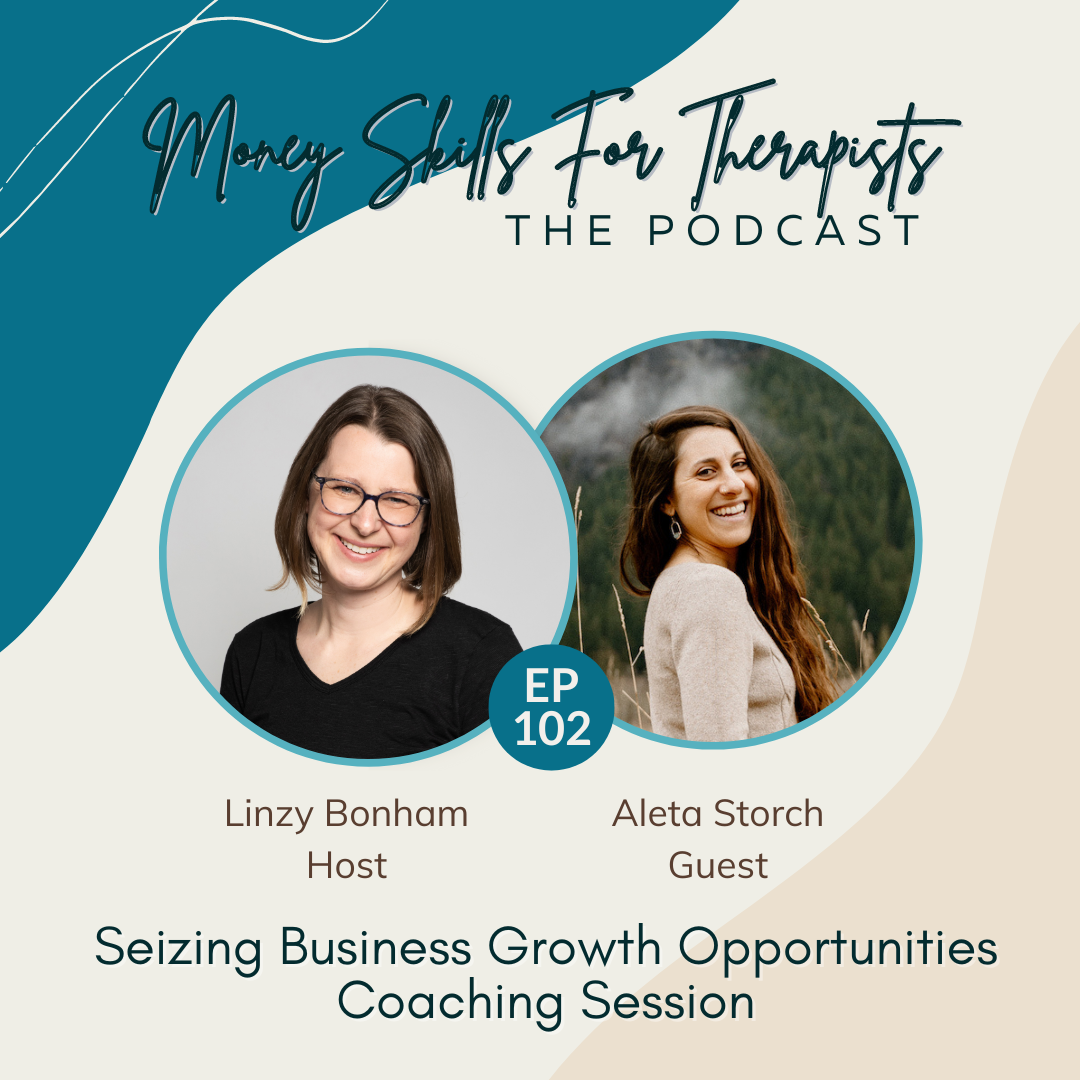
102: Seizing Business Growth Opportunities Coaching Session

Seizing Business Growth Opportunities Coaching Session Ep 102 Episode Cover Art
Header for podcast website

102: Seizing Business Growth Opportunities Coaching Session

Seizing Business Growth Opportunities Coaching Session Ep 102 Episode Cover Art

Linzy: “They like you and you want the people who like you a lot to pay money to actually get the full help that you’re offering inside the membership. So Aleta, what are you noticing with this approach?”

Aleta: “I definitely feel a little less overwhelmed and anxious in just that screw it mentality. It feels less like a Hail Mary, and more like just kind of like first steps.”

Meet Aleta Storch

Aleta is an anti-diet Dietitian, Therapist, and Certified Body Trust® Provider, living in the Pacific-North-West. She specializes in providing anti-diet, values-centered, body liberation work with folks that have disordered eating / a history of dieting, autoimmune conditions, and/or ADHD. Aleta is the owner and founder of her virtual group practice (Wise Heart Nutrition). She is also the creator of the groundbreaking, Eating with ADHD® approach and model, which she developed as a resource for supporting ADHDers in navigating food and eating difficulties, and in developing intuitive eating skills in order to nourish both the body and the brain. This approach is the basis for her monthly membership program, Neurished. She believes wholeheartedly that food freedom and body trust are birthrights, and that every individual is the expert of their own body.

In this Episode...

How can we seize opportunities to grow our businesses? In this coaching session, Linzy talks with guest Aleta Storch about ways to grow our business and to move in the direction of what gives us energy. Aleta shares that she is interested in growing her membership program, Neurished, so that it can be a bigger focus in her business, but she is struggling with how to move toward that goal while also balancing her one-on-one sessions and managing business costs.

Linzy and Aleta talk about how to utilize aspects of Aleta’s business that she already has in place to grow that membership program. Listen in to hear practical strategies that you can use to strengthen your own business through offering more opportunities to your core community.

Connect with Aleta Storch

Get $10 off your first month of Neurished monthly membership program with code BRAINFOOD. Neurished is the only anti-diet monthly-membership program for ADHDers who are looking to heal their relationship with food and their brain so they can neurish themselves the ADHD way. 

Follow Aleta on Instagram: @the_adhd_rd.

Check Out the Jane App

To see how Jane can help you free up your evenings from admin tasks, head to meet.jane.app/more-time to book a personalized demo. But, if you’re ready to get started, you can use the code MNB1MO at the time of sign-up for a 1-month grace period applied to your new account.

Interested in working with Linzy?

Are you a Solo Private Practice Owner?

I made this course just for you: Money Skills for Therapists. My signature course has been carefully designed to take therapists from money confusion, shame, and uncertainty – to calm and confidence. In this course I give you everything you need to create financial peace of mind as a therapist in solo private practice.

Want to learn more? Click here to register for my free masterclass, “The 4 Step Framework to Get Your Business Finances Totally in Order.

This masterclass is your way to get a feel for my approach, learn exactly what I teach inside Money Skills for Therapists, and get your invite to join us in the course.

Are you a Group Practice Owner?

Join the waitlist for Money Skills for Group Practice Owners.This course takes you from feeling like an overworked, stressed and underpaid group practice owner, to being the confident and empowered financial leader of your group practice.

Want to learn more? Click here to learn more and join the waitlist for Money Skills for Group Practice Owners. The next cohort starts in January 2026.

Episode Transcript

[00:00:00] Linzy: They like you and you want the people who like you a lot to pay money to actually get the full help that you’re offering inside the membership. So Aleta, what are you noticing with this approach?

[00:00:12] Aleta: I definitely feel a little less overwhelmed and anxious in just kind of like that screw it mentality. It feels less like a Hail Mary, and more just like first steps.

[00:00:22] Linzy: Welcome to the Money Skills for Therapists podcast, where we answer this question: how can therapists and health practitioners go from money, shame and confusion to feeling calm and confident about their finances and get money really working for them in both their private practice and their lives? I’m your host, Linzy Bonham, therapist turned money coach, and creator of the course Money Skills for Therapists.

[00:00:49] Hello, and welcome back to the podcast. So today we have a coaching episode with a grad of the first round of Money Skills for Group Practice Owners, Aleta Storch. Aleta is an anti-diet dietician, therapist, and a certified body trust provider. She specializes in providing anti-diet value-centered body liberation work to folks who have disordered eating, a history of dieting, autoimmune conditions, and or ADHD.

[00:01:15] She also has an online membership community, Nourished, to support these folks, and today we get into a conversation about this bind that Aleta feels that I think a lot of us have been in before where it’s like you want to be investing in your business beyond the one-to-one work that she does.

[00:01:32] She wants to be investing in her membership community, but also her one-to-one work is how she makes money. So how do you shift into investing in the membership site, in her case, and having the energy to grow the membership site when her energy is going towards the one-to-one work. So we dig into this question today.

[00:01:52] The conversation takes a little bit of a turn. We end up talking about ways that are within reach even right now that she has to make money without investing, and we talk about where we can fall into the trap of wanting to invest. Lots of ground we covered today. Here is my conversation with Aleta Storch.

[00:02:24] Linzy: So Aleta, welcome to the podcast.

[00:02:26] Aleta: Hello, so happy to be here.

[00:02:28] Linzy: So happy to have you here. We were just chatting off mic about how it’s so nice to see each other again, cause it’s been a little while, like three, four months now, since we worked together in Money Skills for Group Practice Owners… I know! So it’s nice to be able to reconnect, and I’m excited to hear where you’re at and what’s going on in your business, during our conversation today.

[00:02:48] Aleta: Yeah, yeah, thanks for having me. I loved that program so much, and I’ve just been missing it.

[00:02:52] Linzy: Yes. Awesome. Okay. So, for today, what would you like to dig into during our coaching episode?

[00:02:59] Aleta: So I… just like thinking about my business structure, one of my offers is one-to-one services. But I am feeling really burnt out on that. And so I’ve really, in the last year, I’ve been focusing on offering a group membership program, so that I can have a wider reach and it’s more affordable.

[00:03:18] And so now that I have my financial picture a little more worked out, thanks to that program, I feel like I can put a little more time and energy into building this program. And I do feel like it could be really lucrative and could open a lot of doors for doing other things.

[00:03:34] But I’m in this place where I’m feeling stuck because if I see fewer clients, then I’m not bringing in as much money. And if I don’t have money to invest, then I can’t grow the program. And it just feels like this vicious cycle of what do I do with that?

[00:03:50] Linzy: Mm hmm. Yes. Okay. So, I mean, my first question is when you’re thinking about growing the program, what specifically are you thinking about investing in?

[00:03:58] What do you need money for?

[00:04:00] Aleta: Yeah, and maybe that’s part of where I’m feeling stuck is I’ve never been in a position where I’ve had money to think about investing, and so I’ve never really thought it through.

[00:04:12] But I know I need more help. I’m working way too many hours. I’m exhausted. I have a practice manager, and she’s really lovely, but she’s not like a marketer.

[00:04:22] She doesn’t really have that knowledge or skill set. So I think more support around the back end of things like funnel building and advertisements, marketing, and then also, do I even invest in advertisements? Do I need that? Yeah, just the stuff I’m not good at and don’t really like doing.

[00:04:41] Linzy: Okay, yes, because you have administrative support for the group practice side of things, so that is taken care of, but yeah, like all these other skills that are not your area that you’re looking for support with. Yeah, because that’s the first thing I was curious is are you looking to bring somebody on board?

[00:04:56] Are you looking to learn these things yourself? Hahaha.

[00:05:02] Aleta: I’ve tried learning, and I just, yeah, I don’t have enough hours in the day. I can’t pay myself enough to do all of those things, right, so…

[00:05:10] Linzy: yeah. Cause do you have specific strategies that you’re thinking about trying to grow your membership site? Are you thinking about Facebook ads? Are you thinking about social media? What are you thinking about?

[00:05:21] Aleta: Yes. Yes. So right now we mostly do Instagram. I have a Facebook group that has quite a few members. It’s pretty active. And I feel like that’s something that we could harness, to create more interest in the membership. But again, like I just… I don’t have the time and resources to do it. And so I think that would be a really good place to focus.

[00:05:44] And then email. Like the email audience I think would be another really great place.

[00:05:49] Linzy: How much are you selling the membership? Like how often are people hearing about it and getting the opportunity to join?

[00:05:55] Aleta: Yeah. So Marcy sends out, once a month she sends out the calendar with an invitation. And then, partly through the month, she’ll send out an announcement for, we do like guest workshops. So that’s like another opportunity in email. And then inconsistently we post in the Facebook group.

[00:06:11] Like if someone has a question, right, we’ll say Oh, this would be really great to bring to the Nourished program. And then on Instagram, again, just here and there, and in stories.

[00:06:21] Linzy: Do you launch?

[00:06:23] Aleta: We did initially. I guess, yeah, do you mean, because it’s like an evergreen program…

[00:06:28] Linzy: Yeah, Yeah. But do you do… Do you ever do like big sales where everybody knows the difference? Okay. Tell me about the face you just made.

[00:06:34] Aleta: Because that feels really overwhelming, right? Because I had a three month group program before this, and I loved it. Yeah, it went decent every time I launched, but it was so exhausting, and so the idea of putting together, right, a funnel, and like, all of the materials, it feels like too much, so I just have popped it out, I guess.

[00:06:55] Linzy: Okay. Yes. And it is a big project. There’s no question about that. you can build evergreen funnels that like, give folks the experience of being launched to with all of the emails and videos and all that stuff. automated, but you have to build out that structure.

[00:07:09] It’s a project. It’s a project I’ve done several times in my own business. And yeah, it definitely is quite consuming. I guess as I’m thinking about this, Aleta, like I’m hearing there’s dietetics work that you do, right? Like your direct work that you’re doing with clients. There’s the membership site that you wanna grow, but marketing is clearly not your first love.

[00:07:31] You would be very happy to outsource it. I guess Something that I’m curious about is like, how big do you want the membership site to be? Like what do you want your days to look like? what do you want the balance between this one-on-one and your membership to be?

[00:07:42] Aleta: Yeah. Yeah. That’s a great question. I would love to get down to a maximum of five clients a week. And then be able to spend like the rest of my time on content creation and community engagement, and connecting with people who could potentially do workshops. And that’s where I find the best.

[00:08:02] I feel really energized working on that community. But after seeing four clients in a row, there’s just no, no energy left, nothing left to give.

[00:08:13] Linzy: Yes. I’m hearing that kind of teaching work is very energizing for you.

[00:08:18] Aleta: Yeah.

[00:08:19] Linzy: Yeah. And as you say, it does feel like a bit of a bind when we’re trying to make a shift like this, because it’s like, you need to make money to pay people to help you.

[00:08:26] But you also, if you’re working so hard, then you don’t have any bandwidth to actually work on it. So, something that I’m thinking about for this in part… I guess there’s two ways that we could think about this. One is what could a runway look like for you where you’re working? Maybe your days don’t change very much in terms of your one on one work, but you are working towards a goal.

[00:08:45] There’s money that’s being put aside for a reason, for a specific plan. That’s one version, which is where you’re planning to make a change. The other way to deal with this would be to start to make incremental change and starting next week, you’re starting to open up more space.

[00:09:02] What makes more sense for you and what you need?

[00:09:04] I feel more drawn to the second one. Just because I feel like, again, like so much excitement about the program. Yeah, and following that energy and that spark. And that’s certainly what I have found is like when you’re excited about something, it is easier to do that work. Like the work has more levity to it. So if we think about this piece then, because what I am hearing is the equation that’s in your head is like,you’re not going to work, but you’re going to need money.

[00:09:28] And I think part of what I’m curious about is is there like a middle road here where at first you start taking your time, and applying your time to marketing. And this is why I was asking about selling because something that I notice about the kind of program you’re talking about which is like a membership, and you’ve had a course before, and that’s a very similar business model to my own is like you can do all the marketing in the world actually, but if you’re not selling, nobody has the chance to buy.

[00:09:51] And if you’re not selling enough that people actually hear about it… Because we always think we’re annoying people, right? Like it’s easy for us to be like, Oh, but they already hear about this, like once a month. But if you think about how often people actually open your email, if you think about how busy they are, if you think about how often people are like, “Oh yeah, I do want to join Aleta’s membership.”

[00:10:07] And then they got distracted, and then they like walk off and like never come back, which I think also for your audience is going to be particularly relevant… Sometimes we have to be waving the flag to say “Hey, I have this great thing!” a lot more often than we might want to at first for anybody to even actually hear your message.

[00:10:25] Right. And it does make me wonder, are there ways that you can be selling to start to generate more money to feed the membership business thatwork, or that you know how to do already that you wouldn’t be creating something from scratch.

[00:10:39] Aleta: I guess I’m confused about the difference between selling and marketing.

[00:10:42] Linzy: So marketing is like great content. Like I’m Aleta. I teach eating for folks with ADHD. Here’s some great tips for you. It’s like giving folks value. It’s building your brand. And so people know who you are, right? That’s marketing, right? It’s creating awareness. Selling is you have until Friday to buy the course.

[00:11:01] Here’s why you should buy it now. Come join the course. The way that I can really help you is if you’re in the membership or the course. That is selling. Like selling is where you’re actually asking somebody to make a decision. Do you want to buy or not right now?

[00:11:15] Aleta: Yes. Yeah. And I think we don’t have a lot of creativity with that. it’s repetitive and yeah, I don’t think we’re doing a good job with that part.

[00:11:25] Linzy: Yes, that selling piece like I’ll share with you like I have a business friend who has a similar size audience to what I have. We have similar size email lists. We have similar size Instagrams. I think I actually did a bigger audience than her. She’s making a lot more money than me because she sells all the fucking time.

[00:11:42] She’s always selling. She’s willing to do that right, and like I don’t love the work. And so it’s something that I find I like to spread out my like times when I’m really like, “Hey, the doors are open. Come join Money Skills for Therapists, or come join Money Skills for Group Practice Owners. She launches every single month.

[00:11:57] Every month she does some sort of event, like a five day workshop series, like some sort of… Yeah, something where folks get value, but then they also get the opportunity to join her course. And there’s some sort of urgency, some reason to join right now, like a discount or a bonus or…

[00:12:10] And, doing that, her business is now at $700,000 a year. She has a smaller team than I do. She has a smaller audience, but she’s just willing to sell. Right? And because she sells. People who are interested get a chance to buy, right? And I’m curious about, if you are going to start selling a little bit more, or bring a little bit of the spark that you have for teaching to selling, if there’s folks in your audience who are already waiting to join your course who’ve just, not gotten the message that, they can join now, and this is why they should join now and not wait till the summer or not wait

[00:12:43] till the fall. Yeah. Like, how do you prompt people to get in the door?

[00:12:45] Aleta: Yeah. Right. Yeah, that makes me think about, over the last six months, we’ve talked about raising the price because there’s so many more resources available, and so using that as a push: get in now, lock in your price. And then we are experimenting with something where I’m doing, a free webinar, or a free workshop, and I am afraid that we’re not going to leverage that in a way that is going to create more revenue.

[00:13:12] Linzy: And so if you’re afraid you’re not going to leverage it, how can you leverage it? How can you turn this event that you’re already excited about into an opportunity for folks to like actually work with you and actually get the full help that you can provide for them? How do you make it a funnel?

[00:13:26] Aleta: As you were talking, a light bulb went off where I was thinking, would it make sense for people who attend the workshop to maybe get a discount on their first month or, have some kind of incentive after offering them free knowledge and support, just to keep that momentum up, and that wouldn’t require that much the back end.

[00:13:47] Linzy: Basically you need to think about how can you pitch people at the end, right? And this can be really uncomfortable and I’m sure for a lot of folks listening like a lot of therapists and health practitioners that are like,

[00:13:55] [panting breath]. Because like selling is like not what we do, but like a phrase that I do find helpful to remind myself of is “selling is helping.”

[00:14:04] Because if you don’t sell, if somebody doesn’t buy the thing that you actually do that helps them, then they’re not actually getting the help that you have to offer, right? It’s like we think we’re doing them a favor by being small and not bothering them and not being annoying, but like you know the effect that your membership has on people and like just to ground yourself in that, what do you see happening for folks who are in your membership community?

[00:14:26] What’s the value that they’re getting out of being there?

[00:14:29] Aleta: Yeah. I mean, I think just, feeling seen and heard and having a safe space where people can show up with a neurodivergent brain and not have to mask, and then also a space where we’re not talking about diets and we’re not… Right, like talking about body sizes and it’s, yeah, it’s just a very like safe community, and I think that’s helpful for people.

[00:14:49] Linzy: Absolutely. Safe community is very valuable, and many people don’t have that.

[00:14:54] Aleta: Right. Yeah.

[00:14:56] Linzy: So if you think about that, like that value that you’re giving folks, because I’m sure you’re also giving them a lot of information as well, and like all these other things you take for granted because this is your zone of genius… I’m sure if I joined your community I would learn a ton of things that I don’t know…

[00:15:09] Aleta: Right, that’s right. Yeah, that is true.

[00:15:11] Linzy: Yeah, just to flesh out that other part of what you offer.

[00:15:13] It’s not just a cuddle puddle. It is actually education that they’re getting. If you think about that, can you use that to help you actually make sure that people know they should join you in there, that it’s worth it for them to pay what is the membership price right now?

[00:15:30] Aleta: It’s only $57 a month.

[00:15:32] Linzy: Okay, that they should pay $57, are you thinking about increasing that to a specific number?

[00:15:37] Aleta: Yes, and I don’t know where to start. I feel like I should know… But I don’t know what makes sense or kind of where to start with that.

[00:15:47] Linzy: Yes. And with pricing, like there’s a lot of pieces that go into pricing. There’s always going to be this kind of element of price elasticity is what they call it, where as you raise your price at first, like if your sales stay about the same, you’re going to be making more money, but then there’s going to be a certain price where less people buy, and you’re like evening out because you’re making more high value sales, but less sales. Like there’s some play and experimentation to happen there, but like something that makes me think about is this saying that I heard recently, which is a ship in motion can change course, right? But it’s getting in motion is very hard, right? So it’s like you do have a ship in motion, but I think it’s like a little slow right now because I think you’re a bit afraid, maybe, to like really be like, “Hey, get on my boat!”

[00:16:30] Aleta: Yep. Yes.

[00:16:31] Linzy: To extend the metaphor in a way that it’s not meant to go. But it’s if you do this launch, do you want to sell at 57? Do you want to try a different price and see, or do you just… What’s your priority right now? Is it to get folks in the door, or is it to test a new price?

[00:16:46] Aleta: I think it’s probably to get people in the door because members, yeah… there just hasn’t been a lot of movement in number of members.

[00:16:55] Linzy: Get that energy flowing. Beautiful.

[00:16:57] Aleta: Yeah.

[00:16:57] Linzy: Then it’s thinking about, with this workshop that you’re already planning, and I don’t think you actually need to pay somebody to do this. You can. We’ll talk about that in a minute. But you already are creating this event where there’s going to be this energy.

[00:17:08] Folks are going to get value from you. They’re going to, like, get a sense of your vibe. They’re going to see how you teach. They’re going to feel seen and heard. At the end, how do you want to be inviting them into the membership? What could that look like that is a natural,

[00:17:22] And next, if you want more from me…

[00:17:24] Aleta: Right.

[00:17:25] Linzy: Do you do an email launch?

[00:17:27] Are you going to announce it on the webinar? Do you want to give them a reason to join now? You mentioned maybe a discount, maybe… sometimes people will join now and your first three months is only this much money… what makes sense to you knowing what tends to work for your folks?

[00:17:41] Aleta: Yeah. And maybe a mix of all 3, right. Just like with ADHD, multiple exposures.

[00:17:46] Linzy: Just hit all the buttons.

[00:17:47] Aleta: Yeah, talking about it, right, on the webinar saying, you’re going to get an email with the discount code. Here it is as well now. If you want to, if you have that impulsivity and you want to do it now, and…

[00:17:57] Linzy: Maybe don’t say it quite like that, but yes.

[00:17:58] Aleta: Right, right.

[00:17:59] Totally. Yeah.

[00:18:00] Linzy: Don’t pathologize it while you’re talking about it, haha.

[00:18:02] Aleta: Let’s be impulsive. Go with your gut.

[00:18:06] Linzy: Yes.

[00:18:07] Aleta: Yeah. And then following up maybe with multiple emails. And I think right now I just have one that’s set up after that doesn’t have a discount code. It’s just: Come join the community. Cool. And that’s it. And I wonder if maybe even sharing an experience or two from some of our members about what’s been helpful. Yeah. And why.

[00:18:27] Linzy: Yeah. I think if you’re going to do, is it going to be just a one time workshop, or is it a series?

[00:18:32] Aleta: We’re testing it out.. yeah. So right now it’s just one. We’ll see what happens.

[00:18:36] Linzy: So it’s one workshop. You do your best; you teach your heart out. Right. and then at the end you segue into I want to tell you more about how I help people with this long term. This is my community. I’m really proud of it. This is the kind of experience that people get out of it.

[00:18:50] This is what this person shares. This is what this person shares. This is what it includes. And because you’ve been here for this workshop, and you’re part of my community, and you’re going to know if this is, I really want to make it a no brainer for you to keep doing this work together, and making real change in your relationship.

[00:19:03] Here’s a discount code. If you use it by next Friday, you save this much money.

[00:19:07] Aleta: Mhm.

[00:19:07] Linzy: I cannot wait to continue this work with you. I’ll see you inside the community. You’re going to be hearing about this over email. Like, when I say this, I’m making this up, but you get what I’m saying. How does it feel in your body if you think about selling as helping?

[00:19:20] Like really owning the value and like really putting out that value to the folks who are at that workshop?

[00:19:26] Aleta: It feels really good. It feels less like slimy, I guess, when it is, yeah, here’s what I offer, and like you’ve actually seen it, and felt it and experienced it. 

[00:19:37] Linzy: I always feel great when I’m selling and I know that I’ve just like given something really valuable, like that there’s no question. And like I also like selling when somebody’s had a real experience of me because I don’t want somebody to join my community who’s like I don’t like her face or we have totally different politics, and like she’s grating and terrible. You want it to be the right fit, and you’re giving them an opportunity to actually get an experience of working with you and knowing if they want to keep working with you, right? Which is like a beautiful kind of gift and also almost like an assessment session that you’ve had together.

[00:20:09] And then they get to decide if they want to keep going, and you’re going to make it easy for them to keep going.

[00:20:14] Aleta: Those are the people we want in the community as well, like people who are going to show up, who are excited.

[00:20:18] Linzy: Yes. So we had started talking about investing, and putting into the business. So, and you had talked about wanting to take this road kind of gradually, putting more energy towards this other business. So I’m curious, Aleta, like if you think about the work that it’s going to take to build out this pitch for the end of the funnel, build out some emails, think about what is going to be the best offer to create some like real urgency so people are really getting rewarded for making like a decision.

[00:20:45] How much time do you think you need to build out this extra part to the workshop that you’re already planning to do?

[00:20:51] Aleta: Yeah. Some of it’s already done, which is really helpful. I think even if I just spent like a couple hours a week… It’s on the 28th, so three weeks away… I mean I feel like in six hours I should be able to get a lot done. yeah, and then I also do have, right, the help of Marcy, and so maybe figuring out that I can delegate.

[00:21:12] Linzy: Making a project. Do you have a project management tool for your team?

[00:21:19] Aleta: We just meet once a week and kind of make a checklist for each of us. Yeah.

[00:21:24] Linzy: So I would think about I mean, for us, when we do a launch, when we’re selling like this, we have a pretty visual team. So I always make a schema of: they start here, they come to the webinar.

[00:21:32] Then from there, they get five emails and all of the emails lead with little arrows to the sales card that has the special code. And it just helps my team, like us all, to visualize and understand. Also, who’s building what, like what color code things, too, of this is your thing, this is my thing, So like just, with Marcy, working together to think about what exactly are we building, focusing on building that thing, because something that I will reflect to you is this is something that is essentially free for you to do, right?

[00:22:00] Like you already have a cart tool, I’m sure, that you use, and you already have a course, or a membership, I should say, you already have a membership.So what you are giving up, so to speak, is a couple hours of time. Do you think… do you need to give up session time for this? Or is there like administrative time?

[00:22:15] Aleta: No, probably not. And yeah, I mean, there are probably things that I’m doing that aren’t as urgent, or aren’t maybe moving me towards, right, that kind of growth that could wait.

[00:22:27] Linzy: What would be your goal for sales coming out of this workshop?

[00:22:31] Aleta: Like number wise? Or, ooh, that’s a good question.

[00:22:35] I would love even to get like minimum of 10 new members would be amazing. Yeah. Right now I think we, we have 17 paying members.

[00:22:49] Linzy: Okay. Great.

[00:22:50] 10 new members, you’d be growing your team.

[00:22:52] Aleta: I don’t know if that’s a lofty goal…

[00:22:52] Linzy: Yeah, well, you’d be growing your community by almost a third. So something to consider is how many folks do you need to show up live to the webinar, thinking about realistically how many people will jump from there into the course.

[00:23:07] And then from there you can build backwards, right? If I need to have this many people show up live, and generally speaking, 50 percent of people tend to show up to an event that they book for, that’s my experience, maybe even a little less, then how many people do I need to get to register?

[00:23:19] And then you can actually start working towards, using the metrics

[00:23:23] Aleta: I have that sheet that you [gave in the course], those metric skills, which has been so helpful!

[00:23:26] Linzy: Yes, right, because now you can actually quantify it to be like, okay, our goal is because we want to make 10 sales, and we think that maybe we’ll be able to make 20 percent of people who join the webinar will buy, right?

[00:23:39] That means that you need to have 50 people join the webinar. to have 10 people by, right? So how many people do you need to have sign up for the event?

[00:23:49] Aleta: I need a hundred.

[00:23:50] Linzy: A hundred. Yeah. A hundred people to sign up. And then it’s okay, what actions do you have to make to get a hundred people to sign up for this workshop?

[00:23:58] Right? And like with that you have a goal to work towards. So it’s: send an email. Okay, that email got seven people. Okay, let’s make a Facebook post. Okay, that got two people. Let’s make another Facebook post, right? It’s like… it really is like something that now you have an actionable goal… or a goal to action towards, I should say.

[00:24:13] And then you get to also experiment and be curious. What gets us the biggest impact? Where do our people sign up from? What kind of language resonates the most with them? Is it about urgency? Is it when we talk about pain points? Is it when we talk about the picture on the other side, the pleasure picture, right?

[00:24:27] Like the transformation. What gets them the most excited? What do they respond to?

[00:24:31] Aleta: Yeah. That’s super helpful to think about. I don’t need to put a ton of money and investment in immediately. It might be helpful to try some things first and then use that information to put money where it’s going to have the most return.

[00:24:47] Linzy: Because I think sometimes when we… When we want to spend, but we don’t actually know what we want to do yet, sometimes I think it’s an impulse. We want to buy our pain away.

[00:24:56] It’s well, if I put money towards this, then I’m fixing it. Right. But if we don’t actually have a strategy, and we don’t know exactly what we’re doing and why?

[00:25:04] Then we can end up just throwing money in a pit.

[00:25:07] Aleta: Yes, which has been historically my experience, for sure.

[00:25:12] Linzy: And What I have found with business in general, but certainly with this kind of thing like marketing and selling is like I said, a ship in motion can change course, right? But you have to get in motion.

[00:25:21] So it’s kind of like that fail fast, do something, and you’re like, cool. That got me literally zero signups. Okay, so what was that about? Was it like the wrong time of day? Was that subject line really boring? Did people even open that email? But it’s only when you take action that you start to get information that you can use to inform your strategy,

[00:25:39] to let you know what actually works for your audience, right?

[00:25:41] And most of the time, nobody notices what you’re doing anyways.

[00:25:45] The internet is a loud place, right? Like their inbox is super crowded. So if you get an email and nobody opens it, it actually just means they didn’t even realize that you sent them an email. So send them another email.

[00:25:56] Aleta: Right. Right. Make it more fun to open. Yeah.

[00:26:01] Linzy: Yeah. That’s it. Right? Like it’s data. And I’m curious… Can you take that attitude that we talked about, like in, Money Skills for Group Practice Owners of taking it in as data? Could that help you in this project?

[00:26:11] Aleta: Yes. Yeah. Definitely. Rather than this is the be all and end all. If this doesn’t work, then, I’m screwed.

[00:26:18] Linzy: Yes.

[00:26:19] Aleta: Yeah, which I think is how I have been approaching it.

[00:26:21] Linzy: And that is like something that…

[00:26:23] Aleta: An experiment.

[00:26:24] Linzy: Something that my very first coach, when I built my online sales funnel, which I’ve had for five years now, that’s something that she talked about that stuck with me upfront. And it’s helpful for therapists to hear, even though it’s like, this is the kind of thing we help other people with all the time, right?

[00:26:38] But she was like, it’s not about you. You can’t make it a story about yourself. If you do a launch and nobody buys, if you do an ad and somebody says something mean about you, if you put something out there and nobody cares, like it’s just data. And if you can put it on a spreadsheet

[00:26:52] even, and treat it like data, it’s even better because then you start to be able to also collect those things that work, right? But it’s only when we’re in action that we can get feedback. And what I’m wondering as I said, with you, I wonder if you’ve got a bunch of people who want to buy. They just haven’t been given enough urgency to buy or enough of like a notice to realize oh now is a good time to buy,

[00:27:13] but they’re waiting because you’ve already done a lot of work of building a community and audience. And I don’t think it takes a lot of people to get you 10 new members.

[00:27:20] Aleta: I hope not.

[00:27:22] Linzy: But you’ve got to give them the chance.

[00:27:24] Aleta: Yeah, that is true. And just like getting out in front of them and… Yeah.

[00:27:27] Linzy: Yes. They like you. They like you, and you want the people who like you a lot to pay money to actually get the full help that you’re offering inside the membership.

[00:27:35] Aleta: Totally. Totally.

[00:27:37] Linzy: So Aleta, what are you noticing with this approach?

[00:27:41] Aleta: I definitely feel a little less overwhelmed and anxious in just that screw it mentality. It feels less like a Hail Mary and more just like first steps. So that feels really good. And I feel like I have, yeah, kind of like a clear… next steps forward, I guess, of what I’m actually doing.

[00:27:59] What needs to happen?

[00:28:01] Linzy: I’m curious in terms of mindset, like what would be helpful for you to remind yourself of or what is the belief that you need to hold to be able to do these things that are not natural for you at this point?

[00:28:12] Aleta: Yeah, I mean, I think, what you were saying, right? if I don’t put it out there, like I’m doing a disservice in a way, that it’s not annoying to share what I have to offer with people. And if they don’t like me, they can unfollow or unsubscribe. 

[00:28:32] Linzy: Exactly. Yeah. Like your program changes people’s lives, right? And you need to do the service of letting them know that it is available for them. Because what you’ve built is also so specific, it’s so niche that for the folks who are fit, they’re going to be like, “Oh, thank God I’m here.”

[00:28:42] Right? And that is like a real gift that you don’t want to be denying people who are going to be the right people for your program.

[00:28:48] Aleta: Totally. Totally. Yeah, so helpful. Thank you.

[00:28:52] Linzy: Welcome. Thank you. Thanks, Aleta, for coming on the podcast. 

[00:29:10] Linzy: The conversation with Aleta brings up for me something that I see a lot and I feel in myself, too, which is where we have a pain point in our business. And so we just want to make it go away by spending money. I think we all do this to some extent. I know I certainly do. And I have a lot of students who come through Money Skills for Therapists who identify as course junkies, who are just constantly signing up in that case for training, constantly wanting to do training for how to use Instagram, and do training on this new modality, and do training on, I don’t know, supervision.

[00:29:41] And constantly doing these things and putting money out, and it can feel like spending money is an action in itself because after all we’re investing when we’re spending money, but we’re only investing if we’re actually doing something that is strategic and that we’re actually going to have the energy to put in to get the value out of, and especially when we’re spending money on outsourcing, as Aleta was thinking about doing, we want to make sure that we’re actually making an investment and not just spending money to try to make a problem go away, right?

[00:30:09] And in this case, as we dug into it with Aleta, my sense is that she has a community, and from knowing her, I know that she has a community that she’s built. She’s like really honed an area of expertise and there’s probably low hanging fruit right there of opportunities to make money and grow her membership site without actually paying somebody else to do anything because she already knows how to sell.

[00:30:32] It’s just putting the energy in, and collecting the data, and those pieces that we were talking about towards the end. So I’m very excited, to hear from Aleta how her launch goes, and, yeah, just to have her taking action, and that’s what we all need to do is it’s very tempting sometimes to pay somebody else or to want to kind of sit

[00:30:49] on our hands around the things that are uncomfortable. But, as we talked about, it’s in taking action that we actually learn what works and learn what doesn’t, and figure out how to actually make the business work and build the business that we want. We do that through action. You can follow me on Instagram at Money Nuts and Bolts.

[00:31:05] And if you’re enjoying the podcast, please take a few minutes to leave a review on Apple Podcast. It’s really, really helpful. It gives folks a sense of what the podcast is about, gives them a sense of the vibe. And it’s the best way for other therapists and health practitioners to learn about the podcast and be part of these conversations.

[00:31:21] Thanks for listening today.

Picture of Hi, I'm Linzy

Hi, I'm Linzy

I’m a therapist in private practice, and a the creator of Money Skills for Therapists. I help therapists and health practitioners in private practice feel calm and in control of their finances.

Latest Episodes

Money can sometimes feel easier to manage in your business than in your relationship. In this episode, I sit down with Ed Coambs to gently explore what happens when you bring your money skills home and begin navigating them alongside a partner. We talk about financial intimacy, emotional safety, and what it truly takes to have honest, grounded conversations when two nervous systems — and two lifelong money stories — are in the room.

Listen to this episode »

In this episode, registered psychotherapist Liane Wood and I gently challenge you to explore what it actually means to build a sellable therapy practice—not because you should sell someday, but because thinking this way creates more freedom, sustainability, and financial clarity right now in your personal and professional life. 

Listen to this episode »

For our 200th episode of Money Skills for Therapists, I invited my business besties, Tiffany McLain and Maegan Megginson, to join me for a conversation that was more honest than polished. We unpacked about the real seasons of entrepreneurship — the times when you feel energized, expanding, and deeply aligned… and the times when you feel tired, restless, like you’re questioning everything, or quietly pulling back. If you’ve ever wondered whether it’s normal to feel both love and resentment toward your business at different points, this conversation is for you.

Listen to this episode »

© Copyright 2022 | Money Nuts & Bolts Consulting Inc. | All Rights Reserved

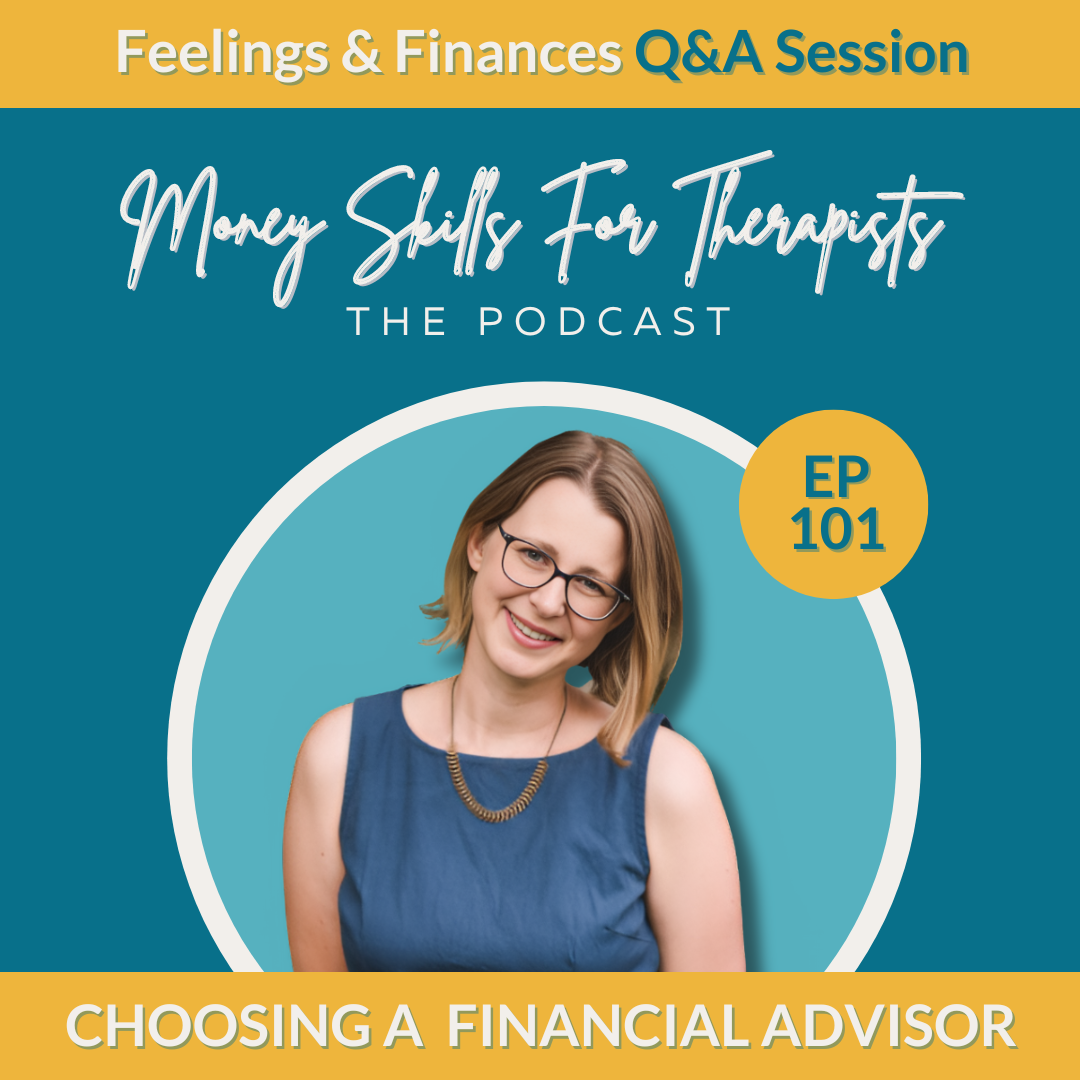
101FF: Choosing a Financial Advisor – Feelings & Finances

Choosing a Financial Advisor Feelings and Finances 101 Episode Cover Graphic
Header for podcast website

101FF: Choosing a Financial Advisor – Feelings & Finances

Choosing a Financial Advisor Feelings and Finances 101 Episode Cover Graphic

In this Episode...

What should you consider when seeking a financial advisor? How can you pivot when you’re already with a sales-based company? In this new mini series, Linzy takes listener questions and answers them in the Feelings and Finances episodes that come out on Fridays. 

Today, Linzy takes a question from Money Skills for Therapists team member Ashley and talks about when it is worth it to make a move with investments and how to take steps toward that move.

Have a Question for Linzy?

You can easily submit your question to Linzy on a voice recording. Go to the podcast page on our website and click the “Start recording” button. https://moneynutsandbolts.com/podcast/ 

Follow the prompts to record your question. When you finish your recording, enter your name and email to submit the recording. You can also submit your question directly to Linzy’s SpeakPipe inbox: https://www.speakpipe.com/MoneySkillsForTherapists 

Interested in working with Linzy?

Are you a Solo Private Practice Owner?

I made this course just for you: Money Skills for Therapists. My signature course has been carefully designed to take therapists from money confusion, shame, and uncertainty – to calm and confidence. In this course I give you everything you need to create financial peace of mind as a therapist in solo private practice.

Want to learn more? Click here to register for my free masterclass, “The 4 Step Framework to Get Your Business Finances Totally in Order.

This masterclass is your way to get a feel for my approach, learn exactly what I teach inside Money Skills for Therapists, and get your invite to join us in the course.

Are you a Group Practice Owner?

Join the waitlist for Money Skills for Group Practice Owners.This course takes you from feeling like an overworked, stressed and underpaid group practice owner, to being the confident and empowered financial leader of your group practice.

Want to learn more? Click here to learn more and join the waitlist for Money Skills for Group Practice Owners. The next cohort starts in January 2026.

Connect with Linzy

Want to feel calm and in control of your finances? Connect with us!

🎥 Subscribe to our YouTube channel: https://www.youtube.com/@moneynutsandbolts

🎙️ Listen to the Money Skills for Therapists Podcast on your favourite app: https://moneynutsandbolts.com/podcast/

🤳 Follow us on Instagram: https://www.instagram.com/moneynutsandbolts

📲 Follow us on Facebook: https://www.facebook.com/moneynutsandbolts

💻 Follow Linzy on LinkedIn: https://www.linkedin.com/in/linzybonham/

Episode Transcript

[00:00:00] Linzy: Hello and welcome to our first ever episode of the Feelings and Finances mini podcast. So this podcast series is going to be second episodes that come out every week on our Money Skills for Therapists Podcast, and these will be short episodes that are all about answering your listener questions.

[00:00:20] So if you have questions for me, if there’s a situation that you have going on in your business that you’re not sure about, if you’re finding it hard to get to your finances, I would love to hear your question and answer it in a podcast episode. I know that it can be intimidating to send your questions out into the universe.

[00:00:38] On our podcast page, we have SpeakPipe set up, which is where you can leave your name and your question for me. I know it’s intimidating to do that, but I also want to remind you that by doing that, by putting yourself out there a little bit… And you only need to share your first name, and you can use a pseudonym if you want, you get the chance to hear back from me and to have it out there and actually get your question answered.

[00:01:02] So to get us started, my team has recorded some questions. So the first question that I’m going to answer today is from Ashley, our podcast editor, and here is Ashley’s question.

[00:01:11] Ashley: Hey, it’s Ashley with the Money Skills for Therapists team. I am so excited to record a question for the Feelings and Finances episodes that we will now be releasing in the Money Skills for Therapists feed. I’ve learned so much from Linzy and from all the amazing guests on the podcast as I’ve been listening over the years, but I have a question that I haven’t really known the answer to.

[00:01:36] So I am excited to pop on here and ask it. And my question is, Linzy, you have shared so much about fiduciaries and other types of financial advisors. And I certainly, now that I know a bit more and have a little more financial literacy, I recognize the benefit of that. But I know for myself, I have been putting money into kind of the, I don’t know, more traditional, financial

[00:02:02] approach. I use Edward Jones specifically. And I’ve been doing that since I was 13 and babysitting, and was like, “Oh, I can invest money. And, I actually can help my money grow.” And so I’ve had that stuff set up for a long time. So I guess my question is, what do you say to people who already have money invested in mutual funds and already have a financial advisor who is more in the sales type role?

[00:02:29] If I want to make a change, is there something I can do now to take steps moving forward, or is it too late? I think probably it’s not too late, but I guess that that is the question that always comes to my mind is knowing what I know now, what steps can I take to be more proactive in my financial investments moving forward, but also recognizing where I am on the journey already?

[00:02:54] I’m excited to hear what you have to say about that. Thanks so much for taking these questions and for giving listeners an opportunity to ask them.

[00:03:02] Linzy: Well, Ashley, thank you for your question. There’s a couple pieces to this question, and I’m going to address the pieces that are really in my lane. And then I’m going to direct you, of course, to the folks who can help you, who this is very much their lane.

[00:03:15] So, as I think everybody listening to this podcast knows, but I should make clear, I’m not a financial advisor; I’m not an accountant. I’m a financial educator. My role is to help you think about where you’re coming from, connect with what’s happening below the surface to get you moving to make

[00:03:31] informed decisions, right? So what I’m hearing, Ashley, first of all, to reflect back to you, where you have done so, so well, is that you have been investing since you were 13 years old, which is amazing. You and I, our little selves could have been friends.And you’ve been investing for so, so long, with this company, Edward Jones, and these mutual funds that what I’m hearing is there’s this probably inertia there in terms of like, well, you’ve been doing this thing for so long, literally decades at this point.

[00:04:00] Is it too late to move? What do you do at this point knowing what you know? And what I’ve noticed can come up with us when we’re more like relational people, and also just around feeling stuck around money, is it can be easy to feel like well I’ve already got this thing I’ve been doing it a long time.

[00:04:15] We can almost get this sense of like loyalty to these large institutions or like a fear of switching that we’ll like do something wrong and whether it’s a loyalty or fear we can feel stuck in these relationships, a little bit like beholden, or that it’s just easier to stay there than it would be to leave. So what I want to remind you of, Ashley, is that it’s never too late to make switches that are going to improve your financial health and… This is outside my lane, again,

[00:04:46] but mutual funds tend to have a much, much higher management rate. So the amount that you pay to have those be actively managed by somebody is usually well over 2%. And 2 percent of your money over like the long, long, long term, over decades, ends up being a lot of money. So you still have decades to go, Ashley, before you retire.

[00:05:08] And I know that because I know you. And so, taking the time to decide what you actually want to do with your money, and making a switch now will have literally decades of impact on how much money you’re going to have when you go to use that money in retirement or in your later years. So, I would say the first thing to do is to get clear about how much it is costing you to have these investments where they are now.

[00:05:31] This is about grounding yourself in where you are, right, rather than just making an emotional decision. I’m going to encourage you to start by looking at the numbers and, find your statement, look at what your MER is, which is the management rate that you’re charged, and see what that percentage is.

[00:05:47] And then you could probably find online. There’s so many great resources around this stuff online. Look at an investment calculator for the MER rate for what you’re currently committed to with Edward Jones, and see over the course of the next week 30 years, how much money is that going to be?

[00:06:02] Based on how much money you’re paying them to management, how much money is going to go towards this MER that you’re paying? I think that’s going to help you to ground in the fact that this is worth making a change. Then when it comes to making a change, this is where bringing in another professional to guide you is a great idea.

[00:06:21] So you have a relationship with somebody right now who, as you say, is in more of a sales role, more of that,old school financial advisor who is also benefiting from you having money in certain places or from selling you certain products. Finding a fee-for-service financial advisor is a great place to start to recalibrate your picture, get somebody’s eyes on your situation to look at like, where are you right now with your goals?

[00:06:43] Where do you want to be? They can help you create that big picture perspective, and then they can also help you start to think about where you want to put your money. I’m a big fan of ETFs. That’s how my partner and I invest, and to learn how to invest in ETFs, we literally learn from blogs on the internet.

[00:06:59] So um, Millennial Revolution is a great blog. They’re a couple from Waterloo, Ontario, so in my neck of the woods, who retired in like their early 30s, saved up a whole bunch of money, and they have some really great blog articles that teach you all about ETFs. How to invest them in a balanced way… The approach now to investing, Ashley, that most folks take is like put your money in everything and then leave it.

[00:07:25] Right? So think about your risk, how much risk do you want to be taking? And then spread your money out over a bunch of different stuff so you don’t have all your money in Tesla or all your money on the American stock exchange. Spread it out and then just leave it, but you’re going to be paying a much, much, much lower rate.

[00:07:41] And that’s where it’s really going to make a big difference for you financially, Ashley, is by having that lower rate. And we’re talking about like tens of thousands of dollars, if not more, over the next few decades, right? So this is one of those things where it’s really worth it to take the time, ground in your numbers.

[00:07:57] Not surprising that that’s the first piece of advice that I’m giving. Look at what you’re paying now. Look at what would happen if you were paying 0. 2 or 0. 1 percent instead for an MER and then look at getting the support in place so you feel like you can confidently make that switch to maybe managing them yourself.

[00:08:17] You can also put your money into large ETFs that are just kind of like a mix of all sorts of different investments. But I would say, ground in your numbers, look at getting support, look at getting a financial advisor who can help you look at your big picture, educate yourself, do some learning, and don’t let yourself get stuck in inertia.

[00:08:34] Because you’ve been with this financial institution, I see this happen with banks sometimes, too, where we feel weirdly loyal to our banks. You need to be thinking about what is best for your family’s financial situation and tens of thousands of dollars, or even more in the future, is what is much more important than the friction of switching now or some of the learning that you’re going to have to do.

[00:08:56] So that’s my advice. I’m excited since I know you, I’m going to get to hear about your journey and what you decide to do with this. And thank you so much, Ashley, for submitting our first question for the Feelings and Finances Podcast Miniseries.

[00:09:09] So folks who are listening, I would love, love, love to receive your questions and dedicate an episode to answering your question. So you can go over to our podcast page, you’ll see a link in the show notes, click on the Speak Pipe, just like Ashley. Introduce yourself, and just share your question. I would absolutely love to be able to answer your question in an episode, help you get moving, help you get thinking about things differently so that you can be actively shifting your relationship with money, as a listener of this podcast.

[00:09:41] Thank you so much for listening today.

Picture of Hi, I'm Linzy

Hi, I'm Linzy

I’m a therapist in private practice, and a the creator of Money Skills for Therapists. I help therapists and health practitioners in private practice feel calm and in control of their finances.

Latest Episodes

Money can sometimes feel easier to manage in your business than in your relationship. In this episode, I sit down with Ed Coambs to gently explore what happens when you bring your money skills home and begin navigating them alongside a partner. We talk about financial intimacy, emotional safety, and what it truly takes to have honest, grounded conversations when two nervous systems — and two lifelong money stories — are in the room.

Listen to this episode »

In this episode, registered psychotherapist Liane Wood and I gently challenge you to explore what it actually means to build a sellable therapy practice—not because you should sell someday, but because thinking this way creates more freedom, sustainability, and financial clarity right now in your personal and professional life. 

Listen to this episode »

For our 200th episode of Money Skills for Therapists, I invited my business besties, Tiffany McLain and Maegan Megginson, to join me for a conversation that was more honest than polished. We unpacked about the real seasons of entrepreneurship — the times when you feel energized, expanding, and deeply aligned… and the times when you feel tired, restless, like you’re questioning everything, or quietly pulling back. If you’ve ever wondered whether it’s normal to feel both love and resentment toward your business at different points, this conversation is for you.

Listen to this episode »

© Copyright 2022 | Money Nuts & Bolts Consulting Inc. | All Rights Reserved

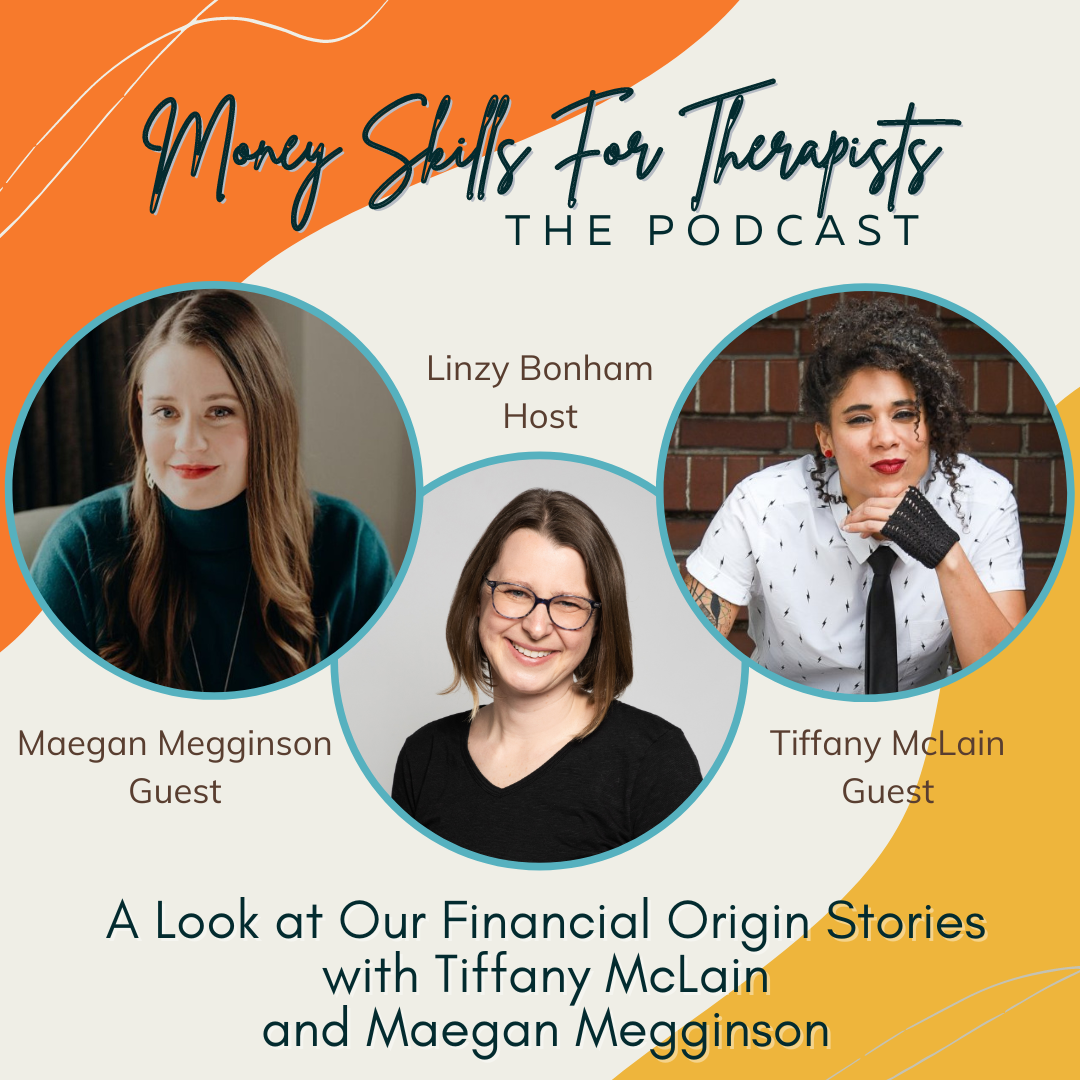
A Look at Our Financial Origin Stories with Tiffany McLain and Maegan Megginson

A Look at Our Financial Origin Stories with Tiffany McLain and Maegan Megginson Episode Cover Image

A Look at Our Financial Origin Stories with Tiffany McLain and Maegan Megginson

A Look at Our Financial Origin Stories with Tiffany McLain and Maegan Megginson Episode Cover Image

“You’re a real inspiration around actually having a well-rounded life. And I literally come to you… this because we talk, and say, how do you do that? How do you have time to serve on the board? How do you have the internal energy to have this garden in your backyard? And then I take it, and I test it out. Yeah. So, thank you for being a model. Your parents, I think, were a model to you of what it could look like, and now you’re a model to me of what a well rounded life can look like.” 

~Tiffany McLain

Meet Tiffany McLain

Tiffany McLain, LMFT is a clinical fee strategist for therapists in private practice. Her mantra is, “Full fees are the new black.” Via her program, The Lean In. MAKE BANK. Academy, she helps therapists ethically earn 30 to 50% more per month while seeing fewer clients by showing them how to think about and directly address fees in a clinically appropriate manner.

The Lean In. MAKE BANK. Academy is a program that addresses the underlying money mindset stories that keep therapists broke so they can become THAT therapist who charges premium fees, cash pay. With the LIMB 4-step framework to make BANK, regular coaching calls to help you go to the next level, a phenomenal community of funny and intelligent therapists, be ready to get real raw and real rich.

Meet Maegan Megginson

Maegan Megginson is a licensed therapist and business mentor who serves mission-driven entrepreneurs online and in person in Portland, Oregon. Maegan helps business owners recover from burnout and reignite their vision for their work and their lives by blending the emotional, psychological, and spiritual elements we need to become deeply rested and wildly successful. 

In this Episode...

How do our first experiences with money and business shape who we become? In celebration of the 100th episode of the podcast, Linzy is joined by her business besties Tiffany McLain and Maegan Megginson, and they dive into their own origin stories when it comes to early perspectives on money, business, and entrepreneurship.

Check out this behind-the-scenes conversation as Linzy, Tiffany, and Maegan examine how their childhoods shape who they are today. They also share about how they consciously run their own businesses and what they hope to put out into the world through those businesses. Do not miss this inspiring, intimate conversation about what business can look like when we approach entrepreneurship with empathy, compassion, and balance.

Connect with Tiffany

You can learn more about Tiffany’s work on her website. 

Check out Tiffany’s  free fee calculator: https://leaninmakebank.com/fee-calculator/

Connect with Maegan

Get Maegan’s Recover From Burnout email series. A 10-day journey to find your way back to yourself—without time blocking, hiring extra help, or trying to “just do less.”

https://maeganmegginson.com/recover-from-burnout/

Previous Episodes with Maegan and Tiffany

Interested in working with Linzy?

Are you a Solo Private Practice Owner?

I made this course just for you: Money Skills for Therapists. My signature course has been carefully designed to take therapists from money confusion, shame, and uncertainty – to calm and confidence. In this course I give you everything you need to create financial peace of mind as a therapist in solo private practice.

Want to learn more? Click here to register for my free masterclass, “The 4 Step Framework to Get Your Business Finances Totally in Order.

This masterclass is your way to get a feel for my approach, learn exactly what I teach inside Money Skills for Therapists, and get your invite to join us in the course.

Are you a Group Practice Owner?

Join the waitlist for Money Skills for Group Practice Owners.This course takes you from feeling like an overworked, stressed and underpaid group practice owner, to being the confident and empowered financial leader of your group practice.

Want to learn more? Click here to learn more and join the waitlist for Money Skills for Group Practice Owners. The next cohort starts in January 2026.

Check Out the Jane App

To see how Jane can help you free up your evenings from admin tasks, head to meet.jane.app/more-time to book a personalized demo. But, if you’re ready to get started, you can use the code MNB1MO at the time of sign-up for a 1-month grace period applied to your new account.

Episode Transcript

[00:00:00] Tiffany: You’re a real inspiration around actually having a well-rounded life. And I literally come to you… this because we talk, and say, how do you do that? How do you have time to serve on the board? How do you have the internal energy to have this garden in your backyard?

[00:00:15] And then I take it, and I test it out. Yeah. So, thank you for being a model. Your parents, I think, were a model to you of what it could look like, and now you’re a model to me of what a well rounded life can look like.

[00:00:24] Linzy: Welcome to the Money Skills for Therapists podcast, where we answer this question: how can therapists and health practitioners go from money, shame and confusion to feeling calm and confident about their finances and get money really working for them in both their private practice and their lives? I’m your host, Linzy Bonham, therapist turned money coach, and creator of the course Money Skills for Therapists.

[00:00:49] Hello and welcome to the 100th episode of the Money Skills for Therapists podcast. I’m very excited that we’ve hit this milestone in the podcast: 100 episodes. It’s hard to believe, but, to celebrate today, I’m really excited to share with you a conversation between myself, Tiffany McLain and Maegan Megginson.

[00:01:10] So Tiffany and Maegan are two of my business besties. They are the folks that I talk to all the time who have been walking this path with me for quite a while. Tiffany McLain is the creator of Lean In. MAKE BANK., and Maegan Megginson coaches entrepreneurs and therapists with building burnout proof businesses, integrating rest into their businesses.

[00:01:30] They’ve both been on the podcast before. And today we are having a conversation about our early beliefs around money and business. We discovered… As I was putting together this episode, I realized I should say that all three of us had entrepreneurial fathers growing up. And I was thinking about how so often we talk about our general money beliefs, and this is like work that I’m doing with folks in Money Skills for Therapists often is what are your earliest memories around money?

[00:01:55] Right? And what did you believe about money as a kid? But there’s this other very specific layer that’s relevant to all of us as well, which is business. What do you believe about business? What did you believe about business? What did you witness about business when you were a kid? Today Tiffany and Maegan and I take turns talking about our own experiences growing up with entrepreneurial fathers, kind of the lessons that we took from that, the things that we observed. We talked about how that shows up in our businesses now, and then we also talk about what we are trying to model, in Tiffany and I’s cases to our kids, and for all of us as well to the people around us, what are we now trying to show other people about business and money? I spend a lot of time thinking about what I want my son’s experience of money to be? What are the stories that I want him to carry into his adulthood? Because all of us who are parents are shaping our kids’ stories about money every single day in the way that we talk about it, the way we show up, the way we talk about our business.

[00:02:50] So we cover a lot of grounds today. We probably could have done a 12 part series on this. Of course, when you get three therapists talking about their families of origin… Here is my conversation with Maegan Megginson and Tiffany McLain for our 100th episode of Money Skills for Therapists podcast.

[00:03:06] You

[00:03:21] Linzy: So Tiffany and Maegan, welcome to the 100th episode of the Money Skills for Therapists podcast.

[00:03:27] Tiffany: Woohoo!

[00:03:29] Linzy: I am very honoured to have you both here. And I will say too, trying to get the three of us into one space is like a miracle. And also Steph Claremont was supposed to join us on this call, and she ended up not being able to make it in the end because of the eclipse that’s happening right now and trying to make sure her children don’t burn their eyeballs out.

[00:03:44] Trying to get four online business entrepreneur health practitioner folks in the same space. It’s difficult. So thank you very much, both of you, for being here.

[00:03:54] Maegan: Today I wanted to dig into our own stories, not just about money, because I talk about money stories a lot with folks, right? About the beliefs that we carry into business and the beliefs that we carry into money and how much that impacts our ability to manage it, our ability to learn about it… And this is definitely what I’ve seen over the last few years of doing this work is more than I ever imagined when I started this work. Those stories shape so much of how folks actually experience money and experience their business, right?

[00:04:25] Linzy: Like those beliefs and those somatic experiences and the emotions. But something that I was thinking about with the three of us, as I was thinking about this opportunity that I have today, talking to the two of you, is also beliefs about business, because there’s like a subtle difference there, between, you know, like beliefs about business that we have and money, and how those things go together.

[00:04:44] And with the two of you as well, something that I realized preparing for this call, is we all have dads who were entrepreneurs growing up, which I think is a very interesting parallel. So I wanted to dig into that. Let’s start at the beginning, with our own memories about business and money from those early memories. Tiffany, could I start with you? Thinking back to your earliest memories about business, and money, and what you absorbed, what do you remember believing about these things when you were growing up?

[00:05:20] Tiffany: I love this topic and also, whoa, what a big topic. I’ll do my best to be brief, and then we’ll see where it goes. For me, money, business, entrepreneurship, it can’t be separated from race. My mom is white. My dad is Black. They were married back in the day. They’re married to this day.

[00:05:41] Often people are surprised, by the way, when I say my parents are still married. I don’t know if that’s a race thing or just a generational thing. My mom always worked a stable nine to five job where you have a pension in the government, making your way up over time. My dad was in and out of entrepreneurship.

[00:05:57] He was always trying things, but always going back to a stable base of working for a car and… actually a used car salesman. My dad was a used car salesman. Cue all of the jokes. So going back and forth between that, trying to get out and do his own thing was a constant occurrence in my family as we were growing up.

[00:06:14] So I had, on one side, my white, stable mother, working consistently, making her way up. And on the other side, my Black father, who truly didn’t believe that he would ever be able to be taken care of and do well, working for somebody else, especially in a white town, a white city. His belief was if he was ever going to make it, he had to make it independently, and on his own, without relying on anybody.

[00:06:39] And in some ways that really served him. And in many ways that really got in the way of him actually becoming an entrepreneur who reached the level of success he wanted.

[00:06:48] Linzy: Yeah, and I do have to say, just when you say that people are surprised that your parents are still together, I feel like I was also surprised when I learned your parents are still together. But the reason, I think the reason that I think that is, you talk about them being so different, like your narrative about them, you’re like, two opposite worlds come together, and you’re like, well, two opposite worlds couldn’t possibly stay together… Yeah, but like huge

[00:07:09] contrast there between your two parents. and I’m curious, Tiffany, like with that, do you remember having specific ideas or beliefs about the way that your dad was operating versus the way that your mom was operating? Like, how did you experience the different ways that they were approaching trying to create stability and yeah, build that for your family.

[00:07:31] Tiffany: The idea of creating stability. So in reality, my mom had the stable ongoing job. My dad was trying to create a bigger sense of stability. And actually over time we really did move up the socioeconomic ladder due to his efforts. He grew up very impoverished in the worst projects in Chicago, and then back when he was growing up… Violence, you know, what he saw was just beyond what… I didn’t learn about it till I was much older, what his experience was like.

[00:07:56] So from where he came from to where he went was profound. He also had to bring a lot of bravado… He had to have a huge narcissistic kind of energy to actually be able to bust out of where he started from, and to go where he was going. But what that did in my mind was create a setup where I looked down on… Two things, both look down on a consistent, reliable position where you’re working for somebody, was devalued, and the idea of going after your own thing, charting your own path, was very much valued.

[00:08:25] However, in reality, my mom’s stability is what actually allowed the family to stay afloat through his ups and downs. So I think in one way, idealizing this doing it on your own, but also for me, there was no other option. I could, I literally thought as a Black person, as a Black woman, who’s quirky or out of the box, I’m not going to ever be able to work for someone else.

[00:08:44] I just couldn’t imagine ever working for anybody who would ever actually let me grow or see my potential. I just imagined that wasn’t a possibility for me. So going off and doing my own thing was literally the only option I could have conceived of in my mind, and yet I saw the disruptions it created in my upbringing.

[00:09:02] My dad was gone a lot of the time, our income would be up where we’re on top of the world. We’re rich people, by the way, not rich people… But in my mind, we’re rich people. and then on the other side, suddenly things were taken away. Or we were in a ton of stress because we suddenly didn’t have any money.

[00:09:15] Didn’t know where it was coming from. So it was this constant rollercoaster and insecurity. On my dad’s end, and also there was a, any day now I’m going to be a millionaire… Any day now the millions are coming. So there was also created in me this idea of relationally, we can put that aside, but even in terms of socioeconomic status, riches come when you just do the one right thing.

[00:09:36] And then in a year, you become rich. So there was this idea of richness as being rich is just around the corner. Having everything you want is just around the corner because you just got to find the secret key. Not like hard work over years and self growth. That doesn’t lead to riches. Those are the suckers.

[00:09:51] The real richness comes from Cryptocurrency or whatever it is that’s going to just unlock the key for us.

[00:09:57] Linzy: Yeah. It’s kind of that magical thinking, but it also makes me think of this other thing that I remember you saying that your dad said, where there’s sheep and there’s wolves? Can you remind me? The sheep get…?

[00:10:07] Tiffany: The sheep get sheared. A constant… That was a constant mantra in my mind. The sheep get sheared, Tiffany. So he was a salesman in all kinds of ways, probably relationally, but also in his professional life. But for him, sales was tied to one person is the sucker and one person is taking advantage of.

[00:10:23] So that really made it difficult when I was going off into my own business to think about sales as a different kind of relationship, or engaging with our team members who we ultimately had to build a team, or a client. I was really resistant to going into business at all because I didn’t want to live in this paradigm of suckers and people taking advantage of.

[00:10:43] And so I had to do a lot of work internally to move away from that as a paradigm for what business actually is and what it needs to be to have ultimate success. And I don’t mean just monetary success, but actually personal and interpersonal success.

[00:10:57] Linzy: I feel like we could just talk, Tiffany, about your story for the next hour.There’s so much here. But yeah, what I really hear there is there’s this real winners, losers, narrative. It’s either you’re winning or you’re losing. this kind of predatory, but you want to be the predator, right?

[00:11:10] If there’s winners or losers, you don’t want to be the loser. That’s not the right side to be on. you need to be on top.

[00:11:16] Maegan: Can I add something, or ask a question? Yeah. Okay. Maegan Megginson here.

[00:11:19] Linzy: Hello, Maegan Megginson.

[00:11:22] Maegan: Buckle up, Tiffany! I’m just kidding. No, I, so I’m still thinking about the sheep and the wolves and how interesting, but also that like, when you said that, what I heard was lone wolf… Not like the wolf as part of the pack, but You’re a sheep, and you get sheared, or you’re a lone wolf, and I’m curious for your dad, how did that translate in terms of community?

[00:11:41] Did he have community as an entrepreneur, or did he live most of his working life as this lone wolf? And what did you learn from that?

[00:11:51] Tiffany: Tiffany getting analyzed by two very good therapists. The hundredth episode. Here’s what I’ll say. Great question.

[00:11:59] Maegan: Don’t worry, my turn’s next.

[00:12:00] Tiffany: We’re waiting for you, Maegan Megginson.I can’t help but come back to race. When we think about the poverty he grew up in, and what it means to be in America and the structural system, a Black man in America, especially one without ties and without financial stability, you’re in trouble if you trust anyone.

[00:12:20] You’re in trouble if you are emotionally vulnerable. And where my dad came from, I mean, you will literally get killed. There are many examples he has of literally having dead bodies in front of him. This is his day to day growing up. So for him, it was absolutely lone wolf. You cannot rely on anyone because everybody, ultimately, all the way up to our very biggest systems of the government, are going to take advantage of you if they can.

[00:12:46] So that really has been something and continues to be something that I’m working on, is how to actually build community. How to build… How to collaborate within business, both within a team, but also within, relating to other businesses without this continual fear of, wait, am I being a sucker right now?

[00:13:06] If I’m open and vulnerable, are they actually going to take advantage? And I think actually our business has grown slower because I have entered into things where I actually wasn’t advocating for myself or the business because I really wanted to be on the other side of… if anyone’s going to be taken advantage of, I’d rather it be me so that I’m not the one, the perpetrator.

[00:13:24] I’d rather be the victim. And so trying to work on… actually we also can move forward and be strong and take up space has been something throughout our business and something we teach I think that’s probably the genesis of the Lean In. MAKE BANK. Academy is helping therapists actually understand their own needs as well, and not simply focusing on the needs of the other, their clients.

[00:13:46] Linzy: Tiffany McLain. Thank you. This has been the hundredth episode of… So much there. Yeah, what I’m hearing there is like, when there’s this model that you absorbed from your dad, because it sounds like your mom’s doing this whole other thing, right? She’s like creating the stability in your family, right?

[00:14:03] But that’s not taking the spotlight. That’s not interesting. That’s not magical. That’s not just wait till next month. Yeah, what I’m hearing is like, when there’s this narrative of good guy, bad guy, you don’t have friends, right? And when you grow up in systemic racism, where systems are set up to treat you disfavorably, and there are so many examples everywhere of the banking system and mortgage system, discriminating against Black people, yeah, it’s just you. Like, where’s the room in there to have an actual community or even have a healthy, positive relationship with the folks you’re doing business with, like with your customers when it’s every man out for himself?

[00:14:40] Tiffany: Absolutely.

[00:14:42] Linzy: Huh. Okay. Maegan Megginson, it’s your turn.

[00:14:45] I’ve got to give Tiffany a break.

[00:14:46] Maegan: Okay. Just gotta take a sharp left turn. I have so many questions, but I… I’m just going to stuff them deep down inside…

[00:14:54] Linzy: That’s very healthy. Just do that.

[00:14:55] Maegan: Next time we’re hanging out, Tiffany. Yeah.

[00:14:58] Tiffany: That’s where they belong.

[00:14:59] Maegan: Stuff my questions deep down inside. Okay. Can you just remind me: what’s the question?

[00:15:02] Linzy: Yes, where we started. Yes. Yes. The question is about your early memories about your beliefs and like interpretations about business and money.

[00:15:11] Maegan: Yeah. Yeah. It’s such a big question.

[00:15:14] Linzy: I know. Thank you.

[00:15:16] Maegan: Tiffany, I see why you made a face at the beginning. Yeah, it’s like my mind is racing with the ways in which, Tiffany, our stories are similar. There are some ways our dads were so similar, and then other ways they are so different. And that is fascinating to me.

[00:15:32] So, yes, I’ll start with a disclaimer. I really do love my dad. So just so everyone knows, I do, I love him. I’m figuring it out. We’re figuring it out. But like my early childhood, the season of my life when my dad was creating his business, was the most complicated part of our relationship.

[00:15:51] And I learned a lot of things that I do not want to replicate as a business owner. And I’m also extremely grateful for the financial privilege his success gifted me and created for me. So it’s really complex. It’s really nuanced, like the origin story of my life with my entrepreneurial father.

[00:16:13] So I’ll say just high level overview that my dad is a hundred percent a white man. So let’s just be very clear about that. He’s just as white as they come. And he grew up pretty poor and his success is quote self made. He considers himself like a self made success. I’m using air quotes because those of us who understand white privilege

[00:16:31] know that there’s no such thing as a white person being self made. But, what I will say about my dad is that he was extremely persistent and extremely driven to create a path for himself that was different than the path his ancestors had followed up to that point. My dad was the first person in his family to go to college.

[00:16:49] He had got an associate’s degree, and then he really worked his way up in his industry from being a salesperson. So it’s boring, but he worked in sandblasting and painting, which is very specific. I grew up in Baytown, Texas, which is where Exxon lives, ExxonMobil Gas. So I grew up around a lot of refineries, and all of those big machines and refineries have to be painted, inside and out.

[00:17:14] So my dad was in sales for the company that would sandblast those machines. So he worked his way up as a salesman and eventually opened his own sandblasting and painting company, and grew that company to the point where he was able to sell it for a lot of money when I was in very early high school.

[00:17:32] And it really changed the financial trajectory for my family at this kind of pivotal early adolescent season of my life. So I feel like my development as a child, an adolescent, followed the rollercoaster of an entrepreneur who started from scratch and took it all the way to the end.

[00:17:55] What did I learn from that experience? So, I’ll say, like, my most predominant memories are really when I was in junior high. And what I witnessed in junior high was someone who really believed he had to sacrifice everything in order to be successful, including his family. I didn’t see my dad much.

[00:18:17] Everything that he did was in service of making more money. All of the conversations in our house were about success and hard work and work ethic, and you can sleep when you’re dead, and pull yourself up by your bootstraps.

[00:18:29] And, to be successful means making a lot of money early in your life so that you can retire early. This was my dad’s dream was to be able to retire early. And he did. And he is retired now when many of his friends and colleagues are still working, and the way he lives his life is not anything like how I want to live my life when I’m in my sixties.

[00:18:52] So I feel like I’ve just grown up with this entrepreneurial figure who was very successful, but had to sacrifice so many parts of himself and his relationship with me along the way.

[00:19:03] When you were growing up, do you remember at that time feeling critical or questioning his approach or was that just how it… How it had to be, how it was?

[00:19:14] Well, I think by nature I’m a person who is critical and questioning of most things, and that has always been true. And I think it’s actually… It was the origin of a lot of conflict that I had with my dad for the first few decades of my life is that I wasn’t afraid to say, “Hey, this thing you’re doing is really messed up,” or like, “Why are you doing this?”

[00:19:35] Or “This isn’t right.” And so we fought a lot. We had a lot of conflict in our relationship. I doubt I was able to say it this succinctly, but I think what I knew in my body was that he was treating his body like a machine, and he was treating his family as expendable.

[00:19:53] And, yeah, we had a lot of conversations about the things that didn’t feel quite right, but also I was 12, so I wasn’t able to… to say clearly, oh, I think you’re giving too much to your business, or I think you’re a workaholic, or whatever the case may be, I was just able to say, you’re being really mean,or mom is really sad when you don’t come home, or why can’t we spend more time together, or whatever was clear to me then, I would say it, but I don’t know that it was clear to any of us at the time that the missing piece of the puzzle was connection.

[00:20:25] And so I think Tiffany, it’s why I was so interested in what you were saying about your dad around the sheep and the wolves, because my dad, too, really similarly, there was always the sense of

[00:20:35] I’ve got to do it on my own. And I think it’s… it really showed, as a kid, that you didn’t get to have success and community.You didn’t get to have success and family, there’s just such this deep internalized capitalism that was reinforced in my upbringing that wealth, financial wealth, is the only type of wealth that matters, and I’ve had to do a ton of work in deconstructing as an adult to say, oh wait, no, no, no. Actually, financial wealth is one small piece of the pie, I want wealth in all areas, in relationships, in love, in time, in freedom, in travel, in creativity.

[00:21:13] But I grew up in a house where success was financial wealth, and the price that we paid for financial wealth was pretty profound.

[00:21:24] Linzy: Yeah, and I mean, it’s kind of like your dad did the American Dream.

[00:21:28] Maegan: He did the American Dream. 100%. And he would say he’s still doing the American Dream.

[00:21:34] Linzy: And it does make you think about the limitations of the American Dream narrative. Because in the American Dream, you never talk about, but then you also balance it with this thing. And there’s… like, yeah, there’s just no nuance there. And I think that I still see so many folks that I know, especially men who have this narrative of I’m going to do this, and then I’m going to retire, and then life is going to begin.

[00:21:56] But it’s But you’re really damaging your marriage right now. And you’re not actually having time with your kid. And I feel like your dad is on the other end of that spectrum. Like he did it. He checked all the boxes. He sold the company. Isn’t that the dream, right? You build the company, you sell the company, you have all the money.

[00:22:08] But yeah, there’s all these other, I love what you’re saying about like these other types of wealth, that you’ve had to learn to expand your

[00:22:15] Maegan: Well, and it’s still to be clear, it’s still a challenge between me and my dad. So my parents did get divorced. My parents are definitely no longer married. They got divorced when I was a senior in high school, and I absolutely see the stress that this business caused as a primary factor. I mean, it probably would’ve happened

[00:22:34] in a dozen other scenarios, too, but the way that his identity became wrapped up in the business, and the way that pulled him away from the family, I have no doubt contributed to my parents splitting and divorcing. The other thing I was just going to say, Linzy, is, so obviously, I’m an entrepreneur now, and this is a major connection point between me and my dad.

[00:22:57] We’re not super close, you know, we have a fine relationship. It’s just it’s totally fine, and I love him, and I hope that we grow closer as the years go on. But really the only thing we have in common in our lives is that I also own businesses. And it’s really hard to talk to him about it because we do have such different values about what it means to be successful,

[00:23:19] the choices that I’m making as I work to sell one of my businesses are very different choices than he made to sell his. And I can experience now as an adult, the projections that he puts on to me based on his understanding of what it means to be successful, what it means to run a business, and it’s really sticky.

[00:23:39] It takes me… I have to stop and pause and breathe all the time to really untangle what’s Dad’s belief and what’s my belief, and how do I create a tapestry where, like, all of that can be true, and we can be in community, and we can talk about this. But I don’t lose myself in the process. Because how I want to be in the world is very different from how he was in the world.

[00:24:02] I would love to also have his success, but I’m not willing to give up what he gave up in order to have it.

[00:24:09] Tiffany: Yeah. Which is a very important distinction. Tiffany, I’m curious what your reflections are with Maegan, what’s coming up for you? I muted myself so that I’m not jumping in and interrupting every 30 seconds!

[00:24:21] Maegan: It’s hard, isn’t it?

[00:24:21] Tiffany: Yeah! So I’m listening from the perspective of the American Dream, and all the people… I know a lot of people who have that idea: if I just build the business, sell it, then I’m free to retire. So can you talk to us a little bit about what doesn’t work for you post?

[00:24:37] So the making his American dream, as being his child didn’t work out for you, but now you’re looking at this person who has achieved the American Dream. And you’re saying, that’s not my American Dream. Can you talk about what you don’t love about the idea of suddenly being free, having time, ultimate time and money freedom?

[00:24:55] Yeah, I mean, I see a person that acquired all of these resources, and now all of a sudden has all of this time, and it’s well, what do I do? Where’s my community? In what ways am I growing?

[00:25:08] Am I healing? Am I becoming more of who I’m meant to be? I think, when you are deeply committed to the American Dream and then you achieve the American Dream, it’s like, “Well, I guess I’m done.” Existentially speaking, I guess I am done. I was here to achieve the American Dream.

[00:25:25] I was here to create something, and sell something, and then have enough money that I could just chill out for the rest of my life. And you finish that, and then what? You just, fuck around all day for the rest of your life? What do you care about? How do you want to contribute to the planet?

[00:25:41] I want to live a life with depth and texture and nuance and questions and exploration. AndI don’t ever want to be finished working. I think that’s the other thing that’s a big difference between us is that my work is my life.

[00:25:55] My work is what I believe in. I feel called to do my work in the world, and I don’t ever want it to be over. And when I see people who achieve the American Dream, and they finish working. It’s just they’re just waiting for the end. And there’s something really depressing about that to me.

[00:26:14] Linzy: Yeah, the phrase that one of my friends uses is talking about people who hit the retire early, sell the business, is that you’re the dog who caught the car. And you catch the car and you’re like, Oh shit, now what do I do with the car? I’ve got a car in my mouth. Yeah. And part of what I’m hearing here, and I think your dad, who is a rich and complex human, who we don’t know everything about, to be clear, but it’s what I’m thinking about partially is projects and energy, right?

[00:26:36] And we only have so much bandwidth for projects and energy and focus. And it’s like your dad put his focus here, and he did this thing really well, right? But when you’re focused all here, you’re not doing all these other things, right? Like you’re not cultivating that relationship with yourself. You’re not exploring, I don’t know, your interest in like Russian literature that you’ve always had. You’re not like building deep relationships with your family, right?

[00:26:59] There’s just so many ways that you can’t be when you’re putting all of your energy into this one project that, as you say, like when you accomplish the project, then it’s yeah, now what?

[00:27:08] Now what do you do? Because I think often, too, like when we spend so much focus on this metric, this number you’re going to hit, you’re not spending time cultivating all these other types of like skills,

[00:27:17] and ways of being, and, I don’t know, challenging yourself, connecting. Because like I think something that we all have in common is our appreciation for richness and texture and meaning, right, and like depth. And I think yeah, if you’re really going hard at being yourself. Business, I’m going to put a Z in there, Bizness…

[00:27:34] There can’t be depth there because if there was depth there, I think you would have to treat people well. You’d have to consider relationships, you’d have to slow down… you’d have to make different decisions that would be contrary to this kind of narcissism that I think helps people win at that traditional business game.

[00:27:50] Maegan: Right. And similar to Tiffany, the only reason my dad was able to create the huge success that he had so quickly in his life, (1) the narcissism and the willingness to sacrifice depth and family and et cetera, but also because he had a wife at home caring for his kids. My mom always worked.

[00:28:10] My mom loves to work. Actually, there came a point after my dad sold his company when I was in high school that my mom was like, “I don’t have to work anymore.” So she took a year off and then she was like, “This is terrible. I’m going back to work. I never want to stay home ever again.”

[00:28:22] But yeah, the reason he was able to do it was, yeah, because she was home. She was cooking meals. She was doing the laundry. She was taking me to play rehearsal. Like she was doing everything that he wasn’t present to do. So I think,isn’t it interesting that here we are, three women who had three entrepreneurial dads, and there’s something really cool here about the generational reversal of gender roles and the claiming of things that maybe our moms weren’t allowed to do or didn’t feel that they had access to.

[00:28:52] So that’s a part of this story that I really appreciate, too.

[00:28:55] Linzy: Mmm hmm.

[00:28:57] Maegan: One quick thing that I do want to give my dad credit for. Again, complicated relationship, but so many gifts. My dad taught me money skills from a very early age in my life. And I am so grateful to him for this. Like he took me to the bank in elementary school.

[00:29:12] He taught me how to open my own savings account. He taught me how to save. We had agreements, where I had to, starting in the third grade, I had to put 50 percent of anything that I got into the bank. If it was birthday money, if I babysat, 50 percent of it had to go into the bank.

[00:29:28] And he taught me how to save money so that I could buy a car when I turned 16. And then he went to the car dealership, and he helped me negotiate. And I’m so grateful to have financial literacy because I was raised by someone who values financial literacy. So I just wanted to say that. And I feel like that foundation of financial literacy helped me to go into business for myself at a very young age as an adult because I did understand the financial workings of the world.

[00:29:56] And I also knew what I wasn’t willing to spend money on, what I wasn’t willing to spend resources on. So I did learn so much from him and will continue unpacking all of this in therapy for the rest of my life, like the rest of us.

[00:30:11] Linzy: Thank goodness for therapy. We can all agree.

[00:30:14] Maegan: Thank God for therapy. Yeah.

[00:30:16] Okay. I’m going to jump in with my dad’s story. We have so many questions for you.

[00:30:20] Linzy: Do you?

[00:30:20] Maegan: So something that is interesting to me thinking about my entrepreneurial father, that’s really different from

[00:30:27] Linzy: your entrepreneurial fathers, is my dad loves people, and he loves community, and he wants to be liked and he really cares what people think about him. And that I think really shaped his relationship to business in a really different way. So my dad, when I was, like a baby, he was a snap on tools dealer. I don’t know… Does Snap on Tools exist in the United States? Is that a thing? I don’t know.

[00:30:48] No idea. He was like a tool dealer, and he had a truck, and he would drive the truck to different zones and sell tools out of the truck. So it’s like you had your own like areas, and when he was away and missed my first steps,

[00:31:01] he decided, okay, I’m going to take my entrepreneurship closer to home, and he started running a retail store. So when I was a kid, my dad ran a retail store still very much in the working class, like blue collar area. He sold work clothes to construction dudes. And he had a lot of Harley Davidson belt buckles.

[00:31:15] I remember lots of those being around. Levi jeans. I had a source when I was a kid, lots of Levi jeans in my life. So he ran that business, but my dad, I think, had, like, all the heart… This is what I witnessed, he had all the heart, he cared so much, but it’s just, he could never get it to work. So one of my earliest money and business memories is, I remember, it was, like, the house that we grew up in, I grew up in the country until I was, like, 12, and then we moved into town, so it’s the house that I grew up in, so I was probably, I don’t know, 8, 7, and I remember my mom crying and running up the stairs because she was so mad at my dad because he was never home.

[00:31:49] And I just understood that he was never home because the business wasn’t working, right? There was this constant kind of cloud hanging over us when I was a child of the business isn’t working, but it’s going to work. I’m going to run these ads. This thing’s going to happen. It’s always very similar to your narrative, Tiffany, of like, it’s just about to work.

[00:32:05] And my dad still, when he talks about his business now, decades later, talks about that. It was always just about to work and then this… then something would happen, right? So there was always this sense of it could work, but it didn’t. Meanwhile, my mom was an accountant. She worked for a corporation.

[00:32:19] She was the highest in that company that any woman had ever been. So she had to deal with this bullshit all day from these misogynists. Right? And she did the heels and the perfume and the eighties, So she would work full time all day. Pick us up at the babysitter’s, come home, make us dinner, like at 5:30 at night, out in the country. So she was really carrying us, is how it felt. Financially, she was the earner in our family, but also she was like creating that stability while my dad was like figuring this thing out. But yeah, I really learned that business is hard.You fail at it.

[00:32:49] Ultimately, my dad’s business did not work, and my parents, thankfully, were able to get a loan from my mom’s parents, who had been, like, farmers, who were very, financially conservative and savvy. My grandmother was very smart about money. So they were actually able to lend my parents $100, 000 to cover off the business debts.

[00:33:06] And this would have been in the nineties. That’s a lot of money in today’s dollars. It was probably more like $300, 000. So there was like this cloud hanging over my parents. Cause it was like, really cool that my grandparents could do this for them. But also there was like this debt that was owed.

[00:33:19] And I remember we would go have dinner with my grandparents on a set schedule and there’d be like a check passed to pay it off. So it was very much this thing of like my dad had lost the business, and my mom’s family had bailed us out. So it always felt like, yeah, with my dad, like it was like so much heart, but not a lot of like strategy and skill.

[00:33:37] And I asked my mom once, like when did you know that dad’s business wasn’t going to work? And she was like, Oh, years before he called it. She could just see; she’s an accountant. She’s very financially savvy, right? She could just see that the numbers weren’t working. The strategy wasn’t there.

[00:33:52] but I definitely, Yeah, I saw a lot of what not to do. Yeah, and I will say, Meg, even though my dad has the experience of being an entrepreneur, we don’t talk about business at all now. He’s never tried to give me business advice, which is really interesting to me. He’s just kind of like, you got this.

[00:34:10] He doesn’t even step in. and I think he’s very impressed with my success, and has said kind things about me, behind my back and in front of my face, about the business, but I think he’s… Now he’s taking this attitude that like, I have done something that he couldn’t do.

[00:34:23] And he ended up having a second career, working for other folks, salesman. My dad’s a salesman, to his core, Tiffany, same thing, and Meg, all salesmen. Which also I have to say, in terms of business beliefs, I really looked down on that when I was a teenager, I thought being a salesman was skeezy. And the fact that my dad was a Canadian who did business in the U S? I thought he was a trader. Right. So so interesting now, cause here I am. Hello. I’m…

[00:34:48] Maegan: Making your money off of us Americans.

[00:34:50] Linzy: Making off of Americans. but like now it’s yeah, now I sell to Americans, and sometimes I have Canadians who get mad at me that like I operate in US dollars, but it’s like, well, there’s 10 times more Americans than there are Canadians.

[00:35:00] I’ve ended up really doing what my dad was doing, but it is that whole like coming… I’m coming full circle or eating my words, I really had a lot of judgments that my dad, sold in the States, would be happy if the Canadian dollar was, like, going down because then he’d make more money, and now, I’m in the exact same boat.

[00:35:16] So here we are.

[00:35:17] Maegan: Oh, it always ends up that way.

[00:35:20] Linzy: I know. Be humble.

[00:35:21] Maegan: Alright, I have a question right out of the gate. I’m really curious about this part of the story when your dad took a loan from your mom’s family. And am I hearing correctly that he paid it back? So your dad took… and you were how old when this happened?

[00:35:40] Linzy: I would have been, when my dad’s business closed, I’m going to say I was probably in grade five or grade six. So, ten.

[00:35:46] Maegan: It’s always grade five, isn’t it?

[00:35:46] Linzy: I know. Isn’t it?

[00:35:48] Maegan: Something so pivotal about those years. Well, I’m just really… I mean, obviously, I’m curious about this because of the work that you do now and the way that I know you now to be this very financially responsible person. So I’m curious about what you felt as a fifth grader, sixth grader… What was it like for you to witness your dad, quote, failing and then having to go to your mom to take all of this money that he then paid back over years and years, the check sliding…

[00:36:18] Linzy: Yeah. And it wasn’t really between my dad and my mom’s parents. It was between my parents and my mom’s parents. So my mom stepped in, really, was the feeling. It’s my mom’s got this now, right? My mom is the financial manager in my parents’ relationship, and in my household when I was a kid, that was very clear.

[00:36:35] There were always checks on the table. Lots of checks on the table. Never in envelopes, always on the table. So I remember the kitchen table, like we’d come down for breakfast. My dad would always get ready for work earlier and leave for work like before my brother and mom and I came down in the morning.

[00:36:48] And there’d be a check on the table like every two weeks. It’s like when he got his paycheck, he would cut my mom a check for his portion of the household expenses,, like he would pay, but she managed all the money. She still does to this day. My mom is very financially competent. So yeah, it really felt more just like my mom had taken it over, and she was now managing this debt between my family and my grandparents, which, to be clear, my grandparents were phenomenal people, and in no way held this over my parents’ head. There was no shame, there was no guilt, it was just this thing that they were able to do, and so they did it, and it was, like, added into, this relational piece of, come have dinner, and just pay us back, it was probably quarterly or something, I don’t know what the frequency was, but it was built into kind of like the relational fiber of the family.

[00:37:32] Yeah, so it wasn’t a burden, but it was just very much Mom’s got this now.

[00:37:37] Maegan: But Dad wrote the checks.

[00:37:40] Linzy: No, Mom wrote the checks.

[00:37:42] Maegan: Mom wrote the checks, too. Did you have a feeling about this as a kid, or was it so well integrated into your family that it didn’t even seem like a big deal?

[00:37:49] Linzy: It just seemed like how it was. Like, yeah… no, I didn’t have feelings about that. I think I feltMeg, you’re not a Dr. Becky person because you don’t have a child that you’re trying not to fuck up. But Tiffany and I have children that we’re trying not to fuck up. So, Dr.

[00:38:01] Becky talks about this… thank you so much… talks about this concept of being a sturdy pilot. And my mom was very much a sturdy pilot. She’s just like, yep, this is what we’re doing. This is how we’re managing it. Like she had this real, like sturdiness to her. And so I do think I felt safe when I knew my mom was managing money. It was like, she’s got it.

[00:38:21] Maegan: Wow. It’s so interesting to me how a core part of the mission of each of our businesses, of our work in the world, is so closely connected to this maybe like small t trauma, complicated thing, that happened around business and around money. I mean, here’s Linzy helping people understand money and make smart financial decisions so that they don’t get into the position where everything fails and they have to take out a loan.

[00:38:54] And here’s me having learned that wealth is about more than money and that we have to slow down and really make space for the things that matter. And then Tiffany, what you were sharing about Lean In. MAKE BANK., and how you feel so, so drawn to support people in really tending to themselves and to creating community and not being the sheep and not being the wolf.

[00:39:17] It’s really inspiring to see. How we can take these places that we grew up in, these lessons that we learned, and turn them into really meaningful work in the world.

[00:39:29] Tiffany: I think that I’m hearing… I don’t quite know how this works with your dad, Linzy. So I’m curious if he fits into this paradigm. I hear the two different options of binary, if there are any, of using a business defensively to avoid introspection and growth, and using a business to lean into self understanding and growth.

[00:39:50] My sense from all three of us is that we actually use our business to understand ourselves better, and to grow as people, both for ourselves but for those around us. And I’m curious, Linzy, if you also felt like your dad was using the business defensively, or if he was actually using it to learn and grow and become a more integrated person, become more conscious.

[00:40:11] Linzy: Yeah, I think my dad… That’s a good question. I mean, I think that kind of language would obviously never be on my dad’s tongue, to learn and grow and become more conscious, but certainly learn and grow. But I think my dad is like a true extrovert. And part of what I see is like for him, his business was all about creating connections.

[00:40:29] Like he’s like our… the folks that we support so often who are just like, they just want to help other people. They just want to take care of people. And my dad, I remember, years ago when I started doing my therapy business, he was like, well, what you and I do is very similar. Sales and therapy are very similar.

[00:40:42] And I was like, like hell they are. And now I’m like, Oh, damn it. Bob Bonham was right again. Because like in the Myers Briggs as well, right? Like the INFJ is only one letter off from the ENFJ, INFJ is the therapist, ENFJ is the salesperson. They’re both about helping, right? They’re about helping somebody like to do the thing that’s going to change.

[00:41:02] And whether that’s like having a quiet, introspective conversation, which is a therapist role or whether that’s sales and being like, look, I know that this sandblasting technology is going to change everything for your company. And I’m totally convinced of that. And I’m going to stick by my guns until you buy it.

[00:41:15] They’re both about helping people, right, in different functions. But I think what my dad didn’t have, and still doesn’t have, is he didn’t have the strategy, right? He didn’t have the balance of… I really love people. I want to make people happy. And also I need to be paying attention to there being enough money in the bank.

[00:41:31] And also I need to be making sure that I’m setting boundaries. And also I need to be strategic about when I’m spending money and how, or making sure that the numbers actually work. I don’t know if my dad’s ever used a spreadsheet before. That’s not true. I’m sure. Bob Bonham, if you’re listening, I’m so sorry.

[00:41:44] I’m sure you’ve used this spreadsheet before. But that’s not his world, right? And I noticed this myself, too, when my spouse, when Rodrigo started a boardroom cafe with some guys, they didn’t read a single fucking business book. I was like, have you heard of books before? Cause for me,the way that I think about business in the world is like, there’s all these really smart people who have walked the path before us, who have figured things out, who have wise things to say, who have strategies and tools we can use.

[00:42:06] And we shouldn’t just be sitting by ourselves trying to reinvent the wheel. We should be tapping into this incredible knowledge that’s out there. But my dad didn’t do that, doesn’t do that. And I think that was really kind of his downfall was he just wanted to make money for his family and everything to be wonderful, and make his customers happy, and take care of his staff.

[00:42:25] And he loved his staff so much. He still talks about his staff with fondness, like years later. But to his own detriment, because there was no bigger plan that actually made it sustainable.

[00:42:34] Tiffany: I might be jumping the gun here, but I’m so curious. We all have beliefs about what our… we saw our fathers doing that put us off certain aspects of entrepreneurship, or we developed very strong beliefs about we’re not going to do it, or we’re not going to do it that way.I’m curious about the ways that has actually limited your growth at times, as you look back over your entrepreneurial journey, have these internal nos actually held you back in terms of how your business has grown, or what you’ve been able to accomplish that you’ve wanted to accomplish.

[00:43:09] Maegan: Yeah, I would say, for me, this is a theme I’ve really been exploring in my personal work the last year, and it’s my tendency to overcorrect. And I think this comes straight from my reactions to my dad in business, and in life, and in general. So overcorrecting, meaning like I see that, I see something that’s bad or wrong.

[00:43:29] So I just want to go in the polar opposite direction and do the total opposite. So if I see someone selling in a sleazy way, I’m just like, I’m just not going to sell. How about that? Oh, if I see someone do, manipulate or cause harm, I just want to go and do the opposite thing. And I think that I’m actively really teasing apart how I’m overcorrecting in my own business even still today because there are these shadow parts of me that don’t want to do it the way that my dad did it. And I think that I really, in my own work, I’m opening up space to say okay, I think we’ve overcorrected.

[00:44:07] How about we spend some time looking at the good things that he did, too. He was incredibly successful. What did he do that worked? What can you take? What can you learn from him? Take the good and leave the bad. So yeah, I think that’s a really great question, Tiffany. And I would say for me, it’s because I saw the ways that he made decisions that felt exploitative to me or decisions that devalued community and connection and family,

[00:44:33] I have slowed down my own growth by maybe not putting fuel on the fire. And in moments when showing up a little bit more, being a little bit more present, could move my business forward, but I’m so afraid of sacrificing the things that I witnessed him sacrifice that I hold back. And I want to let some of that wounding go so that I can more easily step on the gas when the time is right. Yeah. Thanks for that question. That feels really important.

[00:44:59] Linzy: Mhm. Yeah, and like, when I think about that question, Tiffany, I feel like my answer is almost no. As strange as that sounds, but by the time I came into building my own business, my dad’s business that didn’t work was so far in the past that I didn’t look to him for advice. And actually I had to draw a really clear boundary with my dad, which is not something I’ve had to do very often in my life, where when I first started my therapy practice, I was so excited.

[00:45:23] I just was elated, over the moon, that I was building this thing that I got to do on my own terms. And I remember having a conversation with my dad and I was like, it’s been quiet. Like I haven’t got as many phone calls as I wanted and he was like, it could be like this forever. This might just be how it is.

[00:45:38] And I was like, whoa.

[00:45:39] Maegan: Oh God.

[00:45:40] Linzy: And so I actually had to say to him like, Okay, I want to talk to you about this. But if you keep bringing that kind of stress and fear, I’m actually not going to be able to share this part of my life with you because basically, get your bad vibes out of here. Because it was his trauma.

[00:45:55] It’s his, he has business trauma, a hundred percent. My dad, when he drives by like a closed storefront, I remember driving by a closed storefront with him once, and he was like, every time you see a closed storefront, that’s somebody who’s hurting. It’s like his heart just aches for people like, for his story that he’s made up, which often is true, right?

[00:46:13] Like families do lose hundreds of thousands of dollars, especially on storefronts and restaurants. And my dad feels for every single one of those people. So I had to kind of almost put that to the side. And then for me, it was like, it’s always about bringing in that other balance and that skill set that I get from my mom, which my dad, I don’t think ever invited into his business, which is that strategy and groundedness and that accounting.

[00:46:33] My mom is not a people person. Like she likes people, but she’s not like my dad and I, like my dad and I love people. Like I’m like, I love the humans. They’re so interesting. They’re so cute. They’re so fun. We spend a lot of time in my business talking about how cute everybody that we work with is. We just love our students.

[00:46:46] We love each other. We’re like, they’re so cute. That’s my dad. My mom doesn’t feel like that about humans, but if I bring in like her kind of like spreadsheety groundedness with my dad’s love of humans, which I very much have, I feel like I do get this beautiful blend. So I just need to keep that balance of not falling totally into like… I just, especially now with my team, I’m like, I just want to give them all $100, 000 a year, and like they can work one day a week, and take 17 weeks off.

[00:47:11] I want to give them the world and I have to like balance… If we make sales, these things can happen. And that’s very much my mom coming in, right? That like groundedness that then allows me to continue to have jobs for my team, who I want them to have jobs for the long term. So that’s, yeah, I don’t know.

[00:47:26] Do you think… Tiffany, call me out. Do you think that I’m a… am I ignoring my shadow parts? Do you see Bob Bonham’s legacy in me?

[00:47:34] Tiffany: I’m leaving this conversation, like I leave so many of these conversations, which is, Wow, your family was so functional and healthy and stable.

[00:47:41] Maegan: I’ve said this to Linzy times, too.

[00:47:43] Linzy: Sorry.

[00:47:45] Maegan: One of the most functional families I’ve ever known.

[00:47:46] Linzy: I know. I remember once when the two of us were away with Annie Wright and it was revealed in a conversation that my family used to have dinner together, and you all looked at me like I was like an alien, like your family had dinner together? I was like, your family did not have dinner together!

[00:47:58] Okay. Yeah. I mean, I do have the gift of not having a huge amount that I have to undo from my parents. My parents, I mean, speaking, Maegan, about wealth, my parents are incredibly wealthy people. They’ve ended up being financially wealthy. They sold… They bought a house in the right place. They sold it.

[00:48:15] They’ve moved to the city that I live in, but they are also very wealthy relationally. They have a lot of interests. They have so many friends. They have so many hobbies. It’s like a joke when I call them, which of their 18 hobbies are they engaged in right now? So they’re not going to answer my phone call.

[00:48:30] Like they just have really built wealth on so many fronts, and it’s nice to have somebody to look up to and not have to just always be like, I’m not doing that. I’m not doing that, which is often…

[00:48:39] Maegan: So, a quick side story. I met Linzy’s family this summer. I visited Linzy in Canada where she lives. And I was giving her a hard time leading up to it. And I was like, I just, I can’t wait to see that, you’ve been bullshitting me the whole time, and your family is so dysfunctional, and it’s just going to be like the craziest shit I’ve ever seen. And then it wasn’t. We had a barbecue at her parents’ house and I was like, Oh, you literally just have the most, like the sweetest, most well adjusted family.

[00:49:04] This all makes sense. You make so much more sense to me now that I have spent the afternoon with your family, and Linzy, we’re happy for you.

[00:49:11] Linzy: Thank you. So much. Yes, there’s always a part of me that needs to tell you about my other traumas I’ve experienced, but I’m going to hold that back. My life has not been perfect…

[00:49:18] Maegan: Save that for later.

[00:49:19] Linzy: But my parents are great. Yes.

[00:49:21] Maegan: Your life hasn’t been perfect, but entrepreneurially speaking, you just, you’re…

[00:49:26] Linzy: I’m doing great. Okay, Tiffany.

[00:49:28] Maegan: I’m really, yeah, I’m really curious, Tiffany, to hear your answer to your question.

[00:49:32] Tiffany: I was asking the question. I wasn’t intending to answer the question. Holy mackerel.

[00:49:36] Maegan: Good. Yeah, try again.

[00:49:37] Tiffany: How the tables have turned. Shoot. In many ways, I’ll say in the question being, How I’m seeing various aspects of my parents, how they’ve navigated the world… I do feel now driven to give the same caveat you’ve given Maegan over and over again.

[00:49:53] My parents are wonderful. They gave me so much. If it weren’t for them, where would I be? What a delight. We’re continuing to work on our relationship, and it’s wonderful to have them in San Francisco where we could be spending a lot of time together. Okay out of the way, Disclaimer, We’re all growing and changing.

[00:50:12] I think that I’m really aware of the way trauma, I’ll say unconscious patterns, impacted my dad’s ability to be successful. Of course. And to be fair, he was actually, again, given where he came from, incredibly successful. They put me through college undergrad, like what? Somehow they found a way to do that.

[00:50:31] They also later subsequently went bankrupt at least once. So again, ups and downs. He was so… you said earlier Maegan, something about disentangling your mind from your father’s. And I think that’s been a huge factor in my own business. My mind quickly gets co-opted by others, and I lose my own ability to think clearly.

[00:50:49] I get confused because I don’t want to be the one who knows everything and is exactly clear about my path. My dad knew exactly what to do, exactly where to go. Nobody else had feedback because he knew, but ultimately he didn’t know, and it got in his way. And so I’m constantly wondering what is unconscious?

[00:51:06] What actions am I taking that are unconsciously sabotaging my business?I’m working through that now. I have an analyst who I see twice a week. You all hear about her all the time and it’s really been helpful, but before that really feeling like, to collaborate with people in a way that actually works…

[00:51:21] that’s been difficult for me. Finding mentorship or people to learn from has been difficult. I often struggle with wondering what I have a value to offer. Ooh, what do I actually have a value? So these little, probably all the tiny ways trauma makes its way into business has come into my business.

[00:51:39] But maybe the biggest thing, thinking about watching my dad’s trajectory, is how is he so certain that in six months we were all going to be millionaires, and then suddenly six months later we were bankrupt. So constantly makes me vigilant about what am I not seeing here that I need to know? And it’s been helpful over time to find people like you ladies, to be able to give me honest feedback, or point out the things I can’t see, and learning to find people who can do that for me.

[00:52:05] Tell me the things, whether I end up agreeing or not agreeing, at least I’m soliciting all as much feedback from others as I can possibly get without also losing my mind in that. It’s a complicated answer, but there you go.

[00:52:17] Maegan: Oh, no, that really resonates for me, Tiffany, both this thread of, I learned from my dad that I can’t trust myself, which is what I’m hearing, it’s like I learned I can’t trust myself, but also because there was no model for healthy community. I didn’t have anybody to help reflect me back to me. And it’s really inspiring the way you’ve, and continue to, change that in your life by being in community with me and Linzy and the way you show up and share and talk about your story, like this is such a powerful lesson for all of us.

[00:52:55] Tiffany: I want to put you in my pocket and have you just say what I said, but so much more clearly and articulately that I could ever say it. That’s going to be my new app. Maegan Megginson app.

[00:53:06] Maegan: Hey, maybe that’ll make me, maybe that’ll make me rich so I can stop working…

[00:53:09] Linzy: That’s it, Maegan!

[00:53:11] Maegan: And live the American dream forever.

[00:53:12] Linzy: A million dollar idea. You two are so inspiring to me.

[00:53:14] Linzy: I was going to say, I love you guys. I had that moment. I love you guys. Okay, so, starting to wrap it up. Let’s end on not a muddily trauma point, boo. Let’s end on a where are we going point. So, I was thinking about this, because we’re talking about parents.

[00:53:32] Mostly we’ve talked about our dads. Our moms could get a whole bunch of episodes to themselves as well. Especially Karen Bonham, lots to say. But, I was thinking, Tiffany, for you and I, we have kids, so we’re also modeling. Every day, we’re modeling to our own little humans who are absorbing all the stuff, what business means, and what money is.

[00:53:51] And then all of us are trying to put messages out into the world about what business can be, right? And what this life can look like, what these relationships can look like. So I was wondering, what is it that you are trying to put out in the world now? What are you trying to show yourself? The people closest to you? Tiffany, what are you thinking about with your kids? What do you want them to believe about business and money?

[00:54:16] Tiffany: Holy mackerel. For probably the past year, I’ve been thinking a lot about three resources. This is something we’re talking about with our student body, too. Time, money, and emotional and psychological bandwidth. I think we can add relationships in there one day, but for now, we’ll stick with these.

[00:54:33] And I think about business as a tool to continue to increase each of these resources, so we can continue to show up how we want to in our lives. So how can we leverage our time to make more money? How can we leverage our money to get more emotional and psychological bandwidth? So to that end, when I’m thinking about how I incorporate business, and how I want my kids to think about business, my whole entire business is set up so that I can be present for my kids and, on some level, hopefully for myself too, to so I can show up personally for the relationships that matter.

[00:55:05] Business is a tool to do that. Business is a tool to understand more about myself. I would love my kids to take away the idea that, Man, holy mackerel, business… I’m thinking about you, Maegan, with capitalism. I’m like, Oh no, I don’t know how Maegan is going to think about this, but I think about business as a tool to make money.

[00:55:21] We can make money that way, and money can increase our emotional, psychic bandwidth, our ability to be free and present in our relationships. It’s just a tool. And it’s fun to think about also a tool for self growth. So I’d love my kids to be able to imagine… They can add value to the world that people pay them for.

[00:55:38] And in order to do that, they must know themselves, really know who they are in their gut, know what they want for themselves, and clear thinking. And if people are clear thinking, and they want to put that towards money, create a business, they can make an impact, help other people, employ folks, continue to grow and learn themselves.

[00:55:54] That’s really muddled, but I want them to… I want them to understand that business is simply a tool that they can use to create these other aspects of their lives, but mostly I don’t want them to think about business. I just want them to have a mom who’s present. I’m going to work. When are you going to work? I say, “I’m playing.”

[00:56:07] I’m going up to play and make money for us. That’s how I want them to think about their creative lives.

[00:56:12] Maegan: I’ll ask my Maegan app later to translate that for me.

[00:56:15] Linzy: It’ll be so concise, you’re going to love it.

[00:56:17] Maegan: You’re making

[00:56:18] Linzy: Maegan, you’re Maegan, no, I would like that. I would pay for that. Okay, Maegan, you’re up next.

[00:56:22] Maegan: Well, Tiffany, I think you nailed it, and I think that what makes capitalism exploitative is the focus on making money above all other things in the world. Making money to the detriment of the well being of the earth, of our bodies, of our relationships. That’s what makes exploitative capitalism a problem.

[00:56:44] Money isn’t the enemy here. Like money is a tool, just like you said, and I do think that dismantling capitalism requires small business owners like us having conversations like this saying, how can I remove myself from oppressive systems that harm people, right? How can I make changes in my business so that no one’s being harmed and we’re actually funneling our energy and our resources into the people, places, and things that matter to us you the most, and that requires saying no to a lot of like ways of doing business that people like my dad tell us are the only ways to do business successfully.

[00:57:26] So I just want to piggyback on what you said, Tiffany, because I think you actually said it really beautifully. Like, how can I show my nieces and my nephews and my friends and my community that business can be playful, it can be joyful, and most importantly it can support me in making my life so rich in all of the ways that matter, and then by extension I get to make the lives of everyone around me better, and then by extension they get to make the lives of everybody around them better. And it’s just this infinite ripple effect of goodness that all starts with the business that makes money for me day to day.

[00:58:04] Tiffany: Can you say, Tiffany, to answer this question and then can you just plug in Maegan’s answer and I’ll move my mouth and it’ll look like I said all of that so gloriously?

[00:58:14] Linzy: No, we like your answer. We like your answer a lot.

[00:58:16] Maegan: Yeah, and I only arrived at my answer because of your answer. So I feel like this just takes us back to the beginning of… we need each other. We need to be in community. Like when we’re operating like lone wolves, like my dad did, like your dad did, Tiffany, like we, of course, will continue perpetuating the harmful ways of operating because they thrive on us being isolated.

[00:58:37] It’s by being in dialogue about this together, we get to expand the way we think about all of this, and that’s the power. The power is in the community conversation. So, yeah. I’m just like, Linzy, I’m so glad that you did this. Okay, Linzy, we, but obviously we really want to know your answer, too.

[00:58:54] Linzy: Building on your answers, which were both brilliant, especially Tiffany’s, the words that come to mind for me, and this is possibly partially it’s I want to show my child what I didn’t experience, right? Like I feel like for me as a child, business was heavy. It was foreboding. It was like this dark cloud of Eugh, it’s maybe going to work, but it’s not working.

[00:59:14] I don’t think I ever really believed that it was going to be this magical thing. It always did feel like this kind of burden. And when I think about what I want to be modeling to my son, is expansiveness, lightness. This is also about my own personal growth, right? Because so much of my coping and like my nervous system response when I’m under stress is to go small, fade out, quiet, heavy.

[00:59:37] And so, so much for me about the business has been about, as you said Meg, like when you really own your… yourself, your gifts, you can find ways to make that your living, and you can find ways to even make that living for other people. If I think about my business now, it’s not just my living.

[00:59:55] I have two full time people who work for me. I have three contractors who have fairly significant contracts with me that’s probably 30 to 50 percent of their income comes from me showing up, and like doing my thing and I have noticed like that’s been really good for my self esteem. Maybe my self esteem has had to grow in order to keep that going, but I notice now my son is five, and sometimes he tries to be like a little asshole. It’s like a game that he plays where he tries to upset me so he’ll call me like Mummy Dummy and… I know! Mean, right? Ouch. It rhymes,

[01:00:24] so it’s true? So I will counter him with oh, you mean Mummy Beautiful, Mummy Intelligent, Mummy Compassionate, Mummy Kind. And I can say those things about myself and actually mean them. And I was noticing that just yesterday when I was in a little bit of a back and forth with my son where I was countering something unkind he had said.

[01:00:41] And I was like, yeah, I could probably say 20 kind things about myself confidently in a list. And I think so much of that has been about owning my gifts and just letting myself be seen, and attracting the folks who want those gifts, which is not everybody, but attracting folks and like having folks come into the course and like them just being like, I’m so happy to be here.

[01:00:59] And I’m like, I’m so happy you’re here. And it just feels so generative and connective that it’s it’s just all good stuff. So that’s kind of the feeling I want him to have is like this sense of possibility. And then when I think about, too, like money as a tool, it’s we’re building out our backyard this summer.

[01:01:13] I’m going to do these big planting beds, there’s going to be apple trees and birches, and I just got the list this morning from our landscape designer, who I love, of these plants, and it just made my heart sing… This list of like 40 plants that we’re going to plant in the backyard and like I love that I get to pay him to be in his zone of genius and design this incredible thing that I could never do and we’re going to create that in the world and we’re going to share that with our tenants like it does feel like this gorgeous ripple effect when you have the tool that is money to like make cool shit happen and support other people in their own like gifts and livelihoods. So that’s… it.

[01:01:44] Yeah, that’s what I want my son to be absorbing about business and money.

[01:01:47] Tiffany: Beautiful. Mommy Beautiful. Beautiful.

[01:01:50] Maegan: Mummy Beautiful.

[01:01:52] Tiffany: Mommy Smart. Mommy Smart.

[01:01:54] Maegan: Linzy, while we’re on the compliment train, can Tiffany and I just say a couple nice things to you because it is your 100th podcast episode? Are you open to that?

[01:02:03] Linzy: I, yeah. I wouldn’t be upset if you did that. Yeah.

[01:02:05] Maegan: I mean, I’m just so proud of you, Linzy. Track us back in time to, when was it? 2016? 2017? I always forget which year it was.

[01:02:14] Whatever. It was way back then. We were in a mastermind group hosted by Tiffany, and we were in San Francisco, and we met each other, and we were both just these little therapists who had dreams of, doing other things, and, here we are on your freaking 100th episode of this podcast, which Linzy told us before we recorded is in the top 2.5% of podcasts on the entire planet Earth, which is amazing! And Linzy, it’s just what you’re talking about, you want to teach Auggie, you are. Every single day. But you’re not only teaching it to him, you’re teaching it to all of us, so, I’m so proud of you, and I’m so grateful to be your friend.

[01:02:53] Linzy: Thanks,

[01:02:53] Tiffany: Yeah. First of all, you were never a baby therapist, Maegan. When you and Linzy showed up back in whenever that was, 2016, you were already baller. So I was like, what am I going to possibly be able to help these two with? Likewise, Linzy, you were… I don’t know if I can tell you this. I’m so inspired by you.

[01:03:09] We even just two weeks ago, put a little garden bed in our backyard because Linzy is somebody who you have rich relationships, you’re involved with the school, you’re building things in your backyard, and you’re running a business, and you’re hiring people, and you’re having these huge successes like being in the top 2.5% of podcasts. You’re a real inspiration around actually having the well rounded life. And I literally come to you… you know this because we talk, and say, how do you do that? How do you have time to serve on the board? How do you have the internal energy to have this garden in your backyard?

[01:03:40] And then I take it and I test it out. Yeah. So, thank you for being a model. Your parents, I think, were a model to you of what it could look like, and now you’re a model to me of what a well rounded life can look like. I’ve actually been able to implement friendships now. I have friends that I go out on walks with, or at this garden that I’m now doing with my kids in the backyard, because I’m paying attention to and learning from how you live your life.

[01:04:02] Linzy: Thanks, friends. This is so nice. And it does make me excited because we’re going to be together for my 40th birthday. Because that’s another expansive thing that I’m doing where I turned 40, and I’m going to make a big fucking deal out of it. So we’re going to be together in London, going to high tea, and going to bookstores.

[01:04:18] And I’m so excited because I find with you two as well… I’m going to keep the love fest short enough, but, every time I spend time with the two of you in person, too, I feel like my cup fills right back up. Like it’s like I’ve been high for a long time and, Yeah. I think for a little while there, I had the challenge of like, how do I find friends in town that I like as much as Tiffany and Maegan who live on the other side of the continent? You set the bar high! You are hard to beat.

[01:04:44] You truly are. So I feel really blessed to have both of you in my life. It’s been a huge gift. Tiffany, you changed everybody’s life when you did Next in 2016 slash 17, whatever year it was in San Francisco. That was for me, like when I pushed go on the business, but it’s also, I think when I pushed go on No, I am going to take myself seriously, and I am going to, think about what I actually want life to look like, and, it’s really happening, and that’s, an immense gift, and you two are a huge part of that, so thank you. Thank you to both of you for coming on the 100th episode of the Money Skills for Therapists podcast.

[01:05:14] Maegan: Such an honor!

[01:05:15] Linzy: Yeah, I’m so glad. I’m so glad you’re here. I’m so excited to share this.

[01:05:18] Maegan: But I would love you both to plug yourselves, so folks can find you and follow you if they want to get further into your world, Tiffany McLain will start with you.

[01:05:28] Tiffany: I would say go to leaninmakebank. com. That’s the best place to go to get started, and get our fun with fees calculator.

[01:05:34] Linzy: That calculator is amazing.

[01:05:35] Maegan: Your fun with feet calculator is so great. I’ve given it to so many people. I’ve used it so many times. It’s just great. Shameless plug for Tiffany. Okay. Hi. Yes. you can find me at Maeganmegginson.Com. Linzy will tell you how to spell my name in the show notes, and I would love for you to join my Deeply Rested newsletter.

[01:05:52] Linzy: Do it. All right. Thank you, friends. This was really fun.

[01:05:57] Tiffany: Thanks, Linzy.

[01:05:57] Maegan: Thanks, Linzy.

[01:06:13] Linzy: Coming to the end of this conversation, I feel immense gratitude for my friends.I’m very blessed. And I really encourage folks who are listening, if you do not have folks in your own world who are also walking the same path that you’re walking, whether that’s solo practice, or group practice, or looking to expand into larger kind of coaching offers or courses like Maegan and Tiffany and I do, get those people in your world.

[01:06:40] It really does change everything. And I think that the pieces that Tiffany and Maegan were talking about today, like what they witnessed with their own fathers and this kind of lone wolf version of business, this kind of like predatory capitalism where there’s winners and losers and it’s cutthroat, it really can be different.

[01:06:56] And part of it being different is having folks around you who you trust, who have values that align with your values, who can call you out. If you’re doing something that doesn’t align with your values, who you can talk through about the challenges that are coming up, have those deeper conversations.

[01:07:12] I think having that support, for me at least, has been such a huge part of being able to actually grow a business that I’m proud of that actually reflects my values, where I feel like I’m not like, saying one thing and doing another. Having the right people is so, so, so important. I think especially for therapists and health practitioners where it’s so easy to be isolated in private practice and be by yourself, and not have those sounding boards to talk things through, and really be clear on what you’re doing and why and where you want to be going.

[01:07:38] If you don’t have business besties, get business besties. It is a very worthwhile thing to put your energy into. So, Maegan and Tiffany, you can find the links for them in the show notes. As Maegan said, you’ll see the spelling of Maegan’s name in the show notes as well, because it’s not your typical Maegan Megginson.

[01:07:53] But just so, so grateful to Tiffany and Maegan for coming on the podcast today. You can follow me on Instagram at Money Nuts and Bolts. And if you’ve been thinking about leaving a review for the podcast, and every time you’re like, next time I’ll do it. This is what I’m asking you for my 100th podcast birthday.

[01:08:12] Let’s just say this is my birthday. Let’s say this was my 100th birthday podcast. I would so appreciate it if you could take 30 seconds to commemorate the 100th episode of the podcast to go over and leave a review on Apple Podcasts. It really does make a huge difference. It lets folks see that people are listening to the podcast.

[01:08:30] It lets Apple know that people are interested. It helps people to find us. It helps people to understand what to expect, to know if the podcast is going to be for them. It would be a beautiful gift that you could give me if you can leave a review for the podcast today. Thank you so much for listening.

Picture of Hi, I'm Linzy

Hi, I'm Linzy

I’m a therapist in private practice, and a the creator of Money Skills for Therapists. I help therapists and health practitioners in private practice feel calm and in control of their finances.

Latest Episodes

Money can sometimes feel easier to manage in your business than in your relationship. In this episode, I sit down with Ed Coambs to gently explore what happens when you bring your money skills home and begin navigating them alongside a partner. We talk about financial intimacy, emotional safety, and what it truly takes to have honest, grounded conversations when two nervous systems — and two lifelong money stories — are in the room.

Listen to this episode »

In this episode, registered psychotherapist Liane Wood and I gently challenge you to explore what it actually means to build a sellable therapy practice—not because you should sell someday, but because thinking this way creates more freedom, sustainability, and financial clarity right now in your personal and professional life. 

Listen to this episode »

For our 200th episode of Money Skills for Therapists, I invited my business besties, Tiffany McLain and Maegan Megginson, to join me for a conversation that was more honest than polished. We unpacked about the real seasons of entrepreneurship — the times when you feel energized, expanding, and deeply aligned… and the times when you feel tired, restless, like you’re questioning everything, or quietly pulling back. If you’ve ever wondered whether it’s normal to feel both love and resentment toward your business at different points, this conversation is for you.

Listen to this episode »

© Copyright 2022 | Money Nuts & Bolts Consulting Inc. | All Rights Reserved

Simplify Clinical Note Taking with Mentalyc Founder Maria Szandrach

Episode Cover Image for Simplify Clinical Note Taking with Mentalyc Founder Maria Szandrach

Simplify Clinical Note Taking with Mentalyc Founder Maria Szandrach

Episode Cover Image for Simplify Clinical Note Taking with Mentalyc Founder Maria Szandrach

“If you take care of yourself and make sure that your priorities are right and you’re there to help providing therapy and not just stressing out about notes being submitted on time, then just basically the therapy quality goes up, and it’s more fulfilling also. I think we can use AI and use technology actually as a way to basically maximize on this time with clients, to maximize on our presence in sessions.And yeah, just focus on this human, human element AI cannot do.” 

~Maria Szandrach

Meet Maria Szandrach

Serial entrepreneur, social impact leader, and CEO of Mentalyc, Maria Szandrach is a force to be reckoned with in the mental health tech space. Driven by a personal experience with therapy and a mission to make mental healthcare more accessible and effective, Maria has spearheaded the development of groundbreaking AI-powered solutions that are revolutionizing the industry.

Mentalyc, Maria’s current brainchild, is a testament to her unwavering commitment to innovation and positive impact. This AI-powered platform automates note-taking for therapists, streamlines administrative tasks, and personalizes treatment plans, all while building a unique dataset to enhance psychotherapy. With thousands of happy clients under its belt, Mentalyc is rapidly transforming the way therapy is delivered and experienced.

In this Episode...

Are you looking for ways to save time with your clinical notes? Linzy talks with guest Maria Szandrach, founder of Mentalyc, about how therapists can use Mentalyc to simplify their clinical notes with the support of AI. Maria shares how Mentalyc leverages AI to generate accurate, organized clinical notes that comply with insurance standards and HIPAA standards.

Linzy and Maria dig into how to assess the return on investment of tools like Mentalyc, and they discuss the benefit of saving time on tasks like clinical notes. Maria talks about both the tangible and intangible benefits of using Mentalyc to simplify note taking while maintaining privacy and protecting client information.  

Check Out Mentalyc

Discover Mentalyc with a 30-day free trial – https://www.app.mentalyc.com/register 

You can also benefit from a 10% discount when using the code: “MSFT10“. 

Interested in working with Linzy?

Are you a Solo Private Practice Owner?

I made this course just for you: Money Skills for Therapists. My signature course has been carefully designed to take therapists from money confusion, shame, and uncertainty – to calm and confidence. In this course I give you everything you need to create financial peace of mind as a therapist in solo private practice.

Want to learn more? Click here to register for my free masterclass, “The 4 Step Framework to Get Your Business Finances Totally in Order.

This masterclass is your way to get a feel for my approach, learn exactly what I teach inside Money Skills for Therapists, and get your invite to join us in the course.

Are you a Group Practice Owner?

Join the waitlist for Money Skills for Group Practice Owners.This course takes you from feeling like an overworked, stressed and underpaid group practice owner, to being the confident and empowered financial leader of your group practice.

Want to learn more? Click here to learn more and join the waitlist for Money Skills for Group Practice Owners. The next cohort starts in January 2026.

Episode Transcript

[00:00:00] Maria: If you take care of yourself and make sure that your priorities are right and you’re there to help providing therapy and not just stressing out about notes being submitted on time, then just basically the therapy quality goes up, and it’s more fulfilling also, I

[00:00:15] I think we can use AI and use technology actually as a way to maximize on this time with clients, to maximize on our presence in sessions.And yeah, just focus on this human element AI cannot do.

[00:00:26] Linzy: Welcome to the Money Skills for Therapists podcast, where we answer this question: how can therapists and health practitioners go from money, shame and confusion to feeling calm and confident about their finances and get money really working for them in both their private practice and their lives? I’m your host, Linzy Bonham, therapist turned money coach, and creator of the course Money Skills for Therapists.

Hello and welcome back to the podcast. So today’s guest is Maria Szandrach. She is the founder of Mentalyc. And today we are talking about her tool that she’s developed, which helps therapists with note keeping through AI. We talk about AI in general when it comes to mental health and the world. You will hear in this episode that I am not a total adopter of AI.

[00:01:13] I have my fears and concerns. And I bring those to my conversation with Maria today. And we get into discussing tools for therapists. return on investment, how to think through when a tool is worth investing for you. And, just the solution that she’s come up with for a pain point that I know was huge for me in private practice, which was clinical notes.

[00:01:32] Here is my conversation with Maria Szandrach.

[00:01:50] Linzy: So Maria welcome to the podcast.

[00:01:52] Maria: I am very happy to be here, very excited about this conversation given that I actually studied finance and it’s a topic close to my heart as well. 

[00:01:59] Linzy: Yes, So finance is where you’re coming from, and we chatted about that just a little bit off mic. You’ve come kind of through that world and now you’re supporting therapists. And you’ve entered into the therapy space. Can you tell folks who are listening a little bit about what you do?

[00:02:12] Maria: Yeah, sure. So I studied finance, as I mentioned, and I was always very interested in businesses, how they operate. So already as a child, I was running some businesses. My first one was to breed hamsters, and I was trading violins. So it has always been a big hobby of mine. And also as I was… Actually when I was a teenager, I went to therapy myself for an eating disorder.

[00:02:35] So I went to five different therapists and two psychiatrists in that process, until I recovered. So, it was a very confusing and painful time for me and my family. So that’s basically, brought me at some point later in life, after having different business experiences, to this point where I decided that helping therapists is something that I want to invest my time and my skills into.

[00:03:00] So currently I’m running a company called Mentalyc, which writes notes for psychotherapists, so they don’t have to.

[00:03:06] Linzy: I’m sure people’s ears are perking up right now because I know for myself, when I was in private practice, notes were one of my biggest pain points as a therapist, right? So they love doing the clinical work, but writing a note afterwards, I noticed, can be a huge barrier for a lot of therapists.

[00:03:24] I hear this come up again and again as a part of our jobs that we do not like, and can really pile up. I was just talking to somebody the other day about how at one point I fell behind on like literally hundreds of notes in my practice and like just the emotional weight of that and knowing that I had this massive mountain of work…

[00:03:41] I think that’s a little bit extreme, but I don’t think that’s an unusual experience to really fall behind on notes. I think that happens to a lot of therapists.

[00:03:49] Maria: That is something that we also see that some notes are basically on the to do list since like weeks or even months in some cases, right? And then it’s impossible for anyone to remember exactly what happened.And also insurance is never happy with notes that look all the same, right?

[00:04:05] Copied and pasted from the previous note. So those are the problems that we are solving. And given that there is so much amazing progress, technological progress, in the field of AI, it just makes sense to use all this technology in a safe and ethical manner to help therapists focus on where they bring the most value, which is spending time with their clients, right?

[00:04:29] Being really like present in the session and, really like close to their emotional state rather than being like pulled away from this, trying to jot something down on the side, lose the eye contact and then be stressed in the basically the whole evening and weekend are blocked with note taking.

[00:04:48] That’s not what we want for therapists. Or for anyone!

[00:04:51] Linzy: No, I have a friend who I went to my social work master’s with, who’s still a very good friend, and she works at a university in a clinical setting. And she has now her system that she’s kind of worked out after, the 15 years that she’s been practicing is she writes notes on Saturday mornings, like it’s actually part of her weekend.

[00:05:07] That’s the only way that she can actually make it happen is like Saturday morning, she goes to a cafe and she stays there until she writes all of her notes, which is a solution to a problem. But it’s also that she is literally having to give up part of her weekend in order to do the thing that she’s being paid to do during the week.

[00:05:23] She’s not being paid to do that on the weekend. So it, yeah, it can, definitely just add up and become quite a burden for folks.

[00:05:30] Maria: We did survey therapists extensively, like in our early days, because Mentalyc is about three years old right now, but, uh, when we were starting, we did an extensive research on when therapists take notes, how long it takes, and so on. And it really takes usually between 10 to 20 minutes per session.

[00:05:47] And usually there’s no time to do this between sessions, right? So everyone wants to have this pee break and not complete the notes. So that’s exactly like it piles up for the weekend or for one day when there are no sessions. That we also have seen frequently, right? Then like on Friday, for example, the therapist is not meeting anyone and just writing notes the whole day.

[00:06:07] Linzy: Yeah. It can eat a lot of time. So, Okay. So I’m going to go back to the word that you mentioned a little earlier, which I’m sure people’s ears perked up because I feel like it’s a divisive word, which is AI, right? So part of your solution, or I guess the core of your solution, is using AI technology.

[00:06:21] I know for myself, like I live in a household where I feel like we’re a little bit split about AI. My partner loves AI. He does AI art as a hobby in the evenings. And I find myself, there’s like certain elements of AI that I appreciate, but I also am nervous about it.

[00:06:37] My joke to my partner is that he’s just ready to greet our robot overlords. Like he’s welcome. And I’m like, I don’t know if this is good. So, you know, I’m curious about your response to that in terms of concerns about safety, privacy. Tell me more about what you say to people like myself who are not totally all in on AI being an amazing thing.

[00:06:58] Maria: AI is also like a very broad term, which can mean really a lot of things. So.AI is there, for example, in our browser, where we do a Google search, right? And it suggests the terms that you might want to use. Or it does this like auto completion of sentences. Or it fixes your grammar in the text, right?

[00:07:14] Or it helps you find the right movie on Netflix. So, it does a lot of things where you don’t even realize that it’s AI. And recently there’s, like a lot of attention goes to this direction of general AI that will replace humans, and that’s what all the movies are about. So such AI is not there yet.

[00:07:33] And there’s a lot of speculation around when it’s going to happen. But so far there is no proof that it’s anywhere very close. That is a common question also from therapists, whether it’s going to replace them. And that’s actually a very hard question. I would like to say that no, but I would rather say that I don’t know because it depends a bit on the timeline.

[00:07:54] And a surprising discovery, I would say of the last year is that actually a lot of people like to talk to AI, maybe like your partner, right? So not everyone, but there’s definitely a group that likes to chat with an AI bot and finds this helpful for kind of, I don’t know, like brainstorming with themselves and helping them resolve some conflicts and problems, right?

[00:08:14] So, I believe in some form, it might be replacing parts of the work, but I believe it would be ideal if there is still the therapist who is like leading the process, right? So that’s what we want to ensure. That AI is kind of like all around the therapist if needed, but the therapist is still there as a captain of this ship and this process.

[00:08:36] So AI can be great for things like note taking, for example, because it doesn’t actually require any therapeutic qualities to it, right? It’s just like basically a cold analysis of data, of patterns. And that’s where I believe it can be very helpful to therapists because it saves a lot of time. It writes notes in a way that insurance wants to see it.

[00:08:55] So, it also saves a lot of worries, right, about, is my note correct or compliant? It can be trained to write them the medical necessity is well described.

[00:09:06] That’s where AI is great. I guess over time, maybe it will also take some other parts, right? Maybe it will help you organize your calendar or maybe it will facilitate the intake, like for example, sending some questionnaires, right, to the client. There’s a lot of things that can be done, but we should keep it there, not to replace therapy altogether.

[00:09:29] Linzy: We’re not talking about some… The ideal scenario is not that there’s a robot that somebody walks into the room and has a conversation with a robot, but what I’m hearing is like this is a tool, right? And like you can use the tool to support you in being in your zone of genius and doing that therapeutic work with your client.

[00:09:44] And then use this tool to take care of the parts of your business that are not your zones of genius, don’t take like all of your talents and skills, but can pile up and be a pain point, which is, using a tool that’s going to help you to increase your note writing.

[00:09:58] Maria: Because AI has this capability that no human has of being able to process a lot of data and find patterns, right? In our lifetime, we will see like a number of clients, but AI can basically be kind of fed with data from millions of sessions, and identify something that could be basically brought to the attention of therapists, right?

[00:10:19] Say, for example, that for a similar client, I’ve seen somewhere this intervention worked better. So the therapist can decide and potentially implement that in their session, right? But especially if you have a diverse population, so they would have different diagnosis, different problems, different backgrounds,

[00:10:36] That could be helpful to have AI suggest something that you could do as an idea. Or maybe have you noticed that your clients said this, right? And we all have some like blind spots, so that might be helpful as well. So in general, AI can be very helpful, not just to therapists, but to any professional.

[00:10:52] And what we also see is that professionals in other domains use AI way more since a long time. So…

[00:11:00] Linzy: Yeah. It is true. There is something about therapists, I kind of count myself in this, although I have moved into the online space, so certainly I’m a lot more like Internet-y than I used to be, but there is something kind of old school about the profession, right? which I think people are also looking for a need, right?

[00:11:15] Which part of what therapy is providing people is profound human connection, right? And a lot of people are just missing that in their life period, right? Like we are isolated from community. That’s going to feed all sorts of trauma, mental health issues, relationship issues. Everything gets worse I think when we are isolated as people, so as therapists, in some ways, we’re kind of almost filling this gap of being a person who’s deeply present with somebody, just being with them in a room, or maybe over Zoom, but it’s like you’re just with that person, and you’re using all of your own intelligence and your, relational gifts to help that person to move and shift and, you know, heal, right?

[00:11:53] And so I’m not surprised, you know, that you say that we are,as a group, slower to adapt to AI, because I almost wonder if it is a bit of an old school profession in some ways where we’re like, but the people… And I can kind of, imagine, you know, some listeners having that, but yeah, but I like that it’s simple and direct.

[00:12:10] And I’ve even worked with folks who don’t want to use clinic management software. Like they don’t even want to use the EHR because there’s a distrust of that. So they’re keeping paper notes or paper ledgers. That’s not most people, but I think that can even show up in our profession where it’s like the good old days.

[00:12:25] We prefer the good old days instead. I’m curious, what is your response to that in terms of being afraid of this kind of technology or like why it’s worth it for us to think about maybe stretching ourselves a little bit?

[00:12:38] Maria: We actually have a lot of users who have not used any EHR before they came across Mentalyc, and now Mentalyc is the only tool they use. So what I have learned from them is that you can look at it very differently. Like actually in order to preserve this human element, we can eliminate those other destructive elements, such as writing notes for the whole day, and spend more time actually on building that human connection that AI cannot build in the same way.

[00:13:05] And that is actually very needed. Looking at the bigger numbers, kind of like the market trends, there’s a big shortage of therapists, right? And therapists are also getting burned out. They consider changing careers. We also have a lot of such users who were telling us that Mentalyc made them change their minds, and actually,they stayed being a therapist because now they can actually exactly take care of just providing therapy, right? 

[00:13:29] Which is the reason why they even chose this career. You look at it from this perspective, and you consider this being the most valuable element of therapy, I would say it even makes more sense to outsource the other parts, right? Like accounting, or note taking, all those elements, just so that you have more energy, more like presence in the session.

[00:13:52] Because you, of course, if the therapist is getting burned out, the quality of therapy might also decrease, right? So if you take care of yourself and make sure that your priorities are right, and you’re there to help provide therapy and not just stress out about notes being submitted on time, then just basically the therapy quality goes up, and it’s more fulfilling also, I believe, right?

[00:14:14] Because then we actually help. And this is visible also on the, on the receiving end, right? There are more grateful clients, and so on. So I think we can use AI and use technology actually as a way to basically maximize on this time with clients, to maximize on our presence in sessions.And yeah, just focus on this human, human element AI cannot do.

[00:14:38] Linzy: Yes. Yeah. What I’m hearing is, it’s a tool that, by taking off this kind of energy burn, this thing that’s sucking your energy, that’s not why you’re here to do the work, you have energy left to do your best work, right? And show up in the way that you really want to show up with your clients.

[00:14:54] So I’m curious as we’re talking, Maria, I’m having a hard time picturing… What does the tool look like? How does it work? Is it actually sitting with you in session, listening to the conversation? What is Mentalyc?

[00:15:08] Maria: There are multiple ways it can be used. The most popular version is that it can record sessions. Record on audio, and then it transcribes it, and writes a note based on the transcript. So we don’t store audio files, right? We only use them for the transcription process. We anonymize the transcripts.

[00:15:26] So all the addresses, names, locations, all of the PHIs are removed. And, that is done by one AI algorithm. And then a couple of other algorithms basically break this down to understand what were the symptoms, like what was happening, what was like the chief complaint, right? We actually really use a lot of this language that insurance prefers.

[00:15:45] So the note is very well structured, has sections, subsections, bullet points, diagnosis symptoms. It shows actually how the symptoms build out, to the diagnosis, right? What are the impairments? Well, what are the interventions from which modalities they come, right?

[00:16:02] So it’s really, I would say, like a summary of a session, but very specialized that it creates, in a form of an intake or progress note in a lot of different templates. Therapists can create their templates or adjust them. They can write notes for EMDR, for even prescribers can write notes, right?

[00:16:18] Like child therapy, play therapy, couples, families, individuals. So there’s a lot of things that can be adjusted in the tool, but the most unique, I would say, part of it is that you can just hit record at the end of the session, just upload this thread, and then the note is there.

[00:16:36] So all this conceptualizing, seeing how to put it in this note, right? How to organize it… It’s not needed. The only thing the therapist has to do is to review this draft, maybe make some small tweaks, if they disapprove of some interpretation of it or so, and just save it. And if, we don’t have a recording of the session for any reason, like the client didn’t consent.

[00:16:56] It’s very important, right, to ask for consent. Or the therapist forgot to click record or any other reason, then the note can also be created from a recap of that session. So the therapist can just dictate or also type in what happened in that session in a very unstructured, like fluffy language.

[00:17:14] And this would organize it. And again, write the note matching the same template that was used for other recordings.

[00:17:23] Linzy: I’m thinking about Loom, the video software, which I use quite a bit in my business to communicate with my students and, you know, folks who I’m coaching or within my own team. And Loom has recently developed technology, which is very similar to what you’re talking about, same kind of thing, where it’s like I record a video, and like literally within seconds,

[00:17:42] There’s a summary of that video, like a little summary paragraph. There’s chapters that have been created. And it blows my mind. But I will say, you know, as somebody who’s, as I said, has some skepticism or misgiving or yeah, maybe fear, straight up fear about AI. I love that tool. It saves me so much of that processing time to even explain to somebody what I’ve just talked about and,I’m assuming kind of like it’s similar to what Mentalyc is doing, it’s right most of the time.

[00:18:09] It’s amazing how that technology does understand what I was saying and can contextualize it and can pull out the important parts. It’s mind blowing.

[00:18:17] Maria: That’s all I mean… This technology is being used in other contexts, right? Because the difference between let’s say Loom and what we do is this, it’s first of all, a lot of like settings around, like, how do we want to refer to the client, right? Is it the client or a member or a patient or something else, right?

[00:18:33] Who provides the therapy? A provider? I don’t know, counselor, healer, right? There’s a lot of things that you can tell the software how it should do it, that are specifically useful for this therapy context, and this whole summary, like what you described to have chapters could be interesting, maybe for a supervision session or so, right?

[00:18:48] Linzy: Like, analyze what happened. But if we need a progress note that is compliant, then those generic tools just don’t write it that way. And also, obviously, like all the security HIPAA compliance, all of those things Definitely not HIPAA compliant.

[00:19:01] Maria: Yeah. no, it’s not. Yes.

[00:19:03] Linzy: Right. Just to be clear, I’m not suggesting you use Loom to write your clinical notes. I was just, yeah… it really did bring up that experience of yeah, it is really nice to just be able to talk. I’m also a talker, like I’m a verbal processor.

[00:19:14] So for me, writing is actually very difficult, and it’s something that’s taken me quite a while to really realize and own in our business. Like I could talk for literally an hour straight, and I will say things out loud that I’m like, oh I didn’t even realize that thought was there, but that is what I meant. It’s like my thoughts form in the air. If I sit down and try to write that on paper, it takes me five times more energy.

[00:19:35] Like it takes me so much longer, so much more effort. So what I’m hearing, too, is for folks who are verbal processors, even if you don’t record in session, you can just sit down and record your recap out loud. And it’s going to do that organizing, putting it in the right language, making it, you know, insurance compliant to make sure you’re pulling out all of those right pieces.

[00:19:53] It’s going to do that structuring for you.

[00:19:57] Maria: It will, exactly, reframe it. Because yeah, if you, if we’re just talkers, right, we will just say whatever, like something from the beginning of the note, like the client had this issue, but I did this and then they said this and then that happened, I don’t know. It could be like anything, right? And in the note, it’s very important that it’s written in a way that it’s very easy for like an auditor or maybe a referral, right? 

[00:20:16] Or like a supervisor or whoever to read and follow and that it’s well structured. So definitely AI can do that part well.

[00:20:25] Linzy: So this podcast, as you know, we focus on finances. So I’m curious from your perspective, Maria, how would a tool like Mentalyc be of any financial benefit to therapists in private practice?

[00:20:39] Maria: The benefits are, I would say twofold, at least when it comes to solo practitioners or just the therapists. One is the time saved. And that is a really a lot of time if you think about it, because therapists usually spend 10 to 20 minutes per session writing notes, right? So if we see six clients a day, that’s like one to two hours every day, which would be like five to 10 a week, right?

[00:21:03] And 20 to 40 a month, that’s a lot of clients we could see additionally. Usually when we ask clinicians, before they use Mentalyc, what they would do with that time, and they say they, the last thing they would do is to see more clients because they feel so overworked.

[00:21:19] Linzy: Yes.

[00:21:20] Maria: As they use it for, for some time, they actually changed their minds, and we see that they started growing their practices.

[00:21:25] So what usually happens is either they see more clients or they start ideating towards hiring more therapists. So that’s definitely a big financial benefit. Definitely also if you actually grow your practice or have multiple clinicians, all those hours keep adding up plus their extra benefit is that, like no one likes writing notes, right?

[00:21:45] So if we are hiring clinicians to our group practice and we can tell them, we actually don’t have to write notes, that usually leads to just higher work satisfaction, right? And this actually can contribute to them staying longer in our group practice. And actually finding and hiring a therapist is also extra expensive.

[00:22:04] Linzy: So this is an extra benefit because we don’t need to train them, right? all of those things actually consume a lot of money and time. Yes,

[00:22:11] Maria: There’s this part of insurance compliance, even though, practically, audits don’t happen that often. It’s always the second thing that might happen, right?

[00:22:22] That we all fear. So actually not having that worry is a big deal. And actually we have some clients who did have an audit,before using Mentalyc and the way they described it, this is quite terrifying, right? Because then the sample of your notes is reviewed. And, basically we spoke with a group practitioner who told us that he had to pay his debts for two years after this audit.

[00:22:46] Linzy: Whoa, yeah. Yeah, it can be thousands and thousands of dollars if you’re determined not to be in compliance.

[00:22:54] Maria: And the sessions were actually, I believe, very high quality, right? All conditions from this group seemed very qualified. I believe just that… and that’s also what we very often hear that the skill of actually like scribing, especially in a specific way that insurance wants, is a very different skill from providing care.

[00:23:13] And it’s also not well taught in the education process, right? Like usually it depends heavily on whether we’re lucky to have a supervisor who knows well how to write notes.

[00:23:25] Linzy: Yes. Yeah, I think my own note writing style probably changed a few times over time, where it’s like I had, you know, kind of the template I learned from one of my supervisors, who was actually like a marriage and family therapist, and I became a trauma therapist, so like that kind of worked for a bit, but it didn’t quite fit, and then I like saw how another colleague was writing notes, and I was like, oh that’s really nice, so I used that for a bit, but then I didn’t use a certain section.

[00:23:47] Yeah, I would say if I look back on my own note writing, I never felt super solid that I was actually capturing what I needed to capture. That being said, I’m Canadian. I didn’t have concerns about insurance doing clawbacks because it was all out of pocket. But still, it’s a bit of a drain to know that you might not be doing something as well as you could or that there might be deficits later when you go back to try to get information.

[00:24:09] Yeah, what I’m hearing with this is it’s just going to alleviate that concern. You’re just, you just know that it’s being done

[00:24:15] Maria: And that is very common, actually. I would say that the majority of clinicians are somewhat insecure about their notes, right? That’s like what I’ve been doing since forever, but I’m not sure how others do it. There’s a lot of actual training that you can pay for, right? Where someone is supposed to teach you how to do this.

[00:24:31] So all those things are elements that we can save money on, right? So not only it just writes the notes, but also it writes them in a compliant way and it incorporates all those validities into that note. We’re still keeping it insurance compliant, or keeping insurance happy, right?

[00:24:47] So it will include both medical necessity, but also elements that are specific to that modality. We have a lot of EMDR therapists, for example.So we have sections for them inside of the note. So all the notes are optimized for kind of like having this high clinical value in case you want to use this notes to refer someone, right,

[00:25:06] or to discuss as a supervisor, but also insurance value. So there’s a lot of research that goes into it. All those notes are standardized. They try to marry all those requirements, and we follow all the changes in what insurance requires. And that is also a lot of reading of very boring documents.

[00:25:23] So all that time, basically… The note taking time, the research, training… It would still be good, obviously, if the therapist does some training and knows how the notes should be, but the extent of it, right, can be much different. So those are all hours, and every hour, as we know, can be just a billable hour instead of note taking and research.

[00:25:44] Yeah. And something that I find sometimes, therapists in private practice struggle to kind of think through is return on investment, right? Like sometimes the strategy that they want to use for technology is to have as little as possible. Don’t pay for anything that you don’t actually have to, like do the work yourself.

[00:26:01] Linzy: What do you say to somebody who’s like, I do not want to pay for another tool. I want to keep my overhead expenses low. What is your thought on like the return on investment, specifically for Mentalyc?

[00:26:13] Maria: The easiest approach to this would be to just calculate the time you spent on notes. Right. If you don’t know it, you can just put the timer on the whole week, every time you write notes and see how much it takes. And this is basically, something that you then can compare into how much you would pay for a monthly subscription to Mentalyc. 

[00:26:35] And subscriptions are actually starting from $39.99, and the most expensive subscription that we have, that is not even required by most clinicians, costs $119.99, right? And the one that is very common is like $69.99. So this is like less than one session for most clinicians, right? So if you save more time than one session in a month, then it already has a positive ROI.

[00:26:58] And of course you will save a lot more sessions. So basically seeing likehalf a client more a month would already pay for the tool.

[00:27:08] Linzy: And that is a good denomination to use, like client sessions. I think that’s something that we can all wrap our heads around is okay, one hour of my work. How much do I get paid for one hour of my work? And then by making this investment, how many hours am I getting back? Which, as you mentioned earlier, you might end up using to see more clients.

[00:27:22] You might end up using it to expand your practice. And I do find that a lot with therapists is it might just be the folks that I attract, but I do find lots of therapists who I support, You know, with a different problem, like getting their financial. pieces in order, and making peace with their money, and getting their system set up.

[00:27:38] What I often find is once that pain is gone, once it’s not eating their bandwidth anymore, there are all these other things they want to do. They do have these like great ideas, right, for a group practice, or a course that they want to teach, or moving into consulting, or even starting like a totally different type of side business that energy is opening up.

[00:27:55] So yeah, what I’m hearing is like for, you know, if you’re an out of pocket therapist and you’re charging $130 a session, it’s like for half an hour probably, you would be getting back all of these hours, but also like bandwidth and concern. So that’s a decent return on investment, I would say.

[00:28:14] Maria: Exactly. So I think really the easiest would be to see how much time a month you spent on notes. And then how much one session brings you. And then you already have the baseline, right? And then there are all these benefits on top. So those are maybe a bit harder to calculate because if you want to calculate the likelihood of a clawback, right, we would need to actually calculate the risk of this happening.

[00:28:35] So it would be like a more complex financial model, But this small exercise gives you a baseline and then the rest of the benefits are just on top.

[00:28:43] Linzy: Yeah, I totally want to pull out my calculator and do the math, but I don’t need to do that. But folks listening, you could always pull out the calculator and do the math. And this kind of thinking is helpful when you’re thinking about a tool like Mentalyc, if this is something that, you know, would fix a pain point for listeners, but also this applies to so many other things in our businesses of just being able to zoom out and think okay, if I put in this, what am I getting back?

[00:29:04] And as you’re saying, Maria, financially, there’s going to be a return on investment, but then there’s also these other positive intangibles that might be hard to put a dollar amount on, but sometimes can be even more valuable, right? Like the lack of stress or more time for connection or hobbies… like those are things that make life so much better and don’t have a specific dollar amount, but are definitely worth a lot.

[00:29:25] Maria: Yes, it is also you might find out that you spend this time on something else than seeing clients, right? And maybe this actually pays you a different rate per hour. So there’s other things you can find out after you implement the change. And as I was mentioning, a lot of our users were saying they would not see more clients and then they changed their mind.

[00:29:42] But we also found out that they do a lot of other things. We, for example, have a blog, which has hundreds of blog posts written by clinicians. So we basically hire freelancers, clinicians who have experience with writing blogs that are optimized from the marketing perspective, right? So, there are clinicians that basically enjoy writing, right?

[00:30:07] Do we also have clinicians that actually create some posts or videos on our social media because they want to try something else and they want to do something creative, right? And we have a lot of like memes or some a lot of humor in those… so I also highly recommend checking out our social media.

[00:30:25] They’re entertaining, even for me, even though I’m not a therapist.

[00:30:29] Linzy: So, one last piece that’s kind of in my mind is… You did mention earlier, but let’s speak more directly to HIPAA compliance, data storage. Tell me about those pieces of your tool.

[00:30:43] Maria: So We follow the highest possible industry standard of security. So it’s all the same technology that banks use. And encryption and anything you can imagine that makes the product basically almost unhackable. I always say almost because every system can be hacked.

[00:31:00] Our system is actually built in a way that pretty much no one can really hack, like all the databases. So the biggest risk is if someone actually hacks individual therapist accounts. And that’s usually what has happened, actually, is user negligence, right? So if a therapist would leave a laptop somewhere without the password to go away, someone comes and clicks, right?

[00:31:21] So, for this to actually protect such a scenario, we actually have all those like extra security measurements, like for example, not storing audio files, and only storing anonymized transcripts, right? So that if someone would actually leave their computer unattended and these transcripts are somehow leaking anywhere, no one can say whose therapy that was.

[00:31:43] So we even go kind of like an extra mile. We always spend a lot of time brainstorming on the team how to not just kind of like checkmark, you know, like the HIPAA and what we have to have, but to like really make it as safe as possible.And for example, those audio files, we’re like, we don’t need to start them to be able to create a note.

[00:32:00] So then we decided to just not store them. So we definitely are HIPAA compliant. We have a template for client consent. You can download the BAA, all of that stuff is there plus more. We also consult, like clinical lawyers, ethics committees, and we also basically coach ethics committees on how to evaluate tools and technologies and how to build helpful guidelines.

[00:32:25] So we are very involved in all of that, because we definitely believe it’s very important, right? And as I went to therapy myself, I would definitely not want someone to randomly read my notes.

[00:32:36] Linzy: No, none of us want our own therapy notes getting out in the world. What I’m hearing is , they’re anonymous. and then also their, the recordings are gone as soon as they are kind of analyzed by your tool.

[00:32:46] Maria: In general, someone getting access to this data is insanely unlikely, right? But we still like to basically make sure that in this very rare case that would happen, that is the least damage possible. And our client consent also talks about benefits for the client, right?

[00:33:03] How it actually helps therapists to be focused and like all those things, but also talks about risks in detail. So we even have a whole page on our website that talks about security and transparency, where we even draw how the system works and where this data is removed. And we really try to, basically make it very accessible to everyone to understand what is happening. Great. Well, Maria, thank you so much for coming on the podcast today. If folks are curious about Mentalyc, want to learn more about it, where can they find Mentalyc on the internet? Yeah. You just need to look for Mentalyc.Com, and the Mentalyc is spelled like mental YC.

[00:33:42] Linzy: Wonderful. Thank you so much for this conversation today, Maria.

[00:34:00] Linzy: My conversation with Maria definitely got me thinking about my own hesitancy around certain tools and what are the tools that we don’t even question and that we just, you know, use. Like she said, you know, there’s AI built into Google to make suggestions. And there has been for like a decade, at least, I’m sure.

[00:34:17] Where is it that I feel nervous about bringing in technology? And I have to say, I was skeptical, at first when reading about the tool, but, I think that, you know, they figured out something that certainly solves a pain point for a lot of us. And it sounds like there’s been lots of thinking that they’ve done in terms of

[00:34:35] the compliance, and making sure that data isn’t stored that doesn’t have to be. And like I said, I’m a big fan myself of using Loom videos, and sending those, and the summaries that those create are incredibly accurate and very useful. And so Mentalyc doing this in the mental health space, I can see that saving therapists lots and lots of time.

[00:34:54] So check out Mentalyc if you’re curious about it. And I appreciate Maria coming on the podcast today. You can follow me on Instagram at Money Nuts and Bolts. And if you’re enjoying the podcast, I would so appreciate it if you could leave us a review on Apple Podcasts. You can talk about your favorite episode or what you appreciate about the podcast.

[00:35:14] It is the best way for other therapists and health practitioners to find us and be part of these conversations. Thanks for listening today. 

Picture of Hi, I'm Linzy

Hi, I'm Linzy

I’m a therapist in private practice, and a the creator of Money Skills for Therapists. I help therapists and health practitioners in private practice feel calm and in control of their finances.

Latest Episodes

Money can sometimes feel easier to manage in your business than in your relationship. In this episode, I sit down with Ed Coambs to gently explore what happens when you bring your money skills home and begin navigating them alongside a partner. We talk about financial intimacy, emotional safety, and what it truly takes to have honest, grounded conversations when two nervous systems — and two lifelong money stories — are in the room.

Listen to this episode »

In this episode, registered psychotherapist Liane Wood and I gently challenge you to explore what it actually means to build a sellable therapy practice—not because you should sell someday, but because thinking this way creates more freedom, sustainability, and financial clarity right now in your personal and professional life. 

Listen to this episode »

For our 200th episode of Money Skills for Therapists, I invited my business besties, Tiffany McLain and Maegan Megginson, to join me for a conversation that was more honest than polished. We unpacked about the real seasons of entrepreneurship — the times when you feel energized, expanding, and deeply aligned… and the times when you feel tired, restless, like you’re questioning everything, or quietly pulling back. If you’ve ever wondered whether it’s normal to feel both love and resentment toward your business at different points, this conversation is for you.

Listen to this episode »

© Copyright 2022 | Money Nuts & Bolts Consulting Inc. | All Rights Reserved

Making Your Schedule Work for You Coaching Session

Making Your Schedule Work for You Coaching Session Episode Cover Art
Header for podcast website

Making Your Schedule Work for You Coaching Session

Making Your Schedule Work for You Coaching Session Episode Cover Art

“I guess there’s a thought that’s coming up that if I have those boundaries, and I’m not available for my clients, that they’ll leave, which… I know logically, right? If I say it out loud, logically, I know that’s not true. I know that’s just my anxiety coming up. But that story is still there for me.” 

~Margaret Pendergrass

Meet Margaret Pendergrass

Margaret Pendergrass is a licensed therapist and certified grief counselor. She just opened her private practice in Roswell, GA after being in a group practice for a long time. Her practice specializes in grief, chronic illness and caregiver support.

In this Episode...

Is your client schedule working for you? In today’s coaching session, Linzy talks with listener Margaret Pendergrass, and they dive into how Margaret’s business could better support her. Linzy and Margaret discuss how a more predictable schedule and clearer boundaries could better serve her needs. 

Margaret shares that she has reached her goals for her new solo private practice quite quickly, but as she’s considering next steps, she realizes there are areas that could be improved. Linzy and Margaret talk about how our work needs to support our life, and Margaret identifies that her schedule, which needs to change often because of her daughter’s illness, is a source of friction for her. Listen in to hear practical guidance on boundary setting when it comes to your schedule.

Interested in working with Linzy?

Are you a Solo Private Practice Owner?

I made this course just for you: Money Skills for Therapists. My signature course has been carefully designed to take therapists from money confusion, shame, and uncertainty – to calm and confidence. In this course I give you everything you need to create financial peace of mind as a therapist in solo private practice.

Want to learn more? Click here to register for my free masterclass, “The 4 Step Framework to Get Your Business Finances Totally in Order.

This masterclass is your way to get a feel for my approach, learn exactly what I teach inside Money Skills for Therapists, and get your invite to join us in the course.

Are you a Group Practice Owner?

Join the waitlist for Money Skills for Group Practice Owners.This course takes you from feeling like an overworked, stressed and underpaid group practice owner, to being the confident and empowered financial leader of your group practice.

Want to learn more? Click here to learn more and join the waitlist for Money Skills for Group Practice Owners. The next cohort starts in January 2026.

Episode Transcript

[00:00:00] Margaret: I guess there’s a thought that’s coming up that if I have those boundaries, and I’m not available for my clients, that they’ll leave. which… I know logically, right? If I say it out loud, logically, I know that’s not true.I know that’s just my anxiety coming up. But, that story is still there for me.

[00:00:25] Linzy: Welcome to the Money Skills for Therapists podcast, where we answer this question: how can therapists and health practitioners go from money, shame and confusion to feeling calm and confident about their finances and get money really working for them in both their private practice and their lives? I’m your host, Linzy Bonham, therapist turned money coach, and creator of the course Money Skills for Therapists..

[00:00:50] Hello, and welcome back to the podcast. So today we have our coaching episode with listener Margaret Pendergrass. Margaret is a new private practice owner in Roswell, Georgia. After being in group practice for a long time, she stepped out on her own. She specializes in grief, chronic illness, and caregiver support, and sees about 20 clients a week.

[00:01:12] So in our conversation today, Margaret and I dug into this question of, once you’ve hit your initial goals in your practice, right… Once you’ve hit the goal that you were like, okay, this is where I want to be, and in her case, even faster than planned, then what do you do next? What do you focus on next?

[00:01:28] So we dig into that question, talking specifically about. her life with her daughter having leukemia, that being in the picture and coming up, we get into her values both as a business owner and a person, and dig into how her practice can specifically support her and her values. And we talk a lot about boundaries as well, along the way, holding boundaries with clients and around her schedule, and kind of all of the pieces that come up around that.

[00:01:55] Here is my conversation with Margaret Pendergrass.

[00:02:14] Linzy: So Margaret, welcome to the podcast.

[00:02:16] Margaret: Thank you for having me.

[00:02:18] Linzy: Yeah. Thank you for being here. So, Margaret, this is, I think it’s my second episode now of recording a coaching episode with a listener, like someone I haven’t worked with before. So thank you for being up, for coming, and chatting with me on the podcast today. Can you tell me, Margaret, what you’re coming in with today?

[00:02:37] What do you want to focus our time on?

[00:02:39] Margaret: Yeah, so I am fairly new to private practice. I really only went into kind of having my own private practice, really just a few months ago, and it’s been going really well. And I’ve met my initial goals and I’m looking at figuring out what’s next. And so I have about a thousand ideas that I have all thrown at the dartboard, and then all crossed off again.

[00:03:04] And so I have some goals. I’ve got some, some kind of values. I’m an acceptance and commitment therapist, so I love values. And I just need help figuring out between those things, what is it that I really need to be prioritizing.

[00:03:18] Linzy: Okay.

[00:03:19] Margaret: Because I have a lot.

[00:03:20] Linzy: Sure. Of course. Yeah. Yeah. Okay. So tell me about where you are right now in your practice. Like what is the level you’ve gotten to? What is that original goal that you’ve now hit?

[00:03:28] Margaret: Yeah, so my original goal was just to get to around what I considered full. Which is funny because it’s like once you hit something then, of course, you move it.

[00:03:37] Linzy: The goalpost.

[00:03:38] Margaret: right?

[00:03:38] Linzy: Yep. Classic. Classic. Okay.

[00:03:41] Margaret: I wanted to get to around 20 clients a week. And so that’s where I’m at and I wanted to also feel pretty comfortable with the flow in of new referrals, and that’s something that I feel comfortable with.

[00:03:55] And so both of those kinds of goals were met pretty quickly.

[00:03:59] Linzy: Yeah.

[00:04:00] Margaret: So I feel very comfortable with those two things.And I immediately was like, okay, well maybe I need to shift that to maybe I can see more clients, or maybe I need to do groups or…

[00:04:11] Linzy: Yes, okay.

[00:04:12] Margaret: I was immediately like, okay, I need to, again, shift things and move things.

[00:04:17] Linzy: The endless more popped up by the sounds of it. Yes. Okay. Okay. So this is a beautiful opportunity. It’s a nice spot for you to actually be pausing because I think this is where we can be tempted to just add more, more, and more, and more… More clients. As you say, adding groups… It sounds to me like your first idea for more is putting more of your energy into this business by doing more. So that’s an option; that’s on the table. But I am curious, as you’re thinking about these other goals and values, what else are you noticing coming up now that you’ve hit this initial goal in your business?

[00:04:50] Margaret: Yeah. So, one of the things that I really wanted to do when I went into private practice was to have better work-life balance.That was one of the values that I had going in. And so one of the things that I’ve thrown around is maybe not working nights anymore. I still work one night a week, which is an improvement, but maybe not working nights, or I work every other Sunday.

[00:05:18] So maybe not working Sundays.and having that time back. Maybe moving my schedule around. So right now, currently, I’m back to back, so I’m, I see a client eight to nine, and then nine to 10, and then 10 to 11. So maybe reworking it. So I have small breaks in between or something like that.

[00:05:37] So balance, I think, is the value there that I’ve really been maybe neglecting a little.

[00:05:43] Linzy: Yeah, yeah. Yeah, and I’m curious about that; my brain goes in a few different directions at once, but the question that I feel like could be a helpful place to start is ,like, where’s the pain right now? Like what are the things about your schedule that are interfering with your life or that you don’t like, or are depleting you?

[00:05:57] Margaret: Yeah. I think a helpful thing to know is that I, I have a daughter, I have a daughter. she just turned three and she throws a lot of monkey wrenches into my

[00:06:08] Linzy: Oh, they do.

[00:06:09] Margaret: And so Yeah, so every time my schedule gets in a really good place, she comes along and messes it up. So, you know every time I’m like, okay, I think I like this schedule.

[00:06:20] She comes along and messes it up. She also has some health needs. So she has leukemia. She goes in for cancer treatments all the time, and she has frequent hospitalizations And so all the time weekly to bi weekly, my schedule is changing, and so I’m always shifting clients around and moving things.

[00:06:42] And so every time I feel like I can, well, maybe I can stop nights, maybe I can not work Fridays, then something like that comes along, and I need to move clients there, or I won’t be able to fit them in that week.

[00:06:55] Linzy: Yeah.

[00:06:56] Margaret: And so I feel this, this like tug in both directions.

[00:06:59] Linzy: Yeah. It sounds like, so there’s like a health crisis that will come up, and then your schedule has to be shuffled, and you move folks within that week so you don’t lose the income. But then, your beautifully set schedule is immediately just like cast to the side. Yes.

[00:07:14] Okay. Okay. So I mean, that also makes me curious. Given this piece in your life, like with your daughter having leukemia, being in cancer treatment, I’m curious about the 20 clients a week number. Is there a reason you set that particular number? Like, is there a reason your practice needs to look like that?

[00:07:32] Tell me more about what you need your practice to look like to meet your life needs.

[00:07:37] Margaret: Yeah. I guess I based that number off, the amount of income that brings in,

[00:07:41] Linzy: Yep.

[00:07:42] Margaret: And feeling comfortable with that amount of income being something closer to what I would like to make.Ideally, I do use the profit first model. So, making that amount of income and then taking half of that to actually use feels like a good amount.

[00:08:02] So that’s really where that number comes from.

[00:08:04] Linzy: Okay. Yeah. And then in the Profit First model, then you’re also spending maybe about 30 percent on operating expenses, 15 percent on taxes. Are all those numbers also working for your needs?

[00:08:14] Margaret: Yes, I do about 20 percent for taxes is about what I found I need to do. And then I do 5%. that I put away for like profit. but I also use it for taking a week off every quarter. I learned that from one of your masterclasses.

[00:08:32] Linzy: Yes. Yes.

[00:08:32] Margaret: That’s been very helpful.

[00:08:33] Linzy: It’s the best. I just took my kind of week off two weeks ago, and I was just home and I went on a minimalism kick, and I just started throwing out all my things and I was like, this feels great. It just feels great to be able to be a person every quarter. So I’m, yeah, that’s awesome.

[00:08:45] Okay. Yeah. The reason that I was asking about that is I’m just thinking of all of the unpredictability in your life. And also what I can only imagine is an immense amount of stress and emotional duress with having a child who is ill. Is that accurate to assume that that’s also in the picture?

[00:09:02] Margaret: Oh yes, definitely.

[00:09:04] Linzy: Cause with this, you said at the beginning too, there’s this piece around goals, and there’s also values. Tell me about your values. What, what is really important to you?

[00:09:13] Margaret: When it comes to the values that I want out of my career and my business,the most important thing to me is simplicity, something I don’t get a lot of, right now, but I do want. I don’t want to have a lot of complicated systems. So simplicity is number one. I think quality is number two. I want to be able to offer a good service.

[00:09:35] I want to be able to bring a good income for my family. And then number three is balance.

[00:09:43] Linzy: Okay, so balance is third. And tell me about your values in your life.

[00:09:47] Margaret: For me personally, my main value is strength because I think, you know, at least for this part of my life, that’s the most important thing that I can I think bring to the table for, for what I’m experiencing just between opening a new business and having a sick kid. This is, just a lot going on in my life.

[00:10:07] Linzy: Absolutely. Okay. So strength is your top. It sounds like a necessity, too, given where you are. What are other life values that are near the top for you?

[00:10:17] Margaret: Yeah, the other kind of ones that I focus on a lot are celebration.

[00:10:21] Linzy: Okay.

[00:10:21] Margaret: I love that one because it’s easy to forget to do in the, again with all the stress, I very easily find myself just giving into that, and irritability and anxiousness and forgetting to celebrate the little stuff. So celebration. Ease, that’s a big one. And then affection.

[00:10:43] Linzy: Okay.

[00:10:44] Margaret: Again, something that I forget to do. But that does make an enormous difference. when it’s there.

[00:10:50] Linzy: Okay. So, I want to focus on these things for a minute because I hear about the values in your business and that’s important. We’ll come back to those. But, part of what I’m hearing, too, is like, you’ve set up this private practice. It’s going really well. Like way faster than you could have anticipated.

[00:11:07] You are thinking about how it could be better. And then you’re also going through this really stressful season of life with your daughter. And I’m hearing that strength is an important value and a necessity. There’s also celebration, ease, affection. So one curiosity that I have, Margaret, is how can your business support you in having more celebration and ease and affection in your life?

[00:11:34] Margaret: Yeah. I think it goes back to that… the schedule.

[00:11:37] Linzy: Okay. So tell me about what the schedule could look like to support those things.

[00:11:42] Margaret: Yeah. I think about the schedule…I can’t help that it moves around so much. That’s something that’s out of my control, but I think I can set better boundaries around the schedule, even if sometimes there’s clients that I can’t see in a week.Having better boundaries will, in a given week, make a big difference to my quality of life and my ability to actually celebrate and be affectionate and show up.

[00:12:14] And it’s something I know I’ve struggled with is really setting those. And then even more than setting them, actually sticking by them.

[00:12:23] Linzy: Holding them. Yes. Okay. Okay.

[00:12:25] Margaret: Holding them. Yes.

[00:12:27] Linzy: What do those boundaries need to be? What are the boundaries that need to be put in place?

[00:12:31] Margaret: A hard cutoff time for when I stop seeing clients at the end of the day, probably earlier than I have it set now.

[00:12:38] Linzy: Yep.

[00:12:40] Margaret: To give me a little bit of a wiggle room before I pick up my daughter. So I’m not just running from work straight to get my daughter, straight to the madness of home life.

[00:12:50] Linzy: Okay. Yep. Yep.

[00:12:51] Margaret: And then I think maybe giving myself some permission to have most Fridays off.

[00:12:58] Linzy: Mm hmm.

[00:12:58] Margaret: I know there’ll be times where maybe that’s not fully possible. But again, giving myself at least Friday afternoons off,

[00:13:06] Linzy: Okay.

[00:13:07] Margaret: I already noticed myself backtracking.

[00:13:09] Linzy: Okay. Tell me what the backtracking is. What are you noticing? Like, just with being like, at least Friday afternoons? Friday is too much?

[00:13:15] Margaret: Exactly. Right.

[00:13:16] Linzy: Okay. Yes.

[00:13:17] Margaret: I already, I already noticed myself going back into that, like you’re asking for too much…

[00:13:23] Linzy: So that’s the belief. Cause I was wondering. Yeah. Like what is the thought or the belief underneath that? So you’re asking too much. Tell me about asking too much.

[00:13:30] Margaret: I think, it’s like if I, I guess there’s a thought that’s coming up that if I have those boundaries, and I’m not available for my clients, that they’ll leave.which. I know logically, right? If I say it out loud, logically, I know that’s not true.I know that’s just my anxiety coming up.

[00:13:51] But, but yeah, that story is still there for me.

[00:13:54] Linzy: Okay. And that story, like there’s a logical part of you that knows that’s probably not true, right? The part of you that doesn’t know that it’s untrue, that thinks your clients are going to leave if you’re not available Friday, or maybe Sunday, or in the evening. Tell me more about that story. Like, is there something feeding that story?

[00:14:15] Have you had bad experiences? Where does that idea come from that folks will leave if you’re not totally available? Right.

[00:14:21] Margaret: I only started going into private practice a couple of years ago, from leaving a nine to five job. And I went into it very slowly. At the time I didn’t take any insurance. I was only seeing clients private pay, and it took me a very long time to build any kind of caseload.

[00:14:42] For a long time I had one client, maybe one or two, maybe three. And it really stayed like that for quite some time. And it really only built up to be anything close to what it is now, I would say within the past few months. I mean, really my income has doubled within the past six ish months.

[00:15:03] And my referrals have doubled within the past six-ish months. So it feels hard to trust it.

[00:15:08] Linzy: Yes. Absolutely. Yeah. This is relatively new compared to what you experienced before. And that can be hard to trust. And like another way that I think about that as well as it’s kind of like you haven’t caught up to yourself yet. Like there’s still a part of you there back in that one or two client place, having a hard time building a caseload.

[00:15:26] But what I’m hearing, you know, what you started by telling me at the beginning of our conversation is you’re at 20 clients a week, and there’s still a stream of referrals coming, right? Like you have built that over the last six months. That’s become a reality for you. Are you able to really connect with that?

[00:15:43] Like thinking about all the folks on your caseload, and the calls that you regularly get? Yeah.

[00:15:49] Margaret: It really took me a while to find the, like, confidence, right, that was, that was there, but it really took me a while to, to be able to speak with confidence about what I was doing. But now that I can, I think it’s really transformed how I talk with people, and then how they talk with other people.

[00:16:12] And that’s really made an enormous difference. It took me a long time to get to that point, so I think that really was a big contributor.

[00:16:21] Linzy: Okay, so now what I’m hearing is you can talk about what you do with confidence, so people understand what you do, people are able to tell other people about what you do, right? You’re building a reputation, and the demand is more than you can handle by the sounds of it at this point, right? And so that new reality, I wonder, like, if you let yourself trust that that is real, and it’s not just going to evaporate, like there’s not going to be mass amnesia tomorrow, and everybody will forget about their interactions with you, and, you know, what you do.

[00:16:51] Chances are tomorrow everybody will wake up with their same brains and they’ll be like, “Oh yeah, that was a great conversation I had with Margaret, I should tell my neighbor about her, they’d be a perfect fit.” All of those seeds that you’ve planted are growing, right? If you can trust that, tell me exactly, what do you want your schedule to look like to allow you to have this celebration and ease and affection in your life?

[00:17:16] Margaret: Yeah, I think I want to start a little bit later.

[00:17:20] Linzy: What time?

[00:17:20] Margaret: I think I don’t want to see anybody before 10am.

[00:17:24] Linzy: 10 a. m. is your start time. Okay. What’s your end time? Yeah.

[00:17:27] Margaret: think I want to be done by 4.

[00:17:30] Linzy: Love that for you. Okay. And Fridays off.

[00:17:36] Margaret: Fridays off. Yeah.

[00:17:38] Linzy: Fridays off. And tell me what you’re going to do on your Fridays. Let’s put something in. Because when we just take something away, there’s a vacuum. What is going to be happening in your Fridays that make those days as full and compelling as seeing clients?

[00:17:52] Margaret: Yeah, I think I’d like to write.

[00:17:54] Linzy: Those are your writing days.

[00:17:55] Yeah. And writing days, is that already a routine, or a habit that you have of writing?

[00:18:02] Margaret: No. No. It is just a pipe dream.

[00:18:05] Linzy: Great. You are at the pipe dream point of your life where you can make this happen, right? So that’s something to think about. And the reason I’m saying that, like, making it as compelling is when we, yeah, just take something away.

[00:18:17] When we just delete, it’s really hard to hold that boundary if somebody asks us, like, Hey, could I see you on Friday? If you’re like, if what you’re going to be doing is like wandering around your house, and being like, “Oh, what am I doing today?” That makes it really hard to protect that time because that time’s not sacred, right?

[00:18:32] But if this is your writing time, I’m curious, Margaret, what would that look like? What are your writing Fridays look like?

[00:18:40] Margaret: Mm hmm. Yeah, I think I would go to a coffee shop. And sit in a coffee shop. There’s a really great coffee shop not far from my office that I always mean to go to and I never go.

[00:18:51] Linzy: There you go. Okay. Okay. You’re going to go to the coffee shop and what time of day will you go to the coffee shop?

[00:18:56] Margaret: Yeah, probably early. Because I am an early person.

[00:18:59] Linzy: Early, like 8am? Okay. Okay. Like, 8am. Great. Okay. So on Fridays at 8am, you’re going to go to the coffee shop. How long are you going to stay there? Like, what’s a, what’s a good writing session for you?

[00:19:10] Margaret: I think probably like 3 to 4 hours.

[00:19:12] Linzy: You’re going to stay till about lunch. Okay. And then what about weekends? What are your weekends going to look like to make space for celebration and ease and affection?

[00:19:20] Margaret: Yeah, I think I want… yeah, I don’t think I want to think about work at all.

[00:19:25] Linzy: No work. Okay. Great. And what do you think this is going to mean for the quality? Because I’m hearing your values in your business are simplicity, quality, and balance. What would this schedule do for the quality of the work that you’re doing?

[00:19:38] Margaret: I mean, I think I would be able to be much more focused on my sessions because I wouldn’t be so stressed.

[00:19:45] stressed and focused on, oh my gosh, I’m going to work until eight o’clock tonight, or I’m exhausted, and have to run and pick up my daughter in 10 minutes, and I need to be wrapping this up, right?

[00:19:58] I would have the space there to just breathe, and let conversations happen more naturally.

[00:20:05] Linzy: Okay. Yeah. So you’re going to be more focused. You’re not going to be distracted. You had mentioned, too, this idea of like, not working back to back. Right? And I’m thinking about simplicity. So it makes me wonder about if you’re doing 20 clients a week, like if we’re going to stay at that number, which there’s a whole other conversation there, right?

[00:20:21] About potentially like fees and shifting and whatever… But let’s just work on the assumption that 20 is your full; you’re going to stay full. That’s five clients a day. Thinking about your value of simplicity. I’m wondering what would be a nice, simple schedule. Look like client appointment slots that allow you to see five folks a day in that 10 to four window that you want to be working.

[00:20:44] What would those spots be?

[00:20:45] Margaret: Yeah, I mean, I think I would like to have at least a 15 minute break in between. so that I’m not rushing my documentation, but I haven’t done the mental math to see how many hours that is.

[00:20:58] Linzy: Let’s do the math on paper. Okay. I’ve got a pen. And so would you want to start right at 10, or do you like to have a little buffer when you arrive in the office

[00:21:06] Margaret: I’d like to start at 10, cause I’ll probably, I’ll probably get there much before 10.

[00:21:09] Linzy: So the first session is at 10, 15 minute buffer. The next session would be at 11:15. If you want to do a second morning session. So 11:15. This is what I used to do, by the way, is I had 15 minute buffers. I need to make tea, I need to do notes, I need to wander in a circle between clients. It’s very important.

[00:21:25] Okay. So it would be, 11:15, which would give you 12:15 PM then would be like a lunch break. Or 12:30 if you give yourself 15 minutes for those notes. So 12:30 would be lunch. How long would you want to have for lunch?

[00:21:38] Margaret: Probably 30 minutes.

[00:21:40] Linzy: So we do 30 minutes, then 1 o’clock, would be your first afternoon session, 2:15. And then the last one would be, I think it’s a little squishy, 3:30, which would put you to 4:30. So there’s like a little… so then you can decide now, you can kind of accordion it, right?

[00:21:58] Like, is two back to back sessions worth it to get out at four. What are you noticing thinking about these priorities of the 15 minute buffer and getting off at four, what’s more important to really protect?

[00:22:12] Margaret: Yeah, probably the 15 minute buffer.

[00:22:16] Okay.

[00:22:16] Linzy: So this particular schedule that we just sketched out would be sessions at 10 AM, 11:15, one o’clock, 2:15 and 3:30, which would have you finishing your last session at 4:30. And would get you, kind of like, out the door going home, 4:45. How does that sit in your body?

[00:22:38] Margaret: Yeah, that feels good.

[00:22:40] Linzy: Yeah? Is there anything about it you’d want to change?

[00:22:41] Margaret: Yeah. No,

[00:22:43] Linzy: That’s nice.

[00:22:44] Margaret: I mean, I love that schedule.

[00:22:46] Linzy: Yeah, it’s a good schedule.

[00:22:46] Margaret: I wish every week could be like that.

[00:22:49] Linzy: Well, it can be. It can be. So this is, this is another thing for you to decide how much you want to make it a priority. But I, I will tell you that, in my clinical practice where I did complex trauma work, very heavy, very heavy work, I needed those buffers. I had set appointment times every single day.

[00:23:07] So every day there was an appointment slot like this and I had regular appointments with my clients. This particular client would be like Tuesdays at 10 is their day. And like every week, unless something unusual happens, they’re on vacation, or they’re going to be away. I see them every Tuesday at 10 AM.

[00:23:23] And then I see somebody else every Tuesday at 11:15 AM. Right? Like it’s very simple, and it gives you a lot of predictability. You can also then plan your schedule of… say you have two super heavy clients, making sure they’re not back to back, that kind of stuff. Ending your day with a client who you, you always feel light and buoyant after seeing them, or putting a client who you really need a lot of mental space in the morning.

[00:23:44] Cause that’s when you’re brighter, right? Like you get to really be strategic and then it lets your schedule be predictable for you, but it also lets it be predictable for your clients. Cause they know, okay, I see Margaret every Thursday at 1 PM. Super simple. They can plan their life.

[00:23:57] How does that kind of idea sit with you of actually making a set regular schedule for you and your clients?

[00:24:04] Margaret: Yeah. I like it. I think the challenging part is going to be because I haven’t enforced those boundaries before with my clients is going to be a shift for both of us.

[00:24:16] Linzy: Yes. Yes. I was just shredding my clinical notes the other day because on my minimalism kick, I’m now letting go, letting go, letting go of so many things. So I have these clinical notes, mostly from 2017, that I’m shredding, and I found my paperwork that I had forgotten about of my set appointment slot

[00:24:31] paperwork that I had released at a certain point, and this was years into my practice. This is not right away. But it says something to the effect of, I have a regular appointment slot system in my practice. This allows you to have a guaranteed time to see me. This is your spot and it belongs to you.

[00:24:46] Because of that, I ask that you only have so many cancellations in the year. And if you can’t make it, let me know so someone else can use your time. And I was reading it. I was like, damn, this is good. You know, when you do something, you’re like, oh, that was really good. But it’s like, it’s something I rolled out.

[00:24:58] Right. It wasn’t something that kind of just naturally happened. Like I was like, hello, we are making a change. I am making this system, and something that I found myself, Margaret… and I told myself stories that my clients wouldn’t be able to handle it because they’re complex trauma, and some of them can’t leave the house, or they have like DID, like there’s like a lot going on… My reaction that I got from my clients was relief. Even like, I remember one of my teenage clients like literally made a little jump for joy. She was like, “Oh my god, I get to see you every Tuesday at 2:15? This is amazing!” Because it made her life simple, and it let her have that reliability of knowing every week she’s going to see me.

[00:25:34] There isn’t that chance that we’re not going to have our time together. And so, I will share that when I rolled it out, it was good for my clients, and it was definitely very good for me as well. But it is like, there’s a boundary setting there, which can be kind and caring. But yeah, there would be a rollout to it.

[00:25:52] What do you think about the idea of rolling out something like that?

[00:25:55] Margaret: Yeah, I think that’s, again, it’s probably an anxiety story coming up for me. And you’re right, there’s probably… Again, it says a lot more about me and what I’m projecting from my own anxiety onto my clients. I rolled out like a cancellation policy last year, and I had a lot come up around that, and then there was absolutely zero pushback.

[00:26:17] Everybody was like, yes, you should have a cancellation policy!

[00:26:19] Linzy: Good for you.

[00:26:21] Margaret: Yeah.

[00:26:21] Linzy: I think you’ll find this as much the same, right? Because also part of what we do for our clinical clients is we model boundaries, right? Like it’s one thing to talk to them about boundaries, and do boundary exercises with them. But when you actually model boundaries, you are giving them an actual lived experience of healthy, clear boundaries, which is one of the most therapeutic things we can do for somebody, right, is actually like walk the talk.

[00:26:45] So, thinking about this then, if you set up a schedule between 10 and 4, possibly with regular appointment slots so it’s predictable for you, because something that occurs to me, too, Margaret, is if, In this, you could also think about, is there an overflow time, right, where you know if you have to cancel Tuesday, you see folks Friday, or do you have a policy where it’s like, if they get canceled, they get canceled, right?

[00:27:09] And you’re just going to, like, move to the next week. I don’t know if they know about your daughter being sick. Maybe they do, maybe they don’t, but, I’m fairly sure nobody would want you to be overworking yourself if they knew about the energy that obviously is going to be required from you at home.

[00:27:21] But that’s something else for you to think about for your boundaries is like, what happens when shit comes up? Because it’s going to, right? And so planning on that. So that’s part of the situation. But if we think about the schedule, this 10 to 4 with potentially regular appointment slots, right? So you’re, you’re not going to be so tired and distracted and working late.

[00:27:39] I’m curious, what would this do for your relationship with your daughter?

[00:27:43] Margaret: I think it would make me be less anxious at home, which would make me be less irritable and more present.

[00:27:50] Linzy: More ease, more affection, more celebration. Because those things take energy and bandwidth. And I find myself, like, when I’m tired and depleted, I don’t show up as the parent that I want to be. Right? Like, it takes a lot of rest and groundedness to be the parent we want to be, especially in stressful times.

[00:28:06] Margaret: Yes.

[00:28:07] Linzy: Yeah. What do you notice in your body if you think about being able to show up more present for your daughter?

[00:28:13] Margaret: Yeah, like a lightness.

[00:28:15] Linzy: hmm. Yeah. Is there anything about this that isn’t sitting well, or that you’d want to tweak, or that you’re noticing a lot of internal objections to? Mm

[00:28:25] Margaret: No, the only thing that I notice coming up for me is that,I know reliably that my daughter’s going to have these appointments.

[00:28:33] Linzy: Yes.

[00:28:33] Margaret: I know that the schedule’s going to have a lot of change, and all of that, and again, the idea of having to cancel again and again, and again, that brings up a lot of hard feelings for me.

[00:28:46] Linzy: Yes. And with that, that’s where there might be some opportunity for other kinds of wiggle. Like, for instance, if you are able to drop your lowest insurance panel, right? And so that it brings up your income… could you see less clients so there’s less rearranging? Is it having an overflow time where you’re like, I have two overflow slots on Friday afternoon.

[00:29:07] So I have my morning of writing; Friday afternoon is my overflow time. If I have to cancel people early in the week, I will offer the two most urgent cases, I will offer spots on Friday, right? So you know that that’s there. Again, you’re just, you are planning for unpredictability. Right?

[00:29:22] Like you’re building that in. And so I would be curious about what having something like that in place might, might do, to that unpredictability that, that, as you said, you can’t control. You can’t control when appointments are going to come up, or those kinds of things, but how can you control the fact that there’s going to be appointments that come up?

[00:29:36] What can you do about that? What do you think is possible there? What are your options for that reality?

[00:29:41] Margaret: Yeah, I do have one insurance that is significantly lower that I have been, again, one of the things on my many lists of goals and things I’ve been throwing at the dartboard is, is maybe coming off that insurance.So I think that’s probably a place that I should start. I’ve been thinking about it for months.

[00:30:01] Linzy: Okay. That’s a sign.

[00:30:02] Margaret: It’s probably mostly my anxiety keeping me from doing it.

[00:30:06] Linzy: Yeah. And, it is scary to say no to something, right? To say like, actually, I don’t, I don’t need this subpar treatment. Thank you very much. But I would be curious from a numbers perspective, if you spend some time with your numbers, if you did drop that insurance panel, which takes three months, right?

[00:30:20] They don’t just let you walk away right away, but if you did drop that, and if those clients either started paying you out of pocket, or if those clients ended up going to a different therapist, and clients who are on some higher paying insurance panels, what does that do to your income? And my curiosity is, does that allow you to maybe work one or two sessions less a week, and just create more breathing and wiggle room for the unpredictability that’s going to come up? Right? Like what’s the best way that that move could serve you? Is it more money, or is it less clients? Cause you’re in a very specific season of life, right? And so it’s really thinking about, yeah, where, where can, the money serve you best. And one of the things money can do for us is buy back our time, and time is really precious, especially with children. And especially when there’s illness. It’s very precious time. How does that land with you?

[00:31:08] Margaret: I like the way that feels.

[00:31:09] Linzy: Mm hmm.

[00:31:10] Margaret: I like the way that feels of prioritizing how I spend my time, maximizing how I spend my time to make the most income so that the time that I’m not working is intentionally spent.

[00:31:23] Linzy: Precisely. Yeah. I mean, you’re in a spot where you have powerful choices you get to make, right? So you get to decide now how this great thing that you’ve built can support you in your life, and in this season of life that you’re in. So Margaret, coming to the end of our time together today, what are you taking away from our conversation?

[00:31:40] Margaret: Yeah, that I probably have a lot more control over my schedule than it feels like, and that I need to spend some time setting better boundaries, sticking by them with my clients, and that that will probably be liberating for both of us.

[00:31:57] Linzy: Good boundaries are good for everybody.

[00:31:59] Margaret: Yes.

[00:32:00] Linzy: Great. Thank you so much for coming on the podcast, Margaret.

[00:32:02] Margaret: Alright, yeah, thank you so much for having me. 

[00:32:20] Linzy: The conversation with Margaret today had a lot of pieces to it. Some of my favorite pieces, cause they’re the pieces that matter the most. And I’m thinking especially about values. What actually matters to us? How can our practices actually support us in being the therapist we want to be and the business owner we want to be, but also being the human that we want to be, right?

[00:32:40] Making our life look the way that we want it to look… how can our practice support us in that? And then also, what does our practice need to look like for us to be okay? What are our boundaries? And it can be really difficult to give ourselves permission to work within the boundaries that we actually need to be well.

[00:32:58] But as we talked about today, when we do have boundaries that are taking care of us, we show up better. We do better work for our clients. And we’re actually modeling boundaries to our clients. And then also, as we talked about, it also supports values, and so Margaret’s value of being able to celebrate and have ease and affection… that takes energy, right?

[00:33:20] And by making sure that we’re not giving too much energy to our businesses, we have energy to show up for the people that we love the most and the people who need us the most, which is our family and our friends, not our clients, even though it can certainly feel that way so often. So thank you so much to Margaret for coming on the podcast today.

[00:33:39] You can follow me on Instagram at Money, Nuts and Bolts. And if you’re enjoying the podcast, I would so appreciate it if you could leave me a review on Apple Podcasts, you can share about your favorite episode, what you appreciate about the podcast. It is the best way for other therapists and health practitioners to find us and be part of these conversations.

[00:33:57] Thank you for listening today.

Picture of Hi, I'm Linzy

Hi, I'm Linzy

I’m a therapist in private practice, and a the creator of Money Skills for Therapists. I help therapists and health practitioners in private practice feel calm and in control of their finances.

Latest Episodes

Money can sometimes feel easier to manage in your business than in your relationship. In this episode, I sit down with Ed Coambs to gently explore what happens when you bring your money skills home and begin navigating them alongside a partner. We talk about financial intimacy, emotional safety, and what it truly takes to have honest, grounded conversations when two nervous systems — and two lifelong money stories — are in the room.

Listen to this episode »

In this episode, registered psychotherapist Liane Wood and I gently challenge you to explore what it actually means to build a sellable therapy practice—not because you should sell someday, but because thinking this way creates more freedom, sustainability, and financial clarity right now in your personal and professional life. 

Listen to this episode »

For our 200th episode of Money Skills for Therapists, I invited my business besties, Tiffany McLain and Maegan Megginson, to join me for a conversation that was more honest than polished. We unpacked about the real seasons of entrepreneurship — the times when you feel energized, expanding, and deeply aligned… and the times when you feel tired, restless, like you’re questioning everything, or quietly pulling back. If you’ve ever wondered whether it’s normal to feel both love and resentment toward your business at different points, this conversation is for you.

Listen to this episode »

© Copyright 2022 | Money Nuts & Bolts Consulting Inc. | All Rights Reserved