192: Adjusting Your Private Practice in a Changing Economy (Part 2) with Julie Herres

192: Adjusting Your Private Practice in a Changing Economy (Part 2) with Julie Herres 
Lately, I’ve been hearing from so many practice owners who are feeling the shift in the economy, and I want you to know—you’re not alone. Things have changed. The phones aren’t ringing like they used to, and it can feel unsettling. But this is a season that calls for flexibility, curiosity, and compassion for yourself.  

In this follow-up conversation, Julie and I shift from last week’s heavier economic outlook to something far more supportive: real-world strategies therapy practice owners can use right now to steady the ship. 

“What I’m seeing specifically is the practice owners that are really successful in adapting and again, solo to group, they are themselves adaptive. They’re saying, this feels different and I’m not sure what’s going on, but I’m going to go figure it out.” – Julie Herres 

Sometimes that means rolling up your sleeves and stepping back in to see more clients, so your practice stays healthy. Other times it means experimenting with new marketing, reconnecting with referral sources, or gently adjusting your fees based on what your community can sustain right now.  

Adapting Your Practice in Tough Times: Marketing, Flexibility, and Smart Money Moves

In this episode, you’ll hear about the shift we’re all feeling in the therapy world—from years of burnout and endless demand to today’s reality of fewer calls, more price sensitivity, and a need for smart adjustments. Together, we walk through mindset shifts, flexible scheduling, fee strategy, and practical marketing ideas that help you stay grounded and profitable when the numbers feel uncertain. 

(00:03:40) Shifting Focus to New Challenges 

(00:07:23) Overcoming Rock Brain Mindset 

(00:09:55) Embracing Change in Business 

(00:13:31) Adaptive Practices Drive Success 

(00:19:29) Pricing vs. Client Retention 

What matters most is staying present and using your data to guide your choices. None of this is a step backward—it’s you responding wisely to what’s actually happening. And you’re more capable and resilient than you think. You can navigate this season with steadiness and intention. 

Here are 5 key takeaways for anyone running a therapy practice (solo or group):

1. The Pendulum Has Swung 
Over the past few years, many of us were carrying the weight of too many clients and too much demand. Now, things are quieter—and that can feel disorienting. I’m noticing that our challenge has changed, and that’s okay. It just means we’re being invited to look at our practices with fresh eyes and meet this season with intention instead of fear. 

2. Flexibility Matters More Than Ever 
Some of the boundaries we put in place to protect ourselves during busier times might need gentle revisiting right now. This isn’t about abandoning what keeps you well—it’s about allowing yourself to respond to what your practice needs in the moment. Sometimes that means taking on a few more clients or asking for more support from your team, just for a little while. It’s okay to shift. 

3. Know When You Need Quick Wins 
There will be moments when the most supportive thing you can do for yourself and your practice is bring in income quickly, like opening up your caseload if you’re in demand. And there will be other moments when slowing down to work on the business makes more sense. Both are valid. The key is noticing what’s needed right now and giving yourself permission to act on it. 

4. Curiosity And Adaptability Are Strengths 
What I’m seeing again and again is that the practice owners who are navigating this season smoothly are the ones who are staying curious. They’re trying things, tracking what works, and letting go of what doesn’t. Small experiments, gentle adjustments, and thoughtful follow-up can go a long way. You don’t have to have all the answers—you just need to stay present and responsive. 

5. Your Fees Aren’t a Reflection of Your Worth 
If your caseload is feeling light and you’re wondering about adjusting your fee, please know this: changing your rate isn’t a judgment on your skills or your value. It’s simply a business decision based on what the market can hold right now. Run the numbers, see what’s workable, and give yourself permission to make choices that support your sustainability. Your worth remains intact—always. 

Get to Know Julie Herres:

Julie Herres is the founder and CEO of GreenOak Accounting, a firm that exclusively serves therapists, psychologists, and counselors in private practice across the United States. Over the years, Julie and her team have worked with hundreds of private practice owners and developed serious knowledge about what makes a practice financially successful. GreenOak’s goal is to help practice owners feel comfortable with the financial side of their businesses and have profitable practices. Some of the firm’s biggest success stories were achieved through implementing Profit First. 

Julie is an accountant and an enrolled agent (EA). She is also a speaker and the host of the Therapy for Your Money podcast.  

Follow Julie Herres:  

Website: https://www.greenoakaccounting.com/ 

Book: https://www.profitfirstfortherapists.com/ 

Podcast: https://www.therapyforyourmoney.com/ 

Ready to feel confident with your money?

Are you a Solo Private Practice Owner?

I made this course just for you: Money Skills for Therapists. My signature course has been carefully designed to take therapists from money confusion, shame, and uncertainty – to calm and confidence. In this course I give you everything you need to create financial peace of mind as a therapist in solo private practice.

Want to learn more? Click here to register for my free masterclass, “The 4 Step Framework to Get Your Business Finances Totally in Order.”

This masterclass is your way to get a feel for my approach, learn exactly what I teach inside Money Skills for Therapists, and get your invite to join us in the course.

Are you a Group Practice Owner?

Money Skills for Group Practice Owners is a six-month course that takes you from feeling like an overworked, stressed and underpaid group practice owner, to being the confident and empowered financial leader of your group practice. Click here to learn more and join the waitlist.

Episode Transcript

Linzy Bonham [00:00:00]: 

We are in business, and part of business is, like, meeting the world where it’s at and being able to, like, sell the right thing at the right time. And if it’s really hard for you to sell a bunch of $300 sessions, but a whole bunch of people are happy to pay you 180. Again, like, some dollars is a lot more than no dollars. 

Julie Herres [00:00:18]: 

Yeah, run the numbers. 

Linzy Bonham [00:00:20]: 

Yeah, again, run the numbers. See what makes sense. If you’re small, you can experiment. If you’re big, it’s definitely harder. But, yeah, I wanted to put that out there because I do think that, again, that’s another area where so much we have kind of, like, dug in, of, like, no, no. My work is worth this much. 

Julie Herres [00:00:33]: 

Yeah. 

Linzy Bonham [00:00:33]: 

And it’s like, our work is only ever worth as much as people are willing to pay us. Welcome to Money Skills for Therapists, the podcast that helps therapists and health practitioners in private practice go from money confusion and shame to calm clarity and confidence with their finances. If you’ve ever felt overwhelmed by numbers or avoided looking at your business money, you’re in the right place. I’m Lindsay Bonham, therapist turned money coach and creator of Money Skills for Therapists. Before we jump in, check out my free on demand masterclass. You’ll find the link in the show notes or@moneynutsandbolts.com under masterclass. It’s the best first step to finally feeling empowered with money in your private practice. Let’s get started. 

Julie Herres [00:01:15]: 

Hello, everyone, and welcome back to therapy for your money. Today is part two of my episodes with Lindsay Bonham from Money Skills for Therapists. So last week, we talked about in this economy, dot dot dot is how we unofficially named the episode, but we talked about kind of what’s going on in the economy. Honestly, it was a little bit of a downer episode, but the economy is a little bit of a downer right now. Yeah, that’s just how it is. But in this episode, we’re going to be much more uplifting, and we’re going to try at least, and we’re going to talk about what you can do as a practice owner to course correct, if things aren’t going your way, what are some of the things that you can do? So, Lindsay, you want to add some context to that? 

Linzy Bonham [00:01:54]: 

I do, yeah. I do want to add context, because I’m all about context. You know, something that occurs to me and you and I have talked about this idea before is culturally with therapy, too, we’re in a little bit of a pendulum swing in that the things that we’ve been talking about so much and that we’ve been concerned about the last five years mostly has been burnout. Right. Like, we’ve been talking about, like, okay, again, you have all these folks beating down your door. If you say yes to everybody, you’re gonna be seeing 25 complex trauma clients a week. Don’t do that. You’re gonna die. 

Linzy Bonham [00:02:23]: 

So, you know, how do we set the right boundaries? How do we take care of ourselves? How do we space out our schedules? We’ve had to think a lot about self preservation in terms of not overworking, because that’s kind of been the problem that we’ve had. We’ve had the problem where if you’re not intentional, you’re gonna overwork and you are going to, like, burn right out of the field. And that does happen to folks, right? 

Julie Herres [00:02:42]: 

It does. 

Linzy Bonham [00:02:42]: 

So that’s kind of the conversations we’ve been having a lot over the last five years. Cause that’s the problem that we’ve had. But our problem is starting to change. Now we have a new problem, which is, as we talked about last time, folks, all of us, myself included, we’re feeling a bit more cautious with our dollars. You know, we’re thinking kind of twice before we make big investments. People who might have been really happy to spend 200 bucks a week on therapy a year ago now are like, maybe I’ll just leave that money in my household for now. Is that really worth it to me right now? So we are seeing this dampening on demand. And the way that’s showing up is we’re seeing less wait lists for folks who used to always be waitlisted. 


Linzy Bonham [00:03:24]: 

We’re seeing group practice owners having a harder time filling up their clinicians, you know, like, caseloads just not being full. 

Julie Herres [00:03:31]: 

Just less calls altogether. Right. Less calls, less outreach, demand. 

Linzy Bonham [00:03:36]: 

And of course, what that means for all of us is less money coming in the door. 

Julie Herres [00:03:39]: 

Yeah. 

Linzy Bonham [00:03:40]: 

So that’s kind of like our. Our broader picture of where we are now. And I want to name that pendulum swing, because I do think there is a change in conversation there, a change in focus. Then that has to happen. Which is a little weird because we’ve been so used to being like, but don’t burn out, because again, that has been our most, like, our biggest threat. But I’m gonna say, like, our biggest threat is starting to change, and it’s important for us to stop and notice that. Cause otherwise, we can spend all of our time still trying to kind of, like, protect ourself from this old problem, when it’s not actually. Not actually the new problem, it’s not the biggest challenge we have right now anymore. 

Julie Herres [00:04:15]: 

So what would you call the new problem? 

Linzy Bonham [00:04:18]: 

I’m gonna say, oh, the new problem is crickets. Tumbleweed Town. What do we call it? 

Julie Herres [00:04:27]: 

Okay, so I was thinking more of a. Like, to me, the new problem is sometimes you just have to get to work. 

Linzy Bonham [00:04:34]: 

That’s the solution, Julie 

Julie Herres [00:04:36]: 

Okay. Yeah. I’m like, so maybe the problem then is not being willing to do the things that need to get done at this point. Right. 


Linzy Bonham [00:04:45]: 

So. And this is where our fear of burning out and our sometimes what has become maybe a bit of rigidity to protect ourselves. We’re like, no, I do not work past 4:00′. 

Julie Herres [00:04:55]: 

Clock. 

Linzy Bonham [00:04:55]: 

I always pick my son up for the bus stop every day. I always do yoga every Thursday morning. Like, these things that we have put in place to make sure that we don’t burn out. What I’m hearing from you is like, part of the solution for some folks might be that we have to be more flexible. 

Julie Herres [00:05:11]: 

Yes. 

Linzy Bonham [00:05:11]: 

Work a little more than we used to. 

Julie Herres [00:05:14]: 

Yeah. And this came from a conversation that you and I had a couple weeks ago, Linzy. Right. Where I was telling you we’re seeing group practice owners. Say, I worked so hard to get my caseload down to three clients. Do I really need to start seeing clients again? And sometimes the answer is yes. You’re down to almost $0. Yeah. 

Julie Herres [00:05:36]: 

You probably do need to get back to seeing clients. Even though I don’t love that for you. Right. I don’t necessarily want that for you long term and permanently. But just because we got to this point doesn’t mean that that’s what works for the practice right now. Right. Or we’re having clients tell us, like, oh, my clinical director can’t possibly have a client load. Okay. 

Julie Herres [00:05:57]: 

But you’re down to now four therapists. Your clinical director probably shouldn’t even be a clinical director. They need to see clients today, like this week. 

Linzy Bonham [00:06:05]: 

Yes. 


Julie Herres [00:06:06]: 

But we’re seeing a lot of rigidity of. I couldn’t possibly ask them to do that. Like, okay, well, if you’re not willing to do the things that need to be done, there are downhill repercussions to those decisions as well. Right. So that’s the. Like, let’s get to work. Let’s do the hard things. Because there are sometimes some hard decisions that are not fun but that are the job of the business owner. 

Julie Herres [00:06:30]: 

Yeah. 

Linzy Bonham [00:06:30]: 

They are not. They are not fun at all. I’m sighing, you know, thinking about my. Some of my own decisions I’ve had to make over time, where you’re like, okay, wow, for the good of the. Have to make this particular decision, and I literally want to barf. But for the business to continue to exist and take care of all of us and take care of all of the folks that we serve, we have to make these hard calls sometimes. And partially what I’m hearing from you right now is like, it makes me think about kind of two different types of action that we can take as business owners. One is action that’s going to get fast money in the door, and the other is kind of like investing in the business, taking strategic action that will give us, like, longer term money. 

Linzy Bonham [00:07:05]: 

So as a group practice owner, you know, in this scenario, if you’re seeing three clients a week and you’re like, oh, I worked so hard to get here, like, I don’t want to go back. And again, this is where I think we’re suggesting that maybe there’s a bit of rigidity there. My son’s occupational therapist would call that rock brain. You might be in rock brain. 

Julie Herres [00:07:22]: 

Okay. 

Linzy Bonham [00:07:23]: 

If I tell my son he’s in rock brain, he loses his shit. By the way, not into it. Okay, Augie, are you in rock brain? You’re like, I’m not in. But this is where we could be Superflex instead, right? So it’s like sometimes we do get into this. This mode of, like, no, I can’t possibly. I work so hard. That would be like a loss or a failure or moving backwards. But, you know, what I’m thinking is, as the practice owner, if you have a great reputation in the community, and if there’s folks who come to the practice because they want to see you and they end up seeing somebody else instead, but they really want to see you, that’s a fast way to get, like, a bunch of money in the door quickly if you are in demand and you have been turning away that demand. 


Linzy Bonham [00:08:00]: 

So I’m thinking, like, that’s a way to get fast money. Sometimes our businesses need fast money. Sometimes, like, we just need to get some money in the door right now to pay the bills that are coming. Especially for a group practice, this is the most relevant, I think, to, like, pay your payroll. You seeing five clients a week in addition, at 200 bucks each, let’s say that’s an extra $4,000 a month coming into the practice that pays for all the things that are going to have to be paid for anyways. So that’s kind of what I Hear is partially, it’s doing the things that are going to get us those results that immediately start to create stability. 

Julie Herres [00:08:35]: 

Yes. There’s the working in the business and then working on the business. Right. And sometimes it’s like, oh, well, I’m used to having Fridays off, and I’m not willing to give that up. And I’m not saying you should give up your Friday forever and ever, but maybe you do need to do some marketing activities for a couple of hours on a Friday. Right. Or like, there’s some kind of given. And maybe it’s Saturday morning because you’re partner is home and they can, they can manage the kids. 

Julie Herres [00:08:59]: 

Right. And so they can have some great time together. And like, and you’re doing something that’s helpful for the, the business. But that’s the pendulum swing that I’m seeing. Right. Where I’m hearing a lot of I can’t, which to me really usually means I won’t, I’m not willing to, I don’t want to, I don’t want to. And, and, and sometimes, like, as the business owners, we’re just the ones that have to do that, have to do the hard thing. And it can be fun things, it can be new adventures. 

Julie Herres [00:09:30]: 

Right. That’s part of business ownership that I actually really like is the figuring outing or the figure outing of like, what do we need next? What are we gonna try? Right. A, B, C, D, E, who knows? And you just kind of test things out. I like that part. 

Linzy Bonham [00:09:46]: 

Do you? 

Julie Herres [00:09:47]: 

You like that? Okay. 

Linzy Bonham [00:09:48]: 

Which is why we’re still in business. 


Julie Herres [00:09:50]: 

Yeah. 

Linzy Bonham [00:09:51]: 

Because, yeah. If you can think about things as kind of a fun experiment. 

Julie Herres [00:09:54]: 

Yeah. 

Linzy Bonham [00:09:55]: 

I’d be like, well, what if, what if this, what if that, like, we’re in the middle of a sales launch right now, and it’s like, we’ve done something totally different. Might not look too different to our audience, but we know that, like, we’re kind of like doing things in a different order than we usually do. And, like, we’ve kind of like remixed things and we’re seeing what’s happening. Honestly, it’s not going great, so we’ll probably do something different next time. But when you have kind of the resilience to try things, to see how they go and take that as data, you can have fun with it. And also you can just make your business work because you start to really figure out what works for you. 

Julie Herres [00:10:22]: 

Yeah. 

Linzy Bonham [00:10:23]: 

I mean, thinking about the Fridays, like, I used to not work Fridays, and now I do. That has changed in my own business again. Just as like the market has changed, you know, and we’re having to maybe like, think differently and try different things. I have more work to do, so I work on Fridays. And I have actually noticed for me right now that actually feels totally fine. Cause I’m like, okay, this is the season we’re in. Right. Like, I think if we can make peace with the season we’re in, then we can embrace what we need to do. 

Linzy Bonham [00:10:52]: 

But yeah, so that’s, that’s kind of like. Because I’m thinking to the Fridays, this, this makes me think about the. Working on the business piece. 

Julie Herres [00:10:58]: 

Yes. 

Linzy Bonham [00:10:59]: 

Because there’s these actions that sometimes we have to take where we’re just like, okay, I know that, like, maybe it’s a bruise to my ego that I need to start seeing more clients again because I really prided myself on getting down to four clients a week as an owner or only 12 clients a week as a solo practice owner. But also I’m seeing some of my clients are dropping off, so I’m going to like, open up more spaces. That’s fast money. The kind of like more slow money or working on the business. For group practice owners specifically, I will say I think is. And for solo practice, it’s often about marketing. 

Julie Herres [00:11:26]: 

Yeah 

Linzy Bonham [00:11:26]: 

It’s just like we need to find new ways now to get found and. Yeah. What are, what are your thoughts on marketing with. With how things are changing and how much more just like price sensitive people are these days. 

Julie Herres [00:11:37]: 

Yeah. So I, I’m generally, Lindsay. A big believer in hiring people who are experts in their own. In their own space. And that’s the really interesting part though is when the market feels a little bit tighter, when everyone’s just being a little tighter with their dollars, they’re often not willing to do that. But I think that is often a mistake where the way I think of, of spending money or investing money in a, in a program or in a professional is you’re just shortening the length of time to execution. Right. So instead of like, yeah, could I figure out how to chatgpt employment contract? Well, like, not that I have employment contracts already. 

Linzy Bonham [00:12:16]: 

Right. 

Julie Herres [00:12:16]: 

But I’m just. As an example. Yeah, I probably could. And it might be somewhat good or not, depending on the input that I put in it, or I could spend, you know, a few hundred dollars with my attorney and know with certainty that they are actually correct and legal in my state. Right. So you’re just shortening the amount of time where even with your chat GPT thing, you’re probably eventually going to need to go to an attorney and have to rewrite them and do it. Right. You’re just lengthening the time to do that. 

Julie Herres [00:12:43]: 

So the same right now applies to, I mean to marketing, to hiring, to building a business. Facebook advice is worth what you pay for it, right? It is, it is free. And sometimes it is lacking tremendously in context, especially for, for really complex pieces like accounting, which depends on your specific facts and circumstances and your state. Where do you have employees. Right. It depends on a lot of very specific things. So people can give you lots of advice that is good for them on social media and it is crappy for you. But by going to that free advice, you are just lengthening. 

Julie Herres [00:13:22]: 

Ultimately you’re going to end up at some point in the same position. 

Linzy Bonham [00:13:26]: 

Yes, you will. 

Julie Herres [00:13:28]: 

It will just take a lot longer. So I’m a fan whenever possible. 

Linzy Bonham [00:13:30]: 

Right. 

Julie Herres [00:13:31]: 

When, whenever money will allow to shorten that timeline and just pay someone who’s really, who’s good at it to get you on the right track right now. Right. But I think what I’m seeing specifically is the practice owners that are really successful in adapting and again, solo to group, they are themselves adaptive. They’re saying, I, this feels different and I’m not sure what’s going on, but I’m going to go figure it out. So they’re looking at the data, they’re talking to people, they’re trying different things, they’re networking in the community. They’re not just saying like, well, let me, let me spend more money on, on, on. On the same ads that we’ve had for years and see if that works. Right. 

Julie Herres [00:14:06]: 

They are adapting and iterating. Yeah. And course. Correct. And that is what is causing them to still be successful in this economy. That’s, that’s the traits that I am, that I am seeing. Yeah. What about you? What are your thoughts? 

Linzy Bonham [00:14:21]: 

Yeah, I think, you know, the words that come to mind for me as well are like adaptive, resilient. Right. So trying, trying different things. And also, you know, I just had a conversation last week with some of my, my therapists, inside money skills group practice owners about marketing and yeah, just really being creative too. But being creative but then also being present enough to notice what works and what doesn’t. Right. So there’s this mix of creativity trying stuff, but also being organized enough that you can actually see the results. Because when we’re just kind of like randomly throwing things left, right and center, sometimes it’s hard to know what has actually worked and what hasn’t. 


Linzy Bonham [00:14:58]: 

So this is where having some Nice metrics that you’re tracking. This is true for solo practice owners and group practice owners of like, okay, these are the marketing activities that I took last week. Here are the inquiries that came in. This is where the people who converted actually came from. Okay, interesting. That marketing dinner that I attended that I didn’t really enjoy actually gave me, you know, a couple leads. Okay. So I’m going to, like, go back to that group or I’m going to thank those people. 

Linzy Bonham [00:15:21]: 

I’m going to deepen those relationships. I was suggesting, again, just something to try to. One of my group practice owners the other day, she’s built relationships with the doctor’s office. She got a couple good referrals. Send them a box of treats that says thank you with your card next to it. Be memorable. Try stuff. Right. 

Linzy Bonham [00:15:37]: 

What is the cost to your business of sending, like, a box of baked goods? Like 45, 50 bucks. Right. Put your business cards next to them. People come into the break room, they’re like, oh, donuts, cool. Who says, oh, this is from the psychology, like, psychologist. 

Julie Herres [00:15:48]: 

Yeah. 

Linzy Bonham [00:15:49]: 

You know, down the road. 

Julie Herres [00:15:49]: 

Right? 

Linzy Bonham [00:15:50]: 

Oh, yeah. And then you’re top of mind. Right. That’s not just like a, you know, to be clear, I’m not teaching marketing, but it’s. It’s a fun idea and see what happens. Right. Like, that’s. That’s a great example of something that doesn’t cost a lot but makes you stick out, because how many people do that? Right. 

Linzy Bonham [00:16:04]: 

But it is that being present and being curious and willing to try different things. 

Julie Herres [00:16:10]: 

I’m going to admit something that I don’t think I’ve ever said on the, on the podcast, but I’m terrible at predicting which graphics will do well and will not which creatives, but if we were not measuring those things, we would not know what I think is going to do well. Almost never does. And it’s always like the randomest. The random things, like, okay, but, you know, what are you going to do? But if you’re not looking, if you’re not willing to say, you know what, I was wrong, and we’re going to pull it because it’s not doing well. 

Linzy Bonham [00:16:41]: 

Yes. Then, no. It’s your baby and you love it 

Julie Herres [00:16:43]: 

Yes. 

Linzy Bonham [00:16:44]: 

There’s that piece too. Right. We get sometimes overly attached to things and we can’t let them go. 

Julie Herres [00:16:48]: 

Yeah, you hit the nail on the head. Yeah. Yeah. The data will tell us, though, what’s. What’s going on. Right. If you’re, if you’re looking at where the referrals are coming from you won’t know. We’re talking a lot about marketing. 

Julie Herres [00:16:59]: 

Even though we are the focus, it isn’t the focus. 

Linzy Bonham [00:17:03]: 

But part of what I’m thinking is again, so much about, I think the challenges these days are that folks are more price sensitive. 

Julie Herres [00:17:09]: 

Right. 

Linzy Bonham [00:17:10]: 

Like, we’re going to have to attract more people to get them in the door. We don’t have a ton of time left to record. But I do want to throw out a question to you. 

Julie Herres [00:17:18]: 

Okay. 

Linzy Bonham [00:17:18]: 

That came to me recently on a call and I was like, that is a really interesting question. What do you think about out of pocket therapists in Canada? That’s everybody lowering their fees to meet where the market’s at. Ooh, yeah. What do you think about that? 

Julie Herres [00:17:35]: 

I think that’s a ton. That’s an interesting one. I do think. I mean, there’s kind of a high horse and then there’s a practical approach as well. Right. So I think it’s not necessarily for everyone, but I would go to the data. If you have seen a big drop off in clients and as you’re reaching out to folks and saying, hey, I know we noticed you didn’t reschedule or sending them a short survey and they’re saying the cost, I think it could be worth running an experiment and trying to see what is going on. Of course, if that makes sense for you and your practice. 

Julie Herres [00:18:10]: 

Right. That probably means all the other expenses have to be reviewed as well. But I think it’s at least worth the experiment. And then also in reality. Right. We live out here in the real world, you. You and I. If you need money, Right. 

Julie Herres [00:18:25]: 

If you’re a solo therapist and you just simply need money to run your household. Yeah, absolutely. Do what needs to be done. I would rather have some money coming in than 00. So in that sense, I would go back to an analogy you used for our last. Our last episode, which was the ship. Right. If you’re. 

Julie Herres [00:18:43]: 

If you have a large group practice that’s a big cruise ship, it’s a lot harder to move and say, hey, we’re going to do things differently. We’re going to try this thing. But the smaller your practice, the more you can kind of adapt and zoom around and see, test things out. And I would definitely try. Yeah. What’s your opinion? 

Linzy Bonham [00:19:00]: 

Yeah, I mean, the answer that I gave to that therapist, because it was on like a coaching call, was run the numbers to see what the difference would actually be. 

Julie Herres [00:19:10]: 

Like. 

Linzy Bonham [00:19:10]: 

Let’s say your standard fee is $175 and you want to bring it down to 150. There might be something magic about that number. Like, numbers are not logical, Right. Like, we all have very emotional relationships with numbers. So there are some numbers that it’s easier for people to pay. Right. You kind of, like, you get. There’s these different, like, thresholds that become like, ooh, that’s expensive. 

Linzy Bonham [00:19:29]: 

You know, like, 180 wasn’t expensive, but 200 is too much or whatever. But running the numbers of what the actual difference would be, like, let’s say people come for three more sessions because of that. Right. Like, what would be the actual impact of clients being retained or converted compared to the money that you’re losing? Because. Yeah, and this is where I think I bring this up. Not because I actually have the answer, but I do think it’s a good example of a spot where we have learned to be a bit, like, sanctimonious. Right? We’re like, no, no, no, no, no. I am a $300 an hour therapist. 

Linzy Bonham [00:20:03]: 

Like, that’s. That’s who I am. I’ve worked really hard on my mindset to get to this place. And if I go backwards, then I’m kind of, like, failing or I’m letting myself down. And I think that there’s that take on it. But I do think that that’s where we’re maybe making it too personal. We’re making it too personal. Right. 

Linzy Bonham [00:20:20]: 

And really, it’s like, we are in business, and part of business is, like, meeting the world where it’s at and being able to sell the right thing at the right time. And if it’s really hard for you to sell a bunch of $300 sessions, but a whole bunch of people are happy to pay you 180. Again, like, some dollars is a lot more than no dollars. 

Julie Herres [00:20:41]: 

Yeah, run the numbers. 

Linzy Bonham [00:20:42]: 

Yeah, again, run the numbers. See what makes sense. If you’re small, you can experiment. If you’re big, it’s definitely harder. But, yeah, I wanted to put that out there because I do think that, again, that’s another area where so much we have kind of, like, dug in of, like. No, no. My work is worth this much. 

Julie Herres [00:20:55]: 

Yeah. 

Linzy Bonham [00:20:55]: 

And it’s like our work is only ever worth as much as people are willing to pay us. 

Julie Herres [00:20:59]: 

Ooh, yes. Yeah. Same like houses, right? It’s worth what someone is willing to pay for. That’s it. 

Linzy Bonham [00:21:05]: 

Yeah. 

Julie Herres [00:21:05]: 

Yeah. And that’s. And it’s not a reflection of your own self worth as a person or as a therapist either. It’s not personal. Not Julie Lindsay, on that note, We’ve got to wrap it up. Such a pleasure to do a two parter with you. It was really fun. 

Linzy Bonham [00:21:18]: 

Can we just quickly summarize what we talked about today? Because I feel like there were a lot of ideas. 

Julie Herres [00:21:21]: 

Absolutely. 

Linzy Bonham [00:21:22]: 

We talked about being adaptable. 

Julie Herres [00:21:23]: 

Yes. 

Linzy Bonham [00:21:24]: 

And resilient. Those are my words. I just summarize my own points first, not surprisingly. 

Julie Herres [00:21:28]: 

Course correct. 

Linzy Bonham [00:21:28]: 

Course correct. 

Julie Herres [00:21:29]: 

If you need to be willing to try a bunch of different things, I would approach it with curiosity and just. Just try things out. See? 

Linzy Bonham [00:21:37]: 

See what works for you and then measure what works. 


Julie Herres [00:21:40]: 

Measure what works. 

Linzy Bonham [00:21:41]: 

Yes. 

Julie Herres [00:21:41]: 

Look at the data. Yeah. Amazing. 

Linzy Bonham [00:21:44]: 

Everybody. You’re all going to do great. We got this. We’re all in the same suit. 

Julie Herres [00:21:47]: 

Yes. 

Linzy Bonham [00:21:47]: 

We’re all for you. 

Julie Herres [00:21:49]: 

Y and it’s not easy being a business owner. If it was easy, everyone would do it. But you’ve got this. Yeah. Yeah. Thank you. Bye, everyone. Foreign. 

Linzy Bonham [00:22:03]: 

I’m Linzy Bonham, therapist turned money coach and creator of Money Skills for therapists. If you’re ready to go from money confusion and shame to feeling clear and empowered, my free on demand masterclass is the best place to start. You’ll learn my four step framework to get your private practice finances finally working for you. Register today using the the link in the show notes or go to moneynutsandbolts.com under masterclass. I look forward to supporting you. 

Picture of Hi, I'm Linzy

Hi, I'm Linzy

I’m a therapist in private practice turned money coach, and the creator of Money Skills for Therapists. I help therapists and health practitioners in private practice feel calm and in control of their finances.

Latest Episodes

Seasonal slowdowns can shake even the most well-run therapy practices—especially group practices navigating payroll, profit, and growth at the same time. This week, I sat down with Stef Iverson and Lucinda Bibbs, business partners and recent graduates of Money Skills for Group Practice Owners, to talk through what it really looks like to manage cash flow during a summer slump while still honoring long-term vision, wellness, and expansion.

Listen to this episode »

One of the most powerful (and often unspoken) ways we shape our kids’ relationship with money is through our own financial values and beliefs. The way we talk about money, how we feel about money and the habits we build around money ultimately become inherited by our children.

In this solo episode, I reflect on the big hand we play as parents in creating our kids’ money stories. I also explore what it looks like to model healthier financial skills with intention, clarity, and compassion—and why this work is as much a gift to ourselves as it is to the next generation.

Listen to this episode »

As therapists, most of us were never taught how to run a business—let alone how to manage money, payroll, hiring, or leadership in a way that’s both ethical and sustainable.

Licensed therapist and group practice owner Gordon Brewer and I talk openly about money mindset, generosity, boundaries, hiring mistakes, and what it really takes to create a financially sustainable group practice without burning yourself out or sacrificing quality of care.

Listen to this episode »
© Copyright 2026 | Money Nuts & Bolts Consulting Inc. | All Rights Reserved

191: Adjusting Your Private Practice in a Changing Economy (Part 1) with Julie Herres

191: Adjusting Your Private Practice in a Changing Economy (Part 1) with Julie Herres 

Lately, so many of us are feeling the ripple effects of a shifting economy. You might notice yourself being a little more careful with your grocery budget… or you may be seeing clients cancel, space out, or step back from therapy to save money. These changes can feel unsettling, especially when you’re responsible for running a private practice, caring for clients, and supporting your own household. 

In this episode, I sit down with my good friend and trusted financial expert, Julie Herres, to talk through what so many practice owners are experiencing right now.  

“If you’re going to see someone once a week, that’s probably $800 a month […] by eliminating that, that’s a lot of money coming back into the household. We are seeing sometimes that is no longer sustainable or folks are going to every other week. Right? Kind of changing the cadence of what they do. But we’re also seeing practice owners just not wanting to make a lot of changes.” – Julie Herres 

Together, we explore the very real challenges—cash flow tightening, rising costs, and major changes in client behavior—that are showing up for both solo and group practice owners. 

What This Shift Means for Solo and Group Practices 

For group practice owners: 
Some of you are navigating painful cash-flow stress, wondering how to manage payroll or what to do if a few clinicians leave all at once. When there isn’t a financial cushion, even small disruptions can feel overwhelming. 

For solo practitioners: 
Many therapists who were booked solid for years are now noticing more openings in their calendars. That doesn’t mean you’ve done anything wrong. It’s part of a broader, nationwide shift in therapy demand. 

Inflation, Reimbursement Rates, and Changing Client Needs

Julie and I talk through why everything feels “tighter” right now—and why so many therapists are questioning their next steps. 

We explore how inflation, stagnant insurance reimbursement, and economic fear are impacting your practice, your income, and the clients you care for. 

(00:06:18) Therapy Demand Trends in Economy 

(00:09:58) Reflections on Consumer Behavior 

(00:11:06) Certainty Drives Prosperity 

(00:13:57) Therapy Resistance and Cultural Shifts 

(00:18:52) The Hidden Struggles of Ownership 

Key Takeaways for Therapists Navigating Today’s Economy 

Here’s what Julie and I unpacked together: 

Inflation + Uncertainty 
Clients are becoming more price sensitive. Many are weighing therapy against essential household expenses. At the same time, therapists are facing rising overhead with little movement in insurance reimbursement. It’s no wonder things feel tight. 

A Post-COVID Market Correction 
The surge in therapy demand during COVID has eased. Even seasoned clinicians are seeing more openings, more competition, and shifting client priorities. 

Hiring + Retention Challenges 
Group practice owners are struggling to keep clinicians as compensation expectations rise but profitability doesn’t. For some, this has triggered a deeper reflection about whether their current business model is sustainable. 

If you’ve been feeling unsettled, or noticing more uncertainty in your finances or schedule, I want you to know there’s nothing wrong with you and you’re not behind. You’re responding to a larger economic shift that’s affecting therapists everywhere. 

In Part Two, Julie and I will move into action—sharing guidance, grounded strategies, and compassionate next steps to help you adjust your practice with clarity and confidence. 

Get to Know Julie Herres:

Julie Herres is the founder and CEO of GreenOak Accounting, a firm that exclusively serves therapists, psychologists, and counselors in private practice across the United States. Over the years, Julie and her team have worked with hundreds of private practice owners and developed serious knowledge about what makes a practice financially successful. GreenOak’s goal is to help practice owners feel comfortable with the financial side of their businesses and have profitable practices. Some of the firm’s biggest success stories were achieved through implementing Profit First. 

Julie is an accountant and an enrolled agent (EA). She is also a speaker and the host of the Therapy for Your Money podcast. 

Follow Julie Herres:  

Website: https://www.greenoakaccounting.com/ 

Book: https://www.profitfirstfortherapists.com/ 

Podcast: https://www.therapyforyourmoney.com/ 

Ready to feel confident with your money?

Are you a Solo Private Practice Owner?

I made this course just for you: Money Skills for Therapists. My signature course has been carefully designed to take therapists from money confusion, shame, and uncertainty – to calm and confidence. In this course I give you everything you need to create financial peace of mind as a therapist in solo private practice.

Want to learn more? Click here to register for my free masterclass, “The 4 Step Framework to Get Your Business Finances Totally in Order.”

This masterclass is your way to get a feel for my approach, learn exactly what I teach inside Money Skills for Therapists, and get your invite to join us in the course.

Are you a Group Practice Owner?

Money Skills for Group Practice Owners is a six-month course that takes you from feeling like an overworked, stressed and underpaid group practice owner, to being the confident and empowered financial leader of your group practice. Click here to learn more and join the waitlist.

Episode Transcript

Linzy Bonham [00:00:00]: 

That everything is good, then we are so much more willing to make an investment, you know, maybe bet on ourselves a little bit, go for that bigger this or that. Because we. We believe that, you know, more money is coming. But when things feel uncertain, naturally we’re gonna become tighter, right? Like, physically we become tighter. I think we’re stressed, right? We become physically tighter. We become tighter with our money. So I see that in therapists, right? Like our. Our fear to invest in our businesses, and our clients are experiencing that as they’re trying to decide, as you say, do I pay $800 for therapy that I know is really gonna help me with my childhood trauma, or do I keep that 800 in my household because money has become very tight? Welcome to Money Skills for Therapists, the podcast that helps therapists and health practitioners in private practice go from money confusion and shame to calm clarity and confidence with their finances. 

Linzy Bonham [00:00:52]: 

If you’ve ever felt overwhelmed by numbers or avoided looking at your business money, you’re in the right place. I’m Linzy Bonham, therapist turned money coach and creator of Money Skills for Therapists. Before we jump in, check out my free on demand masterclass. You’ll find the link in the show notes or@moneynutsandbolts.com under masterclass. It’s the best first step to finally feeling empowered with money in your private practice. Let’s get started. 

Julie Herres [00:01:18]: 

Hello, everyone, and welcome to Therapy for your Money. We have a special episode today. We’re chatting with my friend Lindsay Bonham from Money Skills for Therapists. Lindsay, you are one of my favorite people. I always enjoy chatting with you, and so thanks for coming on today. 

Linzy Bonham [00:01:34]: 

Yeah, thank you. I’m so excited to be here, and I’m very excited that this is a dual episode, which I also feels very efficient. But we should pat ourselves on the back for efficiency because we’re going to air this episode, I guess kind of like, edited your way on your podcast stream. And edited my way on my podcast stream. So this is a dual function conversation. 

Julie Herres [00:01:56]: 

Yeah. Very efficient. Points for efficiency. So do you want to intro us in? What are we talking about today? We have a fun plan. 


Linzy Bonham [00:02:03]: 

Unofficially, this episode is called in this Economy, which is born out of you and I just talking to about our own businesses and what we’ve been seeing with changes in how people are acting and buying and thinking. And as we were talking about it, we were like, we should record an episode about this because this is impacting literally everybody that we support right now. 

Julie Herres [00:02:41]: 

Yeah. And there’s just a lot of similarities right. In what we’re seeing. We both, I mean, we work with kind of a lot of the same people and we’re recording this at the very, very end of September. It’s almost October. So just for context of like this is what’s going on. Right. Right now in the economy 

Julie Herres [00:02:56]: 

Yeah. So where should we start? 

Linzy Bonham [00:02:58]: 

How about we start by you, you sharing what you’ve been seeing in terms of your clients numbers and the challenges that are coming up for you? 

Julie Herres [00:03:04]: 

Yeah, yeah. We have been seeing. So at Green Oak, we work with a lot of practice owners, specifically a lot of group practice owners. So there are plenty of practices that are doing fine where it’s kind of cruise control. Things are going well. They, for the most part are practices that are pretty well established and that have good marketing mechanisms already. Right. So they know what dials to pull to to attract new clients. 

Julie Herres [00:03:28]: 

But we are seeing a lot more practices that are struggling with cash flow where we are in a place of I’m not sure I can make payroll or payroll taxes are behind or how do I pay myself. Right. Just the where. Where the waterfall keeps going and cash problems keep really spiraling. I imagine it kind of like a, you know, a drain, Lindsay, where things are just spiraling out of control and like the. You get to the bottom of that drain, like you’re just going real fast and there’s not that much that you can do to get out of it. Right. And so sometimes we’re at the top of that spiral, sometimes towards the bot the bottom. 

Julie Herres [00:04:04]: 

But this year specifically, we have seen just a lot more folks coming in to work with us for the very first time. Right. New clients to us that are in a what I would call a cash distress situation where, you know, it might almost be too late, where we are going to do everything in our power to help them get back on track. But it might actually already be too late. Right. There is a point where an account that we don’t have a magic wand and there’s only so much that we can do if things are already in a really bad shape, there may not be enough time for us to get things back on. On track. 

Linzy Bonham [00:04:40]: 

Yeah. And as you’re saying that it Makes you think about how that is so specific. Like that’s the, the gift and the responsibility liability of group practice. 

Julie Herres [00:04:51]: 

Yeah. 

Linzy Bonham [00:04:51]: 

Built something that’s just so much bigger. You know, I think about a group pract, a large group practice. Like, you know, I’m working with one therapist right now who’s 55 clinicians working for them. And I know you work with folks of that scale too. That’s kind of like a cruise ship size business. 

Julie Herres [00:05:05]: 

Yes. 

Linzy Bonham [00:05:06]: 

Where it takes a lot of time to turn and pivot and get everybody on board and. Which is very different than folks who are in like solo practice who are more in like a kayak where they’re. 

Julie Herres [00:05:16]: 

Yes. 

Linzy Bonham [00:05:16]: 

Okay. 

Julie Herres [00:05:16]: 

Wow. 

Linzy Bonham [00:05:17]: 

I just got to like jump out and start doing these different things. So. Yeah, for a large business, the consequences can be huge when we haven’t kind of seen the writing on the wall early enough. 

Julie Herres [00:05:27]: 

Yes. And sometimes it’s because you’re not looking right at what is coming down the pike. Sometimes it just also happens as a surprise. 

Linzy Bonham [00:05:35]: 

Right. 

Julie Herres [00:05:35]: 

Like we’ve seen this year practices lose 25% of their clinicians in one fell swoop. Right. Sometimes in one day. And that’s not common, but it does happen. And it’s. I mean, you can’t plan ahead for that. Right. Unless you hear the rumblings of an uproar. 

Linzy Bonham [00:05:51]: 

Yeah. 

Julie Herres [00:05:52]: 

You usually don’t. Won’t that’s happening until it happens. And if you’re in a precarious situation to begin with, something like that can take the practice down. Right. If you don’t have reserves or a line of credit or cash in retained earnings, I mean, that can be the end of a practice on occasion. Yeah. 

Linzy Bonham [00:06:13]: 

Yeah. Because I’m also seeing this in the folks that I know in solo practice. 

Julie Herres [00:06:17]: 

Okay. 

Linzy Bonham [00:06:18]: 

Just as we kind of think about the, the bigger picture here, it’s happening in group practices where we are seeing like numbers are down. But also I’m seeing in solo practice, I’ve had a couple folks tell me, and of course this is anecdotal because it’s a couple but you know, premium fee therapists who have been full for years, like wait list. Always, always wait list. And now they have like a couple open spots which is going against years and years and years this data of having kind of a lineup out the door. And so we are seeing this kind of dampening in numbers. So let’s, let’s kind of zoom out a little bit because, you know, this episode is unofficially called in this economy. What do you see happening in the economy? Like we’re not officially in a recession. 

Julie Herres [00:07:01]: 

Yeah. 


Linzy Bonham [00:07:02]: 

But we’re definitely not booming either, but. 

Julie Herres [00:07:07]: 

Right, okay. So yeah, officially not in a recession. I definitely want to get your, your input on this too. I’m in the U.S. you’re in Canada, but you work with a lot of American practices as well. So what we are seeing is a lot of inflation. 

Linzy Bonham [00:07:22]: 

Right. 

Julie Herres [00:07:22]: 

The cost of living is really high and there’s a lot of fear is kind of what’s going on in the market. Right. Where changes to health insurance, where for a lot of folks are kind of bracing for including small businesses. Right. For significant increases most likely coming at the end of the year for open enrollment, for renewals of health insurance. That is likely what’s going to be happening just based on the legislative changes this year. Right. And so when then people lose access to healthcare, that mean that reduces the pool of folks to who can go to therapy. 

Julie Herres [00:07:56]: 

But when everything is just feeling a lot more expensive these days, and that’s certainly how it’s feeling over here is you start looking for like what is a little bit more optional. Right. What is, what is something that we could do without. And therapy is as helpful as it is and can be. But specifically sometimes cash pay therapy. 

Linzy Bonham [00:08:16]: 

Right. 

Julie Herres [00:08:16]: 

If we’re looking at, in my area, if you’re going to see someone once a week, that’s probably $800 a month. It’s $200 per session, $800 a month. Like that’s, you know, by eliminating that, that’s a lot of money coming back into the household. We are seeing sometimes that is no longer sustainable or folks are going to every other week. Right. We’re kind of changing the cadence of what they do. But we’re also seeing practice owners just not wanting to make a lot of changes. Right. 

Julie Herres [00:08:44]: 

Be kind of worried of like, well, do I have to just absorb the additional health insurance costs for my team members? Like how are we going to do that? I don’t want to reduce what we offer. It’s costing them more to live. But at the same time we’re seeing sometimes reimbursement decreases. What do we do? Right. There’s a lot of things that are just squeezing. Practice owners are making it just really, really hard. And also on top of that, SEO and ads don’t work the way they used to. Right. 

Julie Herres [00:09:16]: 

What worked two years ago no longer works. And so it’s kind of a relearning process. So that’s what I’m seeing on my side. 

Linzy Bonham [00:09:21]: 

What about. 

Julie Herres [00:09:21]: 

What do you think? 

Linzy Bonham [00:09:23]: 

Yeah, I think there are a couple pieces Going on one is, as you say, there’s just this feeling of being squeezed, of more tightness, inflation. Over the last few years, life has just gotten more expensive. And I think what also used to be considered, you know, a comfortable upper middle class income is no longer comfortable. It’s now just like what you need to get by, right? I had a student of mine tell me this is a couple years ago even that her accountant who is based in Edmonton, his opinion was that the new upper middle class was a household income of $300,000 before. 

Julie Herres [00:09:57]: 

Wow. Wow, right? 

Linzy Bonham [00:09:58]: 

It’s like that is like truly comfortable. Below that you’re still having to make these like this or that kind of decision, your money. Because everything is more, everything’s that little bit more. I notice that in myself. Like it’s always interesting to stop and notice our own consumer behaviors. Like when we ask why aren’t clients coming? Or in my case, why? Why aren’t people so keen to buy courses right now? Or I think about my own consumer behaviors. When I go to the grocery store now and there’s a stand that says like $4 bags of nuts, I’m like, yeah, I’ll take a $4 bag of nuts. 

Julie Herres [00:10:26]: 

Yeah. 

Linzy Bonham [00:10:26]: 

Like I don’t want to pay $10 right now. I’m feeling a little price sensitive, right? So I think that price sensitivity is across the board for a lot of people and I think there’s reasons for that. And there’s also reasons that are political and cultural right now. There’s a lot of bracing happening. You know, when changes started being rolled out by this new government, I was like stunned at what rolled out so fast. It’s like there’s just so much change that’s so shocking and so just fear inducing for a lot of folks. Just this, like, yeah, that’s happening all the time. And what do we do when we’re scared? Like, we tend to freeze. 

Julie Herres [00:11:04]: 

We brace, right. 

Linzy Bonham [00:11:06]: 

Like it doesn’t feel wise to take a risk when it also feels like. But what’s happening in the broader picture? A neighbor of mine who is very business minded made this comment that certainty breeds prosperity. When we feel certain that everything is good, then we are so much more willing to make an investment, you know, maybe bet on ourselves a little bit, go for that bigger this or that. Because we, we believe that, you know, more money is coming. But when things feel uncertain, naturally we’re gonna become tighter, right? Like physically we become tighter. I think we’re stressed, right? We become physically tighter, we become tighter with our money. So I see that in therapists. Right. 

Linzy Bonham [00:11:45]: 

Like, our fear to invest in our businesses. And our clients are experiencing that as they’re trying to decide, as you say, do I pay $800 for therapy that I know is really gonna help me with my childhood trauma, or do I keep that 800 in my household? Because money has become very tight. Right. And I wanna make sure that there’s extra money left at the end of the month, and I’m not scraping bottom. So, you know, I think there’s. 

Julie Herres [00:12:05]: 

That. 

Linzy Bonham [00:12:07]: 

Think that is happening is we are experiencing the. I don’t know if it’s just like the natural market. Correction is a word I would never use on my podcast, to be clear, but it does make you think about, like, a natural, like, correcting out of COVID was such a boom time for therapy. 

Julie Herres [00:12:26]: 

Yes, yes. Right. 


Linzy Bonham [00:12:27]: 

It was so terrible in so many ways. And yet people got therapy because they were stuck at home. Therapy was something you could access online. Maybe you couldn’t see your massage therapist or your osteo, but you could talk to somebody about your stress and anxiety. That was probably through the roof. 

Julie Herres [00:12:42]: 

Yes. 

Linzy Bonham [00:12:43]: 

So for a little while there, like, our job as therapists was to not burn out because we had so much demand. Right. And so that was. That was a boom. That was, you know, a high, high watermark for us as an industry, as much as it’s terrible because the work that we do helps people, like, get through terrible things. And now I think there’s also been a bit of a natural correction there, to put it a certain way. Just like an evening out that we couldn’t have stayed in those high numbers forever. Right. 

Linzy Bonham [00:13:11]: 

At a certain point, people want to spend their money on something else. 

Julie Herres [00:13:14]: 

Yeah. As in, like, for a couple of years, we saw that really, really high demand. And now we’re kind of back to. Yeah. Pre Covid. Right. Where there’s still a demand. There’s definitely still a lot of folks who need therapy, but it’s not as much of a. 

Julie Herres [00:13:27]: 

A priority necessarily. Right. Is that kind of what I’m hearing you say? 

Linzy Bonham [00:13:31]: 

Two, During COVID we saw a lot of folks seek therapy who wouldn’t have under other circumstances. Right. So they only sought therapy because they were stuck at home. And things got so bad, they were like, I need to talk to somebody. And they couldn’t see their friends, and they couldn’t see their family, and they couldn’t go to the beach, and they couldn’t do anything. And so I think, too, we’re probably getting closer to now that more typical therapy population which is folks who have done all the pre work that it takes to be like, okay, I need to do this work. 

Julie Herres [00:13:57]: 

I want to do this work. 


Linzy Bonham [00:13:57]: 

This work is worth it. But there’s always been like a large part of the population who’s really resistant to therapy and aren’t interested in therapy because it’s hard and it’s icky and it’s vulnerable. And now I wonder if, like, the fact that a lot of the folks can go paddle boarding instead means that they’re not going to therapy. Which to me, again, that’s just kind of like a maybe like a natural evening. And I do think that the culture has changed for the positive in that more folks now are therapy and will go back to therapy if they need to. But also a lot of people did therapy a lot during COVID so at a certain point, they’re gonna be like, okay, I’m good with therapy for now. 

Julie Herres [00:14:28]: 

Yeah. Yeah. Anything else that you’re noticing within maybe compensation or benefits or kind of though decisions around hiring? 

Linzy Bonham [00:14:39]: 

Yeah, I mean, what I am also hearing from a lot of group practice owners specifically, is that it’s a lot of competition to try to find folks. Right. So they are having to make decisions around how much can they actually to hire. And as a group practice owner, we know it’s really easy to over offer because you want to be that great boss, you want to attract that great therapist, you want to be a good person. But I definitely see a lot of therapists, they’re having to really, hopefully get really clear on their numbers, so they’re making offers that they can actually afford because new therapists coming to the space, it’s easier and easier to just work for yourself. 

Julie Herres [00:15:19]: 

Right. 

Linzy Bonham [00:15:19]: 

Which, to be clear, I’m totally an advocate for. If you’re up for the business stuff, definitely do it. Yeah, I think too, you’re seeing a lot of applicants who are like, demanding more, which on the group practice side means that group practice owners are having a hard time attracting new clinicians or maybe retaining people and having to figure out that balance of what can they actually offer and what will actually, like, destroy their business. 

Julie Herres [00:15:44]: 

Yeah. 

Linzy Bonham [00:15:44]: 

If they operate. So I’m definitely seeing more demands from. From applicants. 


Julie Herres [00:15:48]: 

So I will be the first to say the insurance market has not kept up. Right. I think that therapists are still vastly underpaid compared to other medical specialties. Like, that was the 10 years ago. That is even more so the case today. And yet, like, I get so much hate online for saying to group practice orders that you cannot overpay like your practice will fail if you overpay your therapists. Right. And the hate is usually in the form of like, look at these people telling therapists to not group practice owners to not pay us or we’re worth more, we should get paid a fair living wage. 

Julie Herres [00:16:20]: 

Like yeah, I agree with that. And yet like if the business that you work for goes underwater, that helps literally no one. Right? Like then there is no business left. A business has to make money. That’s how capitalism works. Like it or not. Like it’s not a non profit. A business must generate more revenue than it spends. 

Julie Herres [00:16:40]: 

Right. That’s how a business works or it will no longer operate. And actually for non profits, that’s the same is true. They still have to bring in more dollars than, than what, what it actually costs to, to run the nonprofit. So, so even, even in a nonprofit sense like that, the numbers still work the same way. But so that is even more important now, right? Where that’s where the squeeze is happening. Those reimbursement rates are not going up. Sometimes they’re even going down. 

Julie Herres [00:17:04]: 

And brand new clinicians are coming in saying like, I want to work 15 hours a week and make 100 grand. Like that’s great. And that’s not possible. Right. Like there is, there is no math that’s going to work for that. And I hope that someday there is. I do hope so. But in a group practice setting, that’s simply not, not possible. 

Julie Herres [00:17:21]: 

It may be in a private pay setting, but then you might be dealing with other things in a private pay setting, like not having enough clients to keep you full. Right. So there’s kind of always a, an ebb and flow and a balance. Of course a private pay practice can pay more, but it also costs a lot more to get a new client in the door. 

Linzy Bonham [00:17:39]: 

It does. Yes. Yeah. 

Julie Herres [00:17:41]: 

Yeah. 


Linzy Bonham [00:17:41]: 

There’s a. No matter what business has its challenges. 

Julie Herres [00:17:45]: 

Right. 

Linzy Bonham [00:17:45]: 

No matter what kind of practice we have, we’re going to have our challenges. Yeah. And so I’m hearing like, yeah, that Reimburs is lower. It’s not catching up. So that’s also something that’s kind of like squeezing therapy practices. And this is what I see sometimes is for, for some folks and this is where for some people it does end up making sense to go private pay. The reimbursements are so low that no matter how many hours you work, you’re not actually going to make enough. Especially if you’re like a solo parent, you just won’t make enough to support your life. 

Linzy Bonham [00:18:10]: 

Right. So that’s Another kind of squeeze that we’re seeing is this larger system, this insurance system that we don’t have direct control over, has not valued the therapy very much in terms of reimbursements. 

Julie Herres [00:18:21]: 

Yeah. 

Linzy Bonham [00:18:22]: 

Yeah. 

Julie Herres [00:18:22]: 

And also in this economy, I do think a lot of practice owners have realized they do not actually want to be business owners. They do not like the business side of running a practice. And that’s whether it’s a solo or group practice. I think a lot of people go in thinking, oh, I’ll just, you know, have a website and that. That’ll be that. Right. Like, just clients will come to me and I’ll see clients, and that’ll be it. But as. 

Julie Herres [00:18:52]: 

As you and I know, there’s so much more to being a business owner than that. Right. There’s the compliance piece, there’s the marketing piece. Like, how does money come in? The billing, the payment processing, the taxes at the end of the year, there’s just so many different things. That is often unpaid labor where you’re not directly getting paid for the time spent doing that. And I have definitely seen more of that this year. People saying, you know what? This is not for me. So either they’re going from a group back to solo or just opting out altogether and saying, I’m gonna go. 

Julie Herres [00:19:23]: 

I will make more money working for group practice. So I’m gonna go do that at this point because I do not enjoy managing people and all of this stuff that comes with it. Yeah. 

Linzy Bonham [00:19:34]: 

Or, you know, I’m thinking about solo practice owners. Go back to work for, like, a hospital system or something like that. 

Julie Herres [00:19:39]: 

Yeah. 

Linzy Bonham [00:19:40]: 

It is true. Like, I think because we’re at a time now where, again, like, the market’s a little quieter, it’s a little harder to get those clients. We’re no longer having to, like, put a table against our door to protect ourselves from the people, like, beating down our door. Now that we’re not in that place. I think a lot of the normal challenges of running a business are becoming applicable to therapists that maybe we were a little spared from before. Yeah. 

Julie Herres [00:20:02]: 

For the long terms of. Yeah. 

Linzy Bonham [00:20:03]: 

Having to, like, figure out all these different ways to market and you figure out how to really get our numbers really working for us. Yeah. We. Some of us have not really had to do this work before, and now this might be the project that a lot of group practice owners or solo practice owners are having to do as things kind of quiet down a little bit. 

Julie Herres [00:20:21]: 

Yeah. Something I say often is in small business, it’s not a question of if something will go wrong, it’s a question of when. 

Linzy Bonham [00:20:28]: 

Right? 

Julie Herres [00:20:29]: 

And this is the when. Now is the when for a lot of people. Like, something is going wrong. And then as the business owner, it’s on you. You have to deal with it, and you have to. There is no one else coming to save you. You have to figure it out. Okay. 


Julie Herres [00:20:41]: 

It’s not easy. 

Linzy Bonham [00:20:42]: 

This is the most downer episode I’ve ever recorded, to be clear. 

Julie Herres [00:20:47]: 

Sorry, everyone. 

Linzy Bonham [00:20:49]: 

There’s a part two coming. Everyone who’s listening right now and is like, oh, my God, this episode’s almost over. And they only talked about things that are bad. So we are doing a part two to this episode because we really wanted to give the lay of the land. So let’s summarize. Julie, kind of our. Our analysis so far of kind of what’s. What’s going on. 

Linzy Bonham [00:21:04]: 

We’ve got economy generally kind of damp. People in a bit of, like, a bracing position right now, holding on to money. Holding on to money. 

Julie Herres [00:21:12]: 

Yeah. 

Linzy Bonham [00:21:12]: 

When I’m making motions with my hand that my listeners won’t be able to see because we do not do full YouTube grasping onto their money. So we’ve got that kind of vibe that’s kind of the zeitgeist right now. Insurance reimbursements are lower sometimes than they even were a couple of years ago. You’re getting not paid as much. We’re seeing after Covid. Maybe this, like, boom that we had in therapy is now kind of evened out. We’re back to maybe more pre Covid numbers. 

Julie Herres [00:21:35]: 

Marketing is challenging. 

Linzy Bonham [00:21:37]: 

Yes, Marketing is challenging. 

Julie Herres [00:21:38]: 

And if you have employees, they’re asking for more, even though there is no more juice left to squeeze off. Yes. Yeah. 


Linzy Bonham [00:21:46]: 

So kind of these squeezing for all times. And I will say in terms of the marketing piece. 

Julie Herres [00:21:49]: 

Yeah. 

Linzy Bonham [00:21:49]: 

Things like SEO and Facebook ads not working like they used to. 

Julie Herres [00:21:52]: 

Yeah. 

Linzy Bonham [00:21:53]: 

I remember when Facebook ads, I will share personally, was like a. A machine. In the kind of marketing course that I did that helped me launch money skills for therapists in the way I sell it now, there was kind of this idea of like, Facebook is like a machine and like you put in a dollar and $3 come out or $4 come out. Like, there really was a time when we talked about Facebook that way and that time is over. So running those, like Instagram ads and Facebook ads still can get you folks, but it’s definitely not. Again, we are out of this kind of boom. Time for therapy and for online business too, I would add. So, yeah, that’s kind of our lay of the land. 

Julie Herres [00:22:25]: 

What a downer. Have some solutions for you, right. Some ideas for you in ep. So I do hope you will join us for the next episode on a more positive note. Yes, we’re doing all the, all the hand signals like we’re going to be so positive folks. Come on back. 

Linzy Bonham [00:22:43]: 

Do some, do some self care, ground yourself, read some escapist romantasy. That’s my new coping mechanism in life. And come back next week and we’re going to talk about how to adjust to these times that we’re in. 

Julie Herres [00:22:54]: 

Perfect, Julie thank you, Lindsay. 

Linzy Bonham [00:22:59]: 

Foreign I’m Linzy Bonham, therapist turned money coach and creator of Money Skills for Therapists. If you’re ready to go from money confusion and shame to feeling clear and empowered, my Free On Demand masterclass is the best place to start. You’ll learn my four step framework to get your private practice finances finally working for you. Register today using the link in the show notes or go to moneynutsandbolts.com under my masterclass. I look forward to supporting you. 

Picture of Hi, I'm Linzy

Hi, I'm Linzy

I’m a therapist in private practice turned money coach, and the creator of Money Skills for Therapists. I help therapists and health practitioners in private practice feel calm and in control of their finances.

Latest Episodes

Seasonal slowdowns can shake even the most well-run therapy practices—especially group practices navigating payroll, profit, and growth at the same time. This week, I sat down with Stef Iverson and Lucinda Bibbs, business partners and recent graduates of Money Skills for Group Practice Owners, to talk through what it really looks like to manage cash flow during a summer slump while still honoring long-term vision, wellness, and expansion.

Listen to this episode »

One of the most powerful (and often unspoken) ways we shape our kids’ relationship with money is through our own financial values and beliefs. The way we talk about money, how we feel about money and the habits we build around money ultimately become inherited by our children.

In this solo episode, I reflect on the big hand we play as parents in creating our kids’ money stories. I also explore what it looks like to model healthier financial skills with intention, clarity, and compassion—and why this work is as much a gift to ourselves as it is to the next generation.

Listen to this episode »

As therapists, most of us were never taught how to run a business—let alone how to manage money, payroll, hiring, or leadership in a way that’s both ethical and sustainable.

Licensed therapist and group practice owner Gordon Brewer and I talk openly about money mindset, generosity, boundaries, hiring mistakes, and what it really takes to create a financially sustainable group practice without burning yourself out or sacrificing quality of care.

Listen to this episode »
© Copyright 2026 | Money Nuts & Bolts Consulting Inc. | All Rights Reserved

190: Healing Money Shame After High-Control Religion

190: Healing Money Shame After High-Control Religion

Have you ever noticed old messages about money, morality, or success still lingering—long after you’ve left a faith community or belief system that once shaped your world? In this episode, I sit down with licensed marriage and family therapist Emily Maynard to explore how growing up in or leaving a high-control religious environment can deeply influence your relationship with money. 

We talk about how these systems teach people—often from childhood—to view money through a moral lens: poverty as virtue, wealth as greed, or sacrifice as proof of goodness. For therapists who grew up in these spaces, those lessons can make it especially difficult to set boundaries, charge appropriately, or believe that rest and success are safe. 

Emily brings such grounded insight to this conversation. Together, we unpack what defines a high-control religion—not as a specific theology, but as a structure of control, shame, and rigidity that can leave lasting marks on how we see ourselves, our worth, and what we deserve. 

Healing Money Shame for Therapists with Religious Trauma Histories

This episode is for you if you’ve ever wrestled with feeling selfish for wanting more stability, questioned your right to rest, or found yourself hustling to “earn” worthiness. 

(00:06:17) Religion Shapes Early Views on Money 

(00:09:31) Subtle Conditioning in Belief Systems 

(00:10:37) Healing After Leaving a Group 

(00:15:41) Sustainability in Healthcare Messaging 

(00:17:18) Money, Morality, and Control 

(00:23:16) Building a Sustainable Healing Practice 

(00:27:03) Money, Religion, and Belonging 

Breaking Free from Money Shame Rooted in High Control Religious Backgrounds

Emily shares what she sees in her work with clients recovering from religious trauma: the body’s lingering responses to old patterns, even years after intellectually moving on. We also explore how healing involves learning to make your own choices, rewriting your “job description” in private practice, and creating boundaries that allow sustainability without guilt. 

Here are a few action steps you can take toward breaking free: 

  • Notice the messages you absorbed early on. What stories about money, morality, or sacrifice still influence your financial decisions today? 
  • Practice autonomy with compassion. Try writing your own “job description” for private practice. What would feel fair, sustainable, and ethical for you? 
  • Challenge inherited shame. When guilt or fear shows up around charging for your work or taking rest, remind yourself: You are allowed to be well. 
  • Build new financial safety. Explore ways to connect money with care, not control—so your business can reflect your current values, not your old programming. 

If you’ve ever questioned your relationship with money after growing up in faith-based or high-control environments, this episode will help you begin healing the shame, rebuilding trust in yourself, and crafting a business that feels both grounded and free. 

Get to Know Emily Maynard:

Emily Maynard is a Licensed Marriage and Family Therapist in California. She works with adults with trauma, particularly religious trauma and high control religion backgrounds. Emily has a small private practice and is certified in EMDR. She loves Jeopardy and talking about things that make other people uncomfortable, like money! 

Follow Emily Maynard: 

Email: emily@emilymaynardtherapy.com 

Website: www.emilymaynardtherapy.com 

Instagram: https://www.instagram.com/emilymaynardlmft/ 

Ready to feel confident with your money?

Are you a Solo Private Practice Owner?

I made this course just for you: Money Skills for Therapists. My signature course has been carefully designed to take therapists from money confusion, shame, and uncertainty – to calm and confidence. In this course I give you everything you need to create financial peace of mind as a therapist in solo private practice.

Want to learn more? Click here to register for my free masterclass, “The 4 Step Framework to Get Your Business Finances Totally in Order.”

This masterclass is your way to get a feel for my approach, learn exactly what I teach inside Money Skills for Therapists, and get your invite to join us in the course.

Are you a Group Practice Owner?

Money Skills for Group Practice Owners is a six-month course that takes you from feeling like an overworked, stressed and underpaid group practice owner, to being the confident and empowered financial leader of your group practice. Click here to learn more and join the waitlist.

Episode Transcript

Emily Maynard [00:00:00]: 

I think a big piece of it in the US Is a huge amount of personal financial education. Happens in one specific conservative or kind of fundamentalist Christian affiliated program and it’s marketed through churches. So not only are you getting moral education around money and wealth, but often churches are offering classes in one particular system that does tend to promote one size fits all. There is one way to manage money and it’s very shame based. It’s your fault you’re not achieving advancement or success. 

Linzy Bonham [00:00:36]: 

Welcome to Money Skills for Therapists, the podcast that helps therapists and health practitioners in private practice go from money confusion and shame to calm, clarity and confidence with their finances. If you’ve ever felt overwhelmed by numbers or avoided looking at your business money, you’re in the right place. I’m Linzy Bonham, therapist turned money coach and creator of Money Skills for Therapists. Before we jump in, check out my free On Demand masterclass. You’ll find the link in the show notes or@moneynutsandbolts.com under masterclass. It’s the best first step to finally feeling empowered with money in your private practice. Let’s get started. Hello and welcome back to the podcast. 

Linzy Bonham [00:01:15]: 

Today’s guest is Emily Maynard. Emily is an LMFT in California and she particularly focuses her work on religious trauma and high control religious backgrounds. Today, Emily and I talk about high control religion. We talk about what it is, how it impacts people’s relationship with money, its connection to money shame, how those stories can continue to show up for you even after you maybe left a high control religious context. And we also talk about how high control religion specifically impacts our relationship to private practice and being in private practice and kind of the huge gap that exists between those kind of high control religious cultural contexts and the messaging you get there in private practice and the skills and the mindset that we need to develop to be successful in private practice. Here is my conversation with Emily Maynard. So, Emily, welcome to the podcast. 

Emily Maynard [00:02:16]: 

Thanks for having me. I’m excited to chat. 

Linzy Bonham [00:02:18]: 

Yes, I’m excited to chat too. I know that what you live and breathe every day, what you teach about and talk about and put out into the world is actually a topic that I have very little personal experience with. But I know a lot of students, a lot of therapists who have had come through Money Skills for therapists have come from experiences of high control religions. And that definitely shows up in our conversation. So I’m excited today to dig into, you know, kind of the overlap between our worlds of like, you know, I think you talk about money all the time you think and talk about high control religion and its impacts. So we’re gonna, we’re gonna jam today and talk about how these things come together. So let’s start by defining these terms, like, what is high control religion? 

Emily Maynard [00:02:58]: 

Yes. So high control religion doesn’t refer to any specific church or theology or religious group, but it’s a structure of relationships. And cult scholars will talk about the spectrum of high control groups where there’s certain behaviors and organizations that are healthy. And then as we go along the spectrum towards a cult or high control group, you’ll see more rigidity, more. More fear of outsiders looking down on others, authoritarian structures, total compliance with a leader’s ideas, with the authority of God or scripture backing them up. And that comes with secrecy, abuse, harm, a lot of things behind the scenes for insiders in these organizations that might be perfect and polished on the outside. So we’re not talking about any specific religion, but a type of religious harm that occurs. 

Linzy Bonham [00:03:51]: 

Yeah, it’s almost like the structure of a way that a group is being run. Yeah. And as you’re talking about that, like, I’m thinking about students I’ve had who’ve had experiences that with the Christian religions, but I’m also thinking about kind of pseudo cults that are like, in the city that I live in, where you’re like, that’s, that’s weird that they would, you know, ask you to participate in something like multiple evenings a week. It seems like they’re kind of trying to control your time, like. Yeah, I think that I’m curious because cults I know a little bit about and I find quite fascinating the psychology of cults. From what you’re saying, I’m understanding there’d be quite a spectrum of how many of these kind of behaviors are being implemented or built into the system. Tell me a little bit more about how you think about this. When does something become high control, I guess is the question. 

Emily Maynard [00:04:35]: 

Yeah, that’s a really specific. That’s usually a difficult point to manage. Usually when the leader, I mean, we see it. If you watch cult documentaries, there’s usually a point where it becomes. Comes from more of a mainstream group where people are free to come and go and interact with other people, with other belief systems. There’s usually a point where there’s a sort of lockdown and a certain sect of those people, a certain segment will become more isolated and really limited in their interactions with the outside world. There’s suddenly only one way to live, and it requires you being in the group and following all Those rules. And there’s usually a lot of shame that starts forming around there if you can’t live up to those ideals or you don’t decide to follow the leader further down the road. 

Emily Maynard [00:05:22]: 

So again, this can happen in any kind of organization. Right. We work in family systems for marriage and family therapists, and it’s a little bit of the same. There’s unhealthy behaviors even in unhealthy families, and we’re there to help the system become healthier. So a lot of my work is helping people understand which parts of their experience were harmful to them and contributing to their current symptoms and which parts of those experiences or values that they were raised with they want to keep with them. 

Linzy Bonham [00:05:50]: 

Right, yeah. Because generally it’s not all bad. 

Emily Maynard [00:05:53]: 

There’s going to be never all or. 

Linzy Bonham [00:05:54]: 

Nothing in any group. Yes, of course. So, you know, shame, like something that I have been talking about and thinking about a lot with my community in the last couple years, is money shame. Right. Like this idea that sometimes our relationship with money is, is so heavy that there really is like a shame component. How do you see high control religion impacting money shame specifically? 

Emily Maynard [00:06:17]: 

Well, I think religion or religious experiences are often some of the first moral education we get as people. So not just from our families. You know, our families all have norms around money and resources. But if you’re involved in a church as a child, that’s some of the first ideas that you get around. Is it good to have money? Is it bad to have money? What ways do you. Should you show that you have money? Is money a blessing from God? Is money a trap that could cause you to sin? Ideas like greed, ideas like poverty, where there’s this explicit moral understanding of money, I think often really gets shaped in our early religious exposures or experiences. And for high control groups, there’s always very specific rules about money. High control groups always involve financial exploitation, labor exploitation, time exploitation, whether or not that’s somebody, you know, requiring that you give most of your money to the group and the leader also lives very simply. 

Emily Maynard [00:07:17]: 

We shun money in the outside world, or whether you give money to the group and the leader gets to live very lavishly to promote, you know, the ideas of the group. 


Linzy Bonham [00:07:25]: 

Right. 

Emily Maynard [00:07:25]: 

Both are pretty harmful. 

Linzy Bonham [00:07:27]: 

Yeah, yeah. Because I think about money and power and how money is a way of having power in the world. It’s, it’s kind of a. An embodiment of power in a certain way. When you have money, you’re able to make choices, you’re able to exchange that money for different things, access, experiences. And it makes sense to me that in a high control religion context, money would always be involved. Because if people have control over their own money, they also have control over their own lives. 

Emily Maynard [00:07:52]: 

Exactly. They have freedom. 

Linzy Bonham [00:07:54]: 

Yeah. Yeah. So, yeah, I could see how inevitably somebody, if there is that tipping point in a group that wasn’t high control before, if they’re going to switch into a high control mode, money is going to be part of that. It sounds like, I would think, almost without exception. 

Emily Maynard [00:08:09]: 

Yes. Yeah. That’s one of the markers of a high control group. Is there going to evolve exploitation in some way of resources that people have? 

Linzy Bonham [00:08:16]: 

Yes. 

Emily Maynard [00:08:17]: 

When you mentioned shame, I think what comes up for me is that high control religion always involves shame, whether that’s around sexual purity. There’s a lot of people that I work with who grew up in purity culture, and they have shame around their relationships and sexuality or whether that’s, you know, what they want, their dreams. They have a lot of shame around that. Or there’s this idea of not living up to some perfection and that brings a lot of shame that I’m bad inside or there’s something wrong with me. And that can come up around any resource that we have, you know, any tool that we use. But I think it, it often comes up around money, too. That comes up in my work with people. 


Linzy Bonham [00:08:56]: 

Yeah. And shame, just as a, as a tool of control, it occurs to me that, you know, shame is a very powerful tool of control because if you can convince other people that there’s something inherently wrong with them, it’s going to be hard for them to get grounded and confident and clear of like, no, this is wrong. Right. Like, it almost seems to me like, you know, there’s going to be an assignment of blame in abusive situations in general. And if you can convince the people who are being abused that they are wrong, inherently wrong, then they’re going to have a really hard time questioning what’s happening to them. Is that, is that accurate or would you think about that differently? Absolutely. Yeah. Yeah. 

Emily Maynard [00:09:31]: 

There’s also a lot of these groups that they don’t, they don’t explicitly say a lot of these beliefs. Like the way that I grew up in very fundamentalist, conservative Christianity in the US There weren’t a lot of things that were explicitly told to me, but there were a lot of norms that I internalized just by seeing who was elevated in the group, who kind of had issues and left. That taught me a lot about how I should behave, what it meant to be a good person. What it meant to be a part of this group. And so a lot of these messages, especially around money, aren’t necessarily explicit. They’re really subtle. But this sense of shame indicates to me there’s something there that happened that made you feel like if you continued on this path, you wouldn’t be able to be a part of the group either now or, you know, eternally in heaven. If that’s part of the group’s belief, yes. 

Linzy Bonham [00:10:20]: 

Okay, so how then can high control religion impact people’s ideas about money? Like, how do you see that kind of playing out for people’s individual relationship with money when they’ve had these experiences, like, maybe even, you know, like you’re talking about after they’ve left that community? 

Emily Maynard [00:10:37]: 

So a lot of the people that I work with are deeply feeling, deeply caring people, and they had some reason why they needed to leave the group or shift their belief systems. And often I work with people who are years out of the group intellectually, but their bodies are still responding to certain things, whether that’s relationships, sexuality, or money, purpose in life, vocation, where they’re like, I don’t know why I’m still having this problem, but I am like, why do I freak out around these conversations? You know, why do I still have this scarcity mindset, even if my needs are met and I have some savings? And that’s often the work that we do is figure out, like, well, what were you really taught about this? What did you observe? Not just what did someone teach you, but what did you learn? Which is a very different kind of question. And really focusing on what did you see elevated? What. And then how do you bring your current moral or ethical positions into those conversations too? 

Linzy Bonham [00:11:40]: 

Yeah, yeah. That trauma piece is so powerful. And I see that with therapists that I work with too, where even if, you know intellectually you’ve moved on from something, these things are still so deeply embedded in our nervous systems. And as you’ve said, sometimes they’re not words like, there aren’t necessarily explicit things that we were taught, but we know we knew what was rewarded and we knew what would get us, like, in trouble or, you know, make us belong less. And so, yeah, that. That imprinting is so, so deep, you know, with trauma in general, but certainly with money, too. And like, what do you see as some of the common. The common ideas that people are still carrying years later around? Money? What are some of maybe the themes that come out of high control religion about money for people? 

Emily Maynard [00:12:25]: 

I sort of see two tracks in this one of Them is this idea of the suffering servant. So that the right way to be moral or good is to live very simply and to continue to give to a mission, whether that’s mental health. Right. And saying like, well, people really need my services and they don’t have access to it, so I must be the one to fix that. And it would be good and right for me to take on a bigger caseload than I have or continue to work with insurances that are not respecting my time, things like that. Or I see people, there’s this idea in high control religion of this prosperity gospel. So the idea that if I do good, I will receive blessing and ease in my life and I will have all these financial resources. And when that’s not happening, that must mean that I’m failing morally or that there’s some sort of misalignment in my spirituality rather than sort of understanding. 

Emily Maynard [00:13:26]: 

There are systems of power around money. There are systems, you know, capitalism has certain goals. White supremacy has certain goals about the exploitation of people and labor. And really I see people sort of stuck in these ideas that, you know, well, I should have financial ease or I should remain suffering and, and not get honest about what my family needs or what my business needs in order to be a good person. 

Linzy Bonham [00:13:55]: 

Yeah. And that’s quite a gap between those two tracks. And obviously we’re talking about a whole range here of groups that have all sorts of different ways of thinking and talking. But certainly that sacrifice one I see a lot because I think already too, folks who are drawn to therapy and other forms of health care. 


Emily Maynard [00:14:18]: 

Right. 

Linzy Bonham [00:14:18]: 

Already tend to be giving, caring, over giving types. So I can see how that trait combined with a religion that really. Or a belief system that really preaches to you that martyr role. It’s a lot to unwind there. Yeah, it’s a lot of the same message in different ways. Right. 

Emily Maynard [00:14:39]: 

I’ve met so many people who’ve left formal religious or church ministry and then they become therapists or mental health clinicians and they’re like, well, at least I’m only working six days a week instead of seven days a week. Or you know, they’re used to working till 7, 8pm and being on call in all these ways and they’re used to maybe overworking for underpay. And it’s easy to bring some of those ideas with us and be like, well, at least it’s not as bad as this other situation I’m in. Rather than figuring out like, well, what is healthy and sustainable for me and how do I build the Practices to achieve that in. In my business or in my group practice. 

Linzy Bonham [00:15:17]: 

Yeah, it’s kind of funny. This is, this is a little bit of a joke, but maybe it’s not a joke. It does make me think about. There’s almost like, maybe this hierarchy is not the right word, but a scale of like high control religions, cults. You’re being exploited. Your time and energy is being exploited at all times. Agency, your time and energy is being exploited quite a lot. Private practice, we tend to start by exploiting ourselves, if that’s what we’ve known before. 

Linzy Bonham [00:15:41]: 

And then eventually we have to figure, as you say, like, what is sustainable energetically and financially, what do we actually need? But yeah, there is that martyr kind of messaging is already strong in the healthcare space, even without high control religious messages. So I can also see that being quite comfortable and familiar for folks who come into this field. It’s like, oh, this aligns with what I know and is, as you say, slightly better. I have a day off or I’m not working 60 hours a week. I’m only working 40 for doing, you know, seeing clients. So yeah. And then that other side, the prosperity track, this is something that I’m not as familiar with because I think that this is. That kind of messaging tends to be more prevalent in the United States. 

Linzy Bonham [00:16:23]: 

I’m Canadian and I don’t see or hear that as much here. So tell me a little bit more about that messaging and when it’s left, like, if you’re not prosperous, then. And again, these are beliefs that wouldn’t be necessarily conscious intellectual beliefs, but just like a deeply. You know, again, if this is your original kind of programming around money is the idea is that if you are not prosperous, something is wrong with you. You’re doing something wrong. Like what would be how that plays out for somebody if the money’s not. Not coming to them? 

Emily Maynard [00:16:55]: 

Yeah. So there are certainly religious groups and churches that make this very explicit. They are prosperity gospel churches. This is where you see pastors in the US Particularly, I’m sure it’s in Canada as well. But where you see people who have private jets and they’re like, God has blessed me so much. And also you need to send me a hundred dollars. 

Linzy Bonham [00:17:13]: 

Of course, God will bless you too. Yes, yeah, yeah. 

Emily Maynard [00:17:18]: 

Very explicit about that. And then I think there’s a lot more subtlety. I mean, we could talk about sort of the American individualism and some of the principles that continue to shape our nation, but I think a big piece of it in the US Is a huge amount of personal financial education happens in one specific conservative or kind of fundamentalist Christian affiliated program and it’s marketed through churches. So not only are you getting moral education around money and wealth, but often churches are offering classes in one particular system that does tend to promote, you know, one size fits all. There is one way to manage money and it’s very shame based. You know, it’s your, your fault is you’re not achieving advancement or success by following these rules rather than sort of teaching people principles and helping them understand their current situation and how to apply some of those principles like high control groups or high control organizations or philosophies don’t want you to think for yourself. They’re not going to give you principles to guide you. They’re going to give you specific actions to follow and when those don’t work, they will blame you. 

Emily Maynard [00:18:33]: 

It must be your fault. 

Linzy Bonham [00:18:36]: 

Right. And I do see and we will not name and I, you know the exact educational organization that you are referring to. But I certainly see a lot of shame specifically around debt, which would be kind of like the opposite of being prosperous. 

Emily Maynard [00:18:50]: 

Right. 


Linzy Bonham [00:18:50]: 

Like having debt is a very shameful thing. And this is something that I see therapists coming into my program into money skills for therapists sometimes struggling with is they have become so focused on paying down debt that it’s so bad that they have debt. And specifically that’s usually like consumer debt, student loans. We tend, there tends to be less shame and charge around. But any kind of consumer debt folks are so focused on trying to make that go away because it must say XYZ about them. Like it’s so embarrassing and shameful that they have this debt that they do so kind of at their own financial peril today and focus so hard on paying down that debt that then they end up having to put money back on that credit card because they’re not giving themselves any breathing room. Right. Like it’s this kind of intense project to try to get out of debt and therefore get out of shame. 

Linzy Bonham [00:19:36]: 

That is often at their own detriment. And is this part of kind of prosperity doctrine that like debt would be shameful like, or is this kind of a different, different school? I’m assuming these things go together. 

Emily Maynard [00:19:49]: 

Yes, it’s absolutely included in this idea that if you are following the rules, if you’re doing well morally, spiritually, that’s going to come with financial stability as well. Right. That really, if you’re doing the right things, right. You won’t have these problems like needing to use a credit card to provide for your family or have some basic resources or even a little bit of fun in your life. 

Linzy Bonham [00:20:12]: 

Right? Yeah. Yeah. So how do you see it as, like, particularly challenging for folks to come from these high control religion contexts into, like, private practice? Right. Like, I see that we kind of. I was kind of joking earlier about this maybe path or hierarchy of, you know, control and private practice is a very different thing where we have to be making our own choices. What do you see as challenging about making the transition from this, like, high control background into being your own boss in a private practice? 

Emily Maynard [00:20:44]: 

I think even that making your own decisions is really hard for people who grew up in a system where they were told the right thing to do, always where that came through an authority structure. You know, from pastor to parents to children, they’re used to believing that there’s one right way and that somebody else is going to help them do that. Rather than starting from the ground up and developing the skills and values to be able to say, no, I can’t adjust my time schedule to fit in this client. Even when I really connect with them, I need to make sure they get to another clinician who can meet their scheduling needs. It’s really easy to, in these tiny little increments, to compromise your values. And that’s how you end up building yourself your own terrible agency. 

Linzy Bonham [00:21:32]: 

Yes. 

Emily Maynard [00:21:33]: 

Because you’re waiting for somebody else to save you, when really the thing that will help you is to deal with the grief of saying, no, I can’t accommodate that fee. But let me get you to somebody who can to do the practice of the challenging relational practice of stating your fee and saying, you know, I really need to increase my fee. Let’s figure out how to do that. These are really tough decisions, and they’re constant. In private practice, they happen all the time because you’re the one doing everything. Or in a group practice, you are helping people make decisions that will help them function well in your business or not. 

Linzy Bonham [00:22:13]: 

Yes. Yeah. In private practice, you are the one who’s in control. But yeah, I’m hearing for folks who’ve had these experiences that might be a very uncomfortable, unfamiliar place to be. 

Emily Maynard [00:22:23]: 

Yeah. And often we hear from people who are a little further ahead on the road who are like, yeah, my caseload’s full. You know, it’s pretty. It’s pretty great. And if you’re not in that place yet, it’s going to bring up a lot of those feelings of what’s wrong with me that I’m not there yet. Why don’t I have an Easy practice that you talk about or why is my marketing, like, so terrifying to me? Because marketing is all about being visible and telling people like, hey, I’m here and I can help with this specific thing. And that is frightening for people who grew up in communities where being singled out means you’re in trouble. 

Linzy Bonham [00:23:01]: 

Yes, yes. So for folks who are listening right now who are like, yes, that is me, hands up, I came from that place. What would you suggest to them to start to heal from these experiences that they had? What are some starting places? 

Emily Maynard [00:23:16]: 

I think part of my healing and what’s helped me in, you know, personally and build my practice is that I had to get really realistic about what I can actually do. Again, I was raised with this idea, like, through Christ, I can do all things. And I had to, in building my practice, figure out how many clients can I actually see and be an ethical clinician and keep myself well back from the brink of making ethical or technical mistakes by working too much. That actually helped me make some of those decisions is I knew I didn’t want to hurt people in this work. I’ve met plenty of people who were hurt by their therapist or, you know, a spiritual leader or counselor before, and I knew I didn’t want to do that. So then I had to get really realistic about, like, well, how do I do that? That means I can’t be on the edge of burnout. That means I can’t be frustrated when a client, you know, cancels right before the window and I don’t get their fee that week. Like, I have to build a practice that doesn’t keep me needing something for my clients so I can be available to them. 

Emily Maynard [00:24:19]: 

So one thing that I think is really helpful, and it’s a little bit silly, is writing out your job description. Even if you’re in private practice, like, what tasks are you responsible for? What hours will you work, what salary will you get? And you can sort of do a before and after. Like, do that, what is it currently? And that’s going to reveal a lot about, would you accept this if somebody else was paying you this little money to work this many hours to do all these, like, high level responsibilities and deep clinical work and then figure out what job description and salary, what’s your offer that you would accept? And then figuring out with any programs like yours, how do you actually build some of those practices into your business? 

Linzy Bonham [00:25:03]: 

Yeah, I’m quite struck by that motivator of kind of not doing harm, because I’ve certainly thought and chatted with folks over the years about being honest, about the impact of overworking. You’re not showing up as your best self. And, and I talk about that because I think that’s a motivator for me is like, I always want to be doing my best. Right. Like, you know, making sure that that client at the end of the day is. Is getting as good of a session as a client at the beginning of the day as much as possible. Right. But that’s a very powerful motivator to also make sure you’re not hurting people. 

Linzy Bonham [00:25:30]: 

Right. That you are not, you know, as you say, making like, ethical mistakes or technical mistakes. Because I think that’s something that as a profession that’s already prone to. To martyrdom, even before this complex layer that you’re talking about, it can be easy for us to not really be honest about the impact of not holding our boundaries. Right. And so that’s very powerful. It’s kind of like it feels like it could be like a little bit of a gut punch for some people who have been hurt, you know, and don’t want to hurt. But that’s really motivating is like, you don’t want to be causing harm in the world to really be honest about. 

Linzy Bonham [00:26:02]: 

Yeah, what is the cost of overworking and saying, yes, too much and yeah, having to work so many sessions a week and having that resentment. If somebody’s life comes up, there is going to be actually negative impact interpersonally from you not actually taking care of yourself. Emily, thank you so much for joining me today. This was, like, very, very illuminating. It’s got my wheels turning in all sorts of ways. I’m thinking about all sorts of folks I’ve known over the years or folks that we’ve had in money skills for therapists. Can you tell us more about what you do? If people are listening and they’re like, oh, my gosh, I need to learn more. I need to be around this person. 

Linzy Bonham [00:26:39]: 

Where can they find you? 

Emily Maynard [00:26:40]: 

Absolutely. The best way to find me is on Instagram. I’mardlmft. I’m a licensed marriage and family therapist in California. I have a private practice, but it’s full right now. So you can also find me@emilymaynardtherapy.com and I’m starting to do some more speaking and training on a lot of these topics. So when I have those opportunities available, I’ll put them on my Instagram. 

Linzy Bonham [00:27:03]: 

Wonderful. Great. Thank you so much for joining me today, Emily. I really learned a lot in this conversation with Emily today. As I mentioned, this is not an area that I have Personal experience, but certainly an area that I do see come up for therapists in money skills for therapists and in different ways in which high control religion has shaped their relationship with money. And I loved Emily’s point about how the messaging we receive is not always accepted. Explicit messaging about money in general is not always explicit, you know, but we absorb the information about what is going to be approved of, what is going to get us like love and belonging and status in these kinds of groups. And we absorb what is going to get us ostracized, right, or cast aside or maybe even make us have to, to leave the group that we are part of. 

Linzy Bonham [00:28:00]: 

And, and the same can be true in families too, right? Even in families, as Emily mentioned, there can be high control aspects and we internalize and understand what is going to get us in trouble, right? What is going to make us belong less. So all these imprints on our nervous systems, all these deeply, deeply held beliefs that maybe were not ever verbalized, but we’re still absorbed and received. You know, we’re all walking around with a bunch of these. So if the information that Emily shared today has got you thinking about some of the messaging that you’ve received, this is a great chance for you to just sit and be with that and be curious about some of the stories that, that you’ve absorbed and question whether or not those are stories that you still want to believe. Now, do those align with your values today? Does that align with how you think life should actually work? Because so often these imprints that we have far outlive our actual current beliefs. So there’s always a gap, you know, between what we’ve absorbed and what’s sitting in our nervous system and where we are now intellectually. So lots and lots to explore here. Do check out Emily on Instagram. 

Linzy Bonham [00:29:10]: 

We will put the link for her Instagram bio in our show notes so it’s easy for you to find. And thank you so much for joining me today. I’m Linzy Bonham, therapist turned money coach and the creator of Money Skills for Therapists. If you are ready to go from money confusion and shame to feeling calm and clear and empowered about money, my free on demand masterclass is the best place for you to start. You’re going to learn my four step framework to get your private practice finances totally working for you. You can register today using the link in the show notes or you can go to moneynutsandbolts.com and click on Masterclass. I look forward to supporting you. 

Picture of Hi, I'm Linzy

Hi, I'm Linzy

I’m a therapist in private practice turned money coach, and the creator of Money Skills for Therapists. I help therapists and health practitioners in private practice feel calm and in control of their finances.

Latest Episodes

Seasonal slowdowns can shake even the most well-run therapy practices—especially group practices navigating payroll, profit, and growth at the same time. This week, I sat down with Stef Iverson and Lucinda Bibbs, business partners and recent graduates of Money Skills for Group Practice Owners, to talk through what it really looks like to manage cash flow during a summer slump while still honoring long-term vision, wellness, and expansion.

Listen to this episode »

One of the most powerful (and often unspoken) ways we shape our kids’ relationship with money is through our own financial values and beliefs. The way we talk about money, how we feel about money and the habits we build around money ultimately become inherited by our children.

In this solo episode, I reflect on the big hand we play as parents in creating our kids’ money stories. I also explore what it looks like to model healthier financial skills with intention, clarity, and compassion—and why this work is as much a gift to ourselves as it is to the next generation.

Listen to this episode »

As therapists, most of us were never taught how to run a business—let alone how to manage money, payroll, hiring, or leadership in a way that’s both ethical and sustainable.

Licensed therapist and group practice owner Gordon Brewer and I talk openly about money mindset, generosity, boundaries, hiring mistakes, and what it really takes to create a financially sustainable group practice without burning yourself out or sacrificing quality of care.

Listen to this episode »
© Copyright 2026 | Money Nuts & Bolts Consulting Inc. | All Rights Reserved

189: Breaking the Hustle Cycle by Shifting your Money Mindset to Heal Scarcity and Fear

189: Breaking the Hustle Cycle by Shifting your Money Mindset to Heal Scarcity and Fear

Have you ever caught yourself living in constant hustle mode — pushing for the next milestone in your therapy practice but rarely pausing to breathe, to celebrate, or to simply be? 

I sit down with Jenny Jonker, a therapist, practice owner, and graduate of both my Money Skills for Therapists and Money Skills for Practice Owners programs. Jenny’s story is powerful — she shares how her immigrant background, her family’s experience fleeing war, and the survival mindset that shaped her early years carried into her life as a business owner. Together, we explore what it looks like to shift from fear and scarcity into calm, trust, and true presence. 

I coach Jenny through the process of breaking free from the “always-doing” cycle and learning to actually enjoy the success she’s built. We talk about how trauma, culture, and early money stories shape the way we work — and why slowing down, resting, and allowing ourselves to feel safe in abundance is part of the deeper healing work for therapists. 

Jenny’s reflections are moving and relatable: honoring her parents’ legacy while learning that she doesn’t have to hustle to prove her worth. She reminds us that the path to financial stability in private practice isn’t only about spreadsheets and systems — it’s about healing what’s underneath. 

The Cost of Constant Hustle and How Therapists Can Embrace Rest

(00:03:11) Finding Purpose Beyond Hustle 

(00:09:01) Breaking Cycles, Reclaiming Your Space 

(00:10:39) Feeling Empowered Through Your Backstory 

(00:18:51) Reflecting on Presence and Growth 

(00:21:07) Hustling to Prove Yourself 

(00:23:01) New Patterns Take Time 

(00:26:10) Prioritizing Rest and Growth 

(00:30:29) Balancing Hustle with Presence 

Redefining “Enough”: Healing the Immigrant Hustle Mindset in Private Practice

(00:10:05) “Being an immigrant and having my own history and the way that I grew up, I think has really informed my practice and how I show up with clients and how I want to create this space with intention and be able to share my story and my experiences of hardship and poverty with clients in a way that helps them have hope.” – Jenny Jonker  

Jenny beautifully describes what she calls her foreboding joy — that anxious feeling when things are finally good, but a part of you is waiting for something to go wrong. She’s practicing new tools to retrain her nervous system, learning to let in safety, joy, and gratitude. One of her grounding techniques: closing her eyes, counting to three, and saying, “I am really here. I deserve this.” 

If you’ve ever felt driven by scarcity, fear, or the pressure to prove yourself, Jenny’s story offers a gentle reminder: your worth doesn’t come from your productivity. It’s okay to slow down, to rest, and to take in how far you’ve come. 

Action Steps to Help You Shift Your Money Narrative:

Explore your family’s money story. Reflect on the messages you absorbed about money, work, and success growing up. Which beliefs are truly yours, and which are ready to be released? 

Notice when “hustle” shows up. When you feel the pull to overwork, ask: “What am I afraid will happen if I slow down?” 

Practice mindful presence and positive affect tolerance. Try the same exercise I walked Jenny through: sit still, close your eyes, count to three, and open them with the words, “I deserve this. This is my life. I built this.” 

Connect with your younger self. When fear arises, connect with that child part of you and gently remind them, “We’re safe now. I’ve made good choices for us.” 

Celebrate your accomplishments – Visibly. Create small rituals to recognize what you’ve built. Light a candle, share your win, or simply pause and feel it. 

Start building in rest and enjoyment. Schedule moments of stillness and pleasure — even if it feels unfamiliar. This is how you grow your capacity to receive the good. 

Seek out financial education & support. Surround yourself with resources that honor your lived experience. My Money Skills for Therapists and Money Skills for Group Practice Owners programs are designed to help therapists like you build calm, confidence, and financial stability — from a place of self-compassion, not hustle. 

Get to Know Jenny Jonker:

Jenny Jonker, MSW, RSW, is the owner and founder of Dragonfly Counselling and Wellness, a private therapy practice offering compassionate, trauma-informed care across Ontario. She came to Canada as a refugee of war from Nicaragua and draws on her lived experience of exile, trauma, and PTSD to inform her work and how she shows up for clients. With over 15 years of experience, Jenny specializes in complex trauma and has advanced training in EMDR, CBT, DBT, and ACT. At the heart of Dragonfly is a human-centered approach—being real, compassionate, and simply human with people is central to the team’s values. Dragonfly proudly serves diverse communities, including a strong focus on Indigenous populations, and offers therapy in multiple languages both in-person and virtually. 

Follow Jenny Jonker:  

Email: jenny@dfcaw.com 

Instagram: https://www.instagram.com/dfca.w/ 

Ready to feel confident with your money?

Are you a Solo Private Practice Owner?

I made this course just for you: Money Skills for Therapists. My signature course has been carefully designed to take therapists from money confusion, shame, and uncertainty – to calm and confidence. In this course I give you everything you need to create financial peace of mind as a therapist in solo private practice.

Want to learn more? Click here to register for my free masterclass, “The 4 Step Framework to Get Your Business Finances Totally in Order.”

This masterclass is your way to get a feel for my approach, learn exactly what I teach inside Money Skills for Therapists, and get your invite to join us in the course.

Are you a Group Practice Owner?

Money Skills for Group Practice Owners is a six-month course that takes you from feeling like an overworked, stressed and underpaid group practice owner, to being the confident and empowered financial leader of your group practice. Click here to learn more and join the waitlist.

Episode Transcript

Linzy Bonham [00:00:00]: 

Yeah. What do you see as the cost of hustle for you? 

Jenny Jonker [00:00:03]: 

The constant needing to hustle. Yeah. The constant need. I can’t stop. I’m like the energizer bunny. 

Linzy Bonham [00:00:10]: 

Yes. Yes. You can’t stop. And I’m curious. What is not happening for you while you’re focused on whatever you’re working on? While you can’t stop, what is not happening that could be happening if you were able to slow down? Welcome to Money Skills for Therapists, the podcast that helps therapists and health practitioners in private practice go from money confusion and shame to calm clarity and confidence with their finances. If you’ve ever felt overwhelmed by numbers or avoided looking at your business money, you’re in the right place. I’m Linzy Bonham, therapist turned money coach and creator of Money Skills for Therapists. Before we jump in, check out my free on demand masterclass. 

Linzy Bonham [00:00:49]: 

You’ll find the link in the show notes or at moneynutsandbolts.com under Masterclass. It’s the best first step to finally feeling empowered with money in your private practice. Let’s get started. Hello, and welcome back to the podcast. Today’s episode is a coaching conversation with Jenny Jonker. Jenny Jonker is a graduate of Money Skills for Therapists and Money Skills for Practice Owners, and she is the owner of Dragonfly Counseling and Wellness. Today, Jenny and I dig into how her immigrant story, that experience of survival and having to hustle, and continues to show up in her entrepreneurial journey. Today, Jenny shares about how hard it is for her to slow down, to get out of that hustle mode, and we dig into the roots of that, we look at the impacts of that, and we start to explore how to bring more presence into her life and her experience of her business. 

Linzy Bonham [00:01:46]: 

I think this is so common for so many of us with, you know, our own variations of our past experiences keep us stuck in a place that is not the place that we are now. And that is certainly the case for Jenny. The space between where she came from and where she is now is a huge gap. So today we explore how to help her be more present in what she has built through the work that she’s done as a therapist with her group practice. Here is my coaching conversation with Jenny Jonker. So, Jenny, welcome to the podcast. 

Jenny Jonker [00:02:25]: 

Thank you so much. I’m so honored to be here. 

Linzy Bonham [00:02:28]: 

I am so excited to have you here. So, Jenny, for our time together today, what would be helpful for us to dig into? 

Jenny Jonker [00:02:36]: 

I’m starting to come to terms that my journey as a business owner and Entrepreneur is kind of being enmeshed with my immigrant story and how I was raised. And I think that that has a lot to do with my money mindset and being able to really be present of where I am and how my business is thriving and figuring out, you know, how to get past some of those, like, mindset hurdles. 

Linzy Bonham [00:03:05]: 

Yeah. 

Jenny Jonker [00:03:05]: 

Yeah. 

Linzy Bonham [00:03:06]: 

And what are you seeing come up that, you know, is your immigrant story kind of popping up today? 

Jenny Jonker [00:03:11]: 

I feel like I. I’m constantly in the hustle. I’m really trying to be mindful and present and not getting caught up in the hustle so much, because when I do that, I lose sight of purpose. And one of the reasons why I opened up Dragonfly Counseling and Wellness was to honor my story and to be able to be present for people in a way that I wish that my family members had done so had. Had gotten that type of therapy, and also the way that I wish people had showed up for me. And so I really want to be able to honor that in a very unique way. But I find that when I’m stuck in the hustle, I lose sight of purpose. 

Linzy Bonham [00:03:57]: 

Okay. 

Jenny Jonker [00:03:58]: 

Yeah. 

Linzy Bonham [00:03:58]: 

What happens when you’re in the hustle? What is that like for you? 

Jenny Jonker [00:04:01]: 

I feel that I need more. 

Linzy Bonham [00:04:05]: 

Right. 

Jenny Jonker [00:04:06]: 

And I need more. I need more. And I don’t stop to see exactly how much I have built. 

Linzy Bonham [00:04:13]: 

Right. 

Jenny Jonker [00:04:13]: 

Yeah. 

Linzy Bonham [00:04:14]: 

You’re always looking at the next thing that you need to get. 

Jenny Jonker [00:04:16]: 

Yeah. And I think, too, you know, I come from. I’m an immigrant family. You know, we came to Canada as refugees and fleeing from war. And so survival was our top priority. We didn’t grow up talking about mental health. Our focus was staying afloat, working hard, pushing through. And I saw that through all my family had to work survival jobs, essentially. 

Jenny Jonker [00:04:40]: 

You know, like, my mom was a surgical nurse at the military hospital in Nicaragua, and when we had to leave and come to Canada, her degree wasn’t transferable here. And so they had to work survival jobs. They worked on farms, tobacco, ginseng, all that stuff. And I actually ended up having to do the same thing, too. And so for us, it was really hard, and rest wasn’t something that we understood. Hustle was our default. And I. Even though that mindset has led me to where I am today, I think that that’s also one of the things that has come as a cost. 

Linzy Bonham [00:05:18]: 

Yeah. What do you see as the cost of hustle for you? 

Jenny Jonker [00:05:21]: 

The constant needing to hustle. Yeah, the constant. Can’t stop. I can’t stop. I’m like, the Energizer Bunny. Yes. 

Linzy Bonham [00:05:29]: 

Yes. You can’t stop. And I’m curious what is not happening for you while you’re focused on whatever you’re working on, while you can’t stop what is not happening that could be happening if you were able to slow down. 

Jenny Jonker [00:05:41]: 

I’m trying to be more mindful of it. Right. Like even transitioning and opening up my own clinic and getting it started the way that it started. And just I remember you saying you built Rome in a day and now you want it to be a throbbing monopolist. 

Linzy Bonham [00:05:56]: 

Right. 

Jenny Jonker [00:05:57]: 

And sometimes I joke about it and tell people about that comment that you made. Sometimes it’s hard for me to really sit in it and recognize how successful it actually has become. 

Linzy Bonham [00:06:09]: 

Yeah. Because your, your story for folks who don’t have the pleasure of knowing you, like, I do. Like, you just started A group practice 6 1/2 months ago. And what is that looking like right now? 

Jenny Jonker [00:06:21]: 

We’re doing really good, you know, and even being able to say like, we’re doing really good and say it with like optimistically optimistic, Right. Or hesitantly optimistic, right? 


Linzy Bonham [00:06:31]: 

Yes. 

Jenny Jonker [00:06:32]: 

Because that immigrant part of me is like, is that enough? Is that enough? 

Linzy Bonham [00:06:38]: 

Yes. 

Jenny Jonker [00:06:39]: 

Yeah. 

Linzy Bonham [00:06:39]: 

I mean, if we zoom out on this a little bit, I’m curious, like I’m hearing, you know, this is your family story. This, this was, this was your parents experience of adulthood, right. Is they had to flee somewhere. They lost their status, like in terms of lost professional status, had to work these survival jobs. You also had to work some survival jobs. I think about that as a transition. Right. It’s like transitioning from one place where you did have establishment to a new place where. 

Linzy Bonham [00:07:07]: 

And we could talk about that, where systems don’t recognize professionalism, which I think is a whole other fucked up thing. But this was your parents experience. What did your parents want for you? 

Jenny Jonker [00:07:18]: 

You know, I remember growing up and my mom saying, education for you is the greatest success. Right. Like that is going to get you out of poverty. And the biggest legacy that I could ever leave you is leave you with an education. And so that for me has always been my driving force. You know, I have three degrees, I have a master’s, I have all of these other certifications under my belt. And now I have a practice, a thriving practice. And so that for me is, is the legacy that I leave behind for my parents. 

Linzy Bonham [00:07:54]: 

Yeah, you’ve done the thing that I wanted for you. 

Jenny Jonker [00:07:56]: 

Yeah. 


Linzy Bonham [00:07:57]: 

Yes. You’re doing the thing. 

Jenny Jonker [00:07:58]: 

I am. I’m doing the thing. Right. And. But it’s kind of learning to slow down and recognize that you have made it. And I even say you have made it with, like, hesitation, right? Yes. 

Linzy Bonham [00:08:12]: 

Because tell me what the fear of slowing down, what would happen for the part of you that’s afraid? We know there’s, like, other perspectives on this, but for the part of you that is worried or afraid, what would happen if you slowed down a little bit? 

Jenny Jonker [00:08:26]: 

The thought that came to mind was, I’ll become complacent. 

Linzy Bonham [00:08:29]: 

Okay. Okay. Tell me more about that. 

Jenny Jonker [00:08:32]: 

Like, I’ll just. I’ll get stuck. 

Linzy Bonham [00:08:36]: 

Okay. And where does that idea come from that if you slowed down, you would actually get stuck? 

Jenny Jonker [00:08:41]: 

I think it’s that constant needing to hustle. Right. And so if you’re not hustling, then you’re not moving, and if you’re not moving, then you’re stuck, right? 

Linzy Bonham [00:08:50]: 

Yeah. Like, I’m hearing they’re kind of like a black and white framing. 

Jenny Jonker [00:08:54]: 

Right. 

Linzy Bonham [00:08:54]: 

It’s like you’re either, like, hustling, you’re going super hard, or you’re, like, not moving at all. 


Jenny Jonker [00:09:00]: 

Yeah. And starting my own practice wasn’t just a professional milestone for me. Like, starting my own practice was about breaking cycles. It was about breaking intergenerational trauma, the poverty, all of those things. Right. Like, it was building something of my own. And as a woman of color and being part of a marginalized community, you know, it felt like reclaiming my space, rewriting my narrative, and showing up in spaces that not a lot of people look like me, that show up. And so even though, like I said, like, our practice is going really good, we have four caseloads, we have a growing team, and I’m very proud of where it is. 

Jenny Jonker [00:09:43]: 

Sometimes the struggle feels like it’s just not enough. Right. Or sometimes the hustle feels like it’s not enough. Right. 

Linzy Bonham [00:09:50]: 

Yeah. Yeah. Because that. The hustle, then when would that part be satisfied? Like, what? What is enough? 

Jenny Jonker [00:09:58]: 

I don’t know. And I think that that’s part of. That’s why I say it’s an ongoing thing for me. And I’m starting to really recognize that. And being an immigrant and having my own history and the way that I grew up, I think has really informed my practice and how I show up with clients and how I want to create this space with intention and be able to share my story and my experiences of hardship and poverty with clients in a way that helps them have hope. Perhaps that might be my Enough. 

Linzy Bonham [00:10:33]: 

Okay. Yeah. Because if that is the enough, how close are you to that place? 

Jenny Jonker [00:10:39]: 

I think I’ve done it. Yeah. Like even yesterday I was having a, a conversation with a client and there was a lot of shame around their money story and not knowing how to use their finances. And we work primarily with indigenous populations and it was sharing some of my stories of how when I went to university and that I didn’t know how to use finances. I had no idea, you know, I racked up credit cards and did all that stuff. And so being able to share that experience of there’s no shame in it really helped to bridge that gap. And for them to also recognize that it’s okay, there’s really no shame in it. So I think being able to use my personal experiences as a place where there’s that commonality with clients has really helped. 


Linzy Bonham [00:11:31]: 

Yes. So I’m gonna ask you now to slow down and sink into that experience yesterday, thinking about not just that conversation and your ability to use your own experiences, excellent use of self, by the way, but also the container that you’re doing it within. You know, you’ve created a group that is very much like your vision, your values, Serving the folks that you thrive in serving and helping them thrive. Thinking about that conversation yesterday and all the things that are built around it that made it possible. What do you notice? 

Jenny Jonker [00:12:04]: 

I think that I was able to really connect with that individual in a way that not a lot of people can. 

Linzy Bonham [00:12:12]: 

So I’m going to ask you to sink into that a little bit more because I’m hearing, I think is up here sinking down into your body. What is it like to be with that interaction you had yesterday? What do you notice in your body? 

Jenny Jonker [00:12:24]: 

I think there’s a sense of relief and satisfaction that I’m able to, to do that and to show up in, in those spaces with people. 

Linzy Bonham [00:12:33]: 

Okay, relief, satisfaction. 

Jenny Jonker [00:12:36]: 

Yeah, yeah. 

Linzy Bonham [00:12:37]: 

Are there any other emotions in the mix there? 

Jenny Jonker [00:12:40]: 

Calmness, I guess. 

Linzy Bonham [00:12:43]: 

Because what I’m. What I’m noticing even in this conversation today is you’re so like head, head led when it comes to this stuff. It’s like I think this and I think that and, and you’re fucking brilliant. So the things you’re thinking are wonderful. Right. But it’s like there’s still this very much like, almost like I’m seeing like your head, like pulling your body along for the ride. Does that kind of image resonate? 

Jenny Jonker [00:13:06]: 

Oh, for sure, for sure. 

Linzy Bonham [00:13:08]: 

Right. 

Jenny Jonker [00:13:08]: 

Like, I have such a deep rooted scarcity mindset that it, it creeps in so many different ways and it just keeps saying, keep building, keep, keep providing, keep doing. And I think slowing down sometimes feels unsafe. Sure. 

Linzy Bonham [00:13:25]: 

Yeah. Yeah. And what. What is unsafe about slowing down? 

Jenny Jonker [00:13:29]: 

What if it all goes away? 

Linzy Bonham [00:13:30]: 

Okay. Yes. 

Jenny Jonker [00:13:32]: 

And I know that even my clinic, the. Like, the Dragonfly, all of it, that there’s so much of me and my story, and the reason why I started it, to honor my nephew, is also highly linked to it, too. And so there’s so much attached to it that. That’s also. If I keep. If I stop hustling, that’s where the. What if it all goes away? But I’m already here. I’m already doing the thing that I sought out to do. 

Linzy Bonham [00:14:02]: 

Yes. Yes. And it’s working. 

Jenny Jonker [00:14:04]: 

It’s working. Yes. 

Linzy Bonham [00:14:06]: 

Can you hear yourself say that? That it’s working? 


Jenny Jonker  

[00:14:09]: 

Mm. Yeah, I do 

Linzy Bonham [00:14:13]: 

Yeah. Yeah. And what do you notice hearing that again? 

Jenny Jonker [00:14:17]: 

It’s, like, hesitantly optimistic. And so I’ve started to actually just sit in the space that I have, because it is mine, and it is very. There’s parts of him everywhere in that space. You know, Like, I have his diploma, and I have. Beside his diploma, I have a sign that says, she believed she could, so she did. And so sometimes even when I come into the space before all the girls come in, I just walk around in silence, or I’ll just sit there, and I’ll be like, good morning. Right. And so I’m very intentional, and I try to, like, really slow it down so that I know that that space is mine and so that I know that I’m safe and I know that it’s okay to be in that space because it is all mine. 

Linzy Bonham [00:15:06]: 

Yeah, it is. Now, this makes me curious about the rest of your life. Right. Because I know you hustle, which makes you busy, and I know you also have high capacity, which I think really needs to be acknowledged. Right. Like, I think we all have different hustle capacity. Your capacity, I would say, is quite a bit higher than my capacity, which also means, like, what we’re able to do is different. We have to do different math as we’re thinking about these things. 

Linzy Bonham [00:15:29]: 

Right. But I am thinking about, you know, your. Your parents brought you here to help you get. When I hear education, I hear, like, stability. There’s, like, a class piece to education, right? Where you have access to certain professional jobs, which gives you a certain life. Tell me about how your life is feeling right now. 

Jenny Jonker [00:15:50]: 

Good. I mean, I think now I’m starting to just do things even within my own private life. Like, you know, for the longest time, it was getting a pool at our house, and always that, like, what if it. What If I don’t have enough, what if I can’t do it? Blah, blah. And now it’s just like, you know what? I’m just gonna fuck it. I’m gonna do it, and we’ll figure it out after. 

Linzy Bonham [00:16:16]: 

Right? 


Jenny Jonker [00:16:17]: 

And so we’re in the process of building a deck now. We have a nice pool. Like, we’re doing the things. Because when you’ve been bereaved, when you have had a lot of loss and, you know, even from the moment that we landed on that we came to Canada and stepped foot in this country, we were bereaved because we had a loss. And so my whole entire life has been about loss and bereavement. Right. And I think that that has taught me to live life with intention and to do the things regardless of how hard the struggle is. Right. 

Jenny Jonker [00:16:51]: 

And so even building the pool and doing all those things, I really started to become more present and recognize that you’ll figure it out. It will be okay. Right. Even though you’re doing this thing, scared you’re still just gonna do it? Yes. 

Linzy Bonham [00:17:08]: 

Yes. And what does that represent to you, the pool and the deck? 

Jenny Jonker [00:17:12]: 

Accomplishments. 

Linzy Bonham [00:17:14]: 

It’s accomplishment. It’s like a certain, like, lifestyle kind of level or something else. 

Jenny Jonker [00:17:20]: 

Accomplishment. And. Yeah, I mean, it’s. It’s being able to say, like, I guess, too, having a visual representation of how hard I’ve worked and to be like, I can. I can now I’m in a place where I can afford this. Like, I don’t have to go and work in tobacco fields in order to afford this anymore. Right. Like, I could do this and I will be okay. 

Jenny Jonker [00:17:43]: 

We can take trips and we will be okay. 

Linzy Bonham [00:17:46]: 

Yeah, I think you’ll be more than okay. 

Jenny Jonker [00:17:48]: 

Yeah. 

Linzy Bonham [00:17:49]: 

What I’m thinking about as we’re talking is, like, there really is this shift that takes time, and it is hard to make between survival and living and thriving. I wouldn’t say it’s kind of like, in terms of business, you are moving into that thriving space, and you’re moving kind of at rocket speed, because that’s the speed at which you move, which I know from knowing you. Like, you know, from. From the time we started working together in money skills. Money skills for therapist, the solo course to now is not that much time. And a lot has changed for you. You’ve done a lot. 

Jenny Jonker [00:18:21]: 

Right. 

Linzy Bonham [00:18:22]: 

So you. You’re able to move quickly to build your businesses. You’re smart, you’re competent, you learn, you apply things. But it’s like your nervous system is still back in that surviving Place. 

Jenny Jonker [00:18:35]: 

Yeah. I find that sometimes, like, it’s hard for my brain to recognize that, like, this is where I am, because it keeps thinking that this is where you were before. And so it hasn’t caught up yet, I guess. 

Linzy Bonham [00:18:50]: 

Yes. 

Jenny Jonker [00:18:51]: 

Yeah. 

Linzy Bonham [00:18:51]: 

It makes me think about, you know, time, orientation, you know, with. With trauma, and, like, actually being able to be here and sitting where you are right now, which, you know, folks who are listening can’t see this because we’re. We’re not going to do video for this episode, but Jenny has this gorgeous sunroom, which I always find very inspiring when I see you sitting here. And she showed me, before we started recording her backyard with this new pool and the deck that’s being built and all these, like, gorgeous green trees. You sitting there now. Can I ask you to take a moment, to take in the fact that this is yours? This is the life that you are building and have built. This is your place. 

Jenny Jonker [00:19:31]: 

No, that’s crazy. 

Linzy Bonham [00:19:32]: 

Yeah. What do you notice taking that in and give it a second. You just moved at Jenny speed. And ask you to slow down just a little more. Slow down and take it in. You have built all this. This is yours. This is your home. 

Jenny Jonker [00:19:48]: 

The holy fuck moment. Holy crap. Right? Yeah. Yeah. 

Linzy Bonham [00:19:57]: 

And I’m curious, like, what parts of you are surprised by it? 

Jenny Jonker [00:20:01]: 

A little immigrant girl. 

Linzy Bonham [00:20:03]: 

Yeah. Yeah. Is that a part of you that you’ve done trauma work with, or emdr? Oh, yeah, for sure, it’s a part, you know. 

Jenny Jonker [00:20:10]: 

Well, yeah, my younger part of self. Right. I call her little one. 

Linzy Bonham [00:20:14]: 

Little one. Okay. 

Jenny Jonker [00:20:15]: 

Yeah. 

Linzy Bonham [00:20:16]: 

And does little one know about your business that you’ve built? Does she know about the group and the work that you do? 

Jenny Jonker [00:20:23]: 

Oh, yeah. Right. Like, I think even doing the transition and the shift from doing, you know, having a partnership to. To now being solo practice, I mean, to. To now being group practice on my own, there’s a lot of work that I had to do with her. A lot of work. Yeah. Yeah. 

Linzy Bonham [00:20:40]: 

You’ve definitely done a lot of the. The hard things to get to where you are. 

Jenny Jonker [00:20:44]: 

Oh, yeah. 


Linzy Bonham [00:20:45]: 

A lot of the scary things. Yeah. So what does this part of you think about this life that you’ve built? 

Jenny Jonker [00:20:53]: 

I don’t think she ever thought she could. 

Linzy Bonham [00:20:55]: 

So there’s still that, like, surprise, disbelief. What is it? Is there acceptance there and, like, ownership? 

Jenny Jonker [00:21:02]: 

I think she’s excited to get into that pool 

Linzy Bonham [00:21:04]: 

Yeah. 

Jenny Jonker [00:21:07]: 

No, yeah. You know, I think it’s. I think I know that when I’m in the hustle and when I feel that I need to keep Going, I know that that’s my younger part of self that comes out because she’s the one that was held back. She’s the one that needed to prove herself in a world where she doesn’t look like the rest. 

Linzy Bonham [00:21:32]: 

Right. 

Jenny Jonker [00:21:33]: 

In a world where you’re the minority and you’ve got to hustle for your sense of self worth. And I think I’m at the point where my, you know, older part of self says, hey, it’s okay. We’ve made really great choices up to now. And I got you. Right. Like, I’ve got you. It’s okay. It’s okay. 

Jenny Jonker [00:21:52]: 

And sometimes I, like, stop myself and I tell myself that and I hold my heart and I say, we’re okay. We’ve got this. Right. And I think it’s taken a lot for me to get to that place. 


Linzy Bonham [00:22:03]: 

And it’s. It’s a process. Right. Like, it’s like, you are your life. Up until now, so much of it was defined by this, like, survival and having to fight for your place and that immigrant legacy. Right. Like, that’s. That’s been most of your life. 

Linzy Bonham [00:22:22]: 

And like, proportionally, if we think about it, what portion of your life do you feel like you’ve really started to. To have that full sense of, like, agency effectiveness? I can build what I want. What portion of your life has been that? 

Jenny Jonker [00:22:36]: 

I’d probably say that’s been something that’s recent. Yeah. 

Linzy Bonham [00:22:39]: 

Like how recent? 

Jenny Jonker [00:22:41]: 

Since I went on my own. Okay. 

Linzy Bonham [00:22:43]: 

So that was eight months ago, six months ago. 

Jenny Jonker [00:22:47]: 

@ this point, I really started to really step into it and started to really take ownership of things because I realized I’ve worked really hard to get to where I am now, and I’m at the point in my life where I don’t need to eat it anymore. 

Linzy Bonham [00:23:01]: 

Yes. Okay, so quick math. I’m just going to round. I’m going to say that that’s probably about 2% of your life that you’ve been in this place, and 98% was getting you up to that place. So it makes a lot of sense that there’s still going to be this old pattern, an old way of doing things, because statistically speaking, this is very, very new. Right. But also, it occurs to me that, you know, by that same logic, the more time that passes, the more and more and more of your life will be life spent in this place where you’ve been able to see kind of the fruits of your labor. 

Jenny Jonker [00:23:36]: 

Yeah. And I think it’s. It’s nice to be able to see the fruits of My labor and to see how hard I’ve worked to get here and to allow myself to be in those spaces, to be present. And I think that’s something that I’m really working on is to allow myself to be present. Yeah. And that’s. 

Linzy Bonham [00:23:54]: 

That’s the curiosity that I have now at this point in the conversation is like, how do you give yourself more of. Of that? Like, I’m hearing you already have developed some practices around being present, like letting yourself really be present in the morning when you go into your space. What else can be integrated into your life to give yourself more and more of those experiences of just being exactly where you are. 

Jenny Jonker [00:24:14]: 

It’s interesting because I use this technique with clients all the time and I tell them about. You know, there was moments where when I first moved into. To this house and my kids were playing on the playground and my husband was, like, playing around with a dog and everything, and I was like, oh, my gosh, things are good. And I was like, good job. We have this beautiful home. Everything’s great. And then all of a sudden, I had this just like, anxiety come over me. And that’s the foreboding joy of, holy shit, something bad is going to happen. 

Jenny Jonker [00:24:47]: 

And the reality is, when you have had a lot of trauma or have had a lot of bereavement in your life, that foreboding joy is very real. Right. Because you. You go into this mindset that things like this don’t happen to people like me. Right. And so a technique that I. That I. I always use is that when I am in moments of happiness and rejoice and things are great, I close my eyes and I count to three, and I say, when you open your eyes, it means that you are really here, that you deserve this, and that this is where you are. 

Jenny Jonker [00:25:28]: 

Right. And I will open my eyes. And sometimes, to be honest, it’s scary to open my eyes, but that helps me to become present and it helps my brain to recognize. No, this is actually happening to you. 

Linzy Bonham [00:25:40]: 

Can we do that now? 

Jenny Jonker [00:25:41]: 

Sure. 

Linzy Bonham [00:25:42]: 

Okay. Do you want to coach yourself or do you want me to talk you through that? 


Jenny Jonker [00:25:45]: 

You can talk me through it. 

Linzy Bonham [00:25:47]: 

Okay. Okay. So close your eyes. We’re going to count to three, and when you open your eyes, you’re going to be able to really take in that this is where you are, this is yours. 

Jenny Jonker [00:25:58]: 

You’ve built this pretty cool. 

Linzy Bonham [00:26:02]: 

What emotions are you noticing? 

Jenny Jonker [00:26:03]: 

I’m happy. I really am happy. I’m very grateful. I’m very grateful. 

Linzy Bonham [00:26:10]: 

And I encourage you to keep giving yourselves more Experiences of that. And I think too also, as you build up the practice, starting to build the practice to make sure that you’re getting good amounts of time off, starting to look at your schedule. Cause I think that I’m also thinking about your business. There are gonna be these next level steps that you’re able to put in place as the business gets into that more of a hum where you’re like, okay, we’ve been in this place now for like a year and a half. I can breathe. You know, the buffers are there. All those practical things that we’ve worked together on in money skills for practice owners. You’re also gonna be able to build bigger sections of time where you just get to be whatever that is for you, whether that’s travel or just having some time at home or always taking Friday afternoons off. 

Linzy Bonham [00:26:51]: 

Do you have a sense of what some of that could be for you as you continue to build out the business? 

Jenny Jonker [00:26:55]: 

I am starting to be more mindful of my schedule, setting certain days, especially with the summer and the kids, and setting time aside for them. I’m really trying to be more mindful of that and taking vacation. Even though in the back of your mind you’re like, should you do that? Blah, blah. It’s like, no, I have to. It’s not whether should you or not. It’s that I have to. Right? And the grounding and being like, no, it’s okay. Like, you don’t constantly need to hustle. 


Jenny Jonker [00:27:25]: 

Like, it’s, you’re okay. And I think, like I said, like, that goes back to I know where it comes from. I know that it’s my immigrant story. I know that it’s that the fear that if I don’t hustle, then it will all go away. And that’s just the foreboding joy. I know that. And it’s just slowing myself down. Slowing it down. 

Jenny Jonker [00:27:45]: 

Yeah. 

Linzy Bonham [00:27:46]: 

Because it sounds like that is one of the antidotes to the foreboding joy that you’ve identified in your own clinical work is just like, just slowing down and being with and noticing and something else that comes to mind. Another, like, clinical phrase is the positive affect tolerance, which I know for me in my life has been something I’ve really had to work on, that it’s actually like, it’s okay to feel good and it’s okay. And like, when we’re not used to that, that’s actually a new skill to build too. Right. It’s just to be able to be with the good and not have that mean that you Know as that logic in our brain can be, it’s good. Therefore something bad is going to happen. 

Jenny Jonker [00:28:20]: 

Right. 

Linzy Bonham [00:28:20]: 

But like, this is real nervous system retraining that you’re doing now 

Jenny Jonker [00:28:24]: 

Yeah. 

Linzy Bonham [00:28:25]: 

That you can do from the place that you’ve built. 

Jenny Jonker [00:28:27]: 

Yeah. And it’s taken a lot of work to get to that place and slowly for surely sometimes it’s uncomfortable and I don’t like it, but I know that it’s something that I. That I have to do because I have purpose. 

Linzy Bonham [00:28:42]: 

So, Jenny, coming towards the end of our conversation today, what are you taking away? 


Jenny Jonker [00:28:46]: 

That I am okay. I am okay. I’m in a really good place and I’m very grateful to say it and I shouldn’t be afraid to say that I am in a good place. 

Linzy Bonham [00:28:55]: 

And you’ve worked hard to get here. 

Jenny Jonker [00:28:57]: 

And I’ve worked really hard to get here. Very hard. 

Linzy Bonham [00:29:00]: 

Yeah. 

Jenny Jonker [00:29:00]: 

Yeah. 

Linzy Bonham [00:29:01]: 

Right. Jenny, before we finish up, I’m curious for some folks listening, they’re going to be, you know, maybe they’ve been around in my world for a while and they’re like, one day, maybe I’ll take Money Skills for Therapists. Do you have any thoughts or anything you want to share about your experience with Money Skills for Therapists and Money Skills for Group Practice Owners? Maybe for somebody who really identifies with you who would be listening. 

Jenny Jonker [00:29:22]: 

Honestly, like, before I took the course, I had no idea. Like, I was scared of taxes. I would, like, taxes would come around and I’d be like, oh, my God, I’m like freaking out. And it’s interesting because this is the first year that I didn’t, like, freak out about taxes. I was okay. And I was actually talking to my bookkeeper about it. And before I used to be like, oh, it’s a write off. It’s a write off. 

Jenny Jonker [00:29:47]: 

And now I’m like, okay, show me the P and L sheet. Show me this, show me that. Like, what are the metrics? All this stuff. And I’ve just grown substantial. And honestly, if it wasn’t for your courses, I don’t think I would have made the leap of faith that I did and be in the place that I am now. And I will forever be grateful for it because I think I really found myself in this course. Thank you. 


Linzy Bonham [00:30:10]: 

Thanks for sharing that, Jenny. And I am amazed by you always. You are a force of nature. And also I’m excited for you to develop the ability to just enjoy what you’ve built, too. 

Jenny Jonker [00:30:20]: 

Thank you. Thank you. I’m so appreciative of you. 

Linzy Bonham [00:30:23]: 

Thanks, Jenny. 

Jenny Jonker [00:30:27]: 

Foreign. 

Linzy Bonham [00:30:29]: 

I’m so happy that Jenny joined me on the podcast today. She is a true force of nature in the money Skills for group practice owners course. A couple times I, you know, would introduce her on calls as like the incomparable Jenny Jonker. Because Jenny is an incredibly high capacity person who can achieve a lot in a short period of time. And I, I realized in doing that, and Jenny and I were chatting about this a little bit after our recording, I am also, also kind of like feeding into that hustle side, right? So when we are in this like business building space and when we are kind of on the achiever side of things, it’s easy for us to really validate other people’s abilities to build huge things because it is awesome and amazing. But also as Jenny was talking about, it’s so important too, when you are that kind of person to actually be able to stop and be present and enjoy what you’ve built. Because otherwise kind of like, what’s the point if we can’t actually enjoy what we’ve built, if we can’t actually be present in the life that we’ve created, then to our nervous system, it’s like it’s not even really real. You know, we’re still in that past place, we’re still in that, that childhood and that survival space. 

Linzy Bonham [00:31:37]: 

So I’m continually impressed by Jenny and also really excited for her to continue to develop her skills, to be able to actually sit back and enjoy that pool and take those vacations and slow down and really be in her body and take in all the benefits of the amazing things that she has built. Thank you so much for joining me today. I’m Linzy Bonham, therapist turned money coach and the creator of money sales for therapists. If you like, Jenny are ready to go from money confusion and fear to feeling clear and empowered about money, my On Demand Masterclass is the best place for you to start. You’re going to learn my four step framework to get your private practice finances really working for you. You can register today using the link in the show notes or go to moneynutsandbolts.com under masterclass. I look forward to supporting. 

Picture of Hi, I'm Linzy

Hi, I'm Linzy

I’m a therapist in private practice turned money coach, and the creator of Money Skills for Therapists. I help therapists and health practitioners in private practice feel calm and in control of their finances.

Latest Episodes

Seasonal slowdowns can shake even the most well-run therapy practices—especially group practices navigating payroll, profit, and growth at the same time. This week, I sat down with Stef Iverson and Lucinda Bibbs, business partners and recent graduates of Money Skills for Group Practice Owners, to talk through what it really looks like to manage cash flow during a summer slump while still honoring long-term vision, wellness, and expansion.

Listen to this episode »

One of the most powerful (and often unspoken) ways we shape our kids’ relationship with money is through our own financial values and beliefs. The way we talk about money, how we feel about money and the habits we build around money ultimately become inherited by our children.

In this solo episode, I reflect on the big hand we play as parents in creating our kids’ money stories. I also explore what it looks like to model healthier financial skills with intention, clarity, and compassion—and why this work is as much a gift to ourselves as it is to the next generation.

Listen to this episode »

As therapists, most of us were never taught how to run a business—let alone how to manage money, payroll, hiring, or leadership in a way that’s both ethical and sustainable.

Licensed therapist and group practice owner Gordon Brewer and I talk openly about money mindset, generosity, boundaries, hiring mistakes, and what it really takes to create a financially sustainable group practice without burning yourself out or sacrificing quality of care.

Listen to this episode »
© Copyright 2026 | Money Nuts & Bolts Consulting Inc. | All Rights Reserved

188: SEO For Therapists: Building Long-Term Practice Growth

188: SEO for Therapists: Building Long-Term Practice Growth 

If you’ve ever felt like marketing your therapy practice is confusing, intimidating, or just not your zone of genius, you’re not alone. In this episode, I want to help you breathe a little easier about it. Marketing doesn’t have to be reactive or overwhelming. It can be intentional, sustainable, and rooted in long-term success for your business and your peace of mind. 

Whether you’re just opening your solo practice, looking to welcome more clients, or scaling into a group practice, my guest Kristie Plantinga and I talk honestly about what actually works when it comes to digital marketing for therapists. You’ll hear how to keep your practice visible online, how to think about your return on investment, and which tools can help you track whether your efforts are truly bringing new clients your way. 

(00:14:21) “It’s about, did I get a return on the investment that I put into this? It’s the most important thing really, when you’re working with a marketing company.” — Kristie Plantinga 

Kristie is the founder of Place Digital (formerly TherapieSEO) and a passionate advocate for helping therapists understand how online marketing really works. Together, we unpack what private practice owners need to know about SEO, Google Ads, and digital marketing strategy — all from a grounded, therapist-friendly perspective. 

Smart Marketing Strategies for Private Practice Therapists

Marketing is one of the biggest investments you’ll make in your practice — and it can feel risky when you don’t know where to start. In this conversation, we explore how to make wise, informed choices about where to spend your time and money so you can build stability for years to come. 


(00:05:43) AI Tools Integrated with Google 

(00:07:44) Flawed Marketing and Hiring Strategy 

(00:12:52) Sustainable Growth Through SEO 

(00:13:57) Long-Term Perspective in Marketing 

(00:19:33) Tools to Demystify Marketing 

(00:22:44) Rethinking Marketing for Practice Owners 

(00:24:48) Big Investments, Big Returns 

(00:28:32) Google Ads vs. SEO Costs 

(00:33:17) Proactive Marketing for Therapists 

(00:34:32) Sustained Growth for Practices 

Google Ads vs. SEO: Choosing the Right Path for Your Therapy Practice

As Kristie reminds us, Google is the gateway to the internet. Whether we love it or not, if potential clients can’t find you there, your practice is essentially invisible. But there’s a catch — Google isn’t always a reliable partner for small businesses. Policies change overnight, and as therapists, we’re rarely their priority. 

That’s why we talk about investing in your marketing before you need it, rather than reacting when your caseload dips. Sustainable marketing is about planting seeds now for the clients you’ll be serving six months from today. 

Kristie shares her honest take on Google Ads — calling Google “a selfish and unreliable partner” — and explains why SEO is a more sustainable, long-term investment. While ads can create short bursts of visibility, SEO helps you build an online foundation that continually attracts your ideal clients. 

How Much Should You Really Spend on Marketing?

In this episode, Kristie and I walk through what a healthy marketing cycle looks like for different stages of private practice. We talk about setting a budget that feels aligned, tracking what’s really working, and investing in strategies that will continue to pay off over time. 

Marketing decisions made from fear rarely lead to growth that lasts. Instead, we can learn to make calm, confident, and informed choices about where to invest our energy and resources. 

Connect with Kristie Plantinga

Kristie Plantinga is a mental health marketer living in Colorado. She is the founder of Place Digital (formerly TherapieSEO)—a marketing agency serving therapists and coaches—and Best Therapists—a therapist directory that vets therapists so therapy-seekers can focus on fit, not quality. When she’s not helping therapists grow and scale their private practices, Kristie can be found snuggling her multiple terriers, sipping a homemade dirty chai, and half-helping her husband cook Lebanese food. 


Follow Kristie Plantinga:  

Get In Contact via email: kristie@therapieseo.com 

Visit her website: placedigital.com 

Explore her directory: besttherapists.com 

Ready to feel confident with your money?

Are you a Solo Private Practice Owner?

I made this course just for you: Money Skills for Therapists. My signature course has been carefully designed to take therapists from money confusion, shame, and uncertainty – to calm and confidence. In this course I give you everything you need to create financial peace of mind as a therapist in solo private practice.

Want to learn more? Click here to register for my free masterclass, “The 4 Step Framework to Get Your Business Finances Totally in Order.”

This masterclass is your way to get a feel for my approach, learn exactly what I teach inside Money Skills for Therapists, and get your invite to join us in the course.

Are you a Group Practice Owner?

Money Skills for Group Practice Owners is a six-month course that takes you from feeling like an overworked, stressed and underpaid group practice owner, to being the confident and empowered financial leader of your group practice. Click here to learn more and join the waitlist.

Episode Transcript

Kristie Plantinga [00:00:00]: 

Again, I’ve run very successful Google Ads campaigns, but Google itself is a selfish and unreliable partner. They could change something like that, their policies, and they’re not going to tell you about it. It’s just going to happen. All of a sudden your ad groups are down and you’re just kind of left in the dust. And we’re not high spenders, therapists, right? We’re not like these other companies that have hundreds of thousands of dollars in ad spends every month, right? Maybe a couple thousand dollars. So we’re not, we’re not Google’s priority, right? So that always freaks me out a little bit when working with Google. And that’s kind of why, like SEO, we’re kind of like behind the scenes more kind of like, how are they working? Because I don’t work for them. I don’t even work with them. 

Kristie Plantinga [00:00:44]: 

I kind of work against them. 

Linzy Bonham [00:00:48]: 

Welcome to Money Skills for Therapists, the podcast that helps therapists and health practitioners in private practice go from money confusion and shame to calm play, clarity and confidence with their finances. If you’ve ever felt overwhelmed by numbers or avoided looking at your business money, you’re in the right place. I’m Linzy Bonham, therapist turned money coach and creator of Money Skills for Therapists. 

Linzy Bonham [00:01:09]: 

Before we jump in, check out my. 

Linzy Bonham [00:01:10]: 

Free on demand masterclass. You’ll find the link in the show notes or@moneynutsandbolts.com under masterclass. It’s the best first step to finally feeling empowered with money in your private practice. Let’s get started. 

Linzy Bonham [00:01:23]: 

Hello and welcome back to the podcast. Today’s guest is Kristie Plantinga. She is a mental health marketer who lives in Colorado. She’s the founder of Place Digital, which was formerly known as Therapy SEO and is a marketing agency that serves specifically therapists and coaches. Today, Kristie and I talk about the digital marketing space. We get into SEO and Google Ads and who are those for and how do they work? We talk about the importance of Google in terms of the way that folks access the Internet and the importance of being able to work with Google as it is. We talk about return on investment both. We talk about how soon you can expect to see a return on your investment when you are spending money on marketing, but also how do you calculate return on investment and how do you know whether somebody who’s come to you has actually come from this marketing activity or that marketing activity? And we also talked about the best forms of marketing. 

Linzy Bonham [00:02:17]: 

Whether you are just starting your solo practice or growing a solo practice or growing a good practice, there’s different levels of marketing that Kristie suggests, which is really helpful to hear. Here’s my conversation with Kristy Plantinga. So, Kristie, welcome to the podcast. 

Kristie Plantinga [00:02:41]: 

Thank you so much. I’m so excited to be here. 

Linzy Bonham [00:02:44]: 

I am excited for this conversation, too. I feel like I have a lot that I can learn from you, and I’m planning to learn from you during this conversation. No pressure. Just so you know about the marketing space, because this is certainly not my favorite part of business. And I’ve joked before when I go to, like, hire a marketing coordinator that I’m always like, so you like marketing? 

Kristie Plantinga [00:03:04]: 

I don’t believe you. Yeah. 

Linzy Bonham [00:03:06]: 

I’m like, are you safe? Like, blink once if you need help because it’s certainly not what lights me up. I mean, I love doing this podcast, which is a certain kind of marketing activity, but that general kind of world, I think, is certainly not where my strengths are. Right. So it’s always, like, lovely to talk with folks who have just, like, different brains, different strengths, like different passions. And marketing for therapists is what you do. 

Kristie Plantinga [00:03:30]: 

Yeah, it’s all I do. You know, we work with therapy practices and rehab centers, but we’re solidly in the mental health space. As unique as it is, as ever changing it is, we specifically focus on website design, but SEO primarily. So all our wagons are hitched to the Google horse, you know, so it’s interesting to see how the healthcare industry and how people search and how Google wants people to search and how Google wants to make money, how that interacts with how my team does what we do to get our clients to grow their businesses. So it’s all very interconnected. And, yeah, I love it. So that’s why I’m here. 


Linzy Bonham [00:04:10]: 

But yeah, yeah, yeah, yeah. I mean, it really does make me think, like, it kind of is like Google’s universe and we just live in it at this point. In terms of the Internet, they really are like the gateway to the Internet. 


Kristie Plantinga [00:04:22]: 

I mean, it’s definitely, I think, the most used platform across all demographics, all ages, and it’s never going anywhere. I think there’s always a lot of panic, you know, oh, my gosh, people are using TikTok more in ChatGPT. Totally. Those things are search engines. And it’s always something that my team and I think about and how we can incorporate to the work that we do. But one reason that I think Google is always a solid investment is they are so motivated to make search work because it is at least 90% of their revenue comes from mostly Google Ads. But still, the Search engine as a whole, that’s really their money maker and they’re one of the biggest companies in the world, so they’re motivated to make it work. Right. 

Kristie Plantinga [00:05:08]: 

So I think there’s always going to be a path forward on Google for therapists. But as you know, the AI overviews come out. I think it’s called AI Mode or something that they’re experimenting with now. It’s all going to be change and different, but the core principles of how I think people will be ranked will stay similar because this is like an algorithm that’s been developing for decades. So of course they’re going to have crazy algorithm updates. In my team, we just observe and figure it out for a while. But yeah, Google’s not going anywhere. 

Linzy Bonham [00:05:43]: 

Yeah, I know. If I think about my own Internet usage, Google is the way into the Internet for me. And I’ve started using Google Gemini also to play especially for accounting questions. I would love to have an accountant that just lives on the couch behind me that I could just ask my questions of like, okay, wait a second, so on the balance sheet, how would this kind of transaction show? So my backup is Google Gemini. I get to ask it accounting questions, which is still Google. They certainly dominate the space and there’s a lot of money and a lot of really, really smart people who are very invested in making sure that it stays the number one search engine. So, yeah, certainly lots to be said about making Google work for you. So something Kristy, that I see a lot with group practice owners, specifically where they have to make sometimes some really big decisions around marketing, like which marketing path they’re going to go down, how much they’re going to spend as they’re trying to fill not just themselves, but many clinicians. 


Linzy Bonham [00:06:42]: 

As solo practitioners, our responsibility, our need is to fill ourself. To fill one clinician as group practice owners, they may need to fill 10 clinicians or 20 clinicians. So there’s these really big decisions they have to make about marketing. As we even just think about the kind of like investment side. How much should group practice owners, group practices be investing in their marketing? 

Kristie Plantinga [00:07:06]: 

Yeah, and it’s such a tough thing to think about, right, because every practice is different, every market is different. So I could never come up with an exact figure. But what I will say is I’ve noticed a cycle, I think for group practice owners that they can sometimes fall into. And, and that’s where, you know, they’ll maybe they don’t really have a ton of marketing in place. Maybe it’s their own reputation or maybe a Facebook post in a local group kind of takes off. And then they get this flurry of inquiries. Great. But they realize they need to hire someone to accommodate those people. 

Kristie Plantinga [00:07:44]: 

So they hire someone. But that flurry of inquiries just isn’t enough to fill that caseload. And so then they’ll kind of, oh, oh, shoot, I need to do some marketing here really quick to fill this person’s caseload. But a lot of times those kind of smaller ad hoc investments don’t really pan out. And so either maybe they’ll get another client or two for their employee, or maybe they’ll just kind of be out of, you know, on the investment altogether. And those things certainly add up, you know, five or ten thousand dollars here over time. That really adds up if you think about it. And then by the end of it, they, you know, start with this company, they invest however much, and then a lot of times, like, they’re not even full. 

Kristie Plantinga [00:08:29]: 

Like the clinician isn’t even full. So then the clinician has to make the tough decision, hey, I can’t do this. I have a family, I have a livelihood that I need. So they leave and then the cycle starts again. Right. So I definitely think if you want, you know, sustainable growth, thinking about. I’m not thinking about my practice surviving the next six months. I’m thinking about how this is going to be my life and my lifestyle and my business for. 

Kristie Plantinga [00:08:54]: 

For five years. I think investments should more reflect that. Could I just spread this out kind of ad hoc over time, or should I just commit to something and work with a company that I really trust and they have results that they can show me that this has worked? I’m more partial to that just because I think so much a part of owning any business, definitely a group practice, is that founder wellbeing. That’s also kind of a meter that can run very, very low. Oh, yeah, if you’re always experiencing this. Because I understand not liking marketing, believe me, I have felt that many times when people come to our doors, they’re like, I don’t want to do this. 

Linzy Bonham [00:09:30]: 

But we get it. 

Kristie Plantinga [00:09:32]: 

You know, we’re not everyone’s favorite, favorite people to contact. But I think just for peace of mind and actual sustainable growth over time, it’s profitable. That’s not going to drive you crazy when you’re thinking about your business in the future. It’s better, I think, to just really commit to something. Go all in again with a company you trust that has a proven track record, and then do that instead of just 5,000 here, 5,000 here, 5,001 here. It’s probably not going to work, or it’s just going to take you a really long time to get where you want to be. Yeah. 

Linzy Bonham [00:10:05]: 

I mean, it sounds like the difference between a reactive approach and a proactive approach. 

Kristie Plantinga [00:10:10]: 

Exactly right. 

Linzy Bonham [00:10:11]: 

If you want to be in this business long term, if you’re not planning to close your doors in six months, then what is this work that has to happen ongoingly to create that ongoing demand for your services? And in a business mastermind that I’m in, somebody the other day said, whenever things are quiet now, she thinks about, what was I not doing six months ago? And I was like, that is very interesting because, yeah, there is a long game here too with marketing. Right. Like, it’s not always this fast thing. And I think with Google Ads, I’m curious your perspective on this. With Google Ads, what I do see is there can be this illusion. Maybe it’s not an illusion, but it can be more instant gratification, feeling where you’re like, I spent this. I got this. This is my results 

Linzy Bonham [00:10:52]: 

And I certainly know for us, when our Facebook ads have been working, it’s like that. It’s like, I spent 5,000, I made 20,000. Like, wow. It almost feels like a machine that you’re just like putting money in and you put $1 in, $4 comes out. That’s not very typical, though. And I’m curious, what do you tend to tell folks about setting expectations for time frames or how do you think about marketing and when we should expect to see returns from the activities that we’re doing? 


Kristie Plantinga [00:11:20]: 

Yeah. And, you know, marketers love to say it depends, especially people, you know in the SEO field. 

Linzy Bonham [00:11:27]: 

Yes, of course. 

Kristie Plantinga [00:11:28]: 

You know, therapists like to say that too. 

Linzy Bonham [00:11:29]: 

So everybody says that. 

Kristie Plantinga [00:11:33]: 

But, you know, I think it depends primarily on the type of marketing that you’re doing. You’re right. With kind of the advertising, whether it’s meta ads or Google Ads, it does feel a little bit like a slot machine. Kind of. You put it in and like the lever and then, ooh, it worked. Or maybe it didn’t. 

Linzy Bonham [00:11:48]: 

Yes. 

Kristie Plantinga [00:11:48]: 

And my only thing with Google Ads, I know some group practices. They just do Google Ads. They’re happy. They love it. No notes. My issue. Google Ads that I’ve experienced, and this isn’t to say it’s the same for everyone. Again, I’ve run very successful Google Ads campaigns, but Google itself is a selfish and unreliable partner. 

Kristie Plantinga [00:12:10]: 

They could change something like that, their policies. And they’re not going to tell you about it, it’s just going to happen. All of a sudden your ad groups are down and you’re just kind of left in the dust. And we’re not high spenders, therapists, right? We’re not like these other companies that have hundreds of thousands of dollars in ad spends every month, right? Maybe a couple thousand dollars. So we’re not, we’re not Google’s priority. Right. So that always freaks me out a little bit when working with Google. And that’s kind of why like SEO, we’re kind of like behind the scenes. 

Kristie Plantinga [00:12:42]: 

How are they working? Because I don’t work for them, I don’t even them, I kind of work against them. Right. We’re like very scrappy people on my team. 

Linzy Bonham [00:12:50]: 

So we kind of that, you know. 

Kristie Plantinga [00:12:52]: 

Like we like the feeling of kind of figuring it out and on Google and their wins and stuff. And we do to a certain extent because it’s our job. But I think again, especially with a group practice, because you just have so much more responsibility in terms of the livelihoods, the families that you’re supporting, thinking about something more sustainable, more long term is the way to go. SEO, traditionally, yeah, that can have a longer turnaround, but there are certainly things that at least my team does where we can, you know, get people, clients, certainly within a couple months. And sometimes that’s typical for a Google Ads campaign as well. If it takes time to kind of figure out the market, optimize the campaign, tweak the landing page, who knows. So I think timelines can actually be similar with SEO if you’re doing certain things, which is something that my team always prioritizes because we know that it’s not fun to have to wait for results and it doesn’t feel good when you’re spending money and you’re not getting that fun slot machine back. You don’t get that with SEO necessarily. 

Kristie Plantinga [00:13:57]: 

But I just always encourage practice owners to think about, let’s not think about where you want your practice to be in three months, although that can be very exciting. And there’s lots of stuff we can do during that time. But what about one year from now? Where do you want to be? So I think it’s more about perspective in terms of that. But when you’re working with a marketing company, because it really is all about results. It’s about, did I get a return on the investment that I put into this? It’s the most important thing really, when you’re working with a marketing company. A lot of times I see marketing companies do this and then of course, you know, the therapists or other clients that come to them focus on this as well. It’s kind of this deliverables focus. What deliverables am I getting? How many pieces of content am I getting? How many backlinks am I getting? Stuff like that. 

Kristie Plantinga [00:14:44]: 

More focus on, like, what is. What are you actually gonna get me in the result? Because I could create you 12 pieces of mental health content within an hour within AI. Right. Or I can make you one really, really good one. So let’s not compare deliverables because it’s more about what’s ranking, what’s working. So that’s kind of where I’m. I’m really just big on is who are you working with and what are this kind of outcomes they’ve seen for practices like yours? What are the things that they’re seeing working now? Have they updated their strategies in the last year, which is important? Like, minimum a year, we update our strategies. It feels like every three months at this point, just because of Google. 

Kristie Plantinga [00:15:22]: 

So, yeah. Not an exact idea on timelines, but I would say with Google Ads, probably within two months, and with SEO, within six months, you should be seeing traction. 

Linzy Bonham [00:15:32]: 

Yeah, yeah. Which is helpful to know in terms of setting your patience and expectations appropriately. Right. Because again, I think the instant gratification has permeated our culture. We’re so used to like, oh, here’s something on Amazon. Oh, it showed up the next morning before I even got out of bed. There has been this real distortion of the idea of kind of cause and effect and marketing. I mean, an analogy that I like to use when I think about marketing is like, you’re planting seeds, and seeds don’t come up right away 

Linzy Bonham [00:16:03]: 

But when you plant lots of seeds, it’s amazing how many of them do come up, you know, within like six months, a year. I have folks sometimes that are around listening to the podcast and on my email list for four years before it’s the right time for them to buy. Right. And every time that I’m putting something out to them that, like, resonates and helps them feel like, oh, yeah, this person really could help me when the time is right. I’m maintaining that connection. But if I was looking for instant results, I would be disappointed because that’s just not really how I think business works in the long term. So I love that emphasis that you have on thinking about five years, because I’ve certainly experienced that being in the business now for five years. I see so many returns on things that I did years and years ago. 

Linzy Bonham [00:16:45]: 

But at that time it seemed like nothing was happening. 

Kristie Plantinga [00:16:48]: 

Yeah. And there probably was not anything happening. Exactly. Like you said, it’s a seed, it’s all underground. But I also think for people who want to even this is for solo and group practices alike. We are in a competitive market. Right. So I think luck favors the bold. 

Kristie Plantinga [00:17:09]: 

So are you going to do the kind of same cop out stuff that everybody else is doing? Who’s afraid? And I get it. But the practices that I’ve worked with, who make their marketing and probably most of their business decisions based on fear, I don’t see many of them making it, frankly. And we’ve worked with lots of people, so it’s scary to. I think just working with a marketing agency can be very vulnerable in the sense that you’re just kind of putting your trust in someone, which is always scary. You’re putting an investment, but also in something that you don’t understand. 

Linzy Bonham [00:17:43]: 

Yes. 

Kristie Plantinga [00:17:43]: 

And you’re just kind of like, okay, I’m just gonna hand this off. I get it’s terrifying. Right. And so I, you know, endless empathy for that. But if you’re making all of your business and marketing decisions out of fear, I think in this market it’s not going to look good for you. Just, just from my experience, what I. 

Linzy Bonham [00:18:00]: 

No, no. And I mean the thing that really matters is return on investment. Right. It’s like, do you actually get back more than you put in? How do you suggest that folks calculate return on investment when it comes to marketing? Knowing that there’s maybe like a bunch of different activities that we’re doing? How do you think about it? 

Kristie Plantinga [00:18:20]: 

Tracking. Tracking. Tracking, yeah. All about tracking. Probably most therapists can set up. It’s very cheap. There’s a tool called CallRail. It’s just like a little line of code on your site. 

Kristie Plantinga [00:18:31]: 

It’s really, you know, pretty cheap. The HIPAA compatible plan is a little bit more. But you know, I know that depends on states. And if your marketing itself needs to be more HIPAA compliant, we have a HIPAA compliant plan just to be safe with our clients. But it’s really, really advanced, essentially what’s called attribution tracking. And that’s. I got a lead. How am I attributing this essentially to what marketing channel? So it can track form submissions if you have kind of like a native form submission. 

Kristie Plantinga [00:19:01]: 

So if you have an embed, like a Jotform or maybe another HIPAA compliant one, CallRail can’t track those, but they can always track any calls. And if you have just like an embedded form, Squarespace, wix, whatever you use, you can see exactly how they found you. So whether it’s Google Ads or Google Organic or Psychology Today, or like, oh my gosh, that podcast I did two years ago, you know, that kind of thing. So then you can see, okay, I’m putting my money here. Did that, you know, I got a lead. Great. But more importantly, did that lead actually become a client? 

Linzy Bonham [00:19:33]: 

Yes. 


Kristie Plantinga [00:19:33]: 

Right. So it’s just a lot of it is just taking the mystery out of it. And there are amazing tools that allow us to do just that. So even if you want to try it out for a couple months, I sometimes say that to my clients if they don’t really want to spend money on the tool, I’m like, just do it for three to six months. Just so at least you can get a picture of what’s going on so that it can guard or guide your future marketing decisions. But that’s really what it comes down to because there are a lot of vanity metrics as well. You know, in, in marketing. Like for example, for a lot of our newer services, we don’t even offer blogging anymore. 

Kristie Plantinga [00:20:11]: 

And that’s. It’s been a staple, a standard in SEO for so many years. You do blogging, but we just couldn’t attribute enough direct results from it. So we’re like, all right, let’s just do the content that we know gets clients instead. So it’s that sort of thing. Like, you can get lots of leads from Google Ads. Are those leads actually turning into something? And if they are, and you’re spending, you know, a couple hundred dollars to sign a private pay client, it’s like, that sounds pretty good to me. You know, Google Ads. 

Kristie Plantinga [00:20:40]: 

So it really just depends. But knowledge is absolutely what. What is going to be the best thing for you? Because you can guess all you want, but there are tools that can help anyone. 

Linzy Bonham [00:20:52]: 

And even people’s self report is often not very good. Like, people will often not actually accurately remember where they found you. They’re like, oh yeah, I think I found you, like on the Internet. 

Kristie Plantinga [00:21:01]: 

But you’re like, right. 

Linzy Bonham [00:21:02]: 

But was it the Google Ads you’re paying for? 

Kristie Plantinga [00:21:04]: 

But I clicked on Psychology Today and you’re like, well, which one last ad? 

Linzy Bonham [00:21:07]: 

Yeah, I know. So I’m hearing. Then if I understand correctly, like CallRail, what it tracks is if someone fills out your form, it will be able to tell you where that person who filled out your form came from. Do I understand that correctly as well? And phone calls. Okay, okay, how does it. 

Kristie Plantinga [00:21:22]: 

And you can do texts too as well. But then you need to get like a legal texting number and there’s a whole bunch of, you know. 

Linzy Bonham [00:21:30]: 

Okay, right. So is that if somebody like is on. I’m going to ask you some, some beginner questions. So when you say calls, is that because somebody’s on their phone looking at your website and then they click the call button from their phone? So it wouldn’t work. Like if I’m looking at a desktop. 

Kristie Plantinga [00:21:46]: 

It doesn’t psychically know call on desktops, at least mine. So I have a MacBook and I can click to call and it’ll open FaceTime and I can call someone. Got it. So it’s not going to work in every scenario, I don’t think. But it does also track. It originally started as call tracking. 

Linzy Bonham [00:22:03]: 

Okay. 

Kristie Plantinga [00:22:04]: 

So a lot of times it’s used, you know, I’ve experienced in the legal marketing industry you’d get intakes, you know, record the intake so you can go back and assess the lead. It’s, it’s very, it’s pretty amazing. 

Linzy Bonham [00:22:15]: 

All the stuff do and what I’m hearing, you know, in terms of that return on investment piece is then you can know where somebody actually came from. So then you can look at how much are you spending on that particular marketing channel that they came from. And then I’m curious like when with your clients do you have a kind of guideline on how many months a client is worth? Like do you have your group practice owners look at like their average sessions per client? Yeah, yeah, yeah. 

Kristie Plantinga [00:22:44]: 

We don’t always know the answers. So we kind of like we’re almost kind of helping them adjust how they think about this, this stuff. Because I think a lot of times business owners and definitely have seen this in therapists marketing is just kind of this like this checklist item. Yeah, it’s like I have to do this. And it’s like no, let’s, let’s really think about this and see how it’s benefiting you and how you’re thinking about your business in light of marketing because they’re, they’re, they’re like this, you know, they’re, they’re very, very connected. So I typically recommend your average hourly rate. A lot of times like a group practice owner’s own rate will pro would be significantly higher. So I would just like remove them because they’re not trying to fill their own caseloads anyways. 

Kristie Plantinga [00:23:24]: 

Yes, that’s true. I remove your rate. Take the average of your, your employees rates and then just calculate average sessions. I typically recommend just because for the most part the clients that I work with do more depth work. They’re usually working with their clients for about at least a year, let’s say. So I’ll say, okay, maybe four sessions were missed, sickness, vacation, whatever. So 11 months weekly sessions, times like 150 or something. So then, you know, your average client value could be 6,000, 8,000. 

Kristie Plantinga [00:23:56]: 

I have some clients where the average client, you know, value is 12,000 or something. And this is before like costs and all that. 

Linzy Bonham [00:24:04]: 

Yes, yes, it’s just, but just you. 

Kristie Plantinga [00:24:05]: 

Have a sense of the value of someone that you sign. Generally you can just like track this in a little CRM and be like, ooh, I signed someone, that’s $8,000 headed my way this year. That’s so exciting. And I only spent a thousand dollars on Google Ads, you know, in the past few months or however it is. So yeah, that’s typically the, the formula there. It’s very simple. 

Linzy Bonham [00:24:26]: 

And that’s, yeah, that’s how I think about it too. And that’s something that I talk to my group practice owners about. So maybe your group practice owners just send them to me. I’ll help them understand their numbers and develop their financial literacy and confidence. Yeah, but like looking at those averages and in terms of return on investment, what do you personally see as a good return on investment when it comes to marketing spend. 

Kristie Plantinga [00:24:48]: 

Yeah. And it’s tough to do a percentage and actually should think about a good percentage. But I think something that at least like, I mean, because ideally, well, at least with the work that I do, we’re not just thinking about your return like in the slot machine sense. It’s like, what’s your return over years? So I would say double, triple, more like it should be. And the bigger the investment, the bigger that return needs to be. Like, those things need to be very, very separate. So it depends on like how long you’re investing for how much you’re investing. But yeah, big, big numbers, big returns is really, you know, what, what you should be going for. 

Kristie Plantinga [00:25:29]: 

But again, those little ad hoc kind of marketing investments that I was referring to before, those are just gonna be smaller returns because they’re just not as transformational. You know, it’s kind of like a little bit of a band aid approach, a little bit of a slot machine approach. Less of, I’m investing in this really long term thing that I know is going to continue to unfold for me for years to come. That’s, that’s gotta be a big, big fun number. 

Linzy Bonham [00:25:55]: 

Yes. By fun number, you mean for many therapists, nausea inducing, like a really large number. And I know for us, as we’ve run ads over the years, we want to see at least double, like at least a two times return on ad spend. Because also in that number is your team’s time and energy and bandwidth. Like, there’s all these costs that are in there, right? Like, it’s not like I actually put a dollar in a slot machine and I got two because my team members are working on that instead of something else. And yeah, so there’s, there’s other ways. So at least double is. Is worthwhile. 

Linzy Bonham [00:26:24]: 

But I’m hearing more is better, obviously, in terms of return for more. 

Kristie Plantinga [00:26:28]: 

And it’s the type of marketing. Some are just higher investment. Again, I think higher risk, higher reward, the bolder you are in a competitive environment, you will get the returns again if you’re working with someone that is trusted and has proven results and are very confident, you know, backing that stuff up. But yeah, it depends. But at least, at least double, right? Yeah, across the board. 

 Linzy Bonham [00:26:52]: 

So for folks who are looking to grow their group practices and they’re thinking about marketing, what forms of marketing do you find are best? 

Kristie Plantinga [00:26:59]: 

It’s interesting. I’m actually kind of working on this, this thing right now where if I were to, you know, I. Someone sits down two minutes, gives me the lowdown, here’s where they’re at in practice. What would I actually recommend for them? Cause I don’t always recommend SEO. I really don’t. Like, I don’t think it’s for everyone, especially not just with how rapidly things are changing. You need to be pretty adaptable. And I think a lot of therapists are just kind of like, I want to do my marketing and then I’ll have done it and then it’s. 

Kristie Plantinga [00:27:28]: 

And then everything’s fine forever. Did it. Yeah, I did it. Marketing check. All done. So I think if, if that’s kind of where you’re at with marketing, like, honestly, SEO is not a good, a good thing for you, right? So I think it depends. I think if you’re just starting out, solo practitioner, doing all of kind of like the basic small stuff, getting on all the directories that you can, again, you can track if you are getting a return on those. Now that everyone knows about CallRail track, if that’s working. 

Kristie Plantinga [00:27:59]: 

I just think, you know, standard networking and that can also be online. If you want to do more like Instagram stuff, being on the list serves the Facebook groups. That’s kind of like a little like base. So anyone who’s like, I’m starting my practice tomorrow or I started in the last three months, I’m like, okay, cover your bases. Solo practitioners, I do think Google Ads is a really good spot to be because you do get more of that money in money back. Is it more expensive per lead probably than something like SEO. Like we have a practice, they get like 150 leads a month from SEO or something. Right. 

Kristie Plantinga [00:28:32]: 

And they don’t spend anything on Google Ads. So it’s a lot cheaper to get ads or through SEO for them. But with solo practitioners, especially when you’re just starting out, I think Google Ads is a good approach because you can really scale the investment to where you are. So with SEO, for example, you kind of just have to go all in. You can’t like dip your toes in SEO. It’s like you either have to do it or it’s just not going to take. Like Google just won’t pick up on you if you’re not really doing enough and doing the right things. Google Ads, it’s like you’re pay, you’re basically like paying them to be your friend, you know, and they’re like, yeah, I’ll be your friend for 500amonth. 

Linzy Bonham [00:29:11]: 

Yeah, they’re like, she’s great. 

Kristie Plantinga [00:29:12]: 

Yeah, she did. She said, great, we’ll do that. Yeah. You know, SEO is like. Sorry, did you say something? You know, like you, you have to be a little bit more aggressive with SEO. So I think if you’re just starting out, solo practitioner, trying Google Ads is a great thing. I wouldn’t put like a ton of money behind it just to try it out again. Work with a company that knows what they’re doing, has worked with therapists. 


Kristie Plantinga [00:29:37]: 

That’s super, super important in Google Ads. And then I think when you’re ready to scale and you’re ready to grow, you’re ready for sustainable growth that’s gonna serve you for years to come. You’re ready to take on more of that, just the, the bolder kind of bigger moves. Then I think SEO is a really good thing. And especially if you’re in a really competitive market. Toronto, Louisiana, New York City, Vancouver, these are very competitive markets. So you just kind of have to be ready for more of that kind of thing. But again, how many practices can say, oh, I got 150 leads just from Google this month. 

Linzy Bonham [00:30:13]: 

Yeah, it’s wild. Yeah, yeah. Like, I’m hearing that SEO is kind of the. I’m trying to think of the right analogy for it. Like, I kind of have a vague visual of it, but it’s like you’re really kind of like reorganizing the whole house. When you do SEO, you can’t just do like a little. It’s like you really have to go in. So I’m hearing that if you’re a practice that’s new, it’s not going to make sense for you to make that kind of huge investment. 


Linzy Bonham [00:30:34]: 

But if you’re a group that’s scaling and looking to be around, that’s a good long term investment that you can make because you’ll just keep showing up on those search engines. 

Kristie Plantinga [00:30:43]: 

If you’re in less competitive, I think you can get away with less. Even as a solo practitioner, you can just do less. But you know, if we have someone coming to us again in one of these hyper competitive markets, it’s like this is the minimum, you know, of what we have to be be doing just to make a dent. So I think it depends on where you’re located. 

Linzy Bonham [00:31:02]: 

Yeah. 

Kristie Plantinga [00:31:02]: 

As well. I will say that’s an important contextual factor. 

Linzy Bonham [00:31:06]: 

Sure. Of course. Like how, how many hundreds of therapists are within a couple miles and how. 

Kristie Plantinga [00:31:11]: 

Much are they spending and how much are they trying. Right. So and that’s how we get into like the competitive market. It’s not just about how competitive Google might be. How much are other therapists around you also doing this? And that’s really where the competition comes from. 

Linzy Bonham [00:31:26]: 

Yeah. And I find that in the meta ad space, which is where we’ve hung out, you also end up with that competition in the market because there’s just limited ad space. So it’s like when it comes to be like Black Friday now I’m competing with like Walmart and Amazon and it’s like we’re just going to stop our ads because like we can’t outspend massive multibillion dollar companies. But yeah, there’s kind of only so much billboard space on the Internet. Right. There’s only so many things can be at the top. So depending on how competitive it is, where you are, or if in the case of like meta ads, there’s only limited spaces, like you’re reaching people all over North America that is also going to determine what your spend is going to have to look like. 

Kristie Plantinga [00:32:05]: 

100%. 

Linzy Bonham [00:32:06]: 

Yeah. Kristie, this has been so informative. Thank you so much. For folks who are interested in learning more about you and the work that you folks do with therapists. Where can they find you? 

Kristie Plantinga [00:32:16]: 

Yeah, they can head over to our website@therapyseo.com and actually, probably when this episode comes out, we will be under our new name, which is place digital. So placedigital.com that’ll take you to where you need to be, reach out. We’d be happy to, you know, take a look at what you have going on and make that recommendation. We’re very honest. We often refer to ourselves as the Bad News Bears because we might tell you what other marketing consultants wouldn’t. So we’ll, we’ll always recommend what we think is actually going to, to work for you. Then in some cases it might not be our services and we’re happy to connect you with other people that we think that can help you out. But yeah, I hope this was, this was helpful. 

Kristie Plantinga [00:32:58]: 

My Bad News Bears approach, you know, some of you gotta do it. 

Linzy Bonham [00:33:03]: 

Well, we are grateful that you are taking that, falling on that sword for us. Thank you so much, Kristie, for joining me today. 


Linzy Bonham [00:33:17]: 

I really appreciate Kristie bringing her marketing expert expertise onto the podcast today. Marketing is not always our favorite thing to do as therapists, but is a non negotiable. And as she said, sometimes we might be riding the benefit of certain things that we have in place already, like our, our reputation or, or some piece of marketing that we did that had a big impact. We might be benefiting from it, but eventually, you know, everything that we do kind of runs out of steam. And so we need to be thinking continually about how we are putting ourselves out there in, in the world and getting found, you know, through SEO, through ads. There’s so many other marketing activities we can do. And I love her point about just saying zoomed out and thinking about where do I want to be in five years. Right? Marketing should not be a reactive thing. 

Linzy Bonham [00:34:07]: 

It should not be the thing that we’re doing and we’re like, oh no. 

Linzy Bonham [00:34:09]: 

We have no clients. 

Linzy Bonham [00:34:11]: 

It should be, you know, to use the analogy that I mentioned, planting seeds continually and seeing what comes up. Right. But putting regular effort into putting ourselves out there, putting a regular investment into putting ourselves out there to keep our name top of mind for those people who really need to find us and. 

Linzy Bonham [00:34:30]: 

Really need to work with us and. 

Linzy Bonham [00:34:32]: 

Especially for group practices, to keep your group practice top of mind for, for everybody, not just you, but your group practice so that you have that continual stream of folks coming in the door to, you know, keep your clinicians full month after month after month. And these things do take continual, sustained effort. So I so appreciate Kristie’s perspective on us taking perspective on our businesses and thinking big picture, not just what do we need to do now to make the next month a good month. But what are the marks marketing activities we need to do now to make the next few years good years? So thank you to Kristie for joining us today. I’m Linzy Bonham, therapist turned money coach and creator of Money Skills for Therapists. If you’re ready to go from money confusion and shame to feeling clear and empowered, my Free On Demand Masterclass is the best place to start. You’ll learn my four step framework to get your private practice finances finally working for you. Register today using the link in the show Notes notes or go to moneynutsandbolts.com under masterclass. 

Linzy Bonham [00:35:32]: 

I look forward to supporting you. 

Picture of Hi, I'm Linzy

Hi, I'm Linzy

I’m a therapist in private practice turned money coach, and the creator of Money Skills for Therapists. I help therapists and health practitioners in private practice feel calm and in control of their finances.

Latest Episodes

Seasonal slowdowns can shake even the most well-run therapy practices—especially group practices navigating payroll, profit, and growth at the same time. This week, I sat down with Stef Iverson and Lucinda Bibbs, business partners and recent graduates of Money Skills for Group Practice Owners, to talk through what it really looks like to manage cash flow during a summer slump while still honoring long-term vision, wellness, and expansion.

Listen to this episode »

One of the most powerful (and often unspoken) ways we shape our kids’ relationship with money is through our own financial values and beliefs. The way we talk about money, how we feel about money and the habits we build around money ultimately become inherited by our children.

In this solo episode, I reflect on the big hand we play as parents in creating our kids’ money stories. I also explore what it looks like to model healthier financial skills with intention, clarity, and compassion—and why this work is as much a gift to ourselves as it is to the next generation.

Listen to this episode »

As therapists, most of us were never taught how to run a business—let alone how to manage money, payroll, hiring, or leadership in a way that’s both ethical and sustainable.

Licensed therapist and group practice owner Gordon Brewer and I talk openly about money mindset, generosity, boundaries, hiring mistakes, and what it really takes to create a financially sustainable group practice without burning yourself out or sacrificing quality of care.

Listen to this episode »
© Copyright 2026 | Money Nuts & Bolts Consulting Inc. | All Rights Reserved

187: Building a Sustainable Private Practice During Perimenopause: Scheduling, Systems, and Self-Compassion

187: Building a Sustainable Private Practice During Perimenopause: Scheduling, Systems, and Self-Compassion 

What happens to your private practice—and your finances—when perimenopause hits and you just don’t feel like you used to?  

As therapists and health practitioners, we’re used to holding space for others—even when our own capacity is changing. If you’re noticing changes in your energy, focus, or mood and wondering how to keep your practice (and your finances) healthy, this episode might be just what you need. 

In this episode, I break down the real impact of perimenopause on therapists, from brain fog and fatigue to the tough decisions about reducing your caseload or raising your fees.  

I share some practical ways to adjust your schedule, automate your money systems, and, most importantly, ask for support so your business and finances work with your new reality. Remember—your practice can and should support you through every season of life! 

Supporting Yourself Financially and Professionally Through Perimenopause in Private Practice

(00:04:14) Perimenopause’s Impact on Therapists 

(00:07:59) Align Business with Current Reality 

(00:12:15) Prioritize Time, Health, and Money 

(00:15:11) Streamline Finances, Seek Support 

(00:18:33) Money Clarity for Therapists 

Private Practice Finances for Therapists Experiencing Perimenopause

If you’ve been noticing a shift in your health, energy, or focus as you move through your late 30s or 40s—especially the ups and downs of perimenopause—you’re not alone. 

Let’s be honest: perimenopause comes with a “whole list of not fun”—from hot flashes and brain fog to headaches, irritability, and unrelenting fatigue. If your capacity isn’t what it used to be, please know that adjusting your expectations and routines isn’t just okay—it’s necessary. 

Listen in for practical steps to create more ease in your schedule, value your expertise as your career progresses, and make sure your money truly supports you through this transitional season. I encourage you to create a clear system and habits for yourself, so you don’t have to think fresh every time you sit down to work on your money. Having a nice, clear checklist of the tasks that you do whenever you do money time will help clear mental barriers and make the best use of the energy you have in that moment. 

(00:15:37) “Let’s reduce the cognitive load associated with your finances when that cognitive energy right now would probably better serve you somewhere else because it might be in more limited supply than it used to be.” – Linzy Bonham 

Financial Self-Care for Therapists Navigating Perimenopause Challenges

Here are 3 key takeaways for therapists in private practice: 

  • Accept Your New Reality: Your energy and focus may look different than they used to. Instead of holding yourself to past standards, adapt your schedule and expectations—this is about working with your reality, not against it. 
  • Let Your Business & Money Support You: Adjust your caseload, consider increasing your fees, and schedule self-care. Your financial decisions now can directly support your health and quality of life. 
  • Simplify Your Systems—And Ask for Help: Clear routines, automation, and seeking support (like hiring a bookkeeper) can help lighten your mental load, freeing up energy for both your work and your wellness. 

Get to Know Linzy Bonham:

Linzy Bonham is a private practice therapist turned money coach who helps private practice owners and health professionals feel calm and in control of their finances through her coaching at Money Nuts & Bolts and her podcast Money Skills for Therapists. 

It all started when she saw her extremely skilled colleagues struggle with the money side of business. Some had even left private practice, or were avoiding starting one, because the financial side was too stressful. 

So Linzy decided to help therapists and health professionals develop peace of mind about their money. Since so many were never taught these skills, she focuses on the “how” of making the business side of private practice doable, and even super satisfying. 

Follow Linzy Bonham:

Ready to feel confident with your money?

Are you a Solo Private Practice Owner?

I made this course just for you: Money Skills for Therapists. My signature course has been carefully designed to take therapists from money confusion, shame, and uncertainty – to calm and confidence. In this course I give you everything you need to create financial peace of mind as a therapist in solo private practice.

Want to learn more? Click here to register for my free masterclass, “The 4 Step Framework to Get Your Business Finances Totally in Order.”

This masterclass is your way to get a feel for my approach, learn exactly what I teach inside Money Skills for Therapists, and get your invite to join us in the course.

Are you a Group Practice Owner?

Money Skills for Group Practice Owners is a six-month course that takes you from feeling like an overworked, stressed and underpaid group practice owner, to being the confident and empowered financial leader of your group practice. Click here to learn more and join the waitlist.

Episode Transcript

Linzy Bonham [00:00:00]: 

What do you do in your private practice and what do you do with your finances when you are not feeling like you used to, when you are no longer having the health and the vitality that you used to? And we know that after menopause you are going to feel better, feel different, but a lot of these symptoms will recede. But it might be again many years that you have these symptoms. Welcome to Money Skills for Therapists, the podcast that helps therapists and health practitioners in private practice go from money confusion and shame to calm clarity and confidence with their finances. If you’ve ever felt overwhelmed by numbers or avoided looking at your business money, you’re in the right place. I’m Lindsey Bonham, therapist turned money coach and creator of Money Skills for Therapists. Before we jump in, check out my free On Demand masterclass. You’ll find the link in the show notes or@moneynutsandbolts.com under masterclass. It’s the best first step to finally feeling empowered with money in your private practice. 

Linzy Bonham [00:00:55]: 

Let’s get started. Hello and welcome back to the podcast. Today’s episode is a solo episode where I’m going to be digging into perimenopause and private practice finances. I’m going to be talking today about perimenopause in general, which is something that is showing up a lot in the folks that I serve in Money Skills for Therapists and Money Skills Group practice owners, who, many of whom are women in their late 30s, early mid-40s. Perimenopause becoming very, very common experience. I’m going to talk about perimenopause, what the symptoms are. I’m going to talk about how they impact us in our private practice, how they impact our finances and our ability to work on our finances. And then what you can do if you find yourself in this place where perimenopause is popping up and changing the way that you can show up in your private practice and changing how money is looking in your life. 

Linzy Bonham [00:01:52]: 

So I think it goes without saying, but I’m going to say it. This is not a medical podcast. I am extremely not a doctor. I am smart in other ways, but there is no way I would ever get through med school. So as you’re listening to this episode today, I’m going to be talking about some of the symptoms of perimenopause. But if you are experiencing these things, of course talk to your doctor about these symptoms. I will say myself that I went to a healthcare professional thinking, thinking I had perimenopause and I actually had Something else. So it’s always good to get a second opinion when you do have symptoms like the ones that we’re going to be chatting about today coming up to make sure that you actually know what the problem is and you can get the appropriate treatment for your actual medical condition. 

Linzy Bonham [00:02:31]: 

So let us dig into the symptoms of perimenopause, which are a whole list of not fun. Basically, perimenopause in a lot of ways can be summed up by you feel crummy, you experience potentially hot flashes and night sweats, your sleep is disrupted, you’re not sleeping as well as before, it’s hard to fall asleep, it’s hard to stay asleep. You are experiencing fatigue and exhaustion, mood swings, anxiety, irritability, like low mood depression, you know, the terrible highs. The terrible lows can come with perimenopause, brain fog, which of course is really relevant when it comes to our work and our money. So having trouble with memory, having trouble with concentration, focus, word retrieval might be challenging. That’s something that I know I myself have been having challenges with lately. Despite not being in perimenopause, your PMS might get way worse. So you might be used to mood swings around certain points in your cycle, but they become much more pronounced. 

Linzy Bonham [00:03:30]: 

So like way more irritable, way more tension going on. Headaches can be another part of perimenopause and a whole bunch of other physical discomfort, which is a little bit less relevant for what we’re going to talk about today, but certainly lead to, again, you feeling just a whole bunch of crummy things like heart palpitation, breast tenderness, bladder problems, low libido. So you’re having less fun. Vaginal dryness and then also changes to your body. So weight gain, you know, you might be noticing your body changing and looking ways that it has never looked before. Change in body shape, it’s a lot. And one of the things about perimenopause is it can go on for a long time before you actually go into full menopause. So I know a friend of mine was diagnosed with perimenopause. 

Linzy Bonham [00:04:14]: 

She was in her early 40s and her doctor said it could be eight or 10 years of this. So it is a lot to weather for a long time in terms of how this impacts our work. Of course, when we are feeling bad, when we’re feeling sick or ill, we can’t really show up as our best selves, right? If you’re having cognitive fogginess, especially word retrieval issues, if your brain is just not feeling as sharp A lot of what we do as therapists is we sit and we work to be fully present and access all of these different aspects of our brain and draw on all of these things that we know about the person sitting in front of us, and also the things that we know about therapy and our natural intuition and skills. Being a therapist involves almost, you know, if we were going to use a computer analogy, having many, many programs pulled up at the same time in your brain to be able to be as effective as possible with the person sitting in front of you. And perimenopause is going to interfere with that, right? Fogginess, headaches, fatigue, exhaustion, all of these things are going to make it harder for you to show up feeling like really the best version of yourself as a therapist and in your life as well, but definitely in your work. You also might be way more tired and have lower capacity for clients. So not only are you not able to show up as the therapist you really want to be and know that you can be in certain times, but also you might just not be able to work like you used to. It might be way more challenging to see those like 15 to 20 clients a week that you used to when you are feeling depleted and drained and foggy and physically uncomfortable. 

Linzy Bonham [00:05:50]: 

This obviously has a big impact on our money as self employed people, right? When we’re not feeling well, it is harder to push ourselves to see more clients. The capacity that you might have had to see clients when you were feeling good in your 20s and your 30s, you might have been able to see 15 or 20 clients a week, no problem. That is impacted when your health is not good. And that in private practice literally impacts our income. Right? We make less money when we see less clients. And you might not have that option of just pushing yourself harder like you used to. It’s also harder to do the big picture work in your business when you are struggling with brain fog and challenges with focus and executive functioning. That big picture thinking requires us to be grounded and really zoom out. 

Linzy Bonham [00:06:37]: 

And kind of similar to the computer analogy that I just used in terms of being a therapist for big picture thinking, we also need to have multiple programs kind of pulled up in our brain at once. But those programs are going to be more about taking perspective on our numbers, having our numbers pulled up and thinking about what’s happening with our clients and what’s happening with marketing and what are the messages that you’re getting that big picture strategic thinking also takes a lot of cognitive brain power that might be hard to access when you are Experiencing symptoms of perimenopause. So what do you do? What do you do in your private practice? And what do you do with your finances when you are not feeling like you used to, when you are no longer having the health and the vitality that you used to? And we know that after menopause, you are going to feel better, feel different, but a lot of these symptoms will recede. But it might be again many years that you have these symptoms. So the first thing is to zoom out and accept your new reality. It’s really easy as humans and in business to have set a certain norm or standard for ourself of like, this is what life looks like, this is how many clients I see a week, this is how much money I make. And then make that be the norm to which you always have to be holding yourself to and striving. Sometimes we have to stop and adapt and we have to accept our new situation. 

Linzy Bonham [00:07:59]: 

And when our health has changed, when our bodies are changing and we don’t have control over that, A big part of making your business work for you and making your money work for you is working with your reality, not working against it. Unfortunately, no amount of willpower is going to change this combination of symptoms that you are experiencing. So with that view of acceptance and really being curious about where you are now, the first thing that you could ask yourself is how can you create more ease in your business? A lot of that is probably going to be around scheduling. What adjustments do you need to make to your schedule to feel as well as you can in this context? Right? Is that putting in like a midday break or nap or walk, Making a longer gap in the middle of the day to help to ground and take care of your body and take care of your mind? Is it ending your workday earlier than you used to? Is it seeing less clients in a row than you used to? Asking yourself these questions of how can my schedule support me now with my body and my mind the way that it is now? And just be curious about what changes would feel supportive, what would make your days feel easier? It might also be reducing your caseload. Right now, you might not have the capacity that you used to have. And when we fight against our capacity, we set ourselves up for burnout. And that is not what you need right now at this point in your life, given that you are in your late 30s and 40s, you probably have a bunch of other responsibilities going on too. So burnout is not going to help your situation. 

Linzy Bonham [00:09:35]: 

So being realistic with yourself about what do you need your caseload to be right now? Would 12 be a better number for you in terms of sessions a week? Right. What are some tweaks that can be made to keep you from feeling as exhausted? You might have to actually look at increasing some fees to offset the reduced caseload. If you are already a therapist who is out of pocket, where clients are paying you cash and you can easily set your own rates, this would be an easier thing to do. Something else to remind yourself of is at this point in your career, you’re not new, you know what you’re doing, you’ve probably established a niche, you probably have an established caseload. And if you don’t, I’m sure that you have honed a specific clinical niche that would allow you to really establish a caseload of folks who really need what you do and really appreciate what you do and the expertise that you have, not just from having clinical experience, but having life experience. So this is always something that I think of when I speak with clinicians who are more in like middle aged or beyond is, you know, we really have to value what we’re bringing to the table as we get older. We have gained a lot of experience professionally and personally. So it might be looking at increasing your fees or if you are completely paneled with insurance and you’ve realized, I can’t keep seeing the amount of clients that I need to see, but also I can’t be making less money, then it might be a time to think about going cash, pay partially or completely, depending on what you need to do. 

Linzy Bonham [00:11:00]: 

And this is where it’s really always about being real about your numbers, your financial needs, and how do you set up that practice to meet your financial needs. Right. And this is what we talk about in Money Skills for therapists is having that sustainable practice that supports you with where you are now in this chapter of your life. It might also be creating more spaciousness in your schedule so you can seize on moments where you feel good and, and clear thinking. For instance, having deep work periods blocked off in your week where it’s like, okay, Tuesday morning I have blocked off and that’s a deep work period where I have the opportunity to really get into something, right? And then that time is there. And if it’s a good day, you might find that you do really dig into something and feel good and see yourself make progress thinking about your marketing plan or taking care of some other backend part of your business that really needs your attention. We have to set that time aside to be able to really get in the groove and if you set aside a good chunk of time, even if you can just get in the groove and get your brain working for you for 45 minutes or an hour, you’ve still created an impactful moment for your business where you’re able to work on something. But setting time aside to allow that to happen really helps because you’re probably not going to have quite the sharpness of mind that you might have used to to like do things between sessions. 

Linzy Bonham [00:12:15]: 

You might have to be more thoughtful about batching your schedule to make sure that there’s enough time for you to work on the business, work in the business, seeing clients, and then also thinking about batching your schedule outside of work. In terms of time for exercise, time, for rest, time to be with friends, to fill up your cup, making sure that you’re really purposely putting in time to replenish yourself when your body is not feeling good, right? You’re kind of like moving against the current physically. We really need to make sure that we are offsetting that with whatever it is that you personally need to take care of yourself. The next piece is thinking about how your money can support you during this time. What do you need now that maybe you didn’t need before? Do you need to commit to doing some sort of regular self care like yoga or Tai chi? Old people love Tai Chi. We’re getting older. Maybe it’s Tai Chi time, I don’t know, right? Be curious about what would feel good now that your money can help to bring into your life, right? Is it getting more healthcare support? Is it buying better food for yourself, giving yourself better fuel? Is it medication, right? Is it looking at hormone replacement therapy? What is it that you need that your money can provide for you, that maybe your money didn’t need to provide for before, but now would really help to support you? Talking to your doctor and your healthcare providers about your support options is gonna help you better understand what your money could do to take care of you. In this chapter of your life, it’s always helpful to stop and ask ourselves, where would your money have the biggest positive impact in your life right now? And when you’re going through a change of seasons, when you’re going through a change in your health, those answers today might be very different than they were three years ago. 

Linzy Bonham [00:13:59]: 

So stopping and asking yourself that question now, where would your money have the biggest positive impact in your life? Will give you information on where to direct your money to really take care of yourself. And then the final piece is the finances piece, right? So we’ve just Talked now about the business, your schedule, how to make sure your business, your private practice is taking care of you in this new chapter, how your money can take care of you in this new chapter. And now let’s talk about how your finances, working on your finances can become easier in this chapter because that’s always the other facet of money is like, there’s what money can do for us, there’s how we direct money, but then there’s also like the work of money, working on money. How do we make that easier when we’re not feeling as good as we used to? One thing is to create a clear system and habits for yourself so you don’t have to think fresh every time you sit down to work on your money, about what you need to do. Having a nice, clear checklist of the tasks that you do whenever you do money time. I’m a big fan of having that weekly time where you work on your money, maybe with a backup time if you might, you know, have a bad headache that morning or something else might pop up. But having that regular time to work on your money and have a checklist. Every time I sit down to work on my money, I look at my bank accounts first, I make sure everything looks good. 

Linzy Bonham [00:15:11]: 

I pay my credit card, I update my budget, I pay my bills, right? Having that clear checklist so that you don’t have to draw on fresh cognitive power when you sit down, but you’re going through your routine takes away some of that mental load. Also, automating more things in your finances, and we talked about this on the ADD episode as well, put more automation into your finances so there’s less of you having to remember that a bill needs to be paid and more of that bill just being paid automatically. Right? Let’s reduce the cognitive load associated with your finances when that cognitive energy right now would probably better serve you somewhere else because it might be in more limited supply than it used to be. And finally asking for help, right? This doesn’t have to be all on you. So many therapists, we tend to be a little bit hyper independent sometimes we want to do everything ourselves. We can struggle with perfectionism, thinking that we’re the only one who can really do something well. But especially when your health is reduced, when your capacity is reduced, think about where you can get support. Who can you bring in to help you? Maybe it’s a bookkeeper. 

Linzy Bonham [00:16:17]: 

As I’ve said many times, you can’t outsource the responsibility for your money. You’re still the boss of your money. You’re still the boss of your business. You still have to be able to understand those numbers and make great decisions about where that money is going to serve you. But you could have somebody else do the task of putting your money all tidy into a system so that you know it’s all categorized very accurately and ready for tax time. It could be bringing in an administrator to take other kinds of tasks off your plate or to do your bookkeeping. You know, if you have a very simple practice, a virtual administrator might be able to just update your QuickBooks for you or update your spreadsheet for you. What tasks can you take off your plate that will give you back energy that you need right now to take care of yourself, right? And to rest and to replenish yourself while your body is going through this transition. 

Linzy Bonham [00:17:03]: 

So to repeat those things in terms of making your money easier to work on, have a nice clear system with routines, automate and ask for help, right? As women especially, we are socialized to take care of everybody else when you are not feeling well. It’s also a beautiful opportunity, let’s call it a spiritual opportunity, to invite more help into your life because you need help too. You’re spending your time and energy professionally helping so many people. You’re probably also helping so many other people in your personal life. So accept help and support during this time of your life. If it’s the first time, then it’s going to be a great opportunity for you to grow in this way of bringing more support into your life. So that is my summary. My thoughts on perimenopause and money Sending lots of good energy to all of you who are going through this transition. 

Linzy Bonham [00:17:56]: 

Health can be a real challenge and folks who have chronic health issues know that. All the things that I’ve talked about are true, as we always when health is not, it’s optimal. Need to be thinking about schedules that take care of us. Need to be thinking about how our money takes care of us. Need to create ease in our financial systems. And for some folks, that has always been true because their health has always been a challenge and their capacity has always been limited. And for some of us, that might be a new transition to get into. But the beautiful thing about having a private practice is you have the flexibility and you have the autonomy to actually set these things up to work for you. 

Linzy Bonham [00:18:33]: 

So I really encourage you to take that seriously and allow your business and allow your money to take care of yourself. I’m Linzy Bonham, therapist turned money coach and creator of Money Skills for Therapists. If you’re ready to go. From money confusion and shame to feeling clear and empowered, my Free On Demand Masterclass is the best place to start. You’ll learn my four step framework to get your private practice finances finally working for you. Register today using the link in the show notes or go to moneynutsandbolts.com under masterclass. I look forward to supporting you. 


Picture of Hi, I'm Linzy

Hi, I'm Linzy

I’m a therapist in private practice turned money coach, and the creator of Money Skills for Therapists. I help therapists and health practitioners in private practice feel calm and in control of their finances.

Latest Episodes

Seasonal slowdowns can shake even the most well-run therapy practices—especially group practices navigating payroll, profit, and growth at the same time. This week, I sat down with Stef Iverson and Lucinda Bibbs, business partners and recent graduates of Money Skills for Group Practice Owners, to talk through what it really looks like to manage cash flow during a summer slump while still honoring long-term vision, wellness, and expansion.

Listen to this episode »

One of the most powerful (and often unspoken) ways we shape our kids’ relationship with money is through our own financial values and beliefs. The way we talk about money, how we feel about money and the habits we build around money ultimately become inherited by our children.

In this solo episode, I reflect on the big hand we play as parents in creating our kids’ money stories. I also explore what it looks like to model healthier financial skills with intention, clarity, and compassion—and why this work is as much a gift to ourselves as it is to the next generation.

Listen to this episode »

As therapists, most of us were never taught how to run a business—let alone how to manage money, payroll, hiring, or leadership in a way that’s both ethical and sustainable.

Licensed therapist and group practice owner Gordon Brewer and I talk openly about money mindset, generosity, boundaries, hiring mistakes, and what it really takes to create a financially sustainable group practice without burning yourself out or sacrificing quality of care.

Listen to this episode »
© Copyright 2026 | Money Nuts & Bolts Consulting Inc. | All Rights Reserved

186: Shifting From Survival Mode into Curiosity and Learning to Thrive

186: Shifting From Survival Mode into Curiosity and Learning to Thrive

Have you been pushing through life, from one milestone to the next, with little rest in between?

If so, you’re not alone. In the early years of establishing a private practice, ambition often outweighs quality of life and self-care, but it doesn’t have to be that way, and it definitely doesn’t have to stay that way…

During this coaching episode, I help Kellie explore what life can look like now that she has moved out of survival mode, built stability in her private practice, and shifted into a space where she’s actually living and beginning to thrive.

Kellie reflects on her upbringing, which focused on doing the right thing and being perfect rather than exploring what truly brought her happiness, and recognizes she’s now at a place where she’s giving herself space to explore and discover what it is she loves and actually wants to do.

If you’ve spent your life trying to get through one thing just to make it to the next thing, constantly hustling, unable to slow down, yet always just scraping by, but you see yourself working towards being in a different place — one where you’re living and thriving — this conversation is for you. 

Together, Kellie and I discuss creating opportunities for curiosity, taking personal time to explore what Kellie’s interests might be, and setting boundaries within her client schedule to facilitate the freedom she desires. 

Tune in for more ideas on how to start to enjoy the stability that you’ve built in your business and shift into the next phase of life. 

Shifting Mindsets: Survive To Thrive With Curiosity

(00:08:34) Thriving Through Mentorship and Giving Back 

(00:11:56) Exploring Personal Passions for Fulfillment and Joy 

(00:14:42) Curiosity and Present Mindset for Fulfillment 

(00:25:32) Rooted Foundation for Sustainable Growth 

(00:27:37) Embracing Mindful Curiosity for Self-Discovery 

Prioritizing Self-Care Through Setting Work-Life Boundaries

(00:14:32) “What do I love? What brings me life? What is not about other people’s opinions or judgments? It’s just like, well, what do I want to do?” – Kellie Murry 

As Kellie reflects on how the anxious part of her occasionally overbooks her day, leaving her without a break and feeling exhausted, I use the metaphor of a tree to illustrate the importance of having firm roots for growth and expansion, suggesting that stability is key to thriving. When you slow down and embrace self-compassion, you can improve your quality of life and discover your values and passions in this new phase of success.

Action Steps to Help You Shift from Surviving to Thriving:

  • Reflect on your current practice. Are you still in survival mode with anxiety and fears running your daily schedule? Or have you begun to shift toward setting boundaries and enjoying more personal time?
  • Start thinking about what the next five years could look like. Begin to envision what ‘living and thriving’ mean to you, and write down your desires and the actions you can take to get there.
  • Set boundaries to protect your time, energy, and well-being. Determine the number of clients that you can see each day without compromising your needs.
  • Make self-care a priority in your daily routine. Ensure you have time for curiosity, self-exploration, and personal growth alongside your professional responsibilities.
  • Take time to get to know yourself and what truly brings you joy. Allow yourself to explore your passions and interests outside of work to enhance your quality of life.

Get to Know Kellie Murry:

Kellie Murry is an independent solo therapist based in Burbank, CA and has been in practice since 2021. She specializes in treating women in their 20s-40s, with anxiety, trauma, people pleasing, and perfectionism. With over four years of independent practice experience, Kellie has achieved significant clarity in her private practice and financial management, thanks to Money Skills for Therapists. As she continues to thrive, Kellie is now contemplating the larger existential questions surrounding the sustainability of her practice and seeking to align her work with her passions. 

Follow Kellie Murry:

Ready to feel confident with your money?

Are you a Solo Private Practice Owner?

I made this course just for you: Money Skills for Therapists. My signature course has been carefully designed to take therapists from money confusion, shame, and uncertainty – to calm and confidence. In this course I give you everything you need to create financial peace of mind as a therapist in solo private practice.

Want to learn more? Click here to register for my free masterclass, “The 4 Step Framework to Get Your Business Finances Totally in Order.”

This masterclass is your way to get a feel for my approach, learn exactly what I teach inside Money Skills for Therapists, and get your invite to join us in the course.

Are you a Group Practice Owner?

Money Skills for Group Practice Owners is a six-month course that takes you from feeling like an overworked, stressed and underpaid group practice owner, to being the confident and empowered financial leader of your group practice. Click here to learn more and join the waitlist.

Episode Transcript


(00:00:00) Kellie Murry  

The first thought that came to mind was just enjoyment. Like, just enjoying life. Like, I don’t have to be striving towards something. 

I don’t have to be… the milestones don’t matter as much. They’re not the driving force, right? Like, it’s just day-to-day, what’s the adventure today? What could happen today? Out of versus the, I have to make something happen today. Yeah.

(0:00:23) Linzy Bonham 

And what do you notice talking about that? That idea of just like, what could happen today?  

(00:00:27) Kellie Murry 

It’s just more curiosity. There’s more like grounding. There’s more compassion for myself, but there’s just, there’s just more, yeah, more freedom.

(00:00:38) Linzy Bonham 

Welcome to Money Skills for Therapists, the podcast that helps therapists and health practitioners in private practice go from money confusion and shame to calm, clarity, and confidence with their finances. If you’ve ever felt overwhelmed by numbers or avoided looking at your business money, you’re in the right place. I’m Linzy Bonham, therapist turned money coach and creator of Money Skills for Therapists. 

Before we jump in, check out my free on-demand masterclass. You’ll find the link in the show notes or at moneynutsandbolts.com under masterclass. It’s the best first step to finally feeling empowered with money in your private practice. Let’s get started.  

Hello, and welcome back to the podcast. Today’s episode is a coaching conversation with Kellie Murry. 

(00:01:22) Linzy Bonham 

Kellie is a therapist based in Burbank, California, and she’s a graduate of Money Skills for Therapists. Today, Kellie and I talk about what to do once you have started to come out of that survival mode. You know, if you’ve spent your life always just trying to get through this to get to the next thing, get through that to get to the thing after that, just kind of surviving and scraping by, and then things actually start to work for you. 

In Kellie’s case, you start to build stability in your private practice. You start to have money around. Then there’s that question of what’s next, and that’s what Kellie and I dig into today. 

What do you do next once you have started to move out of that survival mode? How do you start to shift into more of like a living and thriving space if that’s something you have not been able to do before? This is a great conversation for people who feel like you’re always in that just getting by place, not able to slow down, always hustling, and you see yourself working towards and wanting to work towards being somewhere else. There’s lots of great ideas here today on how to start to enjoy the stability that you’ve built and start to shift into the next phase of life. Here is my conversation with Kellie Murry. 

So Kellie, welcome to the podcast.  

(00:02:41) Kellie Murry 

Thank you for having me. I’m excited. 

(00:02:43) Linzy Bonham 

Yeah, thank you for being here. So Kellie, with our time together today, what would be helpful for us to focus on?  

(00:02:50) Kellie Murry  

I think like where I’m at in my practice, I’ve been practicing for about four years now on my own and finally feel like I’m getting a grasp on it. Like I can see things clearly, finances are clearer, and so it’s looking at like, well, what’s next? Like what’s the visionary, you know, the five-year plan, what’s the next steps here? Now that I’m not in survival mode and just like I hope this all works out, it’s where do I see this going long term and how do I make this sustainable? That kind of bigger existential kind of questions. 

(00:03:23) Linzy Bonham 

Right, yes. Just the existential stuff. That’s fine. 

Yeah. Yeah, because I am curious for you about where this question is coming from. Like is there a rising up in you and like there should be something more? Is it the idea that you should be planning? Do you have hunger for other things? Tell me about where this question is rooted. 

(00:03:40) Kellie Murry  

I think it feels like I’ve worked really hard on just getting by and that’s been so much of my life of just getting to the next thing, like getting through high school, getting to college, getting graduate school, like all of the getting by stuff. And I’m realizing that I really value having more of the solid, not rushing, not getting by, but more of that like intentional planning. So I’m wanting to shift from the getting by to where do I see this going? Like, so there’s nothing like pressing, but it’s more of like, right, I feel stable. Now how do I rearrange the furniture so that I can like enjoy it more?  

(00:04:22) Linzy Bonham  

Yeah, because what I’m hearing there is a shift from more of a survival space where it’s like you’re trying to get through something. You’re trying to get the end, like get to the end of high school, get to the end of college, you know, like there’s always this next point that you need to get to, which is more of a survival space, right, where we’re just like pulling on our resources to make it to that finish line, whatever it is, looking to shift more to living to thriving space. Like I think about this kind of continuum of surviving to living to thriving. 

And a lot of times we spend a lot of time in surviving, especially depending on what we’ve survived, what we’ve grown up with, moving into living. And then the next space naturally once you’re living is like, what else is there? What more is there? And I’m curious, like, if you think about that surviving, living, thriving continuum, where would you put yourself right now?  

(00:05:11) Kellie Murry  

I’d say in the living. Yeah, I’d say especially this year it’s really transitioned out of the surviving and into the living. 

(00:05:19) Linzy Bonham  

So tell me what looks different about living. What does living look like for you?  

(00:05:23) Kellie Murry 

Just a very like lowered sense of anxiety, like that lowered, is it enough? Lowered urgency, like everything has to be done right this second. Just that constant energy is not as present, I would say. 

(00:05:40) Linzy Bonham 

Yeah, because that’s how it was before. I’m hearing this like not enough constant, like almost like a revving. It’s like your engine is coming to more of a hum, maybe. 

(00:05:51) Kellie Murry 

Yeah, like cruising, like we’re just in cruise mode right now. Yes.  

(00:05:54) Linzy Bonham 

And how would you describe cruising? How is it to cruise instead of like to rev and push?  

(00:05:59) Kellie Murry 

It feels weird at first because it’s so different, but it also feels like, oh, this is my life. Like this feels good. This feels comforting. This feels secure. This is like I’m in control rather than situation is in control. So like my practice name is Even If Therapy, which is kind of a model that I have for myself. Even if the worst things happen, even if terrible life circumstances shift my worldview or whatever, I will be okay because I have the resources and I can find ways of getting through it. Rather than the thing defining me, it’s me defining me. And so that living is that, living in that space. Like it doesn’t matter what crazy world is going to throw at me. Like I’m going to be okay.  

(00:06:47) Linzy Bonham 

Yes. Yeah. I hear like a resilience piece there.  Okay. So now you’re in this living place, which is new. Welcome. 

(00:06:56) Kellie Murry 

Thank you. It’s a nice place to be. It’s nice to be here. 

(00:07:01) Linzy Bonham 

Yes. Nice to be here. Yeah. And so, yeah. So this next piece, then this, you know, planning ahead, the word that we chatted about a little bit before we started recording was like this kind of visionary piece of your practice. Tell me about what you’re looking for with that. Like, is there, is there more that needs to be added to the living? I’m thinking about this as a living to thriving move, which is also philosophically, like I find kind of an interesting place of like when we’re like, Hey, I’m no longer surviving. Now what? Yeah. So yeah. Tell me a little bit more about what you’ve noticed you’d like to change or could be different about the living space that you’re in that would make it better for you.  

(00:07:37) Kellie Murry 

Yeah. I mean, there’s just some practical stuff, like being completely debt-free, which I’m on the path to that. And that feels really exciting. Thanks to your skills that you’ve helped me with, but like completely debt-free having just more margin in life where finances are more marginalized living space. I’m in an apartment right now. I’d love to be like in some kind of home house situation. I’m working with my office space to be like, I’m sub-leasing. So I would love to be able to have my own to be able to decorate it how I want to. So kind of like those practical places that I’m like, I want again, that’s secure. Like this is mine almost like ownership. And then I want this, some arm of mine to like teaching, coaching, mentoring, pouring into somebody else, giving what I didn’t have is a big part of like a value of mine. And right now it hasn’t been able like possible. Like I feel like if I brought in like an associate or something, be like, that would be bad for them. And for me, like, I’m not in a space. I don’t have capacity for that. So I see like the thriving of being able to have capacity to help somebody else in this field and to help them learn the things that I had to learn the hard way or to like challenge some of the stuff earlier on. So they don’t have to go through the same route of just getting by in the same way.  

(00:09:10) Linzy Bonham 

Yeah. I have this visual in my head of kind of like turning back and giving a hand up to the person who’s a few steps behind you to help them get to where you are. Yeah. Okay. Okay. So I’m hearing there’s, there’s certainly a goal here of building more, more stability for yourself, right? Like having an office that’s yours, owning a home, which is a journey that doesn’t happen overnight, but yeah, like getting more and more of a toehold of stability in your life. And when I think about stability, I think about what is the stability allow you to do, right? Cause stability is about, about safety, really in a lot of ways, right? We’re talking about in this case, more kind of like financial safety and more control over your environment, which all is about making us safe. And I’m hearing too about like giving back. I’m curious, like once you’re safe or, or even now, what do you want more of in your life now? Cause what I’m almost hearing is another got to get there, right? Like I got to get my own office space. I got to like get a house. And what I’m wondering is if there maybe is a bit of a repetition there of like, okay, I got to get through here to get there. Right. And then when you get there, you’re going to have to get somewhere else, which these milestones are parts of what we, you know, do help us create financial stability in our lives. But I’m also curious about what thriving could look like today for you, right? Like as you’re in more of this living space, there’s still things you want to make more solid, but also what does thriving actually look like for you emotionally, like physically, energetically? What is thriving to you?  

(00:10:34) Kellie Murry 

I think just being more in an ease, like coming out of a place of ease versus again, like I was saying, like that panic, stressful, urgent energy level that I was living in for so long. It’s more of now, like I don’t have to hold things so tightly. I don’t have to stress about little stuff, whether that’s in relationships, whether that’s just real practical things, whether that’s even scheduling or whatever it is, like just holding life a little more loose so that there’s flow versus like that rigid, got to grab onto it.  

(00:11:11) Linzy Bonham 

 Yeah. And once there is more flow, what would you be doing?  

(00:11:14) Kellie Murry 

The first thought that came to mind was just enjoyment, like just enjoying life, like I don’t have to be striving towards something. I don’t have to be, the milestones don’t matter as much. They’re not the driving force, right? Like it’s, it’s just day to day. What’s the adventure today? What could happen today out of versus the, I have to make something happen today. 

(00:11:37) Linzy Bonham 

Yeah. And what do you notice talking about that, that idea of just like, what could happen today?  

(00:11:40) Kellie Murry 

It’s just more curiosity. There’s more like grounding. There’s more compassion for myself, but there’s just, there’s just more, yeah, more freedom.  

(00:11:51) Linzy Bonham 

And then that makes me wonder the freedom to do what, like when we think about visionary, usually it’s that there’s some sort of mission, you know, that we’re driven towards something we’re really passionate about something we can’t stop thinking about something we’ve always loved since we were a kid, but maybe we had to put it aside in order to adult and jump through the hoops. Right. And so when I think about like ease and freedom, it’s like, you know, there’s the, the movement away from something, right? Like you’re moving away from tightness. You’re moving away from having to worry. You’re moving away from having to survive to the next stage. What are you moving towards? What for you really lights you up? And this could be something professionally work that you look to professionally. It could be something that just brings depth and meaning and joy to your life. Like, what do you love that could have more space in your life and would make your life richer and more meaningful?  

(00:12:44) Kellie Murry 

I’ve struggled with this question because so much of my life has been about, well, you got to do the right thing. So the right thing outweighs what you, the exploration to figure out what you love. So I think what I’m working towards is discovering what it is that I love and giving myself the opportunity to explore. Like, I’ve always thought about myself as like loving to travel. Like, well, do I love to travel? I don’t know. I don’t want to travel that much. So like, is that something that I would love? I don’t know. Yeah. So when I think about what do I love, what I work, you know, even as a little girl, like there was so much about what’s coming next and doing the right thing and being perfect, but there wasn’t space for that. So working into giving space to explore, to discover. That’s what thriving feels like. It’s not this set, okay, now we move on or we have this dream or we have this vision. It’s what works like time and space and ease and comfort and curiosity to just, what do I love? What brings me life? What is not about other people’s opinions or judgments that it’s just like, well, what do I want to do?  

(00:13:58) Linzy Bonham 

Yeah. What I’m hearing is the space to actually get to know yourself at this new stage of your life. Like, who are you? Yeah. Like that idea, like travel. Do you like travel? Like sometimes we have a story about who we are. Right. I’ve had this question myself sometimes about gardening. I’m like, I say I like gardening. And then by July, I’m like, ugh. It’s like, do I like gardening? I don’t know. Do I like the idea of gardening? Is there some other version? Although this year I have to say my gardening game is strong. So I think I do like gardening. I just didn’t have the time and space to enjoy it because I was doing other things. So I’m hearing that part of the need here or the opportunity is just to be with yourself and see who you are now, what you like, you know, discover what does let you up through doing and trying and, and being curious. So as we think about, you know, where you are then in your practice, let’s, let’s take a bit of a practical turn. How can you integrate more of this into your practice?  

(00:14:55) Kellie Murry 

I think that checking in of how does this feel? Like, how does it feel after the end of a day that I’ve had seven clients or how does it feel when I’ve had a day of three clients? How does it feel when I’ve worked so many hours? Getting more curious about what does this feel like? What is like the business part of me when she puts on her cap and gown and says, this is who I am? How does she feel at the end of the week? What does she need differently? And getting to know her differently and supporting her. So I think that’s a big piece of it. And then that continued of how do I create more margin? So what steps do I need to do in the sense of like what clients I take, what fees I set, what courses I’m in, what emails I’m getting about do this thing and you’ll save your practice, all that stuff, right? Like listening to what is in line with my values and giving myself the space to get to know myself, to try different things, to be okay with the let’s try this, but not in a tape and glue mindset that I’ve had from the starting, but in the does this shoe fit or what I have been doing, okay, does it still fit?  

(00:16:04) Linzy Bonham 

Yes, because you change. People change over time. Okay, so I’m hearing some room for curiosity throughout the week. Do you have days when you’re seeing seven clients?  

(00:16:13) Kellie Murry 

Tomorrow, unfortunately.  

(00:16:14) Linzy Bonham 

That makes me so sleepy. 

(00:16:16) Kellie Murry 

I know. Yes. Yes, yes, yes, yes. 

(00:16:22) Linzy Bonham 

Okay. What a rich opportunity to check in with yourself at the end of the day and just notice what is that like when you see seven clients? Like almost like what is the cost of that? Because we know what the gain of that is going to be. You’re going to collect seven hourly fees at the fee that you’ve set. So we know financially it’s going to look good on paper. But yeah, letting yourself notice like what is that actually like for you energetically, physically to do a seven client day? Because I’m curious with your practice, have you set a schedule yet? Like, do you have a sense of what that good schedule looks like for you? Or is this also part of the wondering?  

(00:16:57) Kellie Murry 

No, I have. And I’ve really gotten better at that. But there’s always this one-off day or once in a blue moon where I don’t listen to myself and listen to the anxiety part of, I need to put this person in here. They can’t go when I need it. So that’s what this was about. And yeah, I already know like, I shouldn’t have done that. Because that’s the old stuff, right? Like that’s the old me where I saw seven clients regularly. And so leaning more into nope, I need to be more protective of those days so that I can have this curiosity space. So I can have this getting to know me space.  

(00:17:38) Linzy Bonham 

Yeah, because with this as well, it makes me wonder about how do you really protect yourself and protect this space? Because what I’m hearing is the old way is to listen to the anxiety and say, well, I have to fit this client somewhere. Otherwise, I won’t get the money this week or otherwise they won’t be happy with me or whatever the narrative is, right? And you cram them into a day. And now tomorrow, poor Kellie of tomorrow is going to have to see seven clients. I’m sure she will do a great job, but it’s going to hurt, probably. So what are some of the protections you can build into your practice to really protect this need for curiosity and protect this need for having energy for yourself? Practically speaking, are there some hard rules that you know really work? Like no more than x clients a day, you will die. Like I have a belief somewhere inside of me, I’ll tell you that if I saw six clients in a day, I would literally die. I know that’s not true. But there’s a part of me that really believes that and that’s actually helpful. When I was a clinician, that was helpful because I would never in a thousand years book a six client. Like I just know that that costs too much. I’m curious, do you know some limits already that could help you protect this need for curiosity and being with yourself?  

(00:18:44) Kellie Murry 

I do. I don’t always listen to those limits because yeah, there’s still something, there’s a belief there that says, yeah, it’s okay. We can do it once in a while. Once in a while won’t kill us. So like one of them is I know I need a break in a day. So if I see six plus, well really, I see six in a day, I need an hour somewhere in the middle of that day where I can have a break. Unfortunately, tomorrow I don’t. I didn’t do that. I didn’t listen to myself. So I don’t have a break in that. So I think a practice is to really get firmer on that rule of nope, this, I can’t fit you here. And so that means we don’t meet this week. That means we don’t meet this week. One of the rules I do have is I only work four days. I don’t work Fridays, which has been, that was one of the earlier rules that I put in. And that was a game changer. Like I need my three days to just not see anything. I don’t start until noon. I’m trying to get, I have a couple of days where I’m at 11, trying to get down to noon where I just, you know, have my morning. So I’m, there’s like soft rules that are becoming more concrete, but it’s that, it’s that when the anxiety takes in, that scarcity takes in, oh my gosh, I can’t set these rules. And I have to really work with that part and go, no, we’re okay. We can set these rules. So I’m, I’m definitely growing in that muscle to set more firmer. Like I would love to have the belief, like I will die if I have six clients. I think that would save me a lot. 

(00:20:14) Linzy Bonham 

It serves a purpose, I suppose. Yeah. Yeah. Cause it does make me wonder about even just as a shorthand, like it makes me think about with YNAB for instance, with budgeting, sometimes people will name their budget categories, something that is really personally meaningful for them, right? So that it has that personal resonance. I wonder, what would you call that block in the middle of the day that you need between clients? What is, what is that? What is that? What can you call that? So when the anxious part of you is like, well, we’ll just put them there. You have to acknowledge what you’re really overriding.  

(00:20:46) Kellie Murry 

It’s like free time. Is it free time? Yeah. Yeah. That’s what that block is. It’s, I’m not responsible for anything or anybody. Okay. 

(00:20:55) Linzy Bonham 

Okay. Can I suggest that you call it something firmer than free time? Yeah. I was going to say that. Cause free time generally doesn’t have like a very like free time is important. Like that’s not the cultural message we get free time. So I’m like, is that your sanity time? Is it Kellie’s super important self-care time not to be overridden no matter what, you know, like, it’s like, what is, what is a title that will really help you remember that you pay for it when you override that need in yourself?  

(00:21:24) Kellie Murry 

Irresponsible time. Like I, I know that still sounds kind of fat freedom, but it’s, that means a lot to me because it’s something that I don’t have a lot of. And so like on Fridays when I don’t have anything planned, it’s like, I have this cheat day and I can do whatever I want and I’m not responsible to anyone or anything. And it’s great. So having an hour during my work week in the middle of sessions to say, this is my irresponsible time.  

(00:21:54) Linzy Bonham 

So that has a positive connotation?  

(00:22:55) Kellie Murry 

Yeah. 

(00:22:56) Linzy Bonham 

Cause I think about it also like freedom from responsibility time is what I’m hearing. Yeah. Cause like it is interesting me to notice that there, there is still that kind of like a layer of judgment there, the term irresponsible generally not seen as positive. Like if you were like, oh, I’m dating someone new. They’re really irresponsible. People wouldn’t be like, uh, you know, That sounds great!  Yeah. Yeah. But I’m hearing there’s maybe a little, like a little bit of a rebel piece there, you know, like it’s nice to be irresponsible. 

(00:22:20) Kellie Murry 

Oh, it’s rebel time. It’s rebel time. I like that. 

(00:22:22) Linzy Bonham 

Yeah. So can the rebel part of you protect that time from the anxious part of you that it’s important?  

(00:22:29) Kellie Murry 

Yeah. If I build up that, if I strengthen her and resource her and like remind her like, nope, you’re in charge. We need to put anxiety part in our, in her place. Like she’s not needed right now.   

(00:22:40) Linzy Bonham 

Maybe just like give her compassion and love. Remind her that, you know, you don’t actually, it’s not true. Your fears are not true. 

(00:22:47) Kellie Murry 

Yeah. Yeah. You can settle down. 

(00:22:49) Linzy Bonham 

It’s okay. Yes. So coming back to where we started, then we were talking about, you know, this getting kind of this next level, right. To this more like visionary place, moving beyond living towards more of a thriving. What are you noticing, thinking about this plan that we started to talk about of, of building more time to be curious and to notice what’s happening for you? How does that sit with you?  

(00:23:13) Kellie Murry 

It feels really solid, like really just grounded. Like my body feels empowered. I feel strong. It feels confident. It doesn’t feel weak. It doesn’t feel shaky. It feels, yeah, confidence just keeps coming to mind. 

(00:23:28) Linzy Bonham 

Mm-hmm. Yeah. Well, and it’s, there’s an image that often comes to mind for me when we think about expanding, you know, getting more into that thrive stage, which is that in order to really expand, you also have to be firmly rooted, right? Like if you’re a tree and you have no roots and you grow out all these branches, like you’re going to fall over. Structurally, not so good. Right. And so we need that solidity and stability to be able to reach and grow and expand and build amazing new things. And that’s what I’m thinking of when you’re describing this solidity in your body is like, this rootedness is a place from which you can expand and do all sorts of great things once you figure out what those things are.  

(00:24:05) Kellie Murry 

Exactly. Exactly. And that’s what I’m wanting to lean into of, of not rushing to the next thing just because it’s supposed to be with the next thing or supposed to save me from the survival mindset. Right. But like, I want to go deeper and get my roots solid and out of that solid space bloom. Like plant the seeds, you know, like when a tree blooms, it like sheds its seeds everywhere. Not out of that, like I need all the resources. It’s like I have abundance now to give out. 

(00:24:34) Linzy Bonham 

Beautiful. So what are you, what are you taking away from our conversation today?  

(00:24:37) Kellie Murry 

That I’m in a really good spot. That feels really good. 

That there’s some, just some minor shifts to start making those rules to be more like reinforced and to just get more and more comfortable with myself. Getting to know myself in this stage of my practice as well as my person and letting all my parts just lean into who we are now, not who we used to be. Beautiful. 

(00:24:56)   Linzy Bonham 

Thank you so much, Kellie, for coming on the podcast today. Thank you. This conversation with Kellie today makes me think about how so often it’s not just the what we’re doing, but the how we’re doing it that makes such a difference into how we experience our lives. 

So it’s how many clients we’re seeing and what our schedule looks like, but it’s also the way that we are being with ourselves or not throughout the day. It’s, you know, whether or not we’re stopping and pausing to notice, whether we’re creating that space to be curious. Those things make a huge difference to our quality of life. 

And especially when you’re curious about what’s next, when you’re wanting to get to know yourself and see what really lights you up now, you do need to slow down and be able to be with yourself in order to get to know those things. It’s easy to push through life going from one milestone to the next, to the next, to the next, always having your eyes kind of on the horizon. But then, of course, we miss what we’re doing now. 

And we also miss the opportunity to make life rich and enjoyable and meaningful now. I think a lot about money and mortality, which is a bit of a heavy thing to say, but often the way that we manage money and manage business is we’re always looking over the horizon for this next great point. And it’s going to be great when X, like it’s going to be great when I’m making 50k a year, it’s going to be when I’m making 100k a year, that’s when it’s going to feel great. 

Like we can always put off when life kind of starts and when life is going to start counting, but life is actually happening right now. So still letting yourself be ambitious and go towards those goals that some of us need. If you have more of that entrepreneurial kind of spirit, you might be really driven by that need to grow and build.

And I know I certainly have that, and I’m never going to change that about myself, but also being able to enjoy and be present and make sure that as you do get to know yourself and you know what really fills you up, you’re doing those things now instead of deferring for later. We never know what tomorrow is going to look like. So it’s generally a good strategy to make sure that you’re enjoying life today, as well as taking care of your future self and being responsible and mindful about money and all of those things.

So I so appreciate Kellie coming on the podcast today to share where she’s at, and I’m excited for her as she starts to figure out what really lights her up and starts to make her life look more and more like she wants it to look as she gets to know what really lights her up. I’m Linzy Bonham, therapist turned money coach and creator of Money Skills for Therapists. If you’re ready to go from money confusion and shame to feeling clear and empowered, my free on-demand masterclass is the best place to start. 


You’ll learn my four-step framework to get your private practice finances finally working for you. Register today using the link in the show notes or go to moneynutsandbolts.com under masterclass. I look forward to supporting you. 



Picture of Hi, I'm Linzy

Hi, I'm Linzy

I’m a therapist in private practice turned money coach, and the creator of Money Skills for Therapists. I help therapists and health practitioners in private practice feel calm and in control of their finances.

Latest Episodes
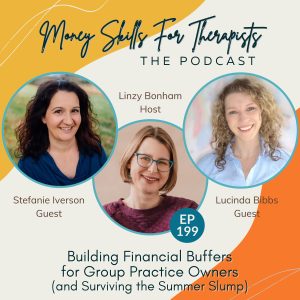
Seasonal slowdowns can shake even the most well-run therapy practices—especially group practices navigating payroll, profit, and growth at the same time. This week, I sat down with Stef Iverson and Lucinda Bibbs, business partners and recent graduates of Money Skills for Group Practice Owners, to talk through what it really looks like to manage cash flow during a summer slump while still honoring long-term vision, wellness, and expansion.

Listen to this episode »

One of the most powerful (and often unspoken) ways we shape our kids’ relationship with money is through our own financial values and beliefs. The way we talk about money, how we feel about money and the habits we build around money ultimately become inherited by our children.

In this solo episode, I reflect on the big hand we play as parents in creating our kids’ money stories. I also explore what it looks like to model healthier financial skills with intention, clarity, and compassion—and why this work is as much a gift to ourselves as it is to the next generation.
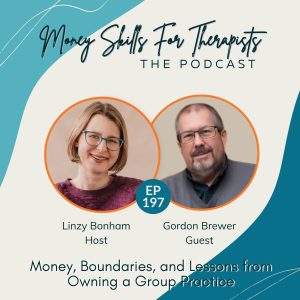
Listen to this episode »

As therapists, most of us were never taught how to run a business—let alone how to manage money, payroll, hiring, or leadership in a way that’s both ethical and sustainable.

Licensed therapist and group practice owner Gordon Brewer and I talk openly about money mindset, generosity, boundaries, hiring mistakes, and what it really takes to create a financially sustainable group practice without burning yourself out or sacrificing quality of care.
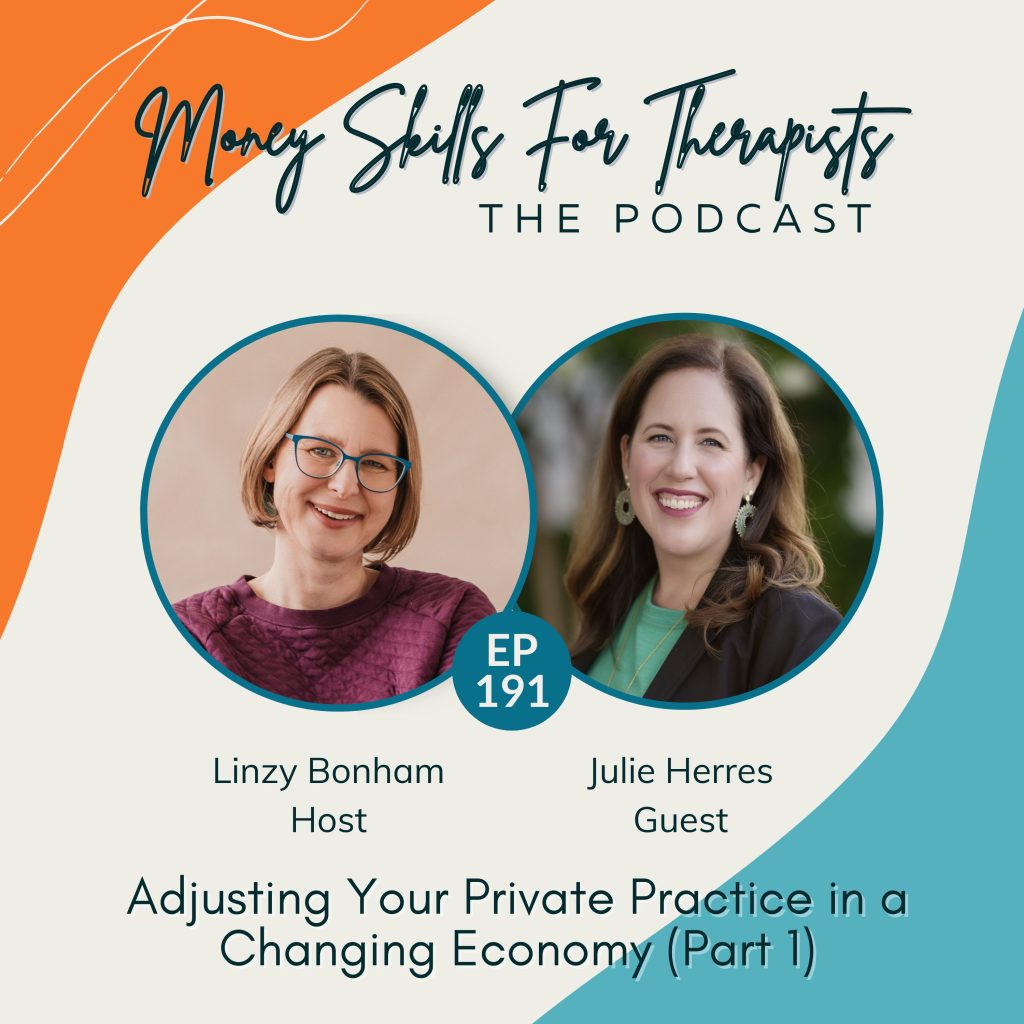
Listen to this episode »
© Copyright 2026 | Money Nuts & Bolts Consulting Inc. | All Rights Reserved
				
					console.log( 'Code is Poetry' );


185: Balancing Financial Success and Christian Values

185: Balancing Financial Success and Christian Values  

Faith is a big part of our relationship to money. And this is something that I’ve had come up with my students over the years, not surprisingly, as they’re working through their beliefs around money. 

So many of the messages we receive about money come from this space — either from what we witnessed growing up in a faith community or from experiences within our current community. And sometimes these beliefs are ones that folks don’t want to hold anymore, but they’ve already shaped how they think about money and the world. 

In today’s episode, faith-based private practice consultant Whitney Owens and I get into how she reconciles her Christian faith with charging premium fees and building wealth in her group practice. She shares what it means to be a financially successful Christian, and how being such elicits feelings of guilt. We also discuss messages about frugality, specifically in Christianity.

The Intersection of Faith and Financial Success

(00:04:17) Enhancing Impact through Team and Services 

(00:10:26) Balancing Faith and Financial Success 

(00:14:16) The Relationship Between Premium Fees and Client Commitment 

(00:17:32) Stewardship and Relationships: Impact of Financial Earnings 

(00:22:12) Money Management Aligned with Christian Values 

(00:28:15) Navigating Emotional Struggles of Financial Success 

(00:31:38) Transformative Profit-First Money Management Strategies 

How Stewardship with Money Impacts Your Relationships and Community

Faith and money are intertwined in our daily lives, whether we realize it or not. 

By intentionally aligning our financial decisions with our spiritual values, we become more financially confident and experience feelings of security and fulfillment. As a result, we’re more likely to make decisions that benefit others.

When we charge higher rates, for example, we are taking care of ourselves and valuing our worth, which allows us to better serve our clients and ultimately provide them with the best care possible. It’s a cycle of self-care leading to better client care, creating a positive impact on both sides of the relationship.

“When we don’t charge our full fees, we don’t feel good about ourselves. We are overwhelmed because we have to see more clients. So it’s the idea that we’re actually serving our clients by serving ourselves. It’s like circular, right? Cyclical.” – Whitney Owens

In addition to implementing profit-first strategies in business, creating a supportive team and culture is crucial to achieving financial success, because it sets the tone for how financial decisions are made. When team members feel supported and valued in their workplace, they are more likely to make decisions that align with their values, including their spiritual beliefs.


Consider these actions to align your money management habits with your faith and personal values: 

  • Invest in marketing services, business consulting, and essential tasks that align with your goals and values to expand your reach and fulfill your mission
  • Create a supportive team and culture that compensates your team members fairly and promotes enjoyment in your workplace
  • Charge premium fees for your therapy work to increase client commitment and to allow yourself to show up as your very best self for those you’re serving 
  • Be a good steward of finances in support of your personal values, using money to care for and support yourself and others, and have a positive impact on issues that matter most to you 
  • Manage money based on your mission to do good in the world, balancing frugality and excessive consumption
  • Implement profit-first strategies and systems in your business, allowing yourself to become the confident, empowered business owner who makes strategic investments 

Follow Whitney Owens:

Instagram: www.instagram.com/wise_practice_consulting 

Therapy Practice: https://watersedgecounseling.com/ 

Practice Consulting: wisepracticeconsulting.com 

Free Facebook Membership Community for Faith based Practice Owners: https://www.facebook.com/groups/533909554128629 

The Wise Practice Podcast: https://www.wisepracticeconsulting.com/wise-practice-podcast 

Ready to feel confident with your money?

Are you a Solo Private Practice Owner?

I made this course just for you: Money Skills for Therapists. My signature course has been carefully designed to take therapists from money confusion, shame, and uncertainty – to calm and confidence. In this course I give you everything you need to create financial peace of mind as a therapist in solo private practice.

Want to learn more? Click here to register for my free masterclass, “The 4 Step Framework to Get Your Business Finances Totally in Order.”

This masterclass is your way to get a feel for my approach, learn exactly what I teach inside Money Skills for Therapists, and get your invite to join us in the course.

Are you a Group Practice Owner?

Money Skills for Group Practice Owners is a six-month course that takes you from feeling like an overworked, stressed and underpaid group practice owner, to being the confident and empowered financial leader of your group practice. Click here to learn more and join the waitlist.

Episode Transcript

00:00:00 – Linzy Bonham 

I’m curious, your perspective on frugality and faith and Christianity. Do you see these things being connected? Is that only in certain areas of the church? 

00:00:13 – Whitney Owens 

I think that’s totally like that. Like, you feel like you have to be that way. And just this whole cultural idea of a pastor’s wife. Yeah. It’s like, oh, I have to hand make my own dresses for my girls, you know? 

00:00:21 – Linzy Bonham 

Totally, totally. 

00:00:24 – Whitney Owens 

I have to fit into this mold. I have to take the casseroles. I mean, it’s so much of a mold. Right. And I was worried about being a pastor’s wife for that reason. And then being a therapist, it was like, oh, so you can give me free advice at church, or, you know, you can see me at a discounted rate because your husband’s a pastor and that’s how you live your life. 

00:00:39 – Linzy Bonham 

Welcome to Money Skills for Therapists, the podcast that helps therapists and health practitioners in private practice go from money confusion and shame to calm clarity and confidence with their finances. If you’ve ever felt overwhelmed by numbers or avoided looking at your business money, you’re in the right place. Hi, I’m Linzy Bonham, therapist turned money coach and creator of Money Skills for Therapists. Before we jump in, check out my Free On-Demand masterclass. You’ll find the link in the show notes or at moneynutsandbolts.com under masterclass. It’s the best first step to finally feeling empowered with money in your private practice. Let’s get started. 

Hello and welcome back to the podcast. Today’s guest is Whitney Owens. Whitney is a counselor, a group practice owner, and she is a faith-based practice consultant. Today, Whitney and I dig into a topic I haven’t, touched at all yet on this podcast, which is faith and money. Faith is a big part of our relationships to money. It’s one of the spaces that we receive messages about money, whether that’s when you’re growing up or with your, your current community. And today Whitney and I get into how she reconciles her Christian faith with charging premium fees. Being successful group practice owners, we talk about guilt in terms of being financially successful and also being a Christian. We talk about messages about frugality, specifically in Christianity, and noticing some of the differences between, you know, being a pastor and being a self-employed person. What is different about those things? And then we also get into some of the practical systems that have allowed Whitney to be so successful in her group practice therapy business and also in her consulting. Here is my conversation with Whitney Owens. So, Whitney, welcome to the podcast! 

00:02:44 – Whitney Owens 

So glad to be on the show. 

00:02:46 – Linzy Bonham 

I am so excited to have you here. I’m so excited for the topic that we’ve talked about talking about today. We’ll see where the conversation goes, but I think this is a really rich topic and this is something I haven’t touched yet on this podcast, which is also really exciting. We get to talk about something new and turn something over from a new angle. So, Whitney before we dive in too much, can you tell folks just a little bit about who you are and what you do.  

00:03:13 – Whitney Owens

Yes. So I’m located in Savannah, Georgia. Most people can tell by my southern accent. It is on the coast of Georgia, which I love. So I’m near the beach. But I have a group practice here, Waters Edge Counseling. We are private pay, 17 therapists, just opened our second location in February. So doing that, having the itch for buildings and more locations, that’s been fun. And then in addition to running my practice, I also am a business consultant that specializes in faith-based practices. So those are people that would say Christianity is a part of my values, overt or not in the way they market their practice, but it definitely influences who they are and the way they run their business. That could be solo or group practice owner. When I’m not working, I am with my husband, he’s actually a pastor. And I have two children, two girls, ages 9 and 12. And I love to read, travel, I love singing. I am in a local choir and gosh, we gotta have fun stuff that we’re doing outside of work because it makes us come alive, right? 

00:04:11 – Linzy Bonham 

Absolutely. Yes. Yeah. I had heard a phrase years ago, which is that we have to make sure that our lives are more compelling than our work. And that’s what I think of when you describe that. Like travel, singing, you know, like ways that we come alive because it’s easy to get absorbed into the work that we do do and have lives that are a bit flat and, you know, two dimensional. And I’m, I’m hearing. 

00:04:33 – Whitney Owens 

Working on it. 

00:04:40 – Linzy Bonham 

Yeah. Yeah. So digging in then to faith and money. You know, this is something that I’ve I’ve had come up with my students over the years, not surprisingly, as they’re working through their beliefs around money. Right. Like so, so many of the beliefs that we have around money can come from our faith community, come from, you know, what we witnessed growing up or what we experienced and maybe sometimes even beliefs that folks don’t want to hold anymore, but that are really, you know, have shaped how, how they think about money and the world. So I’m curious for you. I know that you are a premium fee therapist, you run a group practice, you know how to business. You’re not new here. For you, how do you reconcile, you know, charging premium fees, running a group practice, building wealth with your values as a Christian? 

00:05:26 – Whitney Owens 

Well, this is, this is packed, right? Because we have the Idea of, well, charging our fees, Faith or not, that’s a whole thing, right? And then faith just makes it more complicated. I think therapists that have that Christian background feel a lot more guilt because to us, it’s like, this is our calling. This is our mission. This is how we feel like God’s put this in our heart to do this work. And so then when we charge for it, we feel guilty because, look, missionaries don’t charge. Pastors. Hey, my husband’s a pastor. They make. They make some money, but it’s not like they’re rolling in it. You know what I mean? And so then we feel like we have to do the same. But the thing is, we’re not set up the same, you know, we’re not like, my husband’s a part of denomination. He’s got that extra support. That’s how he’s paid. Like, I don’t have that set up, you know? So I’ve got to find something that’s sustainable. I think something that was said to me, actually, this was said by Mike Michalowicz when he came on my podcast. I love him. And he said, you know, Whitney, when you don’t charge your full fee, do you think about that during the session? Like, are you thinking about your stress about money or which clients are paying full fee? Which ones aren’t? You know? And I was like, well, yeah. And he was like, so you’re not fully invested the way you could be, you know, if you were charging your fees appropriately? I was like, well, yeah. And so just this idea that, like, when we don’t charge our full fees, we don’t feel good about ourselves. We are overwhelmed because we have to see more clients. So. So it’s the idea that we’re actually serving our clients by serving ourselves. It’s like circular, right? Cyclical. 

00:07:04 – Linzy Bonham 

Yeah, Because if the purpose of therapy is to give really good support and. And show up really well for our clients and really help them heal and really help them be with those painful things they haven’t been able to be with previously. Right? Their. Their traumas and experiences, we need to make sure that we’re actually doing that to the best. 

00:07:25 – Whitney Owens 

You know, it’s so interesting. I have found that clients that pay more for therapy are more invested. As weird as it sounds, when a therapist charges a higher rate or their full rate. They’re actually serving the client because the client is more invested. So when I first went cash pay, it wasn’t like I planned all this. I was working at another practice, was taking insurance. I was in the process of getting my hours. This lady fired us all in one day. That’s a whole nother podcast episode. But fired all the therapists on the same day. We all got together and started our own practice within a week. It was crazy, but because I started my own, I couldn’t take insurance anymore because we were credentialed under her practice. So then we had to go cash pay. Well, when I called my clients, I was like, look, I can’t take your Humana or whatever, but I can give you your co. Pay can be what you pay me. I was an associate, so I was doing sessions for like 40, $60. I mean, this was way back, but still. And then my full rate was 80. And the people that paid 80 consistently showed up and got better. And the clients who were paying 40 and 60 just, like, weren’t really there. You know, they would miss sessions, they wouldn’t do the homework. And so as I’ve grown in the profession and I keep raising my rates, I’m finding that the clients that come in are just more focused and working harder in their treatment. 

00:08:49 – Linzy Bonham 

Yeah, they’re literally invested in their treatment. Yeah, yeah. And I have to say these. These numbers that you’re describing, how long ago was this that you went out like that? You lost that  job and had to step into cash pay? 

00:09:05 – Whitney Owens 

It was probably around 2012, 2013. I was in Colorado then, actually. 

00:09:10 – Linzy Bonham 

Yeah. Because I’m like, these numbers are so low. And even then, the difference made, like, showed up the difference between 40 and 80. 

00:09:20 – Whitney Owens 

Totally, totally. And then I came to Savannah and started my practice here because I couldn’t find a job, so might as well start a practice. And I think I started out charging a hundred, but was sliding down to 80 to get clients, you know, and then I was overwhelmed and trying to see as many clients as I could just to make the bills. Like, I didn’t want a full-time caseload because I had children. And so I needed to see about 15 to 18 a week. Well, seeing 15 to 18 a week, charging a hundred dollars and then covering all my expenses, my marketing and all that stuff, I think I made like, I don’t know, 36,000 my first year. And I’m like, what? Like that’s what somebody makes with a high school degree and like, you know, this isn’t. This is not working. Like, I got to do something different. And my coach was like, look, what if you charged 125? And I was like, that’s, you know, like, that’s so awful. And he said, well, you’re full anyway, so what you got to lose? Like, next person that calls, charge 125. See what happens. Well, of course the next person that calls was a mother. I had seen her daughter, and she wanted me to see the other daughter. So then I was like, oh, my gosh, this is so manipulative, because she knows I’m good, blah, blah. But anyway, charged the 125. She didn’t bat an eye. You know, just. It was totally fine. And it just kind of went on from there. I know. 


00:10:34 – Linzy Bonham 

Yeah. Yes. Yeah. And I love the point that you made about the difference between, you know, being a pastor and having your own business. Right. Being a pastor. The way that I would think about it from somebody kind of outside of the faith is like you’re plugged into a bigger institution, right? Like, there’s a bigger machine there that’s managing money and collecting money and distributing money. So you don’t even actually have to think about that as part of your job. You know, you’re just showing up and serving because the money’s going to be there. When we work for ourselves, we’re in a very different position when it comes to the money. So it almost. It almost feels like a little bit of a false comparison, like an apples to oranges to even compare. But I do and have heard that. I’ve had a few students who are married to pastors over the years, and what I have noticed is there is a certain frugality with being a pastor, too. Like, you’re guaranteed an income, but it’s still a low income that also kind of shapes this idea about money. So I’m curious, your perspective on frugality and faith and Christianity. Do you see these things being connected? Is that only in certain areas of the church? 

00:11:40 – Whitney Owens 

I think that’s totally like that. Like, you feel like you have to be that way. And just this whole cultural idea of a pastor’s wife. Yeah. It’s like, oh, I have to hand make my own dresses for my girls, you know? 

00:11:51 – Linzy Bonham 

Totally, totally. 

00:11:52 – Whitney Owens 

I have to fit into this mold. I have to take the casseroles. I mean, it’s so much of a mold. Right. And I was worried about being a pastor’s wife for that reason. And then Being a therapist, it was like, oh, so you can give me free advice at church, or, you know, you can see me at a discounted rate because your husband’s a pastor and that’s how you live your life. And. No, no, I can’t do that. You know, and actually, I’m gonna go so far as to say I can’t do that because I’ve got to make sure our family has the money we need. Like, my husband definitely makes some money to live off of, but it’s my salary that allows us to do anything extra, you know, allows us to go out to dinner, things like that, you know, so we’re not stressed all the time, you know, and so I, in a way, like my business and my work serves the church. So he can keep doing his job, you know, it doesn’t make as much. He’s in a smaller church right now, trying to get it growing. So we can take that risk because I have my business. So I think that brings up this really important point of by making more money, I can serve more people, right? And that could be giving to nonprofits in the area. I’m going to fundraisers as a practice to be able to support things that I care about that align with our values as a practice, but also my own values. I can offer some sliding scales. You know, I can pay my therapists more than if they were over at some agency work. That way they can enjoy their lives more, care for their families, you know. So again, it goes back into this, you know, cyclical experience of by the practice, making more money. I’m taking care of my therapist. They’re taking care of their clients. We’re taking care of the community. And if I was struggling to meet payroll, like, that would be terrible, you know, and then they wouldn’t be paid enough. And it wouldn’t. It wouldn’t go well. They wouldn’t be happy. They would be tired. They’d be overwhelmed. But I’m able to say, hey, you only have to see six clients a day because we charge enough to make it that way. But the practice down the street, they have to see eight clients a day to be able to make ends meet.  

00:14:03 – Linzy Bonham 

Yeah. Well, I mean, what I’m hearing is, by you, and I don’t know what the word is, it’s like, I don’t know if it’s that you’ve made peace with money or you have accepted that money is part of life, like, we can’t get by without it. But I’m hearing that the work that you’ve done around money allows you to support your husband, which allows him to support more. More people in a way that actually his church salary. 

00:14:24 – Whitney Owens 

That’s right. 

00:14:26 – Linzy Bonham 

Not right. And so you’re allowing him to be a more healthy, you know, expansive, happier version of himself. And, you know, I am curious, Whitney, and I’m asking this as someone, you know, a few steps from you. My grandmother was very involved in the church, but I have not been. And so I’ve kind of seen, you know, her world and her life and what the church meant to her. And my grandfather. My grandfather went to the same church from, like, 4 years old till 90 when he passed away. The frugality piece, like, what is that about, like, frugality and ministry? And is there an expectation that folks like Christians should also be frugal? Is frugal good in general, or is that more about folks who are actually just leading the church? There’s a value of frugality. How do these things fit together?  

00:15:07 – Whitney Owens 

I do think that people sometimes feel like they have to be meek. Right. In need. And I. When I think of those terms, I think that’s more of a heart condition. I think you can have. I think you can have money and still be humble. I think you can have money and still be of the meek, of the poor in spirit. I mean, you know, I’m going. I’m referring the attitudes here, but it’s not just about that financial dollar. It’s about your spirit and how your spirit tends to that money. I also, I just had coffee with somebody right before I came here, and we were talking about just pastors that aren’t good, doing bad stuff. Right. Grooming up women and affairs and all this. Somebody was like, so, yeah. What do you think happened to this guy that was so successful as a pastor? And I said, did he buy a plane? You know, because it’s just like, there’s also this. The opposite is also true, that there are some Christians out there that are just making so much money excessively, and these mega churches and what that means and people building themselves up, and that’s sick too, you know? So do you think some people are like, I can’t be that. So they go to this other extreme of, well, I shouldn’t make any money. Well, that’s. That’s not good either. So. 

00:16:28 – Linzy Bonham 

No. Yeah. There’s two extremes there, neither of which is a healthy relationship with money. Yeah. Because the word that’s coming up for me right now is stewardship of, like, being a good steward. For your money. You know, money is power in this world. It allows us to take care of others. It allows us to express our values. But there’s a, you know, a responsibleness there that we can have, or there’s a warmer word I’m looking for there. I don’t know if it’s like, gratitude or, you know, being connected to something bigger that can allow us to use our money in really beautiful, powerful ways. And then at the same time, money can also be used to hurt, abuse. Right. Like, to just build up our own egos. You know, there’s all this potential there. But, yeah, like, does the idea of stewardship resonate with you, or is there another word you would use for. 

00:17:14 – Whitney Owens 

You know, I love that word. I love that word. And as a group practice owner, the most that I think about is how I care for my team, you know, and as I’m hearing you talk, I’m thinking, how can I allow them to have a job they love and get paid a compensation that works for them, that they feel good about, and how can we create that culture together? 

00:17:34 – Linzy Bonham 

Yes. Yeah. There’s a lot of responsibility there that you have as a leader. 

00:17:40 – Whitney Owens 

Yep. 

00:17:41 – Linzy Bonham 

So I am curious. You know the guilt piece. You mentioned guilt at the beginning, does guilt still come up for you? Sometimes. When it comes to, you know, charging your fee or. Or being financially successful, do you ever feel guilty? 

00:17:51 – Whitney Owens 

Yeah. So I was thinking about this as we were preparing. I was thinking about the interview because, Linzy, you and I got to hang out in Orlando back in March, and I just really enjoyed our time together. You had so many great things to say about money. And one of the things we discussed, we were like, well, how’s your group practice? How’s the money? And I was so embarrassed. Remember that? I was like, you were. I don’t want to tell you how much money I make. And I have the issue of. I feel so guilty some of how much money I make, and I don’t even. I’m still kind of, like, processing and dealing with that still. But, yeah, when my accountant calls me and says, hey, here’s the amount, I’m like, what? Like, it’s this amount that I’m like, I don’t even know how to put my mind around that. And then I feel guilty about that. So then I just kind of, like, separate myself from it. I’m like, whatever, we’re fine. Move on. 

00:18:43 – Linzy Bonham 

Yeah. Yeah. You ran away. Diane. Who coaches with me? Diane and Whitney and I were hanging out in my hotel room chatting, and then I Asked Whitney one of those questions that would be very rude if I wasn’t who I am. Or maybe it is rude, but I still asked. I asked, you know, I asked you, how much, how much do you make? Like, what. What did you get paid from your group practice? And you said, uh, I have to go to the washroom, and ran away. And Diane and I had a little laugh, which you could hear. We were like, oh, she’s running away. Okay, bye, Whitney. And then you came back and told us. So you. You literally, you fled with embarrassment. So. Yeah, so there, there is a. You know, I can saw, witnessed and hear that there can be. There’s still some. Some reconciling to do or. 

00:19:27 – Whitney Owens 

Yeah, it’s been interesting. This is timely. We’re working on implementing EOS. Are you familiar with. 

00:19:38 – Linzy Bonham 

Okay, I learned about this last night at a networking. 

00:19:45 – Whitney Owens 

Maybe there’s something happening in the spiritual for you. So. Yeah. So EOS is an entrepreneur operating system. It’s from the book Traction. If people are interested in learning more and there’s like a whole EOS library of books, but it’s just a framework for how to better run your business. And when you get to a certain point, they actually recommend. When you hit about the $2 million mark is when people start to really struggle with the owners just has so much responsibility and all that kind of stuff. So anyway, so I actually recently hired a fractional integrator talking about expensive. But I was like, hey, I got the money, come on. So I hired the fractional integrator to help me kind of start implementing EOS. And one of the concepts of it is you’ve got let people into your money. Linzy, I’ve never showed anyone the bank statements other than my accountant. You know what I mean? And so I sat down with my soon to be integrator who’s like employed at the practice. And I was like, look, I’m about to let you under the hood and I’m freaking out about it. Like, now I’m gonna have this extra accountability. Someone’s gonna see how much money is in there, and I’m nervous about what they’re gonna think about it or judge me for it. And so I’m constantly like, well, I spend money on all these things. Almost like I’m trying to justify and I don’t have to, but I do it, you know, so this is going to be good for me, you know, I’m trusting people, and if you want to grow, you’ve got to. 

00:21:06 – Linzy Bonham 

Yeah. And I am curious, like, thinking about faith, too. If faith is part of this, and maybe it’s not, what do you think is some of the content of that embarrassment for you? Like, what is. What are the fears about the fact that you have been so financially successful? 

00:21:17 – Whitney Owens 

Well, I’m worried that they’re going to think I need to pay them more. Right. Like, and. And to me, I’m very conservative with money because I didn’t. I’ve seen so many practices. I’m sure you’ve seen this so many times, Linzy. So many people who are taking out loans to meet payroll. I. People I would never think would have had to have done that, are doing it consistently, or people who are like, I have 10 therapists, and I make less than I did when I was a solo practice owner all the time. Now, the clinicians aren’t going to understand that, see that they don’t know what you’re spending all that money on. So that’s the thing that worries me, is that I’m going to, like, all of a sudden make all these decisions, and then I’m going to have no money, and then I have to go back to, like, this is crazy. Like, I’m fine. Like, it’s. This is not what it is. So I guess it’s that fear of not having enough, you know? And maybe that does tie into what we were talking about earlier. Like, So when I went through college, I was a missionary for three years at the University of Georgia campus, where I raised funds to be able to stay and mentor students and do ministry. Oh, my gosh. I mean, you just never knew when your next check was coming. I mean, I remember sitting and praying, I need a check. I can’t pay my taxes, and they’re due next week. Of course, things would always work out. The check would come at the right last minute, you know, and it would be everything I needed. But, like, that’s how I started my life as an adult was, I don’t know if I’m gonna be able to pay my bills, and I’m sharing a room with somebody, and I’m 25 years old, not sharing a house, sharing a room. And so I think I started at that place. I remember. I remember being like, I can’t go to Chick Fil A. It’s too expensive. And so I do think, like, I don’t feel it. But on my logical mind as a therapist, the things I know, there’s probably a connection there for how I think about it now. 

00:22:55 – Linzy Bonham 

Yeah. I mean, where you’ve gotten to. I’m sure you never could have imagined when you were sharing a bedroom and not able to go to Chick Fil A. Yeah. 

00:23:05 – Whitney Owens 

Fortunately, I had a friend that paid for my Chick Fil A life, so. So. 

00:23:07 – Linzy Bonham 

Oh, that’s nice. 

00:23:10 – Whitney Owens 

I know. Friends I know. Yeah. Indebted to her. So then later, when we needed to go on a girls trip and her husband had lost his job, I was like, girl, I got you. I can pay for your way. And, you know, so it was. It was a really healing moment for me, actually.

00:23:23 – Linzy Bonham 

Yeah, absolutely. I. I think about money as a resource that’s. 

00:23:24 – Whitney Owens 

Right. 

00:23:25- Linzy Bonham 

To be shared. Right. And I think about this especially in. In family, you know, where in my family, one side of our family is much more financially resourced than the other side of the family. And sometimes I see us as a conduit, just flowing that resource between the two sides because it’s like, there’s more than enough here. Right. If we distribute this well, if we. If we’re good stewards for this money, it’s like we can all be happier and healthier for it. So, yeah, I. I do really think about money of that way, that nice flow. Yeah. Between friends and people that, you know, our loved ones. So, I am curious for you, Whitney, thinking about the practical side of money, like, what practical systems have you implemented in your business that have helped you feel grounded about money and. And make these. These great decisions that you’re making that have gone.  

00:24:12 – Whitney Owens 

Yeah. Well, I’m going to call out Julie Herres’ book Profit Frst for Therapists. Great book. And, you know, we talked about Mike Michalowitz earlier, so the Profit First, I know you talk about it a lot on your podcast. So once I started implementing Profit first, that was Game Changer, where I was like, oh, I am doing better than I realized because I started putting the money in the accounts and I was like, oh, look at all this extra I have. Like, this is great. And that was when I was able to start implementing health insurance and retirement for my team, because for a long time I was like, I don’t think I have enough money to do that. And then Julie’s team was like, yeah, you do. I was like, okay. So I’ve been doing profit first ever since, and that has given me so much confidence in where I’m at and what I’m doing. So I would say that is number one. Another thing that I have done is buy the building. So I purchased. It’s a long story. And I have a whole podcast on my Wise Practice podcast. And Did a whole episode about my journey of buying this building and the faith part of it, of God directing me into it. But it was an 18 month project from the time I put the, put the offer into the time that it got completely renovated and ready to go. But that’s been great. That taught me a lot about investment, a lot about retirement, and I’m really happy to be paying myself rent. So that’s been really great. You know, something else that’s coming up for me as we’re kind of talking about this is this, going back to calling. The idea that’s coming up for me here is that Water’s Edge counseling doing great, you know, and that’s what I can rely on for my income. But the consulting business, I mean the consulting business is, is great. It’s just a newer business. And so it makes money in a very different kind of way. And I don’t have like a lot of people working for me, just a couple. But the point is I do that work more because I love it, what I make, you know, I mean, it’s, it’s something. But I could make a lot more money if I just kept focusing on Water’s Edge and growing that I do the consulting because I love it. I love what I do. I love seeing practices grow. I get to do stuff like this with you, Linzy. Like, this is so much fun and brings me so much energy and passion. And like, even looking at the summit, it’s like, well, yeah, I do make some money off the summit, but I could run a mastermind group for six months and make more than I make off that summit. Like, you know, so it’s, it’s a hard, it’s a hard thing to figure out because we can’t judge everything on money. But then sometimes people are like, well, you should look at how much you make. Is it worth what you make? So it’s hard for me to find that balance of how much should I be looking at money and how much should I just be looking at how much I love something. And then for me, again, I feel called to do consulting. Like, I feel like the Lord made that clear and I ran away from it for a long time. And the summit is something that I just see God’s hand in it. I just can’t walk away from that, even if I’m not making that much money, because it’s so life giving for me and other people. 

00:27:01 – Linzy Bonham 

Yeah, well. And I think one of the beautiful things about where you’re at is you have built a machine with a group practice. And that’s the language that I like to use when I’m working with folks. Like, there’s a machine there and it takes building and sometimes you have to tweak it and you’re like, oh, this was all wrong. Oh, shoot. I have to have all these hard conversations. Like, it’s rarely a smooth path to build a successful group practice, but once you do, like, that’s your bread and butter. But then you can also go have fun, right? Like, you don’t actually have to make money off of the consulting and the summit. I think you will. Right. But there’s also this piece of meaning, right? Like, I have a good friend who’s very financially successful and basically has it made. He’s 30 years old. He could basically just stop working at this point. But, you know, he kind of chased that dream of, like, retiring early and then he could do that now, but he’s like, but I don’t. That’s not satisfying. Like, what is life really about? Right? Like, what actually fills your cup? And it’s been interesting over the last few years to watch him trying all these different things because he has the money and the means to, you know, try living, you know, in different places and living the kind of expat, fun lifestyle. And it’s like, that’s not satisfying. And, you know, and we were just talking the other day about how at the end of the day, a lot of life is just about, you know, like, being with your people, taking care of your people, doing the stuff that you love. And this is what I’m hearing is, you know, this is part of you serving your people.

00:28:20 – Whitney Owens 

That’s right. Yeah, definitely a way that I’m serving my people. And Water’s Edge allows me to do that, and it lets me do fun things. Like, that’s how I went to the ACA conference and was able to speak. Like, the consulting is my platform to be able to do fun things that I. I personally need in my life because it makes me a better therapist. And they do. They truly do feed each other as well. So, you know, that’s important too. I think there’s also something to be said for, like, we use our money. This is something I’m learning right now to create our team. Right. And so, like, for the next conference, which, I’ll tell you, I hate working with the hotels. It’s the worst. Negotiating. Oh, yeah. So now I hired somebody to do that. So this year, she gonna get all that together for me. And I’m like, wow. Like, that’s what I spend my money on. Things that allow me to move the needle forward and things that I love. And I don’t have to feel guilty that I made enough money to do that, you know, because it actually allows me to do more of good, Good. God’s good work in the world. Because I’m not focused on this hotel thing. Right. And so I see so many therapists, or just people in general, they don’t want to invest their money because they’re scared. Well, when you’re not investing your money, you’re actually not doing more of the mission that God put on your heart, and you become the bottleneck for ministry. If you say that your work is ministry, you’re getting in the way of that. You could be doing so much more by putting your money into the marketing services you need or into business consulting or into someone helping answer the phones, whatever that is. You can extend your hand more in the world by having these things. You need the money to do it, so you better charge enough so you can do those things, and then you’re actually doing the mission better. 

00:30:10 – Linzy Bonham 

Yeah. Right. You’re really expanding your reach. Yeah, yeah, because there’s. There’s people who need what you do, whatever that is. Right. And. And this. This is something that I talk about with. With marketing stuff too. But, like, when we’re not really putting ourselves out there, the people who really need us are not able to find us or we’re not able to serve them because we’re busy doing something that we Hate like negotiating with a hotel instead of offering an amazing workshop or opening up another spot on our calendar. Right. So there, there is a kind of like a blunting there of potential or dampening of your gift when we’re spending all this time doing things that are really not our unique contribution. 

00:30:43 – Whitney Owens 

Oh yeah, yeah. My marketing specialist and I were just talking the other day. She’s like, what are we doing with your social media? And I was like, well, we are trying to reach as many faith-based practice owners as possible so that they don’t feel alone in the work they do and then they can find community and someone to help them be successful. That’s what we’re doing. But if I didn’t have the money to pay her, that wouldn’t be happening. 

00:31:07 – Linzy Bonham 

No. Yeah. Whitney, thank you. 

00:31:08 – Whitney Owens 

Oh, I love it. 

00:31:09 – Linzy Bonham 

I have so enjoyed this conversation. For folks who are listening who want to get further into your world, can you tell us about where to find you? Some of the great things you do. 

00:31:17 – Whitney Owens 

Yes. So you can head to wisepracticeconsulting.com I do have a podcast. You were a guest not too long ago. So that’s the Wise Practice podcast. But yeah, you can head to my website. I’ve got a free PDF for ways to market and network with churches. If you’re a faith based therapist or not. It’s helpful because it’s hard to know how do we talk to pastors. So you can grab that. There’s just a bunch of other. We have a membership community for faith based practice owners and then we host a summit every year that I’ve been talking about. We usually do that in the fall, the Wise Practice Summit. So yeah, check it out. 


00:31:52 – Linzy Bonham 

I really appreciate Whitney coming on the podcast today to, to share her experiences and her, her growth over time too, with her relationship to money. As a, as a Christian, I really like the idea that we dug into about taking care of money and what you can do with money. And you know, we can always see these extremes, I think, in, in all sorts of different types of communities that we’re part of and in ways of looking at the world of extreme ways to be with money. Right? Like, we can be extremely frugal and self sacrificing, or we can be extremely kind of consumptive and flashy when it comes to money. And generally speaking in life, my default is that the truth is somewhere in the middle. You know, the balance is somewhere in the middle. And money is a tool. So when we can manage that tool from grounded, loving, values, aligned places, whatever those values are for you, then you can use that tool to do good things in the world. And I just love this idea of really connecting with the potential that money brings to our lives. So I so appreciate Whitney coming on the podcast today. You can check out the links in the show notes to get further into her world.  

So, Thanks so much for joining me today. I’m Linzy Bonham, therapist turned money coach and creator of Money Skills for Therapists. If you’re ready to go. From any confusion and shame to feeling clear and empowered, My Free On-Demand Masterclass is the best place to start. You’ll learn my four-step framework to get your private practice finances finally working for you. Register today using the link in the show notes or go to moneynutsandbolts.com under masterclass. I look forward to supporting you. 


Picture of Hi, I'm Linzy

Hi, I'm Linzy

I’m a therapist in private practice turned money coach, and the creator of Money Skills for Therapists. I help therapists and health practitioners in private practice feel calm and in control of their finances.

Latest Episodes

Seasonal slowdowns can shake even the most well-run therapy practices—especially group practices navigating payroll, profit, and growth at the same time. This week, I sat down with Stef Iverson and Lucinda Bibbs, business partners and recent graduates of Money Skills for Group Practice Owners, to talk through what it really looks like to manage cash flow during a summer slump while still honoring long-term vision, wellness, and expansion.

Listen to this episode »

One of the most powerful (and often unspoken) ways we shape our kids’ relationship with money is through our own financial values and beliefs. The way we talk about money, how we feel about money and the habits we build around money ultimately become inherited by our children.

In this solo episode, I reflect on the big hand we play as parents in creating our kids’ money stories. I also explore what it looks like to model healthier financial skills with intention, clarity, and compassion—and why this work is as much a gift to ourselves as it is to the next generation.

Listen to this episode »

As therapists, most of us were never taught how to run a business—let alone how to manage money, payroll, hiring, or leadership in a way that’s both ethical and sustainable.

Licensed therapist and group practice owner Gordon Brewer and I talk openly about money mindset, generosity, boundaries, hiring mistakes, and what it really takes to create a financially sustainable group practice without burning yourself out or sacrificing quality of care.
Listen to this episode »
© Copyright 2026 | Money Nuts & Bolts Consulting Inc. | All Rights Reserved
				
					console.log( 'Code is Poetry' );


184: Financial Foundations for Therapists: Essential Jobs for Your Dollars

184: Financial Foundations for Therapists: Essential Jobs for Your Dollars 

How much and how often should I be paying myself from my private practice?  

How can I effectively manage my business expenses? 

How much money should I spend on personal development each year?  

How much should I set aside for taxes? 

These are some of the most common questions I help therapists solve when they join my signature course, Money Skills For Therapists, and are looking to gain clarity into their business finances and create stability in their practices 

In this week’s podcast episode, I offer an in-depth overview of the various jobsyour money must do, no matter how much of it you’re making or the size of your practice.  

But before we dive into the specifics of all these different jobs, the core concept that I want to leave you with today is that your money needs to take care of you.

(00:22:52) “What you can control is what you are doing with your money. We need to focus on what is in our control.” — Linzy Bonham 

In our professions, we give so much time and energy to our clients. We’re also natural caregivers to our children or our aging parents, or we’re giving to our community and our friends in all these other ways. We tend to be very giving, self-sacrificing humans.

What’s important to remember is that when you build a business and start generating money, part of that business’ job is to take care of you so that you can keep showing up in life – both professionally and personally – and do the incredible work in the way that only you can do it.

If you’ve been wanting more clarity around where your money should go — and how to make it work for you — this episode will help you find calm, structure, and confidence in your financial decisions. 

Establishing Clear Boundaries: Fixed vs. Variable Business Expenses

The first step to making your money work for you is to identify business non-negotiables like taxes, rent, software, utilities, and other expenses that are required for you to conduct business. Many practice owners find it useful to use multiple bank accounts – one for each large expense group like taxes, business expenses, and payroll to help manage and visualize how much money goes toward each category.  

For variable expenses, like personal development and continuous learning opportunities, getting clear on your budget, being strategic, and making informed decisions can help prevent overspending funds you might need for license renewals or other necessary expenses.  

And rather than swiping cash from the business to pay your mortgage or other personal bills just before they’re due, you can begin to create stability and security in your personal financial life by having a clear and consistent amount deposited into your personal checking as a regular, reliable paycheck that you and your family can depend on.  

(00:13:31) “Your business needs to be paying you regular, reliable paychecks that your family can depend on.” – Linzy Bonham 

Optimizing Business Expenses for Private Practices

(00:05:25) Separating Your Revenue into Necessary Expense Categories 

(00:07:17) Optimizing Business Expenses for Private Therapy Practices 

(00:10:35) Strategic Budgeting for Personal Development & Continuous Learning 

(00:13:37) Profit & Paycheck Systems That Create Financial Stability at Home 

(00:18:06) Establishing Expense Buffers to Sustain Your Practice During Rough Patches 

Action Steps for Therapists Who Want to Create Financial Stability with their Private Practice:

If you’re ready to feel calmer and more confident with your business finances, here are a few small but powerful steps you can take: 

  • Open a dedicated bank account for taxes. Give your tax money a clear home so it’s always ready when you need it. 
  • Get clear on your expenses. Take a look at both your fixed costs (like rent and software) and your variable ones (like trainings or supplies) so you know what’s truly required to keep things running smoothly. 
  • Set a thoughtful budget for professional development. Decide how much you’ll invest in your growth this year — and give yourself permission to stay within that boundary. 
  • Create a consistent paycheck system. Paying yourself regularly helps your personal finances feel stable and dependable. 
  • Build small buffers into your business accounts. These little cushions can make all the difference when unexpected expenses come up. 
  • Join my free masterclass. Learn the three most common mistakes that keep therapists from finding clarity and peace in their private practice finances — and what to do instead. 
  •  

Follow Linzy Bonham:

Ready to feel confident with your money?

Are you a Solo Private Practice Owner?

I made this course just for you: Money Skills for Therapists. My signature course has been carefully designed to take therapists from money confusion, shame, and uncertainty – to calm and confidence. In this course I give you everything you need to create financial peace of mind as a therapist in solo private practice.

Want to learn more? Click here to register for my free masterclass, “The 4 Step Framework to Get Your Business Finances Totally in Order.”

This masterclass is your way to get a feel for my approach, learn exactly what I teach inside Money Skills for Therapists, and get your invite to join us in the course.

Are you a Group Practice Owner?

Money Skills for Group Practice Owners is a six-month course that takes you from feeling like an overworked, stressed and underpaid group practice owner, to being the confident and empowered financial leader of your group practice. Click here to learn more and join the waitlist.

Episode Transcript

00:00:02 – Linzy Bonham 

Hello and welcome back to the podcast. Today I’m going to talk about the various jobs that your money has to do in your private practice. The core concept that I want to start with before we get into the specifics of those jobs, is the fact that your money in your private practice and your group practice needs to take care of you. In our professions, we give so much time and energy to the people we take care of to our clients. We’re often also just natural caregivers who might be parenting or taking care of our own aging parents, or giving to our community and our friends in all these other ways. We tend to be very giving, self sacrificing kinds of humans. And when you build a business, when you start seeing clients privately, or whether you’ve been doing that for, you know, two months or 10 years, when you’re seeing clients privately, you have created a machine that is generating money.

00:01:04 – Linzy Bonham 

And part of that machine’s job is to take care of you. You are the beating heart of your practice. Without you, there is no practice. Right? Your practice is based on your gifts, your particular personality that you brought to the show. Your practice is built on who you are as an individual person and the services that you can provide because of that. 

00:01:37 – Linzy Bonham 

There is this distinct combination in your practice of your natural gifts with your values combined with your education and all the skills that you’ve learned combined, combined with your passions and your vision. And all of these things come together to allow you to provide therapy, counseling, physical, manual treatments in a way that literally nobody else can. I want to start by saying that by recognizing just how important and central you as an individual are in your business. If you are not well, your business doesn’t exist and you are offering something in the world in a way that literally nobody else can.

00:02:21 – Linzy Bonham 

Your particular flavor of what you do is going to appeal to certain people and it’s going to land with them and allow them to open up about things they never been able to talk about, or allow them to actually stick to new habits and routines and do the homework that you give them in a way that the person down the street would not be able to motivate them and support them in doing right. 

00:02:41 – Linzy Bonham 

Each of us are offering something very specific and unique and we need to honor that when we are building our businesses, because our businesses need to make sure that we continue to be well so we can keep doing that work in the world also, so that we can just be happy, functional humans. We’re living the lives that our clients think that we are living. Our clients think that we are living incredible lives. They think that we have great relationships and amazing communication and we take care of our bodies and we go on great trips or, you know, whatever stories they have, they think that we are living those lives.

00:03:13 – Linzy Bonham 

Wouldn’t it be so great if we actually were, you know, if we’re showing up in our practices with true authenticity, with practicing what we preach, because we are actually taking care of ourselves. And money is a huge part of that. The money that you are generating in your practice feeds back into your life needs to take care of you so you can keep showing up and doing this incredible work in the way that only you can do it. Okay, now that I’ve given that little love pep talk, let’s move into the different jobs then that your money has to do in your practice to take care of you and have you be well.

00:03:46 – Linzy Bonham 

Because some of those are about you. Some of them are about obligations that you have to uphold so that you don’t end up in hot water because that’s never good for you. So let’s start with the least fun obligation first, which is taxes. The money that we collect from our clients that goes towards taxes. I find it’s very helpful, although not fun, to think about that as not your money. Right. The money that you identify is for taxes. 

00:04:16 – Linzy Bonham 

You know, that’s going to be partially your income tax, which is going to be probably somewhere between 15 to 25% of what is left in the business is going to be income tax for you. That is not your money. You are holding it on behalf of the government until they learn about how much you owe them. And they say, give me that sales tax. For those of us who have to collect, sales tax is a much more obvious one. It’s like we collect the money. A certain amount off the top is identified as like, this is sales taxes. We need to have a clear system to set that aside to make it very clear that is not ours. Right? Because once we start to think about all the money in our business bank account as ours, then paying taxes can become that much more painful. 

00:05:02 – Linzy Bonham 

Because it’s like, but that’s mine. I don’t want to give you that tax money. Especially at tax time, if you haven’t done any quarterly remittances or if you’re not an employee of your business, if you’re not incorporated or an S corp, and if you’re not paying monthly, if you have to hand over at the end of the year as a sole proprietor, you know, possibly even like 15,000, $20,000 in taxes, that hurts a lot if you’ve been thinking about that as your money. 

00:05:25 – Linzy Bonham 

So the first job that we need to think about our money doing is to pay taxes. And that’s its job. Once we have identified an earmarked that that money is for taxes, it is not ours. It belongs to the government. We’re holding on behalf of the government sometimes. I’ve seen it actually help therapists who I’ve worked with in money skills for therapists to pay taxes more regularly. So it gets out of their bank account so they don’t form that kind of emotional attachment with it, that ownership of the money. So they do remittances even before the government asks them to just to get it out of their account, just put it towards their tax account with either the IRS or the CRA depending on where you’re located. 

00:06:03 – Linzy Bonham 

Just to make it really clear that’s not yours. That is an obligation you’re fulfilling. You’re paying taxes to the government and. And by fulfilling that obligation you’re keeping your life nice and clear and simple and you are also paying for roads and schools and lots of good things that happen. I know that we’re also in a political time right now where taxes might be even more fraught based on what certain governments are choosing to do with our taxes. Also though tax money belongs to whatever government is in power at the time. You know, when we go into times where we have governments that are making decisions that you agree with, they’re using all the tax money that’s collected to make what you think are great things happen. Right. When you’re in times when the government is doing things you don’t agree with, still some of that money is going to be going towards things that you do agree with. Right. And so finding a way to make your peace with it philosophically really helps to remove some of that pain and resistance and resentfulness that can come with taxes.  

00:07:01 – Linzy Bonham 

So being clear about this, making this more systemized, having a separate bank account for taxes, you know, kind of a profit first style system, even if you don’t do the rest of profit first, even if you just set aside a tax amount that is going to really help you be clear on this is for taxes. 

00:07:17 – Linzy Bonham 

This other money here is for other things in the business. So now let’s talk about those other things in the business are next I’m going to talk about business expenses because that can also be a type of obligation. Right? We’re kind of taking care of like the obligations first here before we talk about the things that are A bit more, more generative and life giving in your practice. So your business expenses, some of them are going to be variable. They’re things that you can choose what to spend on. You can choose to take a certain training because it’s exciting to you. You can choose to buy cute flowers for your office. Those are things of your choice. But other things are going to be fixed. Expenses that you’ve committed to, things like rent, subscriptions for your software, you know, your EHR software. Any kind of advertising that you are doing, regular, what are they called? Any kind of regular advertising that you’re doing, like Psychology Today kind of profiles, those are set expenses that come out every month. 

00:08:20 – Linzy Bonham 

And being clear on what those are, kind of like your monthly baseline of those expenses is important to make sure that also you’re keeping those expenses at a place that is sustainable for your business. So the money in your business has to pay for those ongoing obligations, the things that keep the lights on, your annual license, things like that.  

00:08:38 – Linzy Bonham 

And if you do have large annual expenses that come out, it’s helpful for you to take time to sit down and look at how do those expenses spread out over time and make sure when you’re thinking about your monthly expenses, you’re including, you know, $50 a month that’s going to go towards that large annual expense. Sometimes I’ve seen folks make a separate bank account for those large annual expenses or when they start using a budgeting system, they’re accounting for those large annual expenses in their budgeting.  

00:09:02 – Linzy Bonham 

So it’s not a huge painful surprise. For me, it used to be December. In December it was like my college renewal was up, my insurance was up and I’d have these two really big bills come out at the same time. Expecting those by being clear about what your business expenses are and leaving a little bit of money aside for those so that you’re building up a nice buffer. Takes a lot of the paint out of it with business expenses. Something else we have to be mindful of is to not overspend in our business. 

00:09:29 – Linzy Bonham 

It can be really tempting to overspend in our businesses because for multiple reasons, it is way easier to spend money in our businesses than it is at home. At least I find this for myself, right? Something in my business that I look at that’s, you know, $2,000. I’m like, oh, that’s a no brainer. That’s going to help my, you know, me and my team fix this problem that we have or help us make more sales in the future.  

00:09:51 – Linzy Bonham 

You know, spend money to make money. It’s so easy to spend that $2,000 in the business where at home. I would never spend, you know, maybe that that amount on a comparable thing at home. So businesses can be, you know, money eating machines. That’s, you know, something like that is the phrase that Mike Michalowicz uses in his book Profit First. 

00:10:12 – Linzy Bonham 

You know, our businesses can kind of eat all of our money because it’s very easy to spend on business expenses. So a big part of business expenses is getting clear on yourself of what is actually your budget for business expenses. What is that monthly baseline and then how much are you going to spend on those other fun things. The thing that I see people overspending on the most is professional development. 

00:10:35 – Linzy Bonham 

I think that as helpers and healers, or maybe it’s just the helpers and healers that I hang out with, folks like you, we tend to over invest in our professional development because we always want to be better at what we’re doing. There can be so many reasons for that. It can come from like a not good enough place. It can come from may maybe a bit of FOMO wanting to like get up on the latest training because your colleagues are doing that training. Sometimes it can come from a place of just unbridled enthusiasm of what we’re doing. We just love what we do and it’s so interesting. So you know, a 500 TR$500 training pops up here. We go to that, some cool speakers coming to town to do a workshop. We sign up to that and before you know it, we’re spending thousands and thousands and thousands of dollars a year on our professional development that we might not actually really have. So that’s somewhere that I find can be helpful for folks to stop, slow down, you know, think about your own professional development right now. Do you have clarity yet on what is actually your professional development like budget for the year? Do you have clarity on how many trainings you can take a year without actually just kind of over saturating yourself and not absorbing it anyways? Having clarity, some sort of money rule at least about trainings of like I do, you know, two trainings a year and those trainings are, you know, $2,000 or less, something like that. 

00:11:58 – Linzy Bonham 

That allows you to slow down and notice and make an informed decision about trainings, not overspend. Also having separate bank accounts where you actually have your business expenses or opex operating expenses amount so you can see what you have that can help you slow down and stop from overspending on professional development because it really is, I find one of our Achilles heels as helper healer types. 

00:12:26 – Linzy Bonham 

So that’s the other thing that your money has to do. We first talked about taxes. Second one, business expenses. Your money has to take care of the business itself. It has to take care of the business itself. It has to pay for those regular expenses. It has to help you have tools and systems to run the business smoothly. Often tools that help you to automate a process.  

00:12:47 – Linzy Bonham 

Sometimes it can feel, oh, to like, swallow that, like, I don’t know, 20 bucks a month that you’re paying for a certain tool. But if it saves you lots of time and it helps you retain clients, the return on investment on that can often be great. So business expenses is the second thing. The general guideline for business expenses from, you know, a profit first perspective is 30% or less of what’s coming in the door. I’ve seen huge variability with that with therapists over the years, especially with online business folks working from home. I see that, you know, it can be as low as 15%, but that’s kind of the range. You’re looking at like 15 to 30.  

00:13:20 – Linzy Bonham 

The next one is, I’m going to say, the most important one, although without the other two, this third one can’t exist. And this is your paycheck or salary. Your business needs to be paying you regular, reliable paychecks that your family can depend on. You need to know how much is going to be coming home each month so that you can. You need to know how much is coming home each month so that you can plan how much you’re going to be spending on groceries and know that your rent is covered and be able to put money aside for enjoyable things for yourself or your family. I am so passionate about helping therapists create a regular paycheck system that allows them to have regular paychecks even if they’re sick or away.  

00:14:32 – Linzy Bonham 

Something that we do so often as therapists is we will be going away. So we see a bunch of clients before we go away to try to cram in the client hours before our vacation. And then after we come back, we cram in extra client sessions and we end up actually just undoing the benefit of the vacation or we work when we’re sick because otherwise we’re not gonna be able to get paid. Right. You can build a paycheck system in your business that allows you to have a regular paycheck every month. All it takes is zooming out on your numbers and understanding what your numbers look like and finding that number that makes sense. For you, that covers off the time that you’re going to want to take for vacation, but also just the time you’re going to be sick because you’re a human.  

00:15:15 – Linzy Bonham 

This is an incredibly important job that your money has to do in your business is to give you this regular, reliable paycheck. Because if you are financially stressed, if you are worried about making your own bills, then you are not going to be your best self. Clinically, you just can’t, you just can’t do both of those things. You cannot be stressed at home, you cannot be staying up at night thinking about money, and you cannot be also feeling resentful. 

 00:15:42 – Linzy Bonham 

If clients cancel or stop treatment because you know that it’s going to deeply impact your household finances, those things cannot be happening and also have you be doing your best work. I hate to say that it always feels really harsh to highlight that because I know as therapists, we so pride ourselves on the values, we so pride ourselves on the value of the service we’re providing and wanting to do the best work that we can. But if you are not okay financially, your work is being impacted. So that’s a really important thing that your business has to start doing is paying you regularly, giving you the support and stability so that you can be well. And that is the third job that your business has to do, which again, is the most important job from a big picture perspective. 

00:16:30 – Linzy Bonham 

Because again, you are the beating heart of your business. If you are not well, if you are not taken care of, your business actually can’t exist. The services that you are providing in this container, that is your business will not continue if you are not well and able to show up as your best self and give great service and make great choices. The final job that your money can do, which I see as optional, is this idea of profit systems. The system Profit first, which I have been personally using for probably nine or 10 years now, has a profit account. 

00:17:07 – Linzy Bonham 

And the idea of profit is that you have some extra money in the business to reward yourself. What I find is for some therapists who are more reward oriented, this is like a really exciting thing to like, let their business build up some money and then be able to take, you know, a couple thousand dollars once a quarter or maybe, maybe less, maybe $900 once a quarter to do something fun. 

00:17:29 – Linzy Bonham 

For folks who are more rewards oriented, this can be really motivating. And this is something you can build out using a profit first style system, which I teach in Money Skills for therapists. For other folks, I find that this profit concept is not as resonant because they’d rather have the stability of just having a better regular paycheck. So part of this, too, is identifying for yourself what really motivates you, what feels good, what is a great way that your business can reward you. Would you rather have a bit of a higher paycheck on a regular basis and have this higher level of comfort in your stable income? Or would it be really motivating for you to set up a system where you set some money aside and then once a quarter you’re like, yes, I’m going to go to the spa, right? Or I’m going to buy that nice chair for my living room that I’ve been looking at online for, like, months. That is going to be really up to you. And this is part of really building a good relationship with money, is getting clear on what feels good to you, what is motivating, what is meaningful for you, and building systems that support that. The final piece of what your money has to do for you in the business actually spreads across all these other categories. And these are buffers. I use the phrase in my course Money skills for therapists. Buffers, buffers everywhere. We want buffers all over the place. Saying buffers, buffers everywhere assumes that you do set up eventually a multiple bank account system. 

00:18:53 – Linzy Bonham 

So it’s like in your taxes account, there’s a bunch of money there for taxes. In your business expenses, there’s extra money there so that if you can’t see clients for a few weeks because there’s a family emergency and you can’t work, your rent is still paid next month, you don’t have to worry about the fact that you didn’t see clients for a couple weeks. Same with paycheck and salary. Building up a paycheck buffer. Buffers create the stability to allow you weather Buffers create the stability to allow you to weather storms. 

00:19:21 – Linzy Bonham 

I will say right now, with the what is happening in the therapist space, we have seen more of a dip recently in therapy. We kind of had this heyday with COVID Everybody stayed home and realized that, you know, for folks who were looking for mental health counseling, that they did actually need to, you know, get support and work on these things. Covid brought about, you know, a mental health crisis, but I think also created a space where it was easy for folks to access therapy through online therapy. 

00:19:49 – Linzy Bonham 

And a bunch of people who never would have accessed therapy before started doing therapy. And for our profession, for our businesses, that was a good time. In other ways, obviously, it was not a good time, but now that that kind of boom has subsided and there’s much more political instability and uncertainty, we are not in much of a boom time right now in therapy. 

00:20:10 – Linzy Bonham 

I will say too, in my business, as like an educator, I’m definitely seeing a huge impact on what’s happening right now in terms of the politics, on just, you know, people’s comfort, comfort with investing in themselves. And a lot of folks are in a freeze response right now, which in a lot of ways is the exact opposite of what we need to do when there is this kind of instability. What we actually need is, like, support and connection. But what many of us tend to do when we’re stressed is we isolate, right? We don’t get the support that we need, and that is impacting the therapy field as well as other industries. So having those buffers in your business when things get quieter, that is really the difference between weathering a quiet time and hitting a really desperate situation. In my own business, I’ve had huge buffers that I’ve built in boom times. And then in times like now when things have been weird and people are in a freeze place, those buffers have helped us weather through.  

00:21:06 – Linzy Bonham 

Right? They have allowed the business to keep going and for me to keep being creative and finding new ways to show up and serve you while we’ve had to, like, shift, right? And the buffers will do the exact same thing for you and your business. Building buffers in especially your business expenses and paycheck taxes. Really, you just need to be saving taxes based on the money you’ve made. Having extra tax money, not that helpful. But having your business expenses one to two months of business expense buffer and also a paycheck buffer of maybe. 

00:21:36 – Linzy Bonham 

I see folks generally do like somewhere between two weeks and like a month, month and a half, something like that. Imagine the stability and certainty that you would feel seeing that money there in your bank account all the time and knowing that if a few of your clients need to take a break or if you’re sick, that you are still going to get paid the same amount. Your business will be okay. You will have time to find ways to attract new clients, right? To do some more networking, to reach back to old clients. 

00:22:07 – Linzy Bonham 

You will have time to help your business get back on track because you’ll have the stability of the money built in through these buffers. So, huge fan of buffers. I’m a big advocate of buffers. I encourage you to think about where in your own business you could improve your buffers, where you could see a bit more padding and buffers don’t have to be thousands and thousands and thousands of dollars. We don’t want you to veer into the kind of like, hoarding space of just building up a ton of money in the business that has no purpose. Buffers need to have a purpose. And we really want to see kind of one to two months of business expenses, probably like, let’s say one month of your paychecks on average. 

00:22:45 – Linzy Bonham 

And that is going to give you huge stability that will allow you to have peace of mind when there’s things going on around us that we can’t control. What you can control is what you are doing with your money. Right. We need to focus on what is in our control. And right now, in this period of history, what we do with our money is in our control. How we show up in our lives is in our control. 

00:23:06 – Linzy Bonham 

How we take care of the people that we love is in our control. And money is a tool that can allow you to have the stability and groundedness and resources to live your values and your life while other things are happening that we cannot directly impact in, in the same way. So those are the jobs that your money has to do. I had so many side thoughts in there. Each. Each of these things could have been its own episode. I have lots to say on this subject, but just to recap the different jobs that your money has to do, there’s those obligation, the obligation piece of taxes. Make sure you don’t think about that money as your money. There’s business expenses, taking care of those recurrent base expenses, and also being mindful about your variable expenses. There’s your paycheck and salary work to find some stability in that paycheck. Work to get yourself a regular paycheck. This is something that I teach you how to do in money skills for therapists. This is one of the most exciting parts for me when I see therapists go from that place of kind of stealing money from their business because they need to pay the mortgage.

00:24:06 – Linzy Bonham 

So they grab, you know, $2,000 from the business because the mortgage is coming out tomorrow. Seeing people go from that place of, like, tightness and scarcity into a place of regularity with a regular paycheck is a beautiful thing. It’s a huge, important change that you can make. So working towards that regular, reliable paycheck profit, if that appeals to you, is something that you can play within your business. And then buffers, buffers, buffers everywhere.  

Thank you so much for joining me today. I’m Linzy Bonham, therapist turned money coach and the creator of Money Skills for Therapists. If you are ready to go from money confusion and fear to starting to feel clear and empowered in your finances. If you want my help building buffers and those kinds of things, then my free, On-Demand Masterclass is the best place to start. You’re going to learn my four-step framework to get your private practice finances working for you. 

00:24:55 – Linzy Bonham 

Register today using the link in the show notes or go to moneynutsandbolts.com under masterclass. I look forward to supporting you. 


Picture of Hi, I'm Linzy

Hi, I'm Linzy

I’m a therapist in private practice turned money coach, and the creator of Money Skills for Therapists. I help therapists and health practitioners in private practice feel calm and in control of their finances.

Latest Episodes

Seasonal slowdowns can shake even the most well-run therapy practices—especially group practices navigating payroll, profit, and growth at the same time. This week, I sat down with Stef Iverson and Lucinda Bibbs, business partners and recent graduates of Money Skills for Group Practice Owners, to talk through what it really looks like to manage cash flow during a summer slump while still honoring long-term vision, wellness, and expansion.

Listen to this episode »

One of the most powerful (and often unspoken) ways we shape our kids’ relationship with money is through our own financial values and beliefs. The way we talk about money, how we feel about money and the habits we build around money ultimately become inherited by our children.

In this solo episode, I reflect on the big hand we play as parents in creating our kids’ money stories. I also explore what it looks like to model healthier financial skills with intention, clarity, and compassion—and why this work is as much a gift to ourselves as it is to the next generation.

Listen to this episode »

As therapists, most of us were never taught how to run a business—let alone how to manage money, payroll, hiring, or leadership in a way that’s both ethical and sustainable.

Licensed therapist and group practice owner Gordon Brewer and I talk openly about money mindset, generosity, boundaries, hiring mistakes, and what it really takes to create a financially sustainable group practice without burning yourself out or sacrificing quality of care.
Listen to this episode »
© Copyright 2026 | Money Nuts & Bolts Consulting Inc. | All Rights Reserved
				
					console.log( 'Code is Poetry' );


183: Therapists’ Pricing Guide to Speaking Engagements and One-To-Many Offers

183: Therapists’ Pricing Guide to Speaking Engagements and One-To-Many Offers  

How much should you charge for a talk?  

That’s the question my guest, Alyssa Zajael, has been exploring lately after receiving invitations to speak at a few small local organizations and a larger college group. As a graduate of my Money Skills for Therapists course, Alyssa already feels confident in her one-on-one pricing and the financial management of her solo practice. But stepping onto a stage and speaking to a bigger audience brings a whole new set of questions — about value, purpose, and alignment. 

In this coaching conversation, I help Alyssa connect her service offerings with her personal passions, business goals, and the value she brings to her audience. Together, we explore how to set speaker fees that feel right — starting points that honor her time and energy while also considering the type of audience she’ll be speaking to. 

If you’ve ever wondered how to confidently set a fee for speaking — one that reflects both your expertise and your energy — this episode will give you a grounded way to start that conversation. 

Establishing a Speaking Fee and Offers That Feel Aligned with Your Goals

(00:01:30) Charging for Services: Valuing Expertise and Pricing 

(00:04:48) Navigating Pricing Challenges and Building Confidence 

(00:10:28) Challenging Sports Culture: Mental Health Normalization 

(00:16:18) Normalizing Mental Health in Sports Culture through Public Speaking 

(00:19:33) Tailoring Pricing Strategies for Speaker Engagements 

(00:26:18) Value-Based Pricing Strategies for Effective Engagements 

(00:30:43) Strategic Pricing through Audience Value Analysis 

Value-Based Pricing Strategies for Public Speaking and Events

We talk about the difference between value-based pricing and the more familiar commodity-based pricing many therapists are used to. We also walk through some of the factors that can influence your speaker fee — like whether your ideal clients are in the audience, the effort you put into preparation, the size and reach of the organization, how many people will be attending, and the kind of impact or results the audience might receive. We even touch on ways to think about compensation beyond a flat fee, such as book sales, follow-up sessions, or other creative exchanges. 

(00:35:32) “Pricing is a conversation. So, it’s only when we put out our pricing that we can get feedback on how close that is to what our ideal target audience is looking and able to pay.” – Linzy Bonham 


Get to know Alyssa Zajdel: 

Dr. Alyssa Zajdel is a licensed psychologist and Certified Mental Performance Consultant based in Milwaukee, WI. She specializes in helping athletes and high performers manage anxiety, build confidence, and reach peak performance through her private practice, Inside Edge Counseling and Consulting. In addition to her clinical work, she is an assistant professor at the Wisconsin School of Professional Psychology, where she teaches and mentors doctoral students. Outside of her professional life, Alyssa enjoys reading, cooking, figure skating, working out, and spending time with her husband and their dog. 

Follow Alyssa Zajdel: 

Ready to feel confident with your money?

Are you a Solo Private Practice Owner?

I made this course just for you: Money Skills for Therapists. My signature course has been carefully designed to take therapists from money confusion, shame, and uncertainty – to calm and confidence. In this course I give you everything you need to create financial peace of mind as a therapist in solo private practice.

Want to learn more? Click here to register for my free masterclass, “The 4 Step Framework to Get Your Business Finances Totally in Order.”

This masterclass is your way to get a feel for my approach, learn exactly what I teach inside Money Skills for Therapists, and get your invite to join us in the course.

Are you a Group Practice Owner?

Money Skills for Group Practice Owners is a six-month course that takes you from feeling like an overworked, stressed and underpaid group practice owner, to being the confident and empowered financial leader of your group practice. Click here to learn more and join the waitlist.

Episode Transcript

00:00:00 – Alyssa Zajdel 

A lot of the mentors I’ve talked to, both in sports py and locally, they’re kind of in the old school money mindset. I’ve had people make comments of like, oh, wow, you’re lucky people are even paying you. Or I’ve had mentors say, like, oh, I just charge my regular rate. Or oh, I have like one mentor I was recently talking to said, oh, I charge just a flat rate, 175. No matter if it’s two hours or what, you know this is my hobby, right? 

00:00:30 – Linzy Bonham 

Welcome to Money Skills for Therapists, the podcast that helps therapists and health practitioners in private practice go from money confusion and shame to calm clarity and confidence with their finances. If you’ve ever felt overwhelmed by numbers or avoided looking at your business money, you’re in the right place. I’m Linzy Bonham, therapist turned money coach and creator of Money Skills for Therapists. Before we jump in, check out my free on demand masterclass. You’ll find the link in the show notes or@moneynutsandbolts.com under masterclass. It’s the best first step to finally feeling empowered with money in your private practice. Let’s get started. Hello and welcome back to the podcast. Today’s guest is Alyssa Zadel. She is a graduate of the Money Skills for Therapist course. And today Alyssa and I have a coaching episode about pricing your offers when you are starting to expand. So, Alyssa is a sports psychologist. She has been getting asks from her community to speak and pricing has been a big challenge. So today we talk about different ways to think about pricing your offers. We talk about how to start to get a sense of what the market is willing to pay for what you do and what not to do in terms of how you price your offers. Alyssa has so much to offer the world and it’s very exciting that she’s been getting these asks for these talks. So today we talk about how do you actually price something that is not one on one therapy but is still in your therapeutic expertise? Here is my coaching episode with Alyssa Zadel. So, Alyssa, welcome to the podcast. 

00:02:14 – Alyssa Zajdel 

Thank you so much. I am so excited to be here. I’m an avid listener of your podcast. I think I’ve listened to literally every single episode, minus the two that I’m behind on. 

00:02:23 – Linzy Bonham 

Right. Beautiful. I’m really, really, really happy to have you here today. So, Alyssa, tell me about what you want to dig in during our time together today. 

00:02:33 – Alyssa Zajdel 

Yeah. Yeah. So I am a sports psychologist based out of Milwaukee, Wisconsin, and I started my practice almost three years ago. It’s a solo practice, although I want to move it into group practice land, which is a whole other thing. But I feel good about my like one on one work that I do. I went through your money skills for therapist course. I feel good about the rates that I charge and I even, I was really proud of myself. Even increased my rates this year, which was hard, but I did it and nothing bad happened. 

00:03:10 – Linzy Bonham 

There you go. 

00:03:11 – Alyssa Zajdel 

So that was really great. So the thing that though has been weighing on me is I do get reach outs from groups. So like teams or I had a university reach out to me to do a keynote speaking event for their athletes. And eventually as I grow my business, I want to actually focus on marketing this, but just not quite there yet. But what has been so hard is trying to figure out pricing for these opportunities as they come up. And I think there’s two sides of that. One is just like the practicality of when I went through your course and listening to other podcasts and stuff. It’s very clear of like, okay, you take your max capacity for the week of like what you want your caseload to be, you figure out your personal expenses, you do math to figure out a number. But with these like one off situations, it’s harder to know like what’s going to be worth my time. And yeah, because you don’t know when they’re going to come up, especially because I’m not actively marketing them. And also each one is slightly different too. So it’s not like the one hour therapy container that pricing is for the one on one time. So yeah, so I think it’s just like the practical aspect but then the mindset aspect. I’ve had some bad experiences already with just trying out different numbers and talking to mentors and different things and it’s just been, it’s a lot. So yeah, this has definitely been weighing on me for sure. 

00:04:48 – Linzy Bonham 

Certainly. Yeah. And tell me a little bit about the bad experiences because I want to get partly what I want to get is a sense of kind of the market, so to speak, for you know, what you’re offering. Tell me about what’s happened so far. 

00:04:59 – Alyssa Zajdel 

Yeah, so when I first moved back, started my practice, so I’m part of the figure skating community. That’s my personal sport. I’m still involved locally and we have synchro teams and they wanted to bring me in and going into that I didn’t want to do it for free because I especially being part of the club, I was like this could easily snowball into. They’re Going to expect me to do stuff for free forever. And I also didn’t want to do it for free because a lot like the age demographic they wanted me to come speak to is not the age demographic that I see one on one. So it’s not even like there’s a potential marketing or directly, I guess marketing. So I really did think hard about this and I thought, okay, if my regular rate is 200 an hour and they. I don’t know, maybe I do. I mean, I know myself, I’m going to do way more than an hour of prep. But I’ll charge them for an hour of prep. 

00:05:57 – Linzy Bonham 

Okay, yes. 

00:05:58 – Alyssa Zajdel 

And then I’ll make it kind of a package and offer a 30 minute session with the coaches either before or after to get a sense, a better sense of like, okay, either, you know, what do you want this to be? Or what can you do from here on? And they ghosted me after I gave him a number of like 550 or something. I forget the specifics, but they ghosted me. And then I heard through the grapevine that they were very disappointed and upset that I charge. Like I charged them that. Cause I, maybe they were trying to get it for free. I’m not sure. So then I had another group reach out a dance studio. And when I was talking to them, they really caught me off guard. I should have been prepared for what do you charge? But I wasn’t. And so I ended up saying something like, oh, well, my regular rate is 200 an hour, but I typically charge more for groups because of X, Y and Z. And then I sent them an email after saying, okay, here’s what a quote would be. I just kind of came up with a rate randomly, I guess. And they were like, what? I thought you said it was $200. And so then I was like, okay, well yeah, that was my bad. I’ll do it for $200. But then they like last minute canceled too. So that was a whole thing. And then one other one was I was invited to do public speaking, like at this university for 300 student athletes. They asked me what’s my rate for public speaking? I said 350. Again, not quite sure exactly where that number came from, but I was like, the 500, that was too high, the whatever. So. And then they gave me a weird look and they were like, well, okay, but we’ll do you better because you’re probably gonna have some prep and stuff. So they’re like, we’ll pay you a thousand. So I was like, oh my God. Then I’m like. And so it’s just been so hard. And I. I’ve talked to mentors, and I think a lot of the mentors I’ve talked to, both in sports, psych and locally, they’re kind of in the old school money mindset. I’ve had people make comments of like, oh, wow, you’re lucky people are even paying you. Or I’ve had mentors say, like, oh, I just charge my regular rate. Or, oh, I have like, one mentor I was recently talking to said, oh, I charge just a flat rate, 175, no matter if it’s two hours or what. You know, this is my hobby. And I’m like, okay. But like. And I’m transitioning to being the sole provider in my family, too. So I’m also just not in a place to just be giving out these services for free. I mean, eventually, as I grow my business and, you know, that could be part of the plan because I do want to serve a lot of people or like, you know, people who really need these services. But at least for now, I feel like I need to charge something that people will pay because that’s the problem I’m having. Like, people aren’t. And maybe it’s just a fact of they’re reaching out to me rather than me actually marketing and finding the people who I’m trying, like, who could pay this money. But yeah, so that’s kind of. That’s. That’s all of it. 

00:09:10 – Linzy Bonham 

Yes. Okay. Okay, that’s. That is great context because the first thing that sticks out to me quite a bit is there is a world of difference between these kind of, like, hobby clubs, you know, who are approaching you, and a university. Right. And so part of this is thinking about the customer, so to speak, like, who is the customer? And you would also want to think about who’s the customer you want to speak to. Right. Like, are you passionate about speaking to small clubs? And I’m, you know, I’m thinking about my own involvement. I’ve just done a Learn to row program. Right. So involved in a rowing club. And it’s like, small and there’s not a lot of money. And I’m sure, like, a lot of the members there do things for very little money or for free. Right. Like, it’s like money is not one of the currencies that’s really exchanged there. Right. Like, probably like goodwill and support, and that’s more of like the currency that’s circulating amongst that group of people. But there isn’t a lot of Money circulating universities are a different story. Right. Universities have money. At least for now they do, politics aside. Right. And so something that I’m curious about is, as you think about speaking, who do you want to speak to? Like, if you think about a speaking engagement, that would be exciting for you and that you would be really proud of, and that would really get, like, you know, your wheels turning in terms of really wanting to do a great job. Who would that audience be? 

00:10:28 – Alyssa Zajdel 

That is a good question. I mean, what first comes to mind is the, like, the big talk I did for the university. So, like, my training has been in college counseling centers, and then I was in collegiate athletics before starting my private practice. So I love working with college students. And I was actually surprised with myself that speaking to 300 people, like, that was actually really fun. And so I’d love to do more stuff like that in the future. But yeah, I guess that. And probably more. More of the elite athletes, at least when it’s me, I know I want to, like, bring on other people. I have a student coming on and like, maybe her lane could be more hobby clubs, because then she’s getting hours and I can kind of help her coach and she’ll get our name out there. But I also had. And this one went over a little bit better, I think. Although I haven’t heard back from them. A local. So I live in Milwaukee, Wisconsin. There is the Pettit National Ice center, which is US speed skating training site. And so some of their really elite speed skaters, that group reached out to me and I did try a different strategy with them. I did say, like, okay, I’m not gonna. Like, I don’t necessarily give a quote on the intro call because I’m trying to figure out exactly what the needs are and what’s gonna be most helpful. But then I did give a quote of 350 again. Cause who knows why? And they were like, okay, that might be doable. We’ll get back to you. So I guess those speed skaters, though, would be also like the group of people that I would like to speak to. 

00:12:05 – Linzy Bonham 

And I’m curious about the kind of economics of, you know, those kinds of elite athletes. Is there money in those training centers? Like, are they funded? Yeah. What’s the financial situation there? 

00:12:17 – Alyssa Zajdel 

That’s confusing. I’m not sure. 

00:12:19 – Linzy Bonham 

Okay. 

00:12:20 – Alyssa Zajdel 

I mean, I think like, in figure skating or speed skating, they’re expensive sports, so families, the people who are attracted to them are people who tend to have more money. But then it’s interesting from the organizational level, like, when I Was talking to this, the speed skating person, head manager. I don’t know what they are, but they are kind of like, yeah, we don’t really have a budget. We’re looking into getting funding. The families haven’t said anything about too much expenses, but I don’t know because that’s the other part too is like when you’re going into teams like that, it’s like, okay, will the organization be paying, will the cost be like the, the members pay $20 or however much per thing? So it’s confusing too because there’s different payment structures as well. 

00:13:07 – Linzy Bonham 

Yeah. You’re not walking into a set model of how things are done. It’s like every group is going to do things a little bit differently. Okay. 

00:13:15 – Alyssa Zajdel 

Yeah. 

00:13:15 – Linzy Bonham 

So I’m hearing there is passion around college students, like the institutions. Do you also have passion around the elite athletes? 

00:13:24 – Alyssa Zajdel 

I think so, yeah. 

00:13:24 – Linzy Bonham 

Okay. 

00:13:26 – Alyssa Zajdel 

I think so. I think so. I mean, like in some ways it’s. There just feels like there’s more pressure. 

00:13:33 – Linzy Bonham 

Yeah. 

00:13:33 – Alyssa Zajdel 

And that’s, I think part of the mental side of this too, or the mindset side is, you know, in one on one therapy, it’s like, okay, yes, I, and Now I charge $205 with my rate increase I was talking about earlier, but I can see like, okay, yes, I am making an impact. People’s lives are getting better. And I think what’s been harder for me with these kind of one off things is it feels like a lot of pressure to. And I know this is not what I should be doing, but it feels like I need to put a lot of pressure to prove myself or to change lives in like a 45 minute talk. But then you leave and then you don’t really know exactly the impact. So I think that’s part of like the mindset side too. Of like, Is this worth 350 or is this worth a thousand? I’m not sure. They don’t think so. It seems so that leads me to feel less confident saying what my rate is and then that’s just not good. When we’re not confident saying what our rate is. 

00:14:30 – Linzy Bonham 

Yes. Yeah, certainly. Yeah, yeah. Then we’re undermining ourself before they’ve even had a chance to have their own emotional reaction. Yeah, yeah. And yeah, I’m hearing there is a lot of pressure that you’re putting on yourself. Something that I would think about is like, what are they looking for these different groups when they’re looking for somebody to come in, you know, like, what are their goals? Why are they paying for these talks or why are they seeking out these talks? I suspect there might be different goals or maybe not, I’m not exactly sure. But as you’re thinking about this, it is a different audience than the one to one people. Your customers are actually the organization and making sure you’re helping the organization hit their goals. That’s something that I would be curious about. Even just as you’re thinking about building out this part of your business is what are their goals when a university is bringing you in? What are they trying to accomplish? Are they trying to entertain their students? Do they have a certain problem they’re actually trying to solve? Are they just giving them a variety of perspectives and viewpoints? What is the role that you are playing? Because that I think could also help you to focus on what are you actually putting into that talk to make sure that you are helping them achieve those goals? Because the customers are not actually the listeners of the talk. The people you have to actually show that you have delivered value are whoever is organizing that, like the institution. Right? 

00:15:53 – Alyssa Zajdel 

Yeah. 

00:15:53 – Linzy Bonham 

So I’m thinking about that piece. Another curiosity that I’m having here as we’re thinking about pricing is how this fits into your business. Is this an area that you want to move towards, like being a public speaker, having big stages, being a thought leader in your space? Is that part of the goal? Is this marketing for your practice as well or just marketing for your practice? How does this fit into your bigger plans for your business? 

00:16:18 – Alyssa Zajdel 

Yeah, that’s a great question. Part of me wants me like, oh yeah, let’s do more public speaking, because I liked that. But also then a lot of imposter syndrome comes up, especially in the sports psychology niche. It sometimes feels like there’s an in group and out group. And my path was a little less traditional and I don’t know. So it just brings up like, who am I to be a thought leader in sports psychology when there’s so many other people that know way more than I do. But I think, I guess where the group services fit in is just another revenue stream, another way to get our services out there. And it really does. It can impact a lot more people than the one on one. And I think too I just one of my passions or part of my vision, I guess for the work that I do is just to normalize mental health and normalize especially emotions. Because the sport culture is very based on like Eurocentric, patriarchal, capitalistic values and this like you have to suck it up or just get over it. And so trying to help athletes and just kind of change the culture in general. Make a little dent, I guess in the culture of athletics in general that of course you’re going to have feelings and that’s okay and you can get help. You don’t have to do things on your own. And so I see the benefit of doing like either the large public speaking or the group services is working towards that mission in a larger way. And also coaches are sitting in on those talks too. Right. Because a lot of times the one on one work is like, well, you have a durable coach, but I’m not, the coach is not my client. And so how do we, you know, work through this? And I think the organizers are kind of on that page. Although I think in some ways kind of going to what you were saying of like, what are the organizers goals? I think sometimes because mental health is a scary topic in athletics for the reasons I was saying earlier, even when I was working in college, there’s kind of this like, okay, come in, talk to people and just fix it. We’re having this issue, athletes are having mental health issues, come in and fix it. And so a lot of it is doing education about like, okay, one 30 minute talk with an athlete is not going to fix their mental health issues or the performance anxiety or their lack of dedication. So I think that adds to the pressure. Cause that’s part of their, like, they are just not. They don’t know enough to know what the scope of what me coming in and doing a talk is. 

00:18:58 – Linzy Bonham 

Right? Yes. Okay. Yeah. And this is where you were mentioning earlier, right? Now these have all been folks reaching out to you. They’re like, you do sports psychology. Our people have feelings, we feel weird about it. We don’t know what to do. Can you come in? And then you’re also being contacted within that by a whole range of people with a whole range of ideas of what is affordable, what is not. Totally different budgets. So you’re getting this whole kind of smorgasbord of people reaching out to you, which makes sense that it’s difficult to figure out what to sell to them and what they’re willing to pay. Because there’s almost nothing unifying between these groups except for the fact, like sports, that’s the only unifying thing here. 

00:19:33 – Alyssa Zajdel 

Yep. 

00:19:33 – Linzy Bonham 

Right. So I’m thinking if you were going to sell something where you actually market it, it’s on your website. These are the talks that I offer. There’s this kind of talk, you know, or this kind of series I can do. What would you want to offer that Would really be exciting for you, worth your time and energy. Like you can charge enough that it’s not going to be detracting from what you can make seeing folks one on one because you have a great fee. So you’re at a point where you could just see folks one on one and you could see a few more folks and make some more money. But this is also calling your attention. So we want to make sure it doesn’t undermine what you can earn just doing the work you’re already great at with one on ones. What would you want to talk to folks about? If you could actually set the topic, the tone, or even just the container of what kind of talks do you want to do? Are they one hour talks? Is it an afternoon? Is it a series? 

00:20:24 – Alyssa Zajdel 

Probably what I’ve mostly done is one hour talks. So that feels like the comfortable option. And that’s the thing that I guess has I’ve been thinking about with the pricing too is I already have a bunch of workshops prepared and I thought about, okay, should I put something on my website saying like these are the options and here’s the rate for if you just want a one hour preset talk, obviously slightly tweaking it in tone or I don’t know, whatever to whatever group and then maybe having an option of like. But if you want something custom, like here’s a different pricing. Because I do like the idea of doing something a little more custom, ongoing, like really actually making change. Because I think that’s where the limit of. Not that it’s not helpful to do a one off workshop, but I think sometimes that can come off. Like organizations can be like, oh, we’re just checking the box or you know, is it really making lasting changes? But I find going in, and especially I have all these talks I do enjoy. Part of why I like sports psychology is I love teaching. So this is like a fun way of teaching people. Probably maybe a mix, I guess of just like one off things, but then also maybe having like one or two organizations that I’m more involved with for longer term. 

00:21:52 – Linzy Bonham 

Yeah. Because I’m thinking you need to sell something right now. You have people asking you for random things. They have no idea what kind of price range they’re even talking about. They probably don’t even know really what they’re asking you for. Because as you say, they’re asking you. They’re hoping you’re going to solve this huge issue in 30 minutes, which isn’t even possible. Right. And so what I’m starting to visualize as we’re talking is like a page on your website where you’re like, you know, like public speaking or like group events where you can actually lay out. These are the topics that I cover. This is the pricing for a one hour workshop. Contact me for custom ongoing support available. But also you have to sell them. Like, what do they get? You know, if I bring you in to my university to work with my athletes, what are the results I’m going to get? Right. Like, how is that going to help me as say the coordinator who’s trying to serve our athletes? How is that going to help us accomplish something? What can we accomplish by bringing you in? Right. Because otherwise you’re almost having this disconnect of like they don’t really know what they’re looking for. You don’t really know what they’re looking for. You have no idea what kind of budget that you’re working with. Do they have $5 in their bank account or 5 million? Who knows? Right. And so it makes a lot of sense that you’re having these awkward misses because there’s just no clarity between the two of you of what even a starting point would be. 

00:23:13 – Alyssa Zajdel 

Yeah, yeah, totally. 

00:23:15 – Linzy Bonham 

What do you think about that idea of actually laying out some offers that you could then use as a starting point to have conversations with people? 

00:23:22 – Alyssa Zajdel 

Yeah, I really like that idea because I think that’s. I’ve even just seen that in my solo. I’ve got my sales page, I have my numbers in many different places. 

00:23:35 – Linzy Bonham 

Totally. 

00:23:35 – Alyssa Zajdel 

And so when people are contacting me, they already have a sense of. Yeah. What they’re getting, what the price is. I don’t have to guess if it fits for them. They’ve already self selected. So I think that would be great. Like, because then if I did have random reach outs, I could direct them to a page, they could see what the options are and then that would prompt them to think a little bit more about what they want. Because you’re right. Like it is this weird conversation where they don’t know what they want. I’m trying to figure out what they want and it’s just not a helpful conversation. 

00:24:08 – Linzy Bonham 

No, no, it’s not. And you might not at all be a fit in terms of what you actually would be willing to work for and what they’re able to pay. You just might not be a fit from the very beginning and no amount of communication will change that. Right. If they, if they think they’re going to pay you $75, the conversation’s just not even worth it because your time is Worth so much more than that. Yeah. And then as we’re thinking about pricing, something that I’m thinking about is having clarity too on say group size. You know, like when you give a Talk, if there’s 300 people in the room, it makes a lot of sense that they would pay you $1,000. It’s like $30 a person. Whereas if it’s a smaller group, do you want to think about having some pricing tiers for different group sizes as a way of also laying out? Because you don’t want to say that you charge $500 for talk and show up to a room with a thousand people in it. You would be disappointed. 

00:24:55 – Alyssa Zajdel 

Yeah. 

00:24:56 – Linzy Bonham 

So getting really clear for you on even just some starting points on how you determine pricing as you’re talking to a group, where are you starting? What are the modifiers? If they want to make it a two hour talk instead of one, you probably wouldn’t charge double for that. Or maybe you would, but having that starting point because right now it’s kind of like you’re starting an empty space. So as you think about that talk you did for the university, you got paid $1,000 to talk for an hour. How did that feel in terms of the value of your time if you think about the earnings for that? 

00:25:27 – Alyssa Zajdel 

Yeah, probably not great. Okay. 

00:25:30 – Linzy Bonham 

Okay, tell me about that. 

00:25:31 – Alyssa Zajdel 

Just in the sense that I spent and this is also my own perfectionism and you know, as we were saying, the pressure I put on myself and all that kind of stuff, I spent a lot of time putting that talk together. I do think it, it was a really good talk, it was very well received. So I spent a lot of time. But it’s like, but now I have this talk and I have already repurposed it in slight for slightly other things. So that also too is I guess confusing with the pricing of. It’s the first time I do a presentation, there’s going to be more prep. But if I could reuse that, do I really need to get paid for all that initial prep? Especially if I go above and beyond and spend too much time on it? 

00:26:18 – Linzy Bonham 

Well, and that’s where you can get more into value based pricing rather than commodity based pricing. Right. So commodity based pricing is what we’re used to thinking about as therapists because it’s like a clear exchange. It’s like I give you one hour of my time, you give me $205, I give you two hours of my time, you give me double that. Right. When you’re getting into speaking for groups and that kind of scaled offer, value based pricing is a far more helpful model to work with, which is just what is it worth for them? What are they willing to pay for the result they’re going to get? Right. And so it’s moving out of your time because it’s true, you could go super perfectionist and you could spend 20 hours getting ready for a one hour talk and it would be pretty much impossible for somebody to pay you enough money to make that worth it. Right. But in terms of their side of the equation, again, they’re thinking they’re gonna have certain goals in mind. Right. If you help them fulfill that goal, if you help their athletes feel far more inspired, if you open up more conversations between athletes and coaches or between the athletes themselves, if you start to like shift their culture so it becomes more supportive, athletes are able to like get the help they need. What is that worth to them? And there’s always going to be this like, what is it intangibly worth and what is their actual budget? We know with clients, if we think about clients that we’ve worked with, where we’ve profoundly changed their lives, that might be worth $100,000 to them. It doesn’t mean they have $100,000 to pay us. Right? So there’s always this middle between the value to them and then their budgetary realities. Because money is tangible, there’s a limit on it at some point. But yeah, thinking about the value, especially to a large organization like that, if you think in the scheme of their budget, of the training dollars that they have available to bring in people like this, would it be worth $2,000 for them to have 300 other athletes have a conversation that starts to really shift their culture, Right? Or if you did some ongoing work, if you did a series of talks over the course of three months, maybe that’s worth $8,000 or $10,000 to them because of the tangible results in their athletes performance, which is ultimately what their, their goal is, I think. Right. Is to have the best performing athletes that they can. How does that sit with you? The idea of basing it on value rather than your time? 

00:28:25 – Alyssa Zajdel 

Yeah, I think that is a much better way to think of it. But then I’m also like, but then how do I know what the value is? 

00:28:33 – Linzy Bonham 

Right? 

00:28:33 – Alyssa Zajdel 

Because even I guess another reason why the thousand dollars didn’t sit well is because, okay, if my kind of quote was 350 and they were like, we’ll do a thousand, I’m like, okay, well they probably have way more in their budget and they’re like, ooh, we’re getting a bargain. And then I guess it doesn’t feel good in the sense of. Because I did, like, a really job, and, like, they loved it and were really impressed, and I. Yeah, so that’s where it’s like, oh, okay. So I gave more value than they paid because I undervalued myself. You know what I mean? And that didn’t feel good. 

00:29:06 – Linzy Bonham 

Yeah. Like, they protected you from just how much you were undervaluing yourself by being like, no, no, no, we’re not gonna pay you 350. Let us pay you a thousand. And I have personally done that with people before where I’m like, no, no, no, no. I’m not going to pay you that little. Like, it’s like, I wouldn’t be able to sleep at night paying you that little. But if they paid you a thousand, they probably had 1500 or 2000 in their budget. Right. So, yeah, I’m hearing there is feelings associated with that because it’s just like, damn it, that was a missed opportunity. 

00:29:32 – Alyssa Zajdel 

Yeah. 

00:29:33 – Linzy Bonham 

Going forward, you could look at pricing at 1500 or 2000 for a large group like that part of it. Alyssa is starting to get some intel from the buyer’s perspective of what do they pay for talks like that. You know, if they have, like, an elite speaker come in, what do they pay them? What is their training budget that they have? And I do wonder if you have maybe some connections at the university or folks that, you know who could find that information for you, because that’s getting into the buyer side of things. Of, like, how are they thinking about these decisions? Which, like, there’s somebody who will tell you that information of, like, what they pay on average. 

00:30:10 – Alyssa Zajdel 

Yeah, yeah. I’m trying to think through. No one comes to mind. I can think more about it. I mean, a lot of the universities where I have more connections are in other states, so, like, South Florida. But the pricing there is going to be a lot different because it’s more expensive down there than Milwaukee, Wisconsin. But I’m even just thinking about. There’s always, like, on the listservs, like, oh, has anyone brought this person in to speak? Do you have experience with this person? I can always go on those people’s websites and see what they charge 100%. I’m sure it’s like $10,000 or something. 

00:30:43 – Linzy Bonham 

But this is where market research comes in. Right. Like, you’re moving into a new era in your business. So taking three or four hours to do a really good scan of, like, okay, those elite Speakers, what are they charging? When this university is asking for a speaker, is there a price tag they’re offering? Like when you talk to other colleagues of yours who are speaking in Florida, what are people charging in Florida to give you like a floor and a ceiling? Right, like, okay, nobody’s paying less than 500, so I’m never going to ask less than, than 500. People are paying up to 20,000. Probably not there yet, but yeah, getting that sense, because pricing is always a conversation between the person who is offering the service and the value and the buyer. So there’s always going to be this little bit of a back and forth of how these things are valued. It’s not a set in stone thing, but it’s good to get a sense of what the ballpark is so you can start that conversation on the right foot, not offer super low, but not also offer so high that you’ve just ended the conversation. There’s a negotiation there with large talks like this. And so, yeah, I think some market research coupled with really getting clear on like, yeah, what are the topics that you can offer? Selling it so that when somebody comes. How does that sit with you? That idea of getting much more clarity on your side of what you’re willing to do and for how much?

00:31:58 – Alyssa Zajdel 

Yeah, I think that is really good because the most recent talk I had, like this was with that speed skating group and that was a week or two ago. And I did notice I was selling it more and saying like, oh, yes, this is so helpful for athletes to acknowledge their performance anxiety and talk about things that will help. And so I think be more purposeful in doing that. I mean, part of it too is, yeah, going in with more confidence rather than just trying to guess what will you pay me exactly. Like, what do you think I’m worth? Yes, I think that is really helpful.

00:32:31 – Linzy Bonham 

And I’m curious if we go back to that university talk, because I feel like that was like your biggest win so far. 

00:32:36 – Alyssa Zajdel 

Yeah. Yeah. 

00:32:37 – Linzy Bonham 

What would have been a number that you would have been paid that you’d be like, yeah, that felt really good. That felt like I really was compensated for the value that I gave that group. 

00:32:45 – Alyssa Zajdel 

Yeah, I think 1500. Yeah, feels good. 

00:32:48 – Linzy Bonham 

Okay. Okay. So I think that’s your new number that you start to work with. You’re gonna, you know, do your scan as well and see, make sure that’s in a reasonable ballpark. I think it is based on that first experience. But when you give a talk to a large group of, you know, more than 200 people, it’s $1,500 is your starting point. Yeah. Okay, so what are you noticing? Coming towards the end of our conversation? 

00:33:09 – Alyssa Zajdel 

I feel a lot calmer. And this gives me, like. Well, just. Yeah, it gives me better insight, gives me action items. And I already did have a potential action item of, like, I should probably make a sales page about this. But then I was just getting so stuck on. But, like, what number do I even put? You know? But I think from this, it kind of solidifies. We didn’t directly talk about this. Well, you kind of did, but this idea of, like, okay, just set a number and see what happens and increase or decrease as needed as I learn more. And. Yeah. And I think really thinking about, what are the benefits? Selling it, doing that market research. Like, yeah, this has been. I just feel in my body so much calmer, which is so, so nice. 

00:33:53 – Linzy Bonham 

Yeah. And that conversation piece, like, the market is also shifting. Right. Like. And I’m talking in, like, way too economic terms. Sorry to everybody listening and to you, but, you know, we know politically feel things are feeling uncertain. I’m seeing that impact in our business. I’m hearing that from the folks that we serve is like, you know, it’s less of a boom, prosperity time right now. But when you put out your pricing, you start a conversation, and if you put out fifteen hundred dollars and somebody contacts you and is like, alyssa, we absolutely love you. We want you to come, but our budget has just been cut. Would you do it for 1200? Now you have feedback that you’re in the ballpark, but, you know, and then you can decide if that’s worth it for you. And it’s the same with us when we. Every time I sell, I get the opportunity to get feedback on the price I’ve set and where my people are at right now, and then that gets you a sense of what your people are thinking, and then you can make decisions strategically about how to serve them in this moment. 

00:34:42 – Alyssa Zajdel 

Yeah, totally. That’s really helpful. 

00:34:45 – Linzy Bonham 

Alyssa, thank you so much for coming on today. I’m so excited for you and this work that you’re doing. I just see so much opportunity here, not just to grow yourself as a thought leader and make an impact, but also for that group practice you want to build one day.

00:34:58 – Alyssa Zajdel 

Yeah. 

00:34:58 – Linzy Bonham 

This will also be a great way for folks to know about you. So I’m really, really excited that you’re doing this work. 

00:35:03 – Alyssa Zajdel 

Yeah. Cool. Thank you so much. This has been just so helpful. 

00:35:06 – Linzy Bonham 

You’re welcome. You’re welcome. I so appreciate Alyssa coming on the podcast. Today. And this piece that we talked about, where you think about what you actually want to offer, you know, what is the value of that, so that you’re selling something rather than being asked for something is going to make a big difference for Alyssa. Right? And as I mentioned, it is a conversation. Pricing is a conversation. So it’s only when we put out our pricing that we can get feedback on how close that is to what our ideal target audience is looking and able to pay. So a lot of building expanded offers like Alyssa is doing is just putting it out there and seeing how people respond and starting to sell what you sell and think about what is the value to that person that you’re serving and seeing how they react to certain prices. Getting a sense of like, what is their budget? If you’re looking at Alyssa is like at institutions, what do institutions have? What is normal for them to pay for? A talk like this, getting a sense of all of those things is going to help Alyssa shift from just kind of shooting in the dark. Does she charge $50? Does she charge 50,000? To having a range to work with? So I’m very excited for her for those next steps she’s going to take to get that clarity in being able to set that pricing around her speaking engagements. Thanks so much for joining me today. I’m Lindsey Bonham, therapist turned money coach and creator of Money Skills for Therapists. If you’re ready to go for money confusion and shame to feeling clear and empowered, my free on demand masterclass is the best place to start. You’ll learn my four step framework to get your private practice finances finally working for you. Register today using the link in the show notes or go to moneynutsandbolts.com under masterclass. I look forward to supporting you. 


Picture of Hi, I'm Linzy

Hi, I'm Linzy

I’m a therapist in private practice turned money coach, and the creator of Money Skills for Therapists. I help therapists and health practitioners in private practice feel calm and in control of their finances.

Latest Episodes

Seasonal slowdowns can shake even the most well-run therapy practices—especially group practices navigating payroll, profit, and growth at the same time. This week, I sat down with Stef Iverson and Lucinda Bibbs, business partners and recent graduates of Money Skills for Group Practice Owners, to talk through what it really looks like to manage cash flow during a summer slump while still honoring long-term vision, wellness, and expansion.

Listen to this episode »

One of the most powerful (and often unspoken) ways we shape our kids’ relationship with money is through our own financial values and beliefs. The way we talk about money, how we feel about money and the habits we build around money ultimately become inherited by our children.

In this solo episode, I reflect on the big hand we play as parents in creating our kids’ money stories. I also explore what it looks like to model healthier financial skills with intention, clarity, and compassion—and why this work is as much a gift to ourselves as it is to the next generation.

Listen to this episode »

As therapists, most of us were never taught how to run a business—let alone how to manage money, payroll, hiring, or leadership in a way that’s both ethical and sustainable.

Licensed therapist and group practice owner Gordon Brewer and I talk openly about money mindset, generosity, boundaries, hiring mistakes, and what it really takes to create a financially sustainable group practice without burning yourself out or sacrificing quality of care.

Listen to this episode »
© Copyright 2026 | Money Nuts & Bolts Consulting Inc. | All Rights Reserved
				
					console.log( 'Code is Poetry' );