

202: Shared Finances, Shared Growth: Tackling Financial Dynamics in Couples
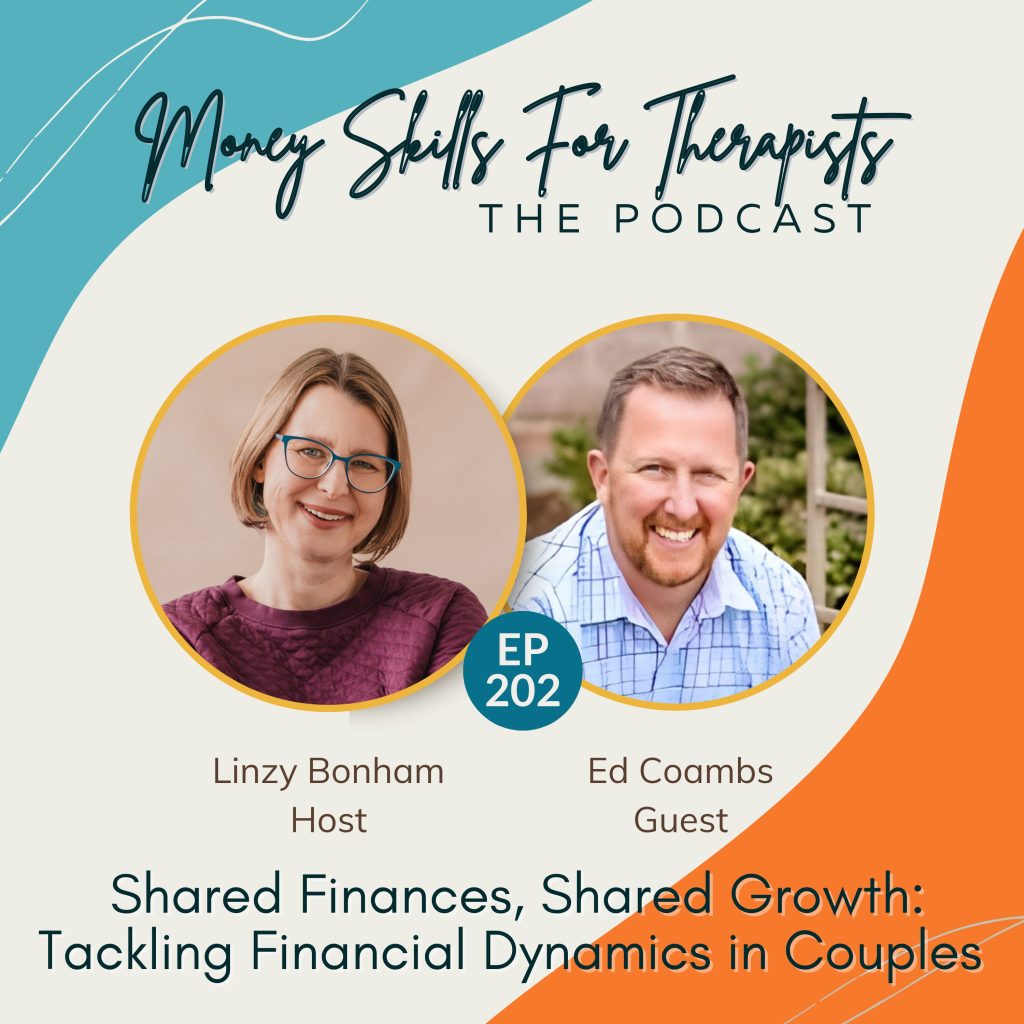
Money can sometimes feel easier to manage in your business than in your relationship. In this episode, I sit down with Ed Coambs to gently explore what happens when you bring your money skills home and begin navigating them alongside a partner. We talk about financial intimacy, emotional safety, and what it truly takes to have honest, grounded conversations when two nervous systems — and two lifelong money stories — are in the room.
“Financial intimacy is the experience of being able to talk openly, safely, vulnerably about your shared financial life, your money hopes, dreams, aspirations, as well as your fears, worries, and anxieties.” – Ed Coambs
Building Financial Intimacy and Healthy Money Conversations
In a relationship, money is rarely just about numbers. It’s about safety, power, vulnerability, and the stories we each carry from childhood into adulthood. In this conversation, Ed and I unpack how financial intimacy gets built — and how it quietly breaks down — through everyday conversations and unspoken dynamics.
I often see couples fall into predictable roles: one partner pushes to engage with money, the other pulls away. Over time, these roles can harden into resentment or shutdown, especially when income shifts, career growth, or differing values enter the picture.
Repair is possible! It begins with slowing down, naming old hurts, owning the part you’ve played in past conflicts, and choosing to approach money conversations with collaboration instead of defensiveness. When you tend to both the emotional and practical sides of money together, trust deepens — and conflict softens.
Emotional Patterns, Relationship Shifts, and Money Conversations
Money shows up in relationships through tone, body language, and nervous system reactions — not just spreadsheets. In this episode, we dig into what’s happening underneath the surface when money becomes tense.
(00:04:39) Understanding Financial Intimacy
(00:06:54) Exploring Emotions Around Money
(00:15:21) Couples and Evolving Money Views
(00:18:32) Navigating Money Dynamics in Relationships
(00:21:52) Owning Your True Feelings
(00:27:40) Modeling Respect Through Conversations
(00:30:11) Money and Relationships with Kindness
What It Really Takes to Talk About Money Together
Building financial intimacy means learning how to stay present when money stirs up fear, shame, or old family patterns. When you start noticing the emotional tone of your conversations — not just the content — you can begin to shift from tension into connection.
When you begin speaking honestly about what money really represents for you — security, freedom, worth, control — power struggles often soften. Over time, those small moments of repair and respect not only change your relationship, they quietly shape the money story your children will inherit as well.
Get to know Ed Coambs, CFP®, CFT-I™, LMFT:
Ed Coambs is a financial therapist and the founder of Healthy Love and Money. Drawing from his experience in financial planning and couples therapy, he helps partners understand the emotional roots of money conflict and build financial intimacy grounded in safety and connection. He’s also the author of The Healthy Love and Money Way, where he explores how attachment styles influence our financial well-being and our closest relationships.
Connect with Healthy Love and Money:
Take the Attachment Style Quiz Related to Money: https://www.healthyloveandmoney.com/attachment-style-quiz
Read the Book: https://www.healthyloveandmoney.com/the-healthy-love-and-money-way
Listen to the Podcast: https://pod.link/1634843162
Ready to feel confident with your money?
Are you a Solo Private Practice Owner?
I made this course just for you: Money Skills for Therapists. My signature course has been carefully designed to take therapists from money confusion, shame, and uncertainty – to calm and confidence. In this course I give you everything you need to create financial peace of mind as a therapist in solo private practice.
Want to learn more? Click here to register for my free masterclass, “The 4 Step Framework to Get Your Business Finances Totally in Order.”
This masterclass is your way to get a feel for my approach, learn exactly what I teach inside Money Skills for Therapists, and get your invite to join us in the course.
Are you a Group Practice Owner?
Money Skills for Group Practice Owners is a six-month course that takes you from feeling like an overworked, stressed and underpaid group practice owner, to being the confident and empowered financial leader of your group practice. Click here to learn more and join the waitlist.
Episode Transcript
Linzy Bonham [00:00:01]:
What often happens when I’m working with folks in Money Skills for Therapists and in Money Skills for Practice Owners is as they’re getting clearer and clearer about their own relationship with money, building out systems and skills, starting to be like, okay, I’m getting this, then they’re like, but at home I have to do this with somebody else.
Ed Coambs [00:00:20]:
Yes.
Linzy Bonham [00:00:21]:
And that— yeah, shoot indeed. Welcome to Money Skills for Therapists. The podcast that helps therapists and health practitioners in private practice go from money confusion and shame to calm, clarity, and confidence with their finances. If you’ve ever felt overwhelmed by numbers or avoided looking at your business money, you’re in the right place. I’m Linzy Bonham, therapist turned money coach and creator of Money Skills for Therapists. Before we jump in, check out my free on-demand masterclass. You’ll find the link in the show notes or at moneynutsandbolts.com under masterclass. It’s the best first step to finally feeling empowered with money in your private practice.
Linzy Bonham [00:01:00]:
Let’s get started. Hello and welcome back to the podcast. Today we have returning guest Ed Coambs. Ed is financial advisor, financial therapist. He is this amazing combination of trained financial expert and therapist smashed together. I suppose similar to myself, but actually is financial advisor. And Ed and I today are talking about financial intimacy, navigating money in relationships. This is a piece I see come up so much with the folks that I work with, because if you are in a partnership, you can do so much work on your own relationship with money, and yet at the end of the day, at home, you have to manage that money with somebody else.
Linzy Bonham [00:01:45]:
You’ve got somebody else’s money stuff and money stories, and the information they’re getting, the way they think about money coming into the picture. So today, Ed and I talk about financial intimacy as a starting place, as a way for couples to get on page about money. We talk about common dynamics that he has seen in relationships around resentment, around being interested in money at different times. And then we talk about how to start to shift towards more financial intimacy in your relationship with your partner. Here is my conversation with Ed Coambs. So Ed, welcome back to the podcast.
Ed Coambs [00:02:31]:
Linzy, so great to be here, and thank you for having me back.
Linzy Bonham [00:02:33]:
Yeah, I’m excited to have you back. We just had some great pre-recording conversation. I was like, we need to stop, we need to record.
Ed Coambs [00:02:40]:
Just hit record, let’s go. Yep.
Linzy Bonham [00:02:43]:
Yeah, I’m very excited to have you back today because I feel like, I mean, in addition to always just enjoying talking to you, our work kind of like fits together side by side in a way that’s really nice. It’s kind of like your work ends, or my work ends where your work begins, in terms of like a lot of therapists that I work with come into working on their finances through their private practice when it’s like, oh no, I don’t know what I’m doing, right? This is overwhelming. I have to make this work. And the way that I often think about working on finances in your private practice is it’s a little bit of like a sandbox. It’s a good place to learn, right? It’s like a smaller amount of transactions that happen. It’s just you. There’s kind of like some nice guidelines we can use to help you understand what works. There’s some percentages we can rely on.
Linzy Bonham [00:03:27]:
Business is like pretty predictable and measurable. But what often happens when I’m working with folks in Money Skills for Therapists and in Money Skills for Practice Owners is as they’re getting clearer and clearer about their own relationship with money, building out systems and skills, starting to be like, okay, I’m getting this, then they’re like, but at home I have to do this with somebody else.
Ed Coambs [00:03:49]:
Yes.
Linzy Bonham [00:03:49]:
And that— yeah, shoot indeed. And that ends up being like a whole other area, which is not the work that I do, right? I’m really working with folks in that business space, but you are working with folks in that relationship space.
Ed Coambs [00:04:02]:
Yeah.
Linzy Bonham [00:04:03]:
So I wanted to talk to you today about that piece of like navigating money with a partner. So as you start to think about this whole navigating money with a partner, yeah, tell me about financial intimacy is something we had chatted about the last time you were here. I feel like that’s a good place for us to start this conversation today.
Ed Coambs [00:04:23]:
Well, you know, Linzy, we were joking about how much we love listicles and like easy 1, 2, 3 steps for this. And so I’m just going to, you know, make this a very quick, easy podcast for everyone. Just focus on financial intimacy, y’all, and you’ll be fine.
Linzy Bonham [00:04:36]:
Great. Number 1.
Ed Coambs [00:04:39]:
Okay. Now I’m imagining listeners like, who is this guy and why is he back on here? What is this? All right, so let’s start with a definition. What is financial intimacy? Financial intimacy is the experience of being able to talk openly, safely, vulnerably about your shared financial life, your money hopes, dreams, aspirations, as well as your fears, worries, and anxieties. Now, if you hear that definition, you— your brain might start blowing up because it’s like, that’s a lot. And it is a lot to experience financial intimacy because what most of us have never seen are loving, safe, kind conversations between intimate partners around money. When I ask my clients who have they seen talk about money in an open and loving way in their life, they look at me like I’m crazy or stupid. What are you talking about? And so I you think, know, we were talking before we hit record is that as humans, we need mental models. We need maps to know how to navigate the territory of our relationship.
Ed Coambs [00:05:47]:
But if we’ve never seen this in action, it’s very hard to know how to execute it because our instincts just come right into play about how to navigate money conversations based on whatever it is that we’ve seen over the course of our childhood and adulthood. And so a big part of the financial therapy with couples is giving them the experience of talking about money in a loving, safe, and open way.
Linzy Bonham [00:06:13]:
That’s very powerful. So I noticed myself when you give that description of that experience of seeing people having loving conversations around money, it’s interesting because obviously I think about money quite a bit and my relationship with it. But when you said that, I had a felt experience that’s more like a childhood experience where I was like, oh yeah, no, that was not a thing in my own household. So it is interesting to notice that modeling piece. I feel like I was taught lots of great financial skills, which I deeply appreciate. But if I think about the modeling, the relationship modeling that I actually received and continue to witness around money with my parents, those aren’t the words that I would probably use to describe it.
Ed Coambs [00:06:54]:
Yeah, and I think— right, so we’ve talked about how do we have some practical exercises for folks. So let’s take a pause. Here’s a practical exercise. Take a moment, listen to what I’m going to say, and then hit pause on this recording. But just think of what are, what are the adjectives or descriptive words you would use to describe how your family members talk to each other about money? Was it scary? Was it loud? Was it angry? Was it soft? Was it quiet, like quiet-avoidant, like nothing was ever said? Was it encouraging? Was it supportive? Was there a sense of pride? Was there a sense of anxiety or shame or fear? Those are all relational experiences around money. And so while we may know the content or the technicalities of how money works, it’s paired with the emotion, with an emotional tenor. And that emotional tenor is what makes it either more comfortable or less comfortable to talk about money. And so that’s what we’re really working on with couples and money is, yes, we want to make sure that we’re having a shared understanding about how money works and what we’re doing with it.
Ed Coambs [00:08:00]:
But it’s, it’s that old cliché phrase of it’s not what you say, it’s how you say it really shows up and matters in money conversations for couples.
Linzy Bonham [00:08:10]:
Yeah, I mean, another word that comes to mind for me is, is the vibe, to use youth speak, right? Like, what what is, is the vibe that’s there? And I just had a conversation with a student in MSFT following up on a podcast recording that just came out at the time that we’re recording this about parenting and money. And I was talking about the energy we put across too, right? It’s like what’s happening in our nervous system and our kids are picking that up. Even if we are trying not to express it, they feel if we are stressed or angry or on edge, right? And so it makes you think about same thing. It’s like we pick up on the energy between parents or the adults that are making decisions. It’s all there, even if it’s not being spoken.
Ed Coambs [00:08:51]:
Absolutely. And this is what I love about the gift of the field of therapy, is, you know, like, interpersonal neurobiology talks about neuroception and the automatic process of picking up where we’re at in our vagal tone and resonance level. And so, right, this is the complexity of being humans, is we can convince ourselves we’re not being scary, we’re not being anxious, we’re not being threatening, that doesn’t matter because it’s what’s actually happening inside of your body is being transmitted to your child or your partner.
Linzy Bonham [00:09:22]:
Yes.
Ed Coambs [00:09:23]:
And so that’s where our own congruence between being in our body, knowing how we’re actually feeling, not the story we’re telling ourselves, matters so much because most of us use denial, minimization, and rationalization to help us navigate the financial world. So it doesn’t feel so scary. But our body is telling us the truth of how we actually feel about things. And we try to override that or get it to be something different. And so we use force to correct that both for ourselves and with our partner. We don’t want our partner to be resentful, frustrated, angry about going on vacation because it’s going to cost money. But instead of meeting them with empathy and compassion, we meet them with frustration. Why are you making a big deal? Or just overriding them.
Ed Coambs [00:10:10]:
And that only exacerbates the cycle of disconnection.
Linzy Bonham [00:10:13]:
Yes, absolutely. So as we’re thinking about this, I’m curious, what are some common dynamics you see in couples around money?
Ed Coambs [00:10:23]:
Yeah, one of the biggest things that’s really been swimming in my mind recently is about the timing and interest in the topic of money for couples is a very big deal. And what I started doing with all my couples when I’m getting to know them is I ask them about their story of bringing their life and money together and what was happening. And one of those patterns that has been jumping off the page, so to speak, recently is the interest in money itself and talking about it is wildly different for some couples. And so if you can imagine one partner is like gung-ho, all into it, trying to figure it out, and the other person’s like, I don’t give two shit, I have other things that are important to me. I’m scared. I’m ashamed. Whatever the motivating factors are, they’re not into it. But this person is busy pursuing, trying to get their partner to engage with them in money.
Ed Coambs [00:11:14]:
Now here again, right, this is back to that energy, is usually that pursuit has anxiety and fear underneath it. Sometimes shame.
Linzy Bonham [00:11:22]:
Right, right.
Ed Coambs [00:11:24]:
And so that doesn’t feel great for this partner. It doesn’t get them interested in wanting to join with them. So they might even be trying to do the right thing or the good thing, but the emotional energy has so much anxiety, shame, fear, anger in it that it’s this repellent, right?
Linzy Bonham [00:11:41]:
Yeah, the other partner will withdraw more.
Ed Coambs [00:11:43]:
Withdraw more and more.
Linzy Bonham [00:11:45]:
Yeah, because probably in addition to whatever of their own reasons they already don’t want to be thinking about money, now there’s all this like charge from their partner around it.
Ed Coambs [00:11:54]:
Yes, right. So now let’s fast forward. It’s been 3, 4, 5 years more. The partner that was really interested in money has finally gotten fatigued and worn out. I can’t get this person interested in what I want to do, how I want to do it, why it’s important to me. So either they collapse and they just give up, or they just go off and do it on their own. Now we go bumbling along a few more years, and now partner number 2 all of a sudden has something change in their life. They’re tired of being controlled, manipulated, cajoled, whatever, educated about money.
Ed Coambs [00:12:28]:
They want to feel more empowered. They get interested in money, they start learning. And this is where we’re talking, Linzy, like you got people that are like coming into your program, they’re getting interested, like, I’m going to learn on my business. And they start to feel a sense of mastery. But then they start to realize, oh God, if I’m in partnership with somebody else or I have kids, Now I’ve got to navigate them.
Linzy Bonham [00:12:49]:
Yes.
Ed Coambs [00:12:50]:
What do I do? And that’s where that crossover into my work shows up. It’s like, how do we get the relationship? So if you haven’t been the financially interested partner, and you had a partner that was, but now you’ve become disconnected over the years, now you’ve got a re-engagement problem too. How do you take responsibility and acknowledgement for not being an active participant for so many years? Because that does matter. And how do we rebuild trust and connection and collaboration so that we can do this together and have a shared language, right? So those are really hard questions fully to answer. But I do think it starts from a place of self-awareness and acknowledgement that you may have unintentionally created some harm and pain. That’s only your side of the road. Your partner likely did some things too that were not great. So they’re not off the hook.
Ed Coambs [00:13:40]:
But you can only take responsibility for what you did and what you contributed. And so that’s where I would say you probably want to start, is being able to go and say, hey, I’m realizing through my own money work how important money was to you for such a period of time, and you couldn’t get me interested. And I’d like to revisit and see if we can start building mutual interest, mutual compatibility around what we’re doing in our shared financial life, because it’s unavoidable. Our lives are intertwined with our partners, which means our financial life is intertwined. What you do or don’t do with money has a direct impact on me.
Linzy Bonham [00:14:17]:
There’s so much there, you know, as I’m thinking about it, because I’m thinking too, sometimes I think we, we think that trying to work on money is a good in itself, and it is good in itself because it’s important, right? As you say, it’s unavoidable. It’s just like trying to improve your relationship with food or exercise or sleep. Like, these things are— we, yeah, we need all of these things, right? They’re, they’re all non-negotiables that are part of our lives.
Ed Coambs [00:14:40]:
They’re all part of the human experience.
Linzy Bonham [00:14:42]:
That’s it. But, you know, I think the— what you were talking about at the beginning of the— it’s the energy, the two that goes with that, that really kind of like taints the experience or colors the experience. So if you have one partner who really is wanting to work on money, but they’re coming to that also with a lot of like anxiety, maybe rigidity, you know, like sometimes I’ll work with folks who, you know, them or their partner really got into like Dave Ramsey and like these kinds of like money formulas that can be very like strict, you know, so that energy comes in. That’s a really important part of what’s happening there with that couple, right? Because it’s not just the, the content that they’re trying to work on, but it’s, it’s the how that is kind of shaping it.
Ed Coambs [00:15:21]:
Yes, 100%. And I think that that’s a really big deal. And I think the energy I’m feeling around this, Linzy, is like I’ve painted this picture of like kind of opposites attract around money. So that’s one couple caricature. The other one is like, I get several stories where couples started out together on the same page and working collaboratively. But what happens is, because we’re learning about how money works in the economic system, like, our view of options and opportunity starts to open and expand. And so, you know, when we have one model and this is the one way to do it and we both share that, it makes life pretty easy. But if you grow and one person becomes an entrepreneur and the other person starts to learn about trading stocks and options and cryptocurrency and this person is wanting to go that direction, this person is wanting to grow their business.
Ed Coambs [00:16:08]:
Now, they’re absorbing information from different sources about what to do and what’s good or right, but no way to coordinate across those two different money outlooks. Real estate investing is another area that I come up against a lot. So, it’s investing, real estate investing, business ownership. These are different categories and big ecosystems of knowledge and outlooks on what to do with money.
Linzy Bonham [00:16:33]:
Yes, yes.
Ed Coambs [00:16:34]:
But they don’t play nicely with each other necessarily. They’re often actually adversarial.
Linzy Bonham [00:16:39]:
Yeah, I was thinking large philosophical differences between some of these kind of like subareas of money, maybe.
Ed Coambs [00:16:48]:
Yeah, subcultures.
Linzy Bonham [00:16:49]:
Yeah, or strategies. Yeah, can, can be wildly divergent in terms of what they think is important What I sometimes see too is as you really get into something like, I don’t know if, if your partner or you get into real estate or crypto or whatever, there can sometimes be, as you said, this adversarial messaging you get of like, well, this other way is dumb. This is the right way. And I’ve seen that before of like, well, you know, investing monthly is dumb. Instead, you should do this. And it’s like, well, actually all of these strategies have their own benefits based on, on your own values and risk tolerance and, you know, all these pieces. But yeah, there, I think also as we’re being taught these things by people who are maybe more influencers than experts, you’re not going to get a really thoughtful perspective on these things.
Ed Coambs [00:17:38]:
Yeah, and I think that’s part of our money maturation, right, is being able to hold our own money view and engage with multiple different money views within the world.
Linzy Bonham [00:17:50]:
Yeah.
Ed Coambs [00:17:51]:
And hold our own center while allowing our center to shift if necessary. Right. And so I think about, as therapists, we have— therapists have a collective view of money. Like, there’s some pretty common themes in the way that we think about and organize around money. And then they come to your course and you’re offering them another view that I would argue is probably more productive for most.
Linzy Bonham [00:18:12]:
Oh, thank you so much.
Ed Coambs [00:18:14]:
Right. That’s why I’m honored to be here, right? Is, you know, like, if I didn’t like what you stood for, I’d be like, no, thanks for the invite.
Linzy Bonham [00:18:21]:
I’m busy forever. Yeah.
Ed Coambs [00:18:23]:
Yeah, you know, my ego is strong enough that I don’t just need to be on every podcast.
Linzy Bonham [00:18:27]:
Yes, same, same.
Ed Coambs [00:18:28]:
Just most of them.
Linzy Bonham [00:18:29]:
Just kidding.
Ed Coambs [00:18:32]:
Um, but you know, listeners, like, it’s easy for me to sit here and pontificate about a lot of this stuff, but what I want you to know is that it’s been years and years of personal exploration and thinking and reflecting about all these things. And so these conclusions that I’m sharing today didn’t just show up in my brain. They’ve been being cultivated intentionally for a long time. And I think that this is one of those pieces too, where in coupleship, you might have someone on the path to money mastery, and somebody else is like, they want to remain a money novice. And how do you hold that tension? And will it be a point at which you have to separate or not? And that’s a, a difficult place of decision. And part of the way I see that showing up is one partner starts to get really more focused on building success in their business and growing and going. And where they may have had relative parity in what they could contribute, now it’s grown and there’s significant difference in what can be contributed. And boy, the resentment and frustration can really start showing up.
Ed Coambs [00:19:41]:
And so like the unintended consequence of creating more success is now you have to navigate inequality in the relationship and what can be contributed financially especially. And as much as we might like to see ourselves as altruistic and capable of managing financial inequality in a relationship, it’s much harder to do.
Linzy Bonham [00:20:00]:
Yes. And I do see this come up often with therapists actually, because If folks do end up going down that path where they really own a niche and, for American therapists, decide to start charging private pay, move into higher fees, you can make a lot of money as a therapist, which is something that might seem strange to people who are not having that experience. But I will tell you, the spectrum of what we can make as therapists is huge. So I do see this with couples often where, yeah, they might have started on a similar page. Maybe one is an artist. One is a therapist. That’s a common pairing that I see. And then, yeah, the therapist starts to be able to earn a lot more than they ever imagined they could, but the artist is still in artist-earning land, and those are different places.
Ed Coambs [00:20:50]:
Yeah.
Linzy Bonham [00:20:50]:
And so, yeah, that resentfulness I do see as something that therapists often have to navigate in relationship.
Ed Coambs [00:20:59]:
When you— I’m hearkening back to one of your more recent episodes where you talked about growth and change and circles of influence and listening to that and just feeling like that’s so spot on. And this is what’s challenging is I think it’s hard to migrate or change your social circle that’s not familial. But most of us take our marriage bonds very seriously. And so the idea of changing that because our outlook on money has changed feels really like in conflict with our deeply held values about the importance of our marriage and long-term committed relationship.
Linzy Bonham [00:21:38]:
Yes.
Ed Coambs [00:21:39]:
Whereas I think there’s more flexibility on like, okay, yeah, I can see and allow friendships to evolve and fade and change.
Linzy Bonham [00:21:45]:
Yeah, that’s so true.
Ed Coambs [00:21:47]:
But do we want to break up our marriage because now I’m making 5 times, 10 times what you’re making?
Linzy Bonham [00:21:52]:
Yes. Yeah, they’re huge questions. And I think going back to what you said at the beginning, something that I think is so important and also so tempting to avoid is, yeah, how are you actually feeling? Right? Like, what is your actual relationship with this situation? In this example that we give, if there’s become a huge disparity between earnings, how do you actually feel about that? Not how do you want to feel, not how does your very best self feel, who can see the value of these different contributions and You know, I’ve had a couple of podcast episodes recently about breadwinning, right? About being a breadwinner and like, what is the difference between being a breadwinner where that really like lights you up, but there’s like equity in other ways in the relationship. There’s a difference between that and like being the breadwinner and also the primary parent and also the household manager and also the this and this and this where you’re, you know, contributing at 85 and your partner’s showing up at a 20. Those are different situations, right? But really actually owning how you feel rather than telling yourself how you want to feel.
Ed Coambs [00:22:56]:
Yes, I think that’s— that is a really— and it’s, it’s a hard place to sit with because there’s some dissonance there. And yet we know as therapists, when you sit with this, when you have the dissonance, it comes out. It does, sometimes directly and sometimes indirectly.
Linzy Bonham [00:23:10]:
I was going to say often sideways.
Ed Coambs [00:23:12]:
Often sideways, right? And so like sexual withdrawal can be a really big factor that shows up when there’s financial dysfunction and incompatibility.
Linzy Bonham [00:23:23]:
Yes.
Ed Coambs [00:23:23]:
And so like what money represents and means to us matters a lot. And how do we continue to honor that? And I think it’s, for me at least, the easy answer, the shortcut answer is beneath all of this, we’re still humans. We still have a fundamental need to be heard, known, valued, understood. And so if we can keep coming back to that, I think it softens a lot of that experience. But it’s so easy as humans to become judgmental, critical, envious of what our partners are doing, or resentful of what they’re not doing.
Linzy Bonham [00:23:59]:
Blaming.
Ed Coambs [00:24:00]:
Yeah, blaming. That it overshadows the positive attributes that are still there.
Linzy Bonham [00:24:06]:
Yeah. And I think that goes back to your, your point number 1, which, as we joked, we both love listicles. We do not love listicles. It’s a joke. But, you know, point number 1, uh, financial intimacy. Right, continuing to show up in these conversations with honesty and care.
Ed Coambs [00:24:23]:
Yeah, and really kind of, right, it sets a different expectation, right? I think language sets expectation and experience. And so that word combination is not one that’s widely used, and yet I think it, for me, is the word combination that is the most powerful and most inspiring. And so in that, that is a therapeutic exercise, is for you to explore what does that word combination evoke within you.
Linzy Bonham [00:24:48]:
Yeah, yeah. I was trying to think of a parallel word combination. This really shows that I’m a parent of a 7-year-old, but I was like, what would be a similar word combination to financial intimacy? And I’m like, nutritious cotton candy. That’s like how much I feel like those words, you know, fit together. So, so some new concepts to, to marry together that maybe you’ve never experienced side by side before.
Ed Coambs [00:25:13]:
Well, and I think I love that you bring that up is because And I think that’s really what I would hope each listener would take from this is what comes up for me, right, is what I want it to do financially, just me, is inspire and motivate couples. But what it can do is actually almost unintentionally be like, that’s what, that’s just not even possible, right? And that just to me says, where are we at in the stages of change? And you may be in a place today where you feel so disheartened, so beat down, so alienated, so alone, that hearing the words financial intimacy just feels like another brick on the coffin. And so if you’re hearing it that way, please back— let’s backpedal this. Let’s find a softer way into just small breaths of hope that can fan a little flame and get some kindling going for you. Because my intention is never for things to be overwhelming. I want them to be inspiring. And yet I realize depending on where you’re at in your emotional journey with this, emotional intimacy can feel like I’m getting back into the gym lifting weights, and it can feel like 45-pound plates stacked up on the bench press. Like, I can’t do it.
Linzy Bonham [00:26:28]:
Yes.
Ed Coambs [00:26:30]:
Like, I can’t even do a push-up on my knees. Yeah, yeah, yeah, yeah. So like, let’s start with baby steps. And so maybe the baby step is just awareness and acknowledgment. We’re not connecting around our finances.
Linzy Bonham [00:26:43]:
Yeah. And I loved that exercise you encouraged folks to do earlier in this conversation of noticing, yeah, what are the words that describe what was modeled to you as well? Right? Because for me, even just thinking about my own words that came up, I’m like, oh, that’s— those are some really interesting starting places for even just conversations with my partner around as much as we’re doing so many things well in this area. When I think about the modeling that I’ve had, and if I think about the words to describe our own conversations, like, yeah, what are those emotional words that name the tone, right? Like starting to name where you actually are.
Ed Coambs [00:27:15]:
Yeah, the way I think about it is, you know, if— and last night I thought about it. I mean, I live in this world. This is where my thoughts swim all the time. But last night, my wife and I, we had dinner with the kids. They each kind of disappeared from the dinner table. But she runs her own dental practice. She’s actively working on a remodel decision for the practice. And so she’s, you know, wanting to keep me up to date, also get my input, talk about it.
Ed Coambs [00:27:40]:
And so we’re talking through this, and one of my kids is just in the other room watching TV. And it’s funny because I said, hey, Zane, can you turn the TV down so Mom and I can talk? And he’s like, yeah. One minute later, he’s like, hey, can you guys talk a little softer so I can hear my show? And it wasn’t because we were yelling and screaming. We were actually having a very calm, regular— we were just normal conversational tone. But what I thought about after that conversation is like, what would my child say about how my wife and I were treating each other as we moved through this conversation? Was dad being open, curious, loving, kind, thoughtful? Was mom being respectful, all those same things in return? I certainly would hope so, and I think so, but that’s that modeling, that’s that informal teaching about how we hold each other’s ideas and experiences, knowing And really come to a deep acceptance. We’re different people. We’re going to see the same problem differently.
Linzy Bonham [00:28:38]:
Yeah, but they’re paying attention. The kids pick up what’s actually happening, not what we want to be happening. 100%.
Ed Coambs [00:28:44]:
Yeah.
Linzy Bonham [00:28:44]:
100%. Thank you, Ed. I feel like we could, you know, this could be another 10 hours, this conversation. But, you know, we do need to finish at some point.
Ed Coambs [00:28:56]:
Well, I think it’s just an opening or an ongoing, right? I mean, I feel grateful that you’ve invited me back, and hopefully we’ll have a chance to have another episode. Hey, yo, down the road.
Linzy Bonham [00:29:07]:
I would love to. I would love to. And for folks who are listening who want to get further into your world, where can they find you?
Ed Coambs [00:29:13]:
Yeah, the easiest place is to go to healthyloveandmoney.com. From there, you’ll find a podcast that I have, an active blog that I write. I offer professional services around financial therapy and couples, as well as financial planning and investment management for couples. And so when couples are trying to navigate this intersection of kind of what do we do technically How much money should we be saving? How are we on the right track? I can answer those questions right alongside. It doesn’t feel good when we talk about money, and I use those planning conversations as an opportunity to go through some of the exercises and many more.
Linzy Bonham [00:29:51]:
I love it. I, uh, so excited for folks to have the opportunity, Americans who have the opportunity to work with you. So Americans, if you are looking for access to financial expertise that also is emotionally intelligent, like, what a gift. You should check out Ed and his team. Thank you so much for joining me today, Ed.
Ed Coambs [00:30:08]:
Thanks, Linzy. Appreciate all the work you’re doing in the world as well.
Linzy Bonham [00:30:11]:
Thank you. I really appreciate Ed bringing his insights and experiences today about working with couples around money. I think that so often when it comes to money or areas where we don’t feel confident or skilled, it’s tempting to want to get, you know, as Ed and I were talking about, that listicle, the like, first do this, then do this, then do this. Relationships are complicated though. You are bringing two different people with their own mix of stuff coming into dynamic together. And I just really appreciate Ed’s nuance and thoughtfulness about that. And about building up your skills in terms of being able to be with where you really are financially, being able to start to open up to being open with your partner with kindness and curiosity in conversations around money. And that is not necessarily going to be a quick fix, right? There’s so much complexity in human relationships, but by actually starting to name where you are, being honest with yourself, being honest with your partner, working to act in ways that are respectful and kind in those hard relationships.
Linzy Bonham [00:31:31]:
There’s just such richness there and such opportunity to actually get on page around money, right? And, and create clarity in your relationship around money and hopefully be able to actually set a plan together about what matters to you as a couple and being able to compromise and plan for things and, and make sure both of your needs are being met through money in your relationship. So, so much opportunity there. So appreciative of Ed, and, uh, definitely check out his podcast, his services, his team. He also has a book which he didn’t mention. Just a lot of knowledge there about relationships and money. So appreciate Ed joining us today. Thank you so much for joining me today as well. I am Linzy Bonham, therapist turned money coach and the creator of Money’s Skills for Therapists.
Linzy Bonham [00:32:16]:
If you are ready to go from money confusion and fear to feeling clear and empowered in your finances, my free on-demand masterclass is the best place for you to start. You’re going to learn my 4-step framework to get your private practice finances working for you. Register today using the link in the show notes or go to moneynutsandbolts.com under masterclass. I look forward to supporting you.



Hi, I'm Linzy
I’m a therapist in private practice turned money coach, and the creator of Money Skills for Therapists. I help therapists and health practitioners in private practice feel calm and in control of their finances.
Latest Episodes

Money can sometimes feel easier to manage in your business than in your relationship. In this episode, I sit down with Ed Coambs to gently explore what happens when you bring your money skills home and begin navigating them alongside a partner. We talk about financial intimacy, emotional safety, and what it truly takes to have honest, grounded conversations when two nervous systems — and two lifelong money stories — are in the room.
In this episode, registered psychotherapist Liane Wood and I gently challenge you to explore what it actually means to build a sellable therapy practice—not because you should sell someday, but because thinking this way creates more freedom, sustainability, and financial clarity right now in your personal and professional life.
For our 200th episode of Money Skills for Therapists, I invited my business besties, Tiffany McLain and Maegan Megginson, to join me for a conversation that was more honest than polished. We unpacked about the real seasons of entrepreneurship — the times when you feel energized, expanding, and deeply aligned… and the times when you feel tired, restless, like you’re questioning everything, or quietly pulling back. If you’ve ever wondered whether it’s normal to feel both love and resentment toward your business at different points, this conversation is for you.