201: Building a Sellable Therapy Practice: Money, Mindset, and Options

201: Building a Sellable Therapy Practice: Money, Mindset, and Options
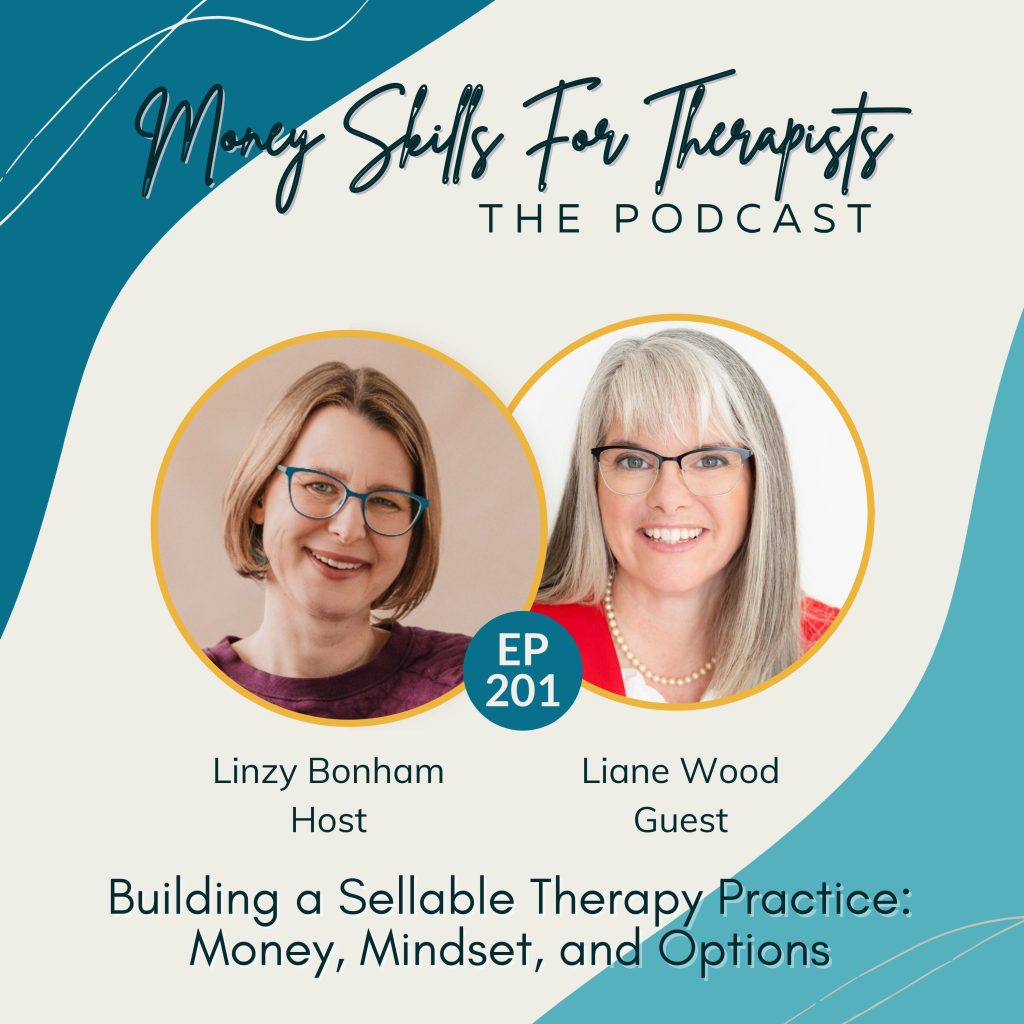
For many private therapy practices, the end-of-the-road often looks like quietly closing the door, but it can be quite exciting to entertain the idea of selling your practice one day.  

In this episode, registered psychotherapist Liane Wood and I gently challenge you to explore what it actually means to build a sellable therapy practice—not because you should sell someday, but because thinking this way creates more freedom, sustainability, and financial clarity right now in your personal and professional life.  

We discuss the emotional blocks therapists face around identity and money, the practical systems that make a business transferable, and how shifting into a CEO mindset can turn your practice into a true asset rather than a job you can never leave. 

“You can be a compassionate, heart-centered therapist and a strategic practice owner at the same time.” — Liane Wood 

The idea of selling a private practice can bring up feelings of grief, guilt, or fear for many therapists—especially when the business feels deeply personal. And if that’s the case for you, I encourage you to tune into this episode to learn how separating who you are from what you own allows your practice to become less stressful, and more profitable and resilient.  

From Therapist Identity to Business Asset: Key Conversations from This Episode

Even if you’re years away from selling your practice, or it’s not even on your radar, making these shifts now creates options for your future: stepping back, delegating, taking real time off, or eventually passing your legacy on to someone aligned. 

(00:04:57) Therapist Identity vs. Business Ownership 

(00:07:37) Emotional Resistance to Selling or Stepping Away 

(00:14:58) What Actually Makes a Therapy Practice Attractive to Buyers 

(00:16:17) Why Systems, Branding, and Diversification Matter 

(00:24:18) How CEO-level Money Habits Change Everything 

Why Making Your Practice Sellable Changes Everything (Even If You Never Sell)

One of my favorite takeaways from this conversation is this: building a sellable practice isn’t about exiting—it’s about creating options. When your business has clean finances, clear systems, diversified revenue, and a brand that isn’t dependent on you alone, everything feels lighter. You’re no longer trapped inside your own practice. Instead, you’re running a business that can support you, your clients, and potentially future owners long after you choose to reduce your personal hours or take a step back. 

Practical Takeaways for Therapists Thinking About the Long Game

  • You are a business owner who practices therapy inside a container you’ve built. You are not the container itself. 
  • Track numbers regularly, separate personal and business finances, and pay yourself intentionally. 
  • Diversifying your income through group therapy, supervision, digital products, or associate teams increases the business’s sustainability and transferability. 
  • Implementing systems that include SOPs, clear workflows, and organizational branding ensures anyone can step into a role. 
  • A sellable practice gives you freedom—whether you sell, step back, or keep running the business forever. 

Building a practice that can be sold doesn’t mean you’re planning to leave—it means you’re honoring your future self. My hope is that this episode helps you see your work not just as meaningful, but also as valuable in a way that supports longevity, choice, and peace of mind. 

Get to know Liane Wood:

Liane Wood is the CEO of Build Your Private Practice Inc., where they’ve been helping mental health practitioners launch, grow, and scale thriving private practices since 2016. As a registered psychotherapist in Ontario, Canada, she is passionate about empowering therapists to build the private practices of their dreams while achieving both client care excellence and business success. 

Book a 60-minute Private Practice Strategy Call with Liane to map out a personalized growth plan for your practice—whether you want to scale, step back, or eventually sell. You can book at https://calendly.com/liane-lo0/strategy-session 

Website: https://www.buildyourprivatepractice.ca 

Email: info@buildyourprivatepractice.ca  

Instagram: https://www.instagram.com/buildyourprivatepractice 

Facebook: https://www.facebook.com/byppinc 

Ready to feel confident with your money?

Are you a Solo Private Practice Owner?

I made this course just for you: Money Skills for Therapists. My signature course has been carefully designed to take therapists from money confusion, shame, and uncertainty – to calm and confidence. In this course I give you everything you need to create financial peace of mind as a therapist in solo private practice.

Want to learn more? Click here to register for my free masterclass, “The 4 Step Framework to Get Your Business Finances Totally in Order.”

This masterclass is your way to get a feel for my approach, learn exactly what I teach inside Money Skills for Therapists, and get your invite to join us in the course.

Are you a Group Practice Owner?

Money Skills for Group Practice Owners is a six-month course that takes you from feeling like an overworked, stressed and underpaid group practice owner, to being the confident and empowered financial leader of your group practice. Click here to learn more and join the waitlist.

Episode Transcript

Linzy Bonham [00:00:01]: 

Hello and welcome back to the podcast. Today’s guest is Leanne Wood. Leanne is a returning guest and she is the owner of Build you’d Private Practice. And today, Leanne and I get into selling your private practice. We talk about some of the emotional blocks that get in the way of thinking that you can sell your practice, which you might be noticing coming up for you right now as you’re listening. Like selling your practice. How is that even possible when you know as a therapist, we are our practice? When get into talking about that, the emotional blocks that get in the way of thinking about selling our practice. We talk about the money habits to put in place, whether or not you’re going to sell your private practice, but certainly that need to be in place if you’re ever going to sell down the road. 


Linzy Bonham [00:00:41]: 

And we talk about the benefits of setting up a business that is sellable. And part of the conversation today is talking about how you could actually sell a private practice, but also just the benefits of having a practice that is sellable itself, what makes a business sellable and how that is beneficial to us in business, regardless of whether or not we actually go on to sell. Very excited about this conversation with Leanne today. Coming at a very salient time for me where it just seems like lots of folks around me are selling businesses and I’m talking to my own students about selling businesses. Here is my conversation with Leanne Wood. Welcome to Money Skills for Therapists, the podcast that helps therapists and health practitioners in private practice go from money confusion and shame to calm clarity and confidence with their finances. If you’ve ever felt overwhelmed by numbers or avoided looking at your business money, you’re in the right place. I’m Linzy Bonham, therapist turned money coach and creator of Money Skills for Therapists. 


Linzy Bonham [00:01:43]: 

Before we jump in, check out my free on demand masterclass. You’ll find the link in the show notes or@moneynutsandbolts.com under masterclass. It’s the best first step to finally feeling empowered with money in your private practice. Let’s get started. So, Leanne, welcome back to the podcast. 


Liane Wood [00:02:03]: 

Thanks for having me. 


Linzy Bonham [00:02:04]: 

Yeah, I am excited to have you back and I’m really excited for what we’re going to chat about today. The topic of selling your practice has been coming up in my world a lot more lately. Like, I’m finding I’m having more students, especially my group practice students who, when we’re working through the finances, there’s also this question of, like, could they sell this if they wanted to Sell this. What would they even do? Like the idea that maybe this is something that actually could be passed on and isn’t just like theirs. I’m starting to notice around, and I also have a couple friends who’ve sold their businesses recently, which has been interesting to see them go through the process. So very, very salient for what’s happening in our universe right now. So I want to start by talking about, you know, what tends to get in the way for therapists, because this to me actually feels like a newer conversation that I’m having with people When I got into this space. 2018 is when I first started teaching. 


Linzy Bonham [00:02:57]: 

I didn’t really hear people talking about selling therapy practices, but I think it’s kind of coming into our consciousness now. So I’m curious, like, what do you notice are some of the roadblocks that people have to selling their practice? And maybe what has kept us from thinking about selling our practices is in the past. And how can they start to like, shift towards maybe thinking that they’re actually building something they could sell? 


Liane Wood [00:03:20]: 

Right. It’s such a powerful question. Right. And I think it really taps into the emotional side of money and your practice. And it’s so often overlooked, I think, especially in helping professions. And one of the, I think the biggest roadblocks that I see is an identity attachment because so many therapists are their practice. Right. Their name is their brand. 


Liane Wood [00:03:48]: 

Yeah. The name of their practice is their name. Right. So they are the ones that clients want to see and their entire practice revolves around them. And that makes the idea of selling a practice feel impossible or even disloyal to their clients. Yeah. Right. So, but there needs to be kind of a mindset shift because I, I believe that you can be a compassionate, heart centered therapist and a strategic practice owner at the same time. 


Liane Wood [00:04:21]: 

They’re not mutually exclusive. Building a practice that can thrive without you is an act of care for your future self, especially for your clients and for whoever carries the torch next. And so I think the shift really begins with recognizing that this, this practice is an asset that I’m building. It’s not just about me. It’s about the systems, the value I create, and the people I serve. 


Linzy Bonham [00:04:51]: 

Yes. 


Liane Wood [00:04:52]: 

I really think that that shift is foundational, whether you sell your practice or you don’t. 


Linzy Bonham [00:04:57]: 

Right. Like that’s an important shift, no matter what, for folks listening. Because that identity piece, I find is so powerful as therapists. Like for so many years I felt like I was a therapist and I go to a party and then I was A therapist at a party, which is like, not, by the way, never be a therapist at a party, but it can become such a core identity for us. And so it’s like the business is where I. Where I am a therapist. But what I’m hearing from you is we need to think about our, our businesses more as, like, I own this business. This is a therapy practice that I practice within. 


Linzy Bonham [00:05:29]: 

But there you’re building like a container for that work to be done. Is that. Yeah. Is that a fair summary? 


Liane Wood [00:05:35]: 

Yeah. Yeah, you’re right there. Yeah. 


Linzy Bonham [00:05:37]: 

And you know, I’m hearing you talk about systems, and this is something that I think talk about with my students when we’re thinking about selling things. You’re talking about building out systems. What else is helpful for folks to think about when they’re, when they’re really sinking into the fact that, like, you are not the business? Like, what is the business then? 


Liane Wood [00:05:54]: 

Right. That. That becomes. That’s. 


Linzy Bonham [00:05:56]: 

Yeah. 


Liane Wood [00:05:56]: 

That’s a million dollar question. Right. What is this thing that I’m. That I’m building? And I think you actually said it really well just a moment ago, you know, when you said, you know, I’m a therapist, but when I’m at a party, I’m a therapist at a party, where recognizing that I’m a business owner, I own a therapy practice and I work as a therapist inside that practice. Right. And so really starting to mentally. Right. Separate those two there. 


Liane Wood [00:06:25]: 

I have a practice and I’m a therapist. And I’m a therapist who works inside this practice. 


Linzy Bonham [00:06:32]: 

Right. 


Liane Wood [00:06:32]: 

Yes. But, you know, really being able to distinguish the practice as separate from you. 


Linzy Bonham [00:06:39]: 

Yeah. This is something that you’ve built. And another framing that I hear on this sometimes that I’m thinking back to a conversation I had years ago on this podcast with Joe Sanic that sometimes too, our business were like, my business is my baby. Like, we have this real, like, kind of like gentle, tender ownership of it. But he was like, don’t think of your business as your baby because you might have to kill it. 


Liane Wood [00:06:57]: 

Right. 


Linzy Bonham [00:06:57]: 

So it’s like, also, I think the ways that we can really, like, develop these really emotionally enmeshed relationships. 


Liane Wood [00:07:03]: 

Yes. 


Linzy Bonham [00:07:03]: 

With our business. Yeah. Makes it hard to imagine that there is actually something here that could exist without you, but you are building something that has a structure to it and an ethos and a brand and a spirit and that somebody else could actually step into. 


Liane Wood [00:07:18]: 

Absolutely. Yeah. 


Linzy Bonham [00:07:20]: 

So for folks who are listening then, like, what kind of practical money habits can they start putting in place if they’re Thinking about selling their practice or even if they’re not, or even if they might sell it in years, or what should they be doing financially to be able to maybe sell down the road? 


Liane Wood [00:07:37]: 

Well, I think it starts with recognizing that great practices aren’t built overnight and neither are sellable ones. And so thinking about this ahead of time, because even if selling isn’t on your radar yet. Right. Creating solid financial habits now sets you up for more freedom and fewer headaches later. And so the first thing I would say is track your numbers. Right. So that means knowing what your monthly revenue expenses and profit are not just at tax time, but regularly. Right. 


Liane Wood [00:08:13]: 

Because if you can’t easily pull a profit loss report or explain your revenue streams to a potential buyer, that’s a red flag. Yeah. And then secondly, it’s really important to separate your personal and your business finances. There’s way too many therapists who have it all combined. 


Linzy Bonham [00:08:32]: 

I know, I know. 


Liane Wood [00:08:34]: 

And so, you know, have a proper business bank account. Pay yourself a consistent salary from that business bank account. Yes. Right. Set aside funds for taxes and reinvestment. It’s really, it’s not just about being organized with your finances. It’s really also about stepping into the CEO role of, of your practice. And then the last thing or the third thing I would say is to start diversifying your revenue in your practice. 


Liane Wood [00:09:04]: 

Right. So that it’s not just one to one therapy, and you’re the only one providing therapy. Right. There’s so many ways that you can diversify your revenue streams. Whether it’s doing things like adding clinical supervision, doing group therapy or therapy intensives, creating digital products, or building an associate team. And I’m sure there’s more, but in this moment, those are the ones that are jumping to my mind. 


Linzy Bonham [00:09:28]: 

Right, but those are good ones. 


Liane Wood [00:09:29]: 

Yeah. 


Linzy Bonham [00:09:29]: 

Right. 


Liane Wood [00:09:29]: 

Like the more that your practice revenue isn’t tied only to your time in client sessions, the more attractive and the more sustainable your practice becomes. 


Linzy Bonham [00:09:41]: 

Right. 


Liane Wood [00:09:41]: 

And I think we really learned the, you know, the sustainable part through the pandemic. Guilty. Because before the pandemic, my practice relied on one to one therapy sessions happening with me. Right. And when the pandemic hit, and my practice was all in person as well, you know, I couldn’t do in person and there were no other revenue streams coming into my practice. 


Linzy Bonham [00:10:01]: 

Yes. 


Liane Wood [00:10:01]: 

Right. And so even from a sustainability perspective, having, you know, diversification in your revenue streams in your practice is a wise move, whether you’re selling or not. 


Linzy Bonham [00:10:12]: 

Yeah. I mean, it’s the sustainability piece. Like sustainability is a Word that I’ve started using a lot in the last couple years because the work can really be unsustainable too. You know, sometimes a business that looks great on paper, it’s like, oh, wow, this is a, you know, a solo practice and they’re bringing in $300,000 a year and like, wow, look how much money they’re making. But the work that it takes to actually generate that through purely one on one sessions. Also somebody else is probably not going to want to actually do that work, which makes it a not very attractive business to sell. Right. If you’re like, yeah, yeah, I make a ton of money. 


Linzy Bonham [00:10:45]: 

So I see 30 clients a week doing intensive trauma work and work back to back to back to back to back. Right. Like, that’s another interesting thing to think about when we think about our businesses is if somebody was gonna consider buying it from you, like, what job are they considering for themselves? Right. Or that they’re gonna hire somebody else into if, if they’re investing in the business. And is it actually a job that would be appealing to like literally anybody but you? Right, yeah, because it’s, it’s easy to build a business that’s really unsustainable. And another thing too that, you know, I think about when you talk about tracking the numbers, is tracking the numbers lets you see, like, is there actually profitability in this business? 


Liane Wood [00:11:22]: 

Yes. 


Linzy Bonham [00:11:23]: 

Right. Because from your experience and knowledge, like, what do buyers tend to be looking for? Like, what do folks find attractive when they’re looking to buy somebody else’s practice? 


Liane Wood [00:11:34]: 

Really great question. Right. I think first of all, they’re looking for potential. Like what’s the potential of this business or this practice that I’m looking at, is it profitable? Right. And it doesn’t have to be outrageously profitable for a buyer to consider it, but it does need to be making a profit and it does need to look like it’s sustainable if the present owner is there or not. You know, they’re looking at profitability and potential, but they’re also looking at can this carry forward without the present owner being involved. Like, can it survive? 


Linzy Bonham [00:12:09]: 

Yes. 


Liane Wood [00:12:10]: 

And so I think, you know, those would be the top three things that I would say potential buyers are looking for is the potential, the profit, and whether, you know, this can continue with a change of ownership. 


Linzy Bonham [00:12:22]: 

Right? Yes. And that, that last piece that you mentioned, you know, can it continue? I’m assuming diversification would be one of the things that would help your practice continue to be sustainable without you. 


Liane Wood [00:12:33]: 

Absolutely. 


Linzy Bonham [00:12:33]: 

What, what else helps to make a business Sustainable when the main person is stepped out. Like, if I’m, if I’m Linzy Bonham, mswrsw, which used to be my, my designation and I have my therapy practice, what can I do to make it so that it could go on without me? You know, when, when, as we talked about earlier, I’ve really, I’ve built the brand. The brand is my name. You know, my clients love me. They love the way that I work. For folks listening, like, yeah, what can you start to do to make it so that it is something that exists and can be sustained without your special traits? Like, you know, we all have our own special mix of stuff that, that makes us the therapists we are. 


Liane Wood [00:13:11]: 

Yeah. I think a big part of it is your marketing. Right. Because if I step out of my practice, what happens to referrals? What happens to. Right. Like, are they, are they being referred to me personally or, you know, like, does that just dry up? Like, what’s your relationship like with your people who refer to your practice? Right, right. And so, you know, I, when I say relationship, yes. I’m talking about, you know, the personal connections that you have made in your practice to have referrals coming into your practice. 


Liane Wood [00:13:42]: 

And so looking at you as a practice owner, looking at, okay, if I was to step away from my practice, how could I transition my existing referral network. 


Linzy Bonham [00:13:52]: 

Right. 


Liane Wood [00:13:52]: 

To a new owner and would that be possible? How could I make sure that that is still successful? Also, you know, looking at, I mean, easier thing to transfer is if you have successful paid advertising happening. Right. And then, you know, that’s, you’ve already got, you’ve already worked out all the kinks to get that paid advertising, generating a really positive roas return on ad spend. Just if we don’t know what ROAS is. 


Linzy Bonham [00:14:16]: 

Yeah, good translating. Yeah. 


Liane Wood [00:14:19]: 

You know, making sure that there’s a positive ROAS happening and that with a couple of tweaks because of new ownership or whatever, that those ad campaigns can absolutely continue. So I think, you know, a big part of it is, you know, if I step out of the practice because I’m selling or I’m retiring or whatever and it’s going to continue on, are the referrals going to keep coming in? 


Linzy Bonham [00:14:40]: 

Yeah. Right. So if my whole referral network are, you know, my friends who I did my MSW with. 


Liane Wood [00:14:45]: 

Yeah. 


Linzy Bonham [00:14:45]: 

Probably not going to be great for the next person stepping in who does not have those relationships, like, I’m not really going to be able to transfer that trust fully because that’s a very kind of Individual and personal referral network there. 


Liane Wood [00:14:57]: 

Exactly. 


Linzy Bonham [00:14:58]: 

Yeah. Okay, so I’m hearing then that those more, maybe broader reaching marketing strategies, like having ads that are working or I think also, you know, I’m thinking too about maybe the benefits of having a practice that has. Has a name that’s not your name. So the practice name is known. Yeah. Can we talk about that for a bit? Because I think for a lot of us, the default is that our business is just our. Our name. I do see many students, if I think about in my money skills for therapists, where it’s solo practitioners, many folks do also have a business name. 


Linzy Bonham [00:15:28]: 

But can we talk about the, you know, having your name as your business versus having a business name? How. How important or how much of a difference do you think it makes if you’re thinking about selling? 


Liane Wood [00:15:37]: 

Well, if you’re thinking about selling, it makes a lot of difference. 


Linzy Bonham [00:15:40]: 

Right? 


Liane Wood [00:15:40]: 

Yes. 


Linzy Bonham [00:15:41]: 

Change it today. 


Liane Wood [00:15:42]: 

Right. And I think, you know what, as soon as you said that, what started rolling through my brain is I watched a little while ago the Martha Stewart story on Netflix. 


Linzy Bonham [00:15:51]: 

Okay, yes. 


Liane Wood [00:15:52]: 

You know, because her whole brand is her name. Yeah, right. Then her company went public, and now all of a sudden, she doesn’t own it. But it’s still her name being out there. And even though she’s not liking the direction it’s going, it’s still her name on it. And so I would encourage you, you know, I don’t think we’re all Martha Stewart’s. You know, where our name. Oh, yeah, I know my name is not as valuable. 


Linzy Bonham [00:16:13]: 

Oh, okay. 


Liane Wood [00:16:14]: 

Okay. 


Linzy Bonham [00:16:14]: 

Yeah, yeah. Maybe one day we’ll be there. Yeah, maybe. 


Liane Wood [00:16:17]: 

But it’s not today. But, you know, just kind of looking at like, does somebody want to buy Leanne Wood Therapy? No, probably not, because it’s too tied to me. And do I want to sell Leanne Wood Therapy and have no idea what the new owner is going to do to my personal name? Yes, yes, yes. Also be a business name. And so from the aspect of, you know, if you are looking at creating your practice in a way that you can sell it, I do not recommend using your personal name at all. You want something that somebody else is going to feel comfortable stepping into and, you know, the name is not tied to an individual person. Again, that also ties into the sustainability. Right. 


Liane Wood [00:17:00]: 

Like, who wants to come to Leanne Wood Therapy when Leanne Wood isn’t there? 


Linzy Bonham [00:17:04]: 

Yes. It’s a little confusing. If folks contact, they’re like, okay, so can I work with Leanne? They’re like, oh, no, Leanne hasn’t been here for years. 


Liane Wood [00:17:10]: 

Years. 


Linzy Bonham [00:17:11]: 

Yeah. Yeah. Interesting. And it makes me think too about how law firms will change their names depending on partners too, you know, like, and then you’ll have these, these names that kind of rotate a little bit. 


Liane Wood [00:17:21]: 

And it’s okay, right? Like looking at the law firms that do that. Right. It’s okay to rebrand, to change the name, right? 


Linzy Bonham [00:17:27]: 

Yes. 


Liane Wood [00:17:28]: 

And so you could do that through an acquisition. Like, you know, if you sold your practice and the person who acquired it changed the name, you could do that. What I’m going to suggest is that, you know, you also need to think about how much change you’re putting your clients through. Right. And so, you know, a name change and a change of ownership, those are two changes at the same time. 


Linzy Bonham [00:17:51]: 

Right. It’s like, is it even the same thing anymore? 


Liane Wood [00:17:53]: 

Is it the same thing? Right. Whereas if you have a name that is easily transferable and you know, it’s just, it’s like, okay, it’s still, you know, ABC Therapy. There’s just a new person at the helm. 


Linzy Bonham [00:18:04]: 

Yes, right. And which is funny because everything else could be the same, you know, in terms of like, the systems that are built would still be transferred. But yeah, there is something really powerful about that, that name, continuity. So it’s like, oh, yeah, I used to see this person, ABC Therapy, and then they sold and now I’m still at ABC Therapy, but I see this other person. Even though it’s just a name, it does mean something. Again, it’s almost like the container you’re identifying, that you’ve stayed in the same container even if the person offering services has changed. 


Liane Wood [00:18:34]: 

Right. 


Linzy Bonham [00:18:35]: 

So what do you see as some of the financial and lifestyle benefits of building a practice that is, that is sellable? Even if you don’t plan to sell, why do you really advocate that folks should be thinking about making a business that is actually sellable? What is helpful about that? 


Liane Wood [00:18:51]: 

Oh, I love this question. Because preparing your practice to sell isn’t just about selling. Right. I think it’s really about creating options for yourself. 


Linzy Bonham [00:19:02]: 

Right. 


Liane Wood [00:19:03]: 

Because even if you never list your practice for sale, the act of making it sellable makes your practice more profitable, more sustainable and more enjoyable to run. Yes. From a financial standpoint, a sellable practice tends to have more stable revenue, cleaner systems and multiple revenue streams, all of which increase the day to day profitability. And then, you know, from a lifestyle perspective, it gives you freedom. 


Linzy Bonham [00:19:33]: 

Right. 


Liane Wood [00:19:33]: 

Freedom to step back when you need to, to take a vacation and know that things aren’t going to fall apart or you’re not going to like have zero income. It allows you to build a team or to delegate without constant micromanaging. 


Linzy Bonham [00:19:47]: 

Yes. 


Liane Wood [00:19:47]: 

And that’s the type of results that I help people create inside our scale your practice program. So the real benefit here is peace of mind. Right. Because you’re building something that can grow with you. It’ll support you and eventually be passed on or sold when you decide. And that’s really financial empowerment. And I think that’s what every therapist deserves. 


Linzy Bonham [00:20:08]: 

Absolutely. And I think that idea that you can sell your practice to, I personally find that quite exciting because often with therapy and other service based businesses, the road is like you kind of get to the end of the road and then you just kind of close the door, which I’m sure can be beautiful too in its own way. Sometimes you’re like, okay, we’re wrapping up an era, but being able to actually see where what you built continue to serve people and maybe serve the same folks that you were serving. Right. Because if you also find someone, a buyer who’s a great fit and still everything else about the practice is the same and like, you know, the buyer is values aligned. Yeah. There’s that continued legacy there of your business is still serving the community even though you’re not running it anymore, which is really powerful. 


Liane Wood [00:20:52]: 

It is, it is. And I, you know, I think often too about just how much time, energy and effort it takes to build a thriving therapy practice. And it makes my heart sad when I see therapists, you know, just, just close their doors. I’m like that, you know, how much work it takes, how much time and effort it takes to make that thriving practice. 


Linzy Bonham [00:21:14]: 

Yeah. 


Liane Wood [00:21:14]: 

And we’re just closing the doors, understanding that there are other therapists out there who don’t want to do all that work to create a practice from scratch and to start from scratch and will gladly, you know, come up with financial arrangements to acquire a practice that is already thriving that they can step into and be making money from day one. 


Linzy Bonham [00:21:36]: 

Yes. 


Liane Wood [00:21:37]: 

There’s so many creative ways to finance and structure a deal for an acquisition that, you know, doesn’t put you in such financial hardship that like, it’s really workable. So, and then as a seller, you just need to be flexible. Right. In terms of like what payment can look like, what, you know, how it might be structured and those types of things. 


Linzy Bonham [00:21:57]: 

And I find too with selling, what I’ve observed from, from having actually a few friends, if I think about it, selling businesses recently is I feel like there there’s kind of a formal market for selling businesses and that’s where for probably like larger businesses that are like, you know, 2 million plus kind of more that range where maybe you’re working with a broker, it’s all very formalized. You get like a formal audit done. Your EBITDA is calculated, which is like the profitability of the business, you know, and then that is circulated to people who are already looking to buy businesses. Like, there is this formal market for selling. Then there’s also the market of just like there is a colleague in the community that you love and you’re ready to close the doors and they’re thriving and would love to step into that practice. And usually that, you know, that second type of sale is much less lucrative. 


Liane Wood [00:22:43]: 

Right. 


Linzy Bonham [00:22:43]: 

Like, they’re probably not going to pay you a million dollars for your business. But I’ve also seen that that can feel really good and values aligned to know that somebody’s stepping into your business who, like, really gets the folks that you serve and, you know, is going to just run your business with so much love and thoughtfulness. And so, yeah, that’s been my observation of the two different types. And I think the type that you’re talking about is probably more the second type where it’s like, yeah, like it can be quite collaborative and creative the way that we transfer business to somebody else. 


Liane Wood [00:23:12]: 

Absolutely. And I mean, to your point, yes. It could be a colleague in the same city. It’s. It could be somebody on your team. 


Linzy Bonham [00:23:18]: 

Yes. Which I personally love that idea. It’s not always going to be possible, but certainly when I think about, you know, my group practice folks, where sometimes they might have somebody who’s kind of their clinical lead, who’s been there for 10 years and like, absolutely gets the business and is already on the inside, that’s a great person to transfer ownership of the business to. And that can be done gradually as well. 


Liane Wood [00:23:40]: 

Right. 


Linzy Bonham [00:23:41]: 

Of like, you know, starting to gradually move them into that role. So I do think there’s maybe more flexibility and options there than folks tend to imagine. It might not be as scary of a process as folks can imagine on their worst days, you know. 


Liane Wood [00:23:54]: 

Absolutely. And I think, you know, if we think about anything that we do for the first time, you know, the first time you bought a house, the first time you bought a car. Right. Those are scary things because we don’t quite know the process and how it’s going to work. Once you’ve bought a few cars and sold a few cars, you’re like, oh, yes, no, Big deal. 


Linzy Bonham [00:24:08]: 

Yeah, exactly. Yes. 


Liane Wood [00:24:10]: 

Honestly, it’s kind of the same with businesses. Like, I have bought and sold business, like, multiple businesses at this point. So it doesn’t feel scary. 


Linzy Bonham [00:24:18]: 

Right. Because, you know, you know what you’re walking into, you know, what all is involved, which I admire personally. I’m, you know, like, this is an area that I’m starting to feel a little bit of, like, interest and curiosity for folks listening. I’m not going anywhere in this business, just so you know, but just starting to think about business skills because I think, too, for. For some of us in the therapist space who get the entrepreneur bug and discover that we actually love that side of. Of the work to. Or maybe even more than the therapy work, eventually those business skills can also transfer to other industries. 


Liane Wood [00:24:51]: 

Absolutely. 


Linzy Bonham [00:24:51]: 

And I’ve started a business mastermind with some Canadian business owners. Not that I’ve started, but I’ve joined a business mastermind that already exists with female Canadian business owners. And they run all kinds of businesses. Right. They run mediation businesses, yoga studios, like. And it’s fun and interesting to be with folks in other industries and learn about how they think and the neat things that they’ve accomplished in these other spaces, but using the same entrepreneurial skills that we develop when we build successful therapy practices. 


Liane Wood [00:25:19]: 

Right. 


Linzy Bonham [00:25:20]: 

Leanne, thank you. This has been informative, inspiring to, you know, think about the options there. And for folks listening, I hope that this has planted some seeds for you that selling your business is even a possibility. 


Liane Wood [00:25:31]: 

Right. 


Linzy Bonham [00:25:32]: 

Or maybe buying a business is a possibility too. For some folks listening, maybe that makes sense for where you are in business. What I’m hearing from you is that could be somebody that you already know or somebody you’re already working for or with, that you could transfer this great thing that’s been built. So, Leanne, for folks who want to learn more about you, get further into your world, where can they find you? 


Liane Wood [00:25:53]: 

Yeah, my website is buildyourprivatepractice ca. We’re also on Instagram buildyour Private Practice, and we have a free Facebook group. If you search Build, you’d private practice, you’ll find us in the group section on Facebook. 


Linzy Bonham [00:26:07]: 

And to clarify, is that business for Canadians? Canadians and Americans? Who’s in that group? 


Liane Wood [00:26:12]: 

It’s mostly Canadians, but we also have some American friends in there as well, and we welcome them. 


Linzy Bonham [00:26:17]: 

Beautiful. Thank you so much for joining me today, Leanne. 


Liane Wood [00:26:19]: 

Thank you for having me. It’s been a pleasure. 


Linzy Bonham [00:26:34]: 

I so enjoy this conversation with Leanne today. It’s a great reminder that our Businesses are not who we are. You are not your business. I am not my business. Our businesses are something bigger. Our businesses are the container in which services can be delivered, but they are not us. So taking the time to think about your business and what it actually is outside of you, have you built up consistent systems? Do you have clear ways that you do things every time? That makes it also consistent for your clients. It’s also just great for our clients too, to be dealing with a business that has consistent practices, where there’s clear SOPs, where they know what to expect, where they understand how things work. 


Linzy Bonham [00:27:16]: 

That is also part of building a business is that there is clarity in the processes in place. That’s great for you. You don’t have to think about how to do something in a fresh way every time you do it. But it’s also great for the folks that we serve that they can know what to expect. And that’s a lot of what businesses are about. If I think about fast food businesses as an example, where you know there’s many of a certain chain, part of what’s great about going into a chain when you’re on a road trip is you know what to expect. You know a brand means something. You know when you go into a Tim Hortons, what’s going to be on the menu and you know what you like and you know how the process works of ordering and you know how long you’re going to wait. 


Linzy Bonham [00:27:57]: 

All those things make a business and the individual folks who work in the business and deliver that service are part of what makes it happen. But also they could step away and somebody else could step in and it would still be a good consistent experience. Of course, you know, if they’re great employees, which we always are going to be looking for great folks to replace ourselves. So definitely food for thought from Leanne. So appreciate her bringing this topic to the podcast today. If you are interested in working with me, there are two ways to do that. I have our course for solo practice owners, Money Skills for Therapists, and I have our course for group practice, Money Skills for Group Practice Owners. So to learn about those courses you can just head to my website and click on courses. 


Linzy Bonham [00:28:38]: 

Click on the course that makes the most sense for you in the drop down menu or I will also put links in the show notes for you to learn more about each of those courses and see if you want to get my support in getting your business finances really working for you whether it’s at that solo level or whether it’s in group practice. Thanks so much for joining me today. I’m Linzy Bonham, therapist turned money coach and creator of Money Skills for Therapists. If you’re ready to go from money confusion and shame to feeling clear and empowered, my Free On Demand Masterclass is the best place to start. You’ll learn my four step framework to get first, your private practice finances finally working for you. Register today using the link in the show notes or go to moneynutsandbolts.com under masterclass. I look forward to supporting you. 


Picture of Hi, I'm Linzy

Hi, I'm Linzy

I’m a therapist in private practice turned money coach, and the creator of Money Skills for Therapists. I help therapists and health practitioners in private practice feel calm and in control of their finances.

Latest Episodes

Money can sometimes feel easier to manage in your business than in your relationship. In this episode, I sit down with Ed Coambs to gently explore what happens when you bring your money skills home and begin navigating them alongside a partner. We talk about financial intimacy, emotional safety, and what it truly takes to have honest, grounded conversations when two nervous systems — and two lifelong money stories — are in the room.

Listen to this episode »

In this episode, registered psychotherapist Liane Wood and I gently challenge you to explore what it actually means to build a sellable therapy practice—not because you should sell someday, but because thinking this way creates more freedom, sustainability, and financial clarity right now in your personal and professional life. 

Listen to this episode »

For our 200th episode of Money Skills for Therapists, I invited my business besties, Tiffany McLain and Maegan Megginson, to join me for a conversation that was more honest than polished. We unpacked about the real seasons of entrepreneurship — the times when you feel energized, expanding, and deeply aligned… and the times when you feel tired, restless, like you’re questioning everything, or quietly pulling back. If you’ve ever wondered whether it’s normal to feel both love and resentment toward your business at different points, this conversation is for you.

Listen to this episode »
© Copyright 2026 | Money Nuts & Bolts Consulting Inc. | All Rights Reserved

EP 200: Seasons of Entrepreneurship: Growth, Contraction, and the Truth About Business

200: Seasons of Entrepreneurship: Growth, Contraction, and the Truth About Business 

For our 200th episode of Money Skills for Therapists, I invited my business besties, Tiffany McLain and Maegan Megginson, to join me for a conversation that was more honest than polished. Together, we unpacked the real seasons of entrepreneurship — the times when you feel energized, expanding, and deeply aligned… and the times when you feel tired, restless, like you’re questioning everything, or quietly pulling back. If you’ve ever wondered whether it’s normal to feel both love and resentment toward your business at different points, this conversation is for you. 

Navigating the Seasons of Business

Running a therapy-focused business isn’t a constant upward climb. It has seasons of expansion, contraction, clarity, confusion. In this conversation, we let ourselves name that truth. 

We talked about what it feels like when you’re all in — launching, creating, hiring, dreaming bigger. And we also opened up about the quieter seasons: reducing your client load, winding down programs, letting team members go, or wondering if you even want to keep doing this work in the same way. 

There’s so much pressure in entrepreneurship to always be scaling. But sometimes wisdom looks like pulling back. Sometimes contraction isn’t failure — it’s integration. 

At the same time, building work you genuinely enjoy doesn’t happen by accident. It requires noticing your energy, building systems that support you instead of draining you, and being honest about what you’re doing because you want to rather than because you think you “should.” 

We also talked about money — because underneath many expansion or contraction decisions is a financial story. Cultural conditioning around money. Fear of losing relevance. Fantasies about quitting. Fantasies about scaling. And how helpful it is to have friends who understand the nuance of all of it. 

Listening to Your Season Instead of Forcing Growth

Entrepreneurship isn’t just strategy — it’s discernment. It’s noticing whether you’re in a building season or a gathering season. Whether something needs to grow… or gently end. 

(00:04:02) Life and Business Have Seasons 
(00:12:52) Shifting Beliefs in Business 
(00:14:25) Creative Business as Living Practice 
(00:24:06) Embracing Healthy Contraction 
(00:25:14) Winding Down with Care 
(00:32:46) Embracing Flexibility and Growth 
(00:38:21) Slow Down, Take a Breath 
(00:39:15) Discernment Before Building Something New 
(00:44:36) Value of Business Besties 
(00:46:02) Mastering Money for Therapists 

Letting Your Business Evolve with You

One thing we kept circling back to is this: your business is allowed to change as you change. 

There are seasons where you build aggressively, seasons where you stabilize, seasons where you question everything, and seasons where you rediscover joy. 

You don’t have to cling to an old identity just because it once worked. You don’t have to keep scaling just because you can. And you don’t have to quit just because you’re tired. 

Sometimes the most mature move is slowing down long enough to ask, “What season am I actually in?” 

About Tiffany McLain:

Tiffany McLain, LMFT is a clinical fee strategist for therapists in private practice. Her mantra is, “Full fees are the new black.” Via her program, The Lean In. MAKE BANK. Academy, she helps therapists ethically earn significantly more per month while seeing fewer clients and doing BETTER clinical work. 

The Lean In. MAKE BANK. Academy is a program that addresses the underlying money mindset stories that keep therapists broke so they can become THAT therapist who charges premium fees, cash pay. With the LIMB 4-step framework to make BANK, regular coaching calls to help you go to the next level, a phenomenal community of funny and intelligent therapists, be ready to get real raw and real rich.  

Connect with Tiffany McLain:  

Website: https://leaninmakebank.com/ 

Email: hey@leaninmakebank.com

Instagram: https://www.instagram.com/leaninmakebank/ 

About Maegan Megginson:

Maegan Megginson is a spiritual advisor and sabbatical coach who supports leaders and small business owners at pivotal crossroads in life and work. As a former psychotherapist and founder of a seven-figure mental health agency, her approach blends therapeutic insight, grounded spiritual guidance, and practical business wisdom to help people recover from burnout, reconnect with their intuition, and clarify what’s next for their work. She believes tending to your inner world isn’t a detour from success—it’s the foundation for sustainable growth and meaningful impact. 

Connect with Maegan Megginson:  

Website: https://deeplyrested.com 

LinkedIn: https://www.linkedin.com/in/maegan-megginson/ 

Ready to feel confident with your money?

Are you a Solo Private Practice Owner?

I made this course just for you: Money Skills for Therapists. My signature course has been carefully designed to take therapists from money confusion, shame, and uncertainty – to calm and confidence. In this course I give you everything you need to create financial peace of mind as a therapist in solo private practice.

Want to learn more? Click here to register for my free masterclass, “The 4 Step Framework to Get Your Business Finances Totally in Order.”

This masterclass is your way to get a feel for my approach, learn exactly what I teach inside Money Skills for Therapists, and get your invite to join us in the course.

Are you a Group Practice Owner?

Money Skills for Group Practice Owners is a six-month course that takes you from feeling like an overworked, stressed and underpaid group practice owner, to being the confident and empowered financial leader of your group practice. Click here to learn more and join the waitlist.

Episode Transcript

I feel incredibly blessed that this is my life because I could— I probably could be paid more doing a corporate job. Like, I’m a very competent human, but the trade-off, like, it’s not worth it to me at all to have to ask for time off. 


Tiffany McLain [00:00:13]: 

What? 


Maegan Megginson  [00:00:13]: 

Never. 


Linzy Bonham [00:00:13]: 

Never. 


Tiffany McLain [00:00:15]: 

Out. 


Maegan Megginson  [00:00:16]: 

Absolutely not. Can you even imagine? 


Tiffany McLain [00:00:19]: 

No. 


Linzy Bonham [00:00:23]: 

Welcome to Money Skills for Therapists. The podcast that helps therapists and health practitioners in private practice go from money confusion and shame to calm, clarity, and confidence with their finances. If you’ve ever felt overwhelmed by numbers or avoided looking at your business money, you’re in the right place. I’m Linzy Bonham, therapist turned money coach and creator of Money Skills for Therapists. Before we jump in, check out my free on-demand masterclass. You’ll find the link in the show notes or at moneynutsandbolts.com under masterclass. It’s the best first step to finally feeling empowered with money in your private practice. Let’s get started. 


Linzy Bonham [00:00:59]: 

Hello and welcome back to the podcast. Today is episode 200 of the Money Skills for Therapists podcast, and to mark this milestone, I have invited Tiffany McLain, creator of Lean In Make Bank, and Maegan Megginson, creator of most recently Sabbatical School, to join me to talk about our own relationships to the different seasons of business. Often with business, we are taught that everything is going to be great all the time. It’s always going to be summer. Everything’s going to be awesome. So today we talked about our own ups and downs with business, our changes in our relationships to our businesses at different points in time, and how we think about that. We also talk about what we tend to say to therapists who think about, you know, building a scaled business model like each of us has done. Off the side of our desks as when we were therapists. 


Linzy Bonham [00:01:53]: 

I always love talking with Tiffany and Maegan What you don’t see, because this is not a recording, is you don’t see Tiffany’s very thoughtful listening that she always does as Maegan and I are talking. We always ping off of each other in these really fun ways when we have these conversations, and I feel like when I’m having the conversations, it’s like my thinking is evolving as I am talking to these wonderful women. Here is my 200th episode featuring Maegan Megginson and Tiffany McLain. Hello and welcome back to the podcast. Today is my 200th episode, and to celebrate and market, I have invited in two of my biz besties, Maegan Megginson and Tiffany McLain. Maegan, welcome to the podcast. 


Maegan Megginson  [00:02:45]: 

Lindsay, congratulations on having created 200 podcast episodes. Wow. 


Linzy Bonham [00:02:51]: 

Thank you. 


Maegan Megginson  [00:02:52]: 

I’m amazed. 


Linzy Bonham [00:02:53]: 

And Tiffany, welcome. 


Tiffany McLain [00:02:54]: 

Also, congratulations. That’s phenomenal. 


Linzy Bonham [00:02:57]: 

Thank you. So we were pre-chatting about what to talk about because, first of all, we can get very chatty and off the rails very quickly, which has already happened before we started recording, but also It’s such an opportunity for the three of us to talk to each other. It’s so enjoyable for us to also get to jam with each other and chat about business. So in our pre-chat, we were talking about this idea of cycles of business and noticing these cycles or seasons of business that we’ve gone through. Because at this point, Tiffany, you are 10 years into teaching Lean and Make Bank. Holy moly. Meg, you are— how many years are you into Scaled? You’re like 8 years into No, 10 years into group. 


Maegan Megginson  [00:03:37]: 

10 years into group practice and 8 years in online business. 


Linzy Bonham [00:03:42]: 

Beautiful. 


Tiffany McLain [00:03:43]: 

Okay. 


Linzy Bonham [00:03:44]: 

And I’m also 8 years in online business, so we’ve gone through some seasons. So I wanted to chat about that idea. Meg, can you kick us up by talking about some of your experiences of going through different seasons in your relationship with your business? 


Maegan Megginson  [00:03:57]: 

Man, sure can. 


Tiffany McLain [00:04:01]: 

Let’s do it. 


Maegan Megginson  [00:04:02]: 

Okay, I’m just— I’m gathering my thoughts to practice the art of brevity, which is an art form I’m not skilled in. I’m taking lessons and I’m going to practice that now because seasons, I mean, first of all, I have a nature-based business and I teach nature-based business planning in my work, so I could talk ad nauseam about seasons. But I think just to distill it down, I always try to remind myself that life exists in seasons and capitalist conditioning teaches us that business has no season except summer. That summer is the only acceptable season, so you should constantly be in like a growth-harvest cycle. And then when you spiral out of that into a fall or a winter, it can become a problem. Like, you make it a problem. So when I think about my relationship with my business over time, I think about all of the years I was in a natural fallow period that I spent so much energy beating myself up about it. Like, what’s wrong with you that you, you know, don’t like this right now or that you’re not growing right now? Or, you know, there are many things I’ve created that were really successful that I felt like they lived their life and then they died and I let them die. 


Maegan Megginson  [00:05:18]: 

And all of like the judgment and the criticism that I would get from other people about shutting down something that was really successful really kind of sent me into an inner exploration, being like, hold on a second, like, what do I believe about cycles of work, cycles of business. And I’m finding that the more I just like really relax into everything lives and everything dies and we’re constantly in, in cycles of change and rebirth, the more my work starts to flow and the less stressed I feel about it. 


Linzy Bonham [00:05:52]: 

That was great. Wow, thanks for coming on the episode, both of you. That was wonderful. 


Tiffany McLain [00:05:56]: 

Nothing more to add. 


Linzy Bonham [00:05:59]: 

Yeah, so I mean, Tiffany, thinking about that, I’m curious, like, yeah, what of that sticks out to you? What resonates? What’s been your experience of seasons? 


Tiffany McLain [00:06:07]: 

Well, first of all, I can say that Maeganalways articulates everything so well. I’m like, what am I even doing in business? Can I just talk like Maegan One. So I’m going to take Maegan’s idea and talk about it from the perspective of my business, which is, I love that you said that. Now you’re making me think. I thought that I was sold the idea that once you have a business that works, you just find the system that works and then it just it works from then on, right? You just scale, you just do the webinar and put it on repeat. You just do this. And I really thought that was what happened. And so, and especially, I really came into business, like my early stages of really going all in on my business was during the pandemic when everybody was just like, everything was online and everything was thriving. 


Tiffany McLain [00:06:48]: 

So I came in then and I thought, it works, not thinking about the way the conditions contributed to it working. And since the pandemic, you know, my business has gone up and down, and we could talk more about that in 23 minutes we have left. But I really was, I really kept up until last year, I kept looking for, oh, what’s the one thing that’s finally gonna work? And then I could just put it on repeat. And I have finally learned, I finally learned that that that is not, does not happen. Business is not, you figure out a thing that works, you put it on repeat and you have a business for the rest of time. That is false. And it took me 9 years to learn that lesson. I’m really glad I learned. 


Tiffany McLain [00:07:23]: 

And now, it’s really causing me to think about my business. Like, do I want to keep doing a thing where every 3 to 6 months I have to pivot and change everything in order to be successful? I don’t know. So that’s the season of life I’m thinking about right now and business. 


Linzy Bonham [00:07:39]: 

Yes. Well, and Tiffany, when you say that, you know, you were sold this idea of, you know, like, lock it in, put on repeat— like, you and I were literally sold that idea because we joined a program not knowing that we were each joining. I think you joined and then maybe 2 days later I joined. And we had worked together before. Like, I had paid you as a student in Next. So all I was like, Tiffany, so cool. And then we joined this program and that was really the promise was like, put it on repeat. Don’t write new newsletters, just keep sending out good content over and over. 


Linzy Bonham [00:08:07]: 

This real kind of basically set it and forget it approach to business. And actually, as your friend, I have to say, this is a new update for me that you have moved out of this idea that you’ll be able to one day just kind of step away because it’s certainly, I have not found it to be true. It’s a beautiful dream. It’s a beautiful dream-ish. It’s a beautiful dream unless you like what you do. And this is what I’ve noticed with myself is as I’ve built the business to work more and more for me and making sure that I’m doing what I like and bringing in folks to fill in the gaps of what I’m not good at, my partner and I, Rodrigo, talk often about how lucky we are that we do work that we like. We don’t need to leave the work. There isn’t a fantasy of selling and exiting because I’m like, then what would I do? I would just do what I’m doing now, but on a volunteer basis. 


Linzy Bonham [00:08:53]: 

And so that’s also something that I’ve noticed. Just thinking about how my relationship to the business has evolved over time, is over time I have realized like you do need to build something that you like because you do need to keep doing it, right? There isn’t going to be this magical exit point unless you build some sort of app that you can sell, but even then, then you’re gonna have to like do something else of meaning with your life. So I think that that fantasy was so pervasive when we started our businesses, Tiffany, in the way that we did in 2020, and, uh, it’s a lie, folks. 


Tiffany McLain [00:09:21]: 

It’s a lie. It’s a lie. 


Linzy Bonham [00:09:25]: 

So thinking about that then, you know, thinking about this in terms of like seasons or cycles, Tiffany, can I ask you more about where you are now? 


Tiffany McLain [00:09:34]: 

Yeah. As of last week, I’m going to burn it all down. And I think it has to do with my mother. Hopefully— I was about to say, hopefully she’s not listening because she’s not listening, folks. I really realize over— I’ve been becoming more and more aware of how I, in every phase of my at every area of my life, have been pulling people along. I’m growing and come with me. Please see my value. I’m really gonna— if I just work hard enough and say the right thing, you know, it’s all our parents, say the right thing, and finally my mom, as a metaphor, will get it. 


Tiffany McLain [00:10:06]: 

And I’m wondering how much I— my whole entire business is built on, I’m going into a culture where therapists have learned I shouldn’t charge money, I should do this for free, I’m bad if I want more. And I’ve been trying to change an entire culture for 10 years as opposed to taking a business where people are like, I like to invest in my business. I want to grow. I’m ready to get to the next level. Let me just pay someone to help. That’s not the therapist world, especially when it comes to the specific thing I went into, the hardest thing, which is charge more money for what you do. The work you do is of value. You should get paid for it. 


Tiffany McLain [00:10:40]: 

That message is one that I’ve had to nurture people into over these past 10 years. And I’m starting to think Oh, maybe maybe I, I need to find people who don’t need to be nurtured into that message for 10 years before they decide to come work with me. That’s a long haul for business. That’s what I’m thinking about, finally, 10 years in. 


Linzy Bonham [00:10:58]: 

Yeah, you have, um, well, actually, I think all of us have, but maybe you in the most confrontational way, maybe, have really like pushed against the therapist culture, right? Like, I’m not very confrontational, And so I’m kind of like, it’s nice, but I’m teaching something that people also know that they need that. At the end of the day, people know that they need to file their taxes. And so after going through a couple seasons of business where they’re like, oh, shit, I didn’t save for taxes, it’s like the problem does become clear eventually. It did feel like when I was first starting to teach money skills, I was having to educate folks about the fact that they did need financial skills. That was an idea. But I do feel like it has shifted over the last few years. But maybe that’s not true. But you are— very much like working against their conditioning in, in a really deep way, which of like asking for more and maybe asking for more than more, right? Like really, like thinking expansively really is against the culture of therapy and certainly against our education as therapists. 


Tiffany McLain [00:11:54]: 

And I find that when I have people who are— who come to me and for enrollment calls and they’re like, I’m actually just ready for more, then I tend to find myself saying, go work with Maegan, because that’s not what my program is for. People typically who are like, I’m ready for more right now, or maybe I’m not quite sure, but I know I’m ready for abundance, then I’m sending those people off to work with other people, which again is not the best business model. I’m happy for the people I send them to, but in terms of my. 


Maegan Megginson  [00:12:16]: 

Business— Welcome for the referrals. Okay, I want to add something to this because I can really— well, there’s two things that are standing out to me. One is the last time we did a joint podcast episode like this, I don’t remember. I think it was— was it episode 100? 


Linzy Bonham [00:12:34]: 

Wow. 


Maegan Megginson  [00:12:34]: 

Okay. And at the time, I was like talking about my dad on the podcast. 


Tiffany McLain [00:12:39]: 

You were right. 


Linzy Bonham [00:12:40]: 

Oh, we all were. We were talking about our dads and their relationship to entrepreneurial life. 


Maegan Megginson  [00:12:45]: 

And I was like, my dad’s the problem. And but he’ll never listen to this episode. Well, he did listen. 


Linzy Bonham [00:12:49]: 

And. 


Maegan Megginson  [00:12:52]: 

So Tiffany, I just wanted to say, you never know who’s— never say never. Um, but that’s, that’s a story for another episode. Okay, but this— when we’re selling something that is really shifting the foundation of our cultural conditioning, it’s really freaking hard. So I think like a lot of the work that I do is, you know, helping people decondition from patriarchal capitalist systems as business owners. One of my flagship offers is how to take a sabbatical, like how to take more time off, and So Tiffany, I’m really connecting to what you’re saying about how fatiguing it is to be someone who is selling something that is really requiring people to do like a deep dive into themselves to say yes to it. And I am finding over time that I need to have multiple offers in like different realms, like some that are very easy yeses that don’t make me feel like I am doing this like heavy, heavy lift to get people on board with, with what I believe in and what I’m doing. And then having the offers that like do require more of that like belief-building process to get people ready to say yes, because it’s just, it’s that really heavy weight that we’re carrying as people that are trying to like get our clients to have a belief change. And yeah, it’s, this is also the first time I’m hearing you say that like you’re done trying to find like the magic potion of like, which is great because that to me feels so boring. 


Maegan Megginson  [00:14:25]: 

Okay, like, I get the fantasy on the surface of being, okay, fine, I found one thing that works and now it can like work on autopilot. But I feel like it’s true for the three of us and for most people listening, our business is our creative practice and it’s a place where we get to come and we get to practice craft and we get to like evolve and change and make new things. And that’s so rich and alive. And I, I don’t want to do anything that just boils it down into a funnel. Because at that point, why am I even doing it? Like, it just doesn’t even feel like a good use of, of my time or like my creative potential. Yeah, anyway, it’s not like a direct response to anything you said, but just it’s all like, it all feels so real and alive. And like, this is what it feels like to— you have to have the capacity as a business owner to hold these really big questions And to be able to like swim around in it and try new things without getting deflated and throwing in the towel when something doesn’t work. Because we’re talking about the escape fantasy of burn it all down, but we’re not actually people who are going to burn it all down. 


Maegan Megginson  [00:15:33]: 

Like, we’re not actually going to do that. 


Tiffany McLain [00:15:35]: 

Lindsay, your face. Was that a no? Was that a—. 


Linzy Bonham [00:15:39]: 

That was a no, maybe. And I think my maybe was actually about you, Tiffany. I’m like, Tiffany might burn it down. I might not. I I would wouldn’t burn it down. 


Maegan Megginson  [00:15:50]: 

Okay, okay, but wait, wait. Would you burn it all down? Because there’s a difference between a forest fire and a giving up. 


Tiffany McLain [00:15:56]: 

As we were talking, I was thinking, you know, this idea of the creative process and the joy of that. I think that requires a couple of things. And I do actually, I would love to have a sales funnel that just worked so all I could do is show up and do the work with my therapist. Like, I love that rich work. It’s the systems that keep it going and bring in revenue. And I think you and I, Megan, have talked about this a lot, and of course Linzytoo. Being in Canada where you’re taken such good care of versus the States. The idea of creativity and play and like really getting in there is great when one has a consistent revenue. 


Tiffany McLain [00:16:29]: 

My partner, as you all know, goes in and out of work. So he’s now on a season of not having a job. We live in San Francisco with 2 kids in private school or like a private at preschool a— because that’s the only preschool you can get. And then private school. So there’s like the fear of like, I can’t actually bring in revenue. It makes it really hard to be like, let me just sit in creative play. So there is like, man, the system we live in live in does require money. And so a lot of my therapists too, I’m talking about go for more. 


Tiffany McLain [00:16:56]: 

And they’re like, I also just need to pay my bills. So there is that like, how do we go from I’m barely making it, I’m burnt out and overwhelmed, which by the way, I can say for my business, I’m so pleased that I’m not in the state of stress and struggle financially. I do live in integrity around I’m gonna have ease and freedom in my life. I’m never gonna be like stressing out. And it does cut down on creativity and play when systems are not creating consistent revenue. 


Linzy Bonham [00:17:22]: 

Maegan, do you want to respond to that? 


Maegan Megginson  [00:17:23]: 

Because you— I want to take one step back because I think it’s like when we’re, when we’re talking about burn it down, I see people, and I have felt this in myself, there’s like two types of burn it down, right? There’s the people who are like, I’m done being an entrepreneur, I’m gonna burn it down and I’m gonna go get a regular job, or some kind of escape fantasy like, I’m gonna be a librarian, or I’m gonna be a barista, or like whatever, I’m just gonna go do this, or I’m gonna go work I’m going to go do something else and I’m not going to be the boss anymore. And then there is like the— if we come back to cycles, there is the life cycle of this has reached its conclusion. That, you know, so maybe it’s limb in this case where it’s— for me it was Next Level Therapist where it’s like was running this really successful thing. It was doing great. And then I just felt this knowing in my body of being like, oh, this is done for me. I could keep going. It’s working. I believe in it, but it’s done for me. 


Maegan Megginson  [00:18:18]: 

And how long am I going to stay in that really painful place where I’m like trying to force it to keep going because of sunk cost fallacy? Like, oh, but I’ve gotten so far. Like, oh, to, what to, to burn it down and start over now. Like, oh, that just feels like so counterintuitive versus the intuitive wisdom that says, actually, you’re, you got what you needed from this. You can burn this down so that you can create something else. That’s what I see for Tiffany. 


Linzy Bonham [00:18:47]: 

Yeah, because Tiffany, you’re not talking about like going to retrain to become a teacher. 


Tiffany McLain [00:18:52]: 

I certainly am not. I will always be a business owner and entrepreneur. 


Maegan Megginson  [00:18:55]: 

Can you imagine being Tiffany’s boss? Oh my God. 


Linzy Bonham [00:19:00]: 

Oh, oh, no one could do it. 


Tiffany McLain [00:19:03]: 

Lindsay, I’m curious. So Maeganand I are talking about our burn it down seasons. 


Linzy Bonham [00:19:07]: 

Yeah, what about you? 


Tiffany McLain [00:19:08]: 

Yeah, very steady You’re working in your garden. I’ve got my garden going again, by the way, inspired by you, Lindsay, again. We talked about a year ago or 2 years ago. So how do you think about these phases in your own business? 


Linzy Bonham [00:19:20]: 

Yeah, for me, the phases that I think of is expansion and gathering. Those are my seasons that I tend to go through in business. And this is how I talk with my students, you know, when there’s these times where it’s like, yeah, like other things are happening in my life or like there just isn’t kind of like a lot of flow here. And I got this phrase way back, Tiffany, when we were getting in the original coaching program where we learned that you can make infinite money forever. Not true, again, but there was this idea of this expansion and contraction. And I don’t like the idea of contraction because I think especially from a somatic perspective, contraction is like stress and tension. But I have certainly gone to seasons of gathering where I’m like, I’m actually not going to try to make a bunch of sales or build something new this season, and often it is a season like this quarter, right? So for instance, for me in this literal quarter, right, that we’re in right now, it’s, we’re going to be doing a price increase launch, which is long overdue. So just, you know, letting folks know the course has been $19.97 for, I don’t know, 75 years now. 


Linzy Bonham [00:20:19]: 

We’re bringing up to $24.97. So still staying like lower in the market because for MSFT, you know, we know that we have a whole range of folks who access that, but we’re doing that. But that’s not something that takes like a huge heavy lift. It’s mostly like folks, there’s going to be folks out there who’ve already been thinking about the course. This might be the reason they decide to join now instead of in 3 years. But otherwise, I’m in a bit of a stabilizing season with the business because I’m building a new house instead. So I noticed too, like, my creative energy sometimes comes in or out of the business. And so identifying what is a season where it’s like, yeah, we’re gonna like really figure some stuff out in the business, and I’m gonna grow my team, which means I need to grow my sales, and I’m in an expansion period. 


Linzy Bonham [00:20:58]: 

And I’ve gone through those periods before. About a year ago, I was in one of those spaces, but this year it’s like Yeah, more of this just kind of a gathering, like we’re just going to let it ride. know, You I’ve got folks around me too who are sustainers. I’m not necessarily a great sustainer. I don’t like doing the same things over and over again, but I love showing up and teaching and coaching because for me, that’s fresh every time. So it’s not the same to me as like, you know, like putting out the schedule every month or whatever for the calls. I have team members who love that steadiness and they bring that to the team. For me, what I do in the business still does feel very like sparky and generative because when I get on a call with my students, whether it’s Money Skills for Therapists or Money Skills for Practice I have no idea what they’re going to ask me. 


Linzy Bonham [00:21:37]: 

I don’t know what the vibe’s going to be. Is it going to be like a sassy call where everybody has lots of energy? Is it going to be like a quiet call? Are we going to get more into like mindset stuff? Is it going to be a lot of like spreadsheets and YNAB? So for me, that part doesn’t feel repetitive. It feels fresh. But that’s where I’ve like built the business that I’m doing the part that I love and the stuff that I don’t love or that I’m not good at, other folks are doing that. So yeah, right. Like, you’re right. I do have a steadiness around me with the business and I don’t know why. I don’t know why, except that I just like I fucking love what I teach so much that to me there’s so much depth in it. 


Linzy Bonham [00:22:10]: 

Even when I’m staying with the core content with MSFT, and I’ve been teaching that same content for 8 years, it still feels fresh to me. But yeah, because I remember we had this conversation when we did an in-person mastermind in San Francisco a few years ago with Annie Wright and April Snow, and Annie Schussler hosted us in her beautiful home. And I remember at that point you folks reflecting that to me where you’re like, Lindsay, why, why are you still happy? Like, why do you— and I don’t know why. I mean, I’d be open I’m curious to hear your reflections of if I do have a burn it down moment that I’m not acknowledging. I have to say my escape fantasy, because I find this really funny, is sometimes I do think about that it might be nice to work at the Costco bakery. Costco’s a really great employer. They give good benefits. I love baked goods so much, as you both know. 


Linzy Bonham [00:22:55]: 

I don’t drink alcohol. I just eat baked goods. Just fucking love them. So that’s my escape fantasy, but obviously that’s not a realistic escape fantasy. I can’t maintain my mortgage working at the Costco bakery, but that’s kind of like the closest that I get. And maybe once or twice over the last few years I’d run the numbers of like, what if I did go back in private practice? But then I look at how much showing up and doing like the hard trauma work that I was doing, or I’d have to like re-niche, but even still that like one-on-one day in, day out, that is really tiring for me. And this is actually much— the variety of owning a business like I do is much more sustainable for me than private practice ever was. So challenge me, because I feel like you two are good at challenging me, and sometimes, you know, sometimes I’m just full of shit when it comes to like Everything’s fine. 


Maegan Megginson  [00:23:39]: 

No, I don’t think you’re full of bullshit. I think it just speaks to like all of our cycles are different and our timing is different. And like, I guarantee there will be a day when you’re like, I’m done with Money Skills for Therapists. You are not going to be 87 years old and still like, oh, I. 


Tiffany McLain [00:23:56]: 

Just love Money Skills for Therapists. 


Linzy Bonham [00:23:58]: 

You know, it all feels fresh. 


Maegan Megginson  [00:24:00]: 

Like there’s going to come a day when like something new is ready to be born through you. 


Linzy Bonham [00:24:05]: 

Oh, for sure. 


Maegan Megginson  [00:24:06]: 

And I also just want to give a shout out for contraction, because I hear what you’re saying about how it can be this somatic trauma symptom, but also, I’m looking out my window right now, it’s February, all of the trees and bushes are in a contraction right now. It’s like they’re pulling. Contraction, for me, a healthy contraction is when you pull energy inward to tend to your roots. And that is where we need to go when new ideas are trying to come through. You have to come inward and pull the energy down, so that you can really feel from an intuitive place, like, what is it that you want to create next? And I think I see you just as— so far as I’ve known you in this life, you’ve been really steady. And I think that’s amazing. And of course, there will come a time when maybe it won’t be like the burn it down energy. Maybe it will just be more like a really thoughtful project. 


Maegan Megginson  [00:24:57]: 

I’m gonna start like, Lindsay’s got project energy where she’s just like, you know, I think I can see this. Just be like, yeah, I’ve just decided, I’ve just decided I’m done with these programs now, so I’m just gonna like very thoughtfully wind them down so that I can build the new thing, and then it’s gonna be beautiful. 


Linzy Bonham [00:25:14]: 

Well, and when I talk to folks sometimes about winding down their business, like when people are thinking about like, should I shut down my group practice, which is like, again, you can’t really just burn down a group practice. Like, there’s tons of folks working for you, there’s all these clients that, you know, are— yeah, yeah, but I think about it as landing a plane, right? Like, there is still all of these logistics to figure out on your way down. And you’re so right, I would just like spreadsheet that shit and be like, okay, we’re doing our wind-down period We’ll do our final sale. We’ll run our last 6-month period. We’ll like, yeah, maybe it’s just the energy to it is that I don’t have Tiffany’s like spark and fire maybe in terms of, not that Tiffany’s actually gonna burn it down, but I think it’s hard for me to get to a burn it down place. It’s just not really in me. And I noticed this with parenting my child who has like what we like to call the Austrian rage. So my partner’s grandfather was Austrian and he was a total domestic terrorist, like just like awful to his family, just yelling, blah, blah, blah, blah, blah, abusive man. 


Linzy Bonham [00:26:06]: 

But there’s like this fieriness that comes down through my partner’s line that my son has where he’ll just like explode. And I’m just like, I don’t know what that is because I don’t have that. It’s just not really in me. 


Maegan Megginson  [00:26:18]: 

I think you’ll go, you’ll go more into like a dark emo existential crisis. 


Linzy Bonham [00:26:24]: 

Yes. Yes. 


Maegan Megginson  [00:26:25]: 

It’ll be quiet. It’ll be, there’ll be a lot of like black clothes, a lot of sad music. That’ll be your crisis. 


Linzy Bonham [00:26:33]: 

Did you say scarves or scars? Scarves. 


Tiffany McLain [00:26:35]: 

Well, I said scars, but let’s go scars, scarves, beanies. Yeah, beanies. 


Maegan Megginson  [00:26:42]: 

I’m seeing black eyeliner. 


Linzy Bonham [00:26:44]: 

Uh-huh. Uh-huh. I hate wearing eyeliner. Actually, I’m allergic to it. But yes, that’s the vibe. Yes, it’s true. It’s true. I think that that is more energetically my pattern, and which is also interesting to note, like, I think this is where I tend to work with a lot of folks who are more on that, like, sparky end of energy, and they’re more anxious around money and who have like an abundance of hyperarousal, we could say. 


Linzy Bonham [00:27:04]: 

And I think that part of why I do so well working with the folks that I do, and I draw so many folks with neurodivergence to me, is that I am very like steady and very calm. And Maegan, you have that energy too. It’s like a deep lake, but like what’s happening under the surface is not clear and it could be anything mysterious, but it’s mysterious. Mysterious. There’s a steadiness. 


Maegan Megginson  [00:27:26]: 

Here’s what’s happening. 


Tiffany McLain [00:27:29]: 

Yes. 


Linzy Bonham [00:27:30]: 

So different energies, but I think still a manifestation of the same question, which is like, do I still want to be doing this? What else do I want to do? But I think all three of us are certainly entrepreneurs for life, right? Tiffany, you would never not be an entrepreneur. I think I would also be a very bad employee. I mean, I think I was a bad employee in a lot of ways, even when I was an employee, because I was just kind of like a smart aleck who is a little bit too self-important or something. So yeah, we do need to be the bosses. We’re not employable is what I’m saying. 


Maegan Megginson  [00:28:01]: 

We really aren’t. No, I like the idea of not being responsible for every single thing all the time, but I will— I do not want the trade-off of having someone telling me when to show up. 


Linzy Bonham [00:28:16]: 

Totally. Well, and I’m feeling that this week because like I mentioned, my, my project energy, which I have in abundance, is currently going into basically rebuilding my house. So of course, what has started as like a let’s add a couple rooms has turned into like, let’s add a whole second story, let’s move walls, let’s move stairs, let’s move bathrooms, let’s do a whole new kitchen. And this is where my partner and I really thrive. Like, we are a project couple. Like, maybe 3 weeks or a month into our relationship, we like built a table together, which like neither of us was remotely qualified to do, but we did. And you know, we do projects forevermore, so So yeah, like right now all of my energy, my project energy is there and it really like lights me up. And just a second, I just forgot why I’m talking about this. 


Linzy Bonham [00:28:54]: 

Where did I start, you two? 


Maegan Megginson  [00:28:56]: 

It doesn’t matter because you’re so in your flow right now, Linds. Like, let the people see who you really are. 


Linzy Bonham [00:29:03]: 

You’re a woman who loves talking about animals. I’m flowing down a hill and into a ravine. But yes, the project energy, I was going to say with my business right now is that we’re just going back to that. Yeah, I love right now that I have the freedom. This is where I was going in the business to be like, I’m spending the next week packing my house. But rather than crying and feeling super overwhelmed, like my really skilled, high-paid friends who are like— we have two friends who just moved who are double PhD couple. One is a university professor, one’s an engineer. They also just moved. 


Linzy Bonham [00:29:35]: 

They had the similar decision to us. Do we renovate? Do we move? And they had so little time freedom that it was so incredibly stressful for them to move. Basically this week it’s like I’m showing up and doing some calls and recording this podcast today. This is the only thing I’m doing today for the business besides answering like a couple WhatsApp messages from my students who I love. That’s it. And then I’m just like slowly packing the house and like treating it like a project with like the spreadsheets that it deserves. And I feel incredibly blessed that this is my life because I could— I probably could be paid more doing a corporate job. Like I’m a very competent human, but the trade-off, like it’s not worth it. 


Linzy Bonham [00:30:09]: 

To me at all to have to ask for time off. 


Tiffany McLain [00:30:12]: 

Never. 


Linzy Bonham [00:30:12]: 

Never. 


Tiffany McLain [00:30:13]: 

Never. 


Maegan Megginson  [00:30:15]: 

Absolutely not. Can you even imagine? 


Linzy Bonham [00:30:17]: 

No. So yeah, I think like whenever I come back to even thinking about not owning a business, which is very only in my darkest moments when I want to be a Costco baker, the math is so bad. The math doesn’t math. Like it’s just not worth it to do that. And that’s what I see for both of you too. I think there’s some folks who are just like entrepreneurs for life. And we are all in that camp. Yeah. 


Linzy Bonham [00:30:38]: 

So Tiffany, what’s your next business going to be? 


Tiffany McLain [00:30:41]: 

Hearing you talk about your business, I’m having— just both of you, I always have so many insights. But I’m thinking like the part of showing up and teaching, I love. Just like you’re talking about, Lindsay, I so resonate with that. And it makes me think about the systems again and the team. Like I started thinking, okay, I’m going to keep Limb 4 Life. I actually love working with therapists, but what would have to be replaced? What needs to change so that I can keep showing up and doing what I love and have the freedom to do I don’t love it? it, but still have the business generating revenue. Like the sales piece, I don’t love it. Like take it or leave it, folks. 


Tiffany McLain [00:31:11]: 

I’m not here to make that. I don’t want to have that conversation. Just come in and then let’s fucking do the work. So really thinking about what would have to be replaced so that I could keep showing up and doing the part I do love is where my mind is going. 


Linzy Bonham [00:31:21]: 

Yes. Yeah, exactly. And something too I think about is the scale, right? Like within that capitalist narrative, it’s like bigger, bigger, bigger. Bigger is better. Bigger will be happier. But when it’s bigger, you also have to make more sales. Like you have to make more money. 


Tiffany McLain [00:31:34]: 

Bigger. I want bigger. Yeah. 


Linzy Bonham [00:31:37]: 

Do you? 


Tiffany McLain [00:31:37]: 

Yeah, I do. I already do. 


Linzy Bonham [00:31:39]: 

Because like, I think ultimately for me, the end of the day question is, what does my lifestyle actually look like? Like, what is the job? What is the job I’m making for myself? What does it demand of me? And then how much money do I want to get paid from the business? 


Maegan Megginson  [00:31:51]: 

Right? 


Linzy Bonham [00:31:52]: 

And I do believe that I could actually— there’s, there’s an optimization point in those numbers that is like not $5 million. Get somewhere well below that. And so this is what I think about as we think about just the freedom, but also the responsibility that we have as business owners is figuring out what is your model that actually serves, checks off. You’re like, okay, we’ve got the money that we need. We can live in San Francisco on a single income. I mean, the money you have to make, Tiffany, to support living in San Francisco is like, it blows my mind. I’m once again wanting to convince you to move somewhere else, but I’m not going to do that because it never works. 


Tiffany McLain [00:32:26]: 

It never works. 


Linzy Bonham [00:32:27]: 

But it’s like, there’s an equation there. That’s going to be different for each of us. And it does make you wonder, Tiffany, like, yeah, what could be tweaked in your equation to allow you to show up and teach and love that part, but have a team size and business expenses that don’t require you to sell as much? You just got to math it. 


Maegan Megginson  [00:32:46]: 

Also, just like feeling into our capacity and like what— when we feel the urge for more, really feeling into what is it I want more of. And I think it’s, it’s easy to say money. And there’s nothing wrong with wanting more money, but often it’s actually something else, you know, or it’s like, okay, more money would be helpful here, but also I feel like I have all this untapped capacity around leading groups or like writing a book or doing a TED Talk. Or it’s like, where, where am I feeling the draw for more in my work? And can I be— I mean, this is the question I always come back to, like, can I loosen my grip on what I think it’s supposed to be or how I think it’s supposed to happen? So, you know, maybe it’s not like scaling this one program that I’m running right now. Maybe it’s like the more comes through a different channel or through a different doorway. And can I just like be loose and flexible with myself in my business so that like I can, I can be surprised by what wants to come through? I think that’s the other thing about cycles. When I think about the last 10 years, it’s like I never in a million years thought I would be here right now. Having this conversation with the two of you, like leading people, business owners, through sabbatical experiences. 


Maegan Megginson  [00:34:00]: 

Like, never in a thousand years did I think that’s what was gonna happen, but it did. And I think when you really relax into cycles and let yourself grow and evolve, like, you can be so surprised by what unfolds. And, and that’s— to me, that’s like one of the sweetest parts of being a business owner, is like getting to be— you don’t get to be surprised like that when you work at Nike. Or Intel, you know? It’s like you see the ladder and like, that’s the ladder. But in this world, like, we actually get to be like so like delighted and surprised by what we’re capable of creating. I love that. 


Tiffany McLain [00:34:37]: 

Can I just say, when you’re saying this, I’m thinking about all the people listening to this episode, and we’re both— we’re talking about, uh, someone I was talking to this morning mentioned this dark side of business, and we’re both talking on the the one, on one side of our mouth that how hard it is to get here and nothing is automated, and you constantly have to be— you’re constantly failing. To get to this point in business, you’re literally failing every week. So, well, oh no. And then on the other side is the joy and the freedom we’re talking about and the creativity and the play. And like, we get to do whatever we want as long as it works to bring in our revenue, we can play. And so for people listening who are maybe just in private practice at this point and they’re like, I want to scale, I’m ready to get to the next level, what would you both say to them? Like, maybe I want to start a group practice. I’m thinking about you, Maegan Or I want to start an online course and like, scale up my, my, what, my revenue. 


Tiffany McLain [00:35:26]: 

What would you say to them? 


Linzy Bonham [00:35:29]: 

What I do say is it’s work. It’s a whole new business. So when you’re running your therapy business and you also have your eye on group practice, a little bit more of a direct connection, but still, you, as I say in the marketing materials for Money Skills Group Practice owners, you are stepping into a whole new level of business complexity. When you grow a group. Even if you just start to bring on a few people, it gets much more complicated very quickly. And when you’re growing an education business like we have, Tiffany, or some sort of like thought leadership business, you know, speaking, books, it’s a whole new business. So it’s just acknowledging that you are going to be a baby all over again. You’re gonna have to learn all these things that might be different than what you had to learn to build a successful private practice, because private practice can feel very daunting. 


Linzy Bonham [00:36:19]: 

But at the end of the day, you really need like maybe 40 clients a year to keep a private practice ticking along. You need 40 people to recognize that what you do is valuable and, you know, to— they can meet you at the price point that you need to be okay. Like, you need 40 people. At this scale of business that we’re at, you need a lot more than 40 people because we’re paying teams, right? You know, Maegan, you’ve got a full-time team member. I have— I don’t know what in terms of like full-time equivalents, speaking like teacher speak, but I think we’re at 2, 2.5 full-time people in terms of the wages that I’m paying beyond myself. Uh, Tiffany, you’re probably similar size to. 


Tiffany McLain [00:36:56]: 

Me, full-time, and then 2 contractors. 


Linzy Bonham [00:36:59]: 

Dang, right. So it’s like you just have to reach so many more people, and you have to have— everything is bigger. So that takes work. So if you are really called to doing that, like, I love, love, love, love teaching. I wanted to be a teacher. I keep talking about teaching on this episode. Apparently I want to go retrain to be I originally wanted to be a teacher and then I ended up in community development. From community development, I moved into social work and from social work, I moved back into being a teacher. 


Linzy Bonham [00:37:24]: 

And so for me, this is worth it. It’s worth all the things I’ve had to learn. It’s worth all the failures. It’s worth all the times that I put together an amazing workshop and only a few people show up or that I make a pitch at the end of a webinar and nobody buys. It’s worth all those moments where I feel like, fuck, I just failed in front of everybody. Or really just that I— it’s more of my internal experience of disappointment. I struggle with disappointment. All of that is worth it, but it’s work. 


Linzy Bonham [00:37:51]: 

And so that’s, that’s really what I want to emphasize. It’s not like, take the, the term passive income, scrub it from your mind. The only passive income that really exists is investing in the stock market, which is like accessible to all of us. So if you want to grow money, put some money into ETFs, put some money into the S&P 500. No matter what the United States does, the S&P 500 seems to do well. I don’t understand why, but it does. So, but your business will never be passive. So just know that you’re going to have to learn a lot and fail a A lot. 


Linzy Bonham [00:38:17]: 

lot and grow a lot. That’s, that’s what I would say. Maegan, what would you say? 


Maegan Megginson  [00:38:21]: 

I mean, I totally agree, and I think I would add— well, first I would say slow down, take a deep breath, because I think often when people are getting to the point where they’re asking these questions, it’s coming from a place of urgency. It’s coming from like a place of desperation often, right? It’s like they’re, they’re feeling really burnt out. They feel like emotionally tapped, and it’s like, ah, like, I can’t do this anymore. I’m gonna— I want to do something else. I want to scale. And it’s like when we get into that place of urgency, we start— I mean, we all did this in our own ways on our journeys. We start looking for someone who can sell us the next roadmap, right? Who we’re like stopping on the side of the road being like, does it— can anybody give me the itinerary for the next leg of the journey? I will pay you thousands and thousands and thousands of dollars to just teach me how to not be as miserable as I am right now. And it’s like, Slow down, take a breath. 


Maegan Megginson  [00:39:15]: 

Do you actually feel the yearning to build something like Lindsay’s saying, different and more complex than the beautiful, like simple private practice model that you have right now? Is that really what’s calling you forward? Or are you like, actually, no. When I think about being a beginner again and running a more complex system, like that doesn’t light me up. I just need to figure out how to do this. This in a way that feels better? And I think really being in the discernment process about that before you invest in coaching or a program to build something new will like save you so much time and energy in your entrepreneurial journey. Because what Linzysaid, it’s like real talk. There is no pathway where you create something new that is easy, that is simple, that is not expensive. Um, and yeah, I just, I think we all see so many people jumping into programs that teach you a new way to do business and then don’t finish them because they had no idea what they were actually saying yes to, and then carry so much shame and like this sense of failure that just like crushes them and makes it hard for them to like exceed or succeed and excel in the thing that they’re doing right now. It’s— yeah, I think we can all— we are all here to deliver the PSA, like slow Slow down. 


Maegan Megginson  [00:40:37]: 

down, take a breath, really get clear on what you need and what’s like the most aligned way for you to do that for yourself. 


Tiffany McLain [00:40:47]: 

Beautiful. 


Linzy Bonham [00:40:47]: 

Tiffany, what would you say? 


Tiffany McLain [00:40:49]: 

I love all of what you both said. I’m thinking about— I’m curious about what it was like for both of you. When I started looking in the online business space, I did it in tandem to my private practice because I always knew that’s when I wanted to build something. Bigger. So I really love this distinction around is your desire to create something bigger coming out of urgency and stress and I have to get out of the situation I’m in now, or are you being pulled along because you are a kind of person who finds creativity and play in that bigger pursuit? Like that challenge, that puzzle, even if it’s daunting, is what is thrilling and exciting. Or some mix of the both. Like Lindsay, I think about you who you just want to build something where you have freedom and flexibility, and it’s going to be a long journey to build it., but ultimately you have time freedom. I think for all of us, time freedom is the thing we’re in pursuit of. 


Linzy Bonham [00:41:39]: 

Yes, yes. Tiffany and Maegan, thank you so much for joining me for the 200th episode. I guess I’ll have to see you again in episode 300 because, uh, this is a tradition now, right? Every 100 episodes, amazing, the three of us get to have a conversation. I really appreciate the two of you being on here, and you two have been such a huge part of my my business growth and my personal growth. You know, like, I, I feel so honored to count you both as colleagues. But also, when it was my 40th birthday and I wanted to go to London, who did I invite? You two, because you’re just incredible women, and I, I really love and respect you. And I want to thank you for being on this 200th episode with me. 


Maegan Megginson  [00:42:21]: 

What an honor. I feel the same. 


Tiffany McLain [00:42:25]: 

I feel both of you challenge me. The way you do your business and the way you live your life always challenges me to up-level, be thinking differently. I’ve been thinking a lot about both of you two as I’ve been in this past couple of months of like, what am I doing? I’m like working on my garden because Lindsay. I’m thinking about capitalism because of you, Maegan. Things that I wrestle with, you two are in my mind to wrestle with. And it really pushes me to play— I was going to say a bigger game, but I’ll actually say a more meaningful game. 


Linzy Bonham [00:42:51]: 

Yes. And something I’ll reflect to folks listening is like sometimes I talk to folks who are really struggling for community. Where they live, and maybe they’re living in— it could be anywhere, but it could be, it could be a rural area, it could be a small town, a small city where it feels like nobody’s on the same page as you. And often people ask me like, how, how did you make your business friends? And we, we live in all different parts of North America, and we have to invest and make a point of staying in touch, right? And like Tiffany, in front of me right now, I have your birthday gifts that you sent me last year. You sent me from Etsy like a little, uh, I’m going to show you this too. I’m about to move my office, so this might change, but you sent me a little Etsy thing of like beeswax products, which I love. And I also keep this— you can’t see it, I’m going to read it to you— I keep this on my computer. It’s not written in your handwriting, but it’s from you. 


Linzy Bonham [00:43:40]: 

It says, have a lovely birthday, my dear. I’m lucky to know you. XO, Tiffany. And I keep these things nearby, both of you. I keep like things that remind me of you because I think that it’s important to stay connected to the folks who really light you up, and they might not be be even in the same country as you. 


Tiffany McLain [00:43:57]: 

Yep. 


Linzy Bonham [00:43:57]: 

But it’s so tremendous, the, the positive impact of having people around you who like inspire you and challenge you. Just really, really grateful for you both. 


Maegan Megginson  [00:44:07]: 

Well said, Lyns. I totally agree. Thank you. Thanks for having us. Here’s to, uh, the next 100 episodes. 


Linzy Bonham [00:44:13]: 

Yeah, yeah, here it is. And, uh, for folks listening, in the show notes I will drop links for the incredible MaeganMegginson and Tiffany McClain and all that they too. So you can check their links out there. And, uh, yeah, I’ll see you two in, um, I don’t know, like 2 years for our next episode. 


Maegan Megginson  [00:44:28]: 

Sounds great. 


Tiffany McLain [00:44:29]: 

Talk to you then. 


Linzy Bonham [00:44:36]: 

I so appreciate Tiffany and Maeganboth joining me today. And something that really I’m sitting with after our conversation is just how important it is to surround yourself with people who are kind of playing at the same level as you, or, you know, a little above you is also nice. And the way that our thinking evolved as we were talking to each other, right? Like, it’s just having people who challenge you and speak a similar language, but also bring in their own perspective, are really like grounded in their own philosophies and ways of thinking, that’s conversation that we just recorded really is this like beautiful synthesis of the three of our brains coming together and kind of inspiring and changing as we’re talking. And it’s so important for all of us to have those people in our lives, but also in our businesses, right? People who can help you reframe what you are thinking and feeling at a given time, who can help you think of another way forward. Business can be really lonely. So I really, really encourage encourage you as you’re listening to think about who are the people around you who can be business friends, right? Who you can talk through what is happening, who can, who can challenge you. And really, if you don’t have those relationships already established, think about starting to build and nurture those relationships. I cannot, cannot recommend highly enough the value of having some good business besties in your corner. 


Linzy Bonham [00:46:02]: 

Thank you so much for joining me today. I am LinzyBonham, therapist turned money coach and the creator of Money Skills for Therapists. If you’re ready to go from money confusion and fear to feeling clear and empowered, then my free on-demand masterclass is the best place for you to start. You’re going to learn my 4-step framework to get your private practice finances working for you. Register today using the link in the show notes or go to moneynutsandbolts.com under masterclass. I look forward to supporting you. 


Picture of Hi, I'm Linzy

Hi, I'm Linzy

I’m a therapist in private practice turned money coach, and the creator of Money Skills for Therapists. I help therapists and health practitioners in private practice feel calm and in control of their finances.

Latest Episodes

Money can sometimes feel easier to manage in your business than in your relationship. In this episode, I sit down with Ed Coambs to gently explore what happens when you bring your money skills home and begin navigating them alongside a partner. We talk about financial intimacy, emotional safety, and what it truly takes to have honest, grounded conversations when two nervous systems — and two lifelong money stories — are in the room.

Listen to this episode »

In this episode, registered psychotherapist Liane Wood and I gently challenge you to explore what it actually means to build a sellable therapy practice—not because you should sell someday, but because thinking this way creates more freedom, sustainability, and financial clarity right now in your personal and professional life. 

Listen to this episode »

For our 200th episode of Money Skills for Therapists, I invited my business besties, Tiffany McLain and Maegan Megginson, to join me for a conversation that was more honest than polished. We unpacked about the real seasons of entrepreneurship — the times when you feel energized, expanding, and deeply aligned… and the times when you feel tired, restless, like you’re questioning everything, or quietly pulling back. If you’ve ever wondered whether it’s normal to feel both love and resentment toward your business at different points, this conversation is for you.

Listen to this episode »
© Copyright 2026 | Money Nuts & Bolts Consulting Inc. | All Rights Reserved

EP 199: Building Financial Buffers for Group Practice Owners (and Surviving the Summer Slump)

199: Building Financial Buffers for Group Practice Owners (and Surviving the Summer Slump)  

Seasonal slowdowns can shake even the most well-run therapy practices—especially group practices navigating payroll, profit, and growth at the same time. This week, I sat down with Stef Iverson and Lucinda Bibbs, business partners and recent graduates of Money Skills for Group Practice Owners, to talk through what it really looks like to manage cash flow during a summer slump while still honoring long-term vision, wellness, and expansion.  

“I think it’s just that the clarity and the reassurance, right? That we’re on the right track…knowing the numbers has really helped us make non-emotional decisions. And just having clarity on what’s actually on the paper and what are those numbers actually telling us? They’re telling us a story and they’re holding up a mirror and they’re allowing us to make changes and pivots as we, as we need to.” – Stefanie Iverson 

Stef and Lucinda came into this conversation fresh off their first slower season since implementing Profit First—and instead of panic, they brought curiosity. We talked through how their profit account temporarily buffered operating expenses, what that revealed about their numbers, and how to proactively plan for next summer so slow seasons don’t feel scary or reactive. 

Using Financial Clarity to Stay Grounded During Seasonal Revenue Dips

What stood out most to me was how empowering it can be to replace “scrambling” with structure. When you know your numbers and intentionally build safety into your business, you give yourself permission to rest, plan, and make thoughtful decisions—even when revenue temporarily dips. 

(00:03:34) Navigating Profit Slumps & Business Growth Effectively 

(00:07:12) Savings Buffer Analysis to Prevent Pulling from Profit 

(00:12:29) Consistent Owner Draws and Keeping Profit Separate 

(00:16:06) Preparing for Economic Uncertainty and Anticipated Slow Seasons 

(00:20:58) Balancing Leadership and Growth with Work, Delegation, and Passions 

(00:26:45) Prioritizing Your Energy and Your Relationships 

(00:30:54) A Successful Partnership Built on Transparency 

(00:34:10) Evaluating and Expanding Services Offered 

(00:38:18) Tree Metaphor for Growth – With a Stable Trunk, Your Branches Can Reach 

Stability First, Then Innovation: Growing Without Undermining the Foundation

We talked through how to experiment with offering new wellness services without neglecting the “main ship” of the group practice—and how to tell the difference between an idea that needs more time versus one that isn’t financially aligned right now. 

Key Takeaways for Therapists Navigating Slow Seasons or Growth 

  • Build buffers before you need them. Aim to have 2–3 months of operating expenses in your account so seasonal dips don’t trigger panic. 
  • Let stability lead. It’s okay to temporarily prioritize cash reserves over profit distributions. 
  • Test new offerings slowly. Pilot, track results, and adjust before fully committing. 
  • Protect the core practice. New ideas are exciting, but the existing business needs consistent care. 
  • Communicate clearly with partners. Transparency reduces emotional decision-making and strengthens trust. 

Slow seasons don’t mean you’re doing something wrong—they’re part of running a real business. With clear numbers, intentional buffers, and honest conversations, you can build a practice that feels both secure and flexible enough to grow in the directions that matter most to you. 

Get to know Stefanie Iverson & Lucinda Bibbs:

Stefanie Iverson and Lucinda Bibbs are the co-owners of New Ground Wellness Collective (formerly South Okanagan Counselling), a group therapy practice based in Penticton, British Columbia, which they founded in 2022. As their practice grew, they recognized that strong clinical care alone wasn’t enough—they needed a deeper, more confident understanding of the financial side of group practice ownership.  

After completing Money Skills for Group Practice Owners, they began implementing clearer financial systems, Profit First principles, and more intentional decision-making across their business. Stefanie and Lucinda are now focused on systemization, metrics tracking, and exploring a potential shift from an independent contractor model to an employee-based structure, including future leadership roles within the practice. Their work reflects a thoughtful, values-driven approach to growth—balancing sustainability, collaboration, and long-term stability for both their team and community. 

Follow New Ground Wellness (formerly South Okanagan Counselling): 

https://www.newgroundwellness.ca/  

hello@newgroundwellness.ca

https://www.instagram.com/newgroundwellnesscollective 

Ready to feel confident with your money?

Are you a Solo Private Practice Owner?

I made this course just for you: Money Skills for Therapists. My signature course has been carefully designed to take therapists from money confusion, shame, and uncertainty – to calm and confidence. In this course I give you everything you need to create financial peace of mind as a therapist in solo private practice.

Want to learn more? Click here to register for my free masterclass, “The 4 Step Framework to Get Your Business Finances Totally in Order.”

This masterclass is your way to get a feel for my approach, learn exactly what I teach inside Money Skills for Therapists, and get your invite to join us in the course.

Are you a Group Practice Owner?

Money Skills for Group Practice Owners is a six-month course that takes you from feeling like an overworked, stressed and underpaid group practice owner, to being the confident and empowered financial leader of your group practice. Click here to learn more and join the waitlist.

Episode Transcript

Linzy Bonham [00:00:00]: 

You’ve put all this work into building these roots. You’ve built out systems, you’ve built out your own relationship, you’ve built out your reputation, you’ve built out your skills in managing your team and your marketing. You’ve built out so much which gives you that stability. So now you can reach your branches, can reach, and you can reach and bend and be like, what about this? What about this? And if one of those things doesn’t work, you’re still totally stable because you’ve built that right? So you’ve now built this foundation upon which you can experiment and play. Welcome to Money Skills for Therapists, the podcast that helps therapists and health practitioners in private practice go from money confusion and shame to calm clarity and confidence with their finances. If you’ve ever felt overwhelmed by numbers or avoided looking at your business money, you’re in the right place. I’m Linzy Bonham, therapist turned money coach and creator of Money Skills for Therapists. Before we jump in, check out my free On Demand masterclass. 


Linzy Bonham [00:00:53]: 

You’ll find the link in the show notes or@moneynutsandbolts.com under masterclass. It’s the best first step to finally feeling empowered with money in your private practice. Let’s get started. Hello and welcome back to the podcast. Today’s episode is a coaching episode with business partners Stef Iverson and Lucinda Bibbs. They are the owner of South Okanagan Counseling, although as they share today in the middle of a rebrand in British Columbia, Stef and Lucinda are graduates of Money Skills Group Practice Owners. At this time of this recording, they are about four months out of the course, maybe only three months out of the course. So fresh graduates from Money Skills Free Practice owners. 


Linzy Bonham [00:01:34]: 

And today we talk about two separate questions. We talk about how to use profit first when the amounts aren’t working for you. Basically profit first through the summer slump. What do you do when you’ve had to take money from different accounts when money is low? How do you improve your system so that you don’t have to do that in the future? So we talk about profit first and weathering that summer slump that comes for almost all of us. And we also talk about balancing some new exciting projects that they’re working on and new offerings that they have within their business with running the group practice and their own balance with service delivery and working on the business. So how do you balance taking care of the business that you already have with building new things into that business that are exciting and fun but that might also end up pulling your attention away or end up being too much. Lucinda and Stef are so lovely and their respect and love for each other is so commendable. You hear it come through in this episode of just how much they appreciate each other and their openness of communication as business partners. 


Linzy Bonham [00:02:43]: 

I wish all business partners had this strength of relationship because it has certainly allowed them to go so, so far in their business. Here is my coaching episode with Stef and Lucinda. Stef and Lucinda, welcome to the podcast. 


Lucinda Bibbs [00:03:03]: 

Thank you. 


Linzy Bonham [00:03:04]: 

Yeah, I’m so excited to have you. Doing these podcast recordings for me is also a nice excuse to just see people who I like, who I’ve gotten to work with, but haven’t had a reason to see recently. So it’s also just such a treat to see the two of you and have an excuse to hang out and talk and work through something together. 


Lucinda Bibbs [00:03:21]: 

Oh, we can share that. Most definitely. 


Stefanie Iverson  [00:03:24]: 

Absolutely. 


Linzy Bonham [00:03:26]: 

So for our time together today, what would be helpful for us to focus on? What do you want to bring forward for this coaching conversation? 


Stefanie Iverson  [00:03:34]: 

Well, I think to start off with just to talk a little bit about the profit first fundamentals that we learned during the course with you and how that’s been going and some of the hiccups that we have experienced in the last few months. I guess we started really implementing the ideas behind that method back in March of this year, and it went really smoothly, honestly. I mean, for me, it took a little bit of time to trust that the process was actually going to work. And once I felt comfortable, it was a huge relief to just know that the numbers are there and everything was working really well. And then we hit the summer, which traditionally, you know, in private practice, there is a bit of a slump that does occur between clinicians taking time off and just the general trend of the industry. And so we noticed that we had to start. Well, yeah, we started pulling from the profit account to balance some of the other accounts. And I guess my biggest question or the area that I’m hoping to get some support and guidance on is what do we need to do or really focus on moving forward so that this doesn’t necessarily happen again next summer when the next anticipated slump hits us? 


Linzy Bonham [00:05:02]: 

Yes. 


Stefanie Iverson  [00:05:03]: 

Yeah. 


Linzy Bonham [00:05:03]: 

Because I think often it can feel like a terrible surprise when there’s that summer slump. But as you say, you know it’s coming. Like, we know that there’s going to be these ups and downs times time. Summer is one of them. Winter holidays can be another one. So, yeah, in terms of that anticipating, I’m hearing that the way that you ended up making the money work is you had money in your profit account that you could redistribute. I am curious just about your percentages. How much is going into profit? Like, what percentage was set of going towards your profit account? 


Stefanie Iverson  [00:05:33]: 

Currently, we had it set at 9.9%. 


Lucinda Bibbs [00:05:37]: 

Based on. 


Stefanie Iverson  [00:05:39]: 

Based on the spreadsheets that we were using. That is kind of where the profit number was. And so, yeah, we were operating off of that. 


Linzy Bonham [00:05:47]: 

Yes. Which makes sense to me that there would have been extra money there. I was just curious about, like, what kind of buffer we’re talking about, because it’s a fairly high profit number. Right. Like, that’s higher than kind of the traditional profit first. But I’m sure there’s a lot of thought that went into that number for you, too. And I would guess that that’s where your personal profit draws are coming from for the two of you, for the extra money. 


Lucinda Bibbs [00:06:06]: 

Yes. 


Linzy Bonham [00:06:07]: 

So, yeah, so what I’m hearing is that that profit account ended up basically buffering the other accounts over the course of the summer. That 9% in profit. 


Lucinda Bibbs [00:06:15]: 

Yeah. 


Linzy Bonham [00:06:16]: 

Coming into the summer, how many months of money did you have in, let’s say, your operating expenses account? Do you have a. A sense or a memory of how much was in that account before the slump hit? 


Stefanie Iverson  [00:06:28]: 

Again, we were operating off. We. I think we were maybe 1 or 2% higher than what was actually needed. So there was a little bit of a. Yes, a buffer that was. Yeah, added in. Added in there. 


Linzy Bonham [00:06:44]: 

Okay. 


Lucinda Bibbs [00:06:45]: 

Yes. 


Stefanie Iverson  [00:06:45]: 

And the other big change, I think that happened over the summer, too, is that Lucinda and I had really started to pull back on our client. Ours too. A bit more maybe aggressively than we were previously used to. Right. So again, it’s not to say that we should again, increase her. It’s just this. The perfect storm. 


Linzy Bonham [00:07:08]: 

There’s a combination of factors. Yes, I hear that. 


Stefanie Iverson  [00:07:11]: 

Yeah. 


Linzy Bonham [00:07:12]: 

Because that 1 to 2% buffer, if we just think about the math on that, if you’re putting Aside, let’s say 2% extra each month above what you’ve identified, kind of your average operating expenses cost over the course of the year, we’re looking at like 2%. I’m just trying to think if percentage would be cumulative. Let me think about this for a second. Because like 2% per month times 12 months is 24% that you would be saving of one month’s worth of money. So the savings there are not very large. Right. Like, it’s kind of like with that extra buffer that you’re building, you’re building like a Quarter of a month’s worth of buffer, which what I’m hearing is it didn’t end up being enough when the time came. Especially since, you know, to put this into context, you just started profit first the spring before. 


Stefanie Iverson  [00:08:00]: 

Yeah. 


Linzy Bonham [00:08:00]: 

Like we had three months. So you really were three months in, which is. 


Lucinda Bibbs [00:08:04]: 

Yes. 


Linzy Bonham [00:08:05]: 

No time to build a buffer. So what I’m immediately noticing is it seems like that buffer amount that has been allocated isn’t enough to get you to the buffer numbers you actually need to see. Do you have a goal on what you want your buffer amount, like how many months of operating expense money you want to have in your bank account as kind of just your safety buffer there? 


Stefanie Iverson  [00:08:27]: 

Well, I think traditionally people say to have at least three months is kind of the ultimate two to three goal. 


Linzy Bonham [00:08:33]: 

Yep. 


Lucinda Bibbs [00:08:33]: 

But. 


Linzy Bonham [00:08:33]: 

Yep, that would be the ultimate goal. 


Stefanie Iverson  [00:08:34]: 

Yeah, at least two. I mean, just to get us in terms of like a summer. Summer slumps typically start. 


Lucinda Bibbs [00:08:41]: 

Yeah. 


Stefanie Iverson  [00:08:42]: 

Like July, August. So even just to get us through two months worth of a dip would be good for next year at least. Yeah, yeah. 


Linzy Bonham [00:08:51]: 

So there’s some math here to do then, because right now we are, you know, we’re into the fall now, so the next summer season is nine months away. Right. So there would be some math here that you two could explore of. Okay, what is the amount you would actually need to save onto your operating expense account to get you to that two months of money? Right. And then we can reverse engineer that of like. Okay, let’s say I’m just going to throw out numbers to make it simple. Let’s say you identify, you need to save $9,000. It’s going to be more than that probably, but I’m going to say 9,000 for super easy math. 


Linzy Bonham [00:09:22]: 

Okay, let’s say $18,000. We’re going to get closer. Let’s say you identify, you need to save $18,000 because your opex is like 9,000amonth you want to have. So it’s like whenever you come into a new month, we want like the zero on that bank account to be 18,000 right. Before new money comes in, all the money is spent from the previous month. You’re coming to the first of the month, there’s 18,000. Then if that’s nine months away, we know that each month between now and next summer you want to be saving $2,000 into that OPEX account to give you that nice two month buffer the next time June, July comes around. How does it sit with you to think about it like that? 


Stefanie Iverson  [00:10:00]: 

Yeah, I think that’s doable. 


Linzy Bonham [00:10:05]: 

Or at. 


Stefanie Iverson  [00:10:05]: 

Least to look at it in that sense, just to start slowly building that up. 


Linzy Bonham [00:10:14]: 

Because building a buffer is a new habit that you’re developing. So to stop and give credit where credit is due, you were building a buffer. You have built a system that’s going to allow you to build buffers and stability. And that system was working well until the slump came and suddenly you needed one more money because revenue dropped. Right. So you’ve already built a system that is working. But what I’m hearing is there’s room for improvement to that system to prioritize this OPEX buffer a little bit more. 


Stefanie Iverson  [00:10:41]: 

Yeah. 


Linzy Bonham [00:10:42]: 

And I’m curious as you think about where other money is, you know, if you think about your bank accounts, the lay of the land, intuitively, where do you think you could maybe fund a little bit less to put more into OPEX to get towards this 2000 extra a month goal? What’s being overfunded now that you could adjust? 


Stefanie Iverson  [00:11:02]: 

Well, I guess that’s a follow up question is which area do we pull from? Right. And I think it’s really a decision between it coming from the owners, our own salaries, if we need to adjust any numbers there potentially, and potentially even the profit draw as put in a more realistic percentage into that profit account. Right. In order to allow those buffers to build up in those other accounts. 


Linzy Bonham [00:11:32]: 

Because once you have the buffers built up, you’re not going to have to keep building buffers. Right. Like they’ll be there and they’ll do their job. So when the summer comes, you know, revenue is going to drop, but there’s two months of money of OPEX sitting there. You’re going to dig into that a little bit during the summer, but you’re never going to get to the point where you have to take money from a different account. Right. Because you’ve built enough breathing room and at that point you can reallocate the money so that more is going towards profit. And my general gut would be towards taking money out of profit rather than like your set paychecks. 


Linzy Bonham [00:12:05]: 

Because are you two, if I recall, do you have like an owner’s pay model where owner’s pay is coming out over here that’s like your, you know, salaries. Yeah. And then you have your. 


Lucinda Bibbs [00:12:13]: 

Yeah. 


Linzy Bonham [00:12:14]: 

So I’m curious for the two of you just to see if this resonates. Would it be a priority to give yourselves still that good regular paycheck each month or is it more important to be able to have these like big draws once in a While for the two of you, what is more important? 


Lucinda Bibbs [00:12:29]: 

Yeah, I think it’s definitely having that consistent paycheck because then that aligns with even personal budgets, even just like not falling into lifestyle and spending habits. Sometimes when you know that profit draw is coming, you start looking at the vacations and house Renault and things like that. So. And obviously that’s going to ebb and flow and just going back a little bit. So with my understanding, say, for example, over the next nine months we’re going to adjust our numbers so that we can meet that 18,000 buffer in the OPEX account. And come July next year we will reallocate the numbers again because we already have the 18,000. So we would kind of be able to increase some numbers in terms of whether we’re taking it from profit. Profit. 


Lucinda Bibbs [00:13:25]: 

And then come the end of summer next year, we’re really only having to build back what we lost from the 18,000 in the buffer we used. Yeah. 


Linzy Bonham [00:13:35]: 

And I think the order of operations there is up to you in terms of what feels like a priority. My instinct, a more maybe conservative or stability focused way to do it would be to use your buffers over next summer, have that dip, then rebuild them again in the fall. Maybe you have to rebuild like $6,000 or something. Right. You’re not going to use the whole 18, but you’re going to dip into it somewhat once you rebuild up to that 18,000. And for a few months, 18,000 is now the new floor. You know, that’s very solid after that point, reallocate so that you are allocating more to profit or, or other areas where you need it. So what that’s doing is you’re really prioritizing the stability of the business. 


Linzy Bonham [00:14:15]: 

Right. And what prioritizing the stability of the business does is makes the business keep being there to keep giving you profit into the future. So yeah, as you think about that, I mean in your terms of your own priorities too, how important is that stability piece? Like how is important to you personally to see that $18,000 in that account compared to being able to like draw some extra money during the summer, like values emotionally, how does that sit with you? 


Stefanie Iverson  [00:14:39]: 

Yeah, I think stability is a really important thing for us to have, just not to have that extra stress added into the mix when there’s other things that we need to be focusing our attention on. And yeah, so I think it’s having that knowing what that number is again, I think that’s always really helpful is leaning into that and knowing like, okay, that’s what we Need. That’s what we’re striving for. Once we achieve it, then we can reallocate it back into other places. For example. 


Lucinda Bibbs [00:15:10]: 

Yes. 


Stefanie Iverson  [00:15:10]: 

Yeah. 


Linzy Bonham [00:15:11]: 

And your tool that you have, which we’re not going to get into in the podcast, because spreadsheets and podcasts, not really friends, but the tool that you have from money skills through practice owners, that big picture tool that does have that section with those buffers where you can set the goal and track how close you are to the goal. So that is a way to like have that front and center. And then when you see we’re stable, we’ve been hitting 18,000 as our, like, baseline or more for three or four months now. We’re going to play with allocating a bit differently. So that is a way to just have that goal very clear and make it very clear when you’ve accomplished it. And then you can always tweak to whatever is going to make sense at that time. 


Stefanie Iverson  [00:15:46]: 

Yeah, that makes a lot of sense. 


Lucinda Bibbs [00:15:48]: 

Yeah. And especially being in such a stage of growth right now, those opex are only going to be increasing over the next year as well in multiple different areas, whether it comes from marketing to accounting. So, yeah, I think it’s. It’s great that we’re. 


Linzy Bonham [00:16:06]: 

Yeah. And I will also say as well, like, given where we are right now in just world events, the economy, it’s not necessarily a boom time right now for our field. So also, just as we think about setting yourself up, stability to kind of weather times that are not going to be quite as abundant as what we’ve had the pleasure to experience so far, it’s also really wise so that if we have a couple rougher years while politics are roiling and tariffs and all these things are kind of wrecking a little bit of havoc and chaos, you will still have that stability to get paid regularly, have the marketing budget to market differently. If you start to need to find clients in different ways, it just allows you to have that stable. While there might be a little bit of chaos that’s out of your control, swirling around. 


Stefanie Iverson  [00:16:53]: 

Yeah, absolutely. And I think that’s exactly what we’ve experienced this past year, is it’s been a very unusual year. Right. And it’s very much been tied to economic and political climates. So, yeah, it’s good to have those safety nets and. 


Linzy Bonham [00:17:10]: 

Yes, for sure. 


Stefanie Iverson  [00:17:11]: 

Yeah. 


Linzy Bonham [00:17:12]: 

So let’s talk a little bit then about that piece that you just mentioned about expanding and growing. I know that both of you have been excited about some. Some new exciting things professionally, and we had chatted before about digging in a little bit to how you, how you work with these, how you balance these. So tell me about what’s happening in terms of your practice expansion. 


Lucinda Bibbs [00:17:32]: 

Yeah. So our practice name, South Okanagan Counseling, was really founded on practicing south in the South Okanagan Clinical Counseling. And over the last few years, we’ve had quite an organic growth in having several clinicians based out of Vancou and a few other areas in B.C. in addition to our services, diversifying. So we do a lot of workplace wellness presentations, whether it be online or in person. We offer a number of series and groups. I myself offer a number of breathwork classes and other sort of holistic avenues of aiding with mental health, in addition to Stephanie transitioning a little bit into more of the coaching realm and so forth. So needless to say, south again, counseling. 


Lucinda Bibbs [00:18:21]: 

We’ve really wanted to explore what a new rebrand or name could be, which we’ve come up on new ground wellness. One of the big shifts that we mentioned earlier with our roles within the business was really starting to pull away our individual client hours and start to work on the business as opposed to in the business. And that’s been a really wonderful transition. I think just in terms of the health of the business, the stability of the business, Stephanie and I really being able to put our strengths forward as it comes to running a business, in addition to both of us really being able to kind of dip our toes into or dig into what we really love to do and to do with our time. And so with that has also come with this expansion, come with us going back to working a little bit in the business as well, so offering a number of these different services. And I guess our question is knowing that in the long term we really want this business to run itself. Stephanie and I can take a month, maybe even three months off, maybe at the same time. And we have a really steady, steady flow and sustainable flow happening. 


Lucinda Bibbs [00:19:37]: 

So as we start to offer more services, more diverse services, I’m just curious to know what you found with other group practice owners that are poor away client hours, balancing the time with working on within the business and potentially diversifying services a little bit too, whether it’s wise to keep that more minimal, less dependable, separate, or whether it’s okay to just kind of have this as another arm to the business and the income of the business and the wealth of the business and so forth. 


Linzy Bonham [00:20:12]: 

Yeah, what I have observed from friends and colleagues who have, you know, built a successful group specifically and then decided they wanted to do other things. There is this real ladder from, like, therapy to group practice to coaching, which is interesting. And I feel like there’s. There could be lots for us to explore of, like, what is that? But it’s certainly, you know, a path that I’ve seen folks take before. And what I have really observed is essential in that is making sure that any on the side, you know, like, fun, exciting, new, sparky things that you’re doing, you’re not doing so to the detriment of the main ship. Right? Like your bread and butter. The group practice is your bread and butter. It’s also your team’s bread and butter. 


Linzy Bonham [00:20:58]: 

Right. It’s what’s paying everybody’s bills. And so the balance, I think, is how do you make sure that the group practice is getting enough care and leadership and attention? You know, on those leadership pieces, mostly, if you’ve already gotten to a point where you’re not seeing as many clients and have been able to maintain profitability, then that’s a model that could be sustainable. But it’s making sure that you’re both still showing up and leading in the ways that you need to to keep that practice healthy and cared for while you’re off. Also kind of doing some other exciting things. Like, it makes me think about a metaphor once that my friend Megan Megginson talked about when we were talking about our businesses at a time where I was also, like, building a new garden and. And she was like, well, you want to make sure that you don’t start neglecting the backyard garden that was already there because you’ve built a new front yard garden. Right? It’s, like, very easy for us to put all our energy into that thing that’s sparky and new and yummy. 


Linzy Bonham [00:21:47]: 

And I think if we have that entrepreneurial spirit, we’re generally drawn that way into the potential. But this thing over here still needs the same amount of care, right? It might be a different kind of care than what it was when you first started, but. But your team still needs to be taken care of, and there still needs to be strategic decisions. And as we just chatted about, with the economy kind of doing whatever it is that it’s doing, being able to adapt and pivot and make maybe some decisions that you didn’t think you were going to make, that still needs to happen. So I’m curious about that balance for the two of you. How available is it for you to really show up the way that you have been showing up that has been working? We know that what you’ve been doing the group practice has been working. Can you do that and also grow these other exciting things on the side or what is the balance between those things for the two of you? 


Lucinda Bibbs [00:22:35]: 

Yeah, I think that’s such a great, great question. And also, yeah, to be a really honest one too. So in the way in which Newground’s been building, it has been with not just ourselves and our sparky fashion products and so forth, but really in the way that actually mental health is transitioning during these times, the services in demand and a number of our contractors that might also be eager to deliver some of those services alongside us. So it’s definitely been, there’s definitely been a deep consciousness to that and also something that I think needs to be carried with every decision, you know. Yeah, I would say. Do you have anything on that, Steph, to be my. 


Stefanie Iverson  [00:23:27]: 

Yeah, I mean, I think for myself it comes down to how many hours do I want to be working every week. Right. And in the past, I’d say year and a half, I’ve really worked on delegating a lot of my administrative roles so that I can focus a lot more on, on the business. And even with my, with my client hours, reducing those down quite significantly, again, just to open up space and time for other things that are important to myself, such as, you know, my own self care, my like time with family. And I think it’s, it’s also opening up opportunity to be able to add in some of these passion projects too. So it’s not, at least for myself. And I think I could speak to Lucinda as well because we’re very, we communicate a lot about what the other person is doing in any particular week, that we’re still very much fully invested in the counseling, basically the mothership of this business. And we’re just really allowing ourselves just to add on a couple extra hours again every single week in a sustainable way, I think as well. 


Stefanie Iverson  [00:24:40]: 

Right. And I think that’s that balance piece of, you know, if I was working 40 hours plus another 15 hours, I think that would not be sustainable. But if I’ve pulled back from seeing 10, 12 clients a week, I could maybe add those a little bit, that little bit of time back in, back into that. Right. But again, yeah, like you said, being very mindful of that because the business does need care. 


Linzy Bonham [00:25:03]: 

It needs care. It really does. Yeah. And I think sometimes, depending on just how much entrepreneurial spirit we have, sometimes the spark can be like, oh, I built that thing, now I get to leave it. It’ll take care of itself. And I’m going to go over here. And that’s what I’m kind of cautioning against, you know, is making sure that it’s getting the care. And I’m hearing that there is still spark and alignment for you two of very much being into the group. 


Linzy Bonham [00:25:26]: 

Because the other thing to be mindful of for the future, and Maybe this is 10 or 20 years down the road, is there may also come a point where one of you is drawn enough to this other thing that you don’t want to run a group practice anymore. 


Stefanie Iverson  [00:25:38]: 

Right. 


Linzy Bonham [00:25:38]: 

So also having conversations about that now, like building the. Building the end into the middle. So it’s like, what happens if Steph, you become a very sought after business coach and you’re like, actually I’m going to run retreats for business owners in Italy. And that’s where my passion is. And I actually am not going to be practicing anymore. And I don’t, you know, just being honest about where you are because I think too, it makes me think about. Two books come to mind. One is 4,000 weeks. 


Linzy Bonham [00:26:04]: 

Oliver Berkman, I believe, is the author. And the second one is Die with Zero. And those two books together for me inform some of the ways that I think about time and how we spend our time and even what time we have and what time is and in 4,000 weeks. Have you two read that book? Have either of you checked out that book? 


Stefanie Iverson  [00:26:22]: 

In part, yes. Yeah, I know which one you read in part. 


Linzy Bonham [00:26:24]: 

Okay. 


Stefanie Iverson  [00:26:24]: 

Yeah, it’s a great book. Yeah. Yes. Yeah. 


Linzy Bonham [00:26:27]: 

Basically his core thesis is you only get to live one life and you’re gonna die. So in that one life that you’re gonna live and you’re gonna die, what do you wanna do with your one and only human life so that you’re not trying to live five lives at once and actually just exhausting yourself and feeling like tired and overwhelmed at all times. 


Lucinda Bibbs [00:26:44]: 

Right. 


Linzy Bonham [00:26:45]: 

Cause I think too when we are people who are capable and excited about the world, it is also easy to overload ourselves to where the function becomes a bit of like a ball and chain, you know, like we tie ourselves to just too many things and then we’re not maybe like showing up for our kids the way that we want to or we’re not having quality time with our partner or all those things that actually matter at the end of our life. You know, when we look back and we think about our relationships mostly is what people reflect on and value at the end. Business success is fun, but like these folks aren’t coming to our Funeral. So it makes me think about that too of like for both of you, really taking the time to really connect with like. Yeah. What is really sparky for you right now? What do you want to follow? Is this like a wonderful balance that you could maintain for 20 years, like taking care of the group and then also doing these other fun things? Is it possible to be a time when one of these will rise up and the other one needs to kind of come down? So just being cognizant that we only have so much energy and really like treating that energy with reverence and respect? 


Stefanie Iverson  [00:27:44]: 

Yeah, absolutely. And as Lucinda mentioned too, is that in part of what we’re trying to establish with new ground is that we are. We are integrating our existing team and their interests into these different hubs essentially and ideally creating the curriculum for these particular passion projects. But that as again, Lucy says, being able to step out of it again. So stepping in, doing the work. Right. Being in the work again for a period of time, but then also being cognizant around like, can we still then in the end pull ourselves back out and have someone else do that? Because I think that’s what adds value to the actual business itself in terms of us from a sellability perspective. It doesn’t do any good if Lucy and I are bringing in an extra hundreds of thousands of dollars a year into the business. 


Stefanie Iverson  [00:28:37]: 

If we aren’t there and that that money isn’t there. 


Lucinda Bibbs [00:28:40]: 

It’s not. 


Stefanie Iverson  [00:28:40]: 

It can’t be attached to the business value, right? Yes. 


Linzy Bonham [00:28:43]: 

If nobody else is able to deliver that value, if it’s just the two of you, then it. 


Stefanie Iverson  [00:28:47]: 

Yeah. 


Linzy Bonham [00:28:47]: 

It doesn’t add to the value of your business. 


Stefanie Iverson  [00:28:48]: 

  1.  


Linzy Bonham [00:28:49]: 

What I’m hearing here, you’re using the frame like the phrase passion project, which I almost think maybe we’re misusing in this sense. Because what I’m actually hearing is you’re expanding the offerings of your group practice into these non traditional counseling spaces. Am I understanding correctly that that’s really the overall project? 


Lucinda Bibbs [00:29:09]: 

Yeah, absolutely. That’s exactly what it is. And it’s something. It’s these services that have actually been kind of birthed organically with some part our own interests and approaches to optimizing to finding the optimal well being. And also what we’ve been approached as, what we’ve been approached with from whether it be organizations, individual clients, groups and so forth. 


Stefanie Iverson  [00:29:32]: 

Yes. 


Lucinda Bibbs [00:29:33]: 

And so zooming out and looking at the field as a whole. 


Stefanie Iverson  [00:29:36]: 

Yeah. 


Lucinda Bibbs [00:29:37]: 

And another thing I would just love to speak to, as you were speaking to it on really kind of things like that, beginning with the end. And one of the huge gifts I think we have in being able to have a bit of an elevated consciousness, too, that is that we’re in a partnership. So, yeah, we’re almost like a mirror to one another in terms of. We can see when one’s kind of got really excited about something, but then the family, the kids, I was gonna say, forgotten to be picked up from school. That’s never happened. Yeah. 


Linzy Bonham [00:30:17]: 

Definitely not. Definitely not. 


Lucinda Bibbs [00:30:18]: 

Like, we can see when one another might be. Yeah. Falling back or feeling pressured for time in the things that really matter. Which really, again, comes back to why group practice. Right. It’s like, so you can have more time with family. So you can. We can offer more to the community in terms of diversity and services. 


Lucinda Bibbs [00:30:38]: 

So we can create jobs. Right. So that is one thing that I feel so deeply grateful for, to be in partnership, because I think it’s. So it can be observed that bit quicker and easier. 


Linzy Bonham [00:30:54]: 

Yes. And I will say that is a feature of your partnership, which is unfortunately not terribly common. You know, you two are colleagues and friends with Stef and Laura, who’ve been on this podcast before, who are another amazing BC practice owning duo. Yes, they are. And I think the transparency that you two have and that the two of them have, like, just the depth of relationship that you’ve built with each other and the honesty and the ability to have hard conversations and as you say, mirror to each other is how partnerships should be. And many partnerships don’t kind of get to that ideal, but the two of yours certainly is. And so I’m hearing, you know, that’s a tremendous gift that you have, that you can also reflect to each other. Hey, what’s happening here? I’m noticing this. 


Linzy Bonham [00:31:38]: 

I’m noticing you’re tapped out of energy. I think if all entrepreneurs had that, we would all be better off if we had somebody being like, I’ve noticed you’re not eating your lunch. That’s very, very helpful to have. 


Lucinda Bibbs [00:31:48]: 

Feedback’s not always received as welcome from the husband or the partner. Sometimes defenses can come up more than it is from the business partner. So. 


Linzy Bonham [00:32:03]: 

Yes. 


Lucinda Bibbs [00:32:03]: 

So true. So true. 


Stefanie Iverson  [00:32:04]: 

And I mean, our business partnership really is. Is like a marriage, right? We definitely work on it. We communicate tons. We’re always in. Checking in with. With each other. And just to come back to that, that comment about misusing or maybe incorrectly using the term passion project, I think. I agree. 


Stefanie Iverson  [00:32:26]: 

I think it’s more about our evolution in what. Where we see ourselves. We started off as individual clinicians owning individual practices, both had a drive and a desire to own and operate a group practice, chose to do so together. And working up the rungs into these different areas that we didn’t even know were possible. Didn’t even know that. Yeah. We would have an interest in. And then just through the various learnings, having worked with like multiple different coaches. 


Linzy Bonham [00:32:59]: 

Yeah. 


Stefanie Iverson  [00:32:59]: 

And now I think it’s just an elevation of that next stage of our entrepreneurial lives, essentially. Right. And for myself, I do not want to sacrifice too much of my time because I can personally say how amazing it was to be able to guilt free, step back this summer and enjoy time with family in a way that I’ve never been able to do before. Right. And yeah. So I think it’s a fine balance of during periods of the year we can dive more in, be more in and on the business. And then having the reward of time. Right. 


Stefanie Iverson  [00:33:39]: 

That we can do other things with that really fuel us again then just to again do better within our business world realm as well. 


Linzy Bonham [00:33:51]: 

Yes. 


Stefanie Iverson  [00:33:51]: 

Right. 


Linzy Bonham [00:33:53]: 

Yeah. And that ability to focus, like work on the things that really matter during the seasons where that’s available and makes sense. Like for instance, I’m very happy to work during the fall. Fall. I’m like, oh, back to my desk. Yep, let’s go. I get to have adult conversations. I love my kid. 


Linzy Bonham [00:34:10]: 

He’s also at school. That’s amazing. So really, I think harnessing the energy of those seasons where you are ready to dig in and do more and build. And something that I’m thinking about too is I’m thinking about your service offering and having new services that you bring on board that have been there organically. Something else to keep your eye on and be really clear about is are you getting the kind of financial feedback that these are really valuable to people and are worth putting your time into building? Because we know that counseling is valuable to people. We know that people are willing to pay for it. You’ve got a business that has been healthy and steady for a long time and it’s a proven business model. We know counseling agencies work the other offers as you put them out there, taking time to really assess the feedback that you get. 


Linzy Bonham [00:34:54]: 

Are people willing to pay for it? How much are they willing to pay? And think about how that fits in your ecosystem because sometimes too we get really excited about something because it’s awesome and cool, but the market’s not quite ready for it and people aren’t really ready to pay, I don’t know, like $4,000 for a retreat that will literally change their whole life, but they’re just not there yet. So putting too much time and energy into that to the detriment of the thing that is proven to work, is not to your advantage. So also thinking about that, too, of just letting those services grow gradually, and as you get the actual feedback that this is really financially valuable, people are really willing to pay for this, then it’s also going to warrant more and more of your time and energy and the energy of your team. 


Stefanie Iverson  [00:35:31]: 

Yeah, I guess to that point as well, is I think one of the strengths that Lucy and I have in running our business is that we don’t get too attached to any particular idea or goal or outcome. And I think I’ve grown personally as a. As in partnership with Lucinda. She’s really helped me let go of a lot of things. I don’t know. Lucinda, do you want to speak to that as well? Because I think that’s an important part of it. 


Lucinda Bibbs [00:35:59]: 

Yeah, I love that you mentioned that, Linzy, because it’s exactly that. Right. It’s like these feel really good, they feel aligned. There is people asking for the services, but one or two can feel like a lot in one week. And then over the bigger stream of things. Yeah, we could talk about breath work, other avenues of holistic health. Like, some things are trends, you know, at the peak and dip and different things like that. So. 


Lucinda Bibbs [00:36:26]: 

And as you’re saying that, I think it’s a good cue for us over the next few months, as we do have a big focus on marketing, is to also really have a big focus on looking at the numbers as we start to really solidify some of these services. And like Stef said, like, just we can get excited and we can also put a lot of work in, and we can also be really okay with letting. Letting it go. Like, it was fun and it didn’t work. We just let it go. That’s all good. Yes. 


Linzy Bonham [00:37:00]: 

Yes. And sometimes, too, it’s a. It’s a not now thing. Like, I know myself, I’ve been planning to run a retreat for group practice owners. Was feeling, like, so excited about it. Had a team member do all this research, was feeling so good. And I sat down with her last night and I looked at the numbers and I said, like, this just doesn’t make sense for us right now. Like, we need to be focusing on our other more profitable offers. 


Linzy Bonham [00:37:18]: 

Like, this is something I can offer when it’s almost like extra because everything else is taken care of. But given how the economy is, this isn’t actually something that makes sense for our business right now. So I have to say not right now. Even though it would be so fun and so great and, like, great memories. Great memories don’t pay the bills. Right. So it’s. It’s like, right thing, right time. 


Stefanie Iverson  [00:37:36]: 

Yeah. And I like that. Not now always having that in brackets, potentially. It’s not that it’s never going to be possible, but being able to just, yeah. Take everything in stride. And I think, again, it’s a gift that we have established a business model that is currently able to allow us to explore this. Right. Without significant consequence, as long as we manage it properly. 


Stefanie Iverson  [00:38:02]: 

But, yeah, that it’s this. We have a very strong foundation. Right. And if, you know, if there’s any failure to launch on any of this, then again we have something to fall back on that is going to just be there and that consistent flow. Right. 


Linzy Bonham [00:38:18]: 

So, yeah, the image that comes to mind for me when I think about stability and expansion is popping into my brain right now, which is a tree. Right. Like, you’ve built out this root system, you’ve put all this work into building these roots. You’ve built out systems, you’ve built out your own relationship, you’ve built out your reputation, you’ve built out your skills in managing your team and your marketing. You’ve built out so much, which gives you that stability. So now you can reach your branches, can reach, and you can reach and bend and be like, what about this? What about this? And if one of those things doesn’t work, you’re still totally stable because you’ve built that. Right. So you’ve now built this foundation upon which you can experiment and play because of all the work you’ve done before. 


Linzy Bonham [00:38:55]: 

So, Stef and Lucinda, coming to the end of our time, what are you taking away from our conversation today? 


Lucinda Bibbs [00:39:01]: 

Honestly, I feel for the most part like we’re just really in a good place. And I think that a lot of that speaks to us continually having a very transparent, open dialogue with each other as partners, but also with ourselves within the business. And also speaks to the incredible coaching yourself, Linzy, that we’ve been very conscious to invest in and trust over the last few years. I love that. I think normally this would have scared the heck out of me. I’m actually excited to sit with Stef and follow her leadership. Steph’s another partner on creating those buffers. I think that actually feels exciting and that we get to do that. 


Lucinda Bibbs [00:39:50]: 

Yeah, that’s the two big ones for sure. 


Stefanie Iverson  [00:39:54]: 

Yeah. And for myself, I think it’s just that the clarity and the reassurance, Right. That we’re on the right track. We’ve got the tools where our business was not even a full year ago, yet to where it is today in very large part due to your financial coaching course, which again, I will rave for that course and recommend it to anyone who, who is ready to invest in themselves and in their business. Because I think it’s the, you know, knowing the numbers has really helped us make non emotional decisions. Right. And just, yeah. Having clarity on like what’s actually on the paper and what are those numbers actually telling us? Those. 


Stefanie Iverson  [00:40:39]: 

They’re telling us a story and they’re holding up a mirror and they’re allowing us to make changes and pivots as we, as we need to. Right. And then I think also, I think just that, and I don’t know if caution is the right word, but I think just that heeding your advice around being careful and being conscientious, maybe that’s more of what I’m. The word that I’m looking for is being conscientious about these next. As we build this new business or, you know, and we’re adding on just being conscientious of our own time, what we want our day to day and week to week lives to look like, are they aligned with our values, et cetera, et cetera. Yeah. And again, I will always lean back on and I will always express gratitude for my partnership with Lucinda because it is a very, very special partnership. And I could not be doing this on my own, nor would I ever want to do this on my own. 


Stefanie Iverson  [00:41:33]: 

And so I feel like together we have the best interests in mind for the business and each other. And we will always come out of conversations feeling very good and very aligned with where the direction of the business is going. So, yeah, always grateful. 


Linzy Bonham [00:41:52]: 

Wonderful. Thank you so much to both of you for joining me today and for your kind words and like, for sharing your love for each other. I think that that’s such a beautiful model for folks who, you know, are considering. Yeah. A business partnership, build one like this. This is good. Thank you so much to both of you for joining me on the podcast today. I really appreciate it. 


Stefanie Iverson  [00:42:10]: 

Thanks for having us, Linzy. 


Lucinda Bibbs [00:42:11]: 

Thanks for. Thank you. 


Linzy Bonham [00:42:20]: 

I really appreciate Stef and Lucinda coming on the podcast today and talking about what’s happening in their business. I so appreciate all the therapists that come on the podcast to do coaching episodes. It’s a vulnerable thing to do, to come on a podcast and talk about what’s coming up for you and also to not know what you’re going to end up talking about or, or say. It’s such a gift that the therapists who come on this podcast give us by sharing their questions and doing coaching in a way that allows hundreds or thousands of other therapists benefit in the future. So my gratitude to Stef and Lucinda, as well as the other amazing listeners and graduates that we’ve had on this podcast over the years doing these coaching episodes. As I’m coming to the end of this episode with Stef and Lucinda, the word that’s coming to mind for me, me is really balance. You know, there’s that balance piece that we talked about with that first question about buffers versus profit. You know, that balance of building stability in the business so that profit can be there in the future. 


Linzy Bonham [00:43:14]: 

Not prioritizing the buffer so much that there isn’t, you know, some extra breathing room, we wouldn’t want that to happen, but at the same time not taking so much from the business before it’s really able to give it to you. So by building stability by building those buffers and prioritizing that this coming year as they’re implementing profit first, they will have the stability coming into next summer, that inevitable summer slump, to weather the summer slump and then be able to reallocate that money towards profit and have more, more fun money in the future. Right? So balancing these two things now is going to give them that long term sustainability and that play money down the road. And then also the balance between taking care of the business you already have have and the exciting new things that you’re building into this business, or sometimes for some folks, the passion project is something kind of totally different that you’re doing outside of the business. Balancing those two so that the new things don’t come at expense of the old thing that is working and taking care of you. It’s so easy for us to get so excited about the new things that we neglect the old things when it is really these old long standing offers that we have, counseling services, the group practice itself, that are proven to work and are, as I said, not just paying our bills as the owners, but also paying the bills of all of our team members. Right? So giving respect and reverence to the business that you’ve already built to what’s already working while giving yourself some time to play and explore and build new things and follow that, that sparky, yummy newness. If you are a good practice owner like Stef and Lucinda and you are curious about the support that I give you to Group Practice Owners. 


Linzy Bonham [00:44:46]: 

If you want to learn more about Money Skills for Group Practice Owners, you can find that on my website. If you go to moneynutsandbolts.com you’ll see the bar at the top. We’ve got courses and you can click on Money Skills for Group Practice Owners. That is my second course. I have two courses that I teach. Money Skills for Therapists for folks in solo practice. Money Skills for Group Practice Owners For Group Practice Owners. It says what it is and learning about Money Skills for Practice Owners will give you a sense of whether that course could be helpful for you. 


Linzy Bonham [00:45:13]: 

There’s a spot for you to sign up for the waitlist so you hear about it. The next time I open the doors to that course, you can check that out on moneynutsandbolts.com thank you so much for joining me today. I’m Linzy Bonham, therapist turned Money Coach and the creator of Money Skills for Therapists. If you are ready to go from money confusion and fear to feeling clear and empowered, my Free On Demand Masterclass is the best place for you to start. You’re going to learn my four Steps framework to get your private practice finances working for you. Register today using the link in the show notes or go to moneynutsimples.com under masterclass. I look forward to supporting you. 


Picture of Hi, I'm Linzy

Hi, I'm Linzy

I’m a therapist in private practice turned money coach, and the creator of Money Skills for Therapists. I help therapists and health practitioners in private practice feel calm and in control of their finances.

Latest Episodes

Money can sometimes feel easier to manage in your business than in your relationship. In this episode, I sit down with Ed Coambs to gently explore what happens when you bring your money skills home and begin navigating them alongside a partner. We talk about financial intimacy, emotional safety, and what it truly takes to have honest, grounded conversations when two nervous systems — and two lifelong money stories — are in the room.

Listen to this episode »

In this episode, registered psychotherapist Liane Wood and I gently challenge you to explore what it actually means to build a sellable therapy practice—not because you should sell someday, but because thinking this way creates more freedom, sustainability, and financial clarity right now in your personal and professional life. 

Listen to this episode »

For our 200th episode of Money Skills for Therapists, I invited my business besties, Tiffany McLain and Maegan Megginson, to join me for a conversation that was more honest than polished. We unpacked about the real seasons of entrepreneurship — the times when you feel energized, expanding, and deeply aligned… and the times when you feel tired, restless, like you’re questioning everything, or quietly pulling back. If you’ve ever wondered whether it’s normal to feel both love and resentment toward your business at different points, this conversation is for you.

Listen to this episode »
© Copyright 2026 | Money Nuts & Bolts Consulting Inc. | All Rights Reserved

EP 198: Parenting With Purpose: Passing On Healthy Beliefs About Money

198: Parenting With Purpose: Passing on Healthy Beliefs About Money 

One of the most powerful (and often unspoken) ways we shape our kids’ relationship with money is through our own financial values and beliefs. The way we talk about money, how we feel about money and the habits we build around money ultimately become inherited by our children. 

In this solo episode, I reflect on the big hand we play as parents in creating our kids’ money stories. I also explore what it looks like to model healthier financial skills with intention, clarity, and compassion—and why this work is as much a gift to ourselves as it is to the next generation. 

Modeling Healthy Money Skills for the Next Generation

Our kids look to us for guidance. They’re always watching us, listening to us and absorbing everything we say and do, and it’s no different when it comes to money. We’re the ones teaching them and planting those seeds—whether we mean to be or not.  

The way we talk about money, react to stress, or make everyday decisions becomes the foundation of their financial narrative, shaping what they believe is normal, possible, or scary. That’s why it’s really important to stop and think about what we want to be modeling to our kids about money. 

Start by getting clear on your own values around money, including: 

  • What you want your kids to emotionally associate with money (stress, confidence, neutrality, joy). 
  • The beliefs you want to model around responsibility, self-sufficiency, generosity, and justice. 

When you become more intentional with both your beliefs and your emotions, you create space for open conversations, skill-building, and confidence—helping your children develop a relationship with money that feels grounded, empowered, and aligned with the life you want for them. 

Raising Money-Aware Kids in an Intentional Way

Look for moments where everyday language and emotional reactions become powerful teaching tools. You’ll notice how small shifts in awareness can transform money from a source of stress or silence into something you and your kids can talk about with honesty, clarity, and care. 

(00:06:45) Modeling Healthy Money Habits 
(00:08:01) Teaching Kids to Talk About Money 
(00:11:16) Navigating Emotional Reactions Around Finances 

Building a Healthier Money Story at Home

Your words, reactions, and everyday habits quietly shape the money stories your kids carry into adulthood. By getting honest with your own values around money, you can model what you actually want to pass on to them, instead of defaulting to inherited beliefs or unconscious patterns. You’ll also start to notice how emotional responses like stress, avoidance, or openness become powerful teachers, often more impactful than any formal lesson.  

This creates space to rethink money as a tool and a form of power that can be used responsibly and in alignment with your values. Ultimately, it’s about giving your kids practical skills, emotional confidence, and a healthier relationship with money than many of us were ever taught. 

Get to Know Linzy Bonham:

Linzy Bonham is a private practice therapist turned money coach who helps private practice owners and health professionals feel calm and in control of their finances through her coaching at Money Nuts & Bolts and her podcast Money Skills for Therapists. 

It all started when she saw her extremely skilled colleagues struggle with the money side of business. Some had even left private practice, or were avoiding starting one, because the financial side was too stressful. 

So Linzy decided to help therapists and health professionals develop peace of mind about their money. Since so many were never taught these skills, she focuses on the “how” of making the business side of private practice doable, and even super satisfying. 

Follow Linzy Bonham: 

About Page: https://moneynutsandbolts.com/about/ 

LinkedIn: https://www.linkedin.com/in/linzybonham/ 

Instagram: https://www.instagram.com/moneynutsandbolts/ 

Ready to feel confident with your money?

Are you a Solo Private Practice Owner?

I made this course just for you: Money Skills for Therapists. My signature course has been carefully designed to take therapists from money confusion, shame, and uncertainty – to calm and confidence. In this course I give you everything you need to create financial peace of mind as a therapist in solo private practice.

Want to learn more? Click here to register for my free masterclass, “The 4 Step Framework to Get Your Business Finances Totally in Order.”

This masterclass is your way to get a feel for my approach, learn exactly what I teach inside Money Skills for Therapists, and get your invite to join us in the course.

Are you a Group Practice Owner?

Money Skills for Group Practice Owners is a six-month course that takes you from feeling like an overworked, stressed and underpaid group practice owner, to being the confident and empowered financial leader of your group practice. Click here to learn more and join the waitlist.

Episode Transcript

Linzy Bonham [00:00:00]: 

So, thinking about kids and money, today, I’m going to be covering three main ideas. First of all, why is it important to model to kids about money? Why does this even matter? With all the things on our to do list, why should we be worried about modeling to our kids about money? The second piece is the importance of clarifying our own values and beliefs as we’re thinking about what we want our kids to be inheriting from us about money. And the last piece is why this is such a gift to your future kids and by extension, your future self to be doing this work now. Welcome to Money Skills for Therapists, the podcast that helps therapists and health practitioners in private practice go from money confusion and shame to calm clarity and confidence with their finances. If you’ve ever felt overwhelmed by numbers or avoided looking at your business money, you’re in the right place. I’m Linzy Bonham, therapist turned money coach and creator of Money Skills for Therapists. Before we jump in, check out my free On Demand masterclass. You’ll find the link in the show notes or@moneynutsandbolts.com under masterclass. 


Linzy Bonham [00:01:13]: 

It’s the best first step to finally feeling empowered with money in your private practice. Let’s get started. Hello and welcome back to the podcast. Today’s episode is a solo episode where I’m going to be talking about money and kids, specifically modeling about money to kids. So, so, so, so many folks who come into Money Skills for therapists ended up spending time being with the stories that they inherited as kids about money. Right? Like the stories that we all heard from our parents really shape our relationship with money. And this is why we’re going to start by talking about why it’s really important to think about what we want to be modeling to our kids and the young people in our lives about money. The ways that adults talk about money really shapes, like, the underlying narrative for their kids, right? So sometimes things that we might say when we’re, like, talking to our partner or when we’re kind of like just airing a thought, our kids, as we know, hear everything. 


Linzy Bonham [00:02:20]: 

So some of the things that we might not even register that we have said about money or said, you know, whether it’s. Yeah, again, to ourself, to somebody else, our kids are just like, hearing all of that. Right? So this is the first piece to think about as we think about our relationship with money is you might not be where you want to be in your relationship with money, but also you. You are now also creating the landscape for your children’s relationship with money, right? This is why it’s important for us to start to think about money and kids is because sometimes, even before we’ve got our own shit figured out, our kids are looking to us for guidance and they’re learning from everything that we say. So this is the first thing to think about is what are the words, you know, that we’re saying around money? The other thing that we are creating for our kids is we’re creating their emotional landscape around money. As parents, right? When discussions about money come up, are they charged? Is there tension because we’re avoiding talking about money with our partner? Or when our kids ask for something, what is the emotions that we’re reacting with? Are we reacting with stress? Like, we don’t have money for that? Are we reacting with anger? Like, why would you think I can afford that? Are we reacting with maybe like a little bit of mania? Of like, sure, whatever. Yeah, let’s get that. We can figure it out, right? All of these reactions that we have shape our kids emotional landscapes around money, right? Like we are creating the emotional and narrative foundation upon which they are building their financial beliefs. 


Linzy Bonham [00:03:47]: 

Right? And building their financial lives. It’s not fun to think about. But the reality is, is that as parents, we are playing a big hand in creating our kids money stories, right? We can think back to our own parents and the things that they did and said that still come into our own heads. You, it might be that your parents said certain things like money doesn’t grow on trees or like, we can’t afford that. They still pop into your own head, you know, years and years later. We are actually the ones who are planting those seeds for our kids now, right? They are absorbing everything that we say and do, which is why it’s so important for us to stop and think about what we want our kids to believe about money. So once we notice and acknowledge that we’re having quite a bit of impact on the little people around us when it comes to their relationship with money, then the good news is we get to stop and think about what we want to do differently, right? What do we want our kids to believe about money? How do we want them to feel around money? And I’m actually not going to tell you what that is for you because money is so personal. So it might be for you that you want your kids to believe that money is about helping others. 


Linzy Bonham [00:05:00]: 

You know, that charity and justice are really important. Those might be things that you want to have your kids associating with money. You might want to have them seeing you do things that shows that money can help others who have not been as fortunate of you folks who are marginalized by systems that might be a big value for you. Money for you might also be about self sufficiency. It might be about creating your own stability and foundation so you don’t have to rely on other people. Right? Maybe that is what you want to model to your kids. There is no right answer to what money is, right. Generally speaking, I like to talk and think about money as a resource or a tool, but what you do with it, right? Like what should tools be used for is up to you. 


Linzy Bonham [00:05:42]: 

And this is where money is so, so powerful. Because it’s the way that we talk about it and what we do with it that actually shapes the meaning of it. Money in itself doesn’t actually have a lot of meaning, right. Which gives us a lot of room to be creative, but it also gives us a lot of responsibility as we’re thinking about it. So as we’re thinking about modeling to the kids, the first question is, yeah, what are your values around money? You know, what do you think money is for? What do you want your kids to believe about money? And then how do you want them to feel about money? Right. Is money about being sober and clear minded, making very like, clear decisions? Is money about fun and joy and seizing, you know, seizing life, seizing the day? Is money about responsibility and teaching them to be responsible and thoughtful? Right. Do we want money to be something that is very serious or is money neutral? Right. Again, thinking about what it is that we want our kids to be getting from us when it comes to money. 


Linzy Bonham [00:06:45]: 

Thinking about these things and being intentional about what we model is a gift for future kids. And this is something that I’ve talked with therapists about over the years as folks are coming into money skills for therapists specifically, and they’re thinking about changing their own relationship with money. It is so powerful to be able to stop and be intentional and give our kids a different experience than we had. If you grew up in a household where money was never talked about and there’s this like silence, just you starting to talk openly about money with your kids, right? To help them actually build skills around money and talk about like, okay, you have allowance, you know, are you going to use it on this or this? What’s important to you, helping them build those skills that maybe you were never taught is in itself so, so powerful, right? So when we are starting to improve our relationship with money, there’s a positive ripple effect that invariably is going to happen with Our kids. But when we’re also aware of that and intentional around that, we have so much opportunity to have this huge positive impact on our kids when it comes to their relationship with money. Right. And make it so that they don’t grow up and are like, well, I don’t know what to do because my parents never talked about money. I don’t know how things were done, you know, And I’ve seen this over the years, even with folks who had parents who were very financially skilled, parents who were accountants. 


Linzy Bonham [00:08:01]: 

If money wasn’t talked about at home, the knowledge and skills weren’t passed on. Right. Like, holding that knowledge to yourself doesn’t actually help your kids. Money is an area that we all need skills. And you helping to have your kids develop, like language around money, skills around money, the ability to just talk about money really, really early on is preventing them from maybe getting into some of the situations that you’ve got into over the years where you don’t know how to do something. And you’re assuming everybody else does, but they also don’t know, but you’re stuck in silence, right? When your kids can talk openly about money and come to you in the future and say, I want to buy a car, but I’m not sure is this a good idea and you’re able to actually be with them in that question and help them look at numbers is an enormous gift that will save your kids some of the financial stress that maybe you’ve experience experienced in your life by giving them the foundation to be able to actually talk about money. Money in itself is also a form of power. And that’s something that I know. 


Linzy Bonham [00:09:01]: 

As helpers and healers, we can often feel kind of icky about. I find as helpers and healers, we can sometimes have a bit of a not black and white thinking around power. We could say where it’s like, power is bad. We don’t want to have that. Power hurts people. Whereas I think that’s where we struggle sometimes to really charge for our work because we know that not everybody has equal access to power, but we are all in skilled professions where we get paid well for what we do. And we can use that privilege and that value that we’ve created by getting great educations, by making sure money does good things, and we can model that to our kids. So when we model to our kids, yep, we make money and we use that money to take care of our debt. 


Linzy Bonham [00:09:50]: 

We’re saving for your education, we’re saving for our future. We’re also supporting these causes that is your kids seeing how money is a powerful tool that can do many positive things at the same time. Right? So when we avoid the power of money, when we don’t look at it ourselves, when we’re not talking about it, first of all, our kids are just inheriting whatever unconscious stories are flying around, but also not. They’re not then getting the education and language to be able to powerfully use money themselves. Right? So when we can start having these conversations with our kids, whether your kid is three, that’s when I started giving my own son allowance. It was a little early, honestly, but I was keen. Whether your child is 3 or whether your child is 23. And maybe you didn’t talk about money when they were growing up. 


Linzy Bonham [00:10:34]: 

There’s still the opportunity now to start to have these conversations with them and share your own growth. I have one duo who’ve gone through Money skills for therapists. First a mother came through and then a daughter. Both lovely, lovely, lovely therapists. And it was like, it makes me so immensely happy to see folks doing their work, their kids doing their work like families healing themselves in terms of their financial narratives, in terms of their feelings and building skills. It’s never too late for us to learn how to have a better relationship with money. And it’s never too late to model that who our kids. So these are my thoughts for you today about kids and money. 


Linzy Bonham [00:11:16]: 

Just remembering that everything we do, our kids are absorbing whether we want them to or not. So we might as well be intentional and think about what we want them to think and believe about money and what skills we want them to have. And by stopping and being clear about that and doing some active modeling and opening the space to talk about money, you are equipping your kids to have a way better head start on building a healthy relationship with money than maybe you ever did. So set aside some time to talk to your kiddos about money. You will not regret it. Thank you so much for joining me today. I am Linzy Bonham, therapist turned money coach and the creator of Money Skills for Therapists. If you are ready to go from money confusion and fear to feeling clear and empowered, my Free on Demand masterclass is the best place for you to start. 


Linzy Bonham [00:12:06]: 

You’re going to learn my four step framework to get your private practice finances working for you. Register today using the link in the show notes or go to moneynutsandbolts.com under masterclass. I look forward to supporting you. 



Picture of Hi, I'm Linzy

Hi, I'm Linzy

I’m a therapist in private practice turned money coach, and the creator of Money Skills for Therapists. I help therapists and health practitioners in private practice feel calm and in control of their finances.

Latest Episodes

Money can sometimes feel easier to manage in your business than in your relationship. In this episode, I sit down with Ed Coambs to gently explore what happens when you bring your money skills home and begin navigating them alongside a partner. We talk about financial intimacy, emotional safety, and what it truly takes to have honest, grounded conversations when two nervous systems — and two lifelong money stories — are in the room.
Listen to this episode »

In this episode, registered psychotherapist Liane Wood and I gently challenge you to explore what it actually means to build a sellable therapy practice—not because you should sell someday, but because thinking this way creates more freedom, sustainability, and financial clarity right now in your personal and professional life. 
Listen to this episode »

For our 200th episode of Money Skills for Therapists, I invited my business besties, Tiffany McLain and Maegan Megginson, to join me for a conversation that was more honest than polished. We unpacked about the real seasons of entrepreneurship — the times when you feel energized, expanding, and deeply aligned… and the times when you feel tired, restless, like you’re questioning everything, or quietly pulling back. If you’ve ever wondered whether it’s normal to feel both love and resentment toward your business at different points, this conversation is for you.
Listen to this episode »
© Copyright 2026 | Money Nuts & Bolts Consulting Inc. | All Rights Reserved