
EP 193: The Benefits of Sabbaticals for Therapists: Resistance, Recovery, and Renewal
193: The Benefits of Sabbaticals for Therapists: Resistance, Recovery, and Renewal 

Have you ever felt that deep longing to step away from your practice—not for a long weekend or a quick vacation, but for a real pause? A stretch of time where you can rest, reset, and reconnect with yourself outside of the constant giving that comes with this work? That’s exactly what Maegan Megginson and I explore in today’s episode. 

Why Sabbaticals Matter—Beyond “Time Off”

Most of us only hear the word sabbatical in academic circles, but as Maegan reminds us, its root is “Sabbath”—rest. Somewhere along the way, rest became another productivity tool, something to “use well” rather than simply experience. As therapists and practice owners, we need something different. A true sabbatical isn’t for catching up on house projects or writing endless to-do lists—it’s about completely reimagining your relationship with time, worth, and spaciousness. 

Transforming Your Relationship with Time: The Power of Sabbaticals for Therapists

(00:06:57) The 4 Types of Sabbaticals for Small Business Owners 

(00:12:12) Healing & Self-Discovery During Time Away 

(00:17:43) Productivity Culture and Its Roots 

(00:20:38) Business Challenges to Taking a Sabbatical  

(00:25:18) Adjusting Business Systems to Integrate a Transformative Experience 

(00:29:45) Modeling Self-Care for Others 

(00:35:24) Collective Sabbatical for Conscious Shifts 

(00:36:45) Sabbatical Journey and Integration 

(00:40:27) Sabbatical School & Financial Freedom 

Why This Feels So Hard—And So Important

I know the fears that come up, because I’ve had them too: 
“My practice will fall apart.” 
“Clients will leave.” 
“I can’t afford a break.” 
“People will judge me.” 

But Maegan and I both believe this wholeheartedly: your business can handle you stepping away for four weeks—and you can handle it too. Preparing your practice for your absence actually builds strength and resilience into your systems. And in truth, four weeks is a tiny blip in your clients’ lives. For many of them, it may even model something deeply healing. 

Sabbaticals as an Act of Rebellion

Stepping back isn’t indulgent—it’s radical. It pushes against the cultural message that your worth depends on your output. It shows your clients, your colleagues, your kids, and the people who look up to you that it’s possible to reclaim time, energy, and humanity in a world that constantly asks for more. 

Your rest creates ripple effects. When you care for yourself, you give others permission to imagine a different way too. 

This conversation reminded me just how essential meaningful time away is—not only for our health and longevity, but for the stability of our businesses and the well-being of the communities we support. If you’re feeling stretched thin, burnt out, or disconnected from yourself, this might be the moment to gently ask: 

What do I truly need right now? 

And… 
What might become possible if I gave myself four full weeks to breathe? 

Get to Know Maegan Megginson:

Maegan Megginson is a licensed therapist, business mentor, and rest advocate who helps mission-driven professionals build sustainable work without burning themselves out. She is the host of the Deeply Rested Podcast and the creator of Sabbatical School, where she teaches therapists and business owners how to step away from their practices for meaningful time off—without fear around finances, client retention, or everything falling apart. Drawing from her own experience with burnout and recovery, Maegan brings a compassionate, practical approach to redefining success beyond constant productivity. Her work supports therapists in creating businesses that honor rest, financial sustainability, and long-term well-being.

If you’re wondering whether you could actually take a month off—without abandoning clients or destabilizing your practice—this free Sabbatical Toolkit is for you. It walks you through how to plan a month-long sabbatical in 2026 with care, clarity, and realistic preparation. Inside, you’ll find a 10-part audio training, a month-by-month planning roadmap, a financial worksheet to explore creative funding options, and sabbatical blueprints to help you design time off that’s genuinely restorative. It’s thoughtful, practical, and designed for clinicians who hold a lot—and need real support stepping away.


Get the free Sabbatical Toolkit at www.YouNeedASabbatical.com/toolkit 


Follow Maegan Megginson:  

Website: https://maeganmegginson.com/ 

Podcast: https://maeganmegginson.com/deeply-rested-podcast/ 

LinkedIn: https://www.linkedin.com/in/maegan-megginson/ 


Ready to feel confident with your money?

Are you a Solo Private Practice Owner?

I made this course just for you: Money Skills for Therapists. My signature course has been carefully designed to take therapists from money confusion, shame, and uncertainty – to calm and confidence. In this course I give you everything you need to create financial peace of mind as a therapist in solo private practice.

Want to learn more? Click here to register for my free masterclass, “The 4 Step Framework to Get Your Business Finances Totally in Order.”

This masterclass is your way to get a feel for my approach, learn exactly what I teach inside Money Skills for Therapists, and get your invite to join us in the course.

Are you a Group Practice Owner?

Money Skills for Group Practice Owners is a six-month course that takes you from feeling like an overworked, stressed and underpaid group practice owner, to being the confident and empowered financial leader of your group practice. Click here to learn more and join the waitlist.

Episode Transcript

Linzy Bonham [00:00:00]: 

If you step into four weeks off but you’re still spending your time in a really similar way, I wouldn’t call that a sabbatical. I would call that just four weeks off. What makes a sabbatical different is that you are really meeting yourself and your time and your energy in a different way. This is what’s going to help you have the deepest transformative experience inside of sabbatical is if you put yourself in an altered state. 

Linzy Bonham [00:00:27]: 

Welcome to Money Skills for Therapists, the podcast that helps therapists and health practitioners in private practice go from money confusion and shame to calm clarity and confidence with their finances. If you’ve ever felt overwhelmed by numbers or avoided looking at your business money, you’re in the right place. I’m Linzy Bonham, therapist turned money coach and creator of Money Skills for Therapists. Before we jump in, check out my free On Demand masterclass. You’ll find the link in the show notes or@moneynutsandbolts.com under masterclass. It’s the best first step to finally feeling empowered with money in your private practice. Let’s get started. 

Maegan Megginson [00:01:04]: 

Hello and welcome back to the podcast. Today’s guest is Maegan Megginson, our most recurring guest on this podcast, who is here to talk about a project that I’m so excited about and a concept that I’m so excited about that I haven’t heard anybody else talking about, which is sabbaticals and taking a sabbatical. Maegan has a program called Sabbatical School that’s coming out that she has been percolating on and gestating for the last five years. And finally it is coming to life. And Maegan is here to talk about the value of taking a sabbatical, taking like a serious chunk of time away from your business. We talk about some of the things that come up and get in the way when people think about taking time off. Things like money, my clients will all leave. Everything will fall apart. 

Maegan Megginson [00:01:49]: 

People will judge me, I’ll judge myself. It’s selfish to take time off. We talk about those objections. She talks about what really defines a sabbatical for her. What is different from a sabbatical to say just taking some time off to, like, do some stuff around your house or go on vacation. And ultimately we talk about our relationship with time that we have as just people living in the world as it is and how taking a sabbatical can really help you change your relationship with time and come back into yourself. Here is my conversation with Maegan Megginson. 

Maegan Megginson [00:02:29]: 

Maegan Megginson, welcome back to the podcast. 


Linzy Bonham [00:02:31]: 

I am so delighted to be back, Linzy. Thanks for having me 

Maegan Megginson [00:02:34]: 

I am also delighted. I don’t know what appearance this is for you. I want to say, like, five, six. 

Linzy Bonham [00:02:40]: 

I think it’s number 721. 

Maegan Megginson [00:02:43]: 

Is that emotionally what it feels like for you? 

Linzy Bonham [00:02:45]: 

Yes. I love it. 

Maegan Megginson [00:02:48]: 

And I’m really excited to have you here today because the topic that we have in mind, I feel like, is something that most therapists don’t even consider as an option for themselves. So I’m so excited that you’re bringing us an idea that, for some folks, might be like, what? Which is, we’re going to talk about taking a sabbatical as a solopreneur. 

Linzy Bonham [00:03:10]: 

We sure are going to talk about that. 

Maegan Megginson [00:03:12]: 

Yep. So sabbaticals for solopreneurs. And I’m saying solopreneurs. Most folks listening to this podcast are probably in the health field, you know, therapists or manual practitioners. Something that defines our business. That’s really different than kind of the normal sabbatical that you might think of is it’s just us. There’s no external paycheck happening. And I know for me, the first time a sabbatical was ever on my radar was like, an academic sabbatical. 

Maegan Megginson [00:03:38]: 

Somebody that I knew whose husband worked for the university, and they took a year off and lived in New Zealand. And I was like, what is happening? That’s incredible. But obviously, in that time, her husband was still being paid his full academic salary and, like, doing some research. That’s, like, pretty different, I think, than the situation of folks listening. Tell me about the distinction. What’s different about sabbaticals for us than maybe that academic sabbatical that we might be used to. 

Linzy Bonham [00:04:05]: 

It’s so interesting that most of us, when we think about sabbatical, our minds immediately go to the academic paradigm, because same for me, same for most people. The only time we’ve ever heard the word sabbatical or have known anyone to go on sabbatical, they’re academics. They work at universities. They work at teaching hospitals. And usually what that sabbatical time looks like is, okay, I’m gonna pay. We’re gonna pay you for. For a year to go somewhere else and do something super productive. Like, we’re gonna pay you to go, like, write your book or publish a bunch of articles or deep dive into a research project, which, on the surface, I love it. 

Linzy Bonham [00:04:47]: 

I think that’s, like, what a cool way to use your time as someone who has developed, like, a body of work in a specific field. But what’s funny to me is that somewhere along the way, that became a sabbatical. Because if we look at the word sabbatical, the root word of sabbatical is Sabbath. And the definition of Sabbath is to rest. And if we track it even further back, like the original use of Sabbath days were to have experiences doing nothing, to cease all activity. And somehow, somewhere along the path of colonization, sabbatical became this activity that was available to the academic elite to go off into the world and to create something to. 

Linzy Bonham [00:05:32]: 

So I think in. In so many ways, like, as a society, we have a really skewed idea of what it means to take time off and what it means to like, take a sabbatical. In particular, solopreneurs feel like this is something that is just not available to them. And this is true. It’s similar for solopreneurs. I’m gonna. I’m gonna make a distinction here between solopreneurs and small business owners. So. 

Linzy Bonham [00:06:02]: 

So let’s think of like, solopreneurs. Like, you’re in private practice. Like, maybe you have a couple contractors who help you in different ways, but it’s just you, like you said. And then we have small business owners. Maybe you’re like a group practice owner. You have a small team, maybe you have a large team. But even the largest group practices are still small businesses in the scope of, like, capitalist business structures. 

Maegan Megginson [00:06:25]: 

What’s possible for sure, but. 


Linzy Bonham [00:06:26]: 

Right, exactly. So a sabbatical experience for a solopreneur versus a group practice owner. It’s going to be a little bit different. But we’ll talk in generalities here just to kind of get the point across. So we, we feel that these sabbatical experiences are so inaccessible to us because there’s nobody to pay us. We can’t imagine being gone for a year like our. What would our clients even do? We think our businesses would fall apart. There’s just this litany of reasons why we can’t place ourself in that paradigm. 

Linzy Bonham [00:06:57]: 

But what I want to offer up is that that’s not the only paradigm for taking a sabbatical and that there is a difference between taking a vacation and taking a sabbatical as a small business owner. And I know we’re going to talk more about this in this conversation, but a sabbatical is something that you can build into the structure of your business to give yourself regular time away from the doing, from the to do lists, from the grind, from the being of service, from the caregiving. Like giving yourself time away from that to really Meet who you are on the other side of your productivity is a profoundly powerful practice that has really powerful impacts on your healing as a person, but also on your business. It’s a great gift that you can give to your business. So for the purpose of this conversation and for my work leading and guiding people through sabbaticals, I like to offer small business owners a one month container. One year isn’t accessible to a vast majority of us, but one month, I find, is an amount of time for a sabbatical experience that really allows you to dive deep and to go through a deeper transformation. That something like a one or two week vacation just doesn’t have the space for that spaciousness. 

Maegan Megginson [00:08:18]: 

The idea of thinking about sabbaticals as spacious, that’s really interesting, that distinction that you made of how now we think of sabbaticals in this academic sense and really what that is. If we think about what a sabbatical is for an academic, it’s more like a deep work period. 

Linzy Bonham [00:08:32]: 

Totally. 

Maegan Megginson [00:08:33]: 

Like it’s one year to do deep work, right? To go off and get out of the daily grind of teaching or yeah, mostly teaching. And then to think deep thoughts and put together a body of work which has really nothing to do with rest. 

Linzy Bonham [00:08:47]: 

It has nothing to do with. And I think it has nothing to do with rest and it has nothing to do with doing nothing. And for me, sabbaticals, getting rest on a sabbatical is absolutely part of the experience, but it’s not the point of the experience, right? I think the purpose of a sabbatical is to deconstruct your relationship with time by giving yourself an extended amount of space to do nothing or to really choose with intention how you are acting and behaving in the world. And in fact, let me share four different types of sabbaticals that you can take. This might be really helpful. I like to say, like, I have an agenda when it comes to sabbaticals. I have a bias about how I think it can be most transformative to spend your time in a sabbatical space. But I’m not the sabbatical police. 

Linzy Bonham [00:09:40]: 

I’m not here to like tell you what you are and are not allowed to do with your time. So I like to give my clients a menu of options, like, let’s look at the different ways, the different intention you can bring to a sabbatical experience so that you can start to play around with how you want to experience a different relationship with time. And that’s the through line. If you’re committing to a sabbatical experience. I want you to spend your time in a drastically different way than you do in your normal day to day life. So for some people, that sabbatical time is productive. I think of this as the productive sabbatical. This is like a really great choice for people who have a project that is just pouring out of their soul. 

Linzy Bonham [00:10:27]: 

Someone who’s like, I am so ready to write a book. I am so ready to like dig into, I don’t know, a house renovation. 

Maegan Megginson [00:10:36]: 

Project or like refinish all my beds. 

Linzy Bonham [00:10:39]: 

Refinishing all of your. We were just talking about this before we started recording that. But what I really want folks to ask themselves is, is stepping into a productive sabbatical going to give me the experience of being with time in a different way than I am with time in my normal day to day life. Because if you step into four weeks off, but you’re still spending your time in a really similar way, I wouldn’t call that a sabbatical. I would call that just four weeks off. Right. What makes a sabbatical different is that you are really meeting yourself and your time and your energy in a different way. This is what’s going to help you have the deepest transformative experience inside of sabbatical is if you put yourself in an altered state, which we can talk more about altered states in a second productive sabbatical. 


Linzy Bonham [00:11:30]: 

That’s the one we’re most used to seeing in the academic setting. There is something pouring out of me and I want time protected time to really channel my creative energy into this thing without the demands of my business knocking on the door every five minutes. That’s the first sabbatical. The second sabbatical is what I think of as an adventure sabbatical. This is for people who are like really feeling called to get into the world. They want to backpack through Europe. They want to like do something wild that they’ve never done before and really be in different places experiencing new and different things. But again, this needs to come from a yearning inside of your soul, not just like a bucket list that you’re trying to check off. 

Linzy Bonham [00:12:12]: 

This isn’t time to do all of the things that you need to do. Because if that’s your mindset, you’re just right back in a place of doing, of following a to do list, of following a plan. But if what you know, you need to experience a total shift and the flow of your daily life is an adventure, an adventure, sabbatical is for you. The third sabbatical is a healing sabbatical so these are sabbatical spaces where people really want to take time away to focus on their own healing, right? This might be doing some like intensive therapy, sitting in ceremony, doing some psychedelic work, working with a nutritionist, changing their diet, their exercise, right? If you need some space to really heal your body, to heal your spirit, you can use a sabbatical to meet yourself with that intention. And then the fourth sabbatical, which is the one I think is the most radical and also often the most transformative, is what I call a timeless sabbatical. And this is a sabbatical where you really have absolutely no agenda. Of course you’re still going to be in all of these sabbaticals, you’re still going to be doing the doing of life, right? You still have to shower, you have to do your laundry, you still have to cook your food stuff to get your children off to school. Like that stuff isn’t going to go away unless you’re like super resourced and you can hire someone to do that for you, which if you do, awesome, love that for you, most of us, that’s not going to be accessible. 

Linzy Bonham [00:13:41]: 

So we’re still doing the doing of life. But inside of the sabbatical experience, we actually have no plans whatsoever except to meet ourself each day, each moment, with inquiry, with curiosity. When I have absolutely nothing on my to do list, what do I want? What do I want to say yes to when there’s no agenda, no plan, no expectation for me to show up, to be something for somebody. The timeless sabbatical is a really powerful container that can pull you into some of the deepest layers of yourself that maybe you’ve never had a chance to visit before because you have been so sucked into the busyness of life, of doing so. Those are four ways you can think about, like how might I spend this time during sabbatical? But again, that through line, the thing that differentiates the sabbatical space from a long vacation or just some time off of work is that I am choosing consciously to, to experiment with time, with my relationship with time. Who am I if I create a huge shift in the way I experience my day to day life? 

Maegan Megginson [00:14:51]: 

Yeah, because that transformation of the relationship with time. I’m curious, what is your observation about the relationship that most of us tend to have developed with time, given the world that we live in? What is our normal relationship with time that you tend to see folks having? 

Linzy Bonham [00:15:06]: 

Our normal relationship with time is feeling victimized by time, feeling like we are in like a subservient relationship. With time. Time is the master. We are servants to the clock. And we feel the constriction of time, too 

Maegan Megginson [00:15:24]: 

Right. 

Linzy Bonham [00:15:24]: 

We have these honestly unrealistic expectations about how much we can do in a day, in a week, in a lifetime. But we’re gonna do everything we can to shove those expectations into the time that’s been allotted to us. So it creates this sort of battle. We’re in a battle with time, and we feel exhausted. We often feel regret that there are things that matter that are important that we’re not making time for, that we don’t have time for. So time becomes like this thing we’re in a relationship with, and it’s not a good relationship. It’s not a right relationship. So we’re struggling. 

Linzy Bonham [00:16:02]: 

Like, we’re really struggling with the parameters of time. 

Maegan Megginson [00:16:05]: 

Yeah. It makes me think about the book 4000 Weeks, about how he talks about how many of us are trying to cram multiple lives into one life. Essentially, we’re trying to do it all. We’re trying to, like, be that really present parent and be a successful business owner and also be an artist or whatever. Right. And we’re, as you say, in that battle with time, rather than kind of adjusting expectations or choosing this instead of that, which is always painful. That’s what people hate about budgeting, right. Is I have to choose this instead of that. 

Maegan Megginson [00:16:32]: 

But I want both. We do that with time, too. It’s like we’re trying to cram so much in that it’s constrained and pressured. And. Yeah, what I’m hearing, too, is ultimately, we don’t get satisfaction, too, when our expectations are here. And I’m putting my hand up in the air because this is a podcast, but what we can actually accomplish in a certain period of time is down here. 

Linzy Bonham [00:16:52]: 

That’s right. 

Maegan Megginson [00:16:53]: 

Yeah. So that transformation element, that transformative element that you’re talking about, I can see how that is so important to change that regular experience that we’re having. Otherwise, as you say, you could take a month off but still basically do exactly what you’ve been doing of still trying to cram a bunch into a day and then feel disappointed that you didn’t get XYZ done. And I told myself when I was off I was going to do these seven projects, which this is all deeply familiar to me, by the way, on the weekend, even when I’m in a good headspace on the weekend, I had a really good day. I’ve been having a lot of headaches lately, so my energy hasn’t been great. But Saturday I felt great and I started working on the backyard. And I was like, oh, then I’m gonna do this. Oh, and I wanna refinish that wheelbarrow. 

Maegan Megginson [00:17:30]: 

I’m gonna take it down to the metal and I’m gonna, you know, powder coat it. And thinking about all these things when ultimately I can really accomplish perhaps about 5% of those things that are on my list. Yeah 

Linzy Bonham [00:17:39]: 

Such a small percentage. Such a small percentage of the expectations that we have for ourselves. 

Maegan Megginson [00:17:42]: 

Yes. 

Linzy Bonham [00:17:43]: 

And just to make sure that no one listening is falling into a shame spiral about this, I think it’s really important to point out that we have been socialized to act this way. This is a direct byproduct of colonization, of capitalism, of industrialism, that we live in an age where we have been brainwashed to believe that our value and our worthiness is directly tied to our output and our productivity. We live in a culture that rewards profit, that rewards having something to show for your efforts. And. And we live in a society where we are all under this illusion that we’re talking about that it is possible to have it all, that it is possible to do all of the things. This is the first time in history we’ve had access to the Internet. Right. Which makes us intimately familiar with the happenings of the entire planet, which is cool in some regards, but also it’s like, really messing us up in other regards. 


Linzy Bonham [00:18:42]: 

We know too much, we’re aware of too many things of. And the more we’re aware of, it’s like the more we want to do and the more we want to experience. And it’s like, hold on a second. These are all byproducts of socialization. And the reality is that my body and time are actually not separate from each other. My body exists in time. I am time. I am nature. 

Linzy Bonham [00:19:08]: 

Right. I am a part of this ecosystem that I live inside of. And taking a sabbatical is a way to come back into connection with yourself and to come back into a really, like, a felt sense of understanding of your place on this planet and of your unique relationship with everything around you, including time. So it really gives you a chance to step away from the hamster wheel of life, of doing, of compare and despair, and just coming back to your own heart, your own soul, to really feel into. I am here now and what is important to me now, and how can I choose that? And how can I really feel into what I’m doing and cramming into my life that’s actually not coming from a yearning inside of my soul? But it’s coming from a set of expectations that live inside of my brain. Yeah. 

Maegan Megginson [00:20:02]: 

What I’m hearing here is like a coming back to yourself. Right. And getting to know who you are now. Because also, we might be in different chapters of life, different seasons than we were when we set a certain plan for ourself. We might still be playing out that plan. But maybe it’s not even what you want anymore. Maybe it’s not what lights you up anymore 

Linzy Bonham [00:20:20]: 

That’s right. It’s often not. 

Maegan Megginson [00:20:23]: 

So as we’re talking about this, folks who are listening, who are like, okay, yeah, I understand that. That sounds like it would be a good idea to get back into myself, get out of the grind, be curious about who I am now, give myself these new, different experiences that change my relationship with time. 

Maegan Megginson [00:20:38]: 

We know some of the things that come up and get in the way of this. These are things that you’ve experienced, and these are things that I certainly see mostly in my students because I’m more in that small business space where I think it’s a little easier to take time away, actually, when you have a team and there’s kind of the business is still happening for folks who are solopreneurs or who own a group where they’re really, like, central a group practice where they are the bottleneck kind of nothing happens without them. Some of the things that I see come up and get in the way. Even if folks are in extreme burnout and really need this kind of transformation is my business will fall apart if I’m not there. Everything will stop happening. My clients will all go away. They’ll go find another therapist to see. They can’t go without seeing me for a whole month. 

Maegan Megginson [00:21:19]: 

They’re going to just go find somebody else, or they’re going to drop off therapy altogether. And then, of course, I can’t afford that. I can’t be taking time off when already money is tight. What are your responses? Because I’m sure you hear folks say this stuff all the time. 

Linzy Bonham [00:21:34]: 

Oh, all of the time. We’ll touch on just the tip of the iceberg right now in this episode and then direct people to more conversations about this afterwards, because each of those questions deserves a really thorough response and explanation. I will throw one more sort of obstacle or challenge into the mix, which is, actually, I’m going to throw two more into the mix. We won’t be able to get to all of these today, but I just want to normalize, like, what comes up when we start sitting with the possibility that we can take this kind of extended time off. One thing that comes up a lot is, like, the fear of judgment. 

Maegan Megginson [00:22:11]: 

Right. 

Linzy Bonham [00:22:11]: 

What will people think of me, and how am I going to communicate about this with other people? That’s a big one. And another one that is a little deeper under the surface, but often bubbles up, especially when you really want this but you feel guilty about it. Is that, like, whoa, this is way too privileged for me. This is, like, selfish. This is a luxury I can’t afford. So that’s an internalized belief that deserves some examination, too. Okay. So we have all of these obstacles that come up when we’re thinking about giving ourselves this time off. 

Linzy Bonham [00:22:49]: 

Linds, which of those questions do you want to start with? 

Maegan Megginson [00:22:53]: 

Let’s start with the. Everything will fall apart. My business will fall apart if I’m not there for a month. Great. 

Linzy Bonham [00:22:59]: 

Okay, So I want to speak to that both from the solopreneur perspective and the small business owner. You have a team perspective. But first, I want to say something that applies to everybody, which is just a little bit of tough love to remind you that even though a month feels like a totally wackadoo amount of time to not be at work, it’s really not that much time at all. 

Maegan Megginson [00:23:27]: 

No. 

Linzy Bonham [00:23:27]: 

Like, most people aren’t even gonna know that you’re gone when, like, most people don’t think about you that much. That’s the truth bomb. Like, most people don’t think about you that much. They probably won’t even notice you’re away if you have to cancel, reschedule sessions. Like, it’s not that much time. People are going to be fine. So I like to come in with a little bit of levity just to, like, bring us back down to earth to be, like, folks. We’re talking about four weeks, not four years. 

Linzy Bonham [00:23:52]: 

Blip on the radar. Relax. Relax into that. Like, one month. Our businesses can tolerate anything for one month. So I just like to say that right out of the gate feels like a long time in our bodies because it’s a pretty. It’s a radical act for the self. For the self to say, I’m not going to do a damn thing for four weeks. 

Linzy Bonham [00:24:13]: 

I’m just going to tend to myself. Crazy. That’s a crazy thing to do. Who does that? Who says that? 

Maegan Megginson [00:24:18]: 

Right. Like, that’s harder for us than it is for anybody else. 

Linzy Bonham [00:24:21]: 

Exactly. 

Maegan Megginson [00:24:21]: 

We are the most impacted by that choice. Like, by an order of magnitude. 

Linzy Bonham [00:24:26]: 

Perfectly said. Now, you said something interesting. You said it’s easier to take time off if you have a team, because Things are still running, but it really depends on your context because I think often the easiest way to begin a sabbatical practice is as a solopreneur. It’s never going to be easier for you to step away than when you are the only person working inside of your business. Now there are more like financial puzzle pieces that have to be put together to make it work for you financially. But in terms of systems, if we’re really looking at that question, like, won’t things fall apart if I’m gone? When you are a solopreneur, everything starts and stops with you. So putting your business on pause for four weeks is not that complicated. It feels complicated if you’ve never done it before. 

Linzy Bonham [00:25:18]: 

But there are so many ways, so many simple systems you can weave into the mix, combined with some really thoughtful analysis around where your time is going to and what is actually necessary to continue while you’re away versus what can pause with you, what doing inside of your business can take a sabbatical along with you. And for the things that need to keep going or moving, there are really simple systems that you can put in place to keep them moving forward. When you have a small team, it gets a little bit trickier for a couple of reasons. Now, it’s nice from the financial perspective because if you have a team like, you’re likely running some group program, you have monthly recurring revenue, you’re selling passive products, there’s some things happening behind the scenes that keep revenue flowing in, which is awesome. But the downside is that you have to coordinate your absence with a team of people. And if those people are used to depending on you for certain things to keep their jobs moving forward, it can be a little bit sticky to figure out how to navigate that. There’s also the level here of equity, which is a really important topic for me as a business owner. When I look at my companies with teams and I’m stepping away to take a sabbatical, what feels equitable to me is making sure that they also have opportunities to take those sabbaticals as well as part of the company. 

Linzy Bonham [00:26:42]: 

I don’t think it’s right that the business owner gets. That’s. To me, when it gets like the luxury privilege part of it gets a little bit sticky where it’s like, I get to do this thing because I own the business and everybody else has to keep working forever. I’m like, something doesn’t sit well about that for me. So I want to kind of zoom out and ask myself both, how can I create a company where everybody gets access to this type of time away to tend to self. I want to make sure we all have an invitation to step into that. And what changes do we need to make inside of the mechanisms of our business so that we can all step out and in and things can still run smoothly? Because if you’re in a position where you are recognizing that you’re the bottleneck, it’s great that that’s being illuminated because that needs to change. Right? It’s like if, if you are the bottleneck, if you cannot step away for four weeks without things falling apart, that actually is shining a light on some larger systemic problems inside of your business that are going to stop it from being sustainable for you for the long term. 

Linzy Bonham [00:27:46]: 

What would happen if you got sick tomorrow? If you were in an accident? Right. If your family member needed you and you had to step away, Your business needs to be able to support you in stepping away. I think hands down. So these are all questions that get illuminated when we start exploring the sabbatical process. And when I walk people through my program, which is called sabbatical school, like when we’re going through sabbatical school, we actually start the program six months before you plan on taking the sabbatical specifically so that there is enough time to really work through all of this. The financial pieces, the systems pieces, getting your team on board. It takes preparation to be able to step away. But once you do it, once, you can build it in as a more regular practice every year, every two, every five years. 

Linzy Bonham [00:28:35]: 

And it gets easier and easier every time. I’ve never known someone’s business to fall apart, by the way, when they do this. 

Maegan Megginson [00:28:41]: 

Yeah. It makes me think about the same thing as making a business that’s sellable. Like when you make a business in which you can take a sabbatical, you’ve also, also just made your business better. You’ve improved your systems, you’ve improved your financial management. Like the things that allow us to step away, you know, when you make your business more resilient, that’s also just good, period. Like, those are all awesome things to do for your business anyway. 

Linzy Bonham [00:29:03]: 

It’s such a. I like to think of it in therapy language as like a secondary gain of a sabbatical practice. You know, it’s like when you are doing, like you’re doing it for yourself first and foremost. Like, this is this. This is a practice you are doing for your capital S self. But there are so many secondary gains that get like wrapped up in a pretty package. You know, you get to Examine your business through this lens. You get to really tighten up your financial systems. 

Linzy Bonham [00:29:29]: 

You get to improve your communication and the expectation you have with clients and colleagues and collaborators. So, yeah, all the work that goes into stepping away for a sabbatical, just like you’re saying, it makes your business stronger from the ground up. 

Maegan Megginson [00:29:45]: 

It also makes me think about their secondary gains when people get their finances together. And sometimes if folks can’t do that capital S, I’m going to do it for me. Because for some folks listening, that might be hard to access. I also think about the secondary gain of, like, your kids get to see you do this thing, even if you can’t quite get to the place yet, of being like, I deserve this. I’m here. Sometimes I find it can help get folks wheels moving in the right direction. If they’re like, what do I want my kids to see? What do I want to think? What do I want to teach them is the value of time and energy and life? Or what do I want to teach them? Money is about right? And I find that that sometimes can be a bit of a spark, of a motivator for folks, especially when we’re so deep in that caretaking role that we’re only thinking about our impact on others. You’re doing incredible modeling when you are stepping away from your business and taking time to be with yourself and get to know yourself. 

Maegan Megginson [00:30:35]: 

And yeah, I just think it’s just such profound work to do for yourself and also for everybody who looks to you for inspiration. 

Linzy Bonham [00:30:42]: 

You’re really speaking to the larger mission I hold around the sabbatical school vision. I really do believe that sabbaticals are acts of rebellion. Right? Sabbaticals are a way to push back against the ways that we’re socialized, the ways that we’re conditioned to reclaim a healthier relationship with self, with family, with community, with the earth. Right. With our businesses. And when we do them out loud, it’s part of the sabbatical school process, is saying, like, how can you do this process out loud? Right? We want to hide. We feel selfish. We feel privileged. 

Linzy Bonham [00:31:20]: 

We feel kind of embarrassed that this is something that we’re doing. But I’m like, sabbatical is an act of social change. It is an act of social justice. And the most powerful thing that you can do, the gift that you can share with the world, is to say, like, yeah, I do. As a solopreneur, as a small business owner, I do have the privilege to do this. I do have the privilege to take this amount of Time off. Most people in this country, on this planet, will never have this privilege. This will never be available to them. 

Linzy Bonham [00:31:54]: 

It is available to us. That’s just a fact. So what are we going to do? Are we going to squander it, or are we going to use it for social good? And I think that the best thing you can do for yourself and for all of the people around you and for the collective is to say, I’m going to step into this as a reclaiming, and I’m going to do it out loud. I’m going to let people watch me do it. I’m going to be strong and steady when people project their judgment or defensiveness onto me. And I’m going to show the people around me that change is possible. And it can start in. In ways that feel very connected to self. 

Linzy Bonham [00:32:32]: 

So, look, here I am. I’m doing it. And I’m doing it not just for myself, but for my kids, for my family, for my clients. I think it’s incredibly powerful when your clients see you taking this type of break and when you’re honest with them about what you’re doing and why you’re doing it. I mean, I could talk about this for hours because I think, like, the ripple effects that happen when you step into this space and claim what it is you’re doing and why you’re doing it are. 

Maegan Megginson [00:32:58]: 

Whoa. 

Linzy Bonham [00:32:59]: 

Profoundly powerful. Yeah. 

Maegan Megginson [00:33:01]: 

Your passion around sabbaticals really mirrors my own passion around money. Like, I feel like I could just sub the word finances into everything you’re saying. Cause what I’m thinking about is, you know, you are really supporting and guiding folks into taking. 

Maegan Megginson [00:33:16]: 

Ownership, autonomy, agency over their time and how incredibly important time is. And that makes me think about, too, when you were mentioning privilege, it’s like, privilege is a power that we have, and whether you use it purposely or not, you still have it. 

Linzy Bonham [00:33:30]: 

That’s right. 

Maegan Megginson [00:33:31]: 

Your privilege doesn’t go away because you choose to do nothing helpful with it. 

Linzy Bonham [00:33:34]: 

You can’t give it away either. 

Maegan Megginson [00:33:35]: 

No. No, you can’t. So it’s like this is your. In being a solopreneur, in being a small business owner, you have this incredible privilege to do this powerful thing with your own life, to model that thing to those around you. I feel the exact same way about money in small business and money in general. It is a power that is there. Let’s use it to do incredible things. And just reminds me how much I like you. 

Linzy Bonham [00:33:56]: 

Wins. 

Maegan Megginson [00:33:57]: 

In conclusion, feeling is mutual. 


Linzy Bonham [00:33:58]: 

We’re basically the same. 

Maegan Megginson [00:34:02]: 

But thankfully, with not directly competing Businesses, which I love about us. 

Linzy Bonham [00:34:05]: 

Confusing. 

Linzy Bonham [00:34:08]: 

Yeah, that would be challenging. 

Maegan Megginson [00:34:10]: 

So, Maegan, tell folks about sabbatical school. Tell them about how they can learn more about it. I want them to know everything. 

Linzy Bonham [00:34:17]: 

Sabbatical school is really an offering that is coming from deep inside of my own soul. And it is coming. It is like the offering that has gestated inside of me during my sabbatical experiences. So I have been taking sabbaticals since 2018, and I find that one of the most powerful things that happens for me on sabbatical is that I clear space in my body, in my mind, to really connect more deeply to what is it I really want to do with my life and my work, and how do I really want to be of service. And it takes time, right? It takes time for those visions, for that clarity, to really crystallize and to come forward. And for me, this idea of having a school for people who want to learn how to do sabbaticals first came through in 2020 when I was on taking sabbatical. And it’s just been. Yeah, it’s been gestating, and now it’s ready to be born, which is so exciting. 

Linzy Bonham [00:35:24]: 

So the vision, the way it’s been coming through for me is that a group of people take a sabbatical at exactly the same time. So the first cohort of sabbatical school is starting in February 2026, and we will work through the sabbatical process together and then take a collective sabbatical in July 2026. So a full month next summer, we take sabbatical together, and then we come back for that seventh month to do integration. My sabbatical model follows a psychedelic model. That is in my work with psychedelics, where I have learned so much about what makes sabbaticals work. And I really do believe a sabbatical, when you do a sabbatical with this intention, to change your relationship with time, to change your relationship with doing, what you’re actually doing is creating an altered state of consciousness for yourself. You are really expanding and shifting your consciousness for an entire month so that you can see and experience your life in a way you don’t have access to in the day to day. So in addition to working on preparing your finances and getting your systems in order and communicating about this radical thing you’re doing with your clients, your family, your friends, we’re also gonna walk through a preparation process, just like you would do. 

Linzy Bonham [00:36:45]: 

Preparing for a psychedelic journey, preparing your mindset, preparing your setting, deciding how you’re gonna spend your time what your intentions are having the sabbatical experience itself and then coming out of that experience in that seventh month, which will be August, to do integration. And integration is where most of the lasting transformation happens, because if you have a great sabbatical experience and then you rush right back into your business the exact same way it was before you started, you will lose the wisdom that you unearthed during your sabbatical experience. So having an integration practice to really be guided through the process of taking the wisdom, taking the golden nuggets that you discovered on sabbatical, and weaving them into your life and business in a practical way is crucial. So that’s the arc of sabbatical school. I’m super psyched that you, Linzy, are going to be a guest teacher in the very first month to help us with the financial piece. So we’re going to be doing some really cool financial deep dives. And I created a whole podcast miniseries all about this process that goes in depth into each of those obstacles that you shared, in addition to lots of other fun stuff about sabbatical. So you can search for sabbatical school wherever you listen to this podcast. 

Linzy Bonham [00:38:04]: 

It’s 10 episodes. You can binge them and really just immerse yourself in this whole sabbatical world, and you can decide if sabbatical is in the cards for you at this moment in time. 

Maegan Megginson [00:38:19]: 

I’m very excited for it. I’m very excited to help folks lay that financial foundation, because I think often that’s where folks get stuck, like, right away. They’re just like, I can’t financially. I just can’t. I just can’t afford it. 

Linzy Bonham [00:38:28]: 

And we got to figure out if you can. Yep, you might not be able to. And I think that’s a gift that you’re bringing into sabbatical school. Is that that realism to, like, let’s really help people see, can you afford this? Because some people can’t, but most people can. And it’s like, we. You and I have talked so much about this. It’s like you. You just have to expand the way you’re thinking about money when you’re planning for a sabbatical. 


Linzy Bonham [00:38:51]: 

So I won’t give any spoilers, but it’s. We’re gonna. It’s. We’re gonna break people’s brains in the best way. 

Maegan Megginson [00:38:58]: 

So if folks are interested in learning more about sabbatical school, we’ll have a link in the show notes where you can click over get into Maegan’s world. I’m so excited. As someone who has watched you gestate this for a few years now. I’m very, very excited the sabbatical school is coming to life and that I get to be part of it. It’s like, it’s gonna be so fun. 

Linzy Bonham [00:39:16]: 

It’s gonna be. I think it’s gonna be the best. I mean, I, you know, I go, it’s. This is the creative process where there are moments when I’m like, this is gonna change the world. This is gonna be so amazing. And then there are moments when I’m like, what if nobody comes and it’s just me and like, nobody likes this idea? And you know what, like, riding those waves, that’s just like part of being a business owner. So if this sings to you, like, come and do this with me so that I don’t feel alone, you know, that’s really. I’m just, I’m begging at this. 

Linzy Bonham [00:39:44]: 

No, I’m just kidding. It’s gonna be awesome. 

Maegan Megginson [00:39:46]: 

It’s gonna be awesome. It’s gonna change your life. I think sabbatical is something, especially as mental health professionals, that we deeply need just time to be in yourself. We spend so much time attuning to others and being able to match where they’re at emotionally and remember what makes them tick and shine. Shine. It’s easy to lose track of that about ourselves. So I think that anybody listening could benefit from sabbatical school. So thank you. 

Maegan Megginson [00:40:09]: 

Thank you, Maegan, for joining me today. So excited about this new beautiful thing that you’re putting out in the world and for folks listening to be part of it. 

Linzy Bonham [00:40:16]: 

Thanks, Linds. Thanks for talking about this with me and for being a part of the vision. I’m so grateful. 

Maegan Megginson [00:40:27]: 

I really appreciate Maegan coming on the podcast today. I’m very excited for sabbatical school. Definitely check out that link in the show notes. I am so excited to be teaching the first lesson in sabbatical school to help folks to lay that financial foundation to be able to take that meaningful time off. Time and money are both resources. They’re both things that we have that take care of ourselves. And your money can absolutely be used strategically, creatively, thoughtfully to allow you to have time back in your life and to be able to be with yourself and revisit and reshape your relationship with time like Maegan talked about, and do whatever fun thing you want to do. As she mentioned, whether you’re needing some adventure deeply, whether you’ve got some project flowing from you that you need time to really be with, whether it’s going to be that, that nothing that open ended sabbatical so many different ways. 

Maegan Megginson [00:41:20]: 

But I do love this idea of really stopping and being with yourself to ask what do you really need right now? If you got rid of all the but what this? What about this? What about that? It won’t work because of this. If you got rid of all of those objections, what do you really need right now? And then doing the work to actually start to put the plan and the systems in place to support you in seeking that experience of giving yourself what you really need. It’s a bold thing. As Maegan said, it’s a revolutionary thing. And I would say also as therapists and caretakers and humans in this world, it’s something that we need to be able to keep being people that we actually like. 

Maegan Megginson [00:41:59]: 

Not being, you know, grizzled and tired and resentful and all these things that can happen when we have been over giving, when we’ve been driving ourselves too hard. It is essential for the that and just to actually enjoy life and be in your life is so valuable in itself. So check out Sabbatical School link in the show notes. Thank you so much for joining me today. I’m Linzy Bonham, therapist turned Money Coach and the creator of Money Skills for Therapists. If you are ready to go from money confusion and fear to feeling clear and empowered, my Free On Demand Masterclass is the best place for you to start. You’re going to learn my four step framework to get your private practice finances really working for you. Register Start day using the link in the show notes or go to moneynutsandbolts.com under masterclass. 

Maegan Megginson [00:42:37]: 

I look forward to supporting you. 

Picture of Hi, I'm Linzy

Hi, I'm Linzy

I’m a therapist in private practice turned money coach, and the creator of Money Skills for Therapists. I help therapists and health practitioners in private practice feel calm and in control of their finances.

Latest Episodes

Money can sometimes feel easier to manage in your business than in your relationship. In this episode, I sit down with Ed Coambs to gently explore what happens when you bring your money skills home and begin navigating them alongside a partner. We talk about financial intimacy, emotional safety, and what it truly takes to have honest, grounded conversations when two nervous systems — and two lifelong money stories — are in the room.
Listen to this episode »

In this episode, registered psychotherapist Liane Wood and I gently challenge you to explore what it actually means to build a sellable therapy practice—not because you should sell someday, but because thinking this way creates more freedom, sustainability, and financial clarity right now in your personal and professional life. 
Listen to this episode »

For our 200th episode of Money Skills for Therapists, I invited my business besties, Tiffany McLain and Maegan Megginson, to join me for a conversation that was more honest than polished. We unpacked about the real seasons of entrepreneurship — the times when you feel energized, expanding, and deeply aligned… and the times when you feel tired, restless, like you’re questioning everything, or quietly pulling back. If you’ve ever wondered whether it’s normal to feel both love and resentment toward your business at different points, this conversation is for you.

Listen to this episode »
© Copyright 2026 | Money Nuts & Bolts Consulting Inc. | All Rights Reserved

192: Adjusting Your Private Practice in a Changing Economy (Part 2) with Julie Herres

192: Adjusting Your Private Practice in a Changing Economy (Part 2) with Julie Herres 

Lately, I’ve been hearing from so many practice owners who are feeling the shift in the economy, and I want you to know—you’re not alone. Things have changed. The phones aren’t ringing like they used to, and it can feel unsettling. But this is a season that calls for flexibility, curiosity, and compassion for yourself.  

In this follow-up conversation, Julie and I shift from last week’s heavier economic outlook to something far more supportive: real-world strategies therapy practice owners can use right now to steady the ship. 

“What I’m seeing specifically is the practice owners that are really successful in adapting and again, solo to group, they are themselves adaptive. They’re saying, this feels different and I’m not sure what’s going on, but I’m going to go figure it out.” – Julie Herres 

Sometimes that means rolling up your sleeves and stepping back in to see more clients, so your practice stays healthy. Other times it means experimenting with new marketing, reconnecting with referral sources, or gently adjusting your fees based on what your community can sustain right now.  

Adapting Your Practice in Tough Times: Marketing, Flexibility, and Smart Money Moves

In this episode, you’ll hear about the shift we’re all feeling in the therapy world—from years of burnout and endless demand to today’s reality of fewer calls, more price sensitivity, and a need for smart adjustments. Together, we walk through mindset shifts, flexible scheduling, fee strategy, and practical marketing ideas that help you stay grounded and profitable when the numbers feel uncertain. 

(00:03:40) Shifting Focus to New Challenges 

(00:07:23) Overcoming Rock Brain Mindset 

(00:09:55) Embracing Change in Business 

(00:13:31) Adaptive Practices Drive Success 

(00:19:29) Pricing vs. Client Retention 

What matters most is staying present and using your data to guide your choices. None of this is a step backward—it’s you responding wisely to what’s actually happening. And you’re more capable and resilient than you think. You can navigate this season with steadiness and intention. 

Here are 5 key takeaways for anyone running a therapy practice (solo or group):

1. The Pendulum Has Swung 
Over the past few years, many of us were carrying the weight of too many clients and too much demand. Now, things are quieter—and that can feel disorienting. I’m noticing that our challenge has changed, and that’s okay. It just means we’re being invited to look at our practices with fresh eyes and meet this season with intention instead of fear. 

2. Flexibility Matters More Than Ever 
Some of the boundaries we put in place to protect ourselves during busier times might need gentle revisiting right now. This isn’t about abandoning what keeps you well—it’s about allowing yourself to respond to what your practice needs in the moment. Sometimes that means taking on a few more clients or asking for more support from your team, just for a little while. It’s okay to shift. 

3. Know When You Need Quick Wins 
There will be moments when the most supportive thing you can do for yourself and your practice is bring in income quickly, like opening up your caseload if you’re in demand. And there will be other moments when slowing down to work on the business makes more sense. Both are valid. The key is noticing what’s needed right now and giving yourself permission to act on it. 

4. Curiosity And Adaptability Are Strengths 
What I’m seeing again and again is that the practice owners who are navigating this season smoothly are the ones who are staying curious. They’re trying things, tracking what works, and letting go of what doesn’t. Small experiments, gentle adjustments, and thoughtful follow-up can go a long way. You don’t have to have all the answers—you just need to stay present and responsive. 

5. Your Fees Aren’t a Reflection of Your Worth 
If your caseload is feeling light and you’re wondering about adjusting your fee, please know this: changing your rate isn’t a judgment on your skills or your value. It’s simply a business decision based on what the market can hold right now. Run the numbers, see what’s workable, and give yourself permission to make choices that support your sustainability. Your worth remains intact—always. 

Get to Know Julie Herres:

Julie Herres is the founder and CEO of GreenOak Accounting, a firm that exclusively serves therapists, psychologists, and counselors in private practice across the United States. Over the years, Julie and her team have worked with hundreds of private practice owners and developed serious knowledge about what makes a practice financially successful. GreenOak’s goal is to help practice owners feel comfortable with the financial side of their businesses and have profitable practices. Some of the firm’s biggest success stories were achieved through implementing Profit First. 

Julie is an accountant and an enrolled agent (EA). She is also a speaker and the host of the Therapy for Your Money podcast.  

Follow Julie Herres:  

Website: https://www.greenoakaccounting.com/ 

Book: https://www.profitfirstfortherapists.com/ 

Podcast: https://www.therapyforyourmoney.com/ 

Ready to feel confident with your money?

Are you a Solo Private Practice Owner?

I made this course just for you: Money Skills for Therapists. My signature course has been carefully designed to take therapists from money confusion, shame, and uncertainty – to calm and confidence. In this course I give you everything you need to create financial peace of mind as a therapist in solo private practice.

Want to learn more? Click here to register for my free masterclass, “The 4 Step Framework to Get Your Business Finances Totally in Order.”

This masterclass is your way to get a feel for my approach, learn exactly what I teach inside Money Skills for Therapists, and get your invite to join us in the course.

Are you a Group Practice Owner?

Money Skills for Group Practice Owners is a six-month course that takes you from feeling like an overworked, stressed and underpaid group practice owner, to being the confident and empowered financial leader of your group practice. Click here to learn more and join the waitlist.

Episode Transcript

Linzy Bonham [00:00:00]: 

We are in business, and part of business is, like, meeting the world where it’s at and being able to, like, sell the right thing at the right time. And if it’s really hard for you to sell a bunch of $300 sessions, but a whole bunch of people are happy to pay you 180. Again, like, some dollars is a lot more than no dollars. 

Julie Herres [00:00:18]: 

Yeah, run the numbers. 

Linzy Bonham [00:00:20]: 

Yeah, again, run the numbers. See what makes sense. If you’re small, you can experiment. If you’re big, it’s definitely harder. But, yeah, I wanted to put that out there because I do think that, again, that’s another area where so much we have kind of, like, dug in, of, like, no, no. My work is worth this much. 

Julie Herres [00:00:33]: 

Yeah. 

Linzy Bonham [00:00:33]: 

And it’s like, our work is only ever worth as much as people are willing to pay us. Welcome to Money Skills for Therapists, the podcast that helps therapists and health practitioners in private practice go from money confusion and shame to calm clarity and confidence with their finances. If you’ve ever felt overwhelmed by numbers or avoided looking at your business money, you’re in the right place. I’m Lindsay Bonham, therapist turned money coach and creator of Money Skills for Therapists. Before we jump in, check out my free on demand masterclass. You’ll find the link in the show notes or@moneynutsandbolts.com under masterclass. It’s the best first step to finally feeling empowered with money in your private practice. Let’s get started. 

Julie Herres [00:01:15]: 

Hello, everyone, and welcome back to therapy for your money. Today is part two of my episodes with Lindsay Bonham from Money Skills for Therapists. So last week, we talked about in this economy, dot dot dot is how we unofficially named the episode, but we talked about kind of what’s going on in the economy. Honestly, it was a little bit of a downer episode, but the economy is a little bit of a downer right now. Yeah, that’s just how it is. But in this episode, we’re going to be much more uplifting, and we’re going to try at least, and we’re going to talk about what you can do as a practice owner to course correct, if things aren’t going your way, what are some of the things that you can do? So, Lindsay, you want to add some context to that? 

Linzy Bonham [00:01:54]: 

I do, yeah. I do want to add context, because I’m all about context. You know, something that occurs to me and you and I have talked about this idea before is culturally with therapy, too, we’re in a little bit of a pendulum swing in that the things that we’ve been talking about so much and that we’ve been concerned about the last five years mostly has been burnout. Right. Like, we’ve been talking about, like, okay, again, you have all these folks beating down your door. If you say yes to everybody, you’re gonna be seeing 25 complex trauma clients a week. Don’t do that. You’re gonna die. 

Linzy Bonham [00:02:23]: 

So, you know, how do we set the right boundaries? How do we take care of ourselves? How do we space out our schedules? We’ve had to think a lot about self preservation in terms of not overworking, because that’s kind of been the problem that we’ve had. We’ve had the problem where if you’re not intentional, you’re gonna overwork and you are going to, like, burn right out of the field. And that does happen to folks, right? 

Julie Herres [00:02:42]: 

It does. 

Linzy Bonham [00:02:42]: 

So that’s kind of the conversations we’ve been having a lot over the last five years. Cause that’s the problem that we’ve had. But our problem is starting to change. Now we have a new problem, which is, as we talked about last time, folks, all of us, myself included, we’re feeling a bit more cautious with our dollars. You know, we’re thinking kind of twice before we make big investments. People who might have been really happy to spend 200 bucks a week on therapy a year ago now are like, maybe I’ll just leave that money in my household for now. Is that really worth it to me right now? So we are seeing this dampening on demand. And the way that’s showing up is we’re seeing less wait lists for folks who used to always be waitlisted. 


Linzy Bonham [00:03:24]: 

We’re seeing group practice owners having a harder time filling up their clinicians, you know, like, caseloads just not being full. 

Julie Herres [00:03:31]: 

Just less calls altogether. Right. Less calls, less outreach, demand. 

Linzy Bonham [00:03:36]: 

And of course, what that means for all of us is less money coming in the door. 

Julie Herres [00:03:39]: 

Yeah. 

Linzy Bonham [00:03:40]: 

So that’s kind of like our. Our broader picture of where we are now. And I want to name that pendulum swing, because I do think there is a change in conversation there, a change in focus. Then that has to happen. Which is a little weird because we’ve been so used to being like, but don’t burn out, because again, that has been our most, like, our biggest threat. But I’m gonna say, like, our biggest threat is starting to change, and it’s important for us to stop and notice that. Cause otherwise, we can spend all of our time still trying to kind of, like, protect ourself from this old problem, when it’s not actually. Not actually the new problem, it’s not the biggest challenge we have right now anymore. 

Julie Herres [00:04:15]: 

So what would you call the new problem? 

Linzy Bonham [00:04:18]: 

I’m gonna say, oh, the new problem is crickets. Tumbleweed Town. What do we call it? 

Julie Herres [00:04:27]: 

Okay, so I was thinking more of a. Like, to me, the new problem is sometimes you just have to get to work. 

Linzy Bonham [00:04:34]: 

That’s the solution, Julie 

Julie Herres [00:04:36]: 

Okay. Yeah. I’m like, so maybe the problem then is not being willing to do the things that need to get done at this point. Right. 


Linzy Bonham [00:04:45]: 

So. And this is where our fear of burning out and our sometimes what has become maybe a bit of rigidity to protect ourselves. We’re like, no, I do not work past 4:00′. 

Julie Herres [00:04:55]: 

Clock. 

Linzy Bonham [00:04:55]: 

I always pick my son up for the bus stop every day. I always do yoga every Thursday morning. Like, these things that we have put in place to make sure that we don’t burn out. What I’m hearing from you is like, part of the solution for some folks might be that we have to be more flexible. 

Julie Herres [00:05:11]: 

Yes. 

Linzy Bonham [00:05:11]: 

Work a little more than we used to. 

Julie Herres [00:05:14]: 

Yeah. And this came from a conversation that you and I had a couple weeks ago, Linzy. Right. Where I was telling you we’re seeing group practice owners. Say, I worked so hard to get my caseload down to three clients. Do I really need to start seeing clients again? And sometimes the answer is yes. You’re down to almost $0. Yeah. 

Julie Herres [00:05:36]: 

You probably do need to get back to seeing clients. Even though I don’t love that for you. Right. I don’t necessarily want that for you long term and permanently. But just because we got to this point doesn’t mean that that’s what works for the practice right now. Right. Or we’re having clients tell us, like, oh, my clinical director can’t possibly have a client load. Okay. 

Julie Herres [00:05:57]: 

But you’re down to now four therapists. Your clinical director probably shouldn’t even be a clinical director. They need to see clients today, like this week. 

Linzy Bonham [00:06:05]: 

Yes. 


Julie Herres [00:06:06]: 

But we’re seeing a lot of rigidity of. I couldn’t possibly ask them to do that. Like, okay, well, if you’re not willing to do the things that need to be done, there are downhill repercussions to those decisions as well. Right. So that’s the. Like, let’s get to work. Let’s do the hard things. Because there are sometimes some hard decisions that are not fun but that are the job of the business owner. 

Julie Herres [00:06:30]: 

Yeah. 

Linzy Bonham [00:06:30]: 

They are not. They are not fun at all. I’m sighing, you know, thinking about my. Some of my own decisions I’ve had to make over time, where you’re like, okay, wow, for the good of the. Have to make this particular decision, and I literally want to barf. But for the business to continue to exist and take care of all of us and take care of all of the folks that we serve, we have to make these hard calls sometimes. And partially what I’m hearing from you right now is like, it makes me think about kind of two different types of action that we can take as business owners. One is action that’s going to get fast money in the door, and the other is kind of like investing in the business, taking strategic action that will give us, like, longer term money. 

Linzy Bonham [00:07:05]: 

So as a group practice owner, you know, in this scenario, if you’re seeing three clients a week and you’re like, oh, I worked so hard to get here, like, I don’t want to go back. And again, this is where I think we’re suggesting that maybe there’s a bit of rigidity there. My son’s occupational therapist would call that rock brain. You might be in rock brain. 

Julie Herres [00:07:22]: 

Okay. 

Linzy Bonham [00:07:23]: 

If I tell my son he’s in rock brain, he loses his shit. By the way, not into it. Okay, Augie, are you in rock brain? You’re like, I’m not in. But this is where we could be Superflex instead, right? So it’s like sometimes we do get into this. This mode of, like, no, I can’t possibly. I work so hard. That would be like a loss or a failure or moving backwards. But, you know, what I’m thinking is, as the practice owner, if you have a great reputation in the community, and if there’s folks who come to the practice because they want to see you and they end up seeing somebody else instead, but they really want to see you, that’s a fast way to get, like, a bunch of money in the door quickly if you are in demand and you have been turning away that demand. 


Linzy Bonham [00:08:00]: 

So I’m thinking, like, that’s a way to get fast money. Sometimes our businesses need fast money. Sometimes, like, we just need to get some money in the door right now to pay the bills that are coming. Especially for a group practice, this is the most relevant, I think, to, like, pay your payroll. You seeing five clients a week in addition, at 200 bucks each, let’s say that’s an extra $4,000 a month coming into the practice that pays for all the things that are going to have to be paid for anyways. So that’s kind of what I Hear is partially, it’s doing the things that are going to get us those results that immediately start to create stability. 

Julie Herres [00:08:35]: 

Yes. There’s the working in the business and then working on the business. Right. And sometimes it’s like, oh, well, I’m used to having Fridays off, and I’m not willing to give that up. And I’m not saying you should give up your Friday forever and ever, but maybe you do need to do some marketing activities for a couple of hours on a Friday. Right. Or like, there’s some kind of given. And maybe it’s Saturday morning because you’re partner is home and they can, they can manage the kids. 

Julie Herres [00:08:59]: 

Right. And so they can have some great time together. And like, and you’re doing something that’s helpful for the, the business. But that’s the pendulum swing that I’m seeing. Right. Where I’m hearing a lot of I can’t, which to me really usually means I won’t, I’m not willing to, I don’t want to, I don’t want to. And, and, and sometimes, like, as the business owners, we’re just the ones that have to do that, have to do the hard thing. And it can be fun things, it can be new adventures. 

Julie Herres [00:09:30]: 

Right. That’s part of business ownership that I actually really like is the figuring outing or the figure outing of like, what do we need next? What are we gonna try? Right. A, B, C, D, E, who knows? And you just kind of test things out. I like that part. 

Linzy Bonham [00:09:46]: 

Do you? 

Julie Herres [00:09:47]: 

You like that? Okay. 

Linzy Bonham [00:09:48]: 

Which is why we’re still in business. 


Julie Herres [00:09:50]: 

Yeah. 

Linzy Bonham [00:09:51]: 

Because, yeah. If you can think about things as kind of a fun experiment. 

Julie Herres [00:09:54]: 

Yeah. 

Linzy Bonham [00:09:55]: 

I’d be like, well, what if, what if this, what if that, like, we’re in the middle of a sales launch right now, and it’s like, we’ve done something totally different. Might not look too different to our audience, but we know that, like, we’re kind of like doing things in a different order than we usually do. And, like, we’ve kind of like remixed things and we’re seeing what’s happening. Honestly, it’s not going great, so we’ll probably do something different next time. But when you have kind of the resilience to try things, to see how they go and take that as data, you can have fun with it. And also you can just make your business work because you start to really figure out what works for you. 

Julie Herres [00:10:22]: 

Yeah. 

Linzy Bonham [00:10:23]: 

I mean, thinking about the Fridays, like, I used to not work Fridays, and now I do. That has changed in my own business again. Just as like the market has changed, you know, and we’re having to maybe like, think differently and try different things. I have more work to do, so I work on Fridays. And I have actually noticed for me right now that actually feels totally fine. Cause I’m like, okay, this is the season we’re in. Right. Like, I think if we can make peace with the season we’re in, then we can embrace what we need to do. 

Linzy Bonham [00:10:52]: 

But yeah, so that’s, that’s kind of like. Because I’m thinking to the Fridays, this, this makes me think about the. Working on the business piece. 

Julie Herres [00:10:58]: 

Yes. 

Linzy Bonham [00:10:59]: 

Because there’s these actions that sometimes we have to take where we’re just like, okay, I know that, like, maybe it’s a bruise to my ego that I need to start seeing more clients again because I really prided myself on getting down to four clients a week as an owner or only 12 clients a week as a solo practice owner. But also I’m seeing some of my clients are dropping off, so I’m going to like, open up more spaces. That’s fast money. The kind of like more slow money or working on the business. For group practice owners specifically, I will say I think is. And for solo practice, it’s often about marketing. 

Julie Herres [00:11:26]: 

Yeah 

Linzy Bonham [00:11:26]: 

It’s just like we need to find new ways now to get found and. Yeah. What are, what are your thoughts on marketing with. With how things are changing and how much more just like price sensitive people are these days. 

Julie Herres [00:11:37]: 

Yeah. So I, I’m generally, Lindsay. A big believer in hiring people who are experts in their own. In their own space. And that’s the really interesting part though is when the market feels a little bit tighter, when everyone’s just being a little tighter with their dollars, they’re often not willing to do that. But I think that is often a mistake where the way I think of, of spending money or investing money in a, in a program or in a professional is you’re just shortening the length of time to execution. Right. So instead of like, yeah, could I figure out how to chatgpt employment contract? Well, like, not that I have employment contracts already. 

Linzy Bonham [00:12:16]: 

Right. 

Julie Herres [00:12:16]: 

But I’m just. As an example. Yeah, I probably could. And it might be somewhat good or not, depending on the input that I put in it, or I could spend, you know, a few hundred dollars with my attorney and know with certainty that they are actually correct and legal in my state. Right. So you’re just shortening the amount of time where even with your chat GPT thing, you’re probably eventually going to need to go to an attorney and have to rewrite them and do it. Right. You’re just lengthening the time to do that. 

Julie Herres [00:12:43]: 

So the same right now applies to, I mean to marketing, to hiring, to building a business. Facebook advice is worth what you pay for it, right? It is, it is free. And sometimes it is lacking tremendously in context, especially for, for really complex pieces like accounting, which depends on your specific facts and circumstances and your state. Where do you have employees. Right. It depends on a lot of very specific things. So people can give you lots of advice that is good for them on social media and it is crappy for you. But by going to that free advice, you are just lengthening. 

Julie Herres [00:13:22]: 

Ultimately you’re going to end up at some point in the same position. 

Linzy Bonham [00:13:26]: 

Yes, you will. 

Julie Herres [00:13:28]: 

It will just take a lot longer. So I’m a fan whenever possible. 

Linzy Bonham [00:13:30]: 

Right. 

Julie Herres [00:13:31]: 

When, whenever money will allow to shorten that timeline and just pay someone who’s really, who’s good at it to get you on the right track right now. Right. But I think what I’m seeing specifically is the practice owners that are really successful in adapting and again, solo to group, they are themselves adaptive. They’re saying, I, this feels different and I’m not sure what’s going on, but I’m going to go figure it out. So they’re looking at the data, they’re talking to people, they’re trying different things, they’re networking in the community. They’re not just saying like, well, let me, let me spend more money on, on, on. On the same ads that we’ve had for years and see if that works. Right. 

Julie Herres [00:14:06]: 

They are adapting and iterating. Yeah. And course. Correct. And that is what is causing them to still be successful in this economy. That’s, that’s the traits that I am, that I am seeing. Yeah. What about you? What are your thoughts? 

Linzy Bonham [00:14:21]: 

Yeah, I think, you know, the words that come to mind for me as well are like adaptive, resilient. Right. So trying, trying different things. And also, you know, I just had a conversation last week with some of my, my therapists, inside money skills group practice owners about marketing and yeah, just really being creative too. But being creative but then also being present enough to notice what works and what doesn’t. Right. So there’s this mix of creativity trying stuff, but also being organized enough that you can actually see the results. Because when we’re just kind of like randomly throwing things left, right and center, sometimes it’s hard to know what has actually worked and what hasn’t. 


Linzy Bonham [00:14:58]: 

So this is where having some Nice metrics that you’re tracking. This is true for solo practice owners and group practice owners of like, okay, these are the marketing activities that I took last week. Here are the inquiries that came in. This is where the people who converted actually came from. Okay, interesting. That marketing dinner that I attended that I didn’t really enjoy actually gave me, you know, a couple leads. Okay. So I’m going to, like, go back to that group or I’m going to thank those people. 

Linzy Bonham [00:15:21]: 

I’m going to deepen those relationships. I was suggesting, again, just something to try to. One of my group practice owners the other day, she’s built relationships with the doctor’s office. She got a couple good referrals. Send them a box of treats that says thank you with your card next to it. Be memorable. Try stuff. Right. 

Linzy Bonham [00:15:37]: 

What is the cost to your business of sending, like, a box of baked goods? Like 45, 50 bucks. Right. Put your business cards next to them. People come into the break room, they’re like, oh, donuts, cool. Who says, oh, this is from the psychology, like, psychologist. 

Julie Herres [00:15:48]: 

Yeah. 

Linzy Bonham [00:15:49]: 

You know, down the road. 

Julie Herres [00:15:49]: 

Right? 

Linzy Bonham [00:15:50]: 

Oh, yeah. And then you’re top of mind. Right. That’s not just like a, you know, to be clear, I’m not teaching marketing, but it’s. It’s a fun idea and see what happens. Right. Like, that’s. That’s a great example of something that doesn’t cost a lot but makes you stick out, because how many people do that? Right. 

Linzy Bonham [00:16:04]: 

But it is that being present and being curious and willing to try different things. 

Julie Herres [00:16:10]: 

I’m going to admit something that I don’t think I’ve ever said on the, on the podcast, but I’m terrible at predicting which graphics will do well and will not which creatives, but if we were not measuring those things, we would not know what I think is going to do well. Almost never does. And it’s always like the randomest. The random things, like, okay, but, you know, what are you going to do? But if you’re not looking, if you’re not willing to say, you know what, I was wrong, and we’re going to pull it because it’s not doing well. 

Linzy Bonham [00:16:41]: 

Yes. Then, no. It’s your baby and you love it 

Julie Herres [00:16:43]: 

Yes. 

Linzy Bonham [00:16:44]: 

There’s that piece too. Right. We get sometimes overly attached to things and we can’t let them go. 

Julie Herres [00:16:48]: 

Yeah, you hit the nail on the head. Yeah. Yeah. The data will tell us, though, what’s. What’s going on. Right. If you’re, if you’re looking at where the referrals are coming from you won’t know. We’re talking a lot about marketing. 

Julie Herres [00:16:59]: 

Even though we are the focus, it isn’t the focus. 

Linzy Bonham [00:17:03]: 

But part of what I’m thinking is again, so much about, I think the challenges these days are that folks are more price sensitive. 

Julie Herres [00:17:09]: 

Right. 

Linzy Bonham [00:17:10]: 

Like, we’re going to have to attract more people to get them in the door. We don’t have a ton of time left to record. But I do want to throw out a question to you. 

Julie Herres [00:17:18]: 

Okay. 

Linzy Bonham [00:17:18]: 

That came to me recently on a call and I was like, that is a really interesting question. What do you think about out of pocket therapists in Canada? That’s everybody lowering their fees to meet where the market’s at. Ooh, yeah. What do you think about that? 

Julie Herres [00:17:35]: 

I think that’s a ton. That’s an interesting one. I do think. I mean, there’s kind of a high horse and then there’s a practical approach as well. Right. So I think it’s not necessarily for everyone, but I would go to the data. If you have seen a big drop off in clients and as you’re reaching out to folks and saying, hey, I know we noticed you didn’t reschedule or sending them a short survey and they’re saying the cost, I think it could be worth running an experiment and trying to see what is going on. Of course, if that makes sense for you and your practice. 

Julie Herres [00:18:10]: 

Right. That probably means all the other expenses have to be reviewed as well. But I think it’s at least worth the experiment. And then also in reality. Right. We live out here in the real world, you. You and I. If you need money, Right. 

Julie Herres [00:18:25]: 

If you’re a solo therapist and you just simply need money to run your household. Yeah, absolutely. Do what needs to be done. I would rather have some money coming in than 00. So in that sense, I would go back to an analogy you used for our last. Our last episode, which was the ship. Right. If you’re. 

Julie Herres [00:18:43]: 

If you have a large group practice that’s a big cruise ship, it’s a lot harder to move and say, hey, we’re going to do things differently. We’re going to try this thing. But the smaller your practice, the more you can kind of adapt and zoom around and see, test things out. And I would definitely try. Yeah. What’s your opinion? 

Linzy Bonham [00:19:00]: 

Yeah, I mean, the answer that I gave to that therapist, because it was on like a coaching call, was run the numbers to see what the difference would actually be. 

Julie Herres [00:19:10]: 

Like. 

Linzy Bonham [00:19:10]: 

Let’s say your standard fee is $175 and you want to bring it down to 150. There might be something magic about that number. Like, numbers are not logical, Right. Like, we all have very emotional relationships with numbers. So there are some numbers that it’s easier for people to pay. Right. You kind of, like, you get. There’s these different, like, thresholds that become like, ooh, that’s expensive. 

Linzy Bonham [00:19:29]: 

You know, like, 180 wasn’t expensive, but 200 is too much or whatever. But running the numbers of what the actual difference would be, like, let’s say people come for three more sessions because of that. Right. Like, what would be the actual impact of clients being retained or converted compared to the money that you’re losing? Because. Yeah, and this is where I think I bring this up. Not because I actually have the answer, but I do think it’s a good example of a spot where we have learned to be a bit, like, sanctimonious. Right? We’re like, no, no, no, no, no. I am a $300 an hour therapist. 

Linzy Bonham [00:20:03]: 

Like, that’s. That’s who I am. I’ve worked really hard on my mindset to get to this place. And if I go backwards, then I’m kind of, like, failing or I’m letting myself down. And I think that there’s that take on it. But I do think that that’s where we’re maybe making it too personal. We’re making it too personal. Right. 

Linzy Bonham [00:20:20]: 

And really, it’s like, we are in business, and part of business is, like, meeting the world where it’s at and being able to sell the right thing at the right time. And if it’s really hard for you to sell a bunch of $300 sessions, but a whole bunch of people are happy to pay you 180. Again, like, some dollars is a lot more than no dollars. 

Julie Herres [00:20:41]: 

Yeah, run the numbers. 

Linzy Bonham [00:20:42]: 

Yeah, again, run the numbers. See what makes sense. If you’re small, you can experiment. If you’re big, it’s definitely harder. But, yeah, I wanted to put that out there because I do think that, again, that’s another area where so much we have kind of, like, dug in of, like. No, no. My work is worth this much. 

Julie Herres [00:20:55]: 

Yeah. 

Linzy Bonham [00:20:55]: 

And it’s like our work is only ever worth as much as people are willing to pay us. 

Julie Herres [00:20:59]: 

Ooh, yes. Yeah. Same like houses, right? It’s worth what someone is willing to pay for. That’s it. 

Linzy Bonham [00:21:05]: 

Yeah. 

Julie Herres [00:21:05]: 

Yeah. And that’s. And it’s not a reflection of your own self worth as a person or as a therapist either. It’s not personal. Not Julie Lindsay, on that note, We’ve got to wrap it up. Such a pleasure to do a two parter with you. It was really fun. 

Linzy Bonham [00:21:18]: 

Can we just quickly summarize what we talked about today? Because I feel like there were a lot of ideas. 

Julie Herres [00:21:21]: 

Absolutely. 

Linzy Bonham [00:21:22]: 

We talked about being adaptable. 

Julie Herres [00:21:23]: 

Yes. 

Linzy Bonham [00:21:24]: 

And resilient. Those are my words. I just summarize my own points first, not surprisingly. 

Julie Herres [00:21:28]: 

Course correct. 

Linzy Bonham [00:21:28]: 

Course correct. 

Julie Herres [00:21:29]: 

If you need to be willing to try a bunch of different things, I would approach it with curiosity and just. Just try things out. See? 

Linzy Bonham [00:21:37]: 

See what works for you and then measure what works. 


Julie Herres [00:21:40]: 

Measure what works. 

Linzy Bonham [00:21:41]: 

Yes. 

Julie Herres [00:21:41]: 

Look at the data. Yeah. Amazing. 

Linzy Bonham [00:21:44]: 

Everybody. You’re all going to do great. We got this. We’re all in the same suit. 

Julie Herres [00:21:47]: 

Yes. 

Linzy Bonham [00:21:47]: 

We’re all for you. 

Julie Herres [00:21:49]: 

Y and it’s not easy being a business owner. If it was easy, everyone would do it. But you’ve got this. Yeah. Yeah. Thank you. Bye, everyone. Foreign. 

Linzy Bonham [00:22:03]: 

I’m Linzy Bonham, therapist turned money coach and creator of Money Skills for therapists. If you’re ready to go from money confusion and shame to feeling clear and empowered, my free on demand masterclass is the best place to start. You’ll learn my four step framework to get your private practice finances finally working for you. Register today using the the link in the show notes or go to moneynutsandbolts.com under masterclass. I look forward to supporting you. 

Picture of Hi, I'm Linzy

Hi, I'm Linzy

I’m a therapist in private practice turned money coach, and the creator of Money Skills for Therapists. I help therapists and health practitioners in private practice feel calm and in control of their finances.

Latest Episodes

Money can sometimes feel easier to manage in your business than in your relationship. In this episode, I sit down with Ed Coambs to gently explore what happens when you bring your money skills home and begin navigating them alongside a partner. We talk about financial intimacy, emotional safety, and what it truly takes to have honest, grounded conversations when two nervous systems — and two lifelong money stories — are in the room.

Listen to this episode »

In this episode, registered psychotherapist Liane Wood and I gently challenge you to explore what it actually means to build a sellable therapy practice—not because you should sell someday, but because thinking this way creates more freedom, sustainability, and financial clarity right now in your personal and professional life. 

Listen to this episode »

For our 200th episode of Money Skills for Therapists, I invited my business besties, Tiffany McLain and Maegan Megginson, to join me for a conversation that was more honest than polished. We unpacked about the real seasons of entrepreneurship — the times when you feel energized, expanding, and deeply aligned… and the times when you feel tired, restless, like you’re questioning everything, or quietly pulling back. If you’ve ever wondered whether it’s normal to feel both love and resentment toward your business at different points, this conversation is for you.

Listen to this episode »
© Copyright 2026 | Money Nuts & Bolts Consulting Inc. | All Rights Reserved

191: Adjusting Your Private Practice in a Changing Economy (Part 1) with Julie Herres

191: Adjusting Your Private Practice in a Changing Economy (Part 1) with Julie Herres 

Lately, so many of us are feeling the ripple effects of a shifting economy. You might notice yourself being a little more careful with your grocery budget… or you may be seeing clients cancel, space out, or step back from therapy to save money. These changes can feel unsettling, especially when you’re responsible for running a private practice, caring for clients, and supporting your own household. 

In this episode, I sit down with my good friend and trusted financial expert, Julie Herres, to talk through what so many practice owners are experiencing right now.  

“If you’re going to see someone once a week, that’s probably $800 a month […] by eliminating that, that’s a lot of money coming back into the household. We are seeing sometimes that is no longer sustainable or folks are going to every other week. Right? Kind of changing the cadence of what they do. But we’re also seeing practice owners just not wanting to make a lot of changes.” – Julie Herres 

Together, we explore the very real challenges—cash flow tightening, rising costs, and major changes in client behavior—that are showing up for both solo and group practice owners. 

What This Shift Means for Solo and Group Practices 

For group practice owners: 
Some of you are navigating painful cash-flow stress, wondering how to manage payroll or what to do if a few clinicians leave all at once. When there isn’t a financial cushion, even small disruptions can feel overwhelming. 

For solo practitioners: 
Many therapists who were booked solid for years are now noticing more openings in their calendars. That doesn’t mean you’ve done anything wrong. It’s part of a broader, nationwide shift in therapy demand. 

Inflation, Reimbursement Rates, and Changing Client Needs

Julie and I talk through why everything feels “tighter” right now—and why so many therapists are questioning their next steps. 

We explore how inflation, stagnant insurance reimbursement, and economic fear are impacting your practice, your income, and the clients you care for. 

(00:06:18) Therapy Demand Trends in Economy 

(00:09:58) Reflections on Consumer Behavior 

(00:11:06) Certainty Drives Prosperity 

(00:13:57) Therapy Resistance and Cultural Shifts 

(00:18:52) The Hidden Struggles of Ownership 

Key Takeaways for Therapists Navigating Today’s Economy 

Here’s what Julie and I unpacked together: 

Inflation + Uncertainty 
Clients are becoming more price sensitive. Many are weighing therapy against essential household expenses. At the same time, therapists are facing rising overhead with little movement in insurance reimbursement. It’s no wonder things feel tight. 

A Post-COVID Market Correction 
The surge in therapy demand during COVID has eased. Even seasoned clinicians are seeing more openings, more competition, and shifting client priorities. 

Hiring + Retention Challenges 
Group practice owners are struggling to keep clinicians as compensation expectations rise but profitability doesn’t. For some, this has triggered a deeper reflection about whether their current business model is sustainable. 

If you’ve been feeling unsettled, or noticing more uncertainty in your finances or schedule, I want you to know there’s nothing wrong with you and you’re not behind. You’re responding to a larger economic shift that’s affecting therapists everywhere. 

In Part Two, Julie and I will move into action—sharing guidance, grounded strategies, and compassionate next steps to help you adjust your practice with clarity and confidence. 

Get to Know Julie Herres:

Julie Herres is the founder and CEO of GreenOak Accounting, a firm that exclusively serves therapists, psychologists, and counselors in private practice across the United States. Over the years, Julie and her team have worked with hundreds of private practice owners and developed serious knowledge about what makes a practice financially successful. GreenOak’s goal is to help practice owners feel comfortable with the financial side of their businesses and have profitable practices. Some of the firm’s biggest success stories were achieved through implementing Profit First. 

Julie is an accountant and an enrolled agent (EA). She is also a speaker and the host of the Therapy for Your Money podcast. 

Follow Julie Herres:  

Website: https://www.greenoakaccounting.com/ 

Book: https://www.profitfirstfortherapists.com/ 

Podcast: https://www.therapyforyourmoney.com/ 

Ready to feel confident with your money?

Are you a Solo Private Practice Owner?

I made this course just for you: Money Skills for Therapists. My signature course has been carefully designed to take therapists from money confusion, shame, and uncertainty – to calm and confidence. In this course I give you everything you need to create financial peace of mind as a therapist in solo private practice.

Want to learn more? Click here to register for my free masterclass, “The 4 Step Framework to Get Your Business Finances Totally in Order.”

This masterclass is your way to get a feel for my approach, learn exactly what I teach inside Money Skills for Therapists, and get your invite to join us in the course.

Are you a Group Practice Owner?

Money Skills for Group Practice Owners is a six-month course that takes you from feeling like an overworked, stressed and underpaid group practice owner, to being the confident and empowered financial leader of your group practice. Click here to learn more and join the waitlist.

Episode Transcript

Linzy Bonham [00:00:00]: 

That everything is good, then we are so much more willing to make an investment, you know, maybe bet on ourselves a little bit, go for that bigger this or that. Because we. We believe that, you know, more money is coming. But when things feel uncertain, naturally we’re gonna become tighter, right? Like, physically we become tighter. I think we’re stressed, right? We become physically tighter. We become tighter with our money. So I see that in therapists, right? Like our. Our fear to invest in our businesses, and our clients are experiencing that as they’re trying to decide, as you say, do I pay $800 for therapy that I know is really gonna help me with my childhood trauma, or do I keep that 800 in my household because money has become very tight? Welcome to Money Skills for Therapists, the podcast that helps therapists and health practitioners in private practice go from money confusion and shame to calm clarity and confidence with their finances. 

Linzy Bonham [00:00:52]: 

If you’ve ever felt overwhelmed by numbers or avoided looking at your business money, you’re in the right place. I’m Linzy Bonham, therapist turned money coach and creator of Money Skills for Therapists. Before we jump in, check out my free on demand masterclass. You’ll find the link in the show notes or@moneynutsandbolts.com under masterclass. It’s the best first step to finally feeling empowered with money in your private practice. Let’s get started. 

Julie Herres [00:01:18]: 

Hello, everyone, and welcome to Therapy for your Money. We have a special episode today. We’re chatting with my friend Lindsay Bonham from Money Skills for Therapists. Lindsay, you are one of my favorite people. I always enjoy chatting with you, and so thanks for coming on today. 

Linzy Bonham [00:01:34]: 

Yeah, thank you. I’m so excited to be here, and I’m very excited that this is a dual episode, which I also feels very efficient. But we should pat ourselves on the back for efficiency because we’re going to air this episode, I guess kind of like, edited your way on your podcast stream. And edited my way on my podcast stream. So this is a dual function conversation. 

Julie Herres [00:01:56]: 

Yeah. Very efficient. Points for efficiency. So do you want to intro us in? What are we talking about today? We have a fun plan. 


Linzy Bonham [00:02:03]: 

Unofficially, this episode is called in this Economy, which is born out of you and I just talking to about our own businesses and what we’ve been seeing with changes in how people are acting and buying and thinking. And as we were talking about it, we were like, we should record an episode about this because this is impacting literally everybody that we support right now. 

Julie Herres [00:02:41]: 

Yeah. And there’s just a lot of similarities right. In what we’re seeing. We both, I mean, we work with kind of a lot of the same people and we’re recording this at the very, very end of September. It’s almost October. So just for context of like this is what’s going on. Right. Right now in the economy 

Julie Herres [00:02:56]: 

Yeah. So where should we start? 

Linzy Bonham [00:02:58]: 

How about we start by you, you sharing what you’ve been seeing in terms of your clients numbers and the challenges that are coming up for you? 

Julie Herres [00:03:04]: 

Yeah, yeah. We have been seeing. So at Green Oak, we work with a lot of practice owners, specifically a lot of group practice owners. So there are plenty of practices that are doing fine where it’s kind of cruise control. Things are going well. They, for the most part are practices that are pretty well established and that have good marketing mechanisms already. Right. So they know what dials to pull to to attract new clients. 

Julie Herres [00:03:28]: 

But we are seeing a lot more practices that are struggling with cash flow where we are in a place of I’m not sure I can make payroll or payroll taxes are behind or how do I pay myself. Right. Just the where. Where the waterfall keeps going and cash problems keep really spiraling. I imagine it kind of like a, you know, a drain, Lindsay, where things are just spiraling out of control and like the. You get to the bottom of that drain, like you’re just going real fast and there’s not that much that you can do to get out of it. Right. And so sometimes we’re at the top of that spiral, sometimes towards the bot the bottom. 

Julie Herres [00:04:04]: 

But this year specifically, we have seen just a lot more folks coming in to work with us for the very first time. Right. New clients to us that are in a what I would call a cash distress situation where, you know, it might almost be too late, where we are going to do everything in our power to help them get back on track. But it might actually already be too late. Right. There is a point where an account that we don’t have a magic wand and there’s only so much that we can do if things are already in a really bad shape, there may not be enough time for us to get things back on. On track. 

Linzy Bonham [00:04:40]: 

Yeah. And as you’re saying that it Makes you think about how that is so specific. Like that’s the, the gift and the responsibility liability of group practice. 

Julie Herres [00:04:51]: 

Yeah. 

Linzy Bonham [00:04:51]: 

Built something that’s just so much bigger. You know, I think about a group pract, a large group practice. Like, you know, I’m working with one therapist right now who’s 55 clinicians working for them. And I know you work with folks of that scale too. That’s kind of like a cruise ship size business. 

Julie Herres [00:05:05]: 

Yes. 

Linzy Bonham [00:05:06]: 

Where it takes a lot of time to turn and pivot and get everybody on board and. Which is very different than folks who are in like solo practice who are more in like a kayak where they’re. 

Julie Herres [00:05:16]: 

Yes. 

Linzy Bonham [00:05:16]: 

Okay. 

Julie Herres [00:05:16]: 

Wow. 

Linzy Bonham [00:05:17]: 

I just got to like jump out and start doing these different things. So. Yeah, for a large business, the consequences can be huge when we haven’t kind of seen the writing on the wall early enough. 

Julie Herres [00:05:27]: 

Yes. And sometimes it’s because you’re not looking right at what is coming down the pike. Sometimes it just also happens as a surprise. 

Linzy Bonham [00:05:35]: 

Right. 

Julie Herres [00:05:35]: 

Like we’ve seen this year practices lose 25% of their clinicians in one fell swoop. Right. Sometimes in one day. And that’s not common, but it does happen. And it’s. I mean, you can’t plan ahead for that. Right. Unless you hear the rumblings of an uproar. 

Linzy Bonham [00:05:51]: 

Yeah. 

Julie Herres [00:05:52]: 

You usually don’t. Won’t that’s happening until it happens. And if you’re in a precarious situation to begin with, something like that can take the practice down. Right. If you don’t have reserves or a line of credit or cash in retained earnings, I mean, that can be the end of a practice on occasion. Yeah. 

Linzy Bonham [00:06:13]: 

Yeah. Because I’m also seeing this in the folks that I know in solo practice. 

Julie Herres [00:06:17]: 

Okay. 

Linzy Bonham [00:06:18]: 

Just as we kind of think about the, the bigger picture here, it’s happening in group practices where we are seeing like numbers are down. But also I’m seeing in solo practice, I’ve had a couple folks tell me, and of course this is anecdotal because it’s a couple but you know, premium fee therapists who have been full for years, like wait list. Always, always wait list. And now they have like a couple open spots which is going against years and years and years this data of having kind of a lineup out the door. And so we are seeing this kind of dampening in numbers. So let’s, let’s kind of zoom out a little bit because, you know, this episode is unofficially called in this economy. What do you see happening in the economy? Like we’re not officially in a recession. 

Julie Herres [00:07:01]: 

Yeah. 


Linzy Bonham [00:07:02]: 

But we’re definitely not booming either, but. 

Julie Herres [00:07:07]: 

Right, okay. So yeah, officially not in a recession. I definitely want to get your, your input on this too. I’m in the U.S. you’re in Canada, but you work with a lot of American practices as well. So what we are seeing is a lot of inflation. 

Linzy Bonham [00:07:22]: 

Right. 

Julie Herres [00:07:22]: 

The cost of living is really high and there’s a lot of fear is kind of what’s going on in the market. Right. Where changes to health insurance, where for a lot of folks are kind of bracing for including small businesses. Right. For significant increases most likely coming at the end of the year for open enrollment, for renewals of health insurance. That is likely what’s going to be happening just based on the legislative changes this year. Right. And so when then people lose access to healthcare, that mean that reduces the pool of folks to who can go to therapy. 

Julie Herres [00:07:56]: 

But when everything is just feeling a lot more expensive these days, and that’s certainly how it’s feeling over here is you start looking for like what is a little bit more optional. Right. What is, what is something that we could do without. And therapy is as helpful as it is and can be. But specifically sometimes cash pay therapy. 

Linzy Bonham [00:08:16]: 

Right. 

Julie Herres [00:08:16]: 

If we’re looking at, in my area, if you’re going to see someone once a week, that’s probably $800 a month. It’s $200 per session, $800 a month. Like that’s, you know, by eliminating that, that’s a lot of money coming back into the household. We are seeing sometimes that is no longer sustainable or folks are going to every other week. Right. We’re kind of changing the cadence of what they do. But we’re also seeing practice owners just not wanting to make a lot of changes. Right. 

Julie Herres [00:08:44]: 

Be kind of worried of like, well, do I have to just absorb the additional health insurance costs for my team members? Like how are we going to do that? I don’t want to reduce what we offer. It’s costing them more to live. But at the same time we’re seeing sometimes reimbursement decreases. What do we do? Right. There’s a lot of things that are just squeezing. Practice owners are making it just really, really hard. And also on top of that, SEO and ads don’t work the way they used to. Right. 

Julie Herres [00:09:16]: 

What worked two years ago no longer works. And so it’s kind of a relearning process. So that’s what I’m seeing on my side. 

Linzy Bonham [00:09:21]: 

What about. 

Julie Herres [00:09:21]: 

What do you think? 

Linzy Bonham [00:09:23]: 

Yeah, I think there are a couple pieces Going on one is, as you say, there’s just this feeling of being squeezed, of more tightness, inflation. Over the last few years, life has just gotten more expensive. And I think what also used to be considered, you know, a comfortable upper middle class income is no longer comfortable. It’s now just like what you need to get by, right? I had a student of mine tell me this is a couple years ago even that her accountant who is based in Edmonton, his opinion was that the new upper middle class was a household income of $300,000 before. 

Julie Herres [00:09:57]: 

Wow. Wow, right? 

Linzy Bonham [00:09:58]: 

It’s like that is like truly comfortable. Below that you’re still having to make these like this or that kind of decision, your money. Because everything is more, everything’s that little bit more. I notice that in myself. Like it’s always interesting to stop and notice our own consumer behaviors. Like when we ask why aren’t clients coming? Or in my case, why? Why aren’t people so keen to buy courses right now? Or I think about my own consumer behaviors. When I go to the grocery store now and there’s a stand that says like $4 bags of nuts, I’m like, yeah, I’ll take a $4 bag of nuts. 

Julie Herres [00:10:26]: 

Yeah. 

Linzy Bonham [00:10:26]: 

Like I don’t want to pay $10 right now. I’m feeling a little price sensitive, right? So I think that price sensitivity is across the board for a lot of people and I think there’s reasons for that. And there’s also reasons that are political and cultural right now. There’s a lot of bracing happening. You know, when changes started being rolled out by this new government, I was like stunned at what rolled out so fast. It’s like there’s just so much change that’s so shocking and so just fear inducing for a lot of folks. Just this, like, yeah, that’s happening all the time. And what do we do when we’re scared? Like, we tend to freeze. 

Julie Herres [00:11:04]: 

We brace, right. 

Linzy Bonham [00:11:06]: 

Like it doesn’t feel wise to take a risk when it also feels like. But what’s happening in the broader picture? A neighbor of mine who is very business minded made this comment that certainty breeds prosperity. When we feel certain that everything is good, then we are so much more willing to make an investment, you know, maybe bet on ourselves a little bit, go for that bigger this or that. Because we, we believe that, you know, more money is coming. But when things feel uncertain, naturally we’re gonna become tighter, right? Like physically we become tighter. I think we’re stressed, right? We become physically tighter, we become tighter with our money. So I see that in therapists. Right. 

Linzy Bonham [00:11:45]: 

Like, our fear to invest in our businesses. And our clients are experiencing that as they’re trying to decide, as you say, do I pay $800 for therapy that I know is really gonna help me with my childhood trauma, or do I keep that 800 in my household? Because money has become very tight. Right. And I wanna make sure that there’s extra money left at the end of the month, and I’m not scraping bottom. So, you know, I think there’s. 

Julie Herres [00:12:05]: 

That. 

Linzy Bonham [00:12:07]: 

Think that is happening is we are experiencing the. I don’t know if it’s just like the natural market. Correction is a word I would never use on my podcast, to be clear, but it does make you think about, like, a natural, like, correcting out of COVID was such a boom time for therapy. 

Julie Herres [00:12:26]: 

Yes, yes. Right. 


Linzy Bonham [00:12:27]: 

It was so terrible in so many ways. And yet people got therapy because they were stuck at home. Therapy was something you could access online. Maybe you couldn’t see your massage therapist or your osteo, but you could talk to somebody about your stress and anxiety. That was probably through the roof. 

Julie Herres [00:12:42]: 

Yes. 

Linzy Bonham [00:12:43]: 

So for a little while there, like, our job as therapists was to not burn out because we had so much demand. Right. And so that was. That was a boom. That was, you know, a high, high watermark for us as an industry, as much as it’s terrible because the work that we do helps people, like, get through terrible things. And now I think there’s also been a bit of a natural correction there, to put it a certain way. Just like an evening out that we couldn’t have stayed in those high numbers forever. Right. 

Linzy Bonham [00:13:11]: 

At a certain point, people want to spend their money on something else. 

Julie Herres [00:13:14]: 

Yeah. As in, like, for a couple of years, we saw that really, really high demand. And now we’re kind of back to. Yeah. Pre Covid. Right. Where there’s still a demand. There’s definitely still a lot of folks who need therapy, but it’s not as much of a. 

Julie Herres [00:13:27]: 

A priority necessarily. Right. Is that kind of what I’m hearing you say? 

Linzy Bonham [00:13:31]: 

Two, During COVID we saw a lot of folks seek therapy who wouldn’t have under other circumstances. Right. So they only sought therapy because they were stuck at home. And things got so bad, they were like, I need to talk to somebody. And they couldn’t see their friends, and they couldn’t see their family, and they couldn’t go to the beach, and they couldn’t do anything. And so I think, too, we’re probably getting closer to now that more typical therapy population which is folks who have done all the pre work that it takes to be like, okay, I need to do this work. 

Julie Herres [00:13:57]: 

I want to do this work. 


Linzy Bonham [00:13:57]: 

This work is worth it. But there’s always been like a large part of the population who’s really resistant to therapy and aren’t interested in therapy because it’s hard and it’s icky and it’s vulnerable. And now I wonder if, like, the fact that a lot of the folks can go paddle boarding instead means that they’re not going to therapy. Which to me, again, that’s just kind of like a maybe like a natural evening. And I do think that the culture has changed for the positive in that more folks now are therapy and will go back to therapy if they need to. But also a lot of people did therapy a lot during COVID so at a certain point, they’re gonna be like, okay, I’m good with therapy for now. 

Julie Herres [00:14:28]: 

Yeah. Yeah. Anything else that you’re noticing within maybe compensation or benefits or kind of though decisions around hiring? 

Linzy Bonham [00:14:39]: 

Yeah, I mean, what I am also hearing from a lot of group practice owners specifically, is that it’s a lot of competition to try to find folks. Right. So they are having to make decisions around how much can they actually to hire. And as a group practice owner, we know it’s really easy to over offer because you want to be that great boss, you want to attract that great therapist, you want to be a good person. But I definitely see a lot of therapists, they’re having to really, hopefully get really clear on their numbers, so they’re making offers that they can actually afford because new therapists coming to the space, it’s easier and easier to just work for yourself. 

Julie Herres [00:15:19]: 

Right. 

Linzy Bonham [00:15:19]: 

Which, to be clear, I’m totally an advocate for. If you’re up for the business stuff, definitely do it. Yeah, I think too, you’re seeing a lot of applicants who are like, demanding more, which on the group practice side means that group practice owners are having a hard time attracting new clinicians or maybe retaining people and having to figure out that balance of what can they actually offer and what will actually, like, destroy their business. 

Julie Herres [00:15:44]: 

Yeah. 

Linzy Bonham [00:15:44]: 

If they operate. So I’m definitely seeing more demands from. From applicants. 


Julie Herres [00:15:48]: 

So I will be the first to say the insurance market has not kept up. Right. I think that therapists are still vastly underpaid compared to other medical specialties. Like, that was the 10 years ago. That is even more so the case today. And yet, like, I get so much hate online for saying to group practice orders that you cannot overpay like your practice will fail if you overpay your therapists. Right. And the hate is usually in the form of like, look at these people telling therapists to not group practice owners to not pay us or we’re worth more, we should get paid a fair living wage. 

Julie Herres [00:16:20]: 

Like yeah, I agree with that. And yet like if the business that you work for goes underwater, that helps literally no one. Right? Like then there is no business left. A business has to make money. That’s how capitalism works. Like it or not. Like it’s not a non profit. A business must generate more revenue than it spends. 

Julie Herres [00:16:40]: 

Right. That’s how a business works or it will no longer operate. And actually for non profits, that’s the same is true. They still have to bring in more dollars than, than what, what it actually costs to, to run the nonprofit. So, so even, even in a nonprofit sense like that, the numbers still work the same way. But so that is even more important now, right? Where that’s where the squeeze is happening. Those reimbursement rates are not going up. Sometimes they’re even going down. 

Julie Herres [00:17:04]: 

And brand new clinicians are coming in saying like, I want to work 15 hours a week and make 100 grand. Like that’s great. And that’s not possible. Right. Like there is, there is no math that’s going to work for that. And I hope that someday there is. I do hope so. But in a group practice setting, that’s simply not, not possible. 

Julie Herres [00:17:21]: 

It may be in a private pay setting, but then you might be dealing with other things in a private pay setting, like not having enough clients to keep you full. Right. So there’s kind of always a, an ebb and flow and a balance. Of course a private pay practice can pay more, but it also costs a lot more to get a new client in the door. 

Linzy Bonham [00:17:39]: 

It does. Yes. Yeah. 

Julie Herres [00:17:41]: 

Yeah. 


Linzy Bonham [00:17:41]: 

There’s a. No matter what business has its challenges. 

Julie Herres [00:17:45]: 

Right. 

Linzy Bonham [00:17:45]: 

No matter what kind of practice we have, we’re going to have our challenges. Yeah. And so I’m hearing like, yeah, that Reimburs is lower. It’s not catching up. So that’s also something that’s kind of like squeezing therapy practices. And this is what I see sometimes is for, for some folks and this is where for some people it does end up making sense to go private pay. The reimbursements are so low that no matter how many hours you work, you’re not actually going to make enough. Especially if you’re like a solo parent, you just won’t make enough to support your life. 

Linzy Bonham [00:18:10]: 

Right. So that’s Another kind of squeeze that we’re seeing is this larger system, this insurance system that we don’t have direct control over, has not valued the therapy very much in terms of reimbursements. 

Julie Herres [00:18:21]: 

Yeah. 

Linzy Bonham [00:18:22]: 

Yeah. 

Julie Herres [00:18:22]: 

And also in this economy, I do think a lot of practice owners have realized they do not actually want to be business owners. They do not like the business side of running a practice. And that’s whether it’s a solo or group practice. I think a lot of people go in thinking, oh, I’ll just, you know, have a website and that. That’ll be that. Right. Like, just clients will come to me and I’ll see clients, and that’ll be it. But as. 

Julie Herres [00:18:52]: 

As you and I know, there’s so much more to being a business owner than that. Right. There’s the compliance piece, there’s the marketing piece. Like, how does money come in? The billing, the payment processing, the taxes at the end of the year, there’s just so many different things. That is often unpaid labor where you’re not directly getting paid for the time spent doing that. And I have definitely seen more of that this year. People saying, you know what? This is not for me. So either they’re going from a group back to solo or just opting out altogether and saying, I’m gonna go. 

Julie Herres [00:19:23]: 

I will make more money working for group practice. So I’m gonna go do that at this point because I do not enjoy managing people and all of this stuff that comes with it. Yeah. 

Linzy Bonham [00:19:34]: 

Or, you know, I’m thinking about solo practice owners. Go back to work for, like, a hospital system or something like that. 

Julie Herres [00:19:39]: 

Yeah. 

Linzy Bonham [00:19:40]: 

It is true. Like, I think because we’re at a time now where, again, like, the market’s a little quieter, it’s a little harder to get those clients. We’re no longer having to, like, put a table against our door to protect ourselves from the people, like, beating down our door. Now that we’re not in that place. I think a lot of the normal challenges of running a business are becoming applicable to therapists that maybe we were a little spared from before. Yeah. 

Julie Herres [00:20:02]: 

For the long terms of. Yeah. 

Linzy Bonham [00:20:03]: 

Having to, like, figure out all these different ways to market and you figure out how to really get our numbers really working for us. Yeah. We. Some of us have not really had to do this work before, and now this might be the project that a lot of group practice owners or solo practice owners are having to do as things kind of quiet down a little bit. 

Julie Herres [00:20:21]: 

Yeah. Something I say often is in small business, it’s not a question of if something will go wrong, it’s a question of when. 

Linzy Bonham [00:20:28]: 

Right? 

Julie Herres [00:20:29]: 

And this is the when. Now is the when for a lot of people. Like, something is going wrong. And then as the business owner, it’s on you. You have to deal with it, and you have to. There is no one else coming to save you. You have to figure it out. Okay. 


Julie Herres [00:20:41]: 

It’s not easy. 

Linzy Bonham [00:20:42]: 

This is the most downer episode I’ve ever recorded, to be clear. 

Julie Herres [00:20:47]: 

Sorry, everyone. 

Linzy Bonham [00:20:49]: 

There’s a part two coming. Everyone who’s listening right now and is like, oh, my God, this episode’s almost over. And they only talked about things that are bad. So we are doing a part two to this episode because we really wanted to give the lay of the land. So let’s summarize. Julie, kind of our. Our analysis so far of kind of what’s. What’s going on. 

Linzy Bonham [00:21:04]: 

We’ve got economy generally kind of damp. People in a bit of, like, a bracing position right now, holding on to money. Holding on to money. 

Julie Herres [00:21:12]: 

Yeah. 

Linzy Bonham [00:21:12]: 

When I’m making motions with my hand that my listeners won’t be able to see because we do not do full YouTube grasping onto their money. So we’ve got that kind of vibe that’s kind of the zeitgeist right now. Insurance reimbursements are lower sometimes than they even were a couple of years ago. You’re getting not paid as much. We’re seeing after Covid. Maybe this, like, boom that we had in therapy is now kind of evened out. We’re back to maybe more pre Covid numbers. 

Julie Herres [00:21:35]: 

Marketing is challenging. 

Linzy Bonham [00:21:37]: 

Yes, Marketing is challenging. 

Julie Herres [00:21:38]: 

And if you have employees, they’re asking for more, even though there is no more juice left to squeeze off. Yes. Yeah. 


Linzy Bonham [00:21:46]: 

So kind of these squeezing for all times. And I will say in terms of the marketing piece. 

Julie Herres [00:21:49]: 

Yeah. 

Linzy Bonham [00:21:49]: 

Things like SEO and Facebook ads not working like they used to. 

Julie Herres [00:21:52]: 

Yeah. 

Linzy Bonham [00:21:53]: 

I remember when Facebook ads, I will share personally, was like a. A machine. In the kind of marketing course that I did that helped me launch money skills for therapists in the way I sell it now, there was kind of this idea of like, Facebook is like a machine and like you put in a dollar and $3 come out or $4 come out. Like, there really was a time when we talked about Facebook that way and that time is over. So running those, like Instagram ads and Facebook ads still can get you folks, but it’s definitely not. Again, we are out of this kind of boom. Time for therapy and for online business too, I would add. So, yeah, that’s kind of our lay of the land. 

Julie Herres [00:22:25]: 

What a downer. Have some solutions for you, right. Some ideas for you in ep. So I do hope you will join us for the next episode on a more positive note. Yes, we’re doing all the, all the hand signals like we’re going to be so positive folks. Come on back. 

Linzy Bonham [00:22:43]: 

Do some, do some self care, ground yourself, read some escapist romantasy. That’s my new coping mechanism in life. And come back next week and we’re going to talk about how to adjust to these times that we’re in. 

Julie Herres [00:22:54]: 

Perfect, Julie thank you, Lindsay. 

Linzy Bonham [00:22:59]: 

Foreign I’m Linzy Bonham, therapist turned money coach and creator of Money Skills for Therapists. If you’re ready to go from money confusion and shame to feeling clear and empowered, my Free On Demand masterclass is the best place to start. You’ll learn my four step framework to get your private practice finances finally working for you. Register today using the link in the show notes or go to moneynutsandbolts.com under my masterclass. I look forward to supporting you. 

Picture of Hi, I'm Linzy

Hi, I'm Linzy

I’m a therapist in private practice turned money coach, and the creator of Money Skills for Therapists. I help therapists and health practitioners in private practice feel calm and in control of their finances.

Latest Episodes

Money can sometimes feel easier to manage in your business than in your relationship. In this episode, I sit down with Ed Coambs to gently explore what happens when you bring your money skills home and begin navigating them alongside a partner. We talk about financial intimacy, emotional safety, and what it truly takes to have honest, grounded conversations when two nervous systems — and two lifelong money stories — are in the room.

Listen to this episode »

In this episode, registered psychotherapist Liane Wood and I gently challenge you to explore what it actually means to build a sellable therapy practice—not because you should sell someday, but because thinking this way creates more freedom, sustainability, and financial clarity right now in your personal and professional life. 

Listen to this episode »

For our 200th episode of Money Skills for Therapists, I invited my business besties, Tiffany McLain and Maegan Megginson, to join me for a conversation that was more honest than polished. We unpacked about the real seasons of entrepreneurship — the times when you feel energized, expanding, and deeply aligned… and the times when you feel tired, restless, like you’re questioning everything, or quietly pulling back. If you’ve ever wondered whether it’s normal to feel both love and resentment toward your business at different points, this conversation is for you.
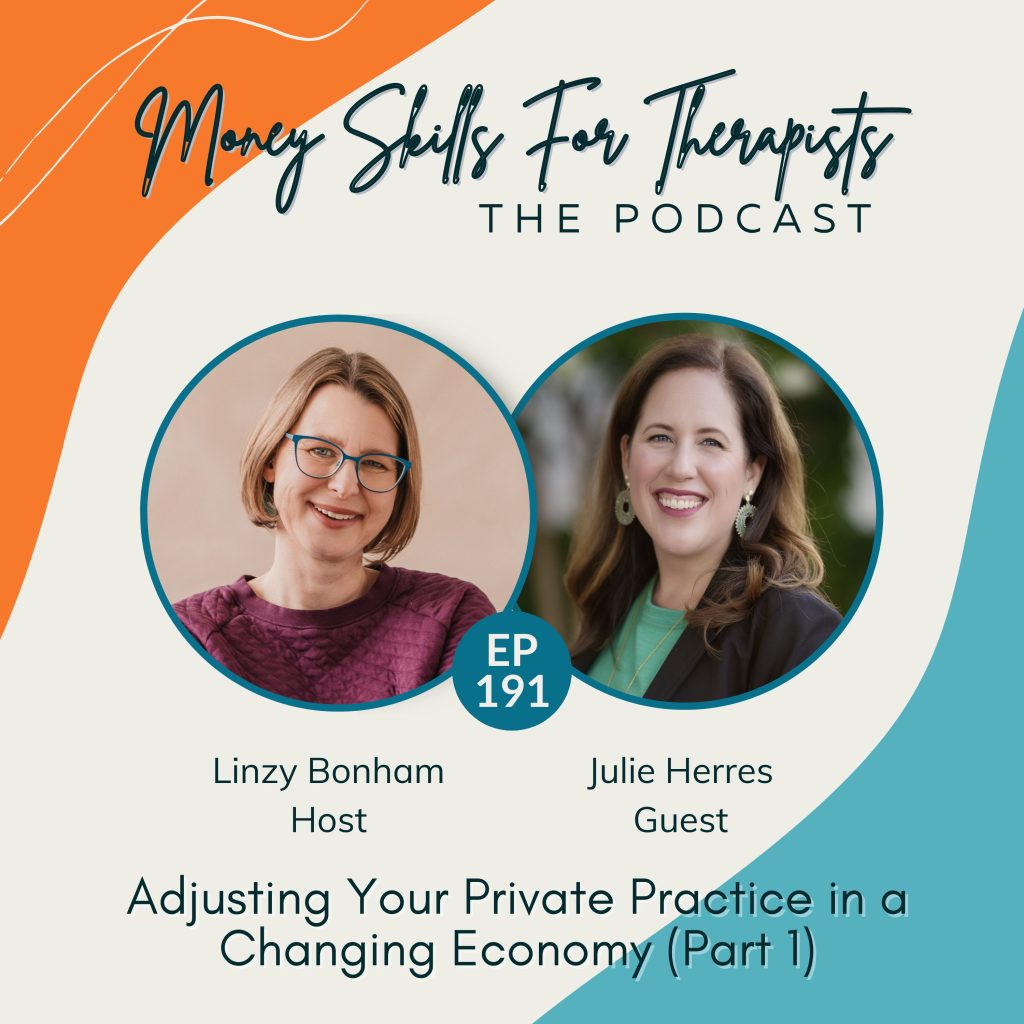
Listen to this episode »
© Copyright 2026 | Money Nuts & Bolts Consulting Inc. | All Rights Reserved