Website Wisdom for Health Practitioners with Samantha Mabe

Episode cover image for Website Wisdom for Health Practitioners with Samantha Mabe
Header for podcast website

Website Wisdom for Health Practitioners with Samantha Mabe

Episode cover image for Website Wisdom for Health Practitioners with Samantha Mabe

 “If you’re going to invest in something, and you’re going to invest in the copy and the messaging that is going to resonate with the people you want to work with… if you’re going to create the design that is going to feel really welcoming and kind and communicates what you do, you are going to see those clients come in as a return on your investment.”

~Samantha Mabe

Meet Samantha Mabe

Samantha Mabe, creative director of Lemon and the Sea, designs websites for therapists and health practitioners who want to make a positive first impression so that they can get started with the right-fit clients faster. With her signature framework, Samantha has designed and customized websites for all different types of entrepreneurs. When she is not digging into design and strategy, Samantha loves reading (her goal is to read 200 books this year), adventures with her kiddo, and trying to keep up with her Netflix queue.

In this Episode...

How can your website better serve your private practice business? Guest Samantha Mabe talks about the importance of having a website presence and the essential components of websites for health practitioners in private practice.

Listen in to hear practical tips about how to design and analyze your website to make sure it is working for you. Samantha also shares about costs and expectations for practitioners looking for support with website creation. 

Connect with Samantha

https://www.lemonandthesea.com/homepage-writer

https://www.instagram.com/lemonandthesea/ 

https://www.linkedin.com/in/samanthamabe/

Interested in working with Linzy?

Are you a Solo Private Practice Owner?

I made this course just for you: Money Skills for Therapists. My signature course has been carefully designed to take therapists from money confusion, shame, and uncertainty – to calm and confidence. In this course I give you everything you need to create financial peace of mind as a therapist in solo private practice.

Want to learn more? Click here to register for my free masterclass, “The 4 Step Framework to Get Your Business Finances Totally in Order.

This masterclass is your way to get a feel for my approach, learn exactly what I teach inside Money Skills for Therapists, and get your invite to join us in the course.

Are you a Group Practice Owner?

Join the waitlist for Money Skills for Group Practice Owners.This course takes you from feeling like an overworked, stressed and underpaid group practice owner, to being the confident and empowered financial leader of your group practice.

Want to learn more? Click here to learn more and join the waitlist for Money Skills for Group Practice Owners. The next cohort starts in January 2026.

Episode Transcript

Samantha [00:00:02] If you’re going to invest in something and you’re going to invest in the copy and the messaging that is going to resonate with the people you want to work with. If you’re going to create a design that is going to feel really welcoming and kind and communicate what you do, you are going to see those clients come in as a return on investment. 


Linzy [00:00:28] Welcome to the Money Skills for Therapists podcast, where we answer this question: How can therapists and health practitioners go from money shame and confusion, to feeling calm and confident about their finances and get money really working for them in both their private practice and their lives? I’m your host, Linzy Bonham therapist turned money coach and creator of the course Money Skills for Therapists. Hello and welcome back to the podcast. Today’s guest is Samantha Mabe. She is a website creator developer who specializes in supporting therapists and health practitioners, folks in the wellness space. And today, not surprisingly, Samantha and I talk about websites. Websites are not, you know, a direct part of finances. And yet we talk today about how they’re so important to private practice, how we really can’t get away without having a website – and a good website – these days in terms of how clients find us. And obviously the right people finding us and wanting to pay us is pretty financially essential. We talk about thinking about your website and making sure that folks are actually getting directed towards where they need to go. Talked about how so many things that therapists we can just take for granted can end up being obstacles to people who come across our website, stopping them from actually completing that contact form and letting us know that they want to meet with us. And we also talked about when to DIY your website and when to pay someone else. I had some definite learnings today in this conversation with Samantha and I think you will too. Here’s my conversation with Samantha Mabe. Samantha, welcome to the podcast. 


Samantha [00:02:14] Thank you so much for having me. 


Linzy [00:02:15] Yeah. So you are a website designer, you are a marketer, and I’m always grateful for marketers because I find personally, as you know, like therapist, coach, teacher, marketing is something that I’ve never really been able to get that excited about, but it’s a kind of non-negotiable part of having people find you. I’m curious, like what led you to focus on therapists and health practitioners? Who are your folks that you serve as a website designer? 


Samantha [00:02:41] When I started website design, I was focusing on pretty much anybody who came my way and then narrowed into online businesses. But what I found was that I had a couple of clients who were in the health and wellness space, and I loved seeing how they were able to serve their clients and really get a transformation. And at the same time that actually one of my clients inspired me to go on this journey to get some fatigue and anxiety issues fixed. So I was seeing a naturopathic doctor, I was seeing a counselor to help with some things, and I was able to experience kind of what they did on the client. And I loved the idea of working with people who were serving clients in the real world who are making a difference in these people’s lives and helping those businesses to thrive by giving them a place to show up online, to showcase their expertise, to start building trust with the people that they wanted to work with. And I found that it was also a need in that space for website expertise, which is what I love to do. 


Linzy [00:03:57] That’s right. Yes. And, you know, I think you’re so right that therapists and health practitioners, like we have such specialized skills that are also really complicated and kind of hard sometimes to explain. And so sometimes it’s hard to translate what you do with your clients and like the transformations that you give them and like the meaning of the relationship and everything that goes into it. Sometimes it’s hard to translate that into the nice digestible page where you’re sharing the right information with somebody who’s coming across you without showing the wrong information that might be overwhelming, but giving them enough. Like I know when I started in my private practice, it was before trauma therapy was really something that made sense to anybody. So even as I would just be like at a dinner party chatting with friends and they were like, Oh, so what are you doing now? I’m like, Well, I’m an I’m in private practice and I do trauma therapy. And then I’d have to try to figure out how to explain trauma therapy in two sentences, which was like really, really hard. And I think most therapists have the equivalent of that kind of experience. How do you distill this big, complicated thing that you do into something digestible that people are like, Oh, I get it. I know somebody who needs that, or, Oh, I need that. How do you make the complex, simple and easy to understand? 


Samantha [00:05:04] Yeah, especially when you specialize in something. So if you’re doing trauma therapy, you’re not going to take just any client. And so, saying I’m a therapist is not going to be helpful to people. 


Linzy [00:05:15] Yes, absolutely. Absolutely. So something that I hear sometimes from therapists, especially those starting out in private practice when they’re trying to figure out what do you do first, what do you have to do? What can you get away with? Sometimes folks will ask me like, do I need a website? Or they only have like a Psychology Today profile, but it’s like, isn’t that enough? What is your argument for why therapists actually need websites? Even at the beginning of private practice? 


Samantha [00:05:42] The best thing that you can do when you start your website, and the reason why I tell people to do this, is get it online, because Google is going to start seeing what you do. And so you are starting from the very beginning of your business or wherever you’re at. When you start, you are creating that profile, you’re building trust, you’re building kind of that sort of that juice with Google to help people find you. And then you are also really showing up as a professional, reliable, trustworthy source for people who stumble across you on search or get referred to you by somebody that they know. We are pretty much all going to type in somebody’s name when we hear a referral or we hear about what they do. And so we want to have an online space that’s going to highlight what we do, highlight our expertise, really connect with people and make it look like we’re professional. We know what we’re doing. We’re still in business. We didn’t close down. All of those things. Because what a website can do for you that other profiles are not going to be able to give the whole picture on. 


Linzy [00:07:00] Yes. And something else I’ve also noticed, even just in myself, is if I do a search for somebody like, say, specifically a therapist, even like a colleague of mine, like, you know, I’ll be talking to somebody who is looking for a therapist. I’m like, Oh, you should really connect with this colleague of mine that I used to work with. When they don’t have a website, sometimes it feels like a bit sus, like you’re like they’re really real. I think we have, for better or worse, reached this time in society where, like the internet is so real to us that if you don’t have a presence on the internet, I think there is this question that comes up in people’s mind of like for who they really are. They really feel like, are they real? Yeah, it’s going to be much easier, I think, for somebody to assess and make a decision about somebody who has an actual website, a presence to look through. Then somebody they’re like, Yeah, I read their like two paragraphs on Psychology Today, but like, it doesn’t look serious. And I do think it does raise little flags in us if someone is not truly searchable, if there’s not actually like a website to land on rather than little like bits and pieces scattered over the internet. 


Samantha [00:08:01] Absolutely. When I was talking to my mom about some of my clients, you know, she goes to her chiropractor and she’s like, Yeah, I Googled my chiropractor and they didn’t have a website and I wasn’t sure that I wanted to call them. And I’m like, If this is just like these older generations and they are Googling people, we know that we need it, like. 


Linzy [00:08:18] The boomers, the boomers, things like that. Everybody below is going to think like that too. Yeah, there is like a legitimacy that a website gives you, unfortunately, in a way, because I’m like, it seems kind of arbitrary, but people are really looking for that and when they don’t find that, it plants seeds of doubt. Yeah. So for people then who are starting a website or they, they have a website, but they’re like, I don’t know if this is actually working for me, not seeing the returns on it. How can you make a website actually get folks in the door? What needs to go into that? 


Samantha [00:08:49] I really like to keep it simple. So when you are taking a look at your website, if you’ve already built it, what I like to start with is looking at some of the data. Are you getting traffic to your website? Because if you don’t have any traffic, right, then the design isn’t going to matter, right? But if you are getting that traffic to your site, what the data can tell you is which pages they’re coming to and kind of how long they’re staying there. And that’s going to give you a good picture of if you’re capturing people’s attention. And then if you get lots of people on there, but you’re not getting them to call in or book an appointment, you know, there’s kind of a disconnect in the way that it’s laid out for them to then take that next step with you. So you’re kind of a detective. You’re figuring out where is the problem and then what do we need to do about it? 


Linzy [00:09:47] Yeah. Yeah. Because I think, you know, one way that I think about it is it’s like they’re in the house of your website. Like, what window are they jumping out of instead of getting to the end and, like, contacting you, which is the goal, right? And so that’s information. You know, if folks are listening now and they’re like, Oh, I don’t know that about my website, is that information that they’re already going to have available to them if they go look in the back end of the website? Or is that something that they’re going to have to specifically add some text to do that? How easy is it for folks to find that information? 


Samantha [00:10:17] Depends on your platform. So any platform you can add Google Analytics, it’s going to give you the most information, probably too much information, but you can install that, give it 30 days and you’ll get data. If you’re on a website platform like Kajabi, Squarespace, I think Wix even has some analytics. If you’re on a paid plan, you can go in and see some basic information. As far as how many people, how many visitors do you have, which pages are they looking at, that kind of stuff. Yeah, and that’s always a good place to start. 


Linzy [00:10:55] Okay. Yeah, but will those platforms tell you where people left? Like what page they were on when they exited your website? 


Samantha [00:11:04] Most of them don’t, you just kind of have to dig in. What I have always seen is a correlation between the most popular pages and the pages people leave from that, which make sense. If you have the most people on your home page, the most people are going to leave from your home page. 


Linzy [00:11:22] Right. Okay. Yeah. So that’s not necessarily something to look for to be like, you know this when people left this page, this page is my weakest link. 


Samantha [00:11:30] Yeah, you have definitely have to have something like Google Analytics that’s going to go more in-depth with that. 


Linzy [00:11:36] Yes. Yeah. And I think that’s really helpful for folks listening, because most therapists, if they are established in private practice, do have a website, right? But it’s like, I love your point of like, is your website even getting traffic right? Like, where are people going? Because something I can think of is like if you have a website that’s getting traffic, but nobody’s making it to your contacts page. That shows you there’s a problem there, right? In a situation like that, what would you- how do you solve that? What do you know to do if you discover that for folks who are listening? 


Samantha [00:12:07] What I always start with is I tell people that we need to look at what your number one goal of your website is. So that’s going to be getting to your contact page, filling out the form, actually getting the submit button. And then we work backwards. So we want to make sure that every page of our website is a journey to move them there. Mhm. So your first call to action on your home page under your headline where you’re talking about what you do should send them to the contact page to get in touch. Yeah. Action on your services page where you’re talking about these are the people that I work with, That’s kind of how we lay everything out. That button should send them to the contact page, so we want them to have a really easy time getting the information they need and getting over to where they need to be without getting distracted by everything else. 


Linzy [00:12:59] Yes. Yes. Okay. That’s a great point. So for people listening, if you feel like you’re not getting enough to your contact page, make sure it’s easy for them to get there. Like using that house metaphor, which may or may not be helpful at all. But I’m thinking like you’re going to be able to see kind of who’s going to what room in the house. It’s like every house should have a portal to the place you actually want them to end up. Yeah. Which for therapists is going to be their contact page where they fill out the form because something else that occurs to me, so the like, I’m just thinking about all the friction points for folks who reach out, especially to mental health therapists because there’s so much vulnerability there. This probably also applies to folks who are looking more for like physical or, you know, health supports, but especially mental health. There’s like so much shame there and there’s so many feelings that I would think that like any friction that you can remove is a good idea. To remove anything that might get in their way could lead to them just jumping off and being like I’ll just contact her later instead. Or like, No, I’m just going to keep. Like, does that, is that accurate? Like, should we really be trying to, like, make it as easy as possible? 


Samantha [00:13:57] Yes, You need to make it as easy as possible. And some easy ways to do that is make your contact form as simple as possible. So only ask the questions you absolutely have to do. It’s not an entire intake questionnaire. Let them fill out a contact form or schedule in an appointment scheduler directly instead of having to call your office. I will not schedule somebody if I have to talk to them on the phone. 


Linzy [00:14:24] Yes. You’re not the only person below the boomer generation who feels that way. Yeah. 


Samantha [00:14:29] And then if you are sending them offsite to some kind of scheduling software that you use, try to make that as clear as possible too. So don’t have them go there and then have to choose which appointment type that they want, for how long it’s supposed to be or which issue you’re dealing with. Like all they need to do is get on your schedule or get that form in your inbox. 


Linzy [00:14:55] That is so true. I sat with someone recently supporting them to reach out to a therapist, and so I got to see all the points where there was friction that if I, if I had not been there, like literally for the purpose of just supporting this person in submitting the form, and it was like, why are you reaching out for help? And like, even that is a hard question for someone to answer if they’re really in distress. And so, yeah, it makes me think about how again, it’s like as therapists and practitioners, we’re so used to what we do that it’s like, Oh, just, just put on the form that you were sexually abused as a child. That’s- I hear that every day. It’s like for them, it’s not every day, right? It’s- we get- we can really forget how hard it is for folks to even name the reasons that they’re coming to see us. So if you’re asking folks to do that before they even meet you, you’re asking a lot and you’re possibly losing people because of that friction. Yes, absolutely. So for a website, then, if somebody is maybe in a place where they’re going to be building their own website or they’re thinking like, okay, is my website actually doing this stuff, what pages and information actually need to be part of a good therapist website? 


Samantha [00:16:02] I always start with four pages, so you have your home page where you’re basically giving an overview of what you do, who you work with, all of kind of the ways people can connect with you. Yeah, you have an about page that’s going to address your credentials. If you have a team, you’re going to include that. Kind of give them all of the things that are going to make you trustworthy, that they’re going to know you were the right person for them and that you have the expertise that they’re looking for. You want a services page, and I like to keep this as simple as possible without a whole bunch of dropdowns and extra links where you’re going to talk about kind of the overall thing that you help people with. And then you can list out, you know, these are some of the issues that we might address. These are the types of therapy that we might use. Because when people come to your services page, they’re not going to know what all of that means necessarily. You as a therapist are going to be working with them to figure out, here’s what we need to do in your specific situation. So people just kind of need to hit these keywords that apply. These are some things I’ve heard of. Want to make sure you know what you’re talking about. If you can include testimonials from clients, even if they’re anonymous, that can be really helpful. And then you’ve got at the end of that, you’ve got your contact page where they’re actually getting in touch to set up an appointment with you. 


Linzy [00:17:30] In a very simple way where you’re not asking too much for them. Yes, yes. Yeah. And the testimonials piece like I know for me, I’m in Ontario, registered as a social worker. Like we’re not allowed to use testimonials at all, which is a, you know, a bummer. The business part of me knows that’s a bummer. The other parts of me know like, No, it’s so complicated. So that’s definitely something that, you know, folks should be checking with their own college to see what you’re allowed to do in the state you are, with a specific licensing body that you’re part of. So how much does a good website cost? I have had friends do $20,000 website overhauls. I’ve heard people do $500 websites. Like it’s such a massive range when folks are looking to like make this investment in their business, how much should they actually expect to pay for a decent website or a good website? 


Samantha [00:18:23] Yeah, it’s, I mean, it’s going to be a range. It’s going to depend, I would say you can if you want to work with a design agency that’s going to do kind of start to finish, everything is going to be 10,000 plus. If you’re willing to do a little bit more work and work with somebody like me, I have my own small business. I am going to be working with you one-on-one. We’re going to design the website, get it launched. So my process is 3500. That’s about what other designers who do what I do charge. Yeah, and then you can add on additional pieces. So if you don’t want to write the copy for your website, I have copywriters who are about that same price range that I refer you to, so it could definitely be under 10,000 depending on what you want to take on and what you want to hand off to somebody else. Yeah. 


Linzy [00:19:14] Yeah. 


Samantha [00:19:15] Yeah. The other cost you have to consider is you’ve got a domain that’s going to be $15, $20 a year. That’s like the URL they type in. Yes, Yes. And then you’ve got your website hosting and that can, that can vary a lot depending on the platform you’re using. But I would expect to spend probably no more than $300 a year on that unless you’re on something like Kajabi that’s also a course hosting platform and that is a lot more expensive. 


Linzy [00:19:46] Yes, yes, yes, yes. Okay. So I’m hearing then, like unless folks are going like premium, which is like the 10,000 plus. A typical website overdo will be a few thousand dollars. And if you add copywriting on top, that’s another like few thousand dollars. So we’re looking like somewhere around $7,000 for a good website. Yeah. And as folks are thinking about this because some people are listening now would be like, Oh, I did not want to spend $7,000 on a website. What would be your argument as to why it’s this is a worthwhile investment for all the things that therapists could be investing in in their business. 


Samantha [00:20:20] What I have seen – and I have looked at a lot of websites – is that most websites in any of the health and wellness fields are pretty outdated. They look like they were designed, you know, 20 years ago. 


Linzy [00:20:33] And so you’re saying they’re bad? Yeah. 


Samantha [00:20:37] But if you’re going to invest in something and you’re going to invest in the copy and the messaging that is going to resonate with the people you want to work with, if you’re going to create a design that is going to feel really welcoming and kind and communicate what you do, you are going to see those clients come in as a return of investment because A, you’re going to jump up in the search results. You’re going to see more of your referrals convert because people are going to see, Oh yeah, you’re a legitimate business. I feel like you’re trustworthy and I want to work with you and you’re just going to start building all of that. And I think everybody is going to be moving in that direction. So if you can get in ahead of everybody else, it’s definitely going to build momentum in your business. 


Linzy [00:21:25] Mm hmm. Mm hmm. Yeah, I know. For me, when I started out, I had a website built by somebody else because web design is one of the few things that makes me feel smashy. It brings out the rage. I have very little rage in my body. But there is something for me about, like, I used to do HTML back in the day in various admin capacities and something about like an HTML script that is not working, and it looks right to me, but it’s not working, just makes me want to smash my computer. So I learned that the emotional value of outsourcing is also really high. But I will say like having made that investment in my practice at the beginning, you know, I used to be the top of Google like, you know, the very top if you searched like trauma therapy Guelph, or therapist Guelph, like I was front page and that probably got me dozens of referrals over the years that I was practicing. So there is like a return on investment piece there. Is there ever a time when you would tell somebody that it’s not the right time to invest in a website? 


Samantha [00:22:24] I encourage people who are just starting out. If you are not seeing a ton of clients yet, feel like that time in your schedule to figure some of this out. If you’re not exactly sure who you want to work with and you’re narrowing down on that, yeah, it’s a great time to just find a platform or find a template, get it up and out there as a DIY solution and know that you can come back to it later. Once you have all those answers and who exactly you want to work with and what your messaging is going to be, right? Instead of putting in that big investment upfront and then having to change a lot of things down the road. 


Linzy [00:23:04] Yeah, and that’s actually, you know, that’s such a great point. Sometimes I think that it’s tempting to want to invest in those things when you first start your business because it feels like a way you’re going to figure that stuff out. Like it’s like a shortcut where it’s like, But if I make a website, then it’s solid and then I’m going to know who I serve and I’m going to know how I talk about what I do. But it doesn’t actually replace that time, though sometimes it takes to like, really, like hone in your niche and be like, Oh, actually I don’t really want to serve folks with like intense anxiety like I used to in my my agency job. I’m actually getting really excited about working with parents, and that’s going to be my niche. Sometimes it does take a time to feel your way through that niche. And so yeah, you wouldn’t want to get a website built that’s all about anxiety when you’re three weeks away from pivoting to being like a parent coach. Yeah, that would not be a great investment. Samantha For folks who are listening, where can they find you if they’re interested in learning more about what you do? 


Samantha [00:23:57] So my business is lemon and the sea, which makes it pretty easy. So my website is lemonandthesea.com . I am on Instagram and LinkedIn. So Instagram is lemonandthesea LinkedIn is Samantha Mabe, just my name and that is mostly where I am hanging out. I also have a podcast that I talk business and website design on, and that’s process to profitability. 


Linzy [00:24:19] Well, great. Thank you so much for joining me today, Samantha. 


Samantha [00:24:22] Yeah, thank you for having me and chatting about this. 


Linzy [00:24:39] Marketing is one of those things that, as therapists, most of us don’t tend to love. I don’t love it. And yet it is such an important part of the business. And I like this framing of your website as being part of, you know, giving your potential clients an experience of you before they even meet you, thinking about what is their experience coming onto this website? Where does this website lead them to? Is there language that makes sense to them? Does it feel overwhelming? Are you asking them questions in order for them to just get a consultation with you that are actually really difficult questions for them to answer? And you don’t realize that because you’re so used to talking about these hard things every single day. These are great things to reflect on, thinking about our own websites and ultimately making sure that we have websites that represent us really well and get the right folks in the door and allow us to thrive in private practice. So thank you to Samantha for coming on the podcast today. You can follow me on Instagram at @moneynutsandbolts. And if you’re enjoying the podcast, I would so appreciate if you’d head over to Apple Podcasts and leave me a review. It’s the best way for other folks to find us and be part of these conversations. Thanks for listening today. 

Picture of Hi, I'm Linzy

Hi, I'm Linzy

I’m a therapist in private practice, and a the creator of Money Skills for Therapists. I help therapists and health practitioners in private practice feel calm and in control of their finances.

Latest Episodes

Money can sometimes feel easier to manage in your business than in your relationship. In this episode, I sit down with Ed Coambs to gently explore what happens when you bring your money skills home and begin navigating them alongside a partner. We talk about financial intimacy, emotional safety, and what it truly takes to have honest, grounded conversations when two nervous systems — and two lifelong money stories — are in the room.

Listen to this episode »

In this episode, registered psychotherapist Liane Wood and I gently challenge you to explore what it actually means to build a sellable therapy practice—not because you should sell someday, but because thinking this way creates more freedom, sustainability, and financial clarity right now in your personal and professional life. 

Listen to this episode »

For our 200th episode of Money Skills for Therapists, I invited my business besties, Tiffany McLain and Maegan Megginson, to join me for a conversation that was more honest than polished. We unpacked about the real seasons of entrepreneurship — the times when you feel energized, expanding, and deeply aligned… and the times when you feel tired, restless, like you’re questioning everything, or quietly pulling back. If you’ve ever wondered whether it’s normal to feel both love and resentment toward your business at different points, this conversation is for you.

Listen to this episode »

© Copyright 2022 | Money Nuts & Bolts Consulting Inc. | All Rights Reserved

Preparing for the Unexpected in Your Private Practice with Mary Beth Simon

Episode Cover image for Preparing for the Unexpected in Your Private Practice with Mary Beth Simon
Header for podcast website

Preparing for the Unexpected in Your Private Practice with Mary Beth Simon

Episode Cover image for Preparing for the Unexpected in Your Private Practice with Mary Beth Simon

 “The thing is that when something goes wrong, people do want to assist us. And if you have a team, they want to be there for you. Even if you have support people like accountants and bookkeepers, they do want to help you. They just need the tools to be able to support you.”

~Mary Beth Simon

Meet Mary Beth Simon

Mary Beth guides business owners to create contingency plans that prepare them and their teams for extended vacations or the unexpected, so the business can continue to run successfully in their absence. She founded Niche Partnership Consulting after seeing the turmoil that a lack of contingency planning can cause when a dear friend developed terminal cancer. Mary Beth is a national conference speaker, continuous learner and loves helping business owners find peace of mind since retiring from a 30+ year career at Vanguard. In her free time, she’s active in her local business community and loves being mom to her rescue dogs.

In this Episode...

Do you have contingency plans in place for your business? In this important conversation, guest Mary Beth Simon explains what it looks like for private practitioners to have contingency plans in place for their businesses. Mary Beth and Linzy discuss why it is wise for practice owners to have business contingency plans in place in addition to personal planning and how that process might look.

Mary Beth explains the four week process that her business uses to get practitioners ready with contingency plans for both their personal and professional affairs. She talks about how the business contingency plans can layer on top of the personal planning and how those plans can be a business asset in addition to a wise planning move in the case of the unexpected. 

Connect with Mary Beth

Get the FREE business contingency plan: https://nichepartnershipconsulting.net/linzy 

Connect with Mary Beth on YouTube or LinkedIn

Interested in working with Linzy?

Are you a Solo Private Practice Owner?

I made this course just for you: Money Skills for Therapists. My signature course has been carefully designed to take therapists from money confusion, shame, and uncertainty – to calm and confidence. In this course I give you everything you need to create financial peace of mind as a therapist in solo private practice.

Want to learn more? Click here to register for my free masterclass, “The 4 Step Framework to Get Your Business Finances Totally in Order.

This masterclass is your way to get a feel for my approach, learn exactly what I teach inside Money Skills for Therapists, and get your invite to join us in the course.

Are you a Group Practice Owner?

Join the waitlist for Money Skills for Group Practice Owners.This course takes you from feeling like an overworked, stressed and underpaid group practice owner, to being the confident and empowered financial leader of your group practice.

Want to learn more? Click here to learn more and join the waitlist for Money Skills for Group Practice Owners. The next cohort starts in January 2026.

Episode Transcript

Mary Beth [00:00:04] The thing is, when something goes wrong, people do want to assist us. And if you have a team, they want to be there for you. Even if you have support, people like accountants and bookkeepers. They do. They want to help you. They just need the tools to be able to support you. 


Linzy [00:00:29] Welcome to the Money Skills for Therapists podcast, where we answer this question How can therapists and health practitioners go from money shame and confusion, to feeling calm and confident about their finances and get money really working for them in both their private practice and their lives? I’m your host, Linzy Bonham, therapist turned money coach and creator of the course Money Skills for Therapists. Hello and welcome back to the podcast. Today’s guest is Mary Beth. She guides business owners to create contingency plans that prepare them and their team for extended vacations or the unexpected so businesses can continue to run successfully in their absence. Today’s episode is a conversation about the things that we don’t like thinking about, which I think makes it very much on par with what we usually talk about here when we talk about money and those things that we don’t like thinking about is what if we get sick? What if we get injured? What if we need to step away to take care of somebody else in our life who gets sick or injured? Or what if we die? They’re not fun questions to think about, but I think we all know if we zoom out, that it’s worthwhile to start to put plans in place to make it possible for things to be taken care of if those things happened, when those things happen. The conversation with Mary Beth today really got my wheels turning, thinking about the importance of having a professional will, the importance of bringing other people into your business. So it’s not just all living in your head. And we get into how to actually make a contingency plan. What does a contingency plan actually look like? What is in it both for your personal life but also for your business? So if you have a hard time thinking about the what-ifs in your life and if you will want to have a plan in place so that your family and your clients are taken care of if you are not able to take care of them. This is going to be a great episode for you. Here’s my conversation with Mary Beth Simon. So Mary Beth, welcome to the podcast. 


Mary Beth [00:02:36] Thank you, Linzy. It’s a pleasure to be here with you. 


Linzy [00:02:39] I’m excited to have you here. And I’m excited partially because we’re going to talk about the things that people don’t like to talk and think about. 


Mary Beth [00:02:47] That is true. 


Linzy [00:02:47] Which I think is really important. Yes. Which I see is kind of part of, you know, the work that I’m trying to do in the world is get folks approaching and thinking about the inevitable things that we don’t like to think about. And you, I think, are on a similar mission with a slightly different focus. So mine is money, you know, yours is the hard stuff that happens in life. There’s contingency plans that we need. 


Mary Beth [00:03:09] Yeah. And the idea is to keep the money flowing. 


Linzy [00:03:12] Yeah, right, right, right. Okay. So we’re going to talk about- I talk about taxes, you talk about death and other things. So we’re going have a death and taxes conversation today. So folks listening. Take a breath, grab a warm drink. Let’s settle in to think about things that we don’t like to think about, but that are inevitable, or at least likely, which is that life happens. So, Mary Beth, you help folks think about contingency plans. So for the therapists who are listening, like what kind of contingency plans do they need to consider having in place? 


Mary Beth [00:03:42] Yeah. So I do a lot of work with therapists, so I can go pretty deep into some of the therapist concepts for contingency planning. So I always recommend that we start with a personal contingency plan and address the things about our legal and financial aspects just as a human being. Right? So that we’re talking about what happens to our family if something happens to us, what do they need to know? And then after the personal contingency plan is in place, then for business owners, the next step is to create a contingency plan for your business so that either someone who you trust professionally or personally will be able to step in and keep your business running if something happens to you, until you get back on your feet. Or know how to address what’s happening, how to understand your business, if you do die unexpectedly. Right? And then the third plan is called a Business Continuance Playbook, and that is about documenting the standard operating procedures – the SOPs – for your role as a business owner. Right. 


Linzy [00:05:01] So and just to, you know, really ground in the kinds of things we’re talking about, like what are the kinds of events that might happen that mean you need a contingency plan in place? 


Mary Beth [00:05:11] Yeah. So, I mean, one of the gifts of COVID was that it brought clarity to us about how people and business owners in particular can be fine and operating in their business one day and then hospitalized the next. Right. Especially, you know, in the early days of it. So, you know, anything can happen from the potential of having even a concussion where you can’t look at a computer, where you can’t read, you can’t be in a room with light, that kind of thing, something that will take time for that to heal. A car accident, an illness, you know, anything that would take you out of the game. All the way up to something that would take you out permanently. 


Linzy [00:06:04] So, like injury, illness, death, these are all things that we need to be- although we don’t like to think about them. And I think especially like, you know, for myself, like I’m a parent to a young child. So, like, these are things that are especially difficult and painful to think about, you know, when we’re I’m so relied on. But they’re the kinds of things that you can put a plan in place so at least you can mitigate some of the impact. 


Mary Beth [00:06:26] Yes. And the idea is that if something does happen that takes you out of the game temporarily, you want your business to be able to continue running. You want to continue getting paid, if that’s possible. You want bills to be paid so that things don’t go off the rails in a 2- to 4-week time period. Yes, that makes it even more difficult for you to come back into the business. 


Linzy [00:06:53] Totally. And what I think about, too, is if you do, I don’t know, have to be hospitalized. You- I mean, last week, my team, we had three different medical crises or emergencies in my team, just, you know, just being people in our early forties, I, you know, like I got injured and then my spouse had to go to hospital and then our other team member had to go to the hospital just like bizarre. But it’s like, that’s just life. What I think about too, is like if you have plans in place as you’re saying that like things are taken care of, even if you’re not in the business, you can actually rest and take care of yourself. You’re not worried about like, oh, God, there’s this thing that I had to do or there’s this bill that has to be paid or that only you can do because there’s no information for somebody else to be able to do it for you. 


Mary Beth [00:07:33] Yeah, and that’s such a great example because that really does happen. I have seen people in that position where they really they cannot rest. They cannot take care of themselves because of the worry that their family isn’t taking care of that. There isn’t enough information in place for someone to assist them. And the thing is, when something goes wrong, people do want to assist. 


Linzy [00:07:57] That’s true. That’s so true. 


Mary Beth [00:07:58]  And if you have a team, they want to be there for you. Even if you have support. People like accountants and bookkeepers, they do. They want to help you. They just need the tools to be able to support you. 


Linzy [00:08:11] Right. So you know something about folks listening right now, like many, many of the people listening to this podcast are probably solo practitioners where it’s like just them in their business. They might not even have an administrator and maybe they have an accountant that they see once in a while. Like for those folks where it’s really just them and their clients, that’s kind of who’s, you know, around. How can they ensure that their clients would be taken care of if they have to be absent or, or even if if they pass away? Like how do you leave a contingency plan for a business that’s really just you? 


Mary Beth [00:08:43] Okay, so let’s start with something that would be more common. So let’s say that there was an illness that took a solo practitioner out of the business for a couple of weeks. In that scenario, to be prepared, you might want to create some type of an agreement with another solo practitioner therapist where you could support each other in the event of an emergency. So have someone who is authorized to contact your clients in the event of your absence, or even just to say someone will reach out to reschedule you at a later date just to have that communication with your client so that they’re not left hanging and that the person who is out of the practice can get some rest and take care of what they need to take care of. So approaching your contingency planning as a way of collaborating with another solo practitioner is one idea that may work. Since you have the credentials, the authority to support that other practitioner. When it goes into a more extreme case where a solo practitioner may die. In that situation, it’s important for therapists to have a professional will and a professional power of attorney. 


Linzy [00:10:16] Okay, Yeah. 


Mary Beth [00:10:17] And this can be difficult to find attorneys who are familiar with creating them. Okay, So it’s a concept that started in California. 


Linzy [00:10:29] Not surprising.  


Mary Beth [00:10:32] And then some attorneys across the country are familiar with what that means. So from the professional will perspective, this person would be authorized to take on your clients to access client records or to do the transition for the clients. And then from the power of attorney perspective, they would be authorized to potentially do some financial work in your business, you know, work with your bank accounts, communicate with your accountant to keep things moving, as well as to have access to your clients and their information. 


Linzy [00:11:12] Right. Okay. So that would actually be a will that you would have drawn up where you, you know, you’ve named your person, your power of attorney. And it sounds like that would also be a colleague. Right? So this would be the more. 


Mary Beth [00:11:24] Yes, it needs to be somebody who is licensed and- 


Linzy [00:11:28] Authorized 


Mary Beth [00:11:29] Authorized. Yeah. 


Linzy [00:11:30] And something I think about with that, too, is that’s such a gift to leave your clients. I mean, this is true of a will, too. Like I’ve gone through the personal will process twice. The first time it was not complicated because I had no kids and, you know, we didn’t we didn’t have like a lot. It was more just making sure that we had a plan in place. It was very simple. The second time was very complicated because we have some complexity in our family’s finances and like really thinking through how you want it to look if you die is not comfortable, but it does really feel like this beautiful legacy to leave your family. And what I’m hearing here is like, this is an opportunity to leave a legacy like that for your clients in the case that you die because that will also be traumatic for your clients. 


Mary Beth [00:12:11] It can be, yeah. You know, like how many therapists have clients who have been with them for years or decades?  


Linzy [00:12:19] Yes. Yes. Right. 


Mary Beth [00:12:20] Even if it’s not constant. Right. You’ve had that connection over the years and they come in and out as they need you and they rely on you as a resource. Yes. And so, Linzy, as you’re talking about creating your personal will, ideally this professional will is something that sits, you know, on top of your personal estate plan. So you start with that foundation of your personal estate plan, depending on how your business has set up, what type of way that it is registered, right, You have to have that incorporated into your personal estate plan and then create your professional will on top of that. 


Linzy [00:13:02] Okay. Yeah, because what I hear there is like, you’re leaving somebody to take care of the business pieces, but also take care of your clients. Right. To, like, inform them of what’s happened and help make sure they get an appropriate referral, whether that is that person themself who maybe does similar work to you, who can take them on, or whether that person helps to do a warm referral to somebody else? 


Mary Beth [00:13:22] Yes. 


Linzy [00:13:23] Yeah. Yeah. That’s a very powerful thing to put in place. And with this Mary Beth, like in your experience, what are some of the things that hold therapists back from doing this work and putting these plans in place? 


Mary Beth [00:13:35] Yeah, So I would say, especially for solo practice therapists, it’s this question that we just talked about. You know, it’s just me and the practice. There is no one- that feeling of there are no other options, right? So opening your mind to the possibilities of what- how that question can be answered and that challenge can be solved. And then on the other hand, if you have a large group practice, then sometimes therapists might feel like it’s so complex. Nobody can be my second in command because it’s so complex. And in that scenario, I suggest that you might want to create more of a board of directors approach to your business where you might have one person who you trust with all of the information and access to the finances, and then potentially have some supporting actors around that individual who are able to do maybe accounting or bookkeeping work or clinical work and make recommendations to that key decision maker, right? 


Linzy [00:14:49] Yes, yes, yes. 


Mary Beth [00:14:50] So those are you know, that who is my second in command is a big question. And the other thing that holds therapists back and people in general back is that we don’t want to go here. We don’t want to think about, you know, at especially at a young age with children, the possibility that we may, you know, we could die early or something like that. We just don’t want to think about it. What I would suggest is when you think about the complexity of your life and your business, just think about somebody needing to navigate that without you there. 


Linzy [00:15:31] Yes. Yes. Yeah. Yeah. That’s kind of like a tangled ball of yarn to leave behind for somebody else who does not- is not you and is not in your brain. And you know, something that I’m thinking about as you’re talking is like the therapist so often just as kind of a type of human – often people I find who are in in therapy and health practitioners too, but definitely mental health clinicians – often they’re used to being caretakers and they’re used to being the one who’s responsible, and they’re used to being the one like, No, no, only I can do this. This is my job. And what I’m hearing is like, that story can show up at the solo practice level, where it’s like, but there’s nobody else. It’s like literally only me. But it also show up at the group practice level where like, but it’s so complicated, nobody else can do it. Right. And what I’m hearing is like, we need to push past that story that nobody else can do it. But also we need to actually set it up so somebody else can do it. 


Mary Beth [00:16:20] Yeah. 


Linzy [00:16:20] Right. That’s part of the plan is like we are actually making a map for somebody else because there are other competent folks around us. We’re not the only competent person in the world, you know, but you can use those skills that you have to make it so that everything’s okay, even if you’re not able to run the show. 


Mary Beth [00:16:37] Exactly. And that the key to creating a really solid plan is to go as far into like a challenging area as possible. Right? So it’s, you know, I die suddenly and somebody needs to be able to do this. Who doesn’t do this on a regular basis. Right. But most often, this plan will most likely be used for intermittent disruptions in your life and your business. So often when I’m working with a therapist or a client, something will happen in the family that pulls the business owner or their spouse out of the picture to take care of somebody else for a period of time. That happens so frequently. And so you need your resources around you so that you can get that assistance that that you need. 


Linzy [00:17:34] Absolutely. Yeah. And you know what to think about, too. Is that also having a plan like that in place means that you get to be present with whatever that is, right? Like if you have a parent who falls ill or if your child is hospitalized or, you know, all these things we don’t like thinking about. But that do happen. You know, you just get to again, just be doing that. You don’t have to be worrying about, oh, was this person informed that I can’t make the session? And was like, oh, there was this loop that had to be closed off. Like, you just got to be in whatever role you’re playing in whatever situation or and just be in your own life and not have to be worrying about all these loose ends that nobody else can tie off. 


Mary Beth [00:18:10] Yeah, that’s exactly it. 


Linzy [00:18:11] Yeah. Yeah. So what is the process then, for creating contingency plans? How do we do this? 


Mary Beth [00:18:18] Yes. So the only reason that we don’t already have them in place is that we don’t know the process. Right? For each plan, it takes about four weeks to create each plan. So as I mentioned before, typically I’d like to start with the people with their personal contingency plan. And the first thing is to gather all of the important documents together. So for your personal contingency plan, this includes things like a statement for each bank account that you have for your personal life. Okay, let’s put the business aside, information about the beneficiaries that you have on all of your accounts. So that’s typically your investment accounts, retirement accounts, life insurance. Things change in life and people often forget to change their beneficiaries. And then other people who are friends and family will be shocked at who inherits what because the beneficiary never went back and updated. So information about your cable internet, copies of every card that you carry in your wallet, copies of your passport, TSA access, anything like that, any of your certificates that are legal, professional or religious. So like birth certificates, marriage certificates, death certificates for anybody, and, you know, parents who have passed anything like that. So you get all of this information together, all of your legal documents. The first week is collecting all of this information, and then the second week is organizing it. Now I create binders for my clients, but everybody can do this on their own as well. And so organizing it in sections in the binders. The other part that happens during the personal contingency plan process is clients are asked to adopt a password management system. I like LastPass, but if it is done in paper, like handwritten passwords, I provide people with a password book that’s flexible and they can add sections and paper to it, depending on needing to expand it or contract the size of it. So passwords are a big part of the contingency planning process. And so we usually talk about that in the very beginning because that can be a big change for people. 


Linzy [00:20:53] Yeah, And you know, we now all have, I don’t know, like 2000 apps and websites that have all different passwords and they force us to update passwords randomly. It’s kind of a new problem, right, That didn’t exist 40 years ago when people needed support or passed away. 


Mary Beth [00:21:10] This is the thing, like our digital life is- can be a burden to somebody who is trying to navigate what’s going on with us. So that’s something that’s worthwhile for everyone to consider. Whether you would be able to get yourself into a- like commit yourself to a password management system and get those who depend on you and you depend on in your personal life to adopt the same system. 


Linzy [00:21:40] Yes. Yes, yes. Yes. Okay. 


Mary Beth [00:21:43] One thing I like about LastPass is that you can name an emergency contact who will have automatic access if you don’t deny it within a certain period of time that you set up in the system. 


Linzy [00:21:56] So someone else can get in. Yeah, if that needs to happen. That’s nice. Yeah, that’s nice. 


Mary Beth [00:22:01] Which is a beautiful thing. 


Linzy [00:22:01]  Yes, absolutely. Okay, so gathering together all this information, I think is where we were talking about in the process. Yeah. And then what happens after that? 


Mary Beth [00:22:11] So then we’ve gathered all of the information and then it’s time to review and assess the current state. So when we look at bank accounts, then it’s how are they registered? Who has authorization to act on their bank account? 


Linzy [00:22:30] Yeah. 


Mary Beth [00:22:30] In some investment accounts you can name a trusted contact who can call in, ask questions. They can’t close the account, they can’t liquidate the account, anything like that. But they would be able to work with with the company and get information on it. Then you may also want to consider when you’re looking at things like bank accounts, do you need to give power of attorney to someone else or do you want to add somebody as another owner on the bank account? 


Linzy [00:23:03] Right. Okay. 


Mary Beth [00:23:05] Yeah. So for example, like you may have opened a bank account under your own name, but now years later, you decide, Well, actually, my spouse should be on there with me too, right now so that they don’t have to enact power of attorney in order to get access. 


Linzy [00:23:21] Yes. Yeah. And that is something that I have heard and encountered, like as my grandparents aged and passed away, like having the account set up so it’s easy for someone else to access in case. Yeah, because it can be very complicated. There can be quite a delay for people to access the money if you’re the sole bank account holder. 


Mary Beth [00:23:41] Right. And then so to keep in mind, power of attorney is a factor while you’re alive, while the principal is alive. And then the will comes into play when the principal is deceased. So power of attorney is only a factor while you’re alive. And then the same thing when we look at credit cards, does anyone need to be added as an account manager on the credit card? So sometimes we get confused because one person in the household gets the credit card and gets a copy of the card or an additional card for somebody else. And we think, Oh, well, that’s my credit card account. But it’s only the person who initially applied for the credit card. Okay. So you may want the person who was not the principal on the credit card account to have account manager status, where they can call up, they can have conversations with the credit card company, report fraud, report something stolen, but they cannot close the account without providing a death certificate. 


Linzy [00:24:49] Okay. 


Mary Beth [00:24:50] The other things that we want in there is like we want to make sure that the will and guardianship documents, power of attorney, medical power of attorney is all up to date. So those documents are not set it and forget it, as you were talking about earlier. Yeah. So as life changes, it’s important to either go back to that attorney or find another attorney who you can develop a long term relationship with to review your documents. Let’s say like every five years or any time that there is a significant change, a birth, a death, anything like that. 


Linzy [00:25:28] Right. 


Mary Beth [00:25:29] And the other thing that we would have in there is medical history. I’ve created a one page medical history inventory that makes it easier for people who want to help us are going to be there to support us, to have access to our critical information, medications, doctors, all of that kind of information. Social media handles. Who has access to your social media? Who is permitted to turn it off or you know? And what do you want? What are your intentions? 


Linzy [00:26:03] Yeah. Which again, this is like a whole new area, you know, with the Internet age that we live in. Yeah. And this is something that I’ve seen people encountered when there’s been, like a sudden death in their family is like, would that person have wanted their Facebook to live on? Would they have wanted their Facebook closed? Either way, they couldn’t access it. So yeah, I think those questions of like, yeah, what do we want our digital footprint to be once we’ve died? 


Mary Beth [00:26:26] Exactly. Yeah, exactly. So these are the things that we talk through and you know that people have an opportunity to make decisions about it. All the information about your vehicles, you know, all of your titles, all that information, how things are registered there, would all go into it, a Social Security statement. So it’s a best practice to check your Social Security statement on an annual basis just to make sure that there’s no fraud and your will and your power of attorney, so all that information is there. So it’s a lot. 


Linzy [00:27:00] It’s a lot. It is. Yeah. Yeah. And for folks listening, like, if we think about doing all those things at once, it would be like very overwhelming. Right. And I know sometimes, like, you know, folks that I work with, I see this with with money where it’s like when you haven’t done something for a long time, it can be very tempting to just want to, like, do it all in like catch up. But I’m hearing for you, this is like a four week process. 


Mary Beth [00:27:22] Yes, it’s a four week process for each plan. And so the best way to approach it is to approach it like a project. And you may not want to do them consecutively, right? You may want to say, okay, this month looks good to do a four week sprint in for my personal life, and then in three months I’ll do a four week sprint for my business, right? 


Linzy [00:27:49] Yes. Yeah. So pace yourself as you’re working. Exactly. Yeah, exactly. And I’m hearing, like the personal is the foundation. Do that first and then business. You build on top of that. 


Mary Beth [00:28:00] And really once, I mean, there can be some resistance to even beginning this. But once you start and you are, you know well along your way in the personal contingency plan, the business contingency plan goes a lot more smoothly. 


Linzy [00:28:15] Yeah, I’m sure it really flows because that that you’ve you’ve already done a lot of like the hard thinking about just what you want. And I’m sure that once you built that muscle, you can naturally apply that to your business. 


Mary Beth [00:28:27] Exactly. 


Linzy [00:28:27] Would be a lot easier. 


Mary Beth [00:28:29] So next you go into the business contingency plan and there’s there are some similarities. But when we talk about bank accounts here, a lot of therapy clients follow profit first. So it’s important to have narratives about your bank accounts, about how you use profit first, about the way that you move money to which accounts for what purpose. This is super informative for anybody who is your second in command. Yes, this includes your business and liability insurance information about your business credit cards. We create an inventory of devices and hardware, and it asserts memberships and subscriptions. So that is an Excel spreadsheet with all of that information, which is super helpful. One, if you want to assess your expenses. 


Linzy [00:29:26] Yeah, Yeah, right. Yeah, it would certainly serve that function. If you made that list, you might see some things that maybe don’t belong there anymore. 


Mary Beth [00:29:34] Exactly. And then for your devices and hardware, it’s great for insurance purposes. If anything were lost, stolen or anything like that. Health insurance administration, if you have a group practice or a larger business, some therapists have insurance contracts. So we include an inventory of that lease agreements or any rentals, loan documents, payroll information, if that were to apply. And then your professional will on power of attorney retirement plan information for you or your group practice. Again, social media handles, who has access, taxes, information about your federal and tax I.D. letters and local and state registrations. Utilities, Utilities are very much like credit cards where you might want to add an account manager who can have conversations with the companies. And then vendor contracts, business associate agreements and information about your website and who are the contacts and resources for them. 


Linzy [00:30:51] Yeah. And you had mentioned earlier, too, about, you know, the idea of having a SOP – standard operating procedures. How much does that overlap this list? Like how much could have good, I suppose, replace some of the need to list these things or how much do you see them as like two separate projects? 


Mary Beth [00:31:07] Yeah. So there are times where it can seem like there is some overlap. So for example, with Health Insurance Administration, you may have – or payroll – you may have SOPs documented for that. So in their business contingency plan, it’s really just highlight information. So for payroll, like we use gusto, you know, whatever other information, if there is another resort, you know, who in the practice is in charge of payroll? What is the frequency? Just like high level information. And then when we get into the business continuance playbook, that’s where we either make sure that SOPs are already documented or we do the document. I do the documentation. Yeah. The client. Okay. 


Linzy [00:31:56] Yeah. Yeah. And that’s the continuance. So that’s the assumption that somebody is going to keep running the business. Yes. So especially group practice, this would obviously apply. Somebody else is able to step in and keep running the business in your absence or in your death. 


Mary Beth [00:32:09] Yeah. So like for group practices, they’re often looking at it being a sellable asset. We talk through, is there anybody on the radar who you think now would have interest in it? Who, you know, has interest in it at this point? That may change, of course, in the future. But yeah. 


Linzy [00:32:29] Yeah. And in that case, like I mean, that’s an interesting piece because it’s like, okay, let’s see. I know somebody is interested in maybe buying my group. How do I fit them in then to the continuance plan? Because I don’t know, maybe, as you say, maybe they won’t be interested if I become unable to work or if I pass away. How do those things fit together? 


Mary Beth [00:32:48] Yeah. So it is worthwhile to have those conversations just talking through. I mean, that person may have a role in the whole second in command structure and B, you know, you may want to inform them that you are putting this plan in place. Yeah. And as part of the planning process, I’m also considering longer term whether I’m here or I’m not. You know, would you want to be part of the succession plan? Right. Some therapists who I’m working with, you know, they do see on the horizon that, you know, in 5 to 10 years they would like to get out of the business. Yeah. And then I would say that your business contingency plan and your business continuance playbook are part of your sellable assets. 


Linzy [00:33:39] Yeah. Yeah. 


Mary Beth [00:33:40] Right. Because how many businesses would just love the opportunity to get the business owner, SOPs.  


Linzy [00:33:49] Yes. By creating this, you’re. I mean, what I’m thinking about, too, is you’re also just building your business structure. So rebuilding your business is not just you. It’s not just in your head. Right. Like it’s something else that somebody else could actually step in and run. It exists outside of your brain. And I think, you know, what we talked about earlier. So often therapists, we think that we’re the only people who can do it. And most of it does live inside of our brain. Right. We haven’t recorded it anywhere, which means that we only we can do it because we haven’t actually made it. So anybody else could access that information. So getting it out of your head helps with your contingency plan, but it also gives you a business that you might be able to sell. 


Mary Beth [00:34:23] That’s right. And we gain so much perspective by taking a step back and looking at our business. No matter what line of work you’re in, it always generates ideas for how to do, how to simplify, how to do things differently. Yeah. 


Linzy [00:34:41] And I think, you know, something that I would be curious about, too, is when people do this process, do you see this ever leading to people reassessing like what they’re doing now, not just in terms of processes, but like, yeah, like I something bad could happen to me. I find for me when I ever I do that kind of reflecting, it does get me thinking like, okay, am I actually living the life I want to live right now? 


Mary Beth [00:35:00] Well, that’s wonderful. I mean, I do see with group practice owners that they’re like, Well, there is this other thing that I would like to do, or with solo therapists who are like, Well, I’d really like to expand into coaching as well. So adding another piece to the business, you know, if they feel like the unknowns are tackled in their existing business, it does kind of open up the space for them to consider adding or changing their business in some way. 


Linzy [00:35:34] That’s so parallel to my experience, Mary Beth, with like helping folks with financial foundations, which is, you know, very much adjacent to what we’re talking about here is like once you have your finances clear and you’re in your solo practice or in your group practice, once you’ve got clarity and you’ve got a good foundation, then you do get to grow or change or expand off of that base, right? But when we don’t have that base under our feet, whether it’s like the foundational financial systems in pieces or as you’re talking about like these contingency pieces that like what if pieces when they’re not taken care of, it does take a lot of our bandwidth. I think it takes a lot of our like worry and anxiety like we feel when we’re not on solid ground. 


Mary Beth [00:36:14] Yeah, absolutely. Even if that’s not something that we can’t put our finger on that we can’t put words to. Once you start working on this and you start to tackle it, it does create a sense of security that you have that cover, that everybody who depends on you, that they are going to be okay because you put this plan in place. 


Linzy [00:36:39] Oh, I love that. So, Mary Beth, for folks who are interested in learning more about you, interested in learning more about contingency planning, where can they find you and what do you have for them? 


Mary Beth [00:36:50] Yeah, so I created a free business contingency plan for your audience. Cool. Yeah. So they can go to nichepartnershipconsulting.net/linzy. And in that you’ll see narratives for the for the bank accounts and the credit cards. And there is a 12 question checklist that will help you get started with creating your business contingency plan. There’s other free resources on the website that you’re welcome to check out as well and active on LinkedIn. If anybody wants to connect with me, they’re wonderful. 


Linzy [00:37:27] That is a very exciting I’m going to go get that that freebie for myself. 


Mary Beth [00:37:33] Yeah. Yes, please do. 


Linzy [00:37:35] Thank you so much, Mary Beth, for joining me today. This is a really thought provoking conversation. 


Mary Beth [00:37:40] It was great to be with you, Linzy. Thank you for having me. 


Linzy [00:37:56] This conversation with Mary Beth has certainly inspired me to get my professional will and contingency plan in place. I have done the work, as I mentioned, around my personal will, although I have not completed my personal contingency plan. I do have a great book called I’m Dead Now What? Where you can fill in all of these things, think through how you want things to look, and help people find all the important information if suddenly you die or if you’re ill. Really, really helpful to think about just putting these things in place now. While we’re well and we’re able to. And what a gift that is for your future self. If you find yourself in one of these situations for your family, but also for your clients. You know, I’ve heard so many people make mention of a therapist dying, their therapist dying and then never finding somebody else. Right. And we can’t guarantee, of course, that our clients will want to work with whoever we have as our executor on our professional. Well, that colleague, that trusted colleague that we bring in. But think of how much better it is for your clients to hear about your death from somebody else who is a skilled professional who can hold the space for them on a phone call, you know, giving them the news and then letting them know that they can either see them themselves or work to connect them with somebody else who would be a good fit. What a gift to leave your clients if you know the worst were to happen. So really, lots to think about after this conversation with Mary Beth today. You can follow me on Instagram at @moneynutsandbolts. If you want some free money content there we’re always doing the practical and emotional pieces that we like to do. And if you’re enjoying the podcast, I’d really appreciate if you can be a review on Apple Podcasts. It is the best way for other therapists and health practitioners to find me and to be part of these conversations. Thanks for listening today. 


Picture of Hi, I'm Linzy

Hi, I'm Linzy

I’m a therapist in private practice, and a the creator of Money Skills for Therapists. I help therapists and health practitioners in private practice feel calm and in control of their finances.

Latest Episodes

Money can sometimes feel easier to manage in your business than in your relationship. In this episode, I sit down with Ed Coambs to gently explore what happens when you bring your money skills home and begin navigating them alongside a partner. We talk about financial intimacy, emotional safety, and what it truly takes to have honest, grounded conversations when two nervous systems — and two lifelong money stories — are in the room.

Listen to this episode »

In this episode, registered psychotherapist Liane Wood and I gently challenge you to explore what it actually means to build a sellable therapy practice—not because you should sell someday, but because thinking this way creates more freedom, sustainability, and financial clarity right now in your personal and professional life. 

Listen to this episode »

For our 200th episode of Money Skills for Therapists, I invited my business besties, Tiffany McLain and Maegan Megginson, to join me for a conversation that was more honest than polished. We unpacked about the real seasons of entrepreneurship — the times when you feel energized, expanding, and deeply aligned… and the times when you feel tired, restless, like you’re questioning everything, or quietly pulling back. If you’ve ever wondered whether it’s normal to feel both love and resentment toward your business at different points, this conversation is for you.

Listen to this episode »

© Copyright 2022 | Money Nuts & Bolts Consulting Inc. | All Rights Reserved

Activating Our Intuition in Our Relationship with Money with Jennifer McGurk

Episode Cover Image for Activating Our Intuition in Our Relationship with Money with Jennifer McGurk
Header for podcast website

Activating Our Intuition in Our Relationship with Money with Jennifer McGurk

Episode Cover Image for Activating Our Intuition in Our Relationship with Money with Jennifer McGurk

 “You have to have a great relationship with money in order to make money really work for you. I feel like the more work we can do around intuition and connect to why money is a tool and what we want money to do for us, the stronger we are in our relationship with money.”

~Jennifer McGurk

Meet Jennifer McGurk

Jennifer McGurk RDN, CDN, CEDS-S is the founder and CEO of Pursuing Private Practice. She began her career in business as a dietitian in private practice. She grew her private practice into a group practice and eventually expanded into speaking, offering workshops, and supervising other professionals. Pursuing Private Practice started as a passion project teaching other professionals about business, but eventually scaled into online courses, a membership program, and a business coaching mastermind. Because of her passion and determination to empower other business owners, Pursuing Private Practice has served hundreds of clients in Business School and in the EXPAND business coaching program. Pursuing Private Practice is a top-rated business podcast. Jennifer’s mission is to encourage others to take up space in business!

In this Episode...

How can intuition play a more meaningful role in our relationship with money? Guest Jennifer McGurk shares about the connection between our relationship with money and our relationship with food. Linzy and Jennifer explore the ways that the stories we internalize about money and about food can have a lot of parallels, and they discuss how the messaging we receive for both can be counterproductive to our own well being. 

Jennifer shares about how with both money and food, we often need to let our intuition guide us toward making mindful decisions that will work best for us as individuals rather than relying on external messaging. Check out this perspective to improve the way that money works in your life. 

Connect with Jennifer

Interested in working with Linzy?

Are you a Solo Private Practice Owner?

I made this course just for you: Money Skills for Therapists. My signature course has been carefully designed to take therapists from money confusion, shame, and uncertainty – to calm and confidence. In this course I give you everything you need to create financial peace of mind as a therapist in solo private practice.

Want to learn more? Click here to register for my free masterclass, “The 4 Step Framework to Get Your Business Finances Totally in Order.

This masterclass is your way to get a feel for my approach, learn exactly what I teach inside Money Skills for Therapists, and get your invite to join us in the course.

Are you a Group Practice Owner?

Join the waitlist for Money Skills for Group Practice Owners.This course takes you from feeling like an overworked, stressed and underpaid group practice owner, to being the confident and empowered financial leader of your group practice.

Want to learn more? Click here to learn more and join the waitlist for Money Skills for Group Practice Owners. The next cohort starts in January 2026.

Episode Transcript

Jennifer [00:00:04] You have to have a great relationship with money in order to make money really work for you. And I feel like the more work we can do around intuition and connect to why money is a tool and what we want money to do for us, the stronger we are in our relationship with money. 


Linzy [00:00:28] Welcome to the Money Skills for Therapist podcast, where we answer this question How can therapists and health practitioners go from money shame and confusion, to feeling calm and confident about their finances and get money really working for them in both their private practice and their lives? I’m your host, Linzy Bonham therapist turned money coach and creator of the course Money Skills for Therapists. Hello and welcome back to the podcast. So today’s guest is Jennifer McGurk. Jennifer McGurk was connected with me through one of my lovely students, Paula Miller, who’s taken Money Skills and now she’s doing Money Skills for Group Practice Owners. She introduced Jennifer and I, and she was like, You two should meet each other. And we just did, and it went so well. So thanks, Paula. Jennifer is the founder of Pursuing Private Practice. She is a dietitian who helps other dietitians start private practices in all these ways. And she’s also expanding and serving other health practitioners. Today, Jennifer and I talked about the relationship between money and food, which is a conversation I’ve been wanting for a while. This has been percolating in my brain. So we talked about how our relationships between money and food can look so similar, both in terms of the societal messages, the fantasies, the magical thinking that we have around money and food, but also in terms of what does an intuitive grounded relationship with these things look like? Tons of parallels there. And then Jennifer also shared about how money looks different at different stages of private practice, which is super helpful to think about as we grow. Money looks different and our skills and what we’re learning also needs to look different. Here is my conversation with Jennifer McGurk. So Jennifer, welcome to the podcast. 


Jennifer [00:02:22] Thank you so much for having me. It’s such an honor to be here. 


Linzy [00:02:25] I’m excited to have you here. I’m excited to have you here. And I was saying to you just off mic, just before we started recording that I had just been thinking the other day, I was walking and I was thinking, I need to have someone on the podcast to talk about the parallels between our relationship to food and our relationship to money. And we had already prescheduled this podcast and here you are. 


Jennifer [00:02:48] The worlds are colliding. 


Linzy [00:02:49] And worlds are colliding. So for folks who are listening, who don’t know who you are, can you tell us a little bit, just a little bit about who you are and what you do to contextualize our conversation? 


Jennifer [00:03:00] Yes. So my name is Jennifer McGuirk. I am the CEO of Pursuing Private Practice. I am a registered dietitian, also a certified eating disorder specialist, clinical supervisor and business coach. And historically, pursuing private practice has really been meant for dietitians, nutritionists. And we just started branching out and talking to other healthcare professionals because so much of the work that we do for dietitians can be across the board to other professions. So I’m so excited about this new direction, although it’s just a little tiny pivot in the world of business, as you know. 


Linzy [00:03:36] Yes. Yes. 


Jennifer [00:03:37] But my background in dietetics and private practice has really solidified the work that I do now with other dietitians. And I love the concepts of health at every size, intuitive eating, weight inclusivity, and those values really inform the work that I do in business. There is a lot of diet culture in business, and I love to find it, point it out, and help business owners be connected to their business and more intuitive about their decisions. While understanding like creating a business that serves them is the number one value and priority. And a lot of times as healing helpers and professionals, we put ourselves last. 


Linzy [00:04:20] Yes, we do. 


Jennifer [00:04:21] So I am so excited to, you know, have my work be out there helping so many business owners. 


Linzy [00:04:26] Yeah. Okay. And I love this. And the way that, you know, you bring your knowledge of diet, culture and all the work that you do to counter diet culture into your work, because I do think there’s there’s so much here. 


Jennifer [00:04:39] Yeah. 


Linzy [00:04:40] Let’s dig into like what do you see as the connections between food and the way we talk about food and money. 


Jennifer [00:04:48] Yes. Okay. I was- I’ve been thinking about this question so much lately because I’ve been talking a lot about money, and you are the perfect person to talk to about this. So many of us focus on the external with the money and they give themselves value. It’s almost like they get a hit of serotonin when they see a certain number in their bank account. And I always say to people like making money is amazing and making money is a boundary, but why does making money matter to you? And I like to think about money as being a tool. I know you’ve said that before on your podcast, too, so I know we’re in alignment with that. But it’s not like you, you know, get all this money and then like, instantly the magic happens for you. You have to have a great relationship with the money in order to make money really work for you? 


Linzy [00:05:44] Mm hmm. 


Jennifer [00:05:44] I feel like so many of us have shame around money. I feel like so many of us want more money, but don’t necessarily know how much more we want. I feel like a lot of us have this, you know, upbringing with money that affects how we think about it today. That just makes us disconnected. And I feel like the more work we can do around intuition and connect to why money is a tool and what we want money to do for us, the stronger we are in our relationship with money. And with food. 


Linzy [00:06:12] Yeah. Yeah. 


Jennifer [00:06:14] Very similar in the sense that so many of us are disconnected. We have these nutrition like recommendations. We have all these diet plans that exist. We have diet culture telling us when you lose this magical number of pounds and when your weight is where it is, your entire life is going to be better. But what happens when all of that doesn’t work for someone? Because it doesn’t work for a lot of people and they’re disconnected to their bodies and the intuition of hunger and fullness and the principles of intuitive eating and satisfaction in eating foods that we actually really want and connecting to our body image in the way that is going to work for us. And said with a ton of nuance, because there’s a lot of oppression in this world that really, you know, affects so many people in different ways and more people have oppression than others. And I am someone that has many unearned privileges and I’ve worked with over a thousand eating disorder clients in my office between my solo work and my group practice. And I have seen so many people battle diet culture and come out on the other side very connected to their why and why their relationship with food is so important in their life. And I see so many parallels with that and money. 


Linzy [00:07:35] Mm hmm. Yeah. Like the the diet culture piece. Like I’m hearing part of it is like, with money, it’s like you look at a number on your bank account, you think it says something about you, or there’s the story. When X happens with money, your whole life is going to be different. Just like there’s a story when you lose X amount of pounds, you’re going to feel great. You’re going to be confident that it ended up like these kind of fantasy narratives that happen with these two things. And yeah, like what I’m hearing from you is, is intuition. Yeah, right. Like there’s there’s a going inside. So I’m curious. You know, if the problem is that we’re kind of sold this story of when X, then Y, right, that either doesn’t come true or isn’t even possible depending on our our circumstances or who we are. Tell me about like how intuition looks like. How does that different relationship with money or with food look? What is that intuitive relationship like? 


Jennifer [00:08:28] First of all, I think it’s different for every single person. In food, there is a concept called intuitive eating. And in intuitive eating, you really do combine so many different nuances into the work of being a connected eater. So there is the nuance of having knowledge about general nutrition and what works for your body. There’s the nuance of connecting to hunger and fullness. There’s the nuance of rejecting diet culture and figuring out like how to respect your body, move in a way that works for you and, you know, figure out like what are satisfying foods that are actually going to work for you. So having that individualization within a framework is how people really connect to what their body needs, right? And in a world where there’s so much diet culture and just noise everywhere telling you what to do, how to eat, I think people lose that internal voice that is guiding them through the choices that they make around food every single day. So connecting to I like these certain foods and I don’t like these other certain foods. 


Linzy [00:09:36] Yes. 


Jennifer [00:09:37] Connecting to like actually, what does nutrition mean for me in terms of setting up meals and snacks that might work for my body. Right. And things that I’m craving and etc., etc.. And then also, to what do I have access to for people that might work, you know, in hospital settings and nurses and people like that. Like they might have a specific meal break where they get to eat at a certain time versus someone else that might have a little bit more flexibility. So what is going to work for them? And this is the work that dietitians do, and this is why, quote unquote, following a meal plan. And then I’ll get to the money thing following a budget that’s given to you. 


Linzy [00:10:16] Yes. 


Jennifer [00:10:17] Following a meal plan doesn’t necessarily work because everyone’s quote unquote, meal plan, is going to be a little bit different depending on their circumstances, their food preferences, what they like and how they connect to their own body. And that’s why diets just don’t work for so many people. And that’s why I feel like money stuff and budgeting doesn’t necessarily work for so many people because you can’t just give someone a cookie cutter budget and have them follow it to a tee. You have to get to know them and what they want in their life and their lifestyle and their expenses and things like that. And then when it comes to business owners, you know, what kind of business are they running? What are the operational costs, what are the expenses, what’s the team that you need? So everyone is going to be a little bit different. The categories might be similar in terms of the different things that you have to think about with money, but the ranges are going to be very different depending on your unique circumstance. 


Linzy [00:11:14] Yes. Yeah. And the really sinking into yourself, you know, is something that I, you know, talk with my students about. And and even when I think about getting to that point where you have like enough money. Right. And it’s like sometimes that’s not satisfying. I’m like, why is it not satisfying? Because we compare what we have to somebody else or we think that we should be spending in certain ways and that that should make us feel certain ways. But that’s not true for most of us. Yes, right. And it’s like sinking into what feels good to you, what is satisfying to you? Like what’s a satisfying way to use money. Right. And I think to with this, there’s also you know, there’s a lot of privilege bound up in this. And I think with money, too, we start to get into certain class stories when we have a certain amount of money. You’re supposed to wear certain types of clothes or drive a certain kind of car. And like, there starts to be this certain outward appearance that you need to maintain because you’ve joined a certain class bracket. But like I will say for myself, for instance, whenever I buy some sort of consumer goods, like there’s just a lot of like cool stuff, you know, as a middle class person. When I buy, like cool stuff from the Internet, it makes me feel good for like about 10 seconds, most of which is me actually placing the order by the time it arrives, I’m already over it, and it’s made my life 0% better. In fact, then I just kind of have this extra thing in my house that I’m more stuff in my house. But I do notice, like, there is this kind of idea of like, you know, you have expendable income, like buying nice, nice things or shiny things. That doesn’t work for me. Right. But if I keep comparing myself to, like, my peers or my friends who make similar money to me, it’s very easy to think that that is what I should be doing, because that’s kind of the that’s what you do when you get to a certain income bracket, right? You, you we compare to people around us so often to guide and so often it’s disconnected with what actually we need. 


Jennifer [00:13:02] It reminds me of going out to dinner and someone with a disordered eating relationship with food might think, I have to get you know, I’m not going to pick an example because I feel like it’s going to be different for everybody. But like, I have to get this really, really healthy thing on the menu. And then all of the people around you are getting exactly what they want. One person might be getting something like an entree. The other person might be getting a couple of appetizers that a person might be deciding to do, like appetizer dessert combo, and everyone is picking what they want based on how they’re feeling and what they’re craving and what works for their body and their situation. And then the person that has that disordered way of thinking around food is picking something based on external rules and not going inward. And I feel like it’s so important to have the insight as to what works for you so you can change your thought patterns, you can change the emotional reactions, and then you can change behaviors. And I say all three of them because sometimes you have to change behaviors before the thoughts and emotions actually change for you. But having that support around it is so important. 


Linzy [00:14:04] Yeah. Yeah. You know, with intuitive, like I’ve tried to think of like what is the term before the equivalent to intuitive eating? Like, is it intuitive spending? Maybe it’s intuitive spending. Yeah. I remember a couple of years ago having someone in the mastermind, one of my- who had done my base course, Money Skills For Therapists, and then we did Mastermind together. And she’s an eating disorder therapist. So, you know, kind of like, yeah, this like dance of like, right. Yeah. And like intuitive spending I think about as the spending decisions where you’re really grounded. Yeah, you’re really connecting with like, why am I making this decision? What is this doing for me? What am I looking for? And this does this thing that I’m purchasing, is it actually going to give me the thing that I’m looking for or am I looking for something else that this can’t even give me? Which I think is the same with food sometimes, too. We’re looking for something from food that food can’t give us. 


Jennifer [00:14:50] Exactly. 


Linzy [00:14:50] And so just like really slowing down to be present with choices is something that I thought would be part of my definition of intuitive spending, like slowing down enough to be with and make a grounded decision for that moment, which might look different than it would the next day. 


Jennifer [00:15:05] Yes, mindfulness mindfulness around why we’re making the choices that we’re making, which is so powerful. 


Linzy [00:15:12] Yes. In terms of business, like you’ve you’ve helped folks at different stages of business growth. And so I’m curious like, how do you see money as being different in different stages of money? 


Jennifer [00:15:26] Yes. So at first in private practice, we have five different stages of business. We have setup, start, grow, scale, and coast. And we love the coasting stage of business so much that really honors self care and boundaries. And sometimes in business you don’t have to keep growing and growing and growing. You can just coast if you want to. 


Linzy [00:15:46] 100%. 


Jennifer [00:15:46] So I feel like money is different at every single one of those stages. When you’re setting up, you’re not making any money in your business. You are literally pouring money into your business. You’re buying courses to educate yourself, you’re getting your software systems set up, you’re spending money on maybe developing a website or, you know, definitely spending money on getting your office set up, whatever that might look for you, whether it’s, you know, an actual in-person space, or home. And in the start stage of business, that’s where you’re making your first amount of money. You are going to be so excited to make your first session fee. That money is going to mean so much more to you than ever before because it’s the first time you actually made money in your business. So it’s so emotional, but you’re still not making a profit at this point because you’re just having a couple of clients. When you’re growing, I find is when you actually start making money in business and you have to be really careful to set great foundational skills in looking at the data, analyzing the numbers. But at this point, I feel like so many of us don’t really know what we’re getting into with the finances because we’ve just spent money and not necessarily had to worry about it so much. And now finally, in the growing stage of business, we are making money. And then for scale, you’re probably hiring someone, you are creating systems in your business. You are really figuring out how to take your growing practice and expand beyond 1 to 1. And that does cost money. But the potential there like big risk, big reward. Yeah, scaling can bring a lot more profit and revenue into your business than maybe what you ever thought possible. Right? So those four stages, I really think focus a lot on money. Coasting, you might just be, you know, hey, maybe I can cut this expense. Maybe, maybe it saves me some time. Pretty much money is flowing and you’re not necessarily trying to grow, but you’re also not trying to lose money in a coasting stage of business. You have to keep up with certain things that will bring revenue into the business. 


Linzy [00:17:45] Mm hmm. Yeah. And something that I hear, not surprisingly, through the lens of Money Skills, is how as we’re in these different stages of business, there are like different skills that start to need to come into play as you move from one stage to another. 


Jennifer [00:18:00] Absolutely. 


Linzy [00:18:01] Can you speak to that a little bit? 


Jennifer [00:18:03] Yes. I mean, I think well, I know you talk about this a lot on your podcast, so I won’t go into it, you know, like there’s so many resources here, but paying yourself is a skill that is very different throughout the different stages of business. I feel like being able, like, especially with scaling, like growing and scaling, you’re probably paying other people to help you if you’re growing. It might be a contractor or two here or there, just helping with website stuff and things like that. And you actually have to start to set boundaries for the value that you expect for the money that you’re paying for the work. And I think that that’s huge. So many people, myself included at the very beginning, just avoid because we’re people pleasers or we want to make sure everyone likes us. And I feel like by the time I hired my 10th team member, I finally figured it all out. 


Linzy [00:18:49] Yes. 


Jennifer [00:18:50] I have to have a job description. I have to have expectations. I have to make sure that the work is getting done. I have to make sure that the business itself is being respected. And I am actually leading the business and not just hiring people to help me. But it’s the business is an asset that I’m trying to protect. So I do think that so many different emotions and feelings and nuances are in this conversation throughout the different stages of the business. 


Linzy [00:19:15] Absolutely. And, you know, when I think about what we were talking about a moment ago in terms of like intuition and being with, yeah, it makes me think about how, you know, you mentioned with intuitive eating, it’s like kind of this mix. There’s a mix of knowledge, right? Like it’s not just like your gut, It’s not just like, what do I want? What does my body want? Yeah, but it’s mixing in knowledge with, you know, that, that like, felt sense of what feels good to your body to make like a balanced decision. And it makes you think about with business. It’s like we do need to be building knowledge at every stage. Like what I’m hearing there is like there’s a skillset around just like HR, like job descriptions, right? Like employee reviews. Being able to have conversations if, like, somebody’s not performing, those are skills. And then you have your gut with it, you have your felt sense of like, is this person fit in? Are they the right hire? Do they make a mistake? But there’s all of this knowledge and these, you know, in a business structures and systems that need to be built around it. So you’re not just firing from the hip. There’s a mix of like head and gut. 


Jennifer [00:20:14] Yes, absolutely. And that’s exactly intuition as well. In food, it’s a mix of knowing, you know, the data around nutrition and what food can do for someone and their health and how it’s connected, and also understanding like where it fits in the realm of health in general. You know, it is a smaller part than what I think people think. People think, oh my gosh, I’m just going to eat healthy and everything’s going to be totally okay. And that’s magical thinking. But it is, you know, figuring out how to take data and intuition together to figure out what’s going to work for you in both business and food. 


Linzy [00:20:46] Hmm. And that’s actually really interesting. You know, going to the parallels again, like that idea of like, I’m just going to eat healthy and everything’s going to be good. It’s like we know that usually that’s not sustainable because you’re eating healthy. What does that mean to you? You’re probably cutting out things that you want. Eventually you’re going to just like go after the things you want. And I think the exact same thing is true with money, right? And like when you have a presence with money, when you have a balanced present relationship, you can look and see like something’s not feeling, right. Oh, I’m not- this is not being fulfilled, right? Like with food, you know, like, oh, well, I love chocolate and I’ve cut chocolate out of my diet and that’s a terrible idea. But with money, too, it’s like, you know, I’m trying to restrict- what I see people do a lot is try to pay down debt super aggressively. Right? It’s like they’ve had this very, like, avoidant relationship with money. They don’t look at it. They’ve accumulated debt. They have a lot of shame or guilt or stress around that. So as soon as they start to try to like, build skills around money, they go like heavy debt pay down. And that’s not sustainable. Right? And so then what ends up happening is like a couple months in a row, you put on 1500 dollars a month on debt and you’re like, I’m the queen of the world, and then the next month your furnace breaks and you can’t put anything down on debt, and then you feel like you’re failing because it’s become this, like, extreme all or nothing. Yeah, right. So those are like swings. It’s not really like a binge purge or restriction, but it is that like going really hard in an unsustainable way to something that might not actually be the most important thing to you in your life at that moment when you actually look at your daily needs and what money could do with you. Yeah, taking your kid to the park might actually be better for you in general than paying that $300 down on debt faster. 


Jennifer [00:22:20] Yes, absolutely. I do think it is a pendulum swing back and forth, though. I see this all the time with food as a dietitian. And I do feel like I see it, too, in business where people will be. So, you know, I’m going to work on my business. I’m going to, you know, spend all this money like getting systems organized, like I’m going to just go heavy, heavy, heavy, and then all of a sudden burn out. 


Linzy [00:22:42] Yes. 


Jennifer [00:22:42] And in the same idea, like people just avoid so much and they do everything themselves. And then they finally start to hire people. And sometimes it’s too late at that point where it’s like you’re going to end up working for a quarter of the year, just eight, 10 hours a day to try to get it all in. And like recognizing the signs of like, where do you meet in the middle? Like, how do you spend intuitively on your business to make sure that you have support and have help and that you don’t reach rock bottom in business before it gets too late. So I think it’s a skill that people learn. I think building the resilience of knowing when to ask for help and when to change course and when to pivot is something that I feel like a lot of us learn through mistakes.  


Linzy [00:23:28] Yeah, yeah, yeah. And I would say that I think the being with and being curious – this is my trauma therapist coming out – can help you notice sooner. Like what’s not working right about the way you’re managing your money or what you’re not spending money on because you’re trying to save money, but it’s costing you in your time and energy like your precious time and energy. Absolutely. Just letting yourself like be open to the information that’s there in front of you. Because I think often when we are in this like pushing stage, it makes you think too about like when folks diet really hard where you’re just like, No, I’m just going to do this and it’s going to be fine. And like, you’re putting your head down and you’re pushing and pushing and pushing. You’re like ignoring always other information from inside and from outside. And like all of this stuff that could help you pick a more balanced course. When you when you slow down in your present, there’s a lot of wisdom. 


Jennifer [00:24:16] Yes. And being okay with getting uncomfortable, if that’s not comfortable for you, for the insight of it all, you know, being okay with challenging yourself to do something different. Because, you know, I know you’ve heard the saying before, too, but like, what gets you somewhere doesn’t get you to the next place. You have to learn new skills, be comfortable, and keep challenging yourself to go forward. 


Linzy [00:24:36] Yes. It’s the like, what got you here won’t get you there. In business. Yeah. Yeah. Well, Jennifer, thank you so much for joining me today. It’s so nice to meet you. I, you know, I was joking with you in the beginning about kind of like we’ve got our little pools. We’ve got like, I’m in like, the little, like, mental health therapist. Let’s help mental health therapists like build businesses and you’re in the little like dietetics portion world, you know, and we both like, serve folks from those modalities. So it’s nice to kind of like join our paddles together a little bit today. 


Jennifer [00:25:04] Yes. Oh, my gosh. Linzy, thank you so much for having me on it was unbelievable. 


Linzy [00:25:07]  And so for folks who are looking to find you, follow you, get further into your world, How can they do that? 


Jennifer [00:25:14] Yes. Pursuing private practice dot com is our website. We have so much information and free resources. Lots of things for you to explore and come find me on Instagram. I love hanging out on Instagram. I have a good relationship with social media, which I feel like a lot of people cannot say. But at the real things that we’re talking about, like relationship with social media. So I do have help. It’s me and my team, but we are @pursuing.private.practice 


Linzy [00:25:42] And then we will put those links in the show. Note Thank you, Jennifer, for joining me today. 


Jennifer [00:25:45] Thank you, Linzy. 


Linzy [00:26:00] I was so glad to have this conversation with Jennifer today and start to pull out these pieces around money and food. I feel like there’s like a whole there’s like a book here. There’s a documentary, there’s a course. Like, there’s just so much in terms of the parallels between these two things and I’m sure so much to more that we could say about desire and and bingeing and restriction, the parallel between these things. But ultimately, I do notice, you know, over time, recording these podcasts and coaching in Money Skills for Therapists and just having these conversations with friends and people that I love, about money, so often it does come back to that piece about presence, right? And just really being with and part of being with, as we talked about, is having the knowledge to be able to get information right. So part of being with your money is developing the skills and knowledge to be able to look at numbers and understand what you’re looking at and understand how to make good decisions with those numbers to get where you want to go. But so much of it is also just being curious and present and tolerating the emotions that come up and just having a relationship with that thing, not ignoring it, but letting yourself be curious about it and be with it. So I just so appreciate this conversation today with Jennifer. You can follow me on Instagram @moneynutsandbolts. And if you’re enjoying the podcast, please Apple users. Those of you who love Apple and use Apple, please jump over to Apple podcasts and leave me review. I already told you my sad, sad story of trying to leave a review for my favorite podcast, which is working it out with Mike Birbiglia and not being able to because I’m not an Apple user. So Apple users. Can you please use your Apple privilege and do what I could not do and leave review for the podcast? It’s the best way for other therapists and dietitians and other health practitioners to find us. Thanks for listening today. 


Picture of Hi, I'm Linzy

Hi, I'm Linzy

I’m a therapist in private practice, and a the creator of Money Skills for Therapists. I help therapists and health practitioners in private practice feel calm and in control of their finances.

Latest Episodes

Money can sometimes feel easier to manage in your business than in your relationship. In this episode, I sit down with Ed Coambs to gently explore what happens when you bring your money skills home and begin navigating them alongside a partner. We talk about financial intimacy, emotional safety, and what it truly takes to have honest, grounded conversations when two nervous systems — and two lifelong money stories — are in the room.

Listen to this episode »

In this episode, registered psychotherapist Liane Wood and I gently challenge you to explore what it actually means to build a sellable therapy practice—not because you should sell someday, but because thinking this way creates more freedom, sustainability, and financial clarity right now in your personal and professional life. 

Listen to this episode »

For our 200th episode of Money Skills for Therapists, I invited my business besties, Tiffany McLain and Maegan Megginson, to join me for a conversation that was more honest than polished. We unpacked about the real seasons of entrepreneurship — the times when you feel energized, expanding, and deeply aligned… and the times when you feel tired, restless, like you’re questioning everything, or quietly pulling back. If you’ve ever wondered whether it’s normal to feel both love and resentment toward your business at different points, this conversation is for you.

Listen to this episode »

© Copyright 2022 | Money Nuts & Bolts Consulting Inc. | All Rights Reserved

Strengthening the Financial Health of Your Private Practice with Cas Tyagi

Episode Cover Image for Strengthening the Financial Health of Your Private Practice with Cas Tyagi
Header for podcast website

Strengthening the Financial Health of Your Private Practice with Cas Tyagi

Episode Cover Image for Strengthening the Financial Health of Your Private Practice with Cas Tyagi

 “Bookkeeping tells you about the financial health of your practice. Bookkeeping is just a way of tracking your income and tracking your expenses that you had during a specific time period, typically a calendar year because that is what the tax rules require. It’s just kind of writing down how much income did you make, how much did you spend on specific types of expenses, and then you being able to see at the end of the day: how much money do I have left over?”

~Cas Tyagi

Meet Cas Tyagi

Cassandra Tyagi, CPA, founded Tyagi Group in 2020 after having an amazing experience with their health team and wanted to give back to the health industry.

While their Chiropractor was talking about opening up their own clinic, Cas couldn’t stop talking about all the things they had learned through CPA training that they knew would help the business operate better⁠!

Tyagi Group works with over 200 Canadian Health Professionals ranging from multi location clinics to individual sole proprietors. The team has expanded to include CPAs with different backgrounds so that the firm can collaboratively learn from each other while helping clients in the best way possible.

In this Episode...

Do you feel a sense of dread when thinking about bookkeeping and budgeting? Guest Cas Tyagi shares with Linzy about how bookkeeping, or looking back, and budgeting, or looking forward, can bring about positive transformation in your private practice business.

Cas talks about budgeting and bookkeeping in a way that may help shift the stories we tell ourselves about these topics. Cas and Linzy dive into specific strategies to put into practice today to move toward more financial ease, and Cas also shares some tax tips from an accountant’s perspective. Listen in to hear how to feel more empowered with your finances. 

Connect with Cas

Get Cas’s FREE Bookkeeping template: https://mailchi.mp/tyagigroup/bookkeeping-template-freebie


Connect with Cas on Instagram: https://www.instagram.com/tyagigroupaccounting/

Interested in working with Linzy?

Are you a Solo Private Practice Owner?

I made this course just for you: Money Skills for Therapists. My signature course has been carefully designed to take therapists from money confusion, shame, and uncertainty – to calm and confidence. In this course I give you everything you need to create financial peace of mind as a therapist in solo private practice.

Want to learn more? Click here to register for my free masterclass, “The 4 Step Framework to Get Your Business Finances Totally in Order.

This masterclass is your way to get a feel for my approach, learn exactly what I teach inside Money Skills for Therapists, and get your invite to join us in the course.

Are you a Group Practice Owner?

Join the waitlist for Money Skills for Group Practice Owners.This course takes you from feeling like an overworked, stressed and underpaid group practice owner, to being the confident and empowered financial leader of your group practice.

Want to learn more? Click here to learn more and join the waitlist for Money Skills for Group Practice Owners. The next cohort starts in January 2026.

Episode Transcript

Cas [00:00:02] Bookkeeping tells you about the financial health of your practice. Bookkeeping is just a way of tracking your income and tracking your expenses that you had during a specific time period, typically a calendar year, because that’s what the tax rules require. And it’s just kind of writing down how much income did you make, how much money did you spend on specific types of expenses, and then you being able to see at the end of the day, how much money do I have left over? 


Linzy [00:00:28] Welcome to the Money Skills for Therapist podcast, where we answer this question How can therapists and health practitioners go from money shame and confusion, to feeling calm and confident about their finances and get money really working for them in both their private practice and their lives? I’m your host, Linzy Bonham therapist turned money coach and creator of the course Money Skills for Therapists. Hello and welcome back to the podcast. So today on the podcast we have Cas Tyagi. Cas is a Canadian accountant who has a firm that specializes in working with therapists and health practitioners. Today on the podcast, Cas and I get into some real nitty gritty financial stuff. We got into bookkeeping, what it means, how to think about bookkeeping, why it’s worth your time to bookkeep as you go. And then we also look at the kind of sibling to bookkeeping – bookkeeping is about the past – budgeting, which is about the future. I know budgeting is not everyone’s favorite topic, but it’s so, so helpful to really start to be able to think about budgeting and what it means in terms of not only money and planning ahead for money that’s going to be coming in. But Cas talks about using your budget to also plan your time by looking at the past, by looking at bookkeeping. You can also look to the future and look at what numbers are going to look like and actually plan your year, plan your practice to fit the way that numbers tend to work in your practice, work with what is a really helpful perspective on budgeting and planning forward into the future so that you can build a practice that works for you and meet your needs and is actually going to be realistic. And then we also get into taxes. So as you can hear, lots of nitty gritty stuff today, but I think you’re going to find Cas to be really accessible, really down to earth, and their love for helping therapists understand these things and make them work for us really shines through. Here’s my conversation with Cas Tyagi. So, Cas, welcome to the podcast. 


Cas [00:02:40] Thanks, Linzy. I’m really excited to be here today. 


Linzy [00:02:43] So you have the distinction of now being the first Canadian accountants that we’ve had on the Money Skills for Therapist podcast. 


Cas [00:02:52] You know what, it’s funny, when we were speaking before, that actually didn’t surprise me because I know a lot of accountants in Canada are just very generalist with anyone who will come to them and they help you in tax season and then they typically go to you for the rest of the year as well as. So excited to be here and help some therapists to understand their finances a little bit better. 


Linzy [00:03:12] And since you are Canadian, you know, some of the things we might talk about today might be just specific for Canadians and we can try to like make a note of those when we do talk about those things. But also as we chatted about just a little bit before we started recording, a lot of the principles of accounting or ways to manage money apply all over the world, literally. So a lot of what we talk about will apply to everybody today as we think about accounting and therapists. So let’s get started. I want to hear your pitch, because a lot of folks who listen to this podcast, they’re listening because, like, maybe money is not their best friend or they’re working on having a better relationship. And when you’re still working on your relationship with money, often it’s hard to stay on top of it, right? And it’s hard to like actually be tracking or yeah, keeping track of or knowing what to do. So from your perspective as an accountant, Cas, why is bookkeeping important for therapists to be doing and what should people be keeping track of in terms of their bookkeeping? 


Cas [00:04:12] Great question. And it’s so funny because I find that a lot of clients that we work with, they kind of come to us and they’re like, Oh, sure, I haven’t done my bookkeeping. So we take a very hands-on approach with our clients to help them actually through this journey because it is really overwhelming until you know what to do. When you know what to do, it’s a lot easier, right? Maybe when someone says, Give me your bookkeeping, it’s kind of like a deer in the headlights moment. I’m like, What does that even mean, right? How do I even do that? I don’t know what the thing is, but bookkeeping tells you about the financial health of your practice. Bookkeeping is just a way of tracking your income and tracking your expenses that you had during a specific time period, typically a calendar year, because that’s what the tax rules require. And it’s just kind of writing down how much income did you make, how much money did you spend on specific types of expenses, and then you being able to see at the end of the day, how much money do I have left over? You know, did I have a big sales month or a small sales month? Did I spend more money than I earned this month? And kind of breaking it down into those categories so you can really understand how much should I spend on a new laptop, how much should I spend on regular monthly recurring costs, the management software, how much did I spend this month on advertising for that one-time cost? But now I don’t have to spend that money going forward, so I can know that that was a big investment into my business. And so it’s really just looking at also like the cash flow is coming in and out of your business and gives you that really great high-level picture of what is your financial health, of your practice, where did you spend money and where did money come in? 


Linzy [00:05:39] Right. Yeah, Yeah. You’re putting together that big picture or small picture, I guess depending on the period of time to understand what happened because bookkeeping is historical. Is that a fair thing to say? 


Cas [00:05:51] Actually, bookkeeping is what has happened up until today. It has happened so far. And we’re going to talk a bit about budgeting as well, I think, a little bit later, too. And that’s kind of the exact opposite. It’s what is going to happen in the future. But when you think about bookkeeping, it’s kind of writing down that, you know, in the month of August, how much sales did I make. You can do some really cool things with bookkeeping as well, because it’s not just necessarily about your sales, right? Money comes into your bank account and that’s a great number. But maybe you invested in a new Google ad about couples therapy. So breaking out your income into individual sessions versus couples sessions could be something really cool to put into your bookkeeping so that you can see how profitable or how much money are now making from those couples sessions and see if that specific ad is now working, right. So break it out by different practitioners if you’re a clinic owner. You maybe want to track how each of the practitioners that you work with are trending and making sure that they’re progressing in the way that you would want them to from a sales perspective so that they’re increasing their sales and you’re also getting value out of having them on your roster as well in lots of different ways that you can breakout your income to actually see really interesting information, even new versus returning patients. How much money do you actually get from your new patients every single month? What is that looking like? Is your practice still building or is it kind of stagnant now means so you’re only doing returning patients. 


Linzy [00:07:14] Yes, right. Yeah. Like what I’m hearing, you know, the way you’re talking about it, there’s – for some reason this has never occurred to me before, but as we’re thinking about as historical, it almost makes me think of keeping a diary, right? Where it’s like you’re recording what happened. And by recording what happens, you get to take some perspective and reflect and make sense of what happened. Right? And it happened no matter what. But by stopping to record it, then you can look at it. And then as you’re saying, you can see these cool things of like, yeah, your return on investment. This ad you paid for, did it make any difference? Has your amount of couples sessions improved or like what’s happening with this particular person that you hired? There’s a story there that you can pull out if you put that information together by bookkeeping. 


Cas [00:07:55] Absolutely. And if you think about it, you know, without having that stuff written down, you have no idea where to even start to make better financial decisions for your business because you just you don’t even know where your money has been going or how your money has been coming in. Yeah. If you sit down and you think, oh, you know, I think I had a lot of sales this month. But then you look at it and it’s perhaps shorter sessions instead of 90-minute sessions. You did only 60 Minutes, You were super busy, but you’re not earning as much. I mean, 90-minute sessions are going to be a little bit more profitable, right? So, yeah. So that gut feeling versus seeing it on paper and maybe it’s aligned, maybe it’s not. And if it’s not aligned, that’s where the issues come out. Right. 


Linzy [00:08:34] And I think that’s such a helpful point because our emotional experience, our emotional story about money can be so strong sometimes, but it’s not necessarily correlated to what’s actually happening with those numbers. Right. And I always tend to think about like the wisdom is in the middle. The wisdom is like in that balance between like, yeah, what was that emotional experience like of making that money? Because if you have a month to use your like 45 session versus 90-minute session example, if you have a month where you do a ton of 90-minute sessions, you only do 90-minute sessions and you’re so, so busy and you’re so tired and you feel so drained and you feel like you can’t catch up, right? But then you look at your numbers and it’s your best month ever. It’s like, Yeah, it’s your best month ever. But emotionally, the cost of doing that, like that’s not sustainable, right? And so like those two things really, I think, work together to tell us what is strategic in our business. But we can only know that – I’m hearing from you – by actually having those numbers that you put together. 


Cas [00:09:28] Exactly. And writing them down. Honestly, we recommend to all of our clients to do it, at least on a monthly basis. And I think, Linzy, you’ll probably have it in the show notes. But we have a free bookkeeping template that would be for Canadian and U.S. listeners as well. If you just need to start. The U.S. one there’s a couple of little tweaks that need to be made. But if you have questions, you can always reach out. And this template we also have some emails and helping you just to understand how to get set up for success as well. But tracking this on a monthly basis and just kind of seeing what happens, I think it’s also important to understand that sometimes you make big investments into your business, like building a new website. And so in that month it probably feels like, Oh my gosh, I’m so frustrated, I have no money left over, how am I going to pay my bills or I have to take out some debt or different things? But getting to that point and then looking back and saying, Oh, well, that’s how I feel that way – it was marketing. It’s not that my sales were less. It’s a big expense. And so that can be okay because I expect it to pay off for me in the future as well. 


Linzy [00:10:24] Mmm Yeah, really lets you take perspective and understand what’s actually happened. So then thinking about the, the flip, so you know, bookkeeping is that looking back on the past, is that like diary keeping. So now let’s talk about budgeting for folks who are listening. How can they start to not only, then, think about the past, but also think about the future and plan through budgeting. 


Cas [00:10:48] So I always say that budgeting is what you expect your bookkeeping to look like at the end of the year. It’s sitting down at the end of the year and saying, okay, in 2024, what do I expect to make? When do I expect to have these big expenses like a new website? You know, I already know that I’m going to pay for that in February, so you’re just kind of slotted in and you mentally reserve that cash or mentally know that maybe February you’re going to have a different month. You know, you’re thinking about your sales pattern. So especially when you’re going to be tracking your sales by month, you can start to see maybe January, February are quite busy and then March starts to trail off. And then if you take vacation in the summer, you already know that maybe July of 2024, you’re not going to earn that much income because that’s when you always take vacation. Yes. You know, but it’s going to be coming and you can plan around that and think about these the sales profile as well, these big expenses that come up and just kind of know that they’re coming and think about this best as you can. 


Linzy [00:11:43] Yeah, that’s that’s a really helpful. Piece to zoom in on, because I think a lot of times when folks think about budgeting, they think about expenses. Right. And spending. And I will say and acknowledge that for many folks listening right now, probably talking about budgeting is like, look, it’s really nobody’s favorite thing. But I love what you’re zooming in on here is like it’s not just thinking about what you’re going to spend or not spend or any of those things. It’s also thinking about like, what are your earnings going to look like based on the plans that you have? Right. So as you’re saying, like if you’re not going to be working in July because you’re going to be taking time off and that’s going be amazing planning ahead. So that means you’re gonna have half the income in July because realistically, that’s what happens when we only work half the time as we have half the income. So putting that into your your projections and plans rather than it having being a surprise or being disappointing because it’s going to happen. 


Cas [00:12:36] Exactly. It’s almost like it’s your roadmap for what your cashflow is going to look like next year. And just to plug in, since I am an accountant, you can also better save for income taxes. Once you know what next year is going to look like, you can come up with a really good amount to be able to save and set aside. We typically talk about a specific percentage or a level, so then you can plan and prepare and just kind of know what that will look like instead of scrambling in April every year to pay, Right? 


Linzy [00:13:02] Yeah, because you’re going to plan forward for times that you’re working, more times that you’re working less and have a better guess of what that number is going to be, because that’s something that I find folks guess on. And there’s some forgiveness to guessing because once you figure out your percentage, you know, as long as you’ve picked within the right tax bracket ish, but it can feel like a big guess as to what your actual take on income is going to be. But I’m hearing that budgeting is a way that you can think about it more accurately. 


Cas [00:13:28] Yeah, exactly. Because you’re already planning for, let’s say, one of your business goals next year. Maybe with this example, you work so many 90-minute sessions and now you’re exhausted and you’re like, Oh my gosh, I never want to do that again. I’m going to scale back. I’m only going to do 15 sessions per week. Maybe Last year you did 20 sessions per week. And so even now, this big income tax bill with this big income tax percentage and now you’re saying, oh, no, scaling back is going to be a better fit for me. I’m going to maybe manage expenses or something like that. You know, what is your sales going to look like If you scale back five sessions per week, how does that work when you actually put it down on paper? What does that impact your finances? So then you can plan your personal life as well, right? This leads so much into your personal, you know, how will you continue to pay your mortgage or afford other things? Right. Right. You can plan in. Oh, well, if I scale this back, then that means maybe I have a virtual assistant. Maybe I’ll scale back the virtual assistant because now I’ll get more admin time as an example to kind of make up that difference. But it’s really to do with your business goals and it’s like, okay, at the end of this year, what do I want to do next year? You know, this year is great or not so great or in the middle. What do I want next year will look like? Where do I want that to go? And planning that out and looking at that cash flow so that you can make some really good decisions today for what you think will end up happening. 


Linzy [00:14:43] So for people who are listening, who might not have a system in place yet and maybe aren’t tracking yet, how can they start to budget? What would be a starting place to start to build this skillset? 


Cas [00:14:57] Yeah, so I’m sorry, everyone listening, but step number one is doing your bookkeeping. 


Linzy [00:15:03] It’s a trap, right? 


Cas [00:15:04] I’m sorry. It’s a trap. It really is. Bookkeeping is going to tell you what has happened so far and it gives you a good idea of what to expect in the future, like expenses that you have in August for Owl and for Zoom and for other things. They’re likely going to happen again next month and next month and every month for the rest of your career. Right. You also already know when you’re going to have to pay your accountant every year. You know, when your membership dues are going to be payable as well. So looking at your bookkeeping and into the past is going to help you to say, okay, this is most likely what’s going to happen in the future. Now, if your rent has increased or your accountant has increased their fees, that’s going to change things. You kind of have to think strategically about, well, how much do I think that will cost next year? But it opens up this conversation for, okay, in February I had to spend $1,000. Do I think that’s going to happen again? Yes or no? What does that look like going forward? 


Linzy [00:15:54] Right. Yeah. And do you suggest that folks do this like on paper spreadsheets? Like what do you suggest to people who are just maybe starting? 


Cas [00:16:04] Yeah, I’ll say whatever works best for you and gets you to actually do it would be the best system, right? Yeah. For me, I’ll be honest, our bookkeeping template that we use, we also use that essentially the exact same template for budgeting for our clients as well. The same ideas, right? Once you do your bookkeeping, you can almost copy it and now call it your budget and then just tweak it a little bit for what’s gonna come. 


Linzy [00:16:24] Yes. 


Cas [00:16:25] Yeah. And then you have all of this really great useful data from last year, like your busy periods and your slow periods, right? Maybe for you, things to pick up in September, maybe not. Maybe if you’re working predominantly with kids, things will pick up till October because parents are still dealing with the back to school thing, right? 


Linzy [00:16:40] Yes. 


Cas [00:16:41] Maybe September is actually a low month for you because of that. But now you can plan and prepare and you know that all. Also look at the large expenses. Your sources of growth if you’re breaking things out. Right. Good one could be adults, couples and children’s therapy in which what are you pushing? And maybe each of those have different types of profiles as well. Right. Couples therapy is probably going to be a lot more popular in January and then maybe trail off, whereas individual therapy tends to be a bit more consistent and then kids all around the school schedule right. So, yes, prepare for that. 


Linzy [00:17:10] Yeah. Yeah. I love it because it’s so clear. Like often what happened in the past is what’s going to happen again unless you’re planning to do something drastically different. Right. And an understanding of ebbs and flows. One of the many benefits I can think of that is it’s not an emotional surprise. It’s not a financial surprise, but also it’s not an emotional surprise when you’re like, Yeah, it’s July and I work with kids, so nobody’s around because kids are off at camps and they’re away with their families, right? Like it allows you, I think, to be real and reasonable about your expectations rather than it being a shock when your numbers look a certain way. 


Cas [00:17:46] Absolutely. And looking at these ebbs and flows, let’s say, you know, if you’re in your first year practicing, you’re just working as much as you possibly can, and then you start to see these natural ebbs and flows. Well, now you should start building out a vacation schedule for yourself. You’re not that busy in July anyway. Why not take time off in July, right? 


Linzy [00:18:02] 100%. Yes. And this is this is like something that I find I have renewed conversations with myself literally every summer. This summer it’s a different conversation because also as your life evolves. But I’ve noticed for me, like even teaching, it’s like folks folks are not as engaged in the summer and it’s kind of like we’re all kind of like, like I’m teaching a new program Money Skills for Group Practice Owners, which is going super well. It’s really fun. And at the same time, people like some of my my repeat students have been kind of like giving me a hard time about like, why are you running this in the summer? You know, my kids are like, why are you doing this to me? And I’m like, I am so sorry, but this next year I’m like, Yeah, I’m going to actually structure my life in the future – because I have a child – around the fact that he’s going to be off school and things are going to look different and our routine, at the very least, it’s going to be different. And just building that into next year’s schedule so that I’m not kind of like fighting against the season, like doing work when other people are not really around or doing work like that. I’m seeing what’s happened in the past and making a note of it means you can like go with the flow and do what makes sense for you in the future rather than repeating the same thing next summer or next holidays or whatever the thing is. 


Cas [00:19:09] Exactly. To the extent that you can, because sometimes your family wants to take a big vacation in July, and even if July is a high month, still go and enjoy that vacation. But now you know that it’s happening. 


Linzy [00:19:19] Mmhmm. 


Cas [00:19:20] And you know what that income loss is going to look like so you can better plan and prepare for that trip that you’re now really excited about and then going to be coming back in August. If that’s a low month for you, maybe, you know, block off Mondays and use that as an admin day so then you can really enjoy your evenings instead of having to chart every single day. You just chart on Mondays as an example. 


Linzy [00:19:38] Right right. 


Cas [00:19:39] Figure out different ways to take on seasonality. 


Linzy [00:19:42] Yeah I like that. I like that creativity too, right, of thinking it can look so many different ways. Working with- by looking at the past and how things have worked and how they’re going to tend to look. You can then tweak the way that you’re working to make it fit the actual situation. 


Cas [00:19:57] Luckily, I would say more people should be excited about what’s going to happen than what has happened in the past. Right? Like I just came back from vacation. I don’t even remember the fact that I was on vacation, but I’m really excited about my next vacation and I’m already planning for that. 


Linzy [00:20:10] Right? Right. 


Cas [00:20:11] Oh, sitting down now. Or, you know, maybe it’s a Christmas exercise or whatever that looks like and going, Oh, hey, what am I doing next year? What I have to be excited about. Just kind of gone through the fall and it’s been busy. You know, Jan and Feb are still going to be busy, right? Yeah. Get yourself excited about what that will look like and then start thinking financially about, okay, how do I afford that even if it’s six months down the road? So that means months. You already maybe have some money set aside so you don’t have that pinch from not working. 


Linzy [00:20:36] Yeah. And I think too, you know, folks that are listing many will be mental health therapists. Some people are, you know, manual practitioners or speech language pathologists. But regardless of the type of helping work that you do, it is also heavy work. And I think it’s good for us from a mental health perspective to have a break, to look forward to, you know, whether that’s going to be like having an extra day off in the summer or actual time away or staycation, whatever it is like. I think that’s so important to bake that in to the way that we do business in the helping professions, because it’s essential to make it sustainable that we actually have that quality time off. And I’m hearing from you as an accountant that that’s something that can be planned from an accounting perspective, that should be part of how we think about our year. 


Cas [00:21:21] Yeah, exactly. And then you can kind of see where the finances are going to end up going, but also get, you know, that almost mental clarity of, okay, what are the finances going to look like? Because it can be really intimidating. So if you’re in your first year of practice, you’ve just been working for the whole year, and the idea of taking some time off is feeling really intimidating. You can plan for it and then all of a sudden just knowing that you already have that plan and setting some money aside in the months before you end up. Going on vacation just feels a lot less intimidating to be able to take. 


Linzy [00:21:49] Yeah, absolutely. Okay. And then speaking of setting money aside, the other question that tends to float around for folks, especially when they’re newer in practice, but also if their financial picture has been changing, right, if their practice has been growing or decreasing – is taxes. That’s the other budgeting piece that like, you know, taxes are inevitable, but sometimes it’s hard for folks to really hone in on how to save. So what do you generally suggest people should be saving for taxes? 


Cas [00:22:19] Yeah, great question. So I’m going to get a little bit Canadian centric. So if the US listeners, you know, saving for taxes, one of the most important things is saving sales tax that you collect. So HST, depending on your province, saving your actuals, the actual amount that you collected. But then by doing your bookkeeping on a regular basis, again, this is a trap all leading you back to bookkeeping or bookkeeping on a regular basis. You can have that number really easily accessible to be able to file. And also when you’re registered for sales tax, you actually get to claim the GST or HST that you paid on purchases as a deduction against the sales tax that you collected. So I’ve seen a lot of health professionals who save their full 13%. If you’re in Ontario and so much money leftover at the end of the year, which is nice because then they feel like they get a bit of a bonus, but it could also be nicer to just save the appropriate amount throughout the year and have a little bit more to spend on groceries, you know, because 2023 inflation, things a little bit too much. 


Linzy [00:23:15] It is a lot. Yeah. Okay. Yeah, Yeah. So that’s a great example of like if you save as you go. So this is for folks who charge sales tax. So for Americans listening to sales tax, it might also apply to you. But yeah, if you’re able to write off your purchases against, you know, the money you’ve collected, you might end up actually owing a lot less than you think you do. But you’re only going to know that if you’re tracking as you go. 


Cas [00:23:35] Exactly. And you know, there are some other things. You know, in Canada, we have what’s called the quick method for sales tax. So if the government, the full 13% so, you know, I don’t want to say never save the full 13%, but you never end up having to pay that because if you work with a good accountant, they should be able to help you get that down pretty significantly. 


Linzy [00:23:51] Yeah. Okay. Okay. And then what about income tax? 


Cas [00:23:56] So income tax, again, we encourage our clients to do that on a monthly basis just to see what’s your taxable income for the specific month. And then you’ve got the cash in your bank account and then you set the amount aside. And we talked a little bit earlier, Linzy, about the percentage model, and that’s what you have to talk about within our client base as well within our firm. And to give you some good examples in the province of Ontario, if you make $50,000 of taxable income, you’re looking at 25%. If you make 100,000, you’re at 29%. So that’s actually don’t change that much. 


Linzy [00:24:27] Yeah, it’s such a smaller jump than you would think between those income brackets. 


Cas [00:24:34] Exactly. Now, the dollar amount is huge, but you know, some people come to me and they say, oh, I’m saving 30% but they’re a new grad who’s never worked. And so you might have some carryforwards. That doesn’t really make sense because you don’t need that much. Right. But the difference between that 25 to 29% from a percentage perspective, it’s really small from a dollar amount, though it can become really big. So if your goal is to grow your business, let’s say last year you made 50,000 and then this year your goal is to make 100,000. You want to double this year. Well, if you only save 25%, you’re actually going to have a pretty big amount of cash to make up at the end of the year. Right. So it’s always best to err on the side of caution, go for that little bit higher number. But as you’ve already set up your budget in place and you have a really good idea of what your income, after all of your expenses will look like, then you better estimate what your percentages are. Let’s say you with $70,000, or you can take somewhere between 25 to 29%, Save that throughout the year. And that’s going to be a pretty reasonable percentage for you. 


Linzy [00:25:30] Right. And to clarify, with that number Cas, does that include their their employer portions of like, you know, in Canada, CPP and E.I. in the U.S., it would be like the self-employment tax. So does that include those portions as well? When we’re talking about 20- those numbers as examples, 29% or 25%. 


Cas [00:25:50] So that includes CPP, the employee and the employer portion. But individuals who own their own business, especially sole proprietors, you don’t have to pay into E.I. Unless you’ve opted in. 


Linzy [00:26:01] Yes. Okay. Okay. So that does include those numbers. Great. 


Cas [00:26:03] Exactly. And just for context, I think in 2023, the number for CPP employee plus employer contribution is $7,500. So it’s not nothing, but it does max out at around $70,000, which is why the percentage doesn’t change too much when you go to 100,000 because you drop off that 11% contributing into your CPP. Right. 


Linzy [00:26:25] Okay. So there’s a tax there that disappears once you pass a certain income bracket. Yeah. Yeah. And that is very helpful to think about, you know, like really looking forward and thinking like, exactly how much are you going to earn because that allows you to set that percentage. And as you say, like even though it’s not a big percentage jump because your income jumps a lot, it would be, you know, several thousand dollars you’d be having to find. It is just nicer not to have to find those if you don’t have to. 


Cas [00:26:49] It’s better to have that as an extra bonus after being processed than to have to magically come up with that amount of money. 


Linzy [00:26:56] Yes. And one tax mistake that I feel like I do need to mention, Cas, because I hear this a lot and you probably hear this from your clients as well, is for a lot of therapists. I know there is a confusion on what number to save that, let’s say 25%, what number to save about 25% on. So for folks who are listening, can you clarify exactly what numbers should they be looking at to save 25% of. 


Cas [00:27:20] Your income after you deduct all of your expenses. So that net income number. Not on the gross big number that you bring in, because you might have a lot of expenses during the year, right? You might be paying rent and you also get to deduct your home office if you’re in Canada or perhaps your vehicle as well, depending on the type of work that you’re doing on your cell phone and other things like that, that you get to bring that really big sales number down a lot smaller. And that’s what you pay tax on. 


Linzy [00:27:45] Yes. Okay. So it’s your earnings that you take home after you’ve paid to run your business, because I many, many times encounter therapists who are saving 30% of everything that they bring in. And then they’re kind of like, why do I have no money to get paid? And it’s like, Yeah, because that’s a lot of money you can end up paying, especially if you’re paying a lot of business expenses. 


Cas [00:28:05] Exactly. Well, and you know, that can be an exercise that you do with your accountant. If you’re not comfortable with thinking about that net number, if that’s something that will jibe with you. I’ve worked with some clients who are like, okay, just give me the number of my gross. Right. The sales coming in, what do I do with that? And so you can get accountant can help you to back into that. But it should really be a lot smaller than 25% in sales tax. 


Linzy [00:28:30] Yeah. Yeah. And in Money Skills for Therapists – because we eventually teach profit first and many folks opt into profit first. That’s where you do take a number off of everything. But it’s a smaller number, right? Like we have an equation to reduce it, so you’re not saving 25% of everything that comes in the door. You might only be saving 15% or or 18%, depending on how much you’re spending to run the business. But I think that’s where I think that’s really added to confusion is people know that profit first exists and that you take percentages off of everything and so they just take their full tax number and take it off of everything. But yeah, I’m hearing from you like if you have questions about this and if you want to think about it, like, how much do I set aside of every dollar? A good accountant can help you figure out that number. 


Cas [00:29:09] Absolutely. And it should be pretty easy for them to be able to help you to figure it out as well. 


Linzy [00:29:13] Yeah. Awesome.


Cas [00:29:14] Some of the other things that can also impact how much you have to pay in taxes are your RRSP contributions. So those additional contributions that you’re making into retirement savings. And for Canadians, I’m going to give you guys a little tip. For 2023, there’s a tax bracket at $106,000. So if you catch up all your bookkeeping, you’re like, oh my gosh, I’m going to be making more than $106,000 this year. Please contribute to your RRSP because you got a 40% savings on that. It’s really significant. 


Linzy [00:29:41] Oh, wow. Okay. Okay. And for Americans listening, I will say an RRSP is our retirement. Registered retirement savings plans that, you know, you don’t have to pay taxes on the money you contribute there. So for Americans, I believe that that is 401K’s are the ones that are like pretax folks who are listening. You probably know the answer you probably already know. So I’m not going to clarify and pretend to be an American investment specialist, but that’s what Cas’s referring to there. So that’s that’s a great tip for Canadians listening is if you notice, you’re going to cross that 106 line. Making an RRSP contribution can bring you back down a tax bracket. 


Cas [00:30:16] And not that it’s ever a bad thing to contribute into your RRSP, even if you’re making $50,000, contributing $100 per year, it does compound interest. And is still a good thing to start making those investments. But actually after that $106,000, just the return on it for that decrease? So if you contribute $10,000, you get a $4,000 decrease in your income tax bill. It’s pretty significant. 


Linzy [00:30:38] That’s significant. Yeah, that’s great. That’s a very good tip. Thank you. Yes, thank you. Thank you so much for joining me on the podcast today. And for folks who are listening, how can they find out more about you? Canadians that are listening, especially, and folks who might be, you know, looking for an accountant who specializes in Canadian therapists who are very few and far between, I will say, where can they find you and and what do you have for them? 


Cas [00:31:02] Yeah, absolutely. So we have a very active social media presence on Instagram. I’m on there with reels three times per week, giving lots of great tips, which has lots of information for you. So follow at @tyagigroupaccounting, it’s going to be a really good place for you. Can also ask us any questions that are idioms. We’re happy to connect you with some good resources and we also offer free discovery calls for any potential clients as well. So if you’re looking to switch accountants or you’re listening to this call and you think that you want to work with an accountant, that’s cool. Instead of just, you know, an accountant, that’s a little bit boring. We have a fantastic team of CPAs on roster, so you can book in at tyagigroupaccounting.ca/book or the link is also on our Instagram bio as well in case you don’t want to try spelling that one of these free discovery calls. And then we always start our clients off with a free one hour onboarding strategy calls so that we can review your financial situation. Although I will give a warning that you have to have bookkeeping completed for us for review as well, but we’re there for you to ask questions and help you along the way and then just get prepped and prepared for next tax season. It’s never too early to start doing that. We actually onboard most of our clients in the fall season because the clients that we work with are people who really want to start understanding their finances and taking it pretty seriously and wanting to just get education, knowledge, understanding and have a good CPA on their team. 


Linzy [00:32:21] Awesome. Thank you so much for coming on the podcast. Cas. 


Cas [00:32:24] Well, thanks, Linzy. 


Linzy [00:32:39] I have a lot of folks ask me if they need to work with an accountant. And my answer is yes. And the reason my answer is yes is for tips like the one that Cas just gave at the end of the conversation where they just shared, you know, this certain tax line in Canadian taxes, you know, where if you cross over $106,000, if you can put money away in your tax-sheltered investments, you can save up to like $4,000 if you can put away a chunk of money. That kind of knowledge of the way that taxes work, the way that different investments work, that is that really specialized niche knowledge that accountants have. You know, the way that I like to talk about it is we should have people on our team who are really geeky and excited about things that we do not like. And most of us don’t read tax code for fun and haven’t done all the research on, you know, these little like tips and advantageous points where if you do a certain thing, you can save a bunch of money, but accountants do. So having someone like us on your team to guide you and being able to make these great choices and answer your really specific questions that are specific to your province or your state is really, really valuable. We don’t know what we don’t know. And I think the conversation with Cas shows that, you know, there’s people who are really excited about the things that we don’t know and it’s worth it to invest and have those folks on your team, whether they’re doing your bookkeeping for you or whether you’re meeting with them periodically or getting your taxes done by them and having those end of year conversations. They add knowledge to your business that you don’t have. If you want to follow me, you can find me on Instagram @moneynutsandbolts. And if you’re enjoying the podcast, you know what I’m going to say? Please jump over to Apple Podcasts and leave me a review. It is the best way for other therapists and health practitioners to find us and be part of these conversations. Thanks for listening today. 

Picture of Hi, I'm Linzy

Hi, I'm Linzy

I’m a therapist in private practice, and a the creator of Money Skills for Therapists. I help therapists and health practitioners in private practice feel calm and in control of their finances.

Latest Episodes

Money can sometimes feel easier to manage in your business than in your relationship. In this episode, I sit down with Ed Coambs to gently explore what happens when you bring your money skills home and begin navigating them alongside a partner. We talk about financial intimacy, emotional safety, and what it truly takes to have honest, grounded conversations when two nervous systems — and two lifelong money stories — are in the room.
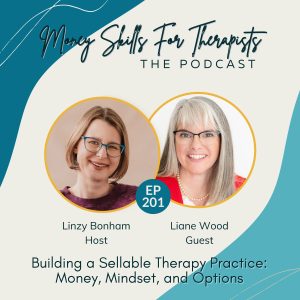
Listen to this episode »

In this episode, registered psychotherapist Liane Wood and I gently challenge you to explore what it actually means to build a sellable therapy practice—not because you should sell someday, but because thinking this way creates more freedom, sustainability, and financial clarity right now in your personal and professional life. 
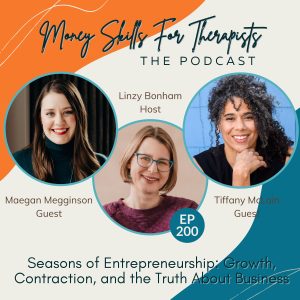
Listen to this episode »

For our 200th episode of Money Skills for Therapists, I invited my business besties, Tiffany McLain and Maegan Megginson, to join me for a conversation that was more honest than polished. We unpacked about the real seasons of entrepreneurship — the times when you feel energized, expanding, and deeply aligned… and the times when you feel tired, restless, like you’re questioning everything, or quietly pulling back. If you’ve ever wondered whether it’s normal to feel both love and resentment toward your business at different points, this conversation is for you.

Listen to this episode »

© Copyright 2022 | Money Nuts & Bolts Consulting Inc. | All Rights Reserved