I feel incredibly blessed that this is my life because I could— I probably could be paid more doing a corporate job. Like, I’m a very competent human, but the trade-off, like, it’s not worth it to me at all to have to ask for time off.
Tiffany McLain [00:00:13]:
What?
Maegan Megginson [00:00:13]:
Never.
Linzy Bonham [00:00:13]:
Never.
Tiffany McLain [00:00:15]:
Out.
Maegan Megginson [00:00:16]:
Absolutely not. Can you even imagine?
Tiffany McLain [00:00:19]:
No.
Linzy Bonham [00:00:23]:
Welcome to Money Skills for Therapists. The podcast that helps therapists and health practitioners in private practice go from money confusion and shame to calm, clarity, and confidence with their finances. If you’ve ever felt overwhelmed by numbers or avoided looking at your business money, you’re in the right place. I’m Linzy Bonham, therapist turned money coach and creator of Money Skills for Therapists. Before we jump in, check out my free on-demand masterclass. You’ll find the link in the show notes or at moneynutsandbolts.com under masterclass. It’s the best first step to finally feeling empowered with money in your private practice. Let’s get started.
Linzy Bonham [00:00:59]:
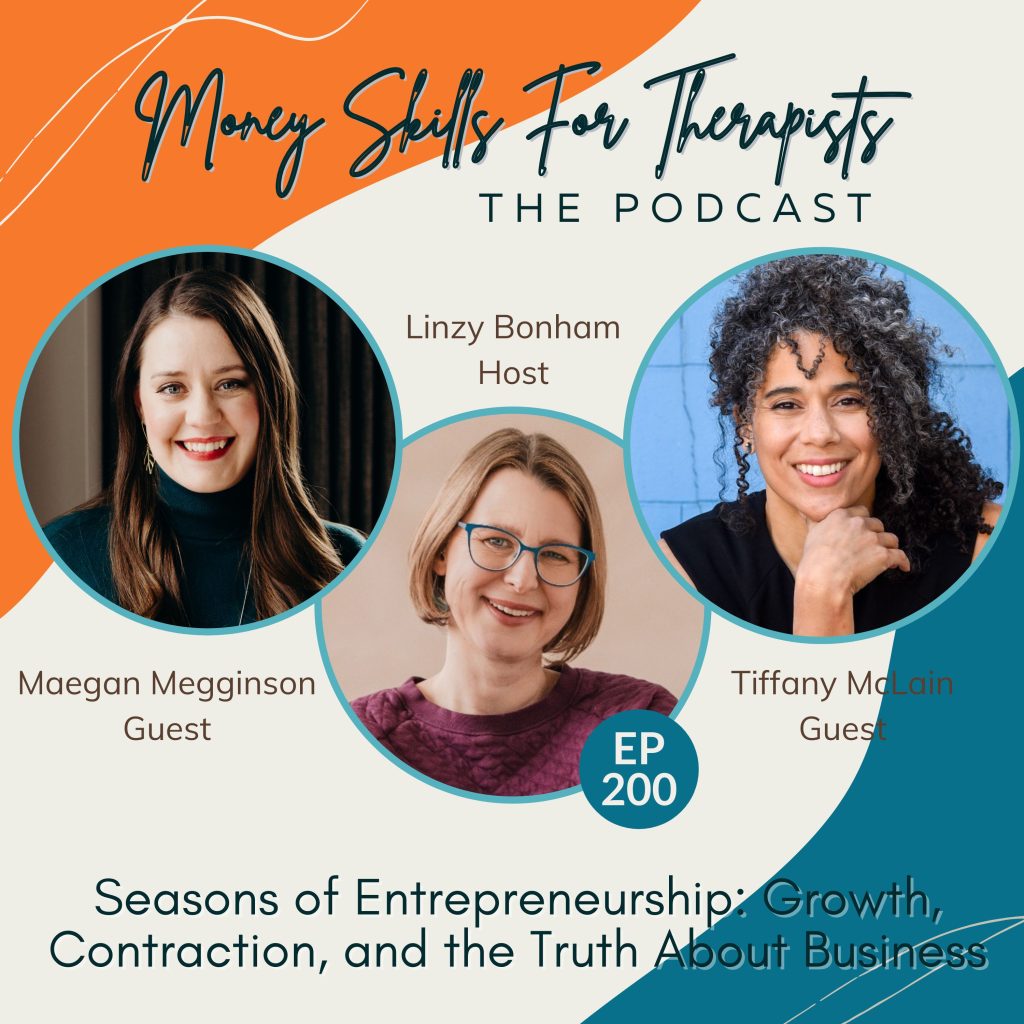
Hello and welcome back to the podcast. Today is episode 200 of the Money Skills for Therapists podcast, and to mark this milestone, I have invited Tiffany McLain, creator of Lean In Make Bank, and Maegan Megginson, creator of most recently Sabbatical School, to join me to talk about our own relationships to the different seasons of business. Often with business, we are taught that everything is going to be great all the time. It’s always going to be summer. Everything’s going to be awesome. So today we talked about our own ups and downs with business, our changes in our relationships to our businesses at different points in time, and how we think about that. We also talk about what we tend to say to therapists who think about, you know, building a scaled business model like each of us has done. Off the side of our desks as when we were therapists.
Linzy Bonham [00:01:53]:
I always love talking with Tiffany and Maegan What you don’t see, because this is not a recording, is you don’t see Tiffany’s very thoughtful listening that she always does as Maegan and I are talking. We always ping off of each other in these really fun ways when we have these conversations, and I feel like when I’m having the conversations, it’s like my thinking is evolving as I am talking to these wonderful women. Here is my 200th episode featuring Maegan Megginson and Tiffany McLain. Hello and welcome back to the podcast. Today is my 200th episode, and to celebrate and market, I have invited in two of my biz besties, Maegan Megginson and Tiffany McLain. Maegan, welcome to the podcast.
Maegan Megginson [00:02:45]:
Lindsay, congratulations on having created 200 podcast episodes. Wow.
Linzy Bonham [00:02:51]:
Thank you.
Maegan Megginson [00:02:52]:
I’m amazed.
Linzy Bonham [00:02:53]:
And Tiffany, welcome.
Tiffany McLain [00:02:54]:
Also, congratulations. That’s phenomenal.
Linzy Bonham [00:02:57]:
Thank you. So we were pre-chatting about what to talk about because, first of all, we can get very chatty and off the rails very quickly, which has already happened before we started recording, but also It’s such an opportunity for the three of us to talk to each other. It’s so enjoyable for us to also get to jam with each other and chat about business. So in our pre-chat, we were talking about this idea of cycles of business and noticing these cycles or seasons of business that we’ve gone through. Because at this point, Tiffany, you are 10 years into teaching Lean and Make Bank. Holy moly. Meg, you are— how many years are you into Scaled? You’re like 8 years into No, 10 years into group.
Maegan Megginson [00:03:37]:
10 years into group practice and 8 years in online business.
Linzy Bonham [00:03:42]:
Beautiful.
Tiffany McLain [00:03:43]:
Okay.
Linzy Bonham [00:03:44]:
And I’m also 8 years in online business, so we’ve gone through some seasons. So I wanted to chat about that idea. Meg, can you kick us up by talking about some of your experiences of going through different seasons in your relationship with your business?
Maegan Megginson [00:03:57]:
Man, sure can.
Tiffany McLain [00:04:01]:
Let’s do it.
Maegan Megginson [00:04:02]:
Okay, I’m just— I’m gathering my thoughts to practice the art of brevity, which is an art form I’m not skilled in. I’m taking lessons and I’m going to practice that now because seasons, I mean, first of all, I have a nature-based business and I teach nature-based business planning in my work, so I could talk ad nauseam about seasons. But I think just to distill it down, I always try to remind myself that life exists in seasons and capitalist conditioning teaches us that business has no season except summer. That summer is the only acceptable season, so you should constantly be in like a growth-harvest cycle. And then when you spiral out of that into a fall or a winter, it can become a problem. Like, you make it a problem. So when I think about my relationship with my business over time, I think about all of the years I was in a natural fallow period that I spent so much energy beating myself up about it. Like, what’s wrong with you that you, you know, don’t like this right now or that you’re not growing right now? Or, you know, there are many things I’ve created that were really successful that I felt like they lived their life and then they died and I let them die.
Maegan Megginson [00:05:18]:
And all of like the judgment and the criticism that I would get from other people about shutting down something that was really successful really kind of sent me into an inner exploration, being like, hold on a second, like, what do I believe about cycles of work, cycles of business. And I’m finding that the more I just like really relax into everything lives and everything dies and we’re constantly in, in cycles of change and rebirth, the more my work starts to flow and the less stressed I feel about it.
Linzy Bonham [00:05:52]:
That was great. Wow, thanks for coming on the episode, both of you. That was wonderful.
Tiffany McLain [00:05:56]:
Nothing more to add.
Linzy Bonham [00:05:59]:
Yeah, so I mean, Tiffany, thinking about that, I’m curious, like, yeah, what of that sticks out to you? What resonates? What’s been your experience of seasons?
Tiffany McLain [00:06:07]:
Well, first of all, I can say that Maeganalways articulates everything so well. I’m like, what am I even doing in business? Can I just talk like Maegan One. So I’m going to take Maegan’s idea and talk about it from the perspective of my business, which is, I love that you said that. Now you’re making me think. I thought that I was sold the idea that once you have a business that works, you just find the system that works and then it just it works from then on, right? You just scale, you just do the webinar and put it on repeat. You just do this. And I really thought that was what happened. And so, and especially, I really came into business, like my early stages of really going all in on my business was during the pandemic when everybody was just like, everything was online and everything was thriving.
Tiffany McLain [00:06:48]:
So I came in then and I thought, it works, not thinking about the way the conditions contributed to it working. And since the pandemic, you know, my business has gone up and down, and we could talk more about that in 23 minutes we have left. But I really was, I really kept up until last year, I kept looking for, oh, what’s the one thing that’s finally gonna work? And then I could just put it on repeat. And I have finally learned, I finally learned that that that is not, does not happen. Business is not, you figure out a thing that works, you put it on repeat and you have a business for the rest of time. That is false. And it took me 9 years to learn that lesson. I’m really glad I learned.
Tiffany McLain [00:07:23]:
And now, it’s really causing me to think about my business. Like, do I want to keep doing a thing where every 3 to 6 months I have to pivot and change everything in order to be successful? I don’t know. So that’s the season of life I’m thinking about right now and business.
Linzy Bonham [00:07:39]:
Yes. Well, and Tiffany, when you say that, you know, you were sold this idea of, you know, like, lock it in, put on repeat— like, you and I were literally sold that idea because we joined a program not knowing that we were each joining. I think you joined and then maybe 2 days later I joined. And we had worked together before. Like, I had paid you as a student in Next. So all I was like, Tiffany, so cool. And then we joined this program and that was really the promise was like, put it on repeat. Don’t write new newsletters, just keep sending out good content over and over.
Linzy Bonham [00:08:07]:
This real kind of basically set it and forget it approach to business. And actually, as your friend, I have to say, this is a new update for me that you have moved out of this idea that you’ll be able to one day just kind of step away because it’s certainly, I have not found it to be true. It’s a beautiful dream. It’s a beautiful dream-ish. It’s a beautiful dream unless you like what you do. And this is what I’ve noticed with myself is as I’ve built the business to work more and more for me and making sure that I’m doing what I like and bringing in folks to fill in the gaps of what I’m not good at, my partner and I, Rodrigo, talk often about how lucky we are that we do work that we like. We don’t need to leave the work. There isn’t a fantasy of selling and exiting because I’m like, then what would I do? I would just do what I’m doing now, but on a volunteer basis.
Linzy Bonham [00:08:53]:
And so that’s also something that I’ve noticed. Just thinking about how my relationship to the business has evolved over time, is over time I have realized like you do need to build something that you like because you do need to keep doing it, right? There isn’t going to be this magical exit point unless you build some sort of app that you can sell, but even then, then you’re gonna have to like do something else of meaning with your life. So I think that that fantasy was so pervasive when we started our businesses, Tiffany, in the way that we did in 2020, and, uh, it’s a lie, folks.
Tiffany McLain [00:09:21]:
It’s a lie. It’s a lie.
Linzy Bonham [00:09:25]:
So thinking about that then, you know, thinking about this in terms of like seasons or cycles, Tiffany, can I ask you more about where you are now?
Tiffany McLain [00:09:34]:
Yeah. As of last week, I’m going to burn it all down. And I think it has to do with my mother. Hopefully— I was about to say, hopefully she’s not listening because she’s not listening, folks. I really realize over— I’ve been becoming more and more aware of how I, in every phase of my at every area of my life, have been pulling people along. I’m growing and come with me. Please see my value. I’m really gonna— if I just work hard enough and say the right thing, you know, it’s all our parents, say the right thing, and finally my mom, as a metaphor, will get it.
Tiffany McLain [00:10:06]:
And I’m wondering how much I— my whole entire business is built on, I’m going into a culture where therapists have learned I shouldn’t charge money, I should do this for free, I’m bad if I want more. And I’ve been trying to change an entire culture for 10 years as opposed to taking a business where people are like, I like to invest in my business. I want to grow. I’m ready to get to the next level. Let me just pay someone to help. That’s not the therapist world, especially when it comes to the specific thing I went into, the hardest thing, which is charge more money for what you do. The work you do is of value. You should get paid for it.
Tiffany McLain [00:10:40]:
That message is one that I’ve had to nurture people into over these past 10 years. And I’m starting to think Oh, maybe maybe I, I need to find people who don’t need to be nurtured into that message for 10 years before they decide to come work with me. That’s a long haul for business. That’s what I’m thinking about, finally, 10 years in.
Linzy Bonham [00:10:58]:
Yeah, you have, um, well, actually, I think all of us have, but maybe you in the most confrontational way, maybe, have really like pushed against the therapist culture, right? Like, I’m not very confrontational, And so I’m kind of like, it’s nice, but I’m teaching something that people also know that they need that. At the end of the day, people know that they need to file their taxes. And so after going through a couple seasons of business where they’re like, oh, shit, I didn’t save for taxes, it’s like the problem does become clear eventually. It did feel like when I was first starting to teach money skills, I was having to educate folks about the fact that they did need financial skills. That was an idea. But I do feel like it has shifted over the last few years. But maybe that’s not true. But you are— very much like working against their conditioning in, in a really deep way, which of like asking for more and maybe asking for more than more, right? Like really, like thinking expansively really is against the culture of therapy and certainly against our education as therapists.
Tiffany McLain [00:11:54]:
And I find that when I have people who are— who come to me and for enrollment calls and they’re like, I’m actually just ready for more, then I tend to find myself saying, go work with Maegan, because that’s not what my program is for. People typically who are like, I’m ready for more right now, or maybe I’m not quite sure, but I know I’m ready for abundance, then I’m sending those people off to work with other people, which again is not the best business model. I’m happy for the people I send them to, but in terms of my.
Maegan Megginson [00:12:16]:
Business— Welcome for the referrals. Okay, I want to add something to this because I can really— well, there’s two things that are standing out to me. One is the last time we did a joint podcast episode like this, I don’t remember. I think it was— was it episode 100?
Linzy Bonham [00:12:34]:
Wow.
Maegan Megginson [00:12:34]:
Okay. And at the time, I was like talking about my dad on the podcast.
Tiffany McLain [00:12:39]:
You were right.
Linzy Bonham [00:12:40]:
Oh, we all were. We were talking about our dads and their relationship to entrepreneurial life.
Maegan Megginson [00:12:45]:
And I was like, my dad’s the problem. And but he’ll never listen to this episode. Well, he did listen.
Linzy Bonham [00:12:49]:
And.
Maegan Megginson [00:12:52]:
So Tiffany, I just wanted to say, you never know who’s— never say never. Um, but that’s, that’s a story for another episode. Okay, but this— when we’re selling something that is really shifting the foundation of our cultural conditioning, it’s really freaking hard. So I think like a lot of the work that I do is, you know, helping people decondition from patriarchal capitalist systems as business owners. One of my flagship offers is how to take a sabbatical, like how to take more time off, and So Tiffany, I’m really connecting to what you’re saying about how fatiguing it is to be someone who is selling something that is really requiring people to do like a deep dive into themselves to say yes to it. And I am finding over time that I need to have multiple offers in like different realms, like some that are very easy yeses that don’t make me feel like I am doing this like heavy, heavy lift to get people on board with, with what I believe in and what I’m doing. And then having the offers that like do require more of that like belief-building process to get people ready to say yes, because it’s just, it’s that really heavy weight that we’re carrying as people that are trying to like get our clients to have a belief change. And yeah, it’s, this is also the first time I’m hearing you say that like you’re done trying to find like the magic potion of like, which is great because that to me feels so boring.
Maegan Megginson [00:14:25]:
Okay, like, I get the fantasy on the surface of being, okay, fine, I found one thing that works and now it can like work on autopilot. But I feel like it’s true for the three of us and for most people listening, our business is our creative practice and it’s a place where we get to come and we get to practice craft and we get to like evolve and change and make new things. And that’s so rich and alive. And I, I don’t want to do anything that just boils it down into a funnel. Because at that point, why am I even doing it? Like, it just doesn’t even feel like a good use of, of my time or like my creative potential. Yeah, anyway, it’s not like a direct response to anything you said, but just it’s all like, it all feels so real and alive. And like, this is what it feels like to— you have to have the capacity as a business owner to hold these really big questions And to be able to like swim around in it and try new things without getting deflated and throwing in the towel when something doesn’t work. Because we’re talking about the escape fantasy of burn it all down, but we’re not actually people who are going to burn it all down.
Maegan Megginson [00:15:33]:
Like, we’re not actually going to do that.
Tiffany McLain [00:15:35]:
Lindsay, your face. Was that a no? Was that a—.
Linzy Bonham [00:15:39]:
That was a no, maybe. And I think my maybe was actually about you, Tiffany. I’m like, Tiffany might burn it down. I might not. I I would wouldn’t burn it down.
Maegan Megginson [00:15:50]:
Okay, okay, but wait, wait. Would you burn it all down? Because there’s a difference between a forest fire and a giving up.
Tiffany McLain [00:15:56]:
As we were talking, I was thinking, you know, this idea of the creative process and the joy of that. I think that requires a couple of things. And I do actually, I would love to have a sales funnel that just worked so all I could do is show up and do the work with my therapist. Like, I love that rich work. It’s the systems that keep it going and bring in revenue. And I think you and I, Megan, have talked about this a lot, and of course Linzytoo. Being in Canada where you’re taken such good care of versus the States. The idea of creativity and play and like really getting in there is great when one has a consistent revenue.
Tiffany McLain [00:16:29]:
My partner, as you all know, goes in and out of work. So he’s now on a season of not having a job. We live in San Francisco with 2 kids in private school or like a private at preschool a— because that’s the only preschool you can get. And then private school. So there’s like the fear of like, I can’t actually bring in revenue. It makes it really hard to be like, let me just sit in creative play. So there is like, man, the system we live in live in does require money. And so a lot of my therapists too, I’m talking about go for more.
Tiffany McLain [00:16:56]:
And they’re like, I also just need to pay my bills. So there is that like, how do we go from I’m barely making it, I’m burnt out and overwhelmed, which by the way, I can say for my business, I’m so pleased that I’m not in the state of stress and struggle financially. I do live in integrity around I’m gonna have ease and freedom in my life. I’m never gonna be like stressing out. And it does cut down on creativity and play when systems are not creating consistent revenue.
Linzy Bonham [00:17:22]:
Maegan, do you want to respond to that?
Maegan Megginson [00:17:23]:
Because you— I want to take one step back because I think it’s like when we’re, when we’re talking about burn it down, I see people, and I have felt this in myself, there’s like two types of burn it down, right? There’s the people who are like, I’m done being an entrepreneur, I’m gonna burn it down and I’m gonna go get a regular job, or some kind of escape fantasy like, I’m gonna be a librarian, or I’m gonna be a barista, or like whatever, I’m just gonna go do this, or I’m gonna go work I’m going to go do something else and I’m not going to be the boss anymore. And then there is like the— if we come back to cycles, there is the life cycle of this has reached its conclusion. That, you know, so maybe it’s limb in this case where it’s— for me it was Next Level Therapist where it’s like was running this really successful thing. It was doing great. And then I just felt this knowing in my body of being like, oh, this is done for me. I could keep going. It’s working. I believe in it, but it’s done for me.
Maegan Megginson [00:18:18]:
And how long am I going to stay in that really painful place where I’m like trying to force it to keep going because of sunk cost fallacy? Like, oh, but I’ve gotten so far. Like, oh, to, what to, to burn it down and start over now. Like, oh, that just feels like so counterintuitive versus the intuitive wisdom that says, actually, you’re, you got what you needed from this. You can burn this down so that you can create something else. That’s what I see for Tiffany.
Linzy Bonham [00:18:47]:
Yeah, because Tiffany, you’re not talking about like going to retrain to become a teacher.
Tiffany McLain [00:18:52]:
I certainly am not. I will always be a business owner and entrepreneur.
Maegan Megginson [00:18:55]:
Can you imagine being Tiffany’s boss? Oh my God.
Linzy Bonham [00:19:00]:
Oh, oh, no one could do it.
Tiffany McLain [00:19:03]:
Lindsay, I’m curious. So Maeganand I are talking about our burn it down seasons.
Linzy Bonham [00:19:07]:
Yeah, what about you?
Tiffany McLain [00:19:08]:
Yeah, very steady You’re working in your garden. I’ve got my garden going again, by the way, inspired by you, Lindsay, again. We talked about a year ago or 2 years ago. So how do you think about these phases in your own business?
Linzy Bonham [00:19:20]:
Yeah, for me, the phases that I think of is expansion and gathering. Those are my seasons that I tend to go through in business. And this is how I talk with my students, you know, when there’s these times where it’s like, yeah, like other things are happening in my life or like there just isn’t kind of like a lot of flow here. And I got this phrase way back, Tiffany, when we were getting in the original coaching program where we learned that you can make infinite money forever. Not true, again, but there was this idea of this expansion and contraction. And I don’t like the idea of contraction because I think especially from a somatic perspective, contraction is like stress and tension. But I have certainly gone to seasons of gathering where I’m like, I’m actually not going to try to make a bunch of sales or build something new this season, and often it is a season like this quarter, right? So for instance, for me in this literal quarter, right, that we’re in right now, it’s, we’re going to be doing a price increase launch, which is long overdue. So just, you know, letting folks know the course has been $19.97 for, I don’t know, 75 years now.
Linzy Bonham [00:20:19]:
We’re bringing up to $24.97. So still staying like lower in the market because for MSFT, you know, we know that we have a whole range of folks who access that, but we’re doing that. But that’s not something that takes like a huge heavy lift. It’s mostly like folks, there’s going to be folks out there who’ve already been thinking about the course. This might be the reason they decide to join now instead of in 3 years. But otherwise, I’m in a bit of a stabilizing season with the business because I’m building a new house instead. So I noticed too, like, my creative energy sometimes comes in or out of the business. And so identifying what is a season where it’s like, yeah, we’re gonna like really figure some stuff out in the business, and I’m gonna grow my team, which means I need to grow my sales, and I’m in an expansion period.
Linzy Bonham [00:20:58]:
And I’ve gone through those periods before. About a year ago, I was in one of those spaces, but this year it’s like Yeah, more of this just kind of a gathering, like we’re just going to let it ride. know, You I’ve got folks around me too who are sustainers. I’m not necessarily a great sustainer. I don’t like doing the same things over and over again, but I love showing up and teaching and coaching because for me, that’s fresh every time. So it’s not the same to me as like, you know, like putting out the schedule every month or whatever for the calls. I have team members who love that steadiness and they bring that to the team. For me, what I do in the business still does feel very like sparky and generative because when I get on a call with my students, whether it’s Money Skills for Therapists or Money Skills for Practice I have no idea what they’re going to ask me.
Linzy Bonham [00:21:37]:
I don’t know what the vibe’s going to be. Is it going to be like a sassy call where everybody has lots of energy? Is it going to be like a quiet call? Are we going to get more into like mindset stuff? Is it going to be a lot of like spreadsheets and YNAB? So for me, that part doesn’t feel repetitive. It feels fresh. But that’s where I’ve like built the business that I’m doing the part that I love and the stuff that I don’t love or that I’m not good at, other folks are doing that. So yeah, right. Like, you’re right. I do have a steadiness around me with the business and I don’t know why. I don’t know why, except that I just like I fucking love what I teach so much that to me there’s so much depth in it.
Linzy Bonham [00:22:10]:
Even when I’m staying with the core content with MSFT, and I’ve been teaching that same content for 8 years, it still feels fresh to me. But yeah, because I remember we had this conversation when we did an in-person mastermind in San Francisco a few years ago with Annie Wright and April Snow, and Annie Schussler hosted us in her beautiful home. And I remember at that point you folks reflecting that to me where you’re like, Lindsay, why, why are you still happy? Like, why do you— and I don’t know why. I mean, I’d be open I’m curious to hear your reflections of if I do have a burn it down moment that I’m not acknowledging. I have to say my escape fantasy, because I find this really funny, is sometimes I do think about that it might be nice to work at the Costco bakery. Costco’s a really great employer. They give good benefits. I love baked goods so much, as you both know.
Linzy Bonham [00:22:55]:
I don’t drink alcohol. I just eat baked goods. Just fucking love them. So that’s my escape fantasy, but obviously that’s not a realistic escape fantasy. I can’t maintain my mortgage working at the Costco bakery, but that’s kind of like the closest that I get. And maybe once or twice over the last few years I’d run the numbers of like, what if I did go back in private practice? But then I look at how much showing up and doing like the hard trauma work that I was doing, or I’d have to like re-niche, but even still that like one-on-one day in, day out, that is really tiring for me. And this is actually much— the variety of owning a business like I do is much more sustainable for me than private practice ever was. So challenge me, because I feel like you two are good at challenging me, and sometimes, you know, sometimes I’m just full of shit when it comes to like Everything’s fine.
Maegan Megginson [00:23:39]:
No, I don’t think you’re full of bullshit. I think it just speaks to like all of our cycles are different and our timing is different. And like, I guarantee there will be a day when you’re like, I’m done with Money Skills for Therapists. You are not going to be 87 years old and still like, oh, I.
Tiffany McLain [00:23:56]:
Just love Money Skills for Therapists.
Linzy Bonham [00:23:58]:
You know, it all feels fresh.
Maegan Megginson [00:24:00]:
Like there’s going to come a day when like something new is ready to be born through you.
Linzy Bonham [00:24:05]:
Oh, for sure.
Maegan Megginson [00:24:06]:
And I also just want to give a shout out for contraction, because I hear what you’re saying about how it can be this somatic trauma symptom, but also, I’m looking out my window right now, it’s February, all of the trees and bushes are in a contraction right now. It’s like they’re pulling. Contraction, for me, a healthy contraction is when you pull energy inward to tend to your roots. And that is where we need to go when new ideas are trying to come through. You have to come inward and pull the energy down, so that you can really feel from an intuitive place, like, what is it that you want to create next? And I think I see you just as— so far as I’ve known you in this life, you’ve been really steady. And I think that’s amazing. And of course, there will come a time when maybe it won’t be like the burn it down energy. Maybe it will just be more like a really thoughtful project.
Maegan Megginson [00:24:57]:
I’m gonna start like, Lindsay’s got project energy where she’s just like, you know, I think I can see this. Just be like, yeah, I’ve just decided, I’ve just decided I’m done with these programs now, so I’m just gonna like very thoughtfully wind them down so that I can build the new thing, and then it’s gonna be beautiful.
Linzy Bonham [00:25:14]:
Well, and when I talk to folks sometimes about winding down their business, like when people are thinking about like, should I shut down my group practice, which is like, again, you can’t really just burn down a group practice. Like, there’s tons of folks working for you, there’s all these clients that, you know, are— yeah, yeah, but I think about it as landing a plane, right? Like, there is still all of these logistics to figure out on your way down. And you’re so right, I would just like spreadsheet that shit and be like, okay, we’re doing our wind-down period We’ll do our final sale. We’ll run our last 6-month period. We’ll like, yeah, maybe it’s just the energy to it is that I don’t have Tiffany’s like spark and fire maybe in terms of, not that Tiffany’s actually gonna burn it down, but I think it’s hard for me to get to a burn it down place. It’s just not really in me. And I noticed this with parenting my child who has like what we like to call the Austrian rage. So my partner’s grandfather was Austrian and he was a total domestic terrorist, like just like awful to his family, just yelling, blah, blah, blah, blah, blah, abusive man.
Linzy Bonham [00:26:06]:
But there’s like this fieriness that comes down through my partner’s line that my son has where he’ll just like explode. And I’m just like, I don’t know what that is because I don’t have that. It’s just not really in me.
Maegan Megginson [00:26:18]:
I think you’ll go, you’ll go more into like a dark emo existential crisis.
Linzy Bonham [00:26:24]:
Yes. Yes.
Maegan Megginson [00:26:25]:
It’ll be quiet. It’ll be, there’ll be a lot of like black clothes, a lot of sad music. That’ll be your crisis.
Linzy Bonham [00:26:33]:
Did you say scarves or scars? Scarves.
Tiffany McLain [00:26:35]:
Well, I said scars, but let’s go scars, scarves, beanies. Yeah, beanies.
Maegan Megginson [00:26:42]:
I’m seeing black eyeliner.
Linzy Bonham [00:26:44]:
Uh-huh. Uh-huh. I hate wearing eyeliner. Actually, I’m allergic to it. But yes, that’s the vibe. Yes, it’s true. It’s true. I think that that is more energetically my pattern, and which is also interesting to note, like, I think this is where I tend to work with a lot of folks who are more on that, like, sparky end of energy, and they’re more anxious around money and who have like an abundance of hyperarousal, we could say.
Linzy Bonham [00:27:04]:
And I think that part of why I do so well working with the folks that I do, and I draw so many folks with neurodivergence to me, is that I am very like steady and very calm. And Maegan, you have that energy too. It’s like a deep lake, but like what’s happening under the surface is not clear and it could be anything mysterious, but it’s mysterious. Mysterious. There’s a steadiness.
Maegan Megginson [00:27:26]:
Here’s what’s happening.
Tiffany McLain [00:27:29]:
Yes.
Linzy Bonham [00:27:30]:
So different energies, but I think still a manifestation of the same question, which is like, do I still want to be doing this? What else do I want to do? But I think all three of us are certainly entrepreneurs for life, right? Tiffany, you would never not be an entrepreneur. I think I would also be a very bad employee. I mean, I think I was a bad employee in a lot of ways, even when I was an employee, because I was just kind of like a smart aleck who is a little bit too self-important or something. So yeah, we do need to be the bosses. We’re not employable is what I’m saying.
Maegan Megginson [00:28:01]:
We really aren’t. No, I like the idea of not being responsible for every single thing all the time, but I will— I do not want the trade-off of having someone telling me when to show up.
Linzy Bonham [00:28:16]:
Totally. Well, and I’m feeling that this week because like I mentioned, my, my project energy, which I have in abundance, is currently going into basically rebuilding my house. So of course, what has started as like a let’s add a couple rooms has turned into like, let’s add a whole second story, let’s move walls, let’s move stairs, let’s move bathrooms, let’s do a whole new kitchen. And this is where my partner and I really thrive. Like, we are a project couple. Like, maybe 3 weeks or a month into our relationship, we like built a table together, which like neither of us was remotely qualified to do, but we did. And you know, we do projects forevermore, so So yeah, like right now all of my energy, my project energy is there and it really like lights me up. And just a second, I just forgot why I’m talking about this.
Linzy Bonham [00:28:54]:
Where did I start, you two?
Maegan Megginson [00:28:56]:
It doesn’t matter because you’re so in your flow right now, Linds. Like, let the people see who you really are.
Linzy Bonham [00:29:03]:
You’re a woman who loves talking about animals. I’m flowing down a hill and into a ravine. But yes, the project energy, I was going to say with my business right now is that we’re just going back to that. Yeah, I love right now that I have the freedom. This is where I was going in the business to be like, I’m spending the next week packing my house. But rather than crying and feeling super overwhelmed, like my really skilled, high-paid friends who are like— we have two friends who just moved who are double PhD couple. One is a university professor, one’s an engineer. They also just moved.
Linzy Bonham [00:29:35]:
They had the similar decision to us. Do we renovate? Do we move? And they had so little time freedom that it was so incredibly stressful for them to move. Basically this week it’s like I’m showing up and doing some calls and recording this podcast today. This is the only thing I’m doing today for the business besides answering like a couple WhatsApp messages from my students who I love. That’s it. And then I’m just like slowly packing the house and like treating it like a project with like the spreadsheets that it deserves. And I feel incredibly blessed that this is my life because I could— I probably could be paid more doing a corporate job. Like I’m a very competent human, but the trade-off, like it’s not worth it.
Linzy Bonham [00:30:09]:
To me at all to have to ask for time off.
Tiffany McLain [00:30:12]:
Never.
Linzy Bonham [00:30:12]:
Never.
Tiffany McLain [00:30:13]:
Never.
Maegan Megginson [00:30:15]:
Absolutely not. Can you even imagine?
Linzy Bonham [00:30:17]:
No. So yeah, I think like whenever I come back to even thinking about not owning a business, which is very only in my darkest moments when I want to be a Costco baker, the math is so bad. The math doesn’t math. Like it’s just not worth it to do that. And that’s what I see for both of you too. I think there’s some folks who are just like entrepreneurs for life. And we are all in that camp. Yeah.
Linzy Bonham [00:30:38]:
So Tiffany, what’s your next business going to be?
Tiffany McLain [00:30:41]:
Hearing you talk about your business, I’m having— just both of you, I always have so many insights. But I’m thinking like the part of showing up and teaching, I love. Just like you’re talking about, Lindsay, I so resonate with that. And it makes me think about the systems again and the team. Like I started thinking, okay, I’m going to keep Limb 4 Life. I actually love working with therapists, but what would have to be replaced? What needs to change so that I can keep showing up and doing what I love and have the freedom to do I don’t love it? it, but still have the business generating revenue. Like the sales piece, I don’t love it. Like take it or leave it, folks.
Tiffany McLain [00:31:11]:
I’m not here to make that. I don’t want to have that conversation. Just come in and then let’s fucking do the work. So really thinking about what would have to be replaced so that I could keep showing up and doing the part I do love is where my mind is going.
Linzy Bonham [00:31:21]:
Yes. Yeah, exactly. And something too I think about is the scale, right? Like within that capitalist narrative, it’s like bigger, bigger, bigger. Bigger is better. Bigger will be happier. But when it’s bigger, you also have to make more sales. Like you have to make more money.
Tiffany McLain [00:31:34]:
Bigger. I want bigger. Yeah.
Linzy Bonham [00:31:37]:
Do you?
Tiffany McLain [00:31:37]:
Yeah, I do. I already do.
Linzy Bonham [00:31:39]:
Because like, I think ultimately for me, the end of the day question is, what does my lifestyle actually look like? Like, what is the job? What is the job I’m making for myself? What does it demand of me? And then how much money do I want to get paid from the business?
Maegan Megginson [00:31:51]:
Right?
Linzy Bonham [00:31:52]:
And I do believe that I could actually— there’s, there’s an optimization point in those numbers that is like not $5 million. Get somewhere well below that. And so this is what I think about as we think about just the freedom, but also the responsibility that we have as business owners is figuring out what is your model that actually serves, checks off. You’re like, okay, we’ve got the money that we need. We can live in San Francisco on a single income. I mean, the money you have to make, Tiffany, to support living in San Francisco is like, it blows my mind. I’m once again wanting to convince you to move somewhere else, but I’m not going to do that because it never works.
Tiffany McLain [00:32:26]:
It never works.
Linzy Bonham [00:32:27]:
But it’s like, there’s an equation there. That’s going to be different for each of us. And it does make you wonder, Tiffany, like, yeah, what could be tweaked in your equation to allow you to show up and teach and love that part, but have a team size and business expenses that don’t require you to sell as much? You just got to math it.
Maegan Megginson [00:32:46]:
Also, just like feeling into our capacity and like what— when we feel the urge for more, really feeling into what is it I want more of. And I think it’s, it’s easy to say money. And there’s nothing wrong with wanting more money, but often it’s actually something else, you know, or it’s like, okay, more money would be helpful here, but also I feel like I have all this untapped capacity around leading groups or like writing a book or doing a TED Talk. Or it’s like, where, where am I feeling the draw for more in my work? And can I be— I mean, this is the question I always come back to, like, can I loosen my grip on what I think it’s supposed to be or how I think it’s supposed to happen? So, you know, maybe it’s not like scaling this one program that I’m running right now. Maybe it’s like the more comes through a different channel or through a different doorway. And can I just like be loose and flexible with myself in my business so that like I can, I can be surprised by what wants to come through? I think that’s the other thing about cycles. When I think about the last 10 years, it’s like I never in a million years thought I would be here right now. Having this conversation with the two of you, like leading people, business owners, through sabbatical experiences.
Maegan Megginson [00:34:00]:
Like, never in a thousand years did I think that’s what was gonna happen, but it did. And I think when you really relax into cycles and let yourself grow and evolve, like, you can be so surprised by what unfolds. And, and that’s— to me, that’s like one of the sweetest parts of being a business owner, is like getting to be— you don’t get to be surprised like that when you work at Nike. Or Intel, you know? It’s like you see the ladder and like, that’s the ladder. But in this world, like, we actually get to be like so like delighted and surprised by what we’re capable of creating. I love that.
Tiffany McLain [00:34:37]:
Can I just say, when you’re saying this, I’m thinking about all the people listening to this episode, and we’re both— we’re talking about, uh, someone I was talking to this morning mentioned this dark side of business, and we’re both talking on the the one, on one side of our mouth that how hard it is to get here and nothing is automated, and you constantly have to be— you’re constantly failing. To get to this point in business, you’re literally failing every week. So, well, oh no. And then on the other side is the joy and the freedom we’re talking about and the creativity and the play. And like, we get to do whatever we want as long as it works to bring in our revenue, we can play. And so for people listening who are maybe just in private practice at this point and they’re like, I want to scale, I’m ready to get to the next level, what would you both say to them? Like, maybe I want to start a group practice. I’m thinking about you, Maegan Or I want to start an online course and like, scale up my, my, what, my revenue.
Tiffany McLain [00:35:26]:
What would you say to them?
Linzy Bonham [00:35:29]:
What I do say is it’s work. It’s a whole new business. So when you’re running your therapy business and you also have your eye on group practice, a little bit more of a direct connection, but still, you, as I say in the marketing materials for Money Skills Group Practice owners, you are stepping into a whole new level of business complexity. When you grow a group. Even if you just start to bring on a few people, it gets much more complicated very quickly. And when you’re growing an education business like we have, Tiffany, or some sort of like thought leadership business, you know, speaking, books, it’s a whole new business. So it’s just acknowledging that you are going to be a baby all over again. You’re gonna have to learn all these things that might be different than what you had to learn to build a successful private practice, because private practice can feel very daunting.
Linzy Bonham [00:36:19]:
But at the end of the day, you really need like maybe 40 clients a year to keep a private practice ticking along. You need 40 people to recognize that what you do is valuable and, you know, to— they can meet you at the price point that you need to be okay. Like, you need 40 people. At this scale of business that we’re at, you need a lot more than 40 people because we’re paying teams, right? You know, Maegan, you’ve got a full-time team member. I have— I don’t know what in terms of like full-time equivalents, speaking like teacher speak, but I think we’re at 2, 2.5 full-time people in terms of the wages that I’m paying beyond myself. Uh, Tiffany, you’re probably similar size to.
Tiffany McLain [00:36:56]:
Me, full-time, and then 2 contractors.
Linzy Bonham [00:36:59]:
Dang, right. So it’s like you just have to reach so many more people, and you have to have— everything is bigger. So that takes work. So if you are really called to doing that, like, I love, love, love, love teaching. I wanted to be a teacher. I keep talking about teaching on this episode. Apparently I want to go retrain to be I originally wanted to be a teacher and then I ended up in community development. From community development, I moved into social work and from social work, I moved back into being a teacher.
Linzy Bonham [00:37:24]:
And so for me, this is worth it. It’s worth all the things I’ve had to learn. It’s worth all the failures. It’s worth all the times that I put together an amazing workshop and only a few people show up or that I make a pitch at the end of a webinar and nobody buys. It’s worth all those moments where I feel like, fuck, I just failed in front of everybody. Or really just that I— it’s more of my internal experience of disappointment. I struggle with disappointment. All of that is worth it, but it’s work.
Linzy Bonham [00:37:51]:
And so that’s, that’s really what I want to emphasize. It’s not like, take the, the term passive income, scrub it from your mind. The only passive income that really exists is investing in the stock market, which is like accessible to all of us. So if you want to grow money, put some money into ETFs, put some money into the S&P 500. No matter what the United States does, the S&P 500 seems to do well. I don’t understand why, but it does. So, but your business will never be passive. So just know that you’re going to have to learn a lot and fail a A lot.
Linzy Bonham [00:38:17]:
lot and grow a lot. That’s, that’s what I would say. Maegan, what would you say?
Maegan Megginson [00:38:21]:
I mean, I totally agree, and I think I would add— well, first I would say slow down, take a deep breath, because I think often when people are getting to the point where they’re asking these questions, it’s coming from a place of urgency. It’s coming from like a place of desperation often, right? It’s like they’re, they’re feeling really burnt out. They feel like emotionally tapped, and it’s like, ah, like, I can’t do this anymore. I’m gonna— I want to do something else. I want to scale. And it’s like when we get into that place of urgency, we start— I mean, we all did this in our own ways on our journeys. We start looking for someone who can sell us the next roadmap, right? Who we’re like stopping on the side of the road being like, does it— can anybody give me the itinerary for the next leg of the journey? I will pay you thousands and thousands and thousands of dollars to just teach me how to not be as miserable as I am right now. And it’s like, Slow down, take a breath.
Maegan Megginson [00:39:15]:
Do you actually feel the yearning to build something like Lindsay’s saying, different and more complex than the beautiful, like simple private practice model that you have right now? Is that really what’s calling you forward? Or are you like, actually, no. When I think about being a beginner again and running a more complex system, like that doesn’t light me up. I just need to figure out how to do this. This in a way that feels better? And I think really being in the discernment process about that before you invest in coaching or a program to build something new will like save you so much time and energy in your entrepreneurial journey. Because what Linzysaid, it’s like real talk. There is no pathway where you create something new that is easy, that is simple, that is not expensive. Um, and yeah, I just, I think we all see so many people jumping into programs that teach you a new way to do business and then don’t finish them because they had no idea what they were actually saying yes to, and then carry so much shame and like this sense of failure that just like crushes them and makes it hard for them to like exceed or succeed and excel in the thing that they’re doing right now. It’s— yeah, I think we can all— we are all here to deliver the PSA, like slow Slow down.
Maegan Megginson [00:40:37]:
down, take a breath, really get clear on what you need and what’s like the most aligned way for you to do that for yourself.
Tiffany McLain [00:40:47]:
Beautiful.
Linzy Bonham [00:40:47]:
Tiffany, what would you say?
Tiffany McLain [00:40:49]:
I love all of what you both said. I’m thinking about— I’m curious about what it was like for both of you. When I started looking in the online business space, I did it in tandem to my private practice because I always knew that’s when I wanted to build something. Bigger. So I really love this distinction around is your desire to create something bigger coming out of urgency and stress and I have to get out of the situation I’m in now, or are you being pulled along because you are a kind of person who finds creativity and play in that bigger pursuit? Like that challenge, that puzzle, even if it’s daunting, is what is thrilling and exciting. Or some mix of the both. Like Lindsay, I think about you who you just want to build something where you have freedom and flexibility, and it’s going to be a long journey to build it., but ultimately you have time freedom. I think for all of us, time freedom is the thing we’re in pursuit of.
Linzy Bonham [00:41:39]:
Yes, yes. Tiffany and Maegan, thank you so much for joining me for the 200th episode. I guess I’ll have to see you again in episode 300 because, uh, this is a tradition now, right? Every 100 episodes, amazing, the three of us get to have a conversation. I really appreciate the two of you being on here, and you two have been such a huge part of my my business growth and my personal growth. You know, like, I, I feel so honored to count you both as colleagues. But also, when it was my 40th birthday and I wanted to go to London, who did I invite? You two, because you’re just incredible women, and I, I really love and respect you. And I want to thank you for being on this 200th episode with me.
Maegan Megginson [00:42:21]:
What an honor. I feel the same.
Tiffany McLain [00:42:25]:
I feel both of you challenge me. The way you do your business and the way you live your life always challenges me to up-level, be thinking differently. I’ve been thinking a lot about both of you two as I’ve been in this past couple of months of like, what am I doing? I’m like working on my garden because Lindsay. I’m thinking about capitalism because of you, Maegan. Things that I wrestle with, you two are in my mind to wrestle with. And it really pushes me to play— I was going to say a bigger game, but I’ll actually say a more meaningful game.
Linzy Bonham [00:42:51]:
Yes. And something I’ll reflect to folks listening is like sometimes I talk to folks who are really struggling for community. Where they live, and maybe they’re living in— it could be anywhere, but it could be, it could be a rural area, it could be a small town, a small city where it feels like nobody’s on the same page as you. And often people ask me like, how, how did you make your business friends? And we, we live in all different parts of North America, and we have to invest and make a point of staying in touch, right? And like Tiffany, in front of me right now, I have your birthday gifts that you sent me last year. You sent me from Etsy like a little, uh, I’m going to show you this too. I’m about to move my office, so this might change, but you sent me a little Etsy thing of like beeswax products, which I love. And I also keep this— you can’t see it, I’m going to read it to you— I keep this on my computer. It’s not written in your handwriting, but it’s from you.
Linzy Bonham [00:43:40]:
It says, have a lovely birthday, my dear. I’m lucky to know you. XO, Tiffany. And I keep these things nearby, both of you. I keep like things that remind me of you because I think that it’s important to stay connected to the folks who really light you up, and they might not be be even in the same country as you.
Tiffany McLain [00:43:57]:
Yep.
Linzy Bonham [00:43:57]:
But it’s so tremendous, the, the positive impact of having people around you who like inspire you and challenge you. Just really, really grateful for you both.
Maegan Megginson [00:44:07]:
Well said, Lyns. I totally agree. Thank you. Thanks for having us. Here’s to, uh, the next 100 episodes.
Linzy Bonham [00:44:13]:
Yeah, yeah, here it is. And, uh, for folks listening, in the show notes I will drop links for the incredible MaeganMegginson and Tiffany McClain and all that they too. So you can check their links out there. And, uh, yeah, I’ll see you two in, um, I don’t know, like 2 years for our next episode.
Maegan Megginson [00:44:28]:
Sounds great.
Tiffany McLain [00:44:29]:
Talk to you then.
Linzy Bonham [00:44:36]:
I so appreciate Tiffany and Maeganboth joining me today. And something that really I’m sitting with after our conversation is just how important it is to surround yourself with people who are kind of playing at the same level as you, or, you know, a little above you is also nice. And the way that our thinking evolved as we were talking to each other, right? Like, it’s just having people who challenge you and speak a similar language, but also bring in their own perspective, are really like grounded in their own philosophies and ways of thinking, that’s conversation that we just recorded really is this like beautiful synthesis of the three of our brains coming together and kind of inspiring and changing as we’re talking. And it’s so important for all of us to have those people in our lives, but also in our businesses, right? People who can help you reframe what you are thinking and feeling at a given time, who can help you think of another way forward. Business can be really lonely. So I really, really encourage encourage you as you’re listening to think about who are the people around you who can be business friends, right? Who you can talk through what is happening, who can, who can challenge you. And really, if you don’t have those relationships already established, think about starting to build and nurture those relationships. I cannot, cannot recommend highly enough the value of having some good business besties in your corner.
Linzy Bonham [00:46:02]:
Thank you so much for joining me today. I am LinzyBonham, therapist turned money coach and the creator of Money Skills for Therapists. If you’re ready to go from money confusion and fear to feeling clear and empowered, then my free on-demand masterclass is the best place for you to start. You’re going to learn my 4-step framework to get your private practice finances working for you. Register today using the link in the show notes or go to moneynutsandbolts.com under masterclass. I look forward to supporting you.