[00:00:00] Kelly: This content is really helping so many people, and I almost think of it as very similar to what Julia did for me of saying, “No, you’re my people. You’re going to charge 250 plus.”
[00:00:13] When I share that sort of income report for people, I think it’s really permission giving in saying as a therapist, you can have this, you can want it. You can do it. It’s possible for you on sort of like a bigger scale. And so that’s a big part of my why behind it, too.
[00:00:31] Linzy: Welcome to the Money Skills for Therapists podcast, where we answer this question: how can therapists and health practitioners go from money shame and confusion to feeling calm and confident about their finances and get money really working for them in both their private practice and their lives? I’m your host, Linzy Bonham, therapist turned money coach, and creator of the course Money Skills for Therapists.
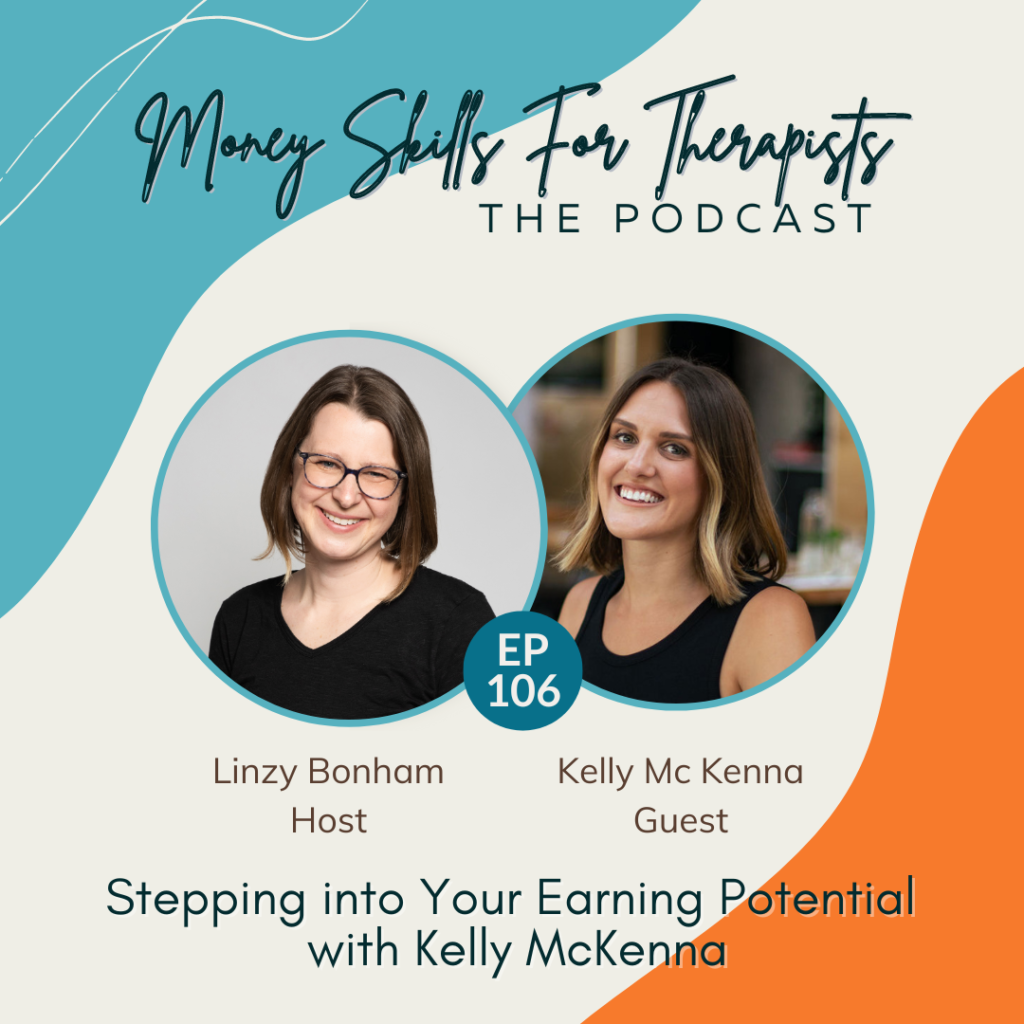
[00:00:49] Linzy: Hello, and welcome back to the podcast. So today’s guest is Kelly McKenna. Kelly is a therapist who built her business on Instagram. She now continues to help women on Instagram with anxiety. She’s helped millions of folks, through her one Instagram account. And now she also helps therapists with building their practice and building their Instagram presence.
[00:01:13] This conversation today with Kelly I really, really appreciated. We talk about her experience with getting started with her private practice, how she made $250,000 of revenue in the first year, which is pretty unheard of. We talk about that process. We talk about having the right people around you and being pushed outside of your comfort zone.
[00:01:33] Something that Kelly talks about today is the importance of being uncomfortable and what that has done for her in her business. And then something that Kelly also does that we chat about today is every single month she shares her business revenue and expenses on Instagram. And so we talk about that experience, the feedback that she’s received about that, what she’s learned from the experience of being so, so transparent about her numbers on Instagram.
[00:01:58] Lots of interesting insights today from somebody who has really figured out, I would say, the business of therapy, which by the way, is also the name of her Instagram account. Here is my conversation with Kelly McKenna.
[00:02:25] Linzy: So Kelly, welcome to the podcast.
[00:02:27] Kelly: Thank you. I’m so excited to be here with you today.
[00:02:29] Linzy: Yeah, it’s great to have you here. And you know, some of the things we’re planning to talk about today I know are going to be really like interesting and maybe even challenging for some of the folks who listen, which I’m excited about. And I wanted to start with your journey because I think some of the folks who are listening, like there’s going to be a range of where folks are at.
[00:02:46] Some folks are maybe making $45,000 a year. Some folks might be making like 120, 150. I know part of your story is that you brought in $250,000 in your first year as a therapist. Do I understand that correctly? Yes. And just to be clear, was that revenue coming into your practice, or was that what you got paid?
[00:03:08] Kelly: That was revenue coming in.
[00:03:10] Linzy: Okay. Okay. So. I’m very curious, how did you do that in your first year of private practice? How did you build up $250, 000 of money coming in the door in your first year?
[00:03:23] Kelly: Yeah. So kind of like going backwards even when I was first starting in private practice, I was working in nonprofit management. I had been doing that for probably seven years at that point and was really kind of feeling burnt out. I sort of was not even feeling like a social worker anymore.
[00:03:40] I was doing so much administrative stuff. And so I decided to work at a group practice one evening a week, just to kind of refresh myself a little bit. And I did that for one day and saw like two clients, which were amazing. And then COVID hit and we went virtual. And that just really very quickly made me start to wonder like, why am I
[00:04:03] kind of doing this in a group practice? I really had no affinity to the group practice since I was there for the one day, and all my clients are coming from Psychology Today. We were accepting insurance via a platform called Headway. And I was kind of like I could be doing this on my own, like I don’t need to be giving 50 to this guy. And so I decided to incorporate my own business and start doing that on the side. And again, at this point, I really just viewed it as like a way for me to kind of sharpen my clinical skills and just feel more connected to things.
[00:04:32] But during COVID I found I was really, really enjoying that clinical work. And so I was scheduling tons of clients in the evening. I also didn’t have much of a social life because it was COVID. And I was really looking forward to that time of being a therapist and kind of dreading the time at my nine to five.
[00:04:50] And so I decided that, you know, I was going to try and go full time in my practice, and really do this thing for real. And so in October 2020, I started an Instagram page, and that’s sort of when I consider like my first year beginning, um, but I did have some, you know, insurance clients up until that point,
[00:05:10] and some people I had been seeing in the group practice as well. And so I gave notice at my job like a month later and fully transitioned full time in February 2021. And at that point I had decided, you know, if I’m going to put my job in nonprofit management, where I was earning a really good salary, six figures at the time.
[00:05:31] I was like, I don’t know that this insurance model is going to work for me. Even if I’m not giving away half my revenue, this probably still is not going to be super sustainable. And so I decided to… you know, that was a big reason why I decided to get on Instagram. So I could find clients who would be excited to pay me $250 a session and really see the value in working with me instead of, you know, another practitioner who maybe took their insurance.
[00:05:58] It was a lot of work at the beginning, a lot of hustle with marketing, but I kind of made that transition off of insurance panels as I was building up my private pay caseload from Instagram and brought in 250, 000 that first year of seeing one on one therapy clients that first year, full time in my business.
[00:06:16] And it totally changed my life and what I even thought was possible. Really, my goal was if I can earn six figures this year, or next year, even, like I’ll be really happy and this will have been worth it and sustainable and a good choice because it will have been more enjoyable for me. I was not even thinking that I could ever kind of like out earn what I was earning at like a senior director role at a non profit.
[00:06:42] Linzy: Mm hmm. It’s almost like a private practice on fast forward. You know, it’s like you did in one year what often folks, well, not even often, which some folks do over three years or five years or 10 years, which is like going through these stages, right? Like it seems like you went through many of the normal stages that folks go through to step into private practice and then to eventually start charging more and like building a niche, and really seeing the money working.
[00:07:05] But you did it very, very fast.
[00:07:08] Kelly: Yep.
[00:07:09] Linzy: Yeah, I’m curious about your style as a person: is that pretty on brand for you? Or was that unusual that it worked so quickly?
[00:07:17] Kelly: I think that’s pretty on
[00:07:18] brand for me.
[00:07:20] Linzy: Yeah, okay.
[00:07:20] Kelly: I’m somebody who’s I’m going to decide something and go for it. and of course there was like, you know, a ton of care with those conversations with clients. I gave people, honestly, probably too much notice, like 6 months notice that I was getting off of insurance panels, which I would not advise, but…
[00:07:35] you know, I think that once I decide that I want to do something though, I’m like, okay, we’re going to start working towards it, at least with everybody new moving forward, and then we can kind of figure out what happens, you know, on the back end.
[00:07:48] Linzy: Hmm. And I’m curious for you… Because I think this is something that sometimes folks struggle with, like I know definitely in Money Skills for Therapists, like I’ll see therapists go through this process of looking at their numbers being like, okay, I probably have to get off insurance or I probably need to raise my fee and like seeing where they need to go, but it can be really hard for them to get from here to there, right?
[00:08:05] There’s all this kind of stuff in the middle. I’m curious, for you, do you think it’s a certain trait that you have, or is it a certain mindset? What allows you to go for it at the rate that you
[00:08:16] Kelly: Yep, I think like a willingness to be uncomfortable and to recognize that people can judge me, and that’s okay. Like we’re not all going to want to build the same business. But I can definitely relate to that. I think there were two instances that come to mind. One is that I met this woman on Instagram.
[00:08:33] Her name is Dr. Julia Colangelo, and she was a therapist in New York and New Jersey. And we just sort of became friendly with each other on Instagram when I first was starting my Instagram page. And she asked me, you know, are you taking any new clients? I have somebody who I think would be a good fit for you.
[00:08:49] And I said, yeah. She said, great. send me your website. What’s your fee? And I told her it was $150 per session at the time when I was first thinking about getting off of insurance panels, although I didn’t have any clients at that 150 rate. And she was like, Kelly, like I charge $400 plus dollars a session.
[00:09:07] I don’t think I can send people to you for $150. They’re going to have a negative impression. Are you open to increasing your rate? I have some clients that I think would be a really good fit. And I remember telling my husband, What the heck is this she talking about? But I guess so, right?
[00:09:22] Like I should do it, right? And I did, and she sent me a few clients and I was like, okay, this is my rate now. This is what we’re doing. And so I think that had a really positive impact of just somebody saying, you know, this is what you can charge. And people actually may assume you’re a better therapist when you charge this kind of rate.
[00:09:41] So that was really, really powerful for me. And then the second thing that comes up for me is when I was kind of making that transition and leaving my nonprofit job, I was super afraid of what my colleagues were going to think. And I remember also talking to my husband and saying should I take my prices off my website for the month that I’m quitting?
[00:10:01] I imagine a lot of my colleagues are going to Google me. They’re going to check me out. They’re going to be a little more interested in what I’m doing. When I make this announcement, I don’t want them to see that I’m charging $250. They’re going to think I’m a bad person. They’re going to think that, you know, I’m only leaving for the money.
[00:10:15] And I had to work through that. I ended up keeping my prices up, but definitely there was a huge fear of being seen and judgment that was super uncomfortable, and that I had to work through in my own therapy, too.
[00:10:27] Linzy: Yes. Yeah, definitely. And I do think that those are things that a lot of folks experience, right? Well, the first one sounds like an amazing resource that you had. Like you had somebody who was
[00:10:35] Kelly: Yep.
[00:10:35] Linzy: Look, let’s just help… I’m just going to help you skip all this middle section, and get right the rate.
[00:10:42] And I think that’s so powerful because it makes me think, too, about women and marginalized people just like lifting each other up, right? Like just saying no, look, I know that there’s all this messaging that makes you afraid, but I know you’re really good. And it sounds like Julia had already cultivated an audience of folks who
[00:10:59] value therapy that amount, have that amount to spend on therapy. So it also sounds like she shared that with you, right? Like this, this abundance that she had built, she shared with you and helped you to kind of skip all of that anxiety around, do I, do I not? She was just like, I need you to do this.
[00:11:15] Kelly: And it was still, so much anxiety, right? When I was at the group practice, I thought that I was, like, the luckiest person in the world. I was getting paid $45 a session. And when I first got it, I was like, this is amazing. Because I had been interviewing at community mental health clinics to sort of do therapy, and they were going to pay $18 a session.
[00:11:33] And I was like, this is great. I hit the jackpot. And so I think that it was also just like another woman showing me what’s possible, right? And seeing you could actually set your goals a whole lot higher than that, was just super, super powerful.
[00:11:47] Linzy: Yeah, absolutely. Yeah, I think who you surround yourself with has a huge impact on what you know is possible. I think that just really speaks to that. That second piece about being judged is really interesting to me because I’ve just recently, in the last week, had kind of this experience of reconnecting more with my local therapist community again, because I basically live inside the internet now, right?
[00:12:06] Like I’m based in Guelph, Ontario. Yeah, it’s really weird. I’m based in Guelph, Ontario, which is a city of 120, 000 people outside of Toronto. And I have been doing online work now for the last five years since my son was born. So I never went back to doing therapy in person, so I don’t know local therapists, but I’ve been giving away my therapy books because I stopped practicing a couple of years ago.
[00:12:25] I posted all my books and so I’ve had some therapists come by and picking up books and mostly I’m just doing like porch pickups, and they’re taking all my complex trauma dissociation books, you know, and then giving them new life, which is so exciting. But I’ve chatted with a couple people who like work at the agencies that I used to work with or like work with people, like I know that they work with like my old boss or whatever, and I’ve noticed those feelings coming up myself again of oh, I kind of don’t want these people to know what I’m doing now, right?
[00:12:50] Which is so interesting that for me there’s still this latent part that’s like, “Oh, I hope that they don’t look me up,” or I hope this person doesn’t mention me to these old co workers that I have who, yeah, I feel like always wanted me to be small, and now I’m doing all these things. Like it is interesting how strong that can be.
[00:13:06] Kelly: Yeah, it’s sort of like a splitting of two identities, too, right? Like I think that as a social worker especially, we were taught like so much of, you know, you don’t go into this profession to make money, it’s bad to make money, like our job is to do social welfare and social justice, and so I think that a lot of us carry that burden into our private practices.
[00:13:26] And in reality, I’m not running a nonprofit, right? Like I’m running a business, and that’s going to look really, really different than my colleagues who work at a nonprofit.
[00:13:36] Linzy: Yes. Yes. So, I mean, thinking about that then, I think a lot of folks who step out of the agency space into their own practices do struggle with this fees question, of course. This is always always the most challenging piece I think of money because it’s the decision you have to make before you do anything else, which is like, what are you charging?
[00:13:54] I’m curious, like in your experience, you know, you got to 250, 000 of revenue in the first year. I’m hearing you did not do that by charging $45 an hour.Tell me about the fees that you charged and just kind of your position on fees for therapists who do actually want to establish a business that pays them well.
[00:14:12] Kelly: So I think it’s super important to actually do math, right? Like I find that so many therapists, and myself included when I set that first 150 rate, just kind of go to psychology today, and they type in their zip code, and they scroll, and they figure out: Okay. What’s sort of in the middle? Let me go ahead and do that.
[00:14:32] And if what’s in the middle works for you and your practice and your family and your goals, I think that that’s fine. But I think it’s really important to actually consider what sort of life you want to live. So when I was setting my fees at my nonprofit job, I actually got six weeks paid vacation because I’d been there for a long time.
[00:14:49] And so I was like, okay, minimum, I want to take six weeks paid vacation. I was getting married that year. I was like, I already had a month long honeymoon booked. I’m like, we’re doing this, you know? And I didn’t want to be burnt out. So at the time I had, I think I saw 25 clients a week in that first year because my, I think, perception was a little skewed of you know, I was probably working 50 hours plus at the nonprofit and doing the group practice.
[00:15:15] And I was kind of like 25 clients is a breeze. Now I could never, but I think that that is important to consider too, is like, what is your capacity? And also how might that capacity change? So I don’t have kids, but I definitely want to have kids one day. And that was something that I considered in setting my rate, too, right?
[00:15:34] Maybe now is a season where I’m working a little more and earning more, and it allows me to save and to kind of position myself to eventually work much more part time hours and still be able to earn a good income with that. So I sort of always tell therapists it should be a fee that feels kind of uncomfortable to say out loud. If you’re not embarrassed that your colleagues and friends are going to see it like that almost might be a warning sign, right?
[00:16:00] You should be a little uncomfortable, but also you should still feel okay with it, right? Like it should be something you’d be potentially willing to pay for your own therapy. It should be something that, you know, you don’t feel like you’re stealing from people or something like that. Like you should still feel okay ethically behind it, but it should also feel a little scary, you know?
[00:16:21] Linzy: Mm, for sure. And I do think, too, that piece about what you’d be willing to pay yourself for a session of therapy is interesting because sometimes for folks it can be a bit of a loop, like a trap, right? Where they’re like, well, I couldn’t pay somebody else 200 for therapy, but the reason they can’t pay somebody else 200 for therapy is they’re making 40, 000 a year because of their fee.
[00:16:39] So that is something that I do find interesting where it’s… It can be tricky to almost imagine stepping up to the next level both as a therapist, but also then what that’s going to do for your life and your ability to pay other people for their skills. Both of those things go up at the same time.
[00:16:54] Kelly: Yes, and I think maybe it’s a little bit less of okay, looking at your budget, what can you pay for therapy now? And more so about like, how it feels to you to pay your therapist that
[00:17:04] amount, right? Does that feel like a hard no, there’s no way I’m getting this much out of it? Or does it feel like I would love to be in the position to pay my therapist that much?
[00:17:13] Like, how can I get there? You know?
[00:17:16] Linzy: Yeah, that’s a great distinction to make because I think that’s really helpful because I do sometimes see folks get caught on that piece that I just brought up. But yeah, it’s yeah, is this a fee that would feel like, oh, I’d feel really good if I could pay my therapist this much because I know they’re definitely bringing much more than that amount of value into my life, which is I think a much more kind of expansive way to think about fees and money.
[00:17:35] Kelly: Totally.
[00:17:37] Linzy: So something that you do now, cause the Instagram part of your story, you made it this big in the story. It’s very small, but now Instagram is a very big part of your story.Is that fair to say, like a big part of what you do? So part of what you do now is you help therapists with Instagram as well as with general practice building.
[00:17:55] And something that you do that I think is, you know, if we want to talk about being uncomfortable, and probably being brave is part of allowing yourself to be uncomfortable, is you share your income every month on Instagram, just like you do a, a reels post every month with your revenue that came into your practice.
[00:18:12] Kelly: Yep.
[00:18:13] Linzy: I’m curious, tell me, tell me why do you do that? How does it feel like to do that? Tell me about that.
[00:18:19] Kelly: Yep. So I’m even going to go backwards, like before Instagram. So that first year that I earned 250, 000 in my private practice, I was doing Instagram and kind of pitching, you know, some news articles and stuff like that, trying to get more media and publicity and really grow my business.
[00:18:39] And I pitched somebody at Business Insider because I saw her write a similar article. And what I wanted to talk with her about was how sort of the mental health tech startups are really hurting therapists and that, you know, people are kind of afraid to start their own practice, but you can do really well.
[00:18:59] And here’s kind of how I did that in that first year. And sort of like showing therapists this other option. She wanted to do the story, but was like, I don’t know about the whole tech startup thing. We’re not comfortable going there. But I was like, okay, we can do like a profile piece.I had to send over, like, all my financials, all this stuff… The article gets published and the title of the article is how this virtual therapist earned 250, 000 her first year in private practice.
[00:19:26] And that was 100 percent not the story I pitched or the story I was trying to tell.And I was like, so mortified and excited at the same time, right? all that fear around what my colleagues were going to think was really showing up again. I had never talked about money on the internet at that point.
[00:19:46] I had not talked about money with my friends. I hadn’t told my parents how much I made in that first year. Like it was just so much exposure. And I sat on that article for two days before sharing it with anybody outside of my husband and my sister and was kind of like, I know I have to share this. Like I know it’s the right thing for my business to share this profile far and wide, but wow, am I ready for it?
[00:20:13] You know, and I had just launched my course, The Private Practice Academy, maybe three or four months before this article was released. And so I was kind of starting to do this business coaching with therapists for the first time, and I knew how good this was going to be for my business.
[00:20:28] So eventually I worked up the courage, and I shared the article. And it was basically like I had a whole launch via this article only. Like I had 15 therapists join my course, and I gained a ton of Instagram followers. And I was like, holy cow, this is super important. Like people really want to hear about this, and it’s really helping me grow my business.
[00:20:49] So I’ll kind of pause there, but that was sort of the catalyst for me starting to talk about money on the internet. Yeah.
[00:20:57] Linzy: You know what’s so interesting is it’s bringing up this thought for me. I have a comedian that I really like who I talk about regularly on this podcast, named Mike Birbiglia. He’s my favourite comedian, and he has a great podcast where he talks about comedy with other comedians, and the process of being creatives and these are all very hardworking, hardworking people, who make amazing things.
[00:21:17] And something that he talks about is, your audience will tell you who you are, right? And that’s kind of what I’m hearing in your story twice now. It’s Julia Kangello, she told you who you were, where she was like, “No, no, no. You’re not a therapist who charges 150. You’re my people, and you charge this fee,” but then also this, this reporter at Business Insider was like, “Oh, you think that you want to talk about this, but your real story is this, that you figured out how to make all this money.” And then it sounds like you’ve stepped into that role, right, of realizing that this is a gift that you have to offer people.
[00:21:50] Kelly: Totally. And, you know, at the time I just had the one Instagram account, Sit with Kelly, which is where I talk about anxiety content for millennial women. It’s how I built my private practice. And so I was sharing about the business coaching there, but it felt like I was very much still in an apologetic space about it because I was also marketing my therapy services.
[00:22:10] And so I was like, what is this balance between trying to tell people I can help them with their anxiety and like how good I am at that, and also being like, and I’m going to make a ton of money
[00:22:19] while I help you do that. It just felt like a little off to me. And so probably a year after that, I was really going all in on this business coaching thing and made a second Instagram account, Business Therapy, where I talk all about marketing and business skills for therapists.
[00:22:35] And that’s when I decided to start the series where every month I share all of my revenue and all of my expenses for people because I think both sides of that transparency are super important.
[00:22:46] Linzy: So important.
[00:22:47] Kelly: And it is, if you look at my Instagram insights, like my top performing reels, every single one of them is one of these posts.
[00:22:56] I think that that also really affirmed for me, okay, we’re going to keep going with this, even if sometimes it gets a little uncomfortable, but I would say mostly the feedback has been super, super positive from folks.
[00:23:07] Linzy: Yes. Okay. So when you, what I’m hearing then is where you say, sometimes it feels uncomfortable. I mean, sometimes you don’t get positive feedback. You’re getting like some sort of pushback from folks. Yeah. Tell me about the pushback. What are the critics saying?
[00:23:20] Kelly: You know, that it can be unethical… Mostly that it’s unethical for therapists to want to make good money. Yeah, I think that that’s sort of it. And that happened, too, when I shared the Business of Therapy article, there was like probably 80 percent of people were really lovely and wonderful. And like 20 percent of people were other therapists or even like therapy attenders who were like, this is what’s wrong with our healthcare system.
[00:23:46] This is what’s wrong with therapists. Like they just are money hungry. They don’t care about you, like all of this messaging, which it’s really hard to be on the receiving end and kind of wondering is this what people think about me, you know, and if yes, is that something I’m okay with?
[00:24:01] Linzy: Yeah. Yeah. That’s it. Right. it’s something I’ve been thinking about more and more lately is the more visible you become, the more people comment out loud about what they think about you, right? Because we always have opinions of each other, right? Everybody forms a really random opinion of a random person, like that, you know, the human brain is made
[00:24:20] in part to judge, to keep you safe, and to discern, you know, where to spend time, where not to spend time. But when you’re visible, when you have an article about you in a big magazine, or when you start to become a public figure, or when, like you, you have, you know, tens of thousands of followers on social media, people, you start to be someone who’s almost like worth commenting on?
[00:24:39] Do you know what I mean? Like people actually put down their thoughts about you rather than just keeping them to themselves or just like griping to their partner, right? Like you get, you start to actually get that feedback from strangers about what their random thought is about you.
[00:24:52] Kelly: And I think manners sort of go out the window, right? Like you would never walk up to somebody in the street and comment on them. Or to like somebody on your personal page, you would never like you like, “Oh, I don’t like your
[00:25:04] dress” or whatever.
[00:25:05] Linzy: Mm hmm.
[00:25:06] Kelly: But it seems like on the internet, especially I think you’re right, when your account sort of reaches a certain size, or even if you have something that goes really viral and people see tons of likes and comments, think that they almost start to view you as an anonymous fake
[00:25:19] person…
[00:25:20] Linzy: Yeah. You’re not a person anymore.
[00:25:21] Kelly: who you can just comment whatever about, you know?
[00:25:24] Linzy: Totally. Yeah, It’s one of my least favorite things about the internet, if not my least favorite thing about the internet, is that like removal of humanity, that people like stop being empathetic towards each other and see each other as like memes or just like a two dimensional figure rather than an actual human with like feelings and complexity and like maybe this doesn’t represent everything about somebody, this like 12 seconds of content that you’ve just consumed.
[00:25:48] But yeah, I mean, talking about being uncomfortable, you mentioned at the beginning that part of what you’re good at is being uncomfortable, like doing things that make you uncomfortable. I’m curious, yeah, how do you weather that, or process or digest, the people who, yeah, might not have a positive opinion of you and let you know about it?
[00:26:06] Kelly: Yep. So I think there’s two things that are really helpful for me. One is I’m a big fan of delete and block. So if somebody, you know, asks a respectful question and they’re like, “As a therapist, I have a really hard time with this. I feel really guilty. How do you sort of justify charging 250 a session?”
[00:26:24] I’m happy to engage with that kind of content, right? If people are just like, you’re a money hungry therapist, it’s wrong to charge 250 a session, I’ll delete and block you. I don’t care, you know? And I kind of view that as this is my home and my space, and I’m going to protect my sanity here. And then I think the other thing that really helps is, I’m so lucky, honestly, I think that I have the most supportive community and there’s so much good that outweighs the bad.
[00:26:49] And I keep tons and tons of screenshots in an album on my phone of just nice things that people say to me, about me, et cetera. And I’ll revisit that whenever I need to. One is it’s great marketing. I like to share those screenshots all the time on my Instagram stories.
[00:27:04] Linzy: Yeah. Those are your testimonials. Yeah.
[00:27:06] Kelly: Yes, but it also really, really helps me on those low days where for whatever reason, a comment sticks and it’s kind of harder for me to get over is I’ll go through and read it and remind myself, “No, I’ve helped literally hundreds of therapists create a better life for themselves, for their families.”
[00:27:20] This is worth the discomfort of, you know, upsetting somebody who may not be ready for this or who may not ever want it. This content is really helping so many people, and I almost think of it as very similar to what Julia did for me of saying, “No, you’re my people. You’re going to charge 250 plus.”
[00:27:38] When I share that sort of income report for people, I think it’s really permission giving in saying as a therapist, you can have this, you can want it. You can do it. It’s possible for you on sort of like a bigger scale. And so that’s a big part of my why behind it, too.
[00:27:52] Linzy: Yeah, and I think, you know, it’s such a good point that you make that what you do is not for everybody. Nothing is for everybody, right? And so there’s going to be folks who are listening right now who are like, yes, that is exactly what I want. That’s what I need to do because of my family situation, that’s what I need to do because I live in San Francisco and to even buy a normal house, I’m going to need to make that income.
[00:28:11] People’s situations are really different. And I think that it’s easy, especially for therapists and healers, like the people pleasing kind of types that we want everybody to like us, right? But something I remind myself of sometimes is like I’ve never walked into a party and liked everybody at the party. When you walk into a party There’s going to be one or two people that you’re like, oh they seem really interesting, like I’d like to talk to them, and that person’s not so much for me I’m going to go get another drink, you know, get back away And it’s there’s nothing wrong with the people that I don’t connect with, but nobody is for everybody.
[00:28:41] We all have those connections, but it is hard sometimes, I think, when you are public like that, like people, yeah, they want to tell you that you’re not for them, but of course, of course, that’s going to be the case. In some ways it’s almost not news.
[00:28:54] Kelly: Yeah, totally. And, you know, we, I’m all for helping therapists build private practices, but we also need therapists who are going to work in nonprofits, who are going to work in community mental health, who are going to, you know, accept insurance while our healthcare system pays therapists, abysmal amounts for,
[00:29:11] therapy. Butif those people don’t desire anything else, if that feels good to them, if that feels fulfilling and purposeful, I’m not going to tell you that you’re doing something wrong by doing that. You can totally do that for the rest of your career. But for therapists who are thinking, I don’t know how long I can do this,
[00:29:29] I want to help show them that there are other options for them.
[00:29:32] Linzy: Yeah, absolutely. Yeah, and people’s life circumstances have a big part to do with that. I remember when I worked in non profit, one of my colleagues who I loved, she talked about how her sister would give her a hard time for having a wifey job, you know, because it’s, a job that she could only have because her, her partner was, like, a high school principal and he was an earner.
[00:29:49] And so, between the two of them, they could afford their life, but living alone, she wouldn’t have been able to, right? But it’s, that worked for their life situation for a long time until it didn’t work anymore. And then, you know, she went and started a private practice, but you know, like that’s very different.
[00:30:00] I, I find a lot of folks in my audience are women who are primary earners in their household. Right. And so like those women should not have to apologize for wanting or needing to make, you know, whatever their salary would be after 250 of revenue, whether that’s 150 or 175, support maybe an entire household, maybe to be a solo parent where there is no other earner, maybe to support a partner.
[00:30:23] Like I have lots of folks who’ve come through my course who have a partner with like chronic illness, right, who like can’t work. So they’re actually supporting two adults, and nobody should have to apologize for making the money that they want and need to make to make their life what they want and need it to be.
[00:30:40] Kelly: Yeah, totally. And I think, too, of also letting yourself be expansive with what you want your life to be. Right? I think that those are all super admirable reasons to want to earn well into the six figures. And you can also do it because you want to buy a vacation house, because you want to pay for your kid’s college for them, because you want to build generational wealth, because you want a new car. You’re allowed to want those things, too, even though I think that as therapists, that can feel harder to say out loud and to say, You know, I want this for me, right? I want to be able to be wealthy.
[00:31:16] Linzy: Mm hmm. Yes. And I think generally, too, like, when we’re talking about it as well, what I see sometimes is therapists have this black and white kind of narrative around money where it’s like you either don’t have money or you’re like, ultra wealthy, you know, like bigger income than like most nations, Elon Musk, Jeff Bezos.
[00:31:33] And the reality is there’s such a massive spectrum in between and like what you’re describing there is like it’s not even like halfway up the spectrum of what some folks live with, right? And so it’s like yeah, you don’t have to apologize for wanting something that many, many, many, many, many, many, many, many people have, and enjoy, and they’re not apologizing for it.
[00:31:53] Kelly: Yep. Totally.
[00:31:54] Linzy: Yeah. So with the sharing your, your revenue and expenses on Instagram as well, like I’m curious, what have you learned from that experience of being so transparent? Because in our company, I will say being transparent about our numbers is one of our values. And we do that within our team, and we do that with our students.
[00:32:11] And I do it kind of more in my teaching spaces. But I’ve never posted on Instagram, partially because I’m not teaching folks how to earn. I’m teaching folks how to like manage. It’s not quite as… It’s not quite as flashy. but I am curious, what, what has that been like? What have you learned from this experience of doing this every month?
[00:32:28] Kelly: Yeah. One it feels really inspiring and empowering for people. And so, like I said, I’ve gotten 95 percent of feedback has been like, super positive. And so that tells me to kind of keep going with it. It sort of makes you like have to surrender to money a little bit more in that naturally as an entrepreneur, there are going to be ups, and there are going to be downs.
[00:32:49] And I think the first time that that sort of happened and I had to say, no, I actually earned less this month than I did last month on Instagram that felt hard. Right? And then it sort of got easier as time went on. And it was, I was able to say I get to normalize this for people and to sort of normalize that there are going to be months where you earn more and months where you earn less, or months where you spend more and months where you spend less, and that that’s okay.
[00:33:14] And so for me, I think that it’s really been healing in like my own relationship with money to be able to talk about it so transparently and to share and to sort of neutralize it a little bit, too.
[00:33:25] Linzy: Totally. Yeah, because you’re sharing the wins and the highs, but you’re also sharing, the mediums and the lows. You’re just sharing whatever. Yeah.
[00:33:33] Kelly: And you know, I spend this much in team support, like I spend this much in software. I see my business coach this month. I think that that is so helpful for people to also see what goes into it. That it’s not just, you know, you make all this money and I’m doing everything by myself cause I think that that can be such a point of like comparison for people, right?
[00:33:53] You know, they see… I had 191 therapists joined the reels membership this past month during my launch, and that was amazing. And the first time I launched it two years ago, I had 18 people join, right? Like it took so much time to get here. There’s so much team that goes behind it. I can never, you know, manage a membership of almost 500 therapists on my own.
[00:34:14] I just think that it needs to share like that full picture to show people how you get there.
[00:34:19] Linzy: Yes, I totally agree. Cause like at this point, the aspects you’re talking about are more almost like the online coaching space. And as somebody who spent the last five years in the online coaching space, something that makes me crazy as a money person is like people, everybody’s talking about revenue.
[00:34:34] It’s you’re seven figure this, right, and you’re six figure that, and that’s very sexy, but it doesn’t give you any sense of like how the money’s actually working. And as you said, like the bigger you get, the more team you need, right? And we all make different decisions about team and what it looks like, but I know in my own business now, it’s like my revenue has gone up, but my team expenses have also gone way up because I actually really like having support, and I like being able to support folks to work in their zone of genius.
[00:34:59] And so it’s like the… My profit is not necessarily that much bigger, right? Because there’s like other factors at play, but it’s easy for, folks to really oversimplify money as though it’s only the numbers that come in the top that works. And you’re really demystifying that by sharing all the numbers below it as well.
[00:35:17] Kelly: Yep, totally. I think that it’s super helpful. And, I’ll admit, it is definitely sexier to share, like, the revenue.
[00:35:23] Linzy: Yes, for sure.
[00:35:24] Kelly: The reel itself is, the video is straight revenue. I’m just like, here’s
[00:35:28] how much I earn from all these things. And then in the caption, I give every detail of here’s the money that went out and the total profit, whatever.
[00:35:35] But, you know, from a marketing standpoint, I definitely lead with like, here’s how much money I’m making.
[00:35:38] Linzy: That’s sexy part.
[00:35:39] Linzy: part. Yes. I made 198, 000 this month and I spent 150, 000. yes. Not that those are your actual numbers, but that is kind of the sober part. So I’m hearing sexy comes first, the sober reality comes second, which is great. Which is great. Kelly, for folks who are interested, well actually before I even tell folks who are interested, I will share that I am part of your Reels membership.
[00:36:01] You know that. I’m sharing with folks in the audience. And I was saying earlier to you, I was joking before we started rolling that I was like, for this conversation in my head and I kind of came up with this like meme, which is like from the most interesting man in the world a few years ago, which is like I don’t always record memes like reels on Instagram, but when I do I use Kelly’s Reels with Kelly subscription. Because it’s so helpful for me as somebody who’s not a social media person and like I’m actually going the other way like I’m becoming a digital minimalist and I’m doing as little kind of phone time, et cetera, as possible, which fits my nervous system.
[00:36:33] But like your membership, which is, you know, every week gives a summary of trending reels and suggestions on how to use them and examples is it just distills. all of this work down into one beautiful document that my team just goes through, and we just pick the ones that… Well, my team picks the one that they like, and then they make me make them and it just saves us so much work.
[00:36:55] It’s so, so, so, so, so helpful. So I will say if folks are looking to make reels on Instagram, Kelly’s, Reels with Kelly subscription is like very, very, very, very worth the investment. that’s my plug for you before I ask you to now plug yourself. So Kelly, for folks who want to get further into your world, where can they find you and follow you?
[00:37:13] Kelly: Yeah. Follow me on Instagram at Business of Therapy. I share tens of tips and marketing resources to help you grow your practice, whether that’s an Instagram or elsewhere. Instagram’s definitely my jam, though. And doing it with a ton of ease with things like the Reels Membership.
[00:37:28] Linzy: Great. Thank you so much, Kelly, for coming on and having this conversation today.
[00:37:33] Kelly: Thank you for having me. This is lovely.
[00:37:50] Linzy: I really appreciated hearing about Kelly’s experience with just being uncomfortable and letting herself be uncomfortable. You know, as I think about it so much in our business when we come up against these hurdles of “Oh, I need to raise my fee,” or “Oh, I need to move off this insurance panel,” or I want to start being seen more and show up in these different ways in these different places on social media or start a podcast like it is uncomfortable.
[00:38:13] It’s uncomfortable. Andas Kelly mentioned, her own basically willingness to be uncomfortable and be with that discomfort has allowed her to grow her business, I would say, much faster than most folks are able to. And it just makes me think about, If we can embrace that discomfort more, how many things can we move through faster?
[00:38:32] And how much can that help us be less stuck in the steps that we know we need to take in our business by embracing discomfort? I know in my own business, and I’ve talked about this on the podcast before, like taking up space, and some of the moves that I’ve made, and decisions that I’ve had to make in my own life have been uncomfortable. But it is true: by letting that just be the reality,
[00:38:52] not moving away from something because it’s uncomfortable, but maybe even moving towards it, you can be moving towards growth and expansiveness. And as Kelly said, like a life that you might not even have imagined was possible. So really inspiring talking with Kelly today. You can follow me on Instagram at Money, Nuts and Bolts.
[00:39:13] You’ll see the reels there that I make sometimes with the support of my team and Kelly’s Reels with Kelly subscription. And Kelly does also have an offer for her, reels with Kelly subscription for our listeners. So you can take a look in the show notes. There is a code there to get your first month of that subscription free.
[00:39:32] And as I said, I super recommend it. I find it a really, really helpful tool in making social media. If you’re enjoying the podcast, as always, I really appreciate reviews on Apple Podcasts. So you can jump over to Apple Podcasts, take 30 seconds to leave a review, share about what you appreciate about the podcast, and that helps other therapists and health practitioners find us and be part of these conversations.
[00:39:55] Thanks for listening today.